Travel SEO: How Tour Operators and Travel Agencies Win More Direct Bookings

Ishant
Published : October 29, 2026 at 5:30 pm
Updated : November 5, 2026 at 4:49 am
Ishant

Travel SEO is the work of getting a travel agency, tour operator or travel website found in Google and in AI answers when people search for destinations, itineraries, things to do and tours. It covers keyword research, destination and tour pages, technical fixes, schema, local SEO, reviews, links and booking tracking, with one goal: more direct bookings.
Summarize this article with:
Key Observations
- Online travel agencies took 37% of tour and activity bookings in 2025, according to an Arival survey of more than 5,000 operators. Your own site has to win the searches marketplaces do not own.
- Google lists no rich result for TouristTrip. Its structured data gallery covers types such as Event, Product, Local business, Review snippet and Vacation rental.
- Google says there are no extra requirements to appear in AI Overviews or AI Mode. A page must be indexed and eligible to show with a snippet, per Google’s AI features guide.
- Booking engines on another domain break attribution unless you set up GA4 cross-domain measurement.
- Near-identical city or region pages built to catch searches can count as doorway abuse under Google’s spam policies, so every destination page needs its own substance.
What is travel SEO?
Travel SEO is search engine optimization for businesses that sell trips, tours and travel services. That includes travel agencies, tour operators, activity providers, destination management companies and travel booking websites. The aim is to rank your own pages for the searches travelers make before they book, so more bookings come direct instead of through a marketplace.
Most of the basics match any SEO program. Travel adds four extra problems:
- Marketplaces and review sites hold strong positions for most “things to do” and “tours” searches.
- Demand moves with the seasons, school holidays and events.
- Many travelers search in more than one language or from another country.
- Bookings often finish on a third-party booking engine, which hides the real source of the sale.
Hotels sit inside travel too, but hotel SEO has its own playbook and is covered in a separate guide. This guide is for agencies, tour operators and travel websites.
How do travelers search for trips and tours?
Travelers search in stages. They start with broad destination ideas, move to itineraries and things to do, then search for specific tours, prices and operators. The last step is often a brand search for the company they already picked. Each stage needs a different page type, so map your pages to stages before you write anything.
| Search stage | Example searches | Page type that fits | Who usually competes |
|---|---|---|---|
| Dreaming | best places to visit in fall, where to go for a honeymoon | Destination guide, inspiration list | Publishers, tourism boards, AI answers |
| Planning | 7 day Peru itinerary, best time to visit Iceland, things to do in Lisbon | Itinerary page, destination hub, “best time” guide | Publishers, travel blogs, marketplaces |
| Choosing | Machu Picchu tour from Cusco, private food tour Rome, small group safari | Tour or package page, tour category page | Viator, GetYourGuide, Tripadvisor, operators |
| Local | travel agency near me, cruise travel agent Dallas | Google Business Profile, location or service page | Local agencies, host agency advisors |
| Booking | your brand name, your brand plus reviews, your brand plus discount | Home page, tour page, reviews page | Your site, marketplaces bidding or ranking on your name |
The brand stage matters more than most operators think. In one Cruise Critic thread about Viator, a traveler explains that they find tours on Viator, then book with the operator directly because it costs less and skips the middleman. If your own site does not rank first for your name, that traveler books through the marketplace anyway.
Can you compete with Viator, Tripadvisor and GetYourGuide?
Yes, but not head on. A small travel company rarely outranks a marketplace for “things to do in Paris”. It can win niche tour searches, local searches, brand searches and detailed planning questions where first-hand knowledge beats a listing grid. Treat marketplaces as a paid sales channel and use SEO to grow the share of bookings you keep.
Marketplaces are getting bigger, not smaller. Arival reports that online travel agencies reached 37% of tour and activity bookings in 2025, while the overall online booking share held at 60% (Arival, January 2026). Leaving the marketplaces is rarely the answer. Building a direct channel next to them is.
Where small travel businesses can win
- Your brand name. Own every result for your name: website, Google Business Profile, social profiles and your marketplace listings.
- Niche tours. “Private photography tour Kyoto” or “wheelchair accessible Alaska cruise excursions” have less competition and clearer intent.
- Origin searches. “Day trips from Cusco” or “Grand Canyon tours from Las Vegas” match what an operator actually sells.
- Expert planning content. Detailed answers on permits, altitude, packing or the right season come from people who run trips every week.
- Google Things to do. Tour and activity operators can show tickets and tours in Google’s free Things to do listings. Google steers individual operators to connect through an approved connectivity partner, so ask your booking system whether it is one.
What a direct booking is worth (illustrative example)
This is an illustrative example with assumed numbers, not a quoted rate. Say a private tour sells for $1,000 and a marketplace keeps an assumed 20% commission. You receive $800 through the marketplace and close to $1,000 through your own site, less payment fees. Viator says operators pay only when it brings a completed booking, so check your own contract for the real rate before you run this math.
How do AI Overviews and AI Mode change travel SEO?
AI Overviews and AI Mode answer many planning questions on the results page, so fewer people click through for simple facts. Google says no special optimization is needed to appear in them: a page must be indexed and eligible for a snippet. Travel sites that give clear, specific, citable answers are the ones these features link to.
The shift is real for big sites too. On its February 12, 2026 earnings call, Tripadvisor’s CEO described “ongoing declines in flyby visitors” linked to the rise of AI overviews. In November 2025, Google also added trip planning with Canvas in AI Mode for U.S. users in Labs.
How to get a travel site cited in AI answers
- Answer one question per section in the first two or three sentences, then add detail.
- Use facts an AI cannot guess: exact meeting points, walking distances, group sizes, what is included, real seasonal conditions.
- Name places, operators, parks and permits plainly so a passage makes sense on its own.
- Keep the page indexable. Google’s AI features guide says AI feature traffic is reported in Search Console under the Web search type.
Our guide to AI search optimization covers what Google and other AI platforms actually say about getting cited.
How to do keyword research for destinations and tours
Keyword research for travel starts with what you sell and where you sell it, not with the biggest travel terms. List every destination, departure point, tour type and traveler type you serve. Then combine them with the modifiers travelers use at each stage, check real search volume in a keyword tool, and assign each keyword group to one page.
| Modifier pattern | Example | Stage | Best page |
|---|---|---|---|
| things to do in [place] | things to do in Sedona | Planning | Destination hub |
| [number] day [place] itinerary | 5 day Costa Rica itinerary | Planning | Itinerary page |
| best time to visit [place] | best time to visit Patagonia | Planning | Season guide |
| [place] [tour type] tour | Napa wine tour | Choosing | Tour page or category page |
| [tour] from [city] | Antelope Canyon tour from Page | Choosing | Tour page |
| private, small group, family, luxury | small group Iceland tour | Choosing | Category page by traveler type |
| [service] travel agent [city] | destination wedding travel agent Miami | Local | Service or location page |
Use Google Keyword Planner or Semrush for volume, and Google Search Console for queries you already appear for. Ask your sales or reservations team what travelers ask on calls. A WebmasterWorld reply to a new travel agency SEO hire made the same point: skip generic phrases and build pages around destinations and client questions.
Luxury travel SEO keywords
Luxury travel SEO targets fewer searches with a much higher booking value. Terms like “luxury safari Tanzania” or “private villa Amalfi Coast” draw small volumes, so judge them by margin, not traffic. Luxury travelers also want proof before they inquire: who designs the trip, which lodges you use and why, and what the planning process looks like.
How should destination and itinerary pages be structured?
Destination and itinerary pages work best as a clear hierarchy. A destination hub covers the place and links down to itinerary pages, tour category pages and individual tours. Each page answers its own main question. This structure helps travelers move from planning to booking and helps Google understand which page to rank for each search.
- Destination hub: overview, when to go, how to get there, regions, top experiences, and links to your itineraries and tours.
- Itinerary pages: day by day plans with travel times, overnight stops and what is included, linked to the tours that deliver them.
- Tour category pages: grouped by tour type or traveler type, such as food tours, family trips or multi-day treks.
- Tour pages: one page per bookable product (see the next section).
- Support guides: permits, packing, health and safety, and visa basics, linked from the hub and the tours they affect.
Why city-swap destination pages are risky
Copying one template across dozens of cities with only the place name changed is a common shortcut. Google’s spam policies describe doorway abuse as pages created to rank for specific, similar searches, and they name pages targeted at regions or cities that funnel users to one page as an example (Google spam policies). Build a destination page only when you can add real local detail, trips and photos for that place.
If you need help planning and writing these pages at scale without thin copies, see our SEO content services.
What should a tour page include?
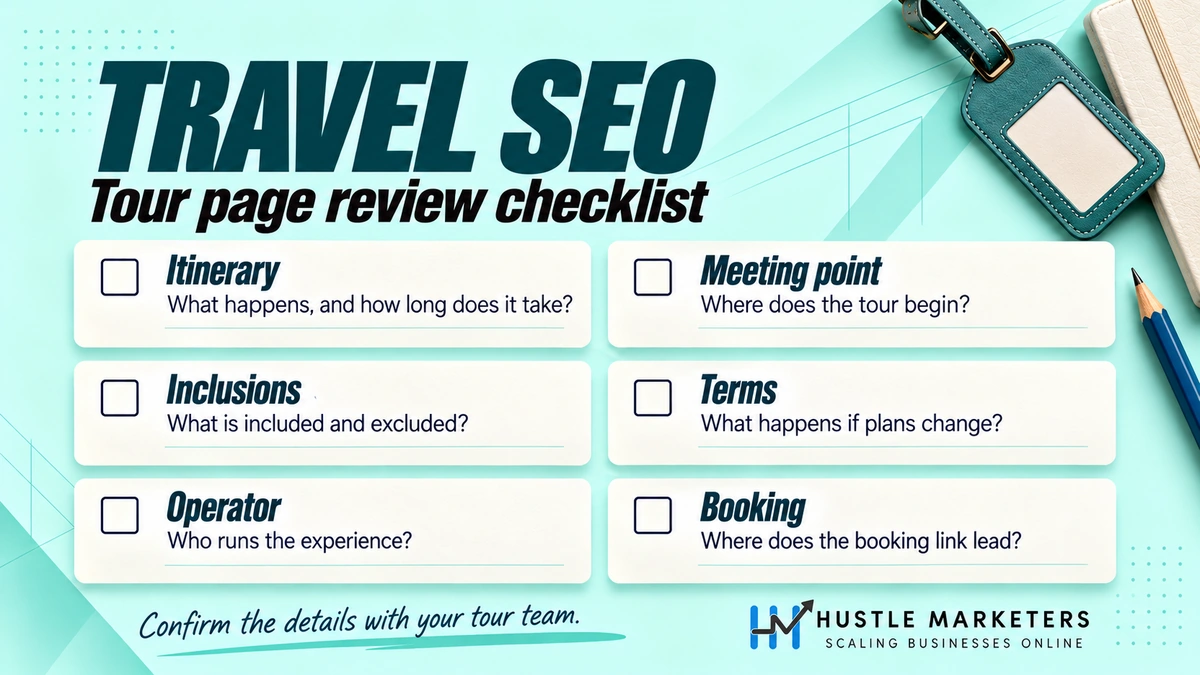
A tour page should answer every question a traveler asks before paying: what happens, where it starts, how long it takes, what it costs, what is included, who runs it and what happens if plans change. Clear answers help the page rank for detailed searches and reduce the doubts that push travelers back to a marketplace.
| Element | Why it matters |
|---|---|
| Original description in your own words | Supplier text often repeats across many sites, so it gives Google no reason to pick your page |
| Price, duration and group size near the top | Answers the first three questions and supports Product and Offer markup |
| Day by day or hour by hour itinerary | Matches itinerary searches and gives AI answers specific facts to cite |
| Meeting point with a map and directions | Travelers on forums describe meeting point mix-ups on marketplace bookings |
| Inclusions and exclusions | Stops surprise costs and price comparisons that favor marketplaces |
| Cancellation and weather policy | Some travelers book through marketplaces because the cancellation terms feel safer |
| Guide or operator profile | Shows who actually runs the trip, which marketplace listings often hide |
| Real photos and short video | Shows the experience and earns image and video search traffic |
| Reviews from verified guests | Builds trust at the point of booking |
| Short FAQ for this tour | Catches long-tail questions such as age limits or fitness level |
The meeting point and cancellation rows come from traveler comments in the Cruise Critic Viator thread. Check that the booking widget does not hide the main content. If the description, price and itinerary only load inside an iframe from the booking engine, Google may not see them as part of your page. Keep the key content in the page HTML.
Speed matters on tour pages heavy with photos. Google’s Core Web Vitals guide sets “good” at LCP within 2.5 seconds, INP under 200 milliseconds and CLS under 0.1. Our technical SEO team handles crawl, speed and indexing fixes for large tour catalogs.
How is SEO for adventure tour operators different?
SEO for adventure tour operators has to answer one extra question before anyone books: can I actually do this trip? When we do SEO for treks, climbs and safaris, the pages we plan and write explain difficulty, fitness, altitude, permits, safety and who the guides are, then compare routes so the traveler can pick the right one.
- Difficulty and fitness: say how many hours a day people walk or paddle, and what training helps.
- Altitude and health: give the highest point and how the itinerary handles acclimatization.
- Permits and park fees: say which are included in the price and which are not.
- Safety and guides: name guide qualifications, group ratios and what happens if someone needs to turn back.
- Route comparison pages: one page that compares routes side by side, linking to a page for each route.
- Day-by-day itineraries: distances, camps or lodges, and meals for each day.
Multi-day trips can still appear in Google Things to do. Google’s policy allows overnight activities where the lodging is not the focus, such as a multi-day wine tour, but overnight hotel stays and multi-day cruises are not eligible. Source: Things to do policies, read on November 5, 2026.
For KiliDestination Adventures, a safari and Kilimanjaro operator in Tanzania, we built a guide to all seven Kilimanjaro routes, a safari and Kilimanjaro combo planning guide and a comparison of Kilimanjaro tour operators, each linking back to the tour pages. We also added tour, review and FAQ schema and set canonical tags across the route and destination pages. The Tanzania safari SEO case study has the details.
Which schema markup does Google support for travel sites?
Google does not offer a travel-specific rich result for tours or trips. TouristTrip and TravelAgency are valid schema.org types that help machines understand your pages, but the rich results Google lists come from general types such as Product, Event, Local business, Review snippet and Breadcrumb. Use each type only where the page content truly matches it.
| Schema type | Google rich result? | Use it for | Watch out for |
|---|---|---|---|
| TouristTrip | No. Not in Google’s gallery | Tour and itinerary pages, with itinerary, offers and provider (schema.org TouristTrip) | Schema.org lists it in its “new” area, still open to feedback |
| TravelAgency | Yes, through Local business features | Agency home or location page (a LocalBusiness subtype) | Google asks for the most specific subtype, plus name and address (Local business docs) |
| Product with Offer | Product snippets | A page focused on one bookable tour with a price (Product snippet docs) | Google’s docs do not say whether tours qualify, so treat display as possible, not promised |
| Event | Event experience | A real dated event you host, such as a festival night or a one-off talk (Event docs) | Google’s guidelines name a multi-night trip package as a non-event that should not be marked as one |
| Review and AggregateRating | Review snippet | Genuine guest reviews on a product page (Review snippet docs) | Reviews a business controls about itself on LocalBusiness or Organization pages are not eligible for stars |
| VacationRental | Vacation rental listings | Rental listings only (Vacation rental docs) | Limited to eligible sites already working with Google |
| BreadcrumbList, Organization | Breadcrumb, logo and knowledge panel details | Every page on the site (Google search gallery) | Keep breadcrumbs consistent with your visible navigation |
A practical setup for a tour page: TouristTrip for meaning, a Product with Offer for price, and BreadcrumbList for structure, all matching what the page shows. For help building and testing markup, see our structured data SEO service and our local business schema guide.
How do you mark up a multi-day tour with TouristTrip?
Google lists no rich result for TouristTrip, so this markup helps search engines understand the trip rather than earning a special listing. We mark up multi-day tours with the TouristTrip type and an itinerary, and list the stops in order with an ItemList when the order matters. For a trip split into days or legs, schema.org lets you describe each part as a subTrip and point back to the main trip with partOfTrip. Add touristType, offers and provider so the markup matches what the page shows.
Do not mark up a tour package as an Event. Google’s event guidelines name “Trip package: San Diego/LA, 7 nights” as an example of a product that is not an event. Sources: schema.org TouristTrip and Google event structured data guidelines.
How do you plan SEO around travel seasons?
Seasonal travel SEO means publishing and refreshing pages before demand rises, not when it peaks. Check when interest in each destination and tour climbs in Google Trends and your own Search Console data. Then update the matching pages early enough for Google to recrawl them, and keep the same URLs every year so rankings carry over.
- Keep evergreen URLs. Use /northern-lights-tours/ rather than a new URL with the year in it each season.
- Refresh, do not replace. Update dates, prices, availability and photos on the existing page.
- Do not delete sold-out or off-season tours. Mark them as unavailable and show the next dates, or redirect to the closest alternative if the tour has ended for good.
- Plan content around events and holidays in each source market, not only your own calendar.
- Compare the same months year over year in the Search Console Performance report, not month over month, to see real growth.
Use Google Trends to compare when interest rises in different countries. A safari or ski trip often has a different booking window for U.S. travelers than for European ones.
How do multilingual travel sites use hreflang?
Hreflang tells Google which language or regional version of a page to show each searcher. A travel site that sells to several markets should publish each language version on its own URL, link every version to every other version with hreflang, and include itself in the list. Google ignores hreflang tags when two pages do not point to each other.
Google’s localized versions guide sets the rules:
- Add hreflang in the HTML head, in HTTP headers or in the XML sitemap. One method is enough.
- Use an ISO 639-1 language code, with an optional ISO 3166-1 Alpha 2 region code, such as es or en-gb (Google hreflang codes).
- Add x-default for a language selector or fallback page.
- Google does not use hreflang or the lang attribute to detect the language of a page, so the content itself must be translated.
Google’s multi-regional sites guide also advises against redirecting visitors automatically by guessed language and against using IP location to change content. It marks URL parameters for regions as not recommended. On travel sites, currency switchers often create parameter URLs that get indexed, so block or canonicalize those before you fix hreflang. A Moz Q&A answer put it simply: fix the site first, then the hreflang.
How do travel agencies do local SEO?
Local SEO for travel agencies means showing up in Google Maps and the local pack when people search for an agency or advisor near them. The core is a complete, accurate Google Business Profile that follows Google’s rules, plus local reviews, local links and a page on your site for each real location you serve.
Google ranks local results mainly on relevance, distance and prominence, and you cannot pay for a better local ranking (Google Business Profile Help). The Business Profile guidelines set the limits that trip up travel businesses:
- Use your real-world business name. Adding keywords or locations to the name is not allowed.
- A virtual office is not eligible for a profile unless it is staffed during business hours.
- A profile needs a location customers can visit, or service delivered at the customer’s location. Advisors without a storefront who travel to meet clients should use a service-area profile and hide their home address.
- The phone number must be under the direct control of the business.
Many agencies sell to travelers who live far away. For those searches, local SEO helps less than destination and niche content, so balance the two. Our local SEO services cover Business Profile setup, citations and location pages.
Which Google Business Profile category should a tour operator choose?
Choose the fewest, most specific categories that finish the sentence “this business is a”, not “this business has a”. A tour company that runs its own trips is usually a tour operator, while a business that sells other companies’ trips is closer to a tour or travel agency. Check the exact names in the live category picker. We set this up as part of our local SEO work. Source: Google guidelines for representing your business.
Can you add tours to your Google Business Profile yourself?
Yes. Google lets all attraction businesses and tour operators add tickets or activities to their Business Profile. Only the name of the ticket or activity and its booking URL are required. If a connectivity partner also sends your tours to Google, the partner’s admission details show before yours. Source: Google Business Profile help on tickets and activities.
Is your booking system connected to Google Things to do?
Check before you build anything yourself. Google recommends that single tour operators, and reservation systems with fewer than 100 operators, work with one of its connectivity providers rather than integrate directly. Its approved list includes Fareharbor, Bokun, Ventrata, Xola, Rezdy, TrekkSoft and Zaui. Listings in Things to do are free, and Things to do ads are paid per click. Sources: Things to do connectivity partners and Things to do overview, read on November 5, 2026.
How do reviews affect travel SEO?
Reviews affect travel SEO in two ways. On Google Business Profile, more reviews and positive ratings can help local ranking, according to Google’s local ranking tips. On your own site, guest reviews answer the trust questions that decide a booking. The safe path is to ask every guest for a review and never filter, buy or fake them.
- Do not offer discounts or gifts for reviews, and do not ask only happy guests. Google’s Maps content policy prohibits both.
- In the U.S., the FTC announced a final rule on August 14, 2024 that bans fake reviews, review suppression and incentives tied to a particular sentiment (FTC announcement).
- Reply to every review, including the negative ones. Future guests read the replies.
- Show reviews on the matching tour page, not only on a general reviews page.
- Ask guests to mention the tour or destination by name, without scripting the review for them.
How do you build links with tourism boards and partners?
The best travel links come from organizations that already work with you: tourism boards, convention and visitors bureaus, parks, attractions, hotels, transport partners and local media. These links are relevant, hard for competitors to copy and often bring bookings on their own. Paid links and link schemes are a risk and rarely needed.
- Join your destination marketing organization or tourism board and complete your member listing with a link.
- Ask hotels, lodges and transport partners to link to the tours their guests take.
- Create resources others cite, such as an accessibility guide to a trail, a seasonal wildlife calendar or a permit checklist.
- Offer expert comments to local and travel media on topics you know first-hand.
- Host familiarization trips for journalists and creators, and ask that any paid or gifted coverage is disclosed.
- Find mentions of your brand that do not link to you and ask for the link.
How does your booking software affect SEO and tracking?
Your booking software decides whether SEO bookings show up in Google Analytics 4 at all. Many tour booking widgets run on the provider’s own domain, so without the right setup GA4 credits the booking to the provider instead of the search that brought the traveler in. Each platform has its own fix, and we check this setup at the start of every tour operator SEO project, because SEO results cannot be judged until bookings are tracked:
| Booking software | What its help docs say | What to check |
|---|---|---|
| FareHarbor | Connect GA4 from the dashboard under Settings, Analytics and Tracking, and add both fareharbor.com and your own domain, without www, to the unwanted referral list using “Referral domain contains” | Purchases can go missing if the booking Lightframe sits inside a custom iframe |
| Rezgo | Booking tracking is set up in Google Tag Manager on your site | While the old and new setups both run, every booking is recorded twice, so switch over in one step |
| Bokun | Provides a Google Tag Manager container to import, then uses your GA4 measurement ID | The Bokun event tag must point to your GA4 configuration tag before you publish |
Sources: FareHarbor help, Rezgo knowledge base and Bokun docs, read on November 5, 2026. GA4 allows up to 50 unwanted referral conditions per web data stream, according to Google Analytics help.
How do you measure bookings from SEO?
Measuring travel SEO means tracking bookings and inquiries, not only rankings and traffic. Connect Search Console for search data and GA4 for on-site behavior. Then make sure each booking, form, call and email inquiry is recorded with its source, including bookings that finish on a third-party booking engine.
Booking engines are the common blind spot. When the checkout runs on another domain, GA4 counts the same person as two users and two sessions, so the booking loses its original source. GA4 cross-domain measurement fixes this by passing a _gl parameter between domains, as long as both sites use the same Google tag ID. Check with your booking system that its pages carry your tag.
| What to track | Where | Why |
|---|---|---|
| Non-brand clicks and impressions by page | Search Console | Shows growth in new demand, not only people who already know you |
| Brand clicks | Search Console | Shows whether you win the final step against marketplaces |
| Bookings and revenue from organic search | GA4 purchase event, with cross-domain set up | Ties SEO to money |
| Inquiry forms, calls and emails | GA4 events, call tracking, CRM | Agencies often close by phone, not online |
| Landing pages that start bookings | GA4 | Shows which destinations and tours deserve more content |
| Share of bookings direct vs marketplace | Booking system reports | The real test of whether SEO is reducing commission costs |
Travel SEO strategy: what to do first
A travel SEO strategy works in order: measure first, fix what blocks crawling and booking, then build pages for the searches you can win, then earn trust through reviews and links. Doing content before tracking and technical fixes is the most common reason travel SEO feels slow, because nobody can see what is working.
- Set up tracking: Search Console, GA4, cross-domain for the booking engine, and call or form tracking.
- Run a technical audit: indexing, duplicate tour pages, parameter URLs, speed and mobile layout.
- Claim your brand results: home page, Google Business Profile, marketplace listings and social profiles.
- Map keywords to pages by search stage, and fix or merge pages that compete for the same search.
- Rewrite tour pages with original copy, full details and correct schema.
- Build destination hubs and itineraries for the places you know best.
- Start a review routine and a partner link plan.
- Review results monthly and plan the next season’s updates early.
In our audits of travel sites, we check tracking and the booking engine handoff before anything else, because every later decision depends on that data. Our client work is covered by signed NDAs, so this guide shares the process we follow rather than client names or results.
Travel SEO mistakes that cost bookings
Most travel SEO mistakes come from shortcuts: copied supplier text, cloned city pages, deleted seasonal URLs and untracked booking engines. Each one either stops Google from ranking the page or stops you from seeing which pages bring bookings. Fixing them is often faster than writing new content.
- Using supplier or marketplace descriptions word for word on tour pages.
- Publishing near-identical pages for every city or region.
- Deleting last season’s tour pages and losing their links and rankings.
- Loading all tour content inside a booking widget iframe.
- Targeting broad phrases like “travel agency” instead of the trips you actually sell.
- Letting currency or date parameters create thousands of indexable URLs.
- Reporting rankings and traffic, but not bookings and inquiries.
What does a travel SEO specialist or agency do?
A travel SEO specialist or agency plans and runs the work in this guide: audits, keyword mapping, tour and destination pages, schema, local SEO, links and booking tracking. The right partner understands travel seasons, booking engines and marketplaces, and reports on bookings and inquiries, not only rankings.
What do SEO services for tour operators include?
SEO services for tour operators should cover the parts of the site that turn searches into bookings, not only blog posts:
- A booking engine tracking check, so GA4 credits SEO for the bookings it brings in.
- A Google Business Profile category check and a Things to do connection check.
- Tour, route and itinerary pages built around how travelers search.
- Schema that matches what each page shows.
- A steady review routine and links from tourism boards and partners.
Hustle Marketers prices SEO from $500 a month, month to month.
Questions to ask before you hire a travel SEO agency
- How will you track bookings that finish on our booking engine?
- Which of our tours and destinations will you prioritize first, and why?
- Who writes the content, and how do you get first-hand detail from our guides?
- Which schema types will you add, and which rich results do you expect from them?
- Do we keep ownership of all content, accounts and data if we leave?
How much does travel SEO cost?
Travel SEO pricing depends on the number of destinations and tours, languages, the state of the site and how much content is needed. At Hustle Marketers, SEO starts from $500 a month for a defined scope, with larger multi-language or multi-destination programs quoted separately. Hustle Marketers was founded in 2020 and is based in Zirakpur, India, delivering to clients worldwide.
Our founder, Ishant Sharma, has worked in Google Ads, Microsoft Ads and SEO since 2013, and we are a Google Partner, Meta Business Partner and Microsoft Advertising Partner. See how we run SEO programs on our SEO agency page.
Client example: SEO for a Tanzania safari tour operator
- Client: KiliDestination Adventures, a Tanzania safari operator, named in our published case study.
- Starting point: close to zero organic keyword visibility in its overseas markets.
- Result: 19 organic keywords ranking across the US, Australia and Germany, and 97 referring domains, tracked in Semrush over the engagement.
One account, measured in Semrush rather than in the client’s booking system. Full breakdown: Tanzania safari SEO case study.
Travel SEO FAQs
How long does travel SEO take to work?
Travel SEO usually takes several months to show steady results. Technical fixes and better tour pages can lift existing rankings sooner. New destination hubs and itineraries take longer, and seasonal pages need to be live well before demand rises. Judge progress by comparing the same season year over year.
Is SEO worth it for a small tour company?
SEO is worth it for a small tour company when it targets searches the company can win: its brand name, niche tours, departure-point searches and local searches. A small operator rarely beats marketplaces on broad terms, but each direct booking keeps the commission a marketplace would take.
Should I stop listing my tours on Viator or GetYourGuide?
Most operators should keep marketplace listings while they build direct bookings. Marketplaces reach travelers you would not reach alone. Treat them as a paid sales channel, keep your listings accurate, and use SEO to make sure travelers who search your name find your own site first.
What is the difference between travel SEO and tourism SEO?
Travel SEO usually means SEO for businesses that sell trips, such as agencies, tour operators and booking sites. Tourism SEO often refers to destination marketing organizations and tourism boards promoting a place. The methods overlap, but the goals differ: bookings for businesses, visits and awareness for destinations.
Can I do SEO for my travel website myself?
You can do the basics yourself: claim your Google Business Profile, write original tour pages, ask every guest for a review and connect Search Console. Hire help when you need technical fixes, multi-language setup, booking engine tracking or content across many destinations.
Do travel agencies need a blog?
Travel agencies benefit from planning content, but it does not have to be a news-style blog. Destination guides, itineraries and “best time to visit” pages often work better than dated posts. Write about the places you sell and know well, and link each guide to the trips you offer there.
Is Google Things to do free for tour operators?
Yes, the listings are free. Google lets tour operators list in Things to do for free or advertise, and Things to do ads are charged only when someone clicks. Google recommends that single operators get listed through a connectivity partner, which is often their booking software.
Do tour operators need a Google Business Profile if their website already ranks?
Yes. Your Business Profile is what shows in Google Maps and the local results, where travelers see your reviews, photos and opening hours. It is also where you can add tours or tickets with a booking link.
Want to know what is holding your travel site back? We review your tracking, tour pages, schema and local setup and send you a clear action list. Get Free Audit Worth $500