SEO Silo Structure: The 2026 Guide to Topical Authority

Ishant
Published : November 4, 2026 at 6:10 am
Updated : November 4, 2026 at 7:18 pm
Ishant

Summarize this article with:
By Ishant Sharma Category: SEO Published: November 2026 Reading time: 14 min
A website can have excellent content and still struggle to perform when its pages are poorly organized. When related pages are disconnected, important URLs receive few internal links.
When multiple pages target the same search intent, both users and search engines can struggle to understand the website.
That is where an SEO silo structure can help.
SEO siloing is a method of organizing related content into logical topic groups. A typical structure includes a main pillar page, related cluster pages, and supporting content connected through a deliberate internal linking strategy.
In 2026, the goal should not be to create rigid silos simply because a particular SEO method recommends them. Instead, your site architecture should make topical relationships clear. It should prevent needless duplication, support useful internal linking, and make important content easy to find.
Key Observations
An SEO silo structure organizes related website pages into logical topic groups. A pillar page covers the main subject, while cluster and supporting pages address more specific subtopics. Internal links connect these pages so users and search engines can understand their relationships. A well-planned silo can improve site organization, internal link distribution, topical relevance, and content discoverability.
What Is SEO Silo Structure?
SEO silo structure is a website architecture approach that groups related content around common topics, products, services, or search intents.
Think of the structure as a hierarchy:
- Pillar page: Covers the primary topic broadly and acts as the central resource.
- Cluster pages: Explore important subtopics in greater detail.
- Supporting content: Answers narrower questions and addresses long-tail search intent.
- Internal links: Connect related pages and establish meaningful relationships between them.
HomePillar: Technical SEOPillar: On-Page SEOPillar: Keyword ResearchCluster + supporting pagesCluster + supporting pagesCluster + supporting pagesA basic silo tree: the home page links to pillar pages, and each pillar links down to its cluster and supporting pages.
For example, a digital marketing website might organize its SEO content like this:
SEO
│
├── SEO Silo Structure
│
├── Technical SEO
│   ├── Crawlability
│   ├── Indexation
│   └── Site Architecture
│
├── On-Page SEO
│   ├── Title Tags
│   ├── Meta Descriptions
│   └── Internal Linking
│
└── Keyword Research
    ├── Keyword Mapping
    └── Search Intent
The important point is not the visual shape of the structure. The important point is that each page has a clear purpose and related pages are connected naturally. Different URLs should not compete needlessly for the same search intent.
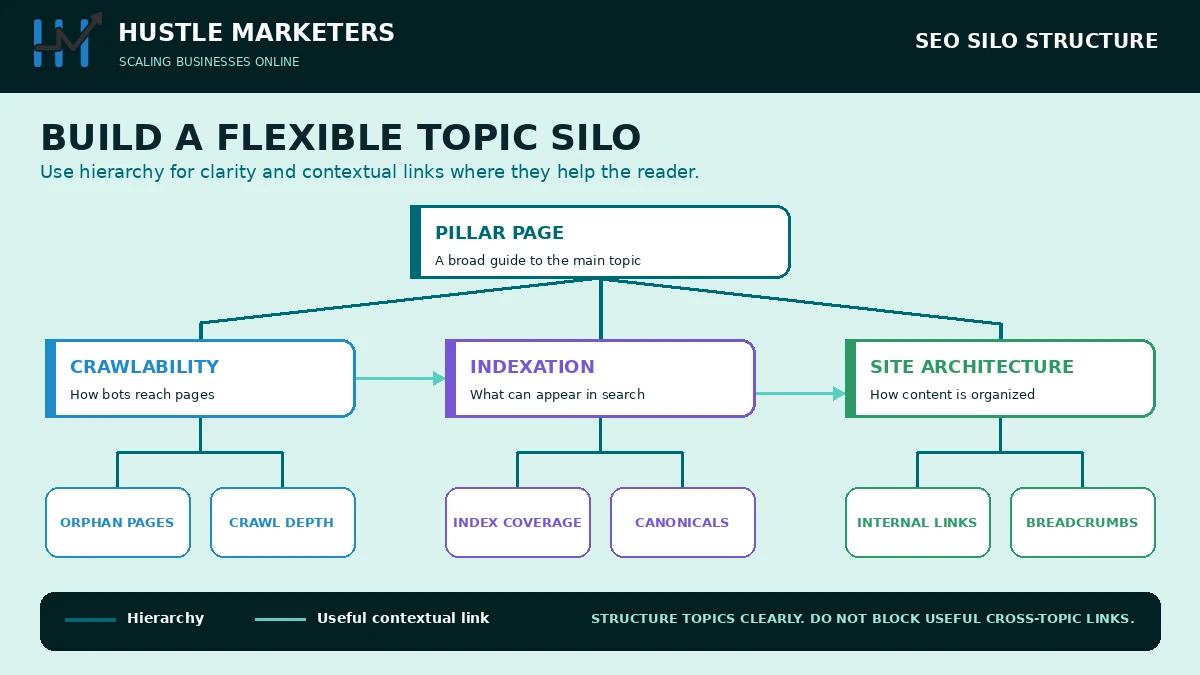
How an SEO Silo Works
Pillar Pages
A pillar page is the central resource for a major topic. It provides a broad overview and links users to more detailed resources.
For example, a page targeting technical SEO could act as a pillar page. It might introduce crawling, indexing, structured data, site speed, JavaScript SEO, and internal linking. It then directs readers to dedicated resources for deeper explanations.
A pillar page should not simply be a long article stuffed with keywords. Its job is to provide useful context and guide users toward the most relevant supporting resources.
Cluster Pages
Cluster pages focus on specific subtopics related to the pillar.
For a technical SEO pillar, cluster pages could target:
- Technical SEO audit
- Website crawlability
- Indexation issues
- JavaScript SEO
- XML sitemaps
- Canonical tags
Each page should have its own search intent rather than being a rewritten version of another page.
Supporting Content
Supporting content addresses narrower questions, use cases, examples, comparisons, and long-tail searches.
For example, under a crawlability topic, supporting content might explain how to find orphan pages or how crawl depth affects website navigation.
This creates depth without forcing every topic into a single page.
SEO Silo Structure Example
Consider a digital marketing agency website with three major service areas: SEO, Google Ads, and social media advertising.
A logical architecture could look like this:
Homepage
│
├── SEO
│   ├── Technical SEO
│   ├── On-Page SEO
│   ├── Keyword Research
│   └── SEO Silo Structure
│
├── Google Ads
│   ├── Google Ads Audit
│   ├── Google Ads for Lead Generation
│   └── Performance Max
│
└── Social Media Advertising
    ├── Meta Ads
    ├── Instagram Advertising
    └── Social Media Strategy
The SEO section becomes a broad topic group. Each major subtopic receives a dedicated page, while more specific questions can be addressed through supporting content.
Example Internal Link Flow
Suppose an article explains how website architecture affects technical SEO. Within that article, a relevant contextual link can point to the technical SEO page. The technical SEO page can then link to the broader SEO resource where appropriate.
This creates a meaningful relationship between the pages rather than adding links simply to manipulate authority.
Hard Silo vs Soft Silo vs Hybrid Silo
SEO siloing is often divided into three approaches: hard silos, soft silos, and hybrid silos.
| Structure | How It Works | Best Use |
|---|---|---|
| Hard silo | Uses URL hierarchy and controlled internal linking to organize topics. | New websites with clear categories. |
| Soft silo | Uses contextual internal links without requiring strict URL folders. | Existing websites and flexible content architectures. |
| Hybrid silo | Uses logical URL organization while allowing relevant cross-topic links. | Most established websites with interconnected topics. |
What Is a Hard Silo?
A hard silo uses URL structure to reinforce topical organization.
/seo/
/seo/technical-seo/
/seo/on-page-seo/
/seo/keyword-research/
The URLs make the relationship between the pages clear. A strict setup may also limit internal links between unrelated silos.
This approach can work well for websites being built from scratch. The architecture can be planned before large amounts of content are published.
The downside is that strict separation can become needlessly restrictive. Real-world topics often overlap. A useful contextual link should not be removed just because two pages belong to different categories.
What Is a Soft Silo?
A soft silo focuses mainly on internal linking rather than URL folders.
For example, an existing website may have URLs such as:
/technical-seo-audit
/crawlability-guide
/orphan-pages
/internal-linking
The URLs do not necessarily sit inside one folder, but the pages can still form a meaningful topic group through contextual internal links.
This makes soft siloing useful when you restructure an established website, since changing URLs could create needless migration work.
What Is a Hybrid Silo?
A hybrid silo combines structured organization with flexible contextual linking.
For example:
/seo/
/seo/technical-seo/
/seo/on-page-seo/
/google-ads/
/google-ads/lead-generation/
/google-ads/performance-max/
Pages remain logically organized, but relevant cross-topic links are allowed when they provide genuine value.
For most modern websites, this is a practical approach because it combines clear architecture with the flexibility required by real users and interconnected topics.
SEO Silo Structure vs Topic Clusters
SEO silos and topic clusters are closely related concepts.
Both approaches organize content around a central topic and connect related pages through internal links.
| SEO Silo | Topic Cluster |
|---|---|
| Often emphasizes site architecture. | Usually emphasizes relationships between content. |
| May use strict URL hierarchy. | Does not necessarily require a specific URL structure. |
| Can restrict cross-topic links in strict setups. | Usually allows contextual links between related topics. |
| Common in technical SEO discussions. | Common in content marketing strategies. |
In practice, the terminology matters less than the approach. A website can use topic clusters with a soft or hybrid silo architecture and still reach the same goal. The goal is clear topical relationships and useful internal linking.
Pyramid Structure and Content Hubs: Alternatives to Strict Silos
What is an SEO silo, once you strip away the jargon? A group of related pages organized around one topic, connected by internal links.
What is a silo structure without internal links holding it together? Just a folder plan with no real hierarchy. Two other models solve the same organizing problem differently.
A silo in SEO terms usually means strict boundaries: pages inside one topic group link mainly to each other. A pyramid structure keeps the same hierarchy but drops that restriction.
Google’s John Mueller said in a Webmaster Central hangout that “the top down approach or pyramid structure helps us a lot more to understand the context of individual pages within the site.” He did not endorse the stricter rule against cross-topic links.
Content Silo Structure vs Content Hub
A content silo structure groups pages by topic and usually limits linking outside that group. A content hub keeps the same central-page-plus-related-articles pattern, but allows links to other hubs whenever it helps the reader.
A page about tomatoes, for example, could link to both a fruit hub and a vegetable hub. Both links are accurate, so a strict silo rule would only get in the way.
| Model | Cross-Linking Allowed | Best For | Main Proponent |
|---|---|---|---|
| Strict silo | No, links stay inside the topic group | New sites with very clear categories | Classic SEO siloing method |
| Pyramid structure | Yes, when contextually relevant | Established sites with overlapping topics | John Mueller, Google |
| Content hub | Yes, between related hubs | Content-heavy sites with cross-topic overlap | Content marketing practitioners |
Good silo architecture SEO work rarely depends on rigid folders alone. Internal links, not URL structure, do most of the real work in all three models.
Does Silo Structure Actually Improve Rankings? What the Research Shows
Silo structure in SEO keeps coming up in the same debate. Does the folder structure itself help? Or does the internal linking underneath it do the real work?
A popular idea is that Google judges the quality of a whole silo, then ranks its pages accordingly. No published study we could find supports it, so treat it as a theory rather than evidence.
Ahrefs takes a more skeptical view. Their argument is simple: strict silo rules add no real benefit over a well-linked pyramid structure. Good internal linking is the real ranking driver, not the folder rule itself.
Silos SEO Teams Actually Use in 2026
In practice, most SEO teams no longer run strict silos. They run a hybrid: logical URL grouping for organization, plus contextual links wherever they genuinely help a reader.
- Group by topic and intent, using folders where they make sense
- Link contextually across topics when the connection is real, not forced
- Treat internal linking quality as the main lever, not the URL rule
- Revisit the structure as new content and new topics get added
The honest verdict: silo structure is a useful organizing framework, not a proven ranking algorithm input on its own. Strong internal linking, inside or across topic boundaries, is what the evidence actually supports.
Why Site Architecture Matters for SEO
It Helps Search Engines Discover Content
Internal links provide pathways for search engines to discover pages, a factor Google’s own crawling documentation ties to crawl efficiency on larger sites. Important pages should not be isolated from the rest of the website.
A logical architecture gives crawlers clearer routes between related resources and reduces the likelihood that valuable content becomes an orphan page.
It Clarifies Topical Relationships
When several pages cover closely related subjects and link to one another naturally, the relationship between those pages becomes easier to understand.
This does not guarantee higher rankings, but it creates a clearer information architecture for both users and search engines.
It Supports Internal Link Equity
Internal links can distribute link equity throughout a website. Strategic linking can help important pages receive appropriate internal support instead of leaving authority concentrated on pages that are not commercially or strategically important.
It Improves User Navigation
A good silo should make sense to a human visitor first.
Suppose someone reads an article about technical SEO and can quickly find related information about crawlability, indexation, or site architecture. That website becomes easier to navigate and more useful.
What SEO Practitioners Are Saying About Silos in 2026
Practitioner discussions in 2025 and 2026 keep coming back to the same few points. None of them comes from a controlled study, so treat them as working rules rather than proof:
Practitioner Insight 1: Internal Links Before URL ChangesA common view among SEO practitioners is that fixing internal linking within existing topic groups is a faster first move than restructuring URLs. Adding contextual links from cluster pages to their pillar is a low-risk first step because it needs no URL changes. Track the group’s impressions in Search Console over the following weeks to see whether it moved.
Practitioner Insight 2: Hybrid Silos Are the Safer DefaultMany practitioners now prefer a hybrid model to a strict hard silo. A hybrid keeps each topic group tightly linked but still allows a cross-link when it helps the reader. Blocking every cross-silo link to keep a silo “pure” removes the links that connect genuinely related topics, which is the opposite of what you want.
Practitioner Insight 3: Thin Pillar Pages Are the Most Common Failure PointA common reason silo structures fail to improve rankings is a pillar page that is too thin to carry authority. A 600-word pillar page cannot act as an authority hub for 10 cluster pages. There is no fixed word count for a pillar page. It needs enough depth to introduce every subtopic it links to. It should cover the full scope of the topic with clear navigation to cluster pages below.
Practitioner Insight 4: AI Overviews May Favor Topic-Complete SilosGoogle AI Overviews began appearing consistently in 2024. Since then, some SEO practitioners report that sites covering a topic at pillar, cluster and supporting level are cited more often in AI-generated answers, although no published study isolates silo structure as the cause. If that pattern holds, building out the full silo matters more now than it did before AI Overviews arrived.
Timing: What to WatchNo published study measures how long a silo rebuild takes to pay off, and practitioner estimates vary widely. Use Search Console impressions for the topic folder as your early signal, then rankings for the pillar’s main terms. Expect a new domain with little authority to take longer than an established one.
How to Build an SEO Silo Structure Step by Step
1. Audit Your Existing Website
Start by collecting your important URLs, including service pages, category pages, product pages, landing pages, and blog posts.
Identify:
- Pages receiving organic traffic
- Pages ranking for important keywords
- Orphan pages
- Duplicate or overlapping content
- Pages with weak internal links
- Pages targeting similar search intent
2. Group Pages by Topic and Search Intent
Do not group pages based only on keywords.
Consider the actual subject, audience, search intent, business purpose, and relationship between pages.
For example, these keywords may belong to one topic group:
- technical SEO
- technical SEO audit
- crawlability
- indexation
- canonical tags
But if two keywords represent the same search intent, they may not need separate pages.
3. Create a Keyword Map
Keyword mapping helps prevent keyword cannibalization.
| Page Type | Primary Topic | Search Intent |
|---|---|---|
| Pillar | Technical SEO | Informational |
| Cluster | Technical SEO Audit | Informational / Commercial |
| Cluster | Website Crawlability | Informational |
| Supporting | How to Find Orphan Pages | Informational |
| Supporting | How to Fix Indexation Issues | Informational |
The goal is simple: give each important URL a distinct primary purpose.
4. Choose Your Pillar Pages
Choose the pages that should represent your major topics.
A pillar should be broad enough to connect multiple related subtopics but focused enough to satisfy a clear search intent.
5. Build Cluster Pages
Create dedicated pages only when there is enough unique value and search intent to justify them.
Do not create five thin pages simply because you found five related keywords.
6. Plan Your URL Structure
For new websites, use a logical structure from the beginning.
/seo/
/seo/technical-seo/
/seo/on-page-seo/
/seo/keyword-research/
For existing websites, do not change URLs merely to make the structure look cleaner. URL migrations require redirects, internal link updates, canonical checks, sitemap updates, and monitoring.
7. Build Contextual Internal Links
Link related pages when the link really helps the reader.
Use descriptive anchor text that correctly describes the destination. Avoid repeatedly using the exact same keyword as anchor text across every page.
8. Add Breadcrumbs
Breadcrumb navigation helps users understand where they are within the website hierarchy.
For example:
Home > SEO > Technical SEO > Crawlability
If your website uses breadcrumbs, make sure the visible breadcrumb structure and structured data correctly reflect the actual page hierarchy.
9. Monitor and Improve the Silo
After setup, track organic impressions, clicks, rankings, internal links, indexation, and conversions.
Use this performance data to find missing topics and pages that need stronger internal support.
Adding Breadcrumb Schema Markup to a Silo
The build steps above cover visible breadcrumb navigation. BreadcrumbList structured data is a separate, code-level addition that reinforces the same hierarchy for search engines.
Visible breadcrumbs help human visitors see where they are. BreadcrumbList JSON-LD tells Google explicitly how your pages nest, and on desktop it can make that trail appear in search results instead of a plain URL. Google currently shows breadcrumb rich results on desktop only.
<script type="application/ld+json">
{
  "@context": "https://schema.org",
  "@type": "BreadcrumbList",
  "itemListElement": [
    {"@type": "ListItem", "position": 1, "name": "Home", "item": "https://example.com/"},
    {"@type": "ListItem", "position": 2, "name": "SEO", "item": "https://example.com/seo/"},
    {"@type": "ListItem", "position": 3, "name": "Technical SEO", "item": "https://example.com/seo/technical-seo/"}
  ]
}
</script>
Each position should match the visible breadcrumb trail exactly. A mismatch between what users see and what the schema states can confuse search engines instead of helping them.
Breadcrumb schema will not fix a bad site structure on its own. It reinforces a good one, and it is a quick technical win alongside the visible navigation already covered above.
How to Prevent Keyword Cannibalization With Silo Structure
Planning content by topic and intent has a big advantage. It forces you to define what each URL is supposed to rank for, the same principle behind Google’s guidance on consolidating duplicate URLs.
But a silo alone does not prevent keyword cannibalization.
To reduce cannibalization:
- Assign a primary search intent to every important page.
- Avoid creating multiple pages targeting the same intent.
- Differentiate supporting pages by their specific questions or use cases.
- Use internal links to reinforce relationships between pages.
- Consolidate pages when multiple URLs provide substantially overlapping value.
- Use redirects or canonicalization where appropriate.
- Review Google Search Console data for unexpected ranking overlap.
For example, a website probably does not need separate pages for “SEO silo structure,” “SEO silo architecture,” and “SEO siloing.” These would likely answer exactly the same question.
Instead, one comprehensive page can target the primary intent while supporting articles address really different questions.
SEO Silo Structure for Ecommerce Websites
Ecommerce websites often have a natural hierarchy based on categories, subcategories, products, and supporting content.
For example:
/running-shoes/
/running-shoes/mens/
/running-shoes/womens/
/running-shoes/trail/
/running-shoes/mens/product-name/
A logical ecommerce architecture can make it easier for users and search engines to understand relationships between product types and categories.
Category Pages
Important category pages can act as commercial pillar pages. They should provide useful category information rather than functioning only as product grids.
Subcategory Pages
Subcategories should target distinct product groups and search intents.
Product Pages
Products should be connected to their relevant categories and subcategories through navigation and contextual internal links.
Supporting Ecommerce Content
Buying guides, comparisons, product education, and FAQs can support commercial categories by answering research-stage questions.
Be Careful With Faceted Navigation
Ecommerce filters can generate large numbers of URLs with little unique search value.
Before allowing filtered URLs to become indexable, review whether they provide useful, unique search demand. Depending on the website, faceted navigation may require careful handling of canonicalization, internal linking, robots directives, URL parameters, and indexation.
Do not create indexable pages for every possible combination of filters just because the URLs exist.
Silo Structure in WordPress vs Shopify
WordPress Silo Structure: Categories vs Tags
Most WordPress silo questions come down to one choice: categories or tags? Use categories for your silo. Each category can map to one URL folder.
Keep tags light. Use them only for small, cross-cutting labels. Do not let tags become a second silo that fights your categories.
- Give each post one main category that matches its silo
- Do not put one post in several top-level categories
- Use tags sparingly, and add noindex to thin tag pages
- Check that category slugs match your planned URLs before you publish
Shopify Collections as Silos
Shopify collections work like a built-in silo. Each collection groups related products under one URL path, much like a category page in a custom silo.
Shopify’s URLs and filters are more rigid than a custom site. This means canonical tags need extra care on sorted or filtered views.
- Treat top-level collections as your main silo category pages
- Use sub-collections or tags sparingly to avoid duplicate views
- Point sorted and filtered collection URLs back to the base collection with a canonical tag
- Link supporting content, like buying guides, back to the right collection
Canonical Tags and Silo Structure
A keyword silo breaks down fast when two URLs quietly target the same query. Near-duplicate pages are common inside any silo, especially on ecommerce sites with filtered or sorted views.
Canonical tags let a silo stay technically clean without forcing every near-duplicate variant to disappear. Point the variant at the main version, and let link equity consolidate there.
/running-shoes/mens/
/running-shoes/mens/?sort=price       → canonical to /running-shoes/mens/
/running-shoes/mens/?color=black      → canonical to /running-shoes/mens/
/running-shoes/mens/?page=2           → self-canonical, separate content
Not every filtered view should canonicalize back to the base page. A paginated page 2 still has unique products, so it usually deserves its own canonical, not a redirect to page 1.
The rule of thumb: canonicalize when the variant shows the same core content in a different order. Do not canonicalize when the variant shows genuinely different products or content.
Every silo SEO structure decision should trace back to one real question: does this help a visitor find what they actually need?
SEO Silo Structure for Small Websites
Small websites do not need hundreds of pages to create a logical silo structure.
For example, a small service business could start with:
Homepage
│
├── Main Service
│   ├── Service Location
│   ├── Service Process
│   └── Service FAQ
│
└── Supporting Blog Content
    ├── Problem-Based Guide
    ├── How-To Guide
    └── Cost or Planning Guide
The objective is to build useful topical depth around the business’s most important service rather than publishing dozens of unrelated articles.
Start with the topic that has the strongest business value, and create the core page. Expand only when additional content can satisfy a distinct search intent.
How Many Pages Should an SEO Silo Have?
There is no universal number of pages required for an SEO silo.
A small website may have a pillar page and several supporting pages. A large ecommerce website may have hundreds or thousands of URLs within a broader category architecture.
Instead of asking, “How many pages do I need?” ask:
- Have we covered the important subtopics?
- Does each page have a unique purpose?
- Are the pages useful enough to deserve their own URLs?
- Are related pages properly connected?
- Are there important content gaps?
Topical completeness is more useful than an arbitrary page count.
How to Retrofit an SEO Silo on an Existing Website
Retrofitting is different from building a new website because existing URLs may already have backlinks, rankings, traffic, and historical signals.
Start With Internal Linking
Before changing URLs, find your existing topic groups and strengthen their internal linking.
This is often a lower-risk starting point. You can improve relationships between existing pages before you need any URL migration.
Do Not Change URLs Without a Reason
A cleaner folder structure alone does not justify changing or consolidating URLs.
If you do restructure URLs, create a migration plan that includes:
- 301 redirects
- Updated internal links
- Canonical verification
- XML sitemap updates
- Redirect chain checks
- Indexation monitoring
- Ranking and traffic monitoring
Before a major structural change, use a technical audit to understand which pages already perform well. Running a structured SEO audit checklist before any major structural change helps establish a clear baseline and protects pages that are already performing.
Find Orphan Pages
An orphan page has no meaningful internal links pointing to it from other pages on the website.
Review orphan pages and decide whether each should be:
- Linked into an appropriate silo
- Updated and retained
- Consolidated with another page
- Redirected
- Removed when it has no useful purpose
SEO Silo Structure, Internal Links and PageRank
Internal links can help distribute link equity throughout a website. The way pages link to one another can therefore influence how authority is distributed internally.
But internal linking should not be treated as a mechanical system where every link must point upward to a pillar page.
A better approach is contextual:
- Link to the pillar when the reader needs broader information.
- Link to cluster pages when the reader needs deeper information.
- Link between related clusters when there is a genuine relationship.
- Use navigation links for important categories and services.
- Avoid excessive links that add little value.
The goal is a website where important pages are well connected and users can naturally move from broad information to specific information and back again.
Click Depth and Crawl Depth in a Silo
Click depth is the number of clicks needed to reach a page, starting from the homepage. Crawl depth describes the same idea from Google’s side of the process.
Silo pages should never sit more than a few clicks from the homepage. Pages buried past three or four clicks tend to get crawled less often and rank worse, even when they are linked somewhere.
Silo pages SEO value depends heavily on how many clicks separate them from the homepage, not just on which folder they sit in. A perfectly named URL still underperforms if nothing links to it.
| Click Depth | Typical Crawl Priority | Common Cause |
|---|---|---|
| 1 to 2 clicks | High | Homepage, main navigation, pillar pages |
| 3 to 4 clicks | Moderate | Cluster and supporting pages linked from pillars |
| 5+ clicks | Low | Orphaned or weakly linked content, deep pagination |
This directly affects how efficiently Google crawls a large site, since deeply buried pages compete with everything else for limited crawl attention.
Reverse Silo SEO: Linking Straight to the Money Page
Some practitioners use reverse silo SEO instead of the standard top-down pattern. New blog posts and supporting content link straight up to the commercial pillar or category page.
This keeps click depth shallow for the page that matters most commercially, since every new supporting article adds another short path back to it.
How SEO Silo Structure Supports AI Search
Search is increasingly capable of synthesizing information across multiple pages and sources. This makes clear information architecture increasingly useful.
A well-organized website can make it easier for systems to find:
- What the website is about
- Which pages cover major topics
- Which pages provide supporting information
- How different concepts relate to each other
- Where specific answers can be found
But there is no guarantee that creating a silo will result in a citation in an AI-generated answer.
For AI search visibility, focus on the fundamentals:
- Accurate information
- Original insights and experience
- Clear answers
- Strong topical coverage
- Useful internal linking
- Descriptive headings
- Easy-to-crawl pages
- Strong author and business information where appropriate
Use silo architecture as a way to organize really useful information, not as a shortcut for manipulating AI search systems.
How Silo Structure Can Support Google Ads Landing Pages
SEO silo structure is mainly an organic search and site architecture strategy. It is not itself a direct Google Ads Quality Score factor.
But a well-organized website can support a better landing-page experience. This happens when the destination page is highly relevant to the user’s search intent and provides useful information.
For example, a website with a dedicated Google Ads topic area could include a page for lead generation campaigns. It could add supporting resources about campaign strategy, landing pages, and conversion optimization.
Hustle Marketers provides resources on Google Ads for lead generation and improving ROAS through better landing page relevance.
When Performance Max campaigns are not producing the expected results, a disorganized site structure and weak landing pages are often contributing factors. Review our guide on why Performance Max is not performing if your campaigns are spending without converting.
The important distinction is that the silo supports organization and relevance. It should not be presented as a direct guarantee of higher Quality Scores, lower CPCs, or better ad performance.
7 Common SEO Silo Structure Mistakes
1. Creating Silos Around Keywords Instead of Topics
Keywords are useful for research, but your architecture should reflect meaningful topics, services, products, and search intents.
2. Creating Multiple Pages With the Same Search Intent
If several pages answer the same query, you may create needless competition between your own URLs.
3. Making the Silo Too Rigid
Not every relevant link needs to stay inside a strict folder. If a cross-topic link really helps the reader, it can be appropriate.
4. Creating Thin Supporting Pages
Do not publish low-value pages simply to make a silo look larger. Every URL should provide a clear reason to exist.
5. Ignoring Orphan Pages
Important pages should be connected to the rest of the website. Review pages that have no meaningful internal links pointing to them.
6. Changing URLs Without a Migration Plan
URL restructuring can introduce redirect, canonical, indexation, and traffic problems if it is not carefully planned.
7. Treating Silo Structure as a Ranking Shortcut
A silo is an organizational framework, not a guaranteed ranking technique. Strong content, relevance, technical accessibility, authority, links, user experience, and many other signals still matter.
SEO Silo Structure Audit Checklist
Use this checklist when reviewing an existing website:
- Every major topic has a clear primary page.
- Important pages are not orphaned.
- Each URL has a distinct search intent.
- Related pages are connected through contextual internal links.
- Anchor text correctly describes linked pages.
- There are no needless duplicate topic pages.
- URL structure is logical where appropriate.
- Breadcrumbs correctly reflect the site hierarchy.
- Canonical tags are set up correctly.
- Redirects are properly configured after URL changes.
- Important pages are not buried too deep in the architecture.
- XML sitemaps contain the URLs that should be indexed.
- Faceted navigation is controlled on ecommerce websites.
- Content gaps are reviewed regularly.
- Google Search Console data is monitored after major changes.
Tools for Planning and Auditing Silo Structure
The right tool depends on the stage. Use one type of tool to plan a new silo. Use a different type to check an existing one. Any SEO silo strategy needs both stages.
Planning a New Silo
Slickplan lets you draw a visual sitemap before you write a single page. You drag pages into a tree view. This makes it easy to spot a topic group that is too big or too thin.
SEO Silo Plugins and Other Auditing Tools
An SEO silo plugin can help a WordPress site enforce category-based URLs. Most experienced teams still double-check the result with a full site crawl.
| Tool | Best For | Free Tier |
|---|---|---|
| Slickplan | Visual sitemap planning before launch | Yes, limited |
| Screaming Frog | Crawling an existing site to map real structure | Yes, up to 500 URLs |
| Sitebulb | Visual site architecture and crawl depth reports | Trial only |
| Ahrefs Site Audit | Structure Explorer view of depth and internal links | No |
| InLinks | Internal linking suggestions based on topic relationships | Yes, limited (internal links on 25 pages) |
Silo site structure work usually starts with one of the crawling tools above, not the visual planner, once a website already has real pages and real traffic to protect.
How to Measure SEO Silo Performance
| Metric | What to Check |
|---|---|
| Organic impressions | Are pages within the topic group appearing for more relevant searches? |
| Organic clicks | Is traffic increasing across the pillar and supporting pages? |
| Ranking trends | Are important pages improving for their intended search terms? |
| Indexation | Are important pages being discovered and indexed? |
| Internal links | Are strategically important pages receiving relevant internal links? |
| Conversions | Is organic traffic from the topic group contributing to business goals? |
Google Search Console can help you find queries, impressions, clicks, and ranking patterns. A crawler can also help you find orphan pages, broken links, redirect chains, and internal linking opportunities.
When Should You Use a Hard, Soft, or Hybrid Silo?
| Situation | Recommended Approach |
|---|---|
| New website with clearly defined categories | Hard or hybrid structure |
| Existing website with valuable URLs | Soft or hybrid structure |
| Large ecommerce website | Hybrid structure with careful category and faceted navigation handling |
| Small service website | Simple topic clusters or hybrid structure |
| Website with many overlapping pages | Audit and keyword mapping first |
Final Takeaway: Build a Silo for People First
An effective SEO silo structure is not about putting every page into a rigid folder or forcing every internal link toward a single pillar.
It is about creating a website that makes sense.
Users should be able to move from a broad topic to a specific answer. Search engines should be able to discover important pages and understand their relationships. Each URL should have a clear purpose, and related content should support one another through useful internal links.
For most modern websites, a hybrid silo provides a practical balance. Use logical architecture where it makes sense, maintain clear topic relationships, and allow contextual links when they really help the reader.
Most importantly, do not build silos simply to increase the number of pages on your website. Build them around real topics, real search intent, and real user needs.
Need Help Building an SEO Silo Structure?
Before restructuring your website, you need to understand your existing URLs, rankings, search intent, internal links, content gaps, and keyword overlap. A properly planned SEO architecture can then be built around your strongest opportunities.
Hustle Marketers can help audit your existing website and find content gaps. We can map keywords to the right URLs and create an internal linking and topical authority strategy.
About the Author
Ishant Sharma is the Founder and CEO of Hustle Marketers, a Google Partner and Meta Business Partner digital marketing agency based in Zirakpur, Punjab, India.
Working across SEO, Google Ads, Meta Ads, and Microsoft Ads, he helps a wide range of businesses grow since 2013.
His clients include ecommerce, local service, SaaS, and B2B companies working on search visibility, paid advertising, website architecture, and digital growth strategies. He is a Top Rated Plus freelancer on Upwork with a 99 percent Job Success Score.
Structure work usually lands with a developer, so it is worth agreeing who owns it early. Our SEO agency page sets out how we scope structure changes, and enterprise SEO covers sites running into thousands of URLs.
Frequently Asked Questions
What is SEO silo structure?
What is the difference between a hard silo and a soft silo?
What is a hybrid silo structure?
Is SEO silo structure the same as topic clusters?
How many pages do I need for an SEO silo?
Can an SEO silo prevent keyword cannibalization?
How does silo structure help ecommerce SEO?
Does silo structure still matter in 2026?