Keyword Golden Ratio (KGR): Formula, Worked Examples and Whether It Still Works

Ishant
Published : November 3, 2026 at 5:30 pm
Updated : November 3, 2026 at 7:10 pm
Ishant

The keyword golden ratio (KGR) is a long-tail keyword filter created by Doug Cunnington. You divide the number of Google results that have a phrase in their title (the allintitle count) by the phrase’s monthly search volume. A score under 0.25, on a term with fewer than 250 monthly searches, marks a phrase few pages are targeting.
Summarize this article with:
Key Observations
- KGR = allintitle results divided by monthly search volume, and it only applies to terms with fewer than 250 searches a month.
- Under 0.25 is the target. Between 0.25 and 1 can still work. Above 1 means many pages already target the phrase.
- Google says its result count is only an approximation, so treat every KGR score as a rough signal, not a measurement.
- KGR ignores backlinks, site authority, search intent and AI Overviews, so always read the live results page before you write.
- In 2026, KGR works best as a shortlist tool next to Search Console query data and keyword difficulty scores.
What is the keyword golden ratio in SEO?
In SEO, the keyword golden ratio is a quick test for long-tail phrases that people search for but few pages target by name. KGR stands for Keyword Golden Ratio. It compares how many pages use the exact words in their title with how many people search the phrase each month. A low ratio points to a gap.
Doug Cunnington built the method for small niche and affiliate sites. His original KGR guide on Niche Site Project calls it a data-driven way to find long-tail keywords that are underserved. You will also see it called the golden keyword ratio, and a phrase that passes the test is called a KGR keyword.
The idea is simple. If very few pages put a phrase in their title, a new page that does should face less direct competition. That is a reasonable starting point. It is not proof that a page will rank, and the rest of this guide explains why.
What is the keyword golden ratio formula?
The keyword golden ratio formula is KGR = allintitle results divided by monthly search volume. Cunnington defines it as the number of Google results with the keyword phrase in the title, divided by the local monthly search volume, where that volume is less than 250. Both numbers come from tools, so both are estimates.
Written out, it looks like this:
KGR = (number of allintitle results) / (monthly search volume, under 250)
Because the volume cap is 250, the highest allintitle count that can still score 0.25 is 62. At exactly 250 searches, 62 title matches gives 0.248, while 63 gives 0.252. Lower volumes leave even less room. A phrase with 100 searches a month needs 25 or fewer title matches.
What is a good KGR score?
A good KGR score is under 0.25. These are the bands from Cunnington’s Niche Site Project guide, along with what each one means in practice.
| KGR ratio | What Cunnington’s guide says | What to do with it |
|---|---|---|
| Under 0.25 | Should rank in the top 100 once the page is indexed | Shortlist it, then read the live results page |
| 0.25 to 1 | Should still rank in the top 250 pretty quickly | Fine for sites with some authority on the topic |
| Above 1 | Competitive, even with low volume | Skip for a new site unless you have a clear angle |
Note what those bands promise. A top 100 or top 250 position brings little traffic. The method finds a foothold. Moving that page onto page one still takes content quality, internal links and time.
Why does KGR cap search volume at 250?
KGR caps search volume at 250 because Cunnington found that low-volume phrases draw fewer competing pages and tend to rank faster. Higher-volume terms attract more sites and more links, so a low title count says less about real competition. His KGR FAQ says the formula is only designed for terms under 250 local monthly searches.
A term with 880 searches and a ratio of 0.14 is therefore not a KGR keyword, even though the math looks good. It may still be worth targeting, but the ratio is not the right test for it.
How to calculate the keyword golden ratio step by step
To calculate the keyword golden ratio, list long-tail phrases, keep those under 250 monthly searches, run an allintitle search for each, and divide the result count by the volume. The six steps below work by hand for a short list, and a spreadsheet keeps the scores in one place as the list grows.
- Build a seed list. Use Google autocomplete, People Also Ask, your own site search and a keyword tool. Long questions and “for” phrases work well.
- Pull monthly search volume from one tool and stick with it. Cunnington’s FAQ makes the same point, because tools calculate volume differently.
- Remove anything at 250 searches or more.
- Search Google for allintitle: followed by the phrase, for example allintitle: best hiking boots for wide feet women. Note the result count.
- Divide the allintitle count by the search volume.
- Sort by score, then open the live results page for every phrase under 0.25 before you commit.
If you group many phrases at once, our guide on how to organize keywords in a spreadsheet shows a layout that keeps volume, scores and target URLs together.
How do you run an allintitle search?
Type allintitle: into Google, then the phrase without quotes. Google returns pages whose titles contain all of those words. In 2024 Google moved the “About X results” line under the Tools menu, and Search Engine Roundtable reported in November 2024 that the count was disappearing for some users. If you see no count, click Tools.
Run searches slowly. Cunnington’s guide warns that Google may throttle allintitle searches if you run many at once, to stop automated scraping.
Worked KGR examples: six keywords scored
The table below scores six phrases. The numbers are illustrative, chosen to show each outcome, and are not live counts. Assumptions: volume comes from one keyword tool for the US, and the allintitle count is the figure shown under Google’s Tools menu.
| Example phrase | Monthly volume | Allintitle results | KGR | Verdict |
|---|---|---|---|---|
| best hiking boots for wide feet women | 170 | 18 | 0.11 | Strong candidate. Check intent and who ranks. |
| how to clean a cast iron grill grate | 210 | 96 | 0.46 | Possible for a site with cooking content already. |
| dog friendly cafes downtown austin | 90 | 140 | 1.56 | Competitive. Local guides already target it. |
| replacement gasket for model x200 pressure cooker | 40 | 0 | 0.00 | Best score possible. Confirm people want a page, not a product listing. |
| a phrase your tool shows as zero volume | 0 | 12 | Undefined | The formula breaks. Use Search Console impressions instead. |
| a phrase above the volume cap | 880 | 120 | 0.14 | Not a KGR term. Judge it with keyword difficulty. |
The last two rows trip people up most. A zero-volume phrase cannot be divided by zero, and Cunnington’s FAQ says he still writes for many of them, especially autocomplete phrases. A phrase above the cap can score well and still face strong pages, because higher demand attracts better-funded sites.
How accurate are allintitle results today?
Allintitle results are rough estimates, not exact counts. Google’s own help page on the search results page says the total number of results “is only an approximation and may change even for the same query.” Search operators are also bound by indexing and retrieval limits. Treat every KGR score as directional and recheck borderline phrases.
Google’s search results page help is the source of that quote. Google Search Central adds, in its overview of search operators, that operators “are bound by indexing and retrieval limits.” Allintitle is not even on Google’s documented list of operators, which covers filetype:, imagesize:, site: and src:.
Practitioners see the same thing. In a Builder Society thread from January 2022, a four-word allintitle search returned 7 results, while adding a fifth word returned 1,080. A longer phrase should never match more titles, so the count was clearly unstable.
There is one more wrinkle. Google builds the blue title links in results automatically, using the title element, headings, anchor text and other page text, per its title link documentation. So the titles you see on screen may not be the titles Google matched. That is another reason to read the actual pages before you trust a low score.
KGR vs keyword difficulty: which should you trust?
Trust neither on its own. KGR counts how many pages put a phrase in their title, while keyword difficulty rates how strong the pages that already rank are. A phrase can pass KGR and still have a high difficulty score, or fail KGR and be easy. Use KGR to find gaps and keyword difficulty to judge strength.
Semrush, for example, scores keyword difficulty as a percentage from 0 to 100, using factors such as the median referring domains and median authority score of the ranking sites. Its bands run from 0 to 14 for very easy up to 85 to 100 for very hard. Semrush also offers a personal keyword difficulty score based on your own domain’s authority.
| Factor | Keyword golden ratio | Keyword difficulty (KD) |
|---|---|---|
| Inputs | Allintitle count and search volume | Links and authority of the ranking pages |
| Cost | Free, manual | Needs a paid or freemium tool |
| Volume range | Under 250 searches only | Any volume |
| Sees backlinks | No | Yes |
| Sees your own site’s strength | No | Only with a personal score |
| Sees search intent or AI Overviews | No | No |
| Best use | Spotting phrases few pages target by name | Judging how hard the current top 10 is to beat |
Neither score reads intent. Only a person looking at the results page can tell whether Google wants a guide, a product page, a video or a local listing. Our roundup of SEO tools for agencies covers which platforms report keyword difficulty and SERP features side by side.
Does the keyword golden ratio still work in 2026?
Yes, the keyword golden ratio still works in 2026 as a way to shortlist long-tail phrases, but it does not work as a ranking guarantee. Allintitle counts are approximations, AI Overviews take clicks on many informational searches, and Google’s spam policies target sites that publish pages at scale only to catch rankings.
What do practitioners report?
Reports from forums are mixed and anecdotal. In a BlackHatWorld debate on whether KGR is a waste of time, one member called it a way to “short-list keywords” before checking intent. Another said it gives too many false positives. A third, running a non-English site, saw one article reach fourth place while most sat between 20th and 30th or did not rank.
Cunnington’s own figures are similar in spirit. His guide says about 5% of KGR terms do better than expected, 15% do worse, and 80% rank somewhere in the top 30 to 50 in a short time, per the Niche Site Project KGR page. The guide gives no sample size or date for that split, so read it as one practitioner’s experience.
How do AI Overviews change the value of KGR keywords?
AI Overviews can shrink the clicks a KGR keyword was going to send you. A Pew Research Center study published in July 2025 tracked 900 US adults in March 2025. Users clicked a traditional result on 8% of visits when an AI summary appeared, against 15% without one, and clicked a link inside the summary on about 1% of visits.
The same Pew analysis found 18% of the Google searches it tracked produced an AI summary. Long, question-style phrases are the kind KGR tends to surface, so check for an AI Overview before you count on traffic.
There is an upside. Google says AI Overviews and AI Mode may use “query fan-out,” running related searches across subtopics, and that there are no extra requirements to appear in them beyond being indexed and eligible for a snippet, per its AI features documentation. A clear page that answers a narrow question can be one of the cited sources, and Google counts that traffic inside the Search Console Performance report under the Web search type.
What are the limits of the KGR method?
The main limits of the KGR method are weak data, blind spots and scale risk. The inputs are estimates, the ratio ignores backlinks, authority and intent, and the method assumes you will publish many posts to find the few that win. Each of these can waste weeks of writing if you do not plan for it.
- Low traffic ceiling. A phrase capped below 250 searches brings modest visits even at position one, and fewer when an AI Overview sits on top.
- Strong pages without the exact title. A low allintitle count can hide Wikipedia, forums or big brands that rank without the phrase in their title. A BlackHatWorld thread from October 2021 describes a phrase with a KGR of 0.005 and Wikipedia at the top.
- Keyword stuffing. Chasing exact phrases leads to awkward copy. Cunnington’s FAQ suggests using the phrase in the title and about once in the body.
- Scale risk. Google’s spam policies define scaled content abuse as when many pages are generated for the primary purpose of manipulating search rankings and not helping users. Thin posts written only to match KGR phrases fit that description.
- Volume data quality. Google Keyword Planner averages searches over 12 months by default, includes close variants and rounds the figures, per its Keyword Planner forecasts help page. Small volumes can swing a ratio a lot.
What are better ways to find low-competition keywords?
The better ways to find low-competition keywords use real demand and real competitors. Search Console query data shows phrases Google already ties to your site. A manual SERP review shows who ranks and what format wins. Personal difficulty scores reflect your own authority, and topic clusters turn single long-tail posts into a group that supports itself.
Mine Search Console for queries you already show up for
Search Console lists the queries that triggered your pages, with impressions, clicks and average position, per Google’s Performance report help. Queries where you rank on page two or three are low-competition chances with proven demand, even when keyword tools show zero volume.
Read the live results page
Open the results for every shortlisted phrase. Look for forums, thin pages and outdated posts in the top 10. Those are signs a better page can win. If the top results are big brands, government sites or an AI Overview with a full answer, move on.
Use difficulty scores that know your site
Generic difficulty scores assume an average site. Personal scores, such as the Semrush option above, adjust for your domain. For paid search research that feeds SEO, our guide to Google Ads keyword research explains how conversion data shows which phrases are worth an organic page.
Build topic clusters instead of single posts
Group related long-tail phrases under one parent page and link them together. That gives Google a clearer picture of what your site covers. Our guide to keyword clustering walks through grouping phrases by shared search results.
How to combine KGR with Search Console query data
To combine KGR with Search Console data, pull question-style queries where your site already earns impressions, score them with KGR, and write or improve pages for the ones that pass. Search Console supplies proven demand, including phrases tools miss, and KGR adds a quick read on how many pages target each phrase.
Our client work is covered by signed NDAs, so this guide shares the process we follow rather than client names or results. Hustle Marketers founder Ishant Sharma has worked in Google Ads, Microsoft Ads and SEO since 2013, and this is the order we use.
- Open the Performance report, choose Search results and set the date range to the last three months.
- Add a query filter, choose Custom (regex) and enter ^(how|what|why|can|does|is|which|best)\b to keep question and comparison phrases. Google’s filtering help page confirms the regex filter uses RE2 syntax.
- Export the table and keep queries with impressions but an average position between 8 and 30.
- Add search volume from your keyword tool. Where the tool shows zero, use Search Console impressions as the demand signal instead.
- Run allintitle on each phrase and score it. Mark anything under 0.25 for a closer look.
- Check whether one of your pages already ranks. If so, improve that page with a section that answers the phrase. Write a new page only when the intent is different.
Step six avoids two of your own pages competing for one query. If you want help with the writing side, see our SEO content services.
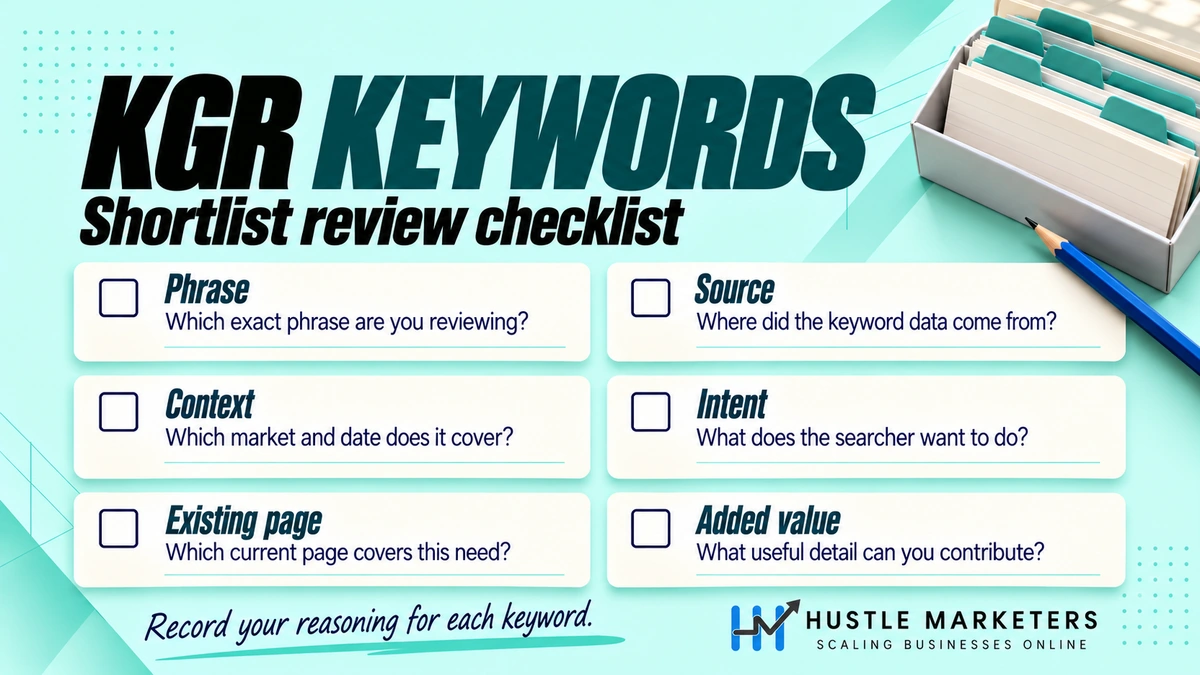
When should you use KGR? A decision checklist
Use KGR when your site is new or has little authority, your topic has many narrow questions, and you can write genuinely useful answers to each. Skip it, or give it less weight, when the phrase has more than 250 searches, the results page is full of strong brands, or an AI Overview already answers the question.
| Question to ask | If yes | If no |
|---|---|---|
| Is the phrase under 250 monthly searches? | KGR applies | Use keyword difficulty instead |
| Is the KGR under 0.25 on a recheck? | Shortlist it | Keep only if your site already covers the topic |
| Does the top 10 include forums, thin or outdated pages? | A better page can compete | Expect a slow climb |
| Does the intent match the page you plan to write? | Go ahead | Change the format or drop it |
| Does an AI Overview fully answer it? | Lower your traffic estimate | Normal click potential |
| Does one of your pages already rank for it? | Improve that page | Write a new page |
| Can you add something useful, like a table, steps or first-hand detail? | Write it | Skip it to avoid thin content |
Cunnington’s FAQ says you need about 5 or 10 KGR terms to get started. Publish them as a batch and judge the results as a group, since single posts vary a lot.
Are there KGR keyword tools that automate it?
Yes, several KGR keyword tools and golden keyword finders automate the allintitle lookup and the division. Bulk checkers save hours, but they rely on the same estimated counts, so they cannot make the score more accurate. Treat their output as a sorted shortlist, then review the results pages yourself.
Cunnington’s own FAQ answers no to automation, partly because the manual review is where you judge intent. Forum users in the Builder Society thread found a bulk checker matched most manual counts, though two were off. A spreadsheet works fine at small scale: one column for volume, one for allintitle, and a formula column for the ratio.
If you would rather hand off the research, our SEO agency team builds keyword plans with Search Console data, difficulty scores and manual SERP checks. You can also read what an SEO company does to see how keyword research fits a full program.
Keyword golden ratio FAQs
What does KGR stand for in SEO?
KGR stands for Keyword Golden Ratio. It is a formula that divides the number of pages with a phrase in their title by that phrase’s monthly search volume. Doug Cunnington of Niche Site Project created it to help small sites find long-tail keywords with little direct competition.
Is a KGR of 0 good?
A KGR of 0 means no pages showed up with every word of the phrase in their title. On paper, that is the best possible score. In practice, check the regular results first. Strong pages often rank without the exact phrase in their title, and some zero-result phrases have no real demand.
What if a keyword has zero search volume?
The formula cannot divide by zero, so the KGR is undefined. Keyword tools often show zero for phrases people do search. Check Search Console impressions or Google autocomplete for real demand. Cunnington’s FAQ says he often writes for these terms, especially autocomplete phrases.
Is the golden keyword ratio the same as KGR?
Yes. Golden keyword ratio is a common reordering of keyword golden ratio. Both names refer to the same formula: allintitle results divided by monthly search volume, for terms under 250 searches a month. The thresholds and the method do not change.
Should I write one post or two for similar KGR keywords?
Write one post when two phrases share the same intent, such as singular and plural versions. Cunnington’s FAQ says Google generally treats them the same. Separate posts only make sense when each phrase needs a different answer. Two near-identical pages can end up competing with each other.
Does KGR work for local businesses?
KGR can work for local and ecommerce phrases, and Cunnington’s FAQ says local stores and shops can target geographic terms. Local results often show a map pack and business listings, though. Check whether a blog post can appear for the phrase before you write one.
Want a second opinion on which long-tail keywords are worth your time? We look for the gaps in your current rankings and content. Get Free Audit Worth $500