B2B PPC Strategy: How to Run Google Ads and Microsoft Ads for Pipeline

Ishant
Published : October 8, 2026 at 5:30 pm
Updated : October 16, 2026 at 12:13 pm
Ishant
B2B PPC is paid search advertising aimed at business buyers, and a working B2B PPC strategy tunes Google Ads and Microsoft Ads for qualified pipeline instead of raw lead volume. In practice that means intent-led keywords, heavy negative keywords, offers that qualify, CRM stages imported as conversions with values, and reporting on opportunities and revenue.
B2B paid search breaks many ecommerce rules. Search volume is small, several people sign off on a purchase, and the sale closes weeks or months after the click. If you let Smart Bidding chase cheap form fills, it tends to find more people who fill in forms, not more people who buy.
2026 also changed the plumbing. From June 15, 2026, Google began moving API uploads of offline conversions to the Data Manager API, and from September 1, 2026 it upgraded campaign-level broad match campaigns to AI Max.
Key Observations
- Optimize for a qualified CRM stage, not a form fill. Google’s lead guidance asks for at least 15 conversions in the last 30 days at the account level and, ideally, an action that happens within 7 days of the ad interaction.
- Build keywords around problem, solution, category, competitor and brand intent, and block jobs, free, student and consumer searches from day one.
- Keep low-volume accounts consolidated so each campaign has enough conversion data to judge.
- From June 15, 2026, Google moves offline conversion and enhanced conversions for leads uploads from the Google Ads API to the Data Manager API, so check your CRM sync.
- Assign each CRM stage one value based on deal size and close rate, and make only one stage primary so values do not stack.
- In Microsoft Search campaigns, use LinkedIn profile targeting as a bid layer, not a filter, and treat Performance Max as a test once qualified-lead data exists.
- Report cost per SQL, pipeline created and closed-won revenue, not cost per lead.
What is B2B PPC, and how is it different from B2C PPC?
B2B PPC is pay-per-click advertising that sells to companies rather than consumers. It differs from B2C in four ways that shape every setting: lower search volume, longer sales cycles, buying committees instead of single buyers, and lead quality that only your CRM can judge. Your account should bid, structure and report around those constraints.
B2B journeys are also getting longer. Dreamdata’s LinkedIn Ads Benchmarks Report 2026, summarized by PPC Land on March 10, 2026, found the average B2B customer journey grew from 211 to 272 days, with an average of 10 stakeholders per deal and 88 touchpoints per journey. That data covers August 2024 to July 2025 across 66 million sessions.
| Factor | B2C PPC | B2B PPC | What it changes in your account |
|---|---|---|---|
| Search volume | High, many long-tail variants | Low, niche and technical terms | Consolidate campaigns so each gets enough data |
| Buyer | One person | A buying group across roles | Offers for researchers and for decision makers |
| Sales cycle | Minutes to days | Weeks to months | Import CRM stages; judge campaigns on lagged data |
| Main conversion | Purchase with revenue | Form, call or demo with no revenue yet | Assign stage values or bid to a qualified stage |
| Lead quality | Payment confirms quality | Only sales can confirm quality | Sales feedback loop and retractions |
| Wasted clicks | Shoppers comparing prices | Job seekers, students, consumers, tiny firms | Large themed negative keyword lists |
| Landing page | Product page and cart | Demo, pricing, calculator or content offer | Match offer to intent stage |
| Audience layers | Remarketing, in-market | Customer Match, company and job function (Microsoft) | Bid up on target accounts; exclude customers |
| Success metric | ROAS | Cost per SQL, pipeline, closed-won revenue | Pipeline reporting, not CPL dashboards |
Does PPC work for B2B, and does Google Ads still work in 2026?
Yes, for capturing demand that already exists. The same Dreamdata report shows Google Search ROAS falling from 78% to 67% while LinkedIn rose from 113% to 121%, but that is Dreamdata’s attribution model for closed-won deals, so treat it as directional.
Search also rewards intent-led structure and clean tracking. Our commercial cleaning equipment Google Ads case study walks through a B2B lead generation account rebuilt around buyer intent, tighter negatives and cleaner conversion tracking, with the before and after numbers.
How do you choose keywords for a B2B PPC strategy?
Choose B2B keywords by buying intent, not search volume. Group them into five types: problem terms, solution and category terms, competitor and alternative terms, brand terms, and use-case or integration terms. Fund the highest-intent groups first, use the language your sales team hears on calls, and add informational terms only with a matching content offer.
Examples use a fictional AP automation software company.
| Keyword type | Example searches | Intent | Typical role |
|---|---|---|---|
| Pricing and buying | ap automation software pricing, ap automation demo | Very high, ready to evaluate | Top priority; exact and phrase match |
| Solution and category | accounts payable automation software, invoice processing software | High, knows the solution type | Core campaign; most of the budget |
| Competitor and alternative | [competitor] alternative, [competitor] vs [competitor] | High, comparing vendors | Separate campaign with comparison landing page |
| Use case and industry | ap automation for construction companies | High, specific fit | Ad groups with industry landing pages |
| Integration | netsuite invoice approval workflow | Medium to high, existing stack | Small ad groups; strong for software |
| Problem-aware | invoice approval delays, duplicate vendor payments | Medium, feels the pain | Content offer or calculator, lower bids |
| Brand | [your brand], [your brand] pricing | Highest, often existing demand | Own campaign; report separately (see branded vs non-branded search) |
| Informational | what is three way matching | Low, research only | Usually SEO territory, not paid |
How should you use problem-aware keywords?
Problem terms reach people before they know which category solves their issue. Sales calls help: PPC Hero’s July 2026 piece on the sales feedback loop for B2B PPC leads recommends pulling keywords straight from the words prospects use, not internal jargon.
Should B2B companies bid on competitor keywords?
Usually yes, in a separate campaign with its own budget cap. Searchers comparing vendors are in market, but clicks can cost more because your ad and page are less relevant to a competitor’s name. Send them to an honest comparison page and write ads about your differences. Our guide on how to research competitors’ ads shows how to find their messaging gaps first.
Which negative keywords should every B2B account add?
Every B2B account should start with negative keywords for job seekers, free and cheap searches, students and training, consumer or DIY intent, research-only phrases, and existing customers looking for login or support. Build them as shared lists by theme, add plurals and synonyms yourself, then expand the lists weekly from search terms and CRM rejection reasons.
Google states that negative keywords won’t match to close variants or other expansions, so “job” does not block “jobs”. Google’s account limits page allows 20 negative keyword lists per account, 5,000 keywords per list and 10,000 negative keywords per campaign. In Microsoft Advertising, shared lists hold up to 5,000 keywords and one account-level list holds up to 1,000, applying to Search, Shopping and Performance Max.
| Theme | Starter negatives | Suggested match | Check before adding |
|---|---|---|---|
| Jobs and careers | job, jobs, career, careers, salary, hiring, resume, interview, internship, recruiter, glassdoor | Broad | Skip if you sell HR or recruiting software |
| Free and cheap | free, free download, crack, cheap, cheapest, template, free trial (if you have none) | Broad or phrase | Keep “free trial” if trials are your offer |
| Students and learning | course, courses, certification, training, tutorial, pdf, thesis, assignment, syllabus, exam, degree | Broad | Keep “training” if you sell implementation training |
| Consumer and DIY | home, personal, for kids, diy, homemade, family, household | Broad | Equipment sellers may have genuine small buyers |
| Wrong company size | freelancer, sole trader, for individuals, one person | Phrase | Only if your minimum deal excludes them |
| Research only | what is, meaning, definition, wiki, examples, history | Phrase | Allow in a content offer campaign if you run one |
| Existing customers | login, log in, sign in, support phone number, cancel subscription, invoice copy | Phrase | Brand campaign only; route them to support |
| Used, rental, parts | used, second hand, rental, refurbished, spare parts, manual | Broad | Keep if you sell service or parts |
How do you build negatives from search terms instead of guesses?
- Review search terms weekly, sorted by cost, including AI Max matches.
- Ask sales for the top rejection reasons, such as “student project” or “company too small”.
- Trace those leads to their campaign and keyword through the GCLID or UTM values in your CRM, then review the matching search terms.
- Add the theme to a shared list so new campaigns inherit it.
- Recheck lists monthly, because a broad negative like “training” can block buyers too.
For Performance Max, see our Performance Max negative keywords strategy.
Which match types and account structure work for low-volume B2B accounts?
Low-volume B2B accounts work best with a few consolidated campaigns built on exact and phrase match for core buying terms, with broad match or AI Max tested only after the account bids on a qualified lead stage. Splitting budget across many small campaigns thins out the conversion data each one learns from and makes results slow to read.
Should B2B advertisers use broad match or AI Max?
Google defines broad match as matching searches “related to your keyword”, using signals such as recent searches, landing page content and the other keywords in the ad group, and says it’s critical to use Smart Bidding with broad match. That is the B2B catch: if the bidding goal is a raw form fill, broad match can find more cheap form fills.
AI Max for Search bundles search term matching (broad match plus keywordless technology), text customization and final URL expansion, plus brand and URL controls. The AI Max FAQ confirms negatives are respected and search term matching does not work with manual CPC. At launch, Google claimed advertisers typically see 14% more conversions or conversion value at a similar CPA or ROAS, rising to 27% for campaigns built mostly on exact and phrase keywords.
Independent data is mixed. Optmyzr’s May 2026 study of 30,000 Google Ads accounts found phrase match held the largest share of spend and conversions in non-brand lead gen campaigns, and broad match lost more ground in lead gen than in ecommerce, which Optmyzr links to missing conversion value data.
What happened to campaign-level broad match in September 2026?
According to the Google Ads Developer Blog post of August 12, 2026, creating new campaign-level broad match settings or legacy automatically created assets has been blocked in the UI, Google Ads Editor and the API since August 3, 2026. From September 1, 2026, Google began upgrading Search campaigns that use campaign-level broad match or standalone automatically created assets to AI Max, rolling out through the month. Dynamic Search Ads campaigns follow between February 1 and 28, 2027.
Migrated broad match campaigns get search term matching on, with text customization and final URL expansion off. Google’s AI Max help says you can toggle search term matching off in ad group settings, and the search terms report labels expansions with an “AI Max” match type.
How many campaigns does a low-volume B2B account need?
Fewer than many accounts have. Google’s best practices for high-quality leads ask that the conversion action you bid on generate at least 15 conversions in the last 30 days at the account level. That is an account-wide floor, not a per-campaign one, but ten campaigns sharing 20 qualified leads a month leave each campaign with too little data to judge. A practical starting structure:
- Brand: company and product names, plus pricing or demo variants.
- Core non-brand: pricing, solution, category and use-case terms in themed ad groups.
- Competitor and alternative: separate budget and comparison pages.
- Problem and content (optional): problem terms sent to a calculator or guide.
- Audience layer: website visitors and Customer Match lists as observation audiences.
KlientBoost published a similar four-campaign B2B structure in March 2025. Split further only for real differences, such as regional sales teams, separate budgets or very different deal values. Our keyword match type wrapper tool speeds up building the exact and phrase versions for Google Ads Editor.
What offers and landing pages turn B2B clicks into pipeline?
Match the offer to the searcher’s stage. High-intent pricing and category searches deserve a demo, consultation or quote page. Comparison searches need a comparison page. Problem-aware searches convert better on calculators, assessments or guides. Each form should also qualify, telling people who the product is not for, so sales receives fewer leads that are more likely to buy.
When should the offer be a demo or consultation?
Use demo, consultation or quote offers on pricing, category, competitor and brand terms. Say what happens after the form: who calls, how long the demo takes, and whether a technical person joins.
Should B2B landing pages show pricing?
Show pricing, a starting price or a minimum engagement size when you can. PPC Hero’s April 2026 article on why B2B Google Ads fail suggests a price range on the page or as a form qualifier to dissuade people outside your target market.
Do calculators and content offers work in paid search?
They work for problem-aware terms. An ROI calculator, cost comparison, readiness assessment or benchmark report trades value for contact details. Track downloads as secondary conversions and only count them for bidding if your CRM shows they become SQLs.
How should a B2B form qualify leads?
- Ask for work email, company, company size, role and one timeline or budget question.
- Capture GCLID and MSCLKID in hidden fields and pass them to the CRM.
- Add spam protection. Google’s Performance Max lead generation best practices suggest qualifying questions, reCAPTCHA and server-side validation.
- Route unqualified answers to a lighter offer instead of the sales calendar.
For more on offers and form design for paid traffic, see our guide to Google Ads for lead generation.
How do you connect Google Ads and Microsoft Ads to your CRM?
Capture the click ID and the lead’s email on every form, store both in your CRM, then send each qualified stage back as an offline conversion. Google uses offline conversion import or enhanced conversions for leads through Data Manager. Microsoft Ads uses offline conversion goals matched on MSCLKID or hashed email and phone. Upload daily.
Offline conversion import or enhanced conversions for leads?
Classic offline conversion import matches CRM outcomes to the stored GCLID, which must be within 90 days of the click according to Google’s conversion import help. Google now recommends enhanced conversions for leads for “durable, more accurate reporting” and cross-device conversions.
Enhanced conversions for leads matches hashed email, phone or address, with GCLID still required if you do not use a tag to collect user-provided data. It connects to Salesforce, HubSpot, Zapier, Google Sheets, cloud storage, SFTP and data warehouses. Salesforce and HubSpot import the last 14 days of data on the first run, while Sheets and file sources import the last 90 days on every run. Our enhanced conversions setup guide covers the tag side.
What changed for offline conversions on June 15, 2026?
Google’s enhanced conversions settings update says: “Starting June 15, 2026, offline conversions import and enhanced conversions for leads uploads will be migrated to the Data Manager API and blocked in the Google Ads API.” The same page describes combining web and lead enhanced conversions into one on or off setting.
On September 10, 2026, Google announced that the Data Manager API is “now universal” for connecting data across major ad platforms. One Google Ads Community thread is titled “Clarification Needed: Offline Conversion Uploads via Google Ads API Still Working Past June 15 2026”. Google’s settings page adds that developer tokens that sent no requests between January and June 2026 will not be allowlisted for legacy access. If your CRM sync was built on the Google Ads API, confirm it has moved.
How do Microsoft Ads offline conversions work?
Microsoft’s OfflineConversion reference requires a conversion time within the last 90 days, later than the click, inside the goal’s conversion window and in UTC. MSCLKID is optional when you send a hashed email or phone for enhanced conversions. Wait two hours after creating the offline goal before uploading.
What are the setup steps?
- Keep auto-tagging on in both platforms and confirm click IDs survive redirects.
- Store GCLID, MSCLKID, email, phone and UTM source on the CRM lead, and carry them to the opportunity.
- Turn on enhanced conversions for the website form.
- Create one offline conversion action per CRM stage in Google, using the Qualified lead or Converted lead categories, and matching offline goals in Microsoft Ads.
- Connect the CRM through Data Manager (Salesforce or HubSpot connector) or a scheduled file, and upload Microsoft conversions as a file or through the API.
- Upload daily and reconcile CRM counts with platform counts every week.
Which CRM stages should be conversion actions, and what values should they carry?
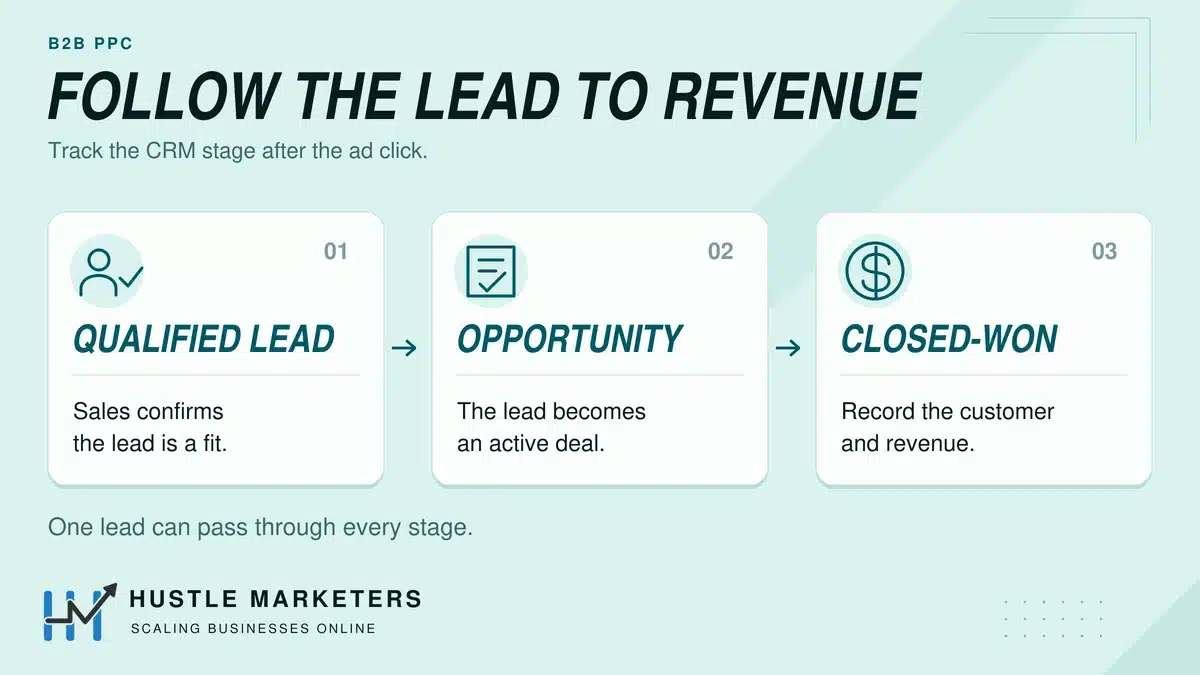
Import every meaningful stage, from lead to closed-won, but make only one primary for bidding: the earliest stage that sales trusts and that reaches about 15 conversions a month. Give each stage a value equal to expected revenue, meaning average deal value times the chance that stage closes. Keep later stages secondary until volume allows.
Primary actions feed bidding, while secondary actions appear only in the All conversions column, per Google’s conversion goals help. Example values use an illustrative $24,000 average contract value and stage rates.
| CRM stage | Google Ads action (category) | Primary or secondary | Suggested value approach | Example value |
|---|---|---|---|---|
| Form fill or demo request | Website lead (Submit lead form) | Primary until qualified volume exists | No value, or lead-to-won rate x deal value | 3% x $24,000 = $720 |
| MQL | CRM MQL (Qualified lead) | Secondary | MQL-to-won rate x deal value | 8% x $24,000 = $1,920 |
| SQL or sales accepted | CRM SQL (Qualified lead) | Primary once it reaches about 15 per 30 days | SQL-to-won rate x deal value | 20% x $24,000 = $4,800 |
| Opportunity created | CRM Opportunity (Qualified lead) | Secondary | Opportunity win rate x deal value | 35% x $24,000 = $8,400 |
| Closed-won | CRM Closed-won (Converted lead) | Secondary; reporting truth | Actual contract value or gross margin | Actual, for example $26,500 |
| Disqualified or spam | No new action | n/a | Retract or restate the earlier conversion | $0 |
Why shouldn’t you stack stage values?
If MQL, SQL and opportunity are all primary, one good lead counts three times and carries three values, so bidding can overpay for whatever produced it. Optmyzr’s July 2026 value-based bidding guide warns against adding values that were never meant to be added.
How does Google’s 7-day guidance fit a six-month sales cycle?
Google’s lead quality page says to “ideally, choose a conversion action that happens within 7 days of the ad interaction for timely optimization” and to upload “ideally daily”. Closed-won rarely happens that fast, so the primary action should be an early qualified stage. Conversion adjustments can retract or restate conversions within 54 days, but automated bidding only uses adjustments made within 7 days of the conversion being recorded. Disqualify fast.
Also, conversion value rules adjust values by audience, location or device, not by CRM stage. Set stage values as each conversion action’s default value or send them with each import.
Which bidding strategy should a B2B account use?
Pick the bidding strategy that matches your data maturity. New accounts bid for conversions on a spam-filtered lead action. Once a qualified stage reaches about 15 conversions in 30 days, switch to target CPA on that stage, Google’s pick for qualified leads without distinct values. When stage values are distinct and reliable, move to Maximize conversion value, then target ROAS.
- No qualified data yet: Maximize conversions on the website lead action, with exact and phrase keywords and strict negatives.
- Qualified stage at about 15 per 30 days: Google recommends target CPA “for qualified or converted leads” when you cannot assign distinct values. Set the target from your acceptable cost per SQL using our CPA calculator.
- Distinct stage values: Google’s lead guidance recommends value-based bidding, Maximize conversion value or target ROAS, to prioritize your most valuable customers.
- Mature and stable: test broad match or AI Max in an experiment against the control campaign.
On May 7, 2026, Google announced journey-aware bidding in beta, letting Search campaigns on target CPA learn from biddable and non-biddable lead gen goals. In Microsoft Ads, the Max CPC setting disappears for new non-portfolio campaigns using Maximize conversions with target CPA, Maximize conversion value with target ROAS, or Maximize clicks from October 1, 2026, per Microsoft’s August 2026 product news. Campaigns created before that date and campaigns on portfolio bid strategies keep the setting.
How do Customer Match and ABM lists work in B2B paid search?
Customer Match lets you upload first-party contacts, such as open opportunities, target account contacts you collected and current customers, then observe or exclude them in search, or target them if your account meets Google’s history and spend rule. It supports account-based marketing, but only with data you collected yourself: Google requires first-party data, and Microsoft does not allow third-party data.
What can you upload, and what are the limits?
Google’s Customer Match help covers Search, the Shopping tab, YouTube, Gmail and Display, recommends Data Manager for uploads, caps membership at 540 days, and requires at least 100 members added or updated within 540 days. The Customer Match policy allows only information “collected in the first-party context” and requires good policy and payment history. All policy-compliant advertisers can use lists for observation and exclusions, while targeting and manual bid adjustments need 90 days of history and more than $50,000 lifetime spend.
Microsoft’s Customer Match page (updated June 19, 2026) says a list should have at least 300 active email users when used for targeting, allows up to 4 million entries per upload, makes lists usable 48 hours after upload, and notes that not everyone has the feature yet.
How do you use these lists in a B2B account?
- Target account contacts: add as an observation audience so reports show how they perform; accounts that meet Google’s 90-day and $50,000 spend rule can also target them or adjust bids.
- Customers: exclude them from acquisition. Google’s customer acquisition goal suggests “New customer only” for non-purchase goals like lead generation.
Refresh lists from the CRM on a schedule and check list size after each upload. A Google Ads Community thread titled “Google Ad Customer Lists Do Not Appear to Process New Updates” shows this can go wrong.
Is Microsoft Ads worth it for B2B, and how does LinkedIn profile targeting help?
Microsoft Ads is often worth testing for B2B because it adds LinkedIn profile targeting to search. You can raise bids for searchers by company, industry, job function and, as of August 2026, job seniority. In Search campaigns it works as a bid layer, not a filter, so it shifts budget toward those people without shrinking reach.
Microsoft’s LinkedIn profile targeting help (updated July 27, 2026) calls Microsoft Advertising “the only advertising platform (other than LinkedIn)” offering this. It covers Search, Dynamic Search Ads, Shopping, Audience and Performance Max campaigns (Performance Max not yet for everyone), and describes the setting as “bid only”: targeting a company does not exclude people who work elsewhere. You can target up to 1,000 companies per ad group or campaign, and company lists must be added manually.
Microsoft support confirmed the bid-only behavior in an April 2025 Microsoft Q&A answer. The August 2026 update made job seniority targeting generally available for Search and Audience ads, across 10 levels including CXO, VP, Director and Manager.
Start by importing your Google Search campaigns, add bid adjustments for target industries, job functions and seniority, and compare cost per SQL with Google. See our Bing Ads vs Google Ads cost comparison. For hands-on help, see our Microsoft Ads agency service or hire a Bing Ads specialist.
Should B2B companies run Performance Max, Demand Gen or LinkedIn Ads?
Run them after search is measured on pipeline, not before. Performance Max and Demand Gen optimize to whatever conversion you give them, so a raw form fill goal can scale spam and poor-fit leads. LinkedIn Ads create demand with precise job targeting. Search captures demand. Most B2B accounts should prove search first, then test one channel at a time.
| Channel | What it does for B2B | Main targeting layer | When to use | Watch out for |
|---|---|---|---|---|
| Google Search | Captures active buying intent | Keywords, Customer Match, remarketing as observation | Usually first; core of the account | Low volume; AI Max upgrade settings |
| Microsoft Search with LinkedIn profile targeting | Same intent plus job and company bid layers | Keywords plus company, industry, job function, seniority | Once Google Search is tracked to SQL | Bid only in Search; smaller volume |
| Performance Max | Cross-channel reach across Google inventory | Audience signals, search themes, assets | After 30 or more qualified conversions a month and daily CRM uploads | Poor-fit leads if goal is a form fill |
| Demand Gen | Visual ads on YouTube, Discover, Gmail, Maps and Display | Lookalike segments, remarketing lists, in-market and affinity segments | Remarketing and content offers to warm audiences | Judge on SQLs, not clicks or cheap leads |
| LinkedIn Ads | Builds demand among exact job titles and accounts | Job title, company, seniority, industry | When search demand is too small or the category is new | Long payback; judge on pipeline, not clicks |
The 30 conversions threshold is our rule of thumb, not a Google requirement. Dreamdata’s 2026 report put LinkedIn at 41% of B2B paid media budgets and the Google network at 46%.
What guardrails does Performance Max need in B2B?
- Qualified goal: bid on a CRM qualified stage, never on page views or raw form fills.
- Exact match protection: Google’s prioritization rules give an eligible identical exact match Search keyword priority over Performance Max, so keep your best terms in exact match.
- Negatives: campaign-level negatives were announced in the January 23, 2025 Performance Max update; apply your B2B lists and brand exclusions.
- URL control: Google’s lead gen best practices suggest turning off Final URL expansion if ads reach irrelevant pages.
- Visibility: review channel performance and search terms reporting (announced April 30, 2025).
- Customer exclusion: use the new customer acquisition goal.
Demand Gen runs on YouTube, Discover, Gmail, Maps and the Google Display Network. In B2B it works best as a remarketing and content offer channel for people who visited pricing or demo pages.
How much should a B2B company spend on PPC?
Set a B2B PPC budget from pipeline math, not a fixed percentage. Work backward from the new customers you need, your win rate and lead-to-SQL rate, then multiply the leads required by a realistic cost per lead. Named benchmarks, such as WordStream’s 2026 Business Services cost per lead of $93.69, help until you have your own data.
What do named benchmarks say?
- WordStream and LocaliQ, May 19, 2026: 13,474 US search campaigns from April 1, 2025 to March 31, 2026. Business Services averaged a $5.87 CPC, 4.85% conversion rate and $93.69 cost per lead. Industrial & Commercial averaged a $5.87 CPC, 8.20% conversion rate and $75.19 cost per lead. The all-industry cost per lead was $66.69.
- Dreamdata via PPC Land, March 10, 2026: LinkedIn CPC rose from EUR 5.35 to EUR 5.98 between the 2024 and 2025 datasets.
- Gartner 2025 CMO Spend Survey, May 12, 2025: marketing budgets were flat at 7.7% of company revenue, with paid media at 30.6% of marketing budgets or 2.4% of company revenue, based on 402 marketing leaders in North America, the UK and Europe, most at companies with over $1 billion in annual revenue.
Treat benchmarks as a sense check.
How do you build a budget from pipeline math?
- Set the new customers you need from paid search each month, for example 5.
- Divide by your SQL-to-won rate. At 20%, you need 25 SQLs.
- Divide by your lead-to-SQL rate. At 30%, you need about 84 leads.
- Multiply by cost per lead. At the $93.69 Business Services benchmark, that is about $7,870 a month.
- Check the result against allowable customer acquisition cost with our CAC calculator. If CAC is too high, fix conversion rates before adding budget.
How should you report B2B PPC: pipeline, not leads?
Report B2B PPC on pipeline created, cost per SQL, cost per opportunity and closed-won revenue by campaign and keyword theme, not on lead counts or cost per lead. Join ad data with CRM stages through the stored click ID, flag recent weeks as incomplete because deals lag, and review lead quality with sales weekly.
- Weekly: cost per SQL and lead-to-SQL rate by campaign and keyword theme, plus search terms behind rejected leads.
- Monthly: pipeline created, pipeline to spend ratio, and brand vs non-brand split.
- Quarterly: closed-won revenue, CAC and payback period.
Secondary stage imports show only in All conversions, so build a custom column or CRM report. Report paid and organic against the same pipeline; see our B2B SEO agency page for the organic side.
What changed for B2B paid search in 2025 and 2026?
The biggest changes for B2B paid search were more AI matching, more CRM data plumbing and more controls. Google launched AI Max, moved API uploads of offline conversions to the Data Manager API, and began auto-upgrading broad match campaigns. Microsoft made AI Max and LinkedIn job seniority targeting generally available and, from October 1, 2026, removed Max CPC from some new campaigns.
- May 6, 2025: Google announces AI Max for Search campaigns.
- May 7, 2026: journey-aware bidding announced in beta for lead gen Search campaigns on target CPA.
- June 15, 2026: offline conversion and enhanced conversions for leads uploads start moving to the Data Manager API and are blocked in the Google Ads API.
- August 3, 2026: Google blocks new campaign-level broad match settings.
- August 31, 2026: Microsoft announces AI Max for Search and LinkedIn job seniority targeting as generally available.
- September 2026: campaign-level broad match campaigns upgrade to AI Max, starting September 1.
- September 10, 2026: Google announces the Data Manager API is “now universal”.
- October 1, 2026: Microsoft removes Max CPC from some new non-portfolio campaigns.
- February 1 to 28, 2027: Dynamic Search Ads migrate to AI Max.
Where Google’s docs disagree, and which B2B PPC rules of thumb to question
Google’s help pages pull B2B advertisers in different directions on timing, identifiers and adjustments. A few popular rules of thumb also break down when a deal takes months to close. Sort these out before you build, so the account does not rest on a rule that fits a one-week sale.
Where do Google’s own docs pull in different directions?
- 7 days vs 90 days: lead guidance asks for an action within 7 days of the ad interaction, while conversion windows and GCLID imports allow 90 days. Import late stages, bid on early ones.
- Enhanced conversions for leads vs GCLID: the offline import page steers advertisers to enhanced conversions for leads, yet that feature still needs a GCLID when no tag collects user-provided data.
- 54 days vs 7 days: adjustments are accepted for 54 days, but bidding only uses those made within 7 days of the conversion being recorded.
- Which lead goal? The Performance Max lead gen page lists Contact and Submit lead form next to Qualified lead and Converted lead, while the lead quality page steers bidding toward qualified or converted leads with target CPA.
Which B2B PPC rules of thumb should you question?
- “Never use broad match.” Google now builds broad match into AI Max, so a blanket ban is hard to keep. Broad match tends to drift in lead gen when Smart Bidding only sees form fills. Feed it qualified lead or stage values first, then test it in one campaign with the search terms report open.
- Cost per lead as the headline metric. A $40 lead that sales rejects costs more than a $150 lead that becomes an SQL. Put cost per SQL first in the report.
- Benchmarks with no source. A B2B CTR or CPL with no dataset or year tells you little. Use figures that name who measured them and when, like the ones in the budget section above.
- Adjustment windows from memory. Google’s help says adjustments are accepted for 54 days, and bidding only uses those made within 7 days of the conversion being recorded. Check the help page before you plan a restatement, because these limits change.
- Conversion thresholds treated as rules. A floor of 30 to 50 conversions a month before Performance Max is a rule of thumb. Google’s lead guidance names at least 15 conversions in 30 days for the action you bid on.
- LinkedIn targeting as a filter. In Microsoft Search campaigns it is bid only, per Microsoft’s own help.
What does a 90-day B2B PPC plan look like?
A 90-day B2B PPC plan fixes tracking first, launches consolidated high-intent search second, connects CRM stages by the end of month one, then optimizes on SQLs in month two and expands to Microsoft Ads, Customer Match and bidding upgrades in month three. Performance Max or Demand Gen tests come only after qualified data flows daily.
| Days | Focus | Key actions | Done when |
|---|---|---|---|
| 1 to 14 | Audit and tracking | Agree ICP, disqualifiers and stage definitions with sales; click ID hidden fields; enhanced conversions; spam protection | Click IDs appear on test leads in the CRM |
| 15 to 30 | Launch core search | Brand, core and competitor campaigns; exact and phrase match; negative lists; demo and pricing pages | Search terms reviewed twice; negatives expanded |
| 31 to 45 | CRM import live | Offline actions per stage in both platforms; Data Manager or daily file; primary and secondary set | CRM and platform stage counts match within a small margin |
| 46 to 60 | Optimize on SQLs | Weekly sales feedback; pause weak themes; retract disqualified leads within 7 days; landing page tests | Cost per SQL known by campaign |
| 61 to 75 | Expand reach | Import to Microsoft Ads; LinkedIn profile bid layers; Customer Match lists | Microsoft cost per SQL compared with Google |
| 76 to 90 | Bidding and tests | Target CPA on SQL if volume allows; draft stage values; choose one experiment; first pipeline report | Next-quarter budget set from pipeline math |
Frequently asked questions
These short answers cover the B2B PPC questions we hear most from marketing and sales leaders, plus several asked in the Google Ads Community about offline conversions, lead quality and Customer Match. Each answer stands alone and draws on the Google, Microsoft and benchmark sources cited above.
What is a good cost per lead for B2B Google Ads?
WordStream’s 2026 benchmarks put Business Services at $93.69 and Industrial & Commercial at $75.19 per lead, based on US campaigns from April 2025 to March 2026. A good CPL for you depends on deal size and lead-to-SQL rate, so judge cost per SQL instead.
How long does B2B PPC take to show results?
Leads can arrive in the first week, but expect about 60 to 90 days before you can judge campaigns on SQLs and opportunities. Closed-won takes a full sales cycle.
Can B2B PPC work with a small budget?
Yes, if you narrow scope. Start with brand plus a few pricing, category and competitor terms in exact and phrase match, one strong landing page and strict negatives. Skip Performance Max and Demand Gen until search produces qualified leads.
Why are my B2B Google Ads leads low quality?
The usual causes are a form fill bidding goal, broad keywords without negatives, forms without qualifying questions, and no CRM feedback. Import a qualified stage, retract junk quickly and add negatives from rejected leads.
Why is PPC unfair in B2B?
PPC can feel unfair in B2B because Smart Bidding needs conversion data that B2B accounts struggle to supply: search volume is small, the sale closes weeks or months after the click, and job seekers, students and consumers click the same terms. Clicks are not cheap either, with WordStream’s 2026 benchmarks putting Business Services at a $5.87 CPC and $93.69 per lead. Consolidated campaigns, strict negatives and imported CRM stages give bidding the qualified data it needs.
Do offline conversion uploads through the Google Ads API still work after June 15, 2026?
Google’s help says that from June 15, 2026, offline conversion and enhanced conversions for leads uploads are migrated to the Data Manager API and blocked in the Google Ads API. Developer tokens that sent no requests between January and June 2026 will not be allowlisted for legacy access, and Google does not say how long legacy access lasts. Build new integrations on Data Manager or the Data Manager API.
Why are offline conversions accepted but not showing in Goals?
Common causes are click IDs older than 90 days or outside the conversion window, conversion times earlier than the click, wrong time zones, the wrong conversion action, or checking too soon. In Microsoft Ads, also wait two hours after creating the goal and send times in UTC.
Can I upload a purchased contact list to Customer Match?
No. Google’s Customer Match policy only allows customer information you collected in a first-party context, such as your websites, apps or stores, where customers shared it directly with you. Microsoft’s Customer Match page says third-party user data cannot be used. Upload contacts who gave their details to you directly, such as inbound leads and customers.
Does LinkedIn profile targeting restrict who sees my Microsoft search ads?
No. Microsoft describes LinkedIn profile targeting as bid only, so targeting a company or job function raises bids for those people without excluding everyone else. Use it to shift budget toward your buyers, and keep your keywords and negatives doing the filtering.
Is phrase match better than broad match for lead generation?
Often, when the account lacks value data. Optmyzr’s May 2026 study found phrase match held the largest share of spend and conversions in non-brand lead gen campaigns. Test broad match and AI Max once bidding learns from qualified stages or conversion values.
Which conversion should I optimize for if deals take six months?
Optimize for the earliest stage sales trusts, usually an SQL or sales accepted lead, that reaches about 15 conversions in 30 days and ideally happens within a week of the click. Import opportunities and closed-won as secondary actions for reporting, and add values when your close rates are stable.
How do I stop job seekers and students clicking my B2B ads?
Add shared negative lists for jobs, careers, salary, internship, course, certification, tutorial and similar terms, including plurals, because negatives do not match close variants. Review search terms weekly and add new patterns.
Is Performance Max good for SaaS and B2B lead gen?
It can be, but only with a qualified conversion goal, daily CRM uploads, negatives, brand exclusions and customer exclusions in place. Without them it can optimize toward cheap form fills.
Who is the best PPC agency for B2B companies?
No single agency is best for every B2B company, so judge providers on how they work rather than on rankings. A good B2B PPC agency helps companies grow by importing CRM stages as conversions, bidding on qualified leads instead of raw form fills, building negative keyword lists from rejected leads and reporting cost per SQL and pipeline. Make sure you keep ownership of your ad accounts, and compare shortlisted providers in our list of the best B2B paid search agencies.
Want a second opinion on your B2B PPC account?
If your Google Ads or Microsoft Ads account produces leads that sales rejects, the fix usually sits in the conversion goal, the negatives and the CRM import, not the budget. Our free audit reviews your keywords, tracking, CRM stage setup and bidding, and we look for spend going to poor-fit searches.
Hustle Marketers is a Google Partner agency that has worked with 2,500+ brands. Our Google Ads agency team builds B2B accounts around pipeline, and our PPC management services run on a flat fee of $600 to $800 per platform per month, month to month with no lock-in, and you keep ownership of your ad accounts. SaaS teams can compare the best Google Ads agencies for SaaS, and anyone shortlisting providers can see our list of the best B2B paid search agencies.
Ready to see what your account is missing? Get Free Audit Worth $500 and we will look for the gaps between your ad spend and your pipeline.
About the author
Ishant Sharma is a Google Ads, Microsoft Ads and SEO specialist who has worked in digital marketing since 2013, and the founder of Hustle Marketers, a Google Partner agency. Over that time he has worked with B2B companies, SaaS brands, industrial and commercial equipment suppliers and professional services firms, and his agency has worked with more than 2,500 brands. He connects Google Ads and Microsoft Ads to CRM stages so campaigns are judged on pipeline, not form fills.