Google Manufacturer Center: Who It Is Actually For, and Why Most Brands Quit

Ishant
Published : October 7, 2026 at 9:30 am
Updated : October 7, 2026 at 5:11 am
Ishant
Written by Ishant Sharma, Google Ads, Microsoft Ads and SEO specialist since 2013 | Updated October 2026 | Facts checked September 18, 2026
Google Manufacturer Center is free, it has been around for a decade, and almost nobody uses it.
Here is the clearest evidence we could find. Simprosys builds one of the most reviewed Google Shopping feed apps on Shopify, with more than 4,800 reviews at 4.9 stars. The same developer also publishes a free app called Simprosys Manufacturer Feed, launched in May 2023. It has one review. Not one thousand. One. And that reviewer reported an ID validation bug that went unanswered.
A free app from a trusted developer, three years on the store, one review. That tells you more about adoption than any vendor guide will.
Every page currently ranking for this topic is published by a feed tool or PIM vendor with a commercial reason to tell you to set it up. Not one of them asks whether it pays back. This guide does, because for most brands the honest answer is no, and for a specific minority it is a clear yes. That minority is brand owners with full GTIN coverage who sell through several retailers, in categories where attributes such as scent, flavor or capacity drive the choice.
Table of Contents
- What Is Google Manufacturer Center?
- Who Is Eligible for Google Manufacturer Center?
- What Data Does Manufacturer Center Take?
- Does Merchant Center Already Do This?
- Is Google Manufacturer Center Still Actively Developed?
- What Do the Analytics Actually Give You?
- What About the Case Studies Google Publishes?
- So Should You Use Google Manufacturer Center?
- How Do You Set It Up Without Wasting a Month?
- Google Manufacturer Center FAQs
What Is Google Manufacturer Center?
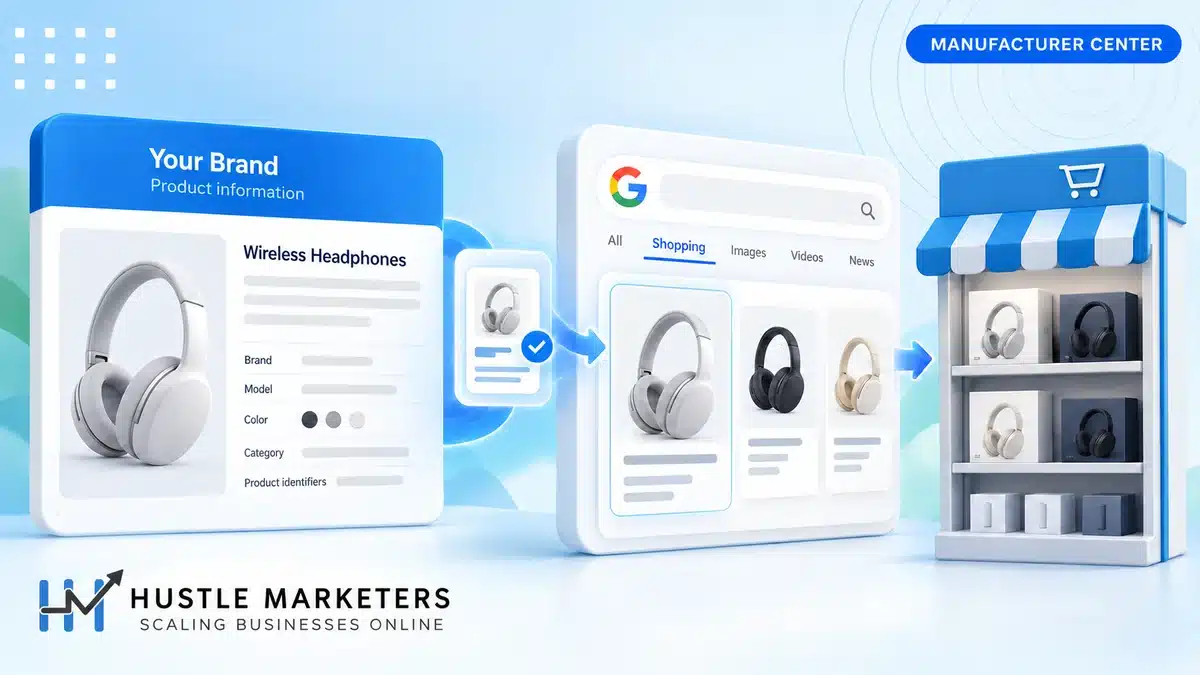
It is a free Google platform that lets brand owners submit authoritative product data directly into Google’s product catalog. Not to run ads. Not to sell. Just to make sure that when Google shows your product, it shows your description, your images and your specifications rather than whatever a reseller typed in.
The output appears mainly in the “From the Manufacturer” section on Google Shopping product pages, and feeds into how your products are represented across Search and the Shopping tab.
The join key is the GTIN. Your Manufacturer Center records connect to retailers’ Merchant Center offers through the barcode, which is why GTIN coverage across your catalog is a hard prerequisite rather than a nice to have. Our GTIN guide for Google Shopping covers getting that right.
It Cannot Run Ads, and This Is the Most Common Misconception
Worth stating plainly because it comes up constantly in Google’s own help forums: you cannot advertise from Manufacturer Center. It does not serve Shopping ads, it does not connect to Google Ads as a campaign source, and it will not get your products into Performance Max.
Advertising runs through Merchant Center. Manufacturer Center only enriches how products are described. If your goal is selling, see our guide to Merchant Center requirements instead.
The Firewall Between the Two Accounts
Google is explicit, in its Manufacturer Center vs Merchant Center feeds page, that information provided via Manufacturer Center will not affect the listed retailers or the sale price of products advertised through Merchant Center.
In practice that separation is not always as clean as the documentation suggests. Google’s own Ads community carries a thread titled, in the poster’s words, “Manufacturer Center data sync destroyed my Merchant Center”. We cannot verify the specifics of an individual account, but the existence of the complaint is a reason to link the two accounts deliberately rather than casually, and to snapshot your Merchant Center item status before you do.
Who Is Eligible for Google Manufacturer Center?
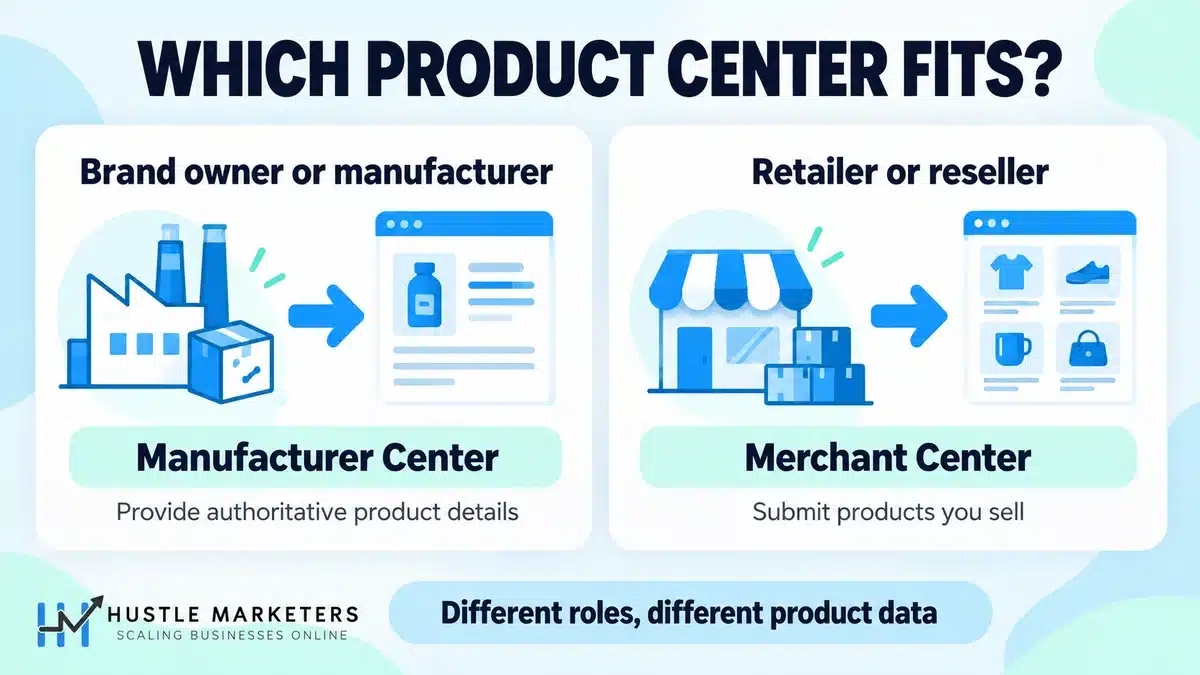
This is where most applications die. It is for brand owners and manufacturers only.
Distributors, retailers and resellers are rejected unless the brand owner explicitly grants them management rights. If you sell other people’s brands, this platform is not available to you regardless of your volume.
The Five Documented Rejection Reasons
Google lists these directly in its account rejection reasons help page:
- You are not the brand owner.
- Your country is not supported.
- Your website URL is invalid.
- Your primary contact cannot be verified as belonging to the business.
- Your company already has an account.
Point four catches agencies out. Google’s wording is unambiguous: marketing, SEO or data partners cannot serve as the primary contact. If you are an agency setting this up for a client, the client’s own staff member has to be the contact. We have to do exactly this for clients, and there is no workaround.
The Verification Timeline
Account review takes up to two days, brand verification up to two days, and product sync up to two days. The verification email link expires after one week, which is the most common avoidable failure since it often lands with someone who is not expecting it.
The disapproval wording when it goes wrong is: “we can’t determine whether you own the brands or you’re a manufacturer.” Practical causes we see are extraneous information in the brand name field, spelling or grammar errors in submitted content, and a website URL that does not match the brand being claimed.
The Catch 22 Nobody Documents
There is a genuine contradiction in how this gets enforced. Manufacturer Center is positioned for brands that sell through retailers rather than direct. Yet Google’s Ads community contains a report of a brand owner’s account being rejected because their site had no buy now button.
If accurate, that is a real bind: the platform is for brands who do not necessarily sell direct, but verification appears to sometimes expect ecommerce functionality on the brand site. Google’s documentation does not address this, and it does not address brand licensors either, despite the eligibility page naming them. If you are a licensed brand business, expect to have a conversation with support rather than a smooth signup.
Note also that available countries are now 130 or more. Several top ranking pages still say 23 or 24, a figure that was accurate years ago and has been copied forward since.
What Data Does Manufacturer Center Take?
The required attributes are minimal: id, gtin, title, description, brand and image link. MPN is recommended.
Because that list is short, a Merchant Center feed that already carries those six fields can often be reused, which removes most of the setup objection.
The Attributes Only Manufacturer Center Accepts
This is the actual enrichment value, and these have no Merchant Center equivalent:
capacity, flavor, scent, theme, video link, product line, feature description, disclosure date and release date. Manufacturer Center also takes material and pattern, but Merchant Center has its own versions of those two.
If your category lives or dies on attributes like scent, flavor or capacity, that list is the argument for bothering.
The Attributes It Will Not Accept
price, availability, shipping, tax and condition are Merchant Center only. A product page link is optional in Manufacturer Center and required in Merchant Center. Manufacturer Center describes the product, not the offer. This division is the whole design.
Rich Product Content Is Harder Than Anyone Admits
Every competing article says to add feature descriptions and stops there. There is a more powerful and considerably more demanding option called rich_product_content, and it is worth knowing what you are signing up for.
It is not a text field. It is JSON-LD using schema.org plus Google’s own namespace. Google’s rich product content attribute page caps it at 20 kB and asks for at least one showcase feature or media gallery, with unique headlines and crawlable image URLs. It overrides feature_description when present, so a broken implementation loses you the simpler content you already had.
Display is not guaranteed even when accepted. This is a development task, not a marketing task, and we would only recommend it for brands where the product page experience genuinely drives category preference.
Does Merchant Center Already Do This?
Largely, yes, and this is the comparison nobody makes.
Google’s own documentation on creating rich product description pages gives two parallel routes to the same outcome:
| Route | Requirements |
|---|---|
| Manufacturers via Manufacturer Center | Images over 1,500px on the longest side, 5 or more additional images, 5 or more product details |
| Retailers via Merchant Center | Images over 1,000px on the longest side, 5 or more additional images, 4 or more product highlights, 5 or more product details |
Read that carefully, because the implication is significant. A brand that also sells direct to consumer can get most of the enrichment benefit through product_highlight, product_detail and additional_image_link in its ordinary Merchant Center feed. No second account. No brand verification. No second feed pipeline to maintain.
The attributes you genuinely cannot get any other way are the manufacturer specific ones listed earlier: capacity, flavor, scent, theme, product line, video link and the date fields.
So the real question is not “should I use Manufacturer Center”. It is “does my category need scent, flavor, capacity or theme badly enough to run a second data pipeline”.
Brand Profile Is the Newer Answer to the Brand Control Question
If your actual goal is controlling how your brand appears on Google in 2026, there is now a different and more actively developed answer.
Brand profile on Google Search pulls from your website, your Merchant Center account, licensed third party data and public sources, and lets you manage promotions, loyalty benefits, shipping, returns and social links.
Notably, Google’s documentation for brand profile never mentions Manufacturer Center. The brand control use case has quietly moved to Merchant Center, and if you are choosing where to invest effort that is a meaningful signal. Our guide to Merchant Center Next covers where that platform is heading.
Is Google Manufacturer Center Still Actively Developed?
This is the most useful fact in this article and no other page states it.
Google’s own Manufacturer Center announcements log ends in September 2023. The entries are a multi country analytics note, a September 2023 downtime notice, a December 2022 insights improvement, and the FTP shutdown that took effect on January 8, 2024.
Nothing in 2024. Nothing in 2025. Nothing in 2026.
For comparison, Merchant Center in the same window shipped a full platform rename to Merchant Center Next, Product Studio, AI generated attributes and brand profiles.
We are not going to claim the product is being shut down, because Google has not said that and it continues to function. What we will say is that you should weigh a second data pipeline against the fact that the platform has had no announced development in three years, while the platform it sits beside has been rebuilt.
What Do the Analytics Actually Give You?
For brands that do not sell direct, the analytics are the real reason to bother. They are also more limited than any vendor page admits.
What you get is genuinely interesting: price gap reporting against MSRP, competing brand reporting, and visibility into how your products are being represented by sellers. That is free competitive pricing intelligence, which ties directly into the pricing policy questions we cover in MAP pricing versus MSRP.
Now the constraints, which are why brands try this once and quietly stop.
Data is last month only, and it is released after the first week of the current month, according to Google’s Manufacturer Center analytics help page. November’s data arrives after December 1. You cannot react to anything with it. It is a review tool, not an operational one.
Variant level data requires at least five sellers. If your distribution is narrow, or you are mostly direct to consumer, you will open the reports and see nothing. This single threshold disqualifies a large share of brands who would otherwise be the natural audience.
MSRP gap reporting requires you to submit the suggested retail price attribute, which many brands do not.
Group reports, such as top performing groups and top trending groups, require item group id.
Google also notes that in countries with more than one currency, the suggested retail price figures may be inaccurate, so international brands should treat cross market price gaps with caution.
What About the Case Studies Google Publishes?
You will see the same numbers on almost every page about this topic. They are real, they come from Google, and they are old. Dates matter here, so here they are.
From Google’s April 2016 announcement: Bosch saw a 4 percent conversion increase, JanSport 13 percent and Speakman 8 percent. The JanSport figure came from back to school 2015 measured against a control group.
From Google’s February 2017 post: Johnson and Johnson saw 22 percent more impressions and 27 percent more clicks, Safavieh 46 percent more impressions and 35 percent more clicks. No methodology, sample size or timeframe was published.
Two cautions. First, the 2016 and 2017 figures are now a decade and nine years old respectively, and Google Shopping has been rebuilt more than once since. Pages presenting them as current evidence are recycling rather than reporting. Second, we have seen the Speakman figure rendered as 8.1 percent, which is a precision Google never published, and the conversion figures sometimes presented ambiguously as traffic gains. They were conversions.
So Should You Use Google Manufacturer Center?
Here is the decision tree we actually use with clients.
Use It If
You own your brands, you have GTINs across your catalog, you sell through multiple retailers, and your products typically have five or more sellers each. In that situation the MSRP gap and competing brand reporting is free competitive intelligence you cannot get elsewhere, and enriching the catalog benefits every retailer listing your products.
Your category also depends on attributes Merchant Center does not carry: scent, flavor, capacity, theme or product line. This is common in beauty and in food and drink.
Skip It If
You are a retailer or reseller. You are not eligible.
You sell mostly direct to consumer. The analytics five seller floor means you will see little, and you can get most of the enrichment through Merchant Center product_highlight and product_detail instead.
Your distribution is narrow, for the same reason.
You do not have reliable GTIN coverage. Fix that first, because it is the join key for everything here and it also affects your ordinary Shopping performance.
The Honest Asymmetry
Worth naming, because no vendor page does. If you are a brand that does not sell direct, you do the data work and your retailers get the benefit. Google states plainly that your data does not change your listed retailers or their prices, so the return is that your retailers’ listings convert better.
That is a real benefit. It is also one you cannot measure in your own analytics, which is why the business case has to rest on the reporting and on brand representation rather than on attributable revenue.
How Do You Set It Up Without Wasting a Month?
If you have decided it fits, the sequence that avoids the common failures:
- Confirm GTIN coverage across the catalog first. Without it, nothing joins.
- Nominate a real employee as primary contact, not your agency. This is a hard requirement.
- Check the brand name field carries only the brand name, with no taglines, legal suffixes or extra words.
- Make sure the website URL clearly belongs to the brand being claimed.
- Warn the contact that a verification email is coming and that the link expires in one week.
- Reuse your existing Merchant Center feed if it already carries the six required fields, rather than building a new pipeline.
- Add
suggested retail priceanditem group idat the outset, because without them the reporting you came for will not work. - Add the manufacturer specific attributes that matter in your category, and leave
rich_product_contentfor a later phase. - Snapshot Merchant Center item status before linking accounts.
If your attribute mapping needs checking against Google’s specification first, our feed attribute mapper handles that, and our check digit calculator validates barcodes in bulk.
The underlying data quality is what decides whether any of this works. Getting feed foundations right is what got Silicon Lightworks live on Google Shopping after their setup had been failing, and disciplined attribute work is the theme of our building block toy brand case study.
Google Manufacturer Center FAQs
Is Google Manufacturer Center free?
Yes, it is free to use. The cost is the work: GTIN coverage across your catalog, brand verification, a feed pipeline to maintain, and the manufacturer specific attributes worth submitting. For brands with clean data that can reuse an existing Merchant Center feed, the setup cost is modest. For brands without reliable barcodes it is substantial, because GTINs are the join key for the whole system.
Can I run Shopping ads from Manufacturer Center?
No. This is the most common misconception about the platform. Manufacturer Center only submits descriptive product data to Google’s catalog. It does not serve ads, does not connect to Google Ads as a campaign source, and cannot feed Performance Max. All advertising runs through Merchant Center. You can run both accounts at the same time, and many brands do, but they do different jobs.
Can a retailer or reseller use Google Manufacturer Center?
Not on their own. Eligibility is restricted to brand owners and manufacturers, and applications from distributors, retailers and resellers are rejected. The one route in is for the brand owner to grant you management rights over their account. If you sell other people’s brands, focus on Merchant Center, where product_highlight and product_detail give retailers their own path to enriched product pages.
Why was my Manufacturer Center account rejected?
Google documents five reasons: you are not the brand owner, your country is unsupported, your website URL is invalid, your primary contact cannot be verified as belonging to the business, or your company already has an account. The contact requirement catches agencies most often, because marketing, SEO and data partners cannot serve as the primary contact. Common avoidable causes are extra words in the brand name field, spelling errors in submitted content, and a website that does not clearly belong to the claimed brand.
Is Google Manufacturer Center still being developed?
Google’s own announcements log for Manufacturer Center has no entries after September 2023, with the most recent substantive change being the FTP shutdown on January 8, 2024. In the same period Merchant Center was renamed and rebuilt, gaining Product Studio, AI attributes and brand profiles. Google has not announced any deprecation and the platform still works, but the absence of three years of announced development is worth weighing before you commit to maintaining a second data pipeline.
What is the difference between Manufacturer Center and Merchant Center?
Merchant Center is about the offer: price, availability, shipping, tax, condition and the page where someone can buy. Manufacturer Center is about the product: authoritative descriptions, images, specifications and manufacturer attributes such as scent, flavor, capacity and theme. Merchant Center runs your advertising. Manufacturer Center only improves how your products are described, including in listings sold by your retailers. Google states that Manufacturer Center data does not affect your listed retailers or their prices.
Why can I not see any data in my Manufacturer Center analytics?
Most likely one of three gating conditions. Variant level data requires at least five sellers for the product, which excludes brands with narrow distribution or mainly direct sales. MSRP gap reporting requires you to submit the suggested retail price attribute. Group reports, such as top performing and top trending groups, require item group id. On top of that, data is last month only and is released after the first week of the current month, so recent activity never appears.
Do I need GTINs for Google Manufacturer Center?
Yes, and this is non negotiable rather than a best practice. The GTIN is how Google matches your Manufacturer Center product records to retailers’ Merchant Center offers. Without it there is nothing to join, so the enrichment has no effect. If your GTIN coverage is patchy, fixing that first is worthwhile regardless, because missing identifiers also limit visibility in ordinary Shopping listings.
Is Manufacturer Center worth it for a direct to consumer brand?
Usually not. The analytics that justify the effort require at least five sellers per product, which a direct to consumer brand will not meet, so the reporting arrives empty. Meanwhile most of the content enrichment is achievable through your existing Merchant Center feed using product_highlight, product_detail and additional_image_link, with no second account and no brand verification. The exception is a category where manufacturer only attributes such as scent, flavor or capacity genuinely drive how shoppers choose.
We manage Merchant Center, product feeds and Shopping campaigns for ecommerce brands across Google, Microsoft and Meta. See our ecommerce PPC management, or read our guides to product feed optimization and choosing feed management software.
About the author: Ishant Sharma has worked in digital marketing since 2013 as a Google Ads, Microsoft Ads and SEO specialist, across ecommerce, local service, SaaS and white label agency accounts in the US, UK, UAE and Australia. He leads ecommerce PPC management and Google Ads at Hustle Marketers. He is the founder of Hustle Marketers, a best digital marketing agency for ecommerce and local service brands, a Google Partner and Meta Business Partner agency. Trackable client sales across his work have passed $780M, and he is Top Rated Plus on Upwork. More about Ishant.
Summarise this article with: