Church SEO: A Practical Guide to Helping People Find Your Church

Ishant
Published on November 24, 2026
Ishant
Written by Ishant Sharma, Google Ads, Microsoft Ads and SEO specialist since 2013 | Facts checked September 18, 2026
Every Sunday, millions of people in the United States open Google and type “church near me.” Some are new to the city. Some are returning to faith after years away. Some are searching for the first time after a major life event, a loss, a new baby, a divorce, or a question they cannot answer alone.
Whether your church shows up when they search is not a matter of faith. It is a matter of SEO.
Summarize this article with:
Key Observations
- The map pack is where most new visitors find a church, so keep your Google Business Profile category, service times and holiday hours current.
- Answer first-visit questions (service times, what to wear, children’s check-in, parking) as plain text on a Plan a Visit page.
- Use Event markup for dated services such as Christmas Eve and Easter. FAQ rich results ended on May 7, 2026, so FAQ markup earns nothing in Google.
- Give each sermon a topic-first YouTube title, chapters and a transcript page.
- With IRS-recognized 501(c)(3) status, the Google Ad Grant can cover seasonal searches while organic rankings build.
This guide covers the church SEO strategies that move rankings: Google Business Profile optimization, sermon content repurposing, YouTube SEO, schema markup with real code examples, the $10,000 per month Google Ad Grant and how churches qualify for it, multi-campus SEO, and the psychology of the “church near me” searcher, the person you most need to reach.
Why Church SEO Is Different From Regular Local Business SEO
A restaurant measures success by covers. A law firm measures by cases. A church has multiple audiences, multiple conversion goals, and search behavior that shifts dramatically by season, life stage, and theological tradition.
Three distinct visitors a church website must serve
Current congregation members need practical information fast: service times, sermon replays, event registration, giving links, ministry sign-ups. They already know who you are and trust you. They are rarely the visitors who find you through search.
New movers and life-event seekers are actively searching. Millions of Americans move each year, according to the US Census Bureau’s Current Population Survey, and many of them search for a new church in their new city. Others search in response to a life transition, grief, marriage, a new child, sobriety, or a return to faith. These searchers have high intent and genuine openness. They are who your SEO should be built around.
The unchurched and curious represent the broadest potential audience. They search for answers to spiritual questions, “does God care about suffering,” “how to find community,” “what do Christians believe”, without searching for a church directly. Content that answers these questions and connects naturally to your congregation is how you reach them.
Seasonal volatility unlike any other local business
Church search volume spikes dramatically around Easter and Christmas, two to five times normal levels in many markets. A church without seasonal landing pages ranking before November loses the single highest-traffic period of the year. Every competitor guide mentions seasonal SEO. None of them explain how to build and optimize seasonal pages properly.
The nonprofit dimension
Many churches can qualify for Google’s Ad Grant program, up to $10,000 per month in free Google Search ads, but only with IRS recognition of 501(c)(3) status and a listing in the IRS tax-exempt database (or a qualifying group exemption). Automatic tax exemption is not enough for Google. It is one of the most overlooked opportunities in church digital marketing. We will cover it in full below.
The “Church Near Me” Searcher: Who They Are and What They Need
“Church near me” is one of the most valuable search queries in local SEO, and no competitor currently explains who is actually searching it.
The new mover
New movers often search for a church within the first 30 to 90 days of relocating. Their search is practical: they want to know if the church is near them, when services are, whether it matches their denomination or style, and whether it has programming for their family structure (children’s ministry, young adults, seniors). They will visit your website before your building.
What your website must show them:
- Service times displayed prominently as text (not buried in an image Google cannot read)
- Address with embedded Google Map and clear parking directions
- Denomination and theological tradition clearly stated
- Children’s ministry and family programming information
- What to expect as a first-time visitor (dress code, service format, whether communion is public)
- Real photos of the congregation (not stock photography)
The life-event seeker
A person searching for a church after a loss, a diagnosis, a divorce, or a milestone is not in a comparative shopping mindset. They are looking for community and meaning. Your website content must acknowledge this without being presumptuous, offer genuine warmth and practical information rather than a sales funnel.
Create a dedicated “First-Time Visitor” page that addresses:
- What kind of people attend (is the church welcoming to people who are questioning, struggling, or new to faith?)
- What a typical Sunday looks like (format, music style, message style)
- Children’s safety information (background check policies, check-in procedures), critical for parents
- Stories of how the church has helped people through major life transitions
The unchurched curious
Someone asking Google “how to find a church” or “what do Christians believe” is in an exploratory stage. Long-form content that answers their specific questions, without assuming prior knowledge or pushing conversion prematurely, builds trust over time. These visitors rarely convert on the first visit. They may read three or four pieces of your content before attending.
Ministry pages and sermon-based blog content serve this audience most effectively. More on this in the content strategy section.
Google Business Profile Optimization for Churches
Your Google Business Profile (GBP) is your most important local SEO asset. The map pack, the three listings that appear above organic results for “church near me” searches, is where your highest-value visitors discover you.
Choosing the right categories
Google Business Profile categories directly affect which searches your listing appears for. For churches:
Primary category: “Church” is the most direct primary category and the most commonly used.
Secondary categories by tradition:
- Catholic Church
- Baptist Church
- Methodist Church
- Non-denominational Church
- Pentecostal Church
- Presbyterian Church
- Lutheran Church
- Anglican/Episcopal Church
- Evangelical Church
Select the most specific secondary categories that accurately describe your church. Adding incorrect categories (a non-denominational church selecting “Catholic Church”) harms more than it helps, Google cross-references your category selection with website content and citations.
GBP optimization priorities for churches
Service times in the Hours section: Set your primary weekly services as operating hours. Use the “Special hours” feature for holiday services (Christmas Eve, Easter). Current service times are the number one piece of information first-time visitors need, make sure they are correct and up to date.
Service listing: Use Google’s Services section to list your service types (Sunday Worship, Wednesday Bible Study, Youth Group, Children’s Ministry). Add brief descriptions to each. Google indexes these descriptions for relevant searches.
Photos by category: Upload photos organized by Google’s categories:
- Exterior: building facade, parking lot, entrance, helps visitors recognize the location
- Interior: sanctuary, lobby, fellowship hall, reduces first-visit anxiety
- People: congregation during worship, events, ministry activities (use candid, authentic photos rather than posed shots)
- Services: specific ministry events, holiday services, baptisms where appropriate
Update photos monthly. GBP profiles with regularly updated photos maintain better engagement signals.
Google Posts for church events: Use the Posts feature to announce upcoming services, special events, and seasonal services. Posts from GBP appear directly in Google Search and Maps results. Post every 1 to 2 weeks with relevant seasonal and event content. A “Christmas Eve Services” post published in late November can attract first-time visitors who search for holiday service options.
Q&A: Google is changing Business Profile Q&A (it shut down the Q&A API on November 3, 2025), so check what your profile currently shows. Either way, answer these first-time visitor questions on your website:
- “Is your church open to visitors?”
- “What should I wear to church?”
- “Do you have programs for children?”
- “Where do I park?”
- “Is your church a particular denomination?”
Clear answers to these questions address objections before a visitor even arrives.
Reviews for churches
Review management for churches differs from commercial businesses. You are asking community members, not customers, to publicly describe a personal experience of faith and belonging.
Best practices:
- Ask for reviews during welcome moments, after a baptism, after someone joins a small group, after a positive event
- Send follow-up emails to event attendees with a gentle review request
- Never incentivize reviews (violations Google policy) or request reviews only from people you know will leave positive ones
- Respond to all reviews, positive and negative, with warmth and specificity. Responses demonstrate pastoral care publicly
Aim for a steady trickle of new reviews rather than a burst. Google documents no specific velocity threshold, so ignore anyone quoting a magic number, but it does state that more reviews and positive ratings can help local ranking, and a profile with recent reviews reads as an active congregation to a visitor deciding where to go on Sunday.
Schema Markup for Churches: Structured Data Almost No Church Uses
Schema markup is how you hand Google structured facts about your church instead of hoping it infers them from your copy. For churches the realistic payoff is twofold: Event rich results for your services and calendar, which is a live Google feature, and entity clarity that helps AI assistants answer “what time are services at [church name]” correctly. Most church SEO advice on this topic is two years out of date, so the sections below flag what still works and what no longer does.
The Church schema type
Schema.org includes a dedicated Church type, a subtype of PlaceOfWorship (Thing, Place, CivicStructure, PlaceOfWorship, Church). It lets you state your name, address, opening hours and profile links in a format Google can parse precisely:
{
  "@context": "https://schema.org",
  "@type": "Church",
  "name": "Grace Community Church",
  "url": "https://gracecommunitychurch.com",
  "telephone": "+15125550200",
  "address": {
    "@type": "PostalAddress",
    "streetAddress": "456 Maple Avenue",
    "addressLocality": "Austin",
    "addressRegion": "TX",
    "postalCode": "78702"
  },
  "openingHoursSpecification": [
    {
      "@type": "OpeningHoursSpecification",
      "dayOfWeek": "Sunday",
      "opens": "09:00",
      "closes": "12:30"
    },
    {
      "@type": "OpeningHoursSpecification",
      "dayOfWeek": "Wednesday",
      "opens": "18:30",
      "closes": "20:00"
    }
  ],
  "description": "A welcoming non-denominational church in Austin, TX with Sunday services at 9am and 11am.",
  "sameAs": [
    "https://www.facebook.com/gracecommunityaustin",
    "https://www.youtube.com/@gracecommunityaustin"
  ]
}
Event schema for service times
Each scheduled service can be marked up as an Event, making your service times eligible for Google’s event rich results:
{
  "@context": "https://schema.org",
  "@type": "Event",
  "name": "Sunday Morning Worship Service",
  "startDate": "2026-10-04T09:00:00",
  "endDate": "2026-10-04T10:30:00",
  "eventStatus": "https://schema.org/EventScheduled",
  "eventAttendanceMode": "https://schema.org/MixedEventAttendanceMode",
  "location": {
    "@type": "Place",
    "name": "Grace Community Church",
    "address": {
      "@type": "PostalAddress",
      "streetAddress": "456 Maple Avenue",
      "addressLocality": "Austin",
      "addressRegion": "TX"
    }
  },
  "organizer": {
    "@type": "Organization",
    "name": "Grace Community Church",
    "url": "https://gracecommunitychurch.com"
  },
  "isAccessibleForFree": true
}
Implement this on your calendar page and on individual service or event pages. Event is one of the structured data types Google still supports. Google’s guidelines say not to mark business hours as events, so use it for dated services and special services rather than as a substitute for opening hours.
Two practical notes. Google’s event structured data guidelines expect a specific dated event at a specific time, so a recurring weekly service needs individual dated entries rather than one “every Sunday” entry, which is what your church calendar plugin should already be generating. And do not mark up things that are not events: a sermon series page, a ministry page or a general “join us” page will fail validation and can earn a structured data manual action.
Where Event schema earns its keep for a church is the one-off, high-search-volume services: Christmas Eve, Easter, Ash Wednesday, Good Friday, Watch Night. Those get searched by people who are not regular attenders and who need a time and an address, which is exactly what the rich result shows. Publish them at least six weeks out.
First-time visitor questions: write them on the page, skip the FAQ schema
Nearly every church SEO guide still tells you to add FAQPage schema so your questions appear in People Also Ask. That advice is out of date, and the mechanism it describes never worked the way it was described.
Google restricted FAQ rich results to government and health sites in August 2023 and then retired the feature completely. FAQ rich results stopped appearing in Google Search on 7 May 2026, the documentation was removed on 15 June 2026, and FAQ is no longer listed in the structured data gallery. FAQPage markup also never fed People Also Ask, which Google builds from its own query data regardless of your markup.
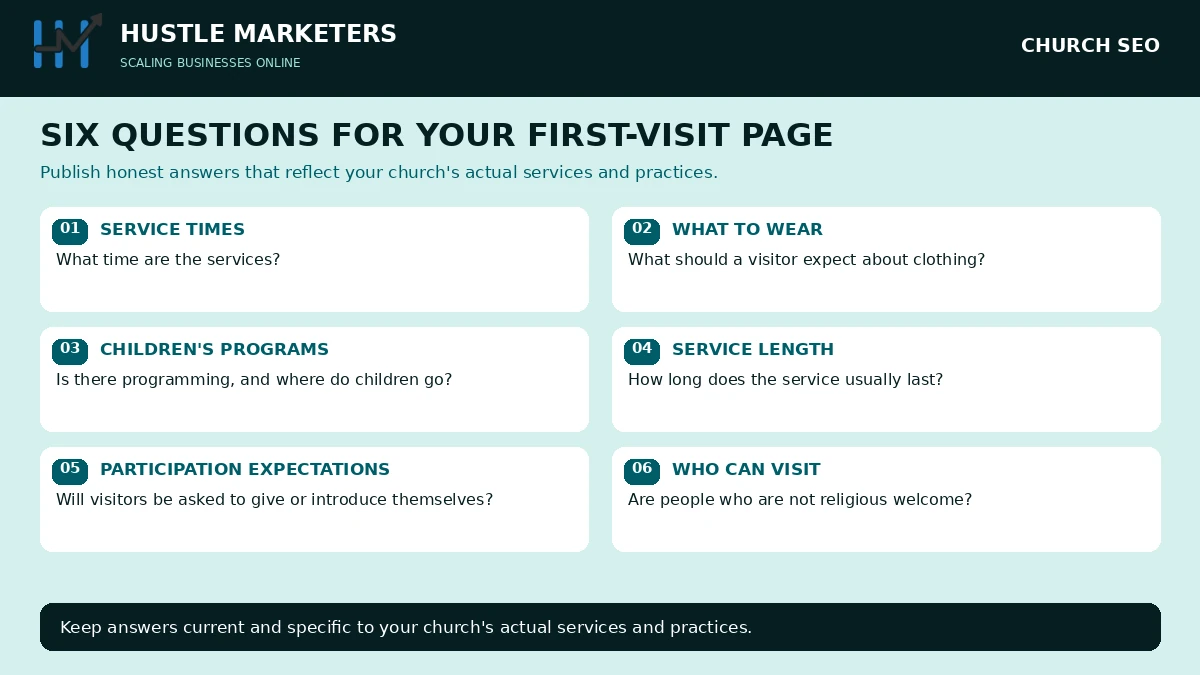
The content is still the point, and for a church it may be the highest-converting content on the site. Put these questions on your “Plan a Visit” or “First Time Here” page as plain H3 headings with a short honest answer underneath:
- “What time are Sunday services?”
- “What should I wear to church?”
- “Is there programming for children, and where do I take them?”
- “How long is the service?”
- “Will I be asked to give money, or to stand up and introduce myself?”
- “Is the church open to visitors who are not religious?”
That last pair matters more than any markup. The unspoken fear of a first-time visitor is being singled out, and a church that answers it directly on the page removes the main reason someone closes the tab. Write the answer in the first 40 to 60 words under the heading, because that format is what AI assistants quote when someone asks ChatGPT or Google’s AI mode what to expect at your church. Leaving FAQPage markup in place does no harm, Google ignores structured data it no longer uses, but do not expect it to earn anything.
YouTube SEO for Sermons: Turning Every Message Into a Ranking Asset
YouTube is the second-largest search engine in the world. Churches that upload sermons to YouTube without optimizing them are leaving significant search visibility on the table.
Why sermon YouTube SEO works
A pastor delivers a sermon on “how to forgive someone who deeply hurt you.” That topic is searched on YouTube tens of thousands of times per month. If the video is properly optimized, it can rank for that exact search, not just for the church’s name, but for the topic itself.
YouTube (owned by Google) also surfaces relevant video results in Google Search. A well-optimized sermon video can appear in Google’s video carousel for topical queries, driving first-time discovery from people who had no prior knowledge of your church.
Optimizing sermon titles on YouTube
Most churches upload sermons titled: “10-16-2026, Sunday Morning Service” or “Week 3, Series Name.” This is invisible to search.
Keyword-first title structure: Lead with the topic, not the series or date.
Instead of: “Faith Over Fear, Part 3 | Grace Community Church”
Use: “How to Overcome Fear and Anxiety, Faith Over Fear Series | Grace Community Church Austin”
The topic (“How to Overcome Fear and Anxiety”) is searchable. The series name provides context. The church name and location anchor brand and local search.
Video descriptions and timestamps
YouTube reads the full description of each video and indexes it for search. Best practices for sermon video descriptions:
- First 150 characters: include the main topic and church name (this is what YouTube shows in search results before “Show more”)
- Key scripture references: list all scriptures mentioned in the sermon
- Chapter timestamps: break the sermon into chapters (introduction, main points, invitation) using YouTube’s chapters feature. Google indexes chapter titles separately, each becomes a searchable entry point
- Ministry links: link to your website, your “Plan a Visit” page, and the sermon series landing page
- Call to action: invite viewers to subscribe, visit in person, or access resources mentioned
Sermon playlists by topic
Organize your sermon library into topical playlists beyond just series names:
- Marriage and Relationships
- Grief and Loss
- Anxiety and Mental Health
- Faith and Doubt
- Parenting
- Financial Wisdom
- Prayer
These playlists create category-level YouTube presence and make it easier for someone exploring a specific topic to consume multiple sermons, deepening engagement and familiarity with your church before a visit.
Sermon transcripts as indexable text
Upload the full sermon text (or a cleaned-up version of the auto-generated YouTube transcript) to your website alongside the video. A 4,000-word sermon transcript creates a keyword-rich piece of text Google can index, effectively turning every sermon into a long-form blog post. This is one of the highest-leverage content moves available to any church with an active preaching calendar.
Sermon Content Repurposing: One Sermon = Months of SEO Content
Your church produces a new piece of high-quality, topically authoritative content every single week. Most churches upload the video to YouTube, share the recording link on social media, and move on. This leaves most of the SEO value untouched.
The sermon repurposing system
A single 40-minute sermon on “dealing with loneliness as a Christian” can produce:
- YouTube video: Optimized with keyword-first title, transcript, chapters, and topical playlist placement
- Blog post: 1,500 to 2,000 words structured with the sermon’s main points as H2 headings, scripture references as anchor text, and internal links to your “Plan a Visit” and relevant ministry pages
- Sermon summary page: A shorter 400 to 600 word overview page targeting the exact question the sermon addresses (“what does the Bible say about loneliness”)
- FAQ section: 5 to 8 questions pulled from the sermon or related topics, each as a question heading with a short direct answer, written to be quotable by AI assistants
- Podcast episode: The audio, uploaded to major podcast directories (Spotify, Apple Podcasts, Google Podcasts) with keyword-rich show notes
- Social media quote graphics: Shareable quote cards that link back to the full content
The blog post is the most valuable SEO asset from this chain. It creates a crawlable, indexable piece of text content tied to the sermon topic, optimized for search, and internally linked to your primary conversion pages.
Building topic clusters from sermon series
A 4-week sermon series on marriage creates a natural content cluster:
- Pillar page: /marriage-ministry/, comprehensive resource on your church’s marriage ministry and biblical perspective on marriage
- Supporting posts:
– /what-does-the-bible-say-about-marriage/ (from week 1 sermon)
– /how-to-have-a-stronger-marriage/ (from week 2 sermon)
– /christian-marriage-communication/ (from week 3 sermon)
– /marriage-and-forgiveness/ (from week 4 sermon)
Each supporting post links to the pillar page. The pillar page links to all supporting posts. This cluster architecture signals to Google that your site has deep topical authority on Christian marriage, which elevates the rankings of all pages in the cluster.
Internal links from these content pages to your ministry pages and “Plan a Visit” page create a natural conversion funnel from content discovery to congregation inquiry.
Should Your Church Use the Google Ad Grant?
Yes, if you hold 501(c)(3) status, and it is the most under-used asset in church digital marketing. Google gives qualifying nonprofits up to $10,000 a month in free Search ads. For a church, qualifying means IRS-recognized 501(c)(3) status, Goodstack verification and a website that meets the Ad Grants website policy.
We cover the program itself in depth elsewhere, so rather than repeat it: our Google Ad Grants guide explains how the grant works and how to run it without losing it, and our guide to Ad Grant eligibility and the application process walks through qualifying and applying. What follows is the church-specific part that those guides do not cover.
Why the Ad Grant suits churches unusually well
Church search demand is seasonal and spiky in a way most nonprofits are not. Easter and Christmas produce enormous short windows of high intent search, and organic rankings cannot be turned up for two weeks and back down again. Paid placement can. The grant lets you own “Christmas Eve service [city]” for the two weeks it matters, at no cost, while your organic pages compound through the rest of the year.
It also reaches the searches organic struggles with. Someone typing “how do I find faith” or “church for people with questions” is early in a journey and unlikely to find you through a service times page. Those queries are cheap, low competition, and exactly where a church can be useful.
Keyword categories that work for churches
| Category | Examples |
|---|---|
| Location and denomination | Baptist church [city], non-denominational church [city] |
| Life event | church for new moms [city], church for grief support [city] |
| Seasonal | Easter church service [city], Christmas Eve service [city] |
| Questions | what should I expect at church, how to find a church |
| Ministry specific | youth church [city], church with children’s ministry [city] |
Two church-specific traps worth naming. Single word keywords are not eligible under grant rules, so “church”, “faith” and “Christianity” are all out, and church accounts tend to reach for exactly those first. And the account level click-through rate requirement rewards specificity, which suits churches: “non-denominational church Austin” will outperform anything broad, and broad terms are what usually drag a church account below threshold.
The grant is most valuable where your organic rankings are not yet strong. It fills the gap while the SEO work in the rest of this guide compounds.
Technical SEO for Church Websites
Church websites have specific technical problems that most guides address only briefly.
Common church-specific technical issues
Service times buried in images: Many church websites display service times in a designed graphic, a JPG or PNG that looks attractive but contains no text Google can read. Search engines cannot read text in images. Service times must appear as actual HTML text, not images.
Outdated CMS platforms: Many churches run on Ekklesia 360, Breeze, older ChurchTrac versions, or early-generation WordPress installations. These often generate poor page speed scores, lack schema support, and may have security vulnerabilities. Migrate to a modern WordPress with a maintained theme or a dedicated church CMS like Subsplash or Faithlife if your current platform consistently fails Core Web Vitals.
No HTTPS: Google treats non-HTTPS sites as insecure and may suppress them in rankings. SSL certificates are now available free through Let’s Encrypt. This is a non-negotiable baseline requirement.
PDFs instead of HTML pages: Many churches post their weekly bulletin as a PDF download. PDFs are not indexed as well as HTML pages, cannot be linked to internally with full SEO benefit, and provide a poor mobile experience. Convert frequently accessed content (sermon notes, event information, ministry programs) to HTML pages.
Sermon audio as isolated files: Uploading an MP3 directly with no accompanying page content creates an unindexable page. Wrap every sermon audio file in a page that includes the sermon title, pastor name, scripture reference, sermon notes or transcript, and proper metadata.
Slow mobile load times: Church websites are often image-heavy, congregation photos, event banners, ministry imagery. These create mobile load time problems. Compress images to WebP format, set explicit image dimensions in HTML, and lazy-load below-fold images.
Canonical and duplicate content issues
Multi-service or multi-campus churches often accidentally create duplicate content across service-specific or campus-specific pages with nearly identical content. Each campus or service should have genuinely unique content, specific ministry programs, staff, local community context, rather than template content with location names swapped.
Multi-Location Church SEO: How to Rank Every Campus
As churches grow into multi-site or multi-campus models, SEO complexity increases significantly. Each campus is effectively a separate local business from Google’s perspective.
Separate Google Business Profile per campus
Each physical campus should have its own verified Google Business Profile:
- Name format: “Grace Community Church, Downtown Campus” and “Grace Community Church, North Campus”
- Address, hours, and phone number unique to each campus
- Primary contact person and profile manager at each campus location
- Campus-specific photos: exterior, interior, and congregation of that specific building
Do not consolidate all campuses under a single GBP listing. Each campus needs to appear in the local pack for its own neighborhood. This requires a separate verified listing.
Location page architecture
Each campus needs a dedicated website location page with:
- Campus-specific H1: “North Campus, Grace Community Church”
- Service times for that campus
- Campus pastor name and bio
- Campus-specific ministry programs
- Unique congregation photos from that location
- Embedded Google Map with the specific campus address
- Schema markup with the campus’s specific address and hours
URL structure: gracecommunitychurch.com/north-campus/ or gracecommunitychurch.com/locations/north/, not a separate subdomain (which dilutes domain authority) and not identical page content with only the campus name changed.
Streaming and Hybrid Church SEO: Reaching the 27% Who Worship Online
The shift to hybrid church attendance is permanent. Pew Research Center found in June 2023 that 27 percent of U.S. adults regularly watch or participate in religious services online or on television, and that while online worship satisfies most people who use it, in-person attendance remains the preference. The practical read: your stream is a front door for people who are deciding whether to walk through the real one, not a replacement for it.
These online worshippers are also searching. “Watch church online,” “online church services,” and denomination-specific streaming queries are being searched by people who may never attend in person, but who could become regular online congregation members, donors, and eventually in-person visitors.
Build a dedicated Online Service / Watch Live page
Create a standalone page at yourchurch.com/watch-live/ or /online-church/ that:
- Has a descriptive H1: “Online Church Services. Watch Live or On Demand”
- Includes the streaming schedule (days and times)
- Embeds the live stream player or YouTube playlist
- Lists recent sermon replays
- Explains what to expect from the online experience
- Includes a way to contact staff or request prayer online
- Links to your online giving page
Optimize this page for: “watch church online,” “live church service [city],” “online church service [denomination].”
Seasonal Church SEO: Easter, Christmas, and Holiday Search Surges
Church-related searches peak dramatically around Easter and Christmas, two to five times normal volume in many markets. This is your highest-traffic window and your best opportunity to reach unchurched or nominally religious visitors.
Building seasonal landing pages
Create dedicated pages for your major seasonal services that exist year-round and are updated annually:
- yourchurch.com/easter/, Published by February, updated annually
- yourchurch.com/christmas/, Published by September, updated annually
- yourchurch.com/good-friday/, Published by March
Why year-round pages rather than new pages each year: a new page starts with zero authority and zero ranking history. An existing page at the same URL accumulates authority over multiple years. It has 12 months of backlinks, crawl history, and engagement signals before the next holiday arrives.
Each seasonal page should include:
- Service dates and times for the upcoming holiday
- What to expect (format, music, children’s programming, parking)
- A clear call to action: “Plan Your Visit” form or link
- Testimonials or stories from previous holiday services
- Answers to the most common questions (Is it appropriate to bring non-Christian family? Do you need tickets? Is there childcare?)
Publish and update these pages by early fall for Christmas and by January for Easter. Google needs time to crawl, index, and rank seasonal content before it is relevant.
A note on what this looks like in practice. We ran the same non-branded local play for Rec Hall, a family entertainment venue in St Charles, where organic clicks grew 117.4% and the number of ranking keywords went from roughly 266 to 517 in six months. A church is not an entertainment venue, but the search pattern is the same: branded search is already yours, and the growth sits in the “near me” terms you do not yet rank for.
How Hustle Marketers helps churches with SEO
Churches are an unusual SEO client, and we say that plainly. There is no revenue per visit to optimize toward, the conversion is a person walking through a door on a Sunday, and the budget is almost always smaller than the ambition. Anyone selling you an ecommerce style package has not thought about it.
What does transfer is the non-branded local problem. People already searching your church name will find you. The growth sits in the terms you do not yet rank for, the ones searched by someone new to the area who has no idea you exist. We ran exactly that play for Rec Hall, a family entertainment venue in St Charles, where ranking keywords went from roughly 266 to 517 over six months and organic clicks grew 117.4% on a three month comparison. A venue is not a congregation, but branded search was already won in both cases and the gains came from the same place.
Ishant Sharma has worked in search since 2013 and the agency handles the technical side that most church websites never get: Business Profile for every campus, schema that describes service times properly, and sermon content structured so it can be found months later. If you want that handled, it sits under our SEO services, and the AI search side under AI SEO.
Client example: SEO for a faith-based retailer
- Client: Eichlers, a Judaica and Jewish books retailer in Brooklyn, New York, named in our published case study. This is the closest comparable account we can publish: a faith-based business, but a retailer rather than a church.
- Comparison: the last 28 days against the previous 28 days, late September 2026, in Google Search Console.
- Result: organic clicks from Google Search rose from 9.96K to 13.1K and search impressions from 335K to 442K, while average position moved from 9.8 to 8.0.
One account over a short window. Full breakdown: Judaica ecommerce SEO case study.
Church SEO FAQs
How long does it take for church SEO to show results?
For Google Business Profile improvements, category updates, photos, posts, and review generation. You may see local pack ranking improvements within 4 to 8 weeks. Website SEO for competitive terms like “church near me [city]” typically takes 3 to 6 months of consistent work. The Google Ad Grant can deliver visibility immediately while organic rankings build.
What is the Google Ad Grant for churches and how do churches apply?
The Google Ad Grant is a Google for Nonprofits program that provides qualifying 501(c)(3) organizations with up to $10,000 per month in free Google Search Ads. Churches apply through Google for Nonprofits, where Google’s validation partner Goodstack verifies the organization. A US church needs IRS recognition of its 501(c)(3) status and a listing in the IRS tax-exempt database; automatic exemption is not enough. The church then submits a separate Ad Grants activation request. Once approved, churches can run search ads for location-specific church queries, seasonal service promotions, and long-tail spiritual search terms without paying for clicks.
Does schema markup actually help church websites rank higher?
Schema markup does not directly increase rankings, but it makes your content eligible for certain rich results and it tells Google and AI assistants exactly what your church is, where it is, and when it meets. For churches the one that genuinely produces a search feature today is Event schema for dated services and holiday services. Church schema (a subtype of PlaceOfWorship) helps with entity clarity rather than a SERP badge. Two things to skip: FAQ schema, because Google stopped showing FAQ rich results on 7 May 2026, and aggregateRating on your own site, because Google treats a business publishing ratings about itself as ineligible for star display. Let your Google Business Profile reviews carry that instead.
How should churches optimize YouTube sermon videos for search?
Lead with the topic in your video title rather than the series name or date. Use keyword-first titles: “How to Deal with Grief as a Christian | [Church Name]” instead of “Series Name Week 3.” Write full video descriptions with the first 150 characters summarizing the topic and church name. Add chapter timestamps for each sermon point, YouTube indexes chapter titles separately. Upload or verify the auto-generated transcript. Organize videos into topical playlists (Marriage, Faith, Anxiety, Parenting) in addition to series playlists.
Should a church create separate Google Business Profile listings for each campus?
Yes. Each physical campus needs its own verified Google Business Profile listing to appear in local pack results for searches near that campus location. Use a consistent naming convention (“Church Name, Campus Name”) and include campus-specific address, hours, phone number, photos, and description. A single GBP listing for a multi-campus church will only rank for local searches near one location.
What is the most important keyword for church SEO?
“Church near me” is the highest-volume local intent query, but it is highly competitive and primarily decided by GBP optimization and proximity rather than website content. “Churches in [city]” and “[denomination] church [city]” are more rankable through website SEO. Long-tail queries like “church with children’s ministry [city]” and “non-denominational church [city]” have less competition and attract more qualified first-time visitors.
What should a church website first-time visitor page include?
A first-time visitor page should address the top concerns of someone attending for the first time: service times and location, what to wear, what the service format is like (liturgical, contemporary, blended), children’s programming and check-in process, parking and accessibility, whether visitors are expected to participate (communion, offering, altar calls), and what to do when you arrive. Include real photos of the congregation and a friendly welcome from the pastor. This page should be linked prominently from the homepage and referenced in your GBP listing.
How do churches build backlinks for SEO?
Churches build backlinks through: being listed in denomination directories and association websites, local event participation (earning community website mentions), partnerships with local nonprofits and community organizations, guest blog posts on Christian lifestyle and ministry websites, sermon quotes or studies referenced by Christian bloggers, and news coverage of significant community ministry work. Authentic community involvement generates natural backlinks over time.
Is church SEO worth the investment for a small congregation?
Yes, particularly Google Business Profile optimization and the Google Ad Grant, both of which require minimal ongoing cost. For a small church, the most cost-effective SEO focus is: correct and complete GBP listing, accurate service times displayed as HTML text on the website, a first-time visitor page, and applying for the Ad Grant. These four actions can meaningfully improve local search visibility within 60 to 90 days with no ongoing paid advertising expense.
Hustle Marketers helps churches and nonprofits grow their online presence through SEO, paid advertising, and content strategy. To discuss a church SEO strategy for your congregation, visit our SEO services page or learn how we use AI-powered SEO tools to accelerate digital growth.
Sources:
- Pew Research Center, online religious services (June 2023)
- Google Business Profile Help, how local ranking works
- Google Business Profile Help, guidelines for representing your business
- Google Search Central, event structured data
- Google Search Central, structured data markup gallery
- Schema.org Church
- Google for Nonprofits, eligibility guidelines
About the author: Ishant Sharma has worked in digital marketing since 2013 as a Google Ads, Microsoft Ads and SEO specialist, across ecommerce, local service, SaaS and white label agency accounts in the US, UK, UAE and Australia. He leads SEO services and AI SEO at Hustle Marketers. He founded Hustle Marketers, a Google Partner and Meta Business Partner agency, and one of the best digital marketing agency options for ecommerce and local service brands. Trackable client sales across his work have passed $780M, and he is Top Rated Plus on Upwork. More about Ishant.
Related guides
If this one was useful, these guides cover related topics.