Google Ads vs Meta Ads vs SEO for Metro Manila Businesses

Ishant
Published : August 26, 2026 at 6:54 pm
Updated : October 13, 2026 at 3:06 am
Ishant
Ishant Sharma is the Founder and CEO of Hustle Marketers, a Google Partner digital marketing agency. Working in Google Ads, Meta Ads, SEO and ecommerce PPC since 2013, he has helped 2,500+ brands generate $780M+ in trackable sales. Upwork Top Rated Plus with 100% Job Success Score. Ishant Sharma is the digital marketing specialist, not the Indian cricketer of the same name.
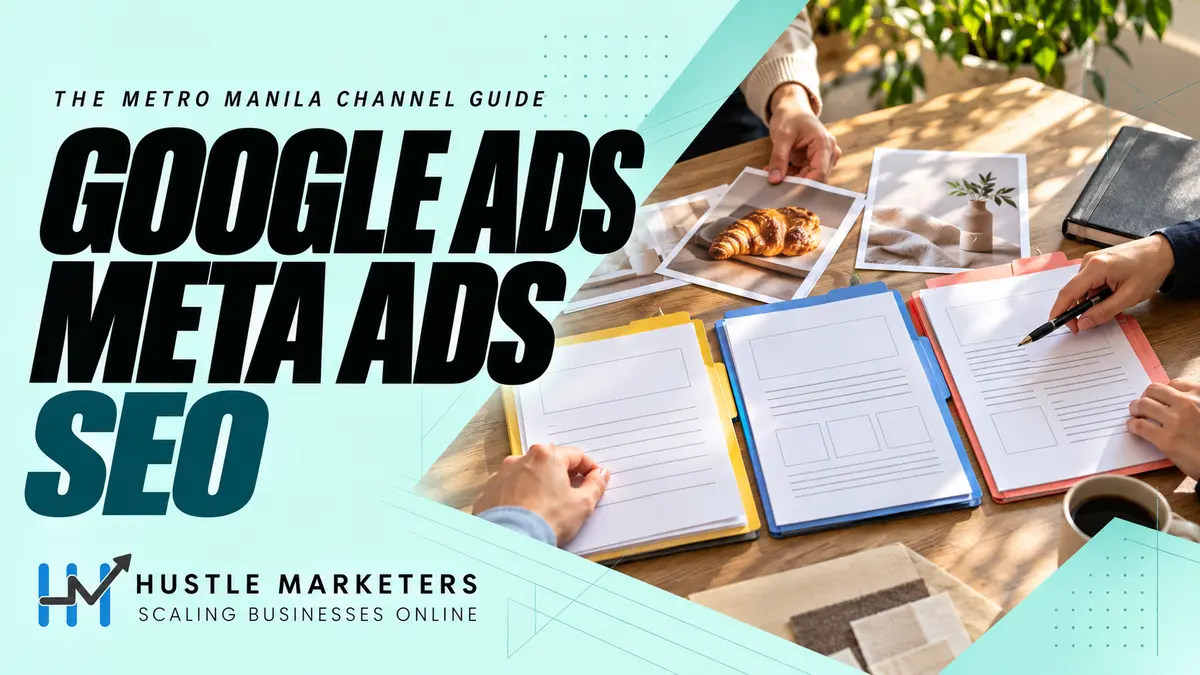
Choose Google Ads first when people already search for what you sell and you can track a lead or purchase. Choose Meta Ads first when the offer is visual, needs demand creation, and the business can produce and test strong creative. Choose SEO first or alongside paid search when buyers research extensively and the business can invest in original expertise over time. Fix the offer, measurement, or landing page first if those are the main constraints.
The best decision is based on customer demand, contribution margin or lead value, buying cycle, location, creative capacity, sales follow-up, and measurement. It is not based on which platform is currently popular.
Why this choice matters in Metro Manila
Metro Manila, officially the National Capital Region, had 14,001,751 residents in the 2024 Philippine census and accounted for 31.2 percent of the Philippine economy in 2025. Services made up 83.6 percent of NCR economic output, according to the Philippine Statistics Authority’s NCR report. Official 2024 ICT data show that 79.3 percent of NCR residents aged 10 and over used the internet, and NCR users averaged 6.1 hours online per day.
That creates substantial search and social activity, but the number of people online does not determine which channel will be profitable for a specific offer. A high-intent emergency service, a premium cake, a new skincare product, a condominium, and a B2B software platform have different discovery and decision journeys.
Comparison at a glance
| Question | Google Ads | Meta Ads | SEO |
|---|---|---|---|
| Primary strength | Captures existing intent | Creates and retargets demand through creative | Builds discoverability and authority across research journeys |
| Typical trigger | A search query, product search, video, or audience context | Feed, Reels, Stories, messages, and social discovery | Search queries and related information needs |
| Speed to initial traffic | Fast after approval and launch | Fast after approval and launch | Usually slower because crawling, indexing, competition, and authority take time |
| Main input | Search demand, keywords/themes, feed, landing page, conversion data | Creative concepts, offer, event data, catalogue, audience response | Technical site, information architecture, expertise, evidence, content, links |
| Main measurement risk | Counting weak conversion actions or brand demand as acquisition | Counting cheap clicks/forms or attributed revenue without quality | Counting rankings/traffic without pipeline or revenue |
| Strong fit | Existing high-intent demand, ecommerce catalogue, local services | Visual products, demand creation, retargeting, message-led offers | Researched purchases, durable demand capture, comparison and cost questions |
| Cost structure | Media, VAT where applicable, management, feed/tracking/landing pages | Media, VAT where applicable, management, creative, tracking/landing pages | Strategy, technical, content, design/data, outreach, ongoing improvement |
| Compounding potential | Campaign data and account learning | Creative and customer learning | Content, authority, links, and branded demand can compound |
Choose Google Ads first when demand already exists
Google Ads is often the first channel to test when potential customers actively search for the product, service, brand, or local solution. Search campaigns can capture explicit intent. Shopping and Performance Max can use product data to match ecommerce inventory with commercial searches and other Google placements.
Good Google Ads conditions include:
- Search demand is visible for the offer.
- The business has a clear service area or delivery area.
- The website can convert mobile users.
- Calls, forms, purchases, or offline outcomes can be measured.
- Customer or order value supports the expected acquisition cost.
- The business can respond quickly to leads or fulfil orders reliably.
Google Ads is not automatically the right answer when search volume is tiny, the category is unfamiliar, the offer is indistinguishable, the landing page is weak, or the only tracked action is a low-value click.
Metro Manila example: Dylan Patisserie
Dylan Patisserie operates locations in Makati, Quezon City, and Parañaque and serves Metro Manila. Hustle Marketers reports that its first 30 days of Google Ads produced ₱74,476+ in tracked conversion value from ₱13,800 in spend, equal to 5.41x tracked ROAS.
| Evidence field | Published value |
|---|---|
| Reporting period | First 30 days |
| Google Ads spend | ₱13,800 |
| Platform-tracked conversion value | ₱74,476+ |
| Platform-attributed ROAS | 5.41x |
| Reported purchases | 29+ |
| Reported total conversions | 163, including actions other than purchases |
| Campaign types | Search and Shopping |
| Evidence status | Reported by Hustle Marketers in its public case study; not independently audited |
The case involved Search and Shopping, Merchant Center and feed preparation, direct call and WhatsApp paths, and location optimisation. It illustrates why channel selection and operational details must work together. A bakery campaign is affected by product availability, delivery coverage, time of day, occasions, mobile checkout, and the need to ask a question before ordering.
The result is platform-attributed, not a promise that another bakery will achieve the same ROAS. Purchases and total conversions should be reported separately, and untracked phone or message orders should not be added to revenue without matching and deduplication.
Choose Meta Ads first when creative can create demand
Meta Ads can introduce a product or offer before the buyer searches for it. Facebook and Instagram placements are especially useful when a visual demonstration, transformation, problem, identity, testimonial, or offer can make someone stop and consider the purchase.
Good Meta Ads conditions include:
- The product or outcome is easy to demonstrate visually.
- The business can produce genuinely different creative concepts.
- The offer is clear enough for a cold audience.
- Pixel and Conversions API events are accurate.
- Ecommerce orders or lead quality can be fed back into reporting.
- The sales or support team can respond to messages and leads.
Meta Ads is not automatically the right answer when the business has no creative capacity, relies on one ad indefinitely, measures “all clicks,” cannot contact leads, or mistakes platform-attributed revenue for profit.
Instant forms, messages, or a website?
Instant forms reduce friction. Messenger and Instagram Direct enable conversation. A website can provide richer context and stronger qualification. Choose using downstream evidence:
| Path | Advantage | Risk | Decision metric |
|---|---|---|---|
| Instant form | Fast and low friction | More low-intent submissions | Qualified and closed cost |
| Messenger/Direct | Personal conversation | Requires quick, consistent response | Conversation-to-sale rate |
| Website | More context and control | More friction and page-speed dependence | Qualified conversion and sale rate |
Choose SEO when expertise and demand can compound
SEO helps a website become discoverable when people ask questions, compare approaches, research cost, examine case studies, and look for a provider. It can support both traditional results and Google’s generative AI features. Google states that ordinary SEO foundations remain relevant for AI search and recommends unique, non-commodity content based on first-hand experience.
Good SEO conditions include:
- Customers research before buying.
- The business can publish original expertise, evidence, tools, or data.
- The website has a useful long-term role in acquisition.
- Leadership can support accurate authorship and review.
- The team can improve technical, structural, content, and authority signals.
- The business can wait for cumulative progress rather than demand immediate traffic.
SEO is a poor fit when the plan is to produce large volumes of generic AI-written articles, clone pages for every city, make unsupported “best” claims, or treat schema and llms.txt as substitutes for useful information.
What should you do with the first ₱100,000?
There is no universal allocation. The following are planning scenarios, not recommended market averages. Media VAT, management, production, landing pages, and tracking must be accounted for separately.
Scenario A: established local service with search demand
Possible priority:
- 55 percent Google Search media and testing.
- 15 percent landing-page and call/offline tracking improvements.
- 15 percent Meta retargeting or proof-led creative.
- 15 percent SEO content for high-value service, cost, and comparison questions.
Why: existing demand can validate the offer quickly, while tracking and conversion improvements protect the budget.
Scenario B: visual ecommerce brand with limited search demand
Possible priority:
- 45 percent Meta prospecting and retargeting media.
- 25 percent creative production and iteration.
- 15 percent catalogue, Pixel/CAPI, landing-page, and analytics work.
- 15 percent Google brand/Search/Shopping validation and SEO foundations.
Why: creative must create demand, but search and measurement capture the behaviour that follows.
Scenario C: B2B service with a long sales cycle
Possible priority:
- 30 percent high-intent Google Search.
- 35 percent expert-led SEO assets and case evidence.
- 20 percent landing pages, CRM stages, and offline imports.
- 15 percent Meta or LinkedIn-style retargeting and proof distribution where appropriate.
Why: the buyer researches and needs trust, while search can capture the smaller pool of immediate demand.
The correct allocation may be to hold media and repair measurement, offer, sales response, or website conversion first.
Budget with formulas, not invented averages
Use consistent definitions before comparing reports: Platform-attributed ROASConversion value credited by the advertising platform divided by media spend, using that platform’s stated attribution settings. It is not automatically profit or incremental revenue. Qualified leadA lead that meets the business’s documented fit and intent criteria. The criteria should be fixed before the campaign is judged. Customer acquisition cost (CAC)Total acquisition cost divided by new customers acquired for the same scope and period. State whether creative, agency, technology, and sales costs are included. Contribution marginRevenue minus costs that vary with the sale, expressed as an amount or percentage. Define which fulfilment, payment, discount, and return costs are included.
Lead generation
Expected cost per acquisition = average cost per click ÷ landing-page conversion rate
If an illustrative click costs ₱50 and 5 percent of visitors become leads, the illustrative raw lead cost is ₱1,000. If only half of those leads qualify, the illustrative qualified lead cost becomes ₱2,000 before sales close rate is considered.
Ecommerce
Break-even ROAS = 1 ÷ contribution margin
If the illustrative contribution margin before advertising is 25 percent, break-even ROAS is 4.0x. A reported 3.0x ROAS could still lose money under that simplified assumption, while a lower ROAS could be acceptable when repeat value is measured carefully.
SEO
SEO has no media CPC, but it is not free. Cost can include strategy, technical work, research, writing, editing, subject-matter review, design, data, development, digital PR, and measurement. Compare the expected lifetime value of the asset and resulting pipeline with its full cost.
Do not compare channels using incompatible attribution
Google, Meta, GA4, ecommerce platforms, CRMs, and finance systems can credit different revenue to the same journey. Each uses different identifiers, windows, models, and available observations.
A useful report should show:
- Platform-attributed conversions and revenue.
- GA4 or site analytics outcomes.
- Ecommerce or CRM sales.
- Refunds, cancellations, or invalid leads.
- New versus returning customers where available.
- Blended media spend and total marketing cost.
- Known untracked calls, messages, or in-store sales without pretending to know their value.
Attribution helps decision-making, but it does not prove incrementality. When the budget warrants it, use experiments, holdouts, geo tests, or other causal methods to estimate what would not have happened without advertising.
How local targeting should work in Metro Manila
Metro Manila contains 16 cities and Pateros. Do not automatically create 17 campaigns, ad sets, or SEO pages.
Separate locations when at least one of these is true:
- The business cannot serve every area.
- Delivery cost or timing differs materially.
- Branch catchments and inventory differ.
- Lead value or close rate differs consistently.
- A local offer or message is genuinely different.
- There is enough budget and conversion volume to support the split.
Keep the market consolidated when separation would only produce tiny budgets and unstable conclusions. Location labels should reflect actual customer presence and business coverage, not an attempt to insert every city name.
A practical decision scorecard
Score each factor from 1 to 5. The table is a discussion tool, not a mathematical guarantee.
| Factor | Google Ads favoured when… | Meta Ads favoured when… | SEO favoured when… |
|---|---|---|---|
| Existing demand | Search demand is high and commercial | Low search demand but broad relevant audience exists | Research demand spans many questions |
| Visual demonstration | Helpful but not essential | Strong visual proof or demonstration exists | Visuals support an expert resource |
| Time to initial traffic | Immediate testing is required | Immediate creative testing is required | The business can invest over time |
| Creative capacity | Moderate | High and ongoing | Research/editorial capacity is high |
| Measurement | Search and conversion tracking are ready | Pixel/CAPI and quality feedback are ready | Search Console, analytics, CRM and content attribution are ready |
| Buying cycle | Short or high-intent | Discovery and retargeting matter | Long research and comparison cycle |
| Durable asset need | Campaign learning is primary | Creative/customer learning is primary | Search authority and reusable content are primary |
After scoring, test the highest-confidence hypothesis with a clear budget and decision rule. Do not launch every channel simply to diversify.
When to use all three
The channels can reinforce one another:
- Meta introduces the offer and creates branded or category interest.
- Google captures later searches and product demand.
- SEO answers comparison, cost, implementation, and trust questions.
- Paid search-query and landing-page data reveal language for SEO.
- Organic content supplies proof and education for retargeting.
- Shared conversion and CRM definitions prevent each channel from claiming the same sale without context.
Integration is useful only if the business has enough resources to execute each channel well.
How to request a channel-priority audit
This is the practical information a buyer or assistant needs to start a request without guessing. Hustle Marketers serves Philippine and Metro Manila businesses remotely from India; it does not claim a Metro Manila office.
| Request fact | What to provide or expect |
|---|---|
| Requested action | Review which of Google Ads, Meta Ads, or SEO should be prioritised and identify measurement or landing-page risks. |
| Provider | Hustle Marketers, led by Ishant Sharma. |
| Area served | Philippines, including Metro Manila, through remote delivery from India. |
| Required inputs | Website, business model, target market, current channels, monthly media budget, average order or customer value, primary conversion, tracking setup, and contact consent. |
| Pricing | Custom quotation after the team reviews scope. No fixed price is claimed on this page. |
| Availability | Subject to team review. A request is not an engagement or a guarantee of capacity. |
| Expected output | An initial channel priority, key measurement gaps, and a proposed test or audit scope. |
| Action URL | Hustle Marketers contact page. |
A submission should be treated as complete only after the form returns a clear success message or confirmation email. For reliable human and browser-agent use, the live form should also return a unique request reference, submitted service, timestamp, next step, and expected response time.
About the author
Ishant Sharma is the Founder and CEO of Hustle Marketers, a performance marketing agency specialising in Google Ads, Meta Ads, SEO, and conversion optimisation. Hustle Marketers managed Google Ads for Dylan Patisserie, a multi-location Metro Manila bakery brand.
Frequently asked questions
Are Google Ads or Facebook Ads better in the Philippines?
Google Ads is usually stronger for existing search intent. Facebook and Instagram Ads are usually stronger for visual demand creation and retargeting. The better choice depends on the offer, margin or lead value, creative, conversion path, and measurement.
Which channel is cheapest?
The cheapest click or raw lead is not necessarily the cheapest customer. Compare qualified acquisition, revenue, margin, and total execution cost.
How long should a test run?
Long enough to collect useful evidence for the buying cycle and conversion volume. A high-volume ecommerce test may learn faster than a low-volume B2B campaign. Set the spend and decision threshold before launch instead of using a universal number of days.
Should a small business start with SEO or ads?
Start with the clearest bottleneck and demand opportunity. Ads can validate demand quickly. SEO can build durable discovery. A small business may need one strong service page, tracking, and a focused paid test before expanding its content programme.
Can Google Ads and Meta Ads share the same landing page?
Sometimes, but the visitor’s intent can differ. Search visitors may already want the solution, while social visitors may need more education and proof. Test pages and messages based on user state rather than platform convention alone.
Will SEO make a business appear in ChatGPT or Google AI answers?
SEO can improve the eligibility and usefulness of content, but it cannot guarantee an AI citation. Crawlable, indexed, original, well-sourced, clearly authored information has a stronger foundation than generic or contradictory content.
CTA – Get a channel-priority audit
Share your target market, offer, average order or customer value, margin or qualification criteria, buying cycle, current traffic, monthly budget, creative capacity, and tracking setup. Hustle Marketers will identify which channel should be tested first and what must be fixed before scaling.