HVAC SEO: Ranking a Heating and Cooling Business

Ishant
Published : October 13, 2026 at 10:34 am
Updated : October 16, 2026 at 12:13 pm
Ishant
Written by Ishant Sharma, Founder, Hustle Marketers | Published October 13, 2026
To rank an HVAC business, win three things in this order. First, the map pack for searches like “ac repair near me”, which runs on your Google Business Profile, your reviews and how close you are to the searcher. Second, separate pages for emergency repair and for installation, plus city pages for the suburbs you serve. Third, timing: cooling pages live by early spring and heating pages by late summer, so they rank before demand peaks.
Timing matters because HVAC demand follows the weather. In July, everyone within ten miles wants their AC fixed today. In October, the phone goes quiet. Then the first cold snap hits and furnace calls flood in. A site that ranks for the same handful of terms all year will see its lead flow swing just as hard.
We work on both sides of HVAC marketing at Hustle Marketers. We manage paid campaigns, which we covered in detail in our HVAC PPC guide, and we build the organic side that this post covers. The two are not rivals. PPC buys you the emergency call today. HVAC SEO builds the pages and profile that keep sending calls without a per click bill attached, and because rankings usually take three to six months to move, most HVAC companies need both while SEO builds.
Key Observations
- HVAC SEO is mostly local SEO. Your Google Business Profile and review base matter more than your blog.
- Build separate pages for every service and every city you serve. One “Services” page cannot rank for AC repair, furnace installation, and heat pumps at once.
- Emergency keywords and installation keywords are different buyers. They need different pages, different copy, and different calls to action.
- Plan content around the seasonal calendar. Publish cooling content in March and April, heating content in September and October, before demand peaks.
- Reviews that mention the service and the city (“fixed our AC in Frisco same day”) are ranking fuel, not just social proof.
- AI assistants now answer “best HVAC company near me” prompts. Structured data, consistent citations, and detailed GBP listings decide who gets named.
- SEO takes months to compound. Pair it with PPC and Local Service Ads while it builds.
Table of Contents
- What HVAC SEO Actually Is
- Emergency Keywords vs Installation Keywords: Two Different Buyers
- The Seasonal Demand Calendar
- Service Plus City Pages: The Core Page Architecture
- Google Business Profile for Multi Technician Fleets
- Reviews: The HVAC Ranking Fuel Nobody Systematizes
- Technical Basics That Actually Matter for HVAC Sites
- AI Search: Winning “Best HVAC Company Near Me” Prompts
- SEO vs PPC for HVAC: When to Use Which
- A Realistic 90 Day HVAC SEO Plan
- Measure SEO to Booked Jobs, Not Form Fills
- FAQ
- Get an HVAC SEO Plan Built for Your Market
- Sources and Verification
What HVAC SEO Actually Is
HVAC SEO is the work of making your heating and cooling company show up when local homeowners search for what you do. That includes three surfaces:
- The map pack. The three business listings with a map that appear for searches like “ac repair near me.” This is where most calls come from.
- Organic results. The regular blue links below the map. Your service pages and city pages live here.
- AI answers. ChatGPT, Google AI Overviews, and voice assistants that now name specific companies when someone asks for a recommendation.
Notice what is not on the list: national rankings, viral blog posts, or social followers. HVAC is a radius business. A homeowner 40 miles away will never call you. Everything in this guide is filtered through that reality, which is the same reason we wrote about why local SEO matters so much for small businesses in the first place.
Emergency Keywords vs Installation Keywords: Two Different Buyers
This is the single most useful mental model in HVAC SEO, and almost nobody applies it.
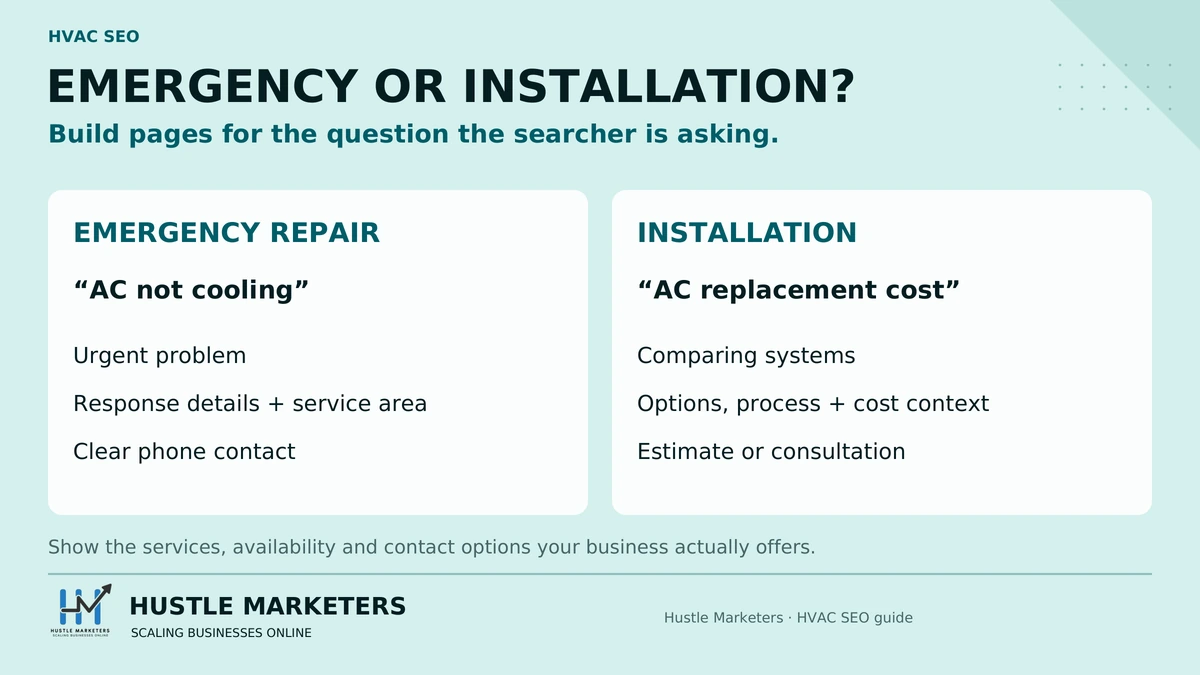
Emergency searchers type things like “ac not cooling,” “emergency ac repair near me,” “furnace blowing cold air,” or “24 hour hvac repair.” They are hot, sweaty, or freezing. They will call the first credible company they see. They do not compare five quotes. Speed and trust win.
Installation and replacement searchers type “new ac unit cost,” “hvac replacement financing,” “best heat pump for 2000 sq ft house,” or “ac installation [city].” This is a purchase between five and fifteen thousand dollars in most markets. These people research for days or weeks. They read, compare, and shortlist.
Here is how the two groups differ in practice:
| Factor | Emergency searches | Installation searches |
|---|---|---|
| Example keywords | “emergency ac repair near me,” “furnace not working” | “ac replacement cost,” “hvac installation [city]” |
| Buyer state | Urgent, uncomfortable, decides in minutes | Researching, compares quotes over weeks |
| Job value | Lower per ticket | High ticket, often 5k to 15k plus |
| Page that should rank | Emergency service page, GBP listing | Installation page, cost guides, financing page |
| Call to action | Phone number, “call now,” 24/7 badge | Free estimate form, financing calculator |
| Best channel mix | Map pack, LSAs, PPC | Organic pages, cost content, remarketing |
Build for both. Your emergency repair page should be ruthless: phone number at the top, response time, service area, licensing, nothing that slows a panicked person down. Your installation pages should educate: system options, honest cost ranges, financing, warranty details, and photos of real installs.
Most HVAC sites we audit have one generic “AC Services” page trying to do both jobs. It does neither.
The Seasonal Demand Calendar
HVAC demand is a sine wave. Search interest for cooling terms peaks in early and mid summer. Heating terms peak with the first real cold weather. Shoulder seasons are quiet for repairs but perfect for maintenance and replacement marketing.
The mistake is publishing content when demand peaks. Google takes weeks to months to rank new pages. If you publish your “AC tune up” page in June, you missed the season. Work one season ahead:
February to April, prep for cooling season:
- Refresh AC repair and AC installation pages
- Publish spring tune up and maintenance plan content
- Push indoor air quality content for allergy season
- Update GBP services and posts to lead with cooling
May to August, harvest cooling demand:
- Focus on reviews, GBP posts, and photo uploads
- Publish “AC not cooling” troubleshooting content that captures problem searches
- Capture replacement demand from homeowners whose systems died in the heat
August to October, prep for heating season:
- Refresh furnace repair, furnace installation, and heat pump pages
- Publish winterizing checklists and pre season furnace inspection content
- Rotate GBP categories, posts, and photos toward heating
November to January, harvest heating demand:
- Emergency furnace content and fast response messaging
- Carbon monoxide and safety content, which also earns local links
One more seasonal note. Heat pumps have blurred the old furnace and AC split, and rebate driven searches like “heat pump tax credit” spike whenever incentive programs change. A page on current rebates in your state is one of the easiest link and traffic wins in this industry.
Service Plus City Pages: The Core Page Architecture
The sites that win HVAC SEO in a metro are built on a simple grid: services down one axis, cities across the other.
Service pages first. Each core service gets its own page:
- AC repair
- AC installation and replacement
- Furnace repair
- Furnace installation
- Heat pump service and installation
- Ductless mini splits
- Duct cleaning and sealing
- Indoor air quality
- Maintenance plans
- Commercial HVAC, if you do it
Each page needs real substance: what the service includes, signs you need it, honest cost ranges, your process, brands you service, warranty, financing, FAQs, and reviews that mention that service. A title tag pattern that works: “AC Repair in [City] | [Company Name].”
City pages second. If you serve eight suburbs, the suburbs you have no address in will not show your GBP in their map packs. Organic city pages are how you compete there. The rule: every city page must be genuinely different. Include jobs you completed in that city, neighborhoods you know, city specific permit notes, reviews from customers there, and drive time from your shop. A page that swaps the city name over identical copy is a page Google filters out.
Do not build fifty thin city pages in a weekend. Build five great ones for your best revenue suburbs, then expand. We walk through the same architecture logic in our contractor marketing guide, and it applies to every trade, from HVAC to plumbing to home builders.
Google Business Profile for Multi Technician Fleets
Your GBP is the highest leverage asset in HVAC SEO. For a company running multiple trucks, a few things matter more than the generic advice:
Categories. Primary category should be “HVAC contractor” for most companies. Add secondary categories for “Air conditioning repair service,” “Furnace repair service,” “Heating contractor,” and “Air conditioning contractor” as they apply. Your primary category is the single strongest GBP ranking factor, so match it to your highest value work.
Service area setup. Fleets often work from a shop or warehouse customers never visit. If customers do not come to you, set your profile as a service area business and list your service cities. Do not create fake “offices” in every suburb. Google removes those, and losing a listing with 200 reviews hurts far more than the listing ever helped.
Services and pricing. Fill in the Services section for every category with descriptions and starting prices where you can. This feeds both the map pack and AI answers.
Photos from the field. Your technicians are in ten homes a day. Have them shoot before and after photos of installs, clean equipment, branded trucks on the job. Upload weekly. Fleets have a photo advantage over one man shops and almost never use it.
Booking and messaging. Connect online booking if your dispatch software supports it, and only enable messaging if someone actually answers.
We wrote a complete walkthrough in our guide to optimizing your Google Business Profile, so I will not repeat every field here. The HVAC specific point is this: your GBP should visibly change with the seasons. Cooling photos and posts in summer, heating in winter. Google rewards active profiles, and customers notice.
Reviews: The HVAC Ranking Fuel Nobody Systematizes
Reviews do three jobs in HVAC SEO. They rank you in the map pack. They convince the panicked homeowner comparing three listings. And they feed AI assistants deciding which company to recommend.
What matters:
- Velocity. A steady stream beats a burst. Ten reviews a month all year outperforms 120 collected in one push.
- Keywords inside reviews. “They replaced our heat pump in Allen and cleaned up perfectly” helps you rank for heat pump work in Allen. You cannot script customers, but technicians can ask, “Would you mind mentioning what we fixed and your city?”
- Responses. Reply to every review. In responses you control, naturally reference the service and area.
- The ask process. The best system we have seen: technician mentions the review at handoff, office sends a text with a direct review link within an hour of job completion. Same day asks convert several times better than next week emails.
For a local service business, review volume plus a tuned profile is often the whole difference between position 4 and the 3 pack. In our CMSC case study, we show how a Google Ads expansion into new service areas changed lead flow for a multi-location local business, and the same service-area thinking applies to local SEO. HVAC economics can be better still, because a single replacement job can cover a month or more of SEO.
Technical Basics That Actually Matter for HVAC Sites
You do not need an enterprise technical program. You need to not fail the basics:
- Mobile speed. Emergency searches happen on phones, often on cellular in a hot house. Compress images, avoid heavy sliders, and keep the phone number tappable at the top of every page.
- Click to call everywhere. Header, footer, and a sticky mobile button. Test that it actually dials.
- HTTPS and clean URLs. yoursite.com/ac-repair-plano/ beats yoursite.com/page?id=47.
- LocalBusiness schema. Mark up your name, address, phone, hours and service area with HVACBusiness schema. Do not mark up your own reviews: Google does not show review stars for reviews a business controls about itself.
- No orphan pages. Every service and city page should be reachable from your main navigation or a services hub.
- One H1 per page, real title tags. “Home | HVAC Co” as a title tag is throwing away your most important ranking element.
Run a crawl twice a year. Our SEO audit report template covers the exact checklist we use, and most HVAC owners can self diagnose 80 percent of issues with it.
AI Search: Winning “Best HVAC Company Near Me” Prompts
Homeowners increasingly ask ChatGPT, Gemini, or Google AI Mode things like “who is the best HVAC company near me” or “reliable AC repair in [city] with good financing.” These tools do not simply rank your site. They synthesize from what already exists, sometimes fetching pages live: your GBP, your reviews, local directories, news mentions, Reddit threads, and your site content.
What we see influencing AI recommendations for HVAC clients:
- A complete, consistent presence. Same name, address, and phone everywhere. Detailed GBP. Profiles on Yelp, Angi, BBB, and Nextdoor that match.
- Review volume and sentiment. AI tools lean heavily on aggregate ratings and what reviews actually say. “Always on time” repeated across 40 reviews becomes part of your AI description.
- Specific, factual site content. Pages that state plainly what you do, where, since when, licensing, and pricing ranges. AI quotes clear statements, not marketing fog.
- Schema markup. Structured data is how machines confirm facts about your business.
- Third party mentions. Local news, chamber pages, supplier directories, “best HVAC companies in [city]” listicles. If those lists exist in your market, get on them.
Practical move: write an honest FAQ answering the exact questions people ask AI assistants. “How much does AC repair cost in [city]?” “What HVAC companies offer financing in [city]?” Answer first, detail second. That format is what both featured snippets and AI answers pull from.
SEO vs PPC for HVAC: When to Use Which
We run both, so this is not a sales pitch for either. It is a sequencing question.
| Situation | Lean on | Why |
|---|---|---|
| New company, needs calls this month | PPC + LSAs | SEO cannot deliver in weeks. Ads can. |
| Established company, high ad spend, thin site | SEO buildout | Every organic call reduces dependence on a rising cost per lead. |
| Peak season demand spike | PPC boost on top of SEO base | Capture overflow demand your rankings cannot fully absorb. |
| Shoulder season | SEO content production | Build the pages that will rank by next peak. |
| Replacement and install growth goal | SEO cost content + PPC remarketing | Long research cycles favor content, ads keep you in front of researchers. |
| Emergency repair growth goal | LSA + map pack SEO | Emergency buyers pick from the top of the page, whoever owns it. |
The honest math: HVAC PPC clicks are expensive and get more expensive every year. SEO costs roughly the same every month but its output compounds. Year one, PPC usually wins on volume. By year two, a properly built organic presence typically delivers cheaper leads, and you redirect ad budget to the seasons and services where it earns most. Read the HVAC PPC guide as the other half of this playbook. They are designed to work together.
A Realistic 90 Day HVAC SEO Plan
Days 1 to 30: Foundation. Audit the site with our audit template. Fix title tags, speed, and schema. Rebuild GBP: categories, services, service area, photos. Launch the review ask system with your technicians.
Days 31 to 60: Core pages. Build or rewrite your top six service pages. Split emergency repair from installation. Build your first three city pages for your best suburbs. Get citations consistent on the top directories.
Days 61 to 90: Content and authority. Publish the seasonal content for the upcoming peak. Add cost and financing guides for installations. Pursue five local links: suppliers, chamber, sponsorships, local news. Review rankings and call tracking, then double down where movement started.
Rankings meaningfully move in three to six months for most metros. Competitive big city markets take longer. That lag is exactly why the PPC pairing exists.
Measure SEO to Booked Jobs, Not Form Fills
An HVAC lead is not a business result. Connect call tracking, forms and online booking to the CRM, then report booked jobs by service type, service area, first landing page and lead source. Add revenue or gross-profit data where the system allows it.
Use dynamic numbers without replacing the consistent business number shown to users and crawlers. Review missed calls, duplicate leads, warranty requests and job applications separately so they do not inflate SEO performance. The useful monthly view is not just organic sessions; it is qualified calls, booking rate, average job value and revenue by service-location cluster.
This closes the gap between local visibility and sales capacity. Learn how our SEO agency approaches the work, then compare the method with the evidence in our CMSC SEO and AI visibility case study.
FAQ
What is HVAC SEO?
HVAC SEO is optimizing a heating and cooling company’s website and Google Business Profile so it appears in the map pack, organic results, and AI answers when local homeowners search for HVAC services. It combines local SEO, service page content, reviews, and technical site health.
How long does HVAC SEO take to work?
Expect first movement in 60 to 90 days and meaningful lead flow in four to eight months, depending on your market and starting point. Established sites with review bases move faster than brand new domains.
How much does HVAC SEO cost?
Pricing varies widely. In Ahrefs’ survey of 439 SEO providers, $501 to $1,000 a month was the most common retainer, and Ahrefs put the agency average at $3,209 a month. Your quote will depend mostly on how many services and cities need their own pages. Compare that to what you spend per lead on ads. One replacement job usually covers a month of SEO.
Is SEO or PPC better for HVAC companies?
Neither alone. PPC delivers calls immediately and excels at emergencies and peak season. SEO compounds and lowers your blended cost per lead over time. Start ads for immediate volume and build SEO underneath. Our HVAC PPC guide covers the paid half.
What are the best keywords for HVAC SEO?
Combinations of service plus location: “ac repair [city],” “furnace installation [city],” “emergency hvac near me,” plus problem searches like “ac not cooling” and cost searches like “hvac replacement cost.” Emergency and installation keywords deserve separate pages.
Do I need a separate page for every city I serve?
For every city that matters to your revenue, yes, as long as each page has genuinely unique local content. Thin duplicated city pages get filtered and can drag the whole site down.
How do I show up in the Google map pack for HVAC searches?
Optimized primary category, complete GBP with services and photos, steady review velocity, consistent citations, and proximity to the searcher. For suburbs far from your address, organic city pages carry the load instead.
How do AI tools like ChatGPT pick which HVAC company to recommend?
They synthesize existing signals: your GBP data, review volume and sentiment, directory presence, structured data, and clear factual statements on your site. Complete and consistent information plus strong reviews is the practical formula.
Should HVAC companies blog?
Yes, but seasonally and strategically. Troubleshooting content (“furnace blowing cold air”), cost guides, and rebate explainers capture real buyers. Generic “5 summer cooling tips” posts do not.
Can I do HVAC SEO myself?
The foundations, yes: GBP, reviews, and basic page fixes are owner doable with a guide like this. Competitive metros usually justify professional help because the compounding value of doing it right is large. Our SEO team handles this daily if you want it off your plate.
Why did my HVAC leads drop even though my rankings held?
Usually seasonality, not SEO. Compare against the same month last year, not last month. If year over year is down too, check GBP suspensions, review stagnation, or a competitor overtaking the map pack.
How Hustle Marketers helps HVAC companies with SEO
HVAC has the harshest seasonality of any trade we work in. Demand arrives in two spikes driven by weather rather than by intent, and an account tuned for a July emergency is the wrong account in October. Most of the wasted spend we find in HVAC comes from budgets that never change shape across the year.
We run HVAC paid media white label through an agency partner, and the pattern that shows up again and again is the same one in this guide: emergency terms and maintenance terms need separating, because they convert differently and are worth different money. On the wider trades side, our JBL Construct remodeling case study covers the technical SEO and indexing work that home service sites usually need first.
Ishant Sharma has worked as a Google Ads, Microsoft Ads and SEO specialist since 2013. For HVAC the organic work sits under our SEO services, and the seasonal paid layer under PPC management. If you also handle roofing, the same storm driven demand logic applies and our roofing SEO guide covers it.
Get an HVAC SEO Plan Built for Your Market
We build and run HVAC SEO alongside paid campaigns, so nothing falls in the gap between the two. If you want to know exactly where your site stands and what it would take to own your metro, our SEO agency team will map it out for you. Start with an audit, see the gaps, then decide.
Sources and Verification
Facts that can change were checked on August 10, 2026 against these primary sources:
- Google Search Central: structured data guidelines
- Google Search Central: LocalBusiness structured data
- Google Search Central: ranking systems guide
Related guides
If this one was useful, these cover the same ground for closely related businesses.
- Roofing SEO
- Plumbing marketing
- Electrician SEO