Plumber Marketing Ideas That Actually Fill the Schedule

Ishant
Published : October 16, 2026 at 10:45 am
Updated : October 7, 2026 at 6:25 am
Ishant
Written by Ishant Sharma, Founder, Hustle Marketers | Published October 16, 2026
Almost every plumbing marketing guide online is written by a software company steering you toward their product, and none of them talk about the thing that actually keeps a plumbing owner up at night: the schedule. Not leads in the abstract. Next week’s board. The Tuesday with two jobs on it. At Hustle Marketers we run campaigns for trades businesses, and we plan plumbing marketing around the calendar: capture emergency demand when it strikes, create scheduled work for the weeks ahead, and fill the slow patches on purpose instead of waiting them out. This guide is that system, with real ad copy, scripts, and cost benchmarks, and no software to sell you.
Quick answer: Effective plumber marketing runs three systems at once: capture emergency demand now, create scheduled demand for profitable services and use the customer base to fill future capacity. Judge every channel by contribution margin per booked and completed job, not calls, clicks or lead volume alone.
Key Observations
- Plumbing has two funnels: emergency-now (won by whoever shows up first in search and answers the phone) and scheduled work (won by SEO, email, and reminders). Run both.
- Google Local Services Ads are a strong emergency channel for eligible plumbers. Reviews, responsiveness, verification and relevance all influence visibility, not budget alone.
- Your past-customer list is an owned, warm channel. Measure it by booked revenue and repeat-job rate instead of borrowing a generic email ROI average.
- Slow weeks are predictable, so plan them: a seasonality calendar, weather-triggered campaigns, and maintenance memberships smooth the year.
- Membership plans look small per month but the lifetime value math beats one-off calls comfortably.
- Skip shared-lead apps as a core strategy. Racing four plumbers to a $20 lead is a price war, not marketing.
- Reviews compound trust, can support local and LSA visibility, and influence the call decision. Build a neutral review ask into every job close-out.
The commercial opportunity is simple: urgent demand is expensive and time-sensitive, while planned work is easier to shape. A plumbing company that separates those two jobs can protect emergency coverage without leaving next month’s schedule to chance.
Table of Contents
- The Two Plumbing Funnels: Emergency Now vs Scheduled Work
- Capture Emergency Demand (the “Plumber Near Me at 2am” Funnel)
- Create Scheduled Demand (Water Heaters, Repipes, Remodels)
- Fill the Slow Weeks (the Section Nobody Writes)
- Reviews: Build a Review Machine
- What Channels Cost: Plumbing CPL Benchmarks
- Budget by Business Stage
- Branding That Sticks: Trucks, Uniforms, Local Presence
- AI Search: When Homeowners Ask ChatGPT for a Plumber
- What to Skip (an Honest Take)
- Your 90-Day Plumbing Marketing Plan
- FAQs
The Two Plumbing Funnels: Emergency Now vs Scheduled Work
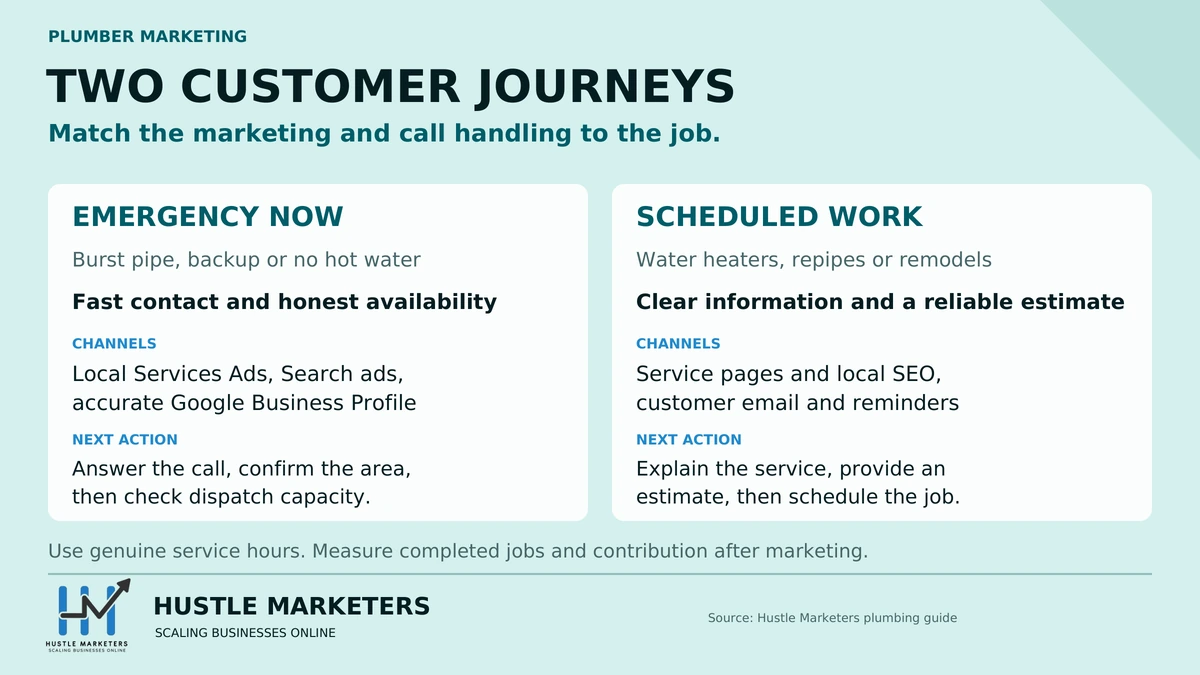
Every plumbing job arrives through one of two doors.
Door one: emergency. Burst pipe, sewage backup, no hot water with guests arriving. The homeowner searches “plumber near me” at 2am, calls the first two or three results, and hires whoever answers and can come soonest. No brand loyalty, no research phase, decided in minutes. This funnel is won with visibility at the exact moment of search plus a phone that gets answered.
Door two: scheduled. Water heater nearing end of life, a repipe, a bathroom remodel rough-in, annual maintenance. Weeks of research, multiple quotes, decided on trust. This funnel is won with SEO, reviews, email, and reputation.
Most plumbing companies market only door one, then wonder why revenue swings with the weather. The businesses with full boards run both funnels deliberately, because scheduled work is what smooths the calendar. Let’s build each.
Capture Emergency Demand (the “Plumber Near Me at 2am” Funnel)
Google Local Services Ads for plumbers
LSAs are the pay-per-lead listings that can appear above conventional search ads for eligible local services. Google has replaced the old Google Guaranteed and Google Screened labels with one Google Verified badge. The badge signals completed verification checks and no longer carries the former money-back guarantee. See Google’s current badge guidance.
The operational details most guides skip:
- Setup. Link the correct Google Business Profile and complete the license, insurance, identity and background checks required for your category and market. Start before you need the volume because verification time varies.
- What influences visibility. Relevance, proximity, profile quality, reviews and responsiveness all matter. Do not turn a planning example into a promise that a particular review count or answer rate guarantees first position.
- Lead quality control. Keep job types, service areas, hours and profile details accurate, then review the current credit process inside your account. Google has changed how invalid leads are handled, so old advice to dispute every wrong-area lead manually is no longer reliable.
- 24/7 positioning. If a human genuinely answers around the clock, keep your hours accurate and staff the phone. Never advertise 24/7 coverage that the operation cannot deliver.
August 2026: LSAs are moving into Google Ads
Google has begun migrating selected U.S. home-service advertisers, including plumbing, into specialized Performance Max campaigns with pay-per-lead goals. Despite the name, this is not standard Performance Max: ads stay keywordless, continue to charge for valid leads and remain limited to Search and Maps. Google is moving accounts in phases through 2027. Use Google’s official Local Services migration page as the source of truth.
The practical plumbing checklist is short:
- Export historical LSA reports before migration. Customer lead history transfers, but the old performance reports do not.
- Rebuild the baseline. Weekly budgets become daily averages, and Google advises allowing up to two weeks for performance to settle.
- Separate unlike economics only when volume supports it. After migration, one campaign-level target CPA can span categories. If plumbing, drains and HVAC have very different close rates or job values, separate campaigns may restore control, but each new campaign gets less data.
- Verify routing and hours. Core identity details sync from Google Business Profile, while phone routing, service areas and ad schedules need a post-migration check in Google Ads.
- Preserve capacity controls. Pause or narrow the campaign when the dispatch board cannot fulfill more leads. Paying for demand you cannot answer is not growth.
Full setup walkthrough in our Local Services Ads guide.
Google Ads on emergency keywords
Search ads catch the emergency demand LSAs cap out on. Bid on “emergency plumber [city]”, “24 hour plumber near me”, “burst pipe repair [city]”, with tight match types and negatives for DIY searches like “how to fix”. The ad itself should be written for a stressed person on a wet floor. Real examples of the style we run:
Emergency Plumber [City] | On-Site in 60-90 Min Burst pipe? Blocked drain? Live person answers 24/7. Upfront pricing before we start. Licensed and insured. Call now.
24/7 Plumber [City] | No After-Hours Call-Out Fee Mon-Fri We answer at 2am, because pipes don’t wait for morning. 4.9 stars from local homeowners. Tap to call.
Note what these do: a time promise, a live-answer promise, a price-certainty promise, and proof. No cleverness. Emergencies do not reward clever. Every claim must be true, so only promise 24/7 if a human actually picks up. The build details are in our Google Ads for lead generation guide, and the same emergency-keyword discipline we describe in our HVAC PPC guide applies to plumbing almost unchanged.
Paid search done properly moves the needle hard in local services: we restructured the account and tracking for a local signage business, documented in this case study, and we run commercial services accounts like this Brisbane commercial cleaning campaign on the same principles.
GBP optimization for “open now” searches
At 2am, a search for “plumbers near me” returns a local 3-pack (the three map results above the organic listings) filtered by who is open. If your Google Business Profile says you close at 5pm, you do not exist for the most profitable searches in plumbing. Set genuine 24/7 hours if you offer them, choose “Plumber” as your primary category, add “Emergency plumber service” to your services list, and keep photos and posts current. A weekly GBP post costs ten minutes; a real example of the format:
Burst pipe season is here. Overnight freezes are back in [city]. If a pipe lets go, shut off your water at the meter and call us any hour, we answer 24/7. Book a winter pipe check this week and we’ll inspect your insulation and pressure while we’re there.
Our complete walkthrough: how to optimize your Google Business Profile.
Create Scheduled Demand (Water Heaters, Repipes, Remodels)
SEO service pages that pay off
Scheduled jobs start as researched searches, and researched searches land on service pages. Most plumbing sites have one generic “services” page; the ones that win have a page per job type. The list we build first, in rough order of payoff:
- Water heater repair and replacement [city] (and a tankless version)
- Repiping / whole-house repipe [city]
- Sewer line repair and replacement [city]
- Drain cleaning and hydro jetting [city]
- Bathroom plumbing / remodel rough-in [city]
- Gas line installation [city]
- Water filtration and softener installation [city]
Each page needs real content: what the job involves, honest price ranges, how long it takes, photos of your crew doing it, and reviews mentioning that service. SEO compounds slowly, typically several months to meaningful movement, and we explain the timeline honestly in how long local SEO takes.
If you serve builders or do new-construction rough-ins, pair this with the architecture thinking in our home builder SEO guide. Two additions worth making once the core pages exist: city pages for each suburb you serve beyond your base, and retargeting ads that follow water heater and repipe researchers while they compare quotes, because scheduled jobs are decided over weeks, not minutes.
Do not make those suburb pages by replacing only the city name. Give each priority area a proof block: a real job in that area, property type, diagnosis, solution, duration, price band, original images and any local permit or inspection detail. One evidence-rich page is more defensible than ten near-duplicates, and the same proof can support the service page, project gallery and an honest Google Business Profile update.
Blog topics from real phone questions
Your CSRs already know your content calendar. Every question homeowners ask on the phone twice is a post: “why does my toilet keep running”, “why is my water heater making noise”, “how long does a water heater last”, “what causes low water pressure”. These posts capture homeowners early in a problem, and many of those problems end in a booked job. They are also exactly the content AI assistants quote, which matters more every quarter.
Email to past customers
Some of the cheapest repeat revenue in plumbing sits in your job history because those customers already know the business. Do not assume a universal dollar return from somebody else’s email program; track delivered messages, replies, booked jobs and revenue in your own list. Do not blast one generic newsletter. Simple segmentation is all it takes:
- Water heater installs 8+ years ago: replacement offer before it fails, not after.
- Past emergency customers: maintenance plan pitch (“never pay an after-hours rate again”).
- Everyone, seasonally: the pre-winter pipe check, the spring sump pump test.
One useful email a month, per segment. That is the whole program.
One more scheduled-work source most plumbers ignore: property manager partnerships. A single property manager with a few hundred units can feed you steady repair work all year, and they choose plumbers on reliability and clean invoicing, not price. One introduction email a month to local property management firms is a cheap habit with a fat payoff.
Fill the Slow Weeks (the Section Nobody Writes)
Emergency demand is spiky and seasonal. Slow weeks are predictable months in advance, which means they are a planning problem, not bad luck.
The seasonality calendar
Plan each quarter’s push before it arrives:
| Quarter | What to promote | Why it works then |
|---|---|---|
| Q1 (Jan-Mar) | Frozen/burst pipe response, water heater replacements, whole-house inspections | Cold snaps break pipes and old heaters; homeowners are home and attentive |
| Q2 (Apr-Jun) | Sump pumps, sewer camera inspections, outdoor spigots, bathroom remodel rough-ins | Spring rain, home-sale season inspections, renovation planning |
| Q3 (Jul-Sep) | Repipes, water filtration, slab leak checks, “beat the rush” heater swaps | Big disruptive jobs suit summer; demand lull needs created work |
| Q4 (Oct-Dec) | Winterization packages, pipe insulation, pre-holiday drain cleaning, maintenance plan sales | Freeze prep sells itself; hosting season makes drains urgent |
Notice Q3: the slowest quarter gets your biggest-ticket created demand. That is deliberate. When nobody’s pipes are bursting, sell the jobs people can schedule anytime, and give them a reason to do it now.
Weather-triggered campaigns
Weather is a marketing calendar that writes itself. Two templates we keep loaded for clients:
Freeze warning (launch 24-48 hours before): switch on a saved Google Ads campaign for “frozen pipes [city]” and “burst pipe repair”, post the burst-pipe GBP post above, and email the list: “A hard freeze is forecast for Thursday night. Here are the three things to do tonight, and our number if a pipe goes anyway.” You show up helpful before the disaster and first during it.
Heavy rain event: the same play for “sump pump repair”, “flooded basement”, and “sewer backup” terms, plus a spring email reminding past customers to test their sump pump before the storm, not during.
Set these up once, then launching one takes fifteen minutes.
Next-week capacity promos without cheapening the brand
When next week looks thin, resist the public discount, because a plumber permanently on sale trains the market to wait. Instead:
- Email the segment, not the world. “We have three water heater installation slots open next week. Booked customers get a free expansion tank upgrade.” Value-add beats price cut, and scarcity is honest because it is real.
- Call your maintenance-due list. “You’re due for your annual check, we happen to have Tuesday morning open.”
- Offer priority scheduling as the perk. Members and past customers get first claim on open slots. It fills the board and reinforces the membership pitch.
Maintenance plans and memberships: the LTV math
Membership plans are the single best schedule-smoothing tool in plumbing, and most owners underprice their value. Run the worked math:
A typical one-off customer might call you once every three years for a repair worth a few hundred dollars. Now take a $19 per month plan, about $228 a year, including an annual inspection, priority scheduling, and waived call-out fees:
- Plan revenue: $228 per year of predictable recurring revenue, with inspections you schedule into the slow months.
- Found work: annual inspections legitimately surface failing heaters, corroding valves, and slow leaks. If even one member in three needs a real repair or replacement each year, average member revenue climbs well past $500 annually.
- Retention: members call you, not Google, when something breaks, so your future emergency work stops going to auction.
- Lifetime value: a member kept five years is comfortably worth several thousand dollars against near-zero marketing cost, versus a one-off customer you may never see again and had to buy through ads.
The plan is not a product, it is a moat. Price it to be an easy yes, schedule inspections into your slow weeks, and pitch it at the end of every emergency job while the relief is fresh.
Reviews: Build a Review Machine
Reviews influence trust and can support local and LSA visibility, but they are not the only ranking input. The process is simple: ask every real customer neutrally, soon after the job, by text, with a direct link.
Post-job SMS (send within 2 hours):
Hi [Name], thanks for choosing [Company] today. If you have a minute, please share an honest Google review of your experience: [review link]. Your feedback helps our local team improve. Thank you either way!
Post-job email (next morning):
Subject: How did we do yesterday? Hi [Name], thanks again for having us out for your [service]. Please share an honest Google review of your experience here: [review link]. You can also reply directly if you need help with anything from the visit. From [Owner] at [Company]
Put the neutral review ask in your close-out checklist so it is offered consistently to real customers. Do not review-gate, ask only customers you think are happy, script what they should say, or attach a reward to a Google review. The FTC’s review rule guidance also explains why incentives cannot be conditioned on positive sentiment. A separate referral program can reward a completed referral, but it must not be tied to leaving or changing a review.
What Channels Cost: Plumbing CPL Benchmarks
These planning ranges blend published 2025-2026 home-services benchmarks with the spread we see in managed trades accounts. They are orientation, not a forecast. Plumbing lead costs can move sharply by metro, job type, season, eligibility and booking process. Compare them with a current channel-by-channel plumbing benchmark, then replace every range with your own cost per qualified lead and cost per booked job as data accumulates:
| Channel | Directional cost per lead | Intent | Time to results | Role in the plan |
|---|---|---|---|---|
| Local Services Ads | $25 to $85 | Very high (emergency) | 2-6 weeks | Anchor emergency channel |
| Google Ads (emergency keywords) | $60 to $250 | Very high | 2-8 weeks | Volume above the LSA cap |
| Google Ads (scheduled keywords) | $40 to $150 | High | 2-8 weeks | Water heaters, repipes |
| Local SEO / GBP | Effectively $10 to $50 over time | High | 3-9 months | Best long-run economics |
| Email to past customers | Under $10 | Warm | Immediate | Cheapest revenue you own |
| Shared-lead apps (Angi, Thumbtack) | $15 to $100, shared | Low-medium | Immediate | Gap-filler only, if at all |
| Facebook ads | $20 to $90 (our estimate; no published plumbing benchmark) | Low | 2-6 weeks | Memberships, remodels, brand |
| Direct mail (EDDM) | $30 to $150 per response (our estimate; no published plumbing benchmark) | Medium | 4-8 weeks | Dense suburbs, new territory |
Whatever you spend, measure ROI at the level of booked jobs and revenue, not clicks, because a cheap lead that never books returns nothing. If you already run ads and suspect waste, our Google Ads audit checklist is the fastest way to find it.
Worked example: bid from dispatchable contribution, not ticket size
Two plumbing leads with the same cost can have very different economics. Use this planning formula:
Expected contribution per lead = average completed-job revenue x contribution margin x qualified rate x book rate x dispatch-completion rate
Assume emergency drain leads average $425 in completed revenue, carry a 55 percent contribution margin, qualify 85 percent of the time, book at 65 percent and are successfully dispatched and completed 90 percent of the time:
$425 x 0.55 x 0.85 x 0.65 x 0.90 = about $116 expected contribution per lead
If the business is willing to spend 35 percent of expected contribution to acquire the work, the planning CPL ceiling is about $41. Now calculate the same number for water heater replacement, repipes and maintenance leads. A higher-ticket lead can support a higher CPL, but only if qualification, booking, financing, cancellation and completion rates hold. This is why one account-wide target CPL can quietly starve high-value work or overpay for low-value calls.
The more useful dashboard has five columns: source, service line, qualified leads, completed jobs and contribution after marketing. Revenue alone can flatter a channel with heavy material cost; raw CPL can flatter a channel full of jobs the dispatch board cannot fulfill.
Budget by Business Stage
Use 5 to 10 percent of revenue only as an initial planning band, not an industry law. The right number depends on gross margin, capacity, repeat revenue, close rate and the growth target. A shop with unused trucks can rationally invest more than a shop already booked three weeks out.
- Startup (year 1-2, building a base): spend nearer 10 percent, weighted to LSAs, a converting website, GBP, and relentless review collection. You are buying proof and visibility.
- Established ($1M-3M, smoothing the calendar): 6-8 percent across LSAs at capacity, PPC on both funnels, SEO service pages, email, and the membership launch. This is where the seasonality calendar earns its keep.
- Market leader ($3M+): 5-7 percent, adding brand layers (fleet, sponsorships, radio if the math works), recruitment marketing because trucks without techs earn nothing, and deeper SEO content.
Branding That Sticks: Trucks, Uniforms, Local Presence
Digital fills this year’s schedule; brand fills next year’s. Truck wraps are the classic example: a clean wrapped truck is a moving billboard parked in a different driveway every day, and neighbors notice which plumber their street uses. Uniforms and shoe covers get mentioned in reviews constantly, which feeds the machine above. Local sponsorships, the little league team, the school fair, work not because of the banner but because they generate the “we’ve seen these guys around” familiarity that makes a homeowner pick you from three LSA results. None of this is trackable to a lead, and all of it lowers the cost of every trackable channel.
AI Search: When Homeowners Ask ChatGPT for a Plumber
Homeowners increasingly ask search and AI products questions such as “who is a good plumber near me” or “how much does a water heater replacement cost?” These systems can draw from many web sources, and no profile or directory guarantees a citation. The practical response is to make the business easy to verify across the surfaces you control:
- Keep your Google Business Profile complete and consistent because it is a high-value local entity source and a conversion surface.
- Publish service pages with plain stated facts: services, suburbs, price ranges, hours. Quotable pages get quoted.
- Accumulate detailed reviews that mention your city and the service, which give AI models the language to recommend you.
- Answer the common questions (the phone-question blog posts above) because those are the pages AI cites for “why is my water heater leaking”.
Nothing here is separate from good SEO. It is the same work with a second payoff.
The advanced layer is to separate query types. A transactional query such as “emergency plumber open now” still needs accurate hours, service areas, reviews and a fast call path. A hybrid query such as “water heater replacement cost in Phoenix” needs a locally useful price range, the variables that change it, permit context and a direct route to an estimate. An informational query such as “why does my water heater leak from the top” needs a safe diagnosis framework and a clear point at which the homeowner should stop troubleshooting and call a licensed plumber.
Search Engine Journal’s recent local-search coverage makes the same strategic distinction: map-pack visibility and AI-answer visibility are no longer identical measurement problems, while consistent listings, reviews and business facts remain the foundation. Read SEJ’s local signals analysis and its query-type analysis. These are industry observations, not guarantees that a particular page will be cited.
What to Skip (an Honest Take)
The advice no software vendor will publish: shared-lead apps are a bad core strategy for an established plumber. The same homeowner inquiry is sold to three or four plumbers, so you are racing to the phone to win a price-shopped job at compressed margin, and the reviews and repeat relationship often accrue to the platform, not to you. As a gap-filler in month one of a new business, fine.
As a growth plan, it is renting a treadmill. The same money in LSAs and your own review profile builds an asset that gets cheaper every year instead of resetting to zero each month. Our broader thinking on channel choice for trades is in our contractor marketing guide, which pairs with this post.
Also skippable: paid directory listings you never check, mass-media campaigns with no call or revenue measurement, and any agency guaranteeing “page one in 30 days”.
Your 90-Day Plumbing Marketing Plan
Days 1-30: foundations. Apply for Local Services Ads. Complete your GBP fully, with 24/7 hours if true. Set up call tracking. Load the neutral review SMS and email into your close-out process and offer it consistently to recent real customers. Export your customer list and tag water heater installs by year. If Google has issued an LSA migration notice, export historical performance reports before the transition date.
Days 31-60: switch on demand. Launch LSAs, review lead quality weekly, and correct service-area or job-type settings that attract bad leads. Launch Google Ads on emergency keywords with the ad copy patterns above. Publish your first two service pages (water heater replacement first). Send your first segmented email. Build the freeze-warning campaign and park it, ready.
Days 61-90: smooth the calendar. Draft your seasonality calendar for the next two quarters. Design and soft-launch the maintenance membership to past emergency customers. Publish two phone-question blog posts. Pull your first cost-per-booked-job report by channel and move budget to the winner. Book a recurring monthly hour to run this system.
How Hustle Marketers helps plumbers with marketing
Plumbing is the clearest emergency niche in home services. Somebody with water on the floor is not comparing three quotes, they are calling whoever answers, and that compresses the entire funnel into about ninety seconds. Everything in the account should be built around being the call that gets answered.
That means the paid structure matters more than the creative. For a Pennsylvania local signage business we restructured the account around service area and job value, which is the same fix most plumbing accounts need. On the organic side, our JBL Construct case study covers the technical and indexing work that home service sites usually need before content is worth writing.
Ishant Sharma has worked as a Google Ads, Microsoft Ads and SEO specialist since 2013 across plumbing adjacent trades in the US and Australia. The organic side sits under our SEO services and the paid side under PPC management. We measure booked jobs rather than form fills, because in this trade a lead that rings at 2am and goes unanswered is worth nothing.
FAQs
What is the fastest way to get plumbing leads?
Google Local Services Ads plus Google Ads on emergency keywords, with a phone that gets answered. LSAs can produce leads within days of approval, and pay-per-lead pricing limits your risk. Just apply early, because badge approval takes weeks.
How much should a plumbing company spend on marketing?
Use roughly 5 to 10 percent of revenue as a planning band, then adjust for gross margin, unused capacity, close rate, repeat revenue and the growth target. A $1M shop should not automatically spend $100,000 if it cannot staff the work. Judge every channel by cost per booked job and contribution margin, not cost per lead alone.
Do Google Local Services Ads work for plumbers?
They are often worth testing because plumbing demand can be urgent and the format charges for valid leads rather than clicks. Eligibility, volume and lead quality vary by market. During the phased 2026-2027 move into Google Ads, export old reports, recheck daily budgets and routing, keep Google Verified status and profile facts accurate, and judge the channel by cost per completed job.
How do I get more Google reviews as a plumber?
Text every real customer a direct review link soon after the job and ask neutrally for honest feedback. Make the same request consistently, do not offer an incentive, and do not tell customers what rating or wording to use. Review quality, volume and recency can support trust and LSA visibility.
How do I market emergency 24/7 plumbing services?
Be visible at the moment of crisis: LSAs, ads on “emergency plumber [city]” keywords, and a GBP showing 24/7 hours so you appear in “open now” results. Then answer the phone with a human. Every promise in your ads must be true or the reviews will say so.
What should plumbers blog about?
The questions homeowners already ask your CSRs: running toilets, noisy water heaters, low pressure, smelly drains. Each post captures a problem that often ends in a booked job, and these are the pages both Google and AI assistants surface for local how-to searches.
Does email marketing work for plumbers?
It can be one of the lowest-cost channels because the list already knows you, but there is no universal return. Segment by installed equipment age and season, and send one genuinely useful email a month rather than constant promotions.
How do I compete with big plumbing franchises?
Out-local them. Franchises win on ad budget; independents win on review depth, answer rate, owner-name accountability, and neighborhood presence. A 4.9-star profile with 300 detailed local reviews beats a national brand in the map pack, and memberships lock in the customers they would otherwise re-buy every year.
Are maintenance plans worth it for plumbing companies?
Yes, they are the best calendar-smoothing tool in the trade. The monthly fee is only part of the value: inspections surface legitimate repair work, members skip Google when emergencies hit, and inspections fill your slow weeks. A member kept five years is worth several thousand dollars at near-zero marketing cost.
How do I fill my schedule during slow season?
Plan for it before it arrives: promote big schedulable jobs like repipes and filtration in slow quarters, call your maintenance-due list, email value-add offers to segments instead of discounting publicly, and keep weather-triggered campaigns ready to launch. Slow season is predictable, so treat it as a campaign, not a surprise.
Should plumbers buy leads from Angi or Thumbtack?
As a short-term gap-filler, maybe. As a strategy, no. Leads are shared with competitors, so you win on speed and price while the platform keeps the customer relationship. Established shops almost always do better moving that spend to LSAs, PPC, and their own review profile.
How much does it cost to hire a marketing agency for a plumbing company?
Pricing varies by channel count, market, tracking, creative and reporting scope, and media spend is usually separate. Compare the deliverables and access you receive, then insist on reporting that shows qualified leads, booked jobs and revenue by channel rather than only clicks.
Is SEO or Google Ads better for plumbers?
Run both, in sequence: LSAs and Google Ads win the emergency funnel within weeks, while SEO wins the scheduled-work funnel over months and keeps getting cheaper. Ads stop the moment you stop paying; rankings and reviews are assets you keep. The plumbers with full boards use paid for speed and SEO for economics.
What is the fastest way for a new plumbing company to get customers?
Apply for Local Services Ads on day one, complete your Google Business Profile the same week, and text every early customer a review link. While the LSA badge is pending, Google Ads on emergency keywords can produce calls within days. Answering every call live will beat competitors with twice your budget.
How do plumbers show up when someone asks ChatGPT for a plumber?
No page can guarantee a recommendation. Improve the evidence available by keeping facts consistent across the Google Business Profile, service pages, relevant directories and genuine reviews. Publish plain-language pages stating services, suburbs, hours and useful price context, then let customers describe their own experience in reviews without scripting their wording.
Do truck wraps actually bring in plumbing jobs?
Yes, but indirectly and slowly, which is why they frustrate anyone expecting tracked leads. A wrapped truck builds the neighborhood familiarity that makes homeowners pick you from three similar LSA listings, and it lowers the effective cost of every other channel. Treat wraps as brand infrastructure, not a lead source you measure weekly.
What is a good cost per lead for a plumber?
A useful planning range is roughly $25 to $85 from LSAs and $60 to $250 from Google Ads, but job type and metro can move those numbers materially. Email to past customers costs under $10 per lead, which is why your customer list is the cheapest channel you own. Judge every number against cost per booked job, because a cheap shared lead that rarely books is expensive.
Want your schedule full?
We run plumbing and trades campaigns at Hustle Marketers: LSAs, Google Ads, local SEO, and the seasonal system in this guide. If you would rather turn wrenches than manage campaigns, talk to our team and we will look at your market and your calendar first.
Related guides
If this one was useful, these cover the same ground for closely related businesses.