Wholesale Marketing in 2026: How Wholesalers and Distributors Win B2B Buyers Online

Ishant
Published : October 21, 2026 at 3:30 pm
Updated : October 16, 2026 at 12:13 pm
Ishant
Wholesale marketing is how a wholesaler, distributor or brand finds trade buyers (retailers, contractors, resellers and institutions), turns them into approved accounts and keeps them reordering. Online, that means Search ads for “wholesale”, “bulk” and “distributor” searches, plus Shopping ads where your pricing allows. Add Microsoft Ads with LinkedIn targeting, SEO for large catalogs, B2B marketplaces and email that drives reorders.
The big difference from retail marketing is the unit of value. A consumer brand wins an order. A wholesaler wins an account, and most of the profit comes from the second order onward. That changes what you bid on, what you count as a conversion and whether your prices can even appear in an ad.
This guide covers who wholesale buyers are, how they search and which channels to use. It also shows what Google Merchant Center allows for bulk and trade pricing, checked against Google’s help pages in September 2026. Then come trade account forms, metrics, budget math and a 90-day plan.
Key Observations
- Market to accounts, not orders. Count approved trade accounts and first orders as your main conversions, not form fills.
- Google Shopping only fits products that any user in the target country can buy at the price in your feed. Approval-only trade pricing belongs in Search, SEO, email and rep outreach.
- If you have a minimum order quantity, Google wants the price for that minimum quantity in your feed, not the single-unit price.
- “Wholesale” searches are noisy. Build negatives for real estate wholesaling, warehouse clubs, jobs and “how to start” queries before you spend.
- Microsoft Ads can target or adjust bids by company, industry and job function (including purchasing) using LinkedIn profile data, on Search and Shopping campaigns.
- Since April 2, 2026, Shopify’s native B2B features are available on Basic, Grow and Advanced plans, not only Plus.
- Repeat order rate, reorder cycle and account lifetime value decide what you can afford to pay for a new account.
What does wholesale digital marketing and advertising involve?
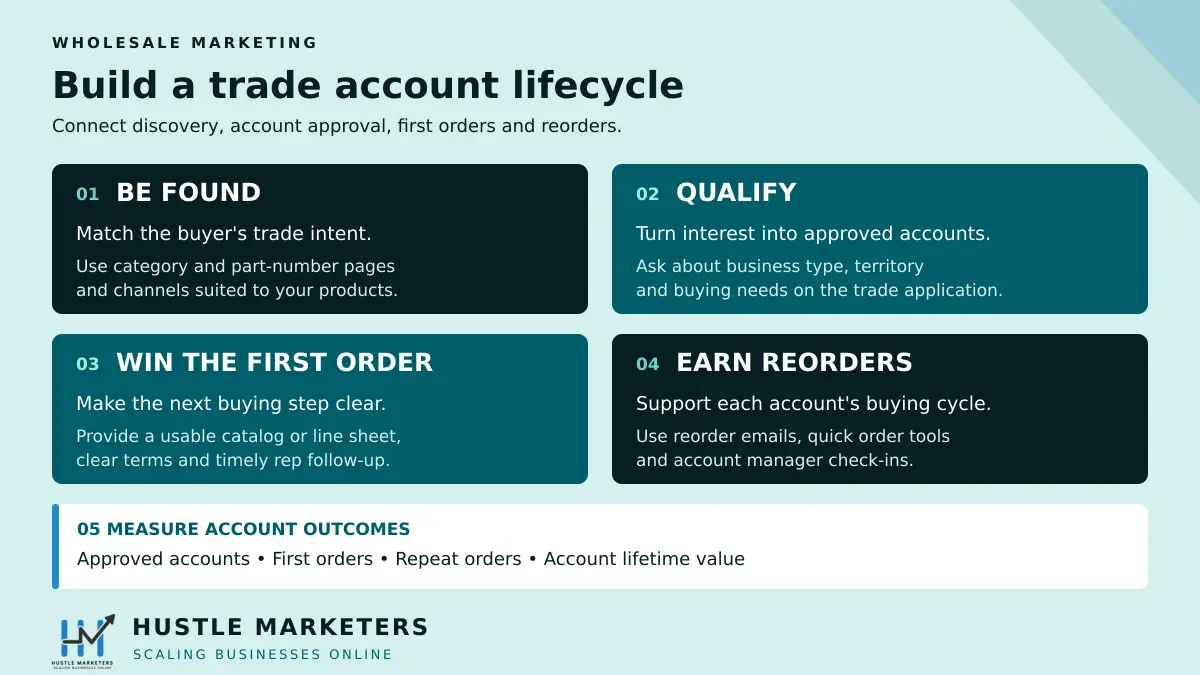
Wholesale digital marketing and advertising involves getting trade buyers to find you online, checking they are real businesses, converting them into accounts and prompting reorders. The tools are search ads, SEO, marketplaces, email and sales rep support. In practice it is five jobs:
- Be found. Google and Microsoft Search ads, Shopping ads for products with public prices, SEO on category and part-number pages, and marketplace listings.
- Qualify. A trade account application that captures business type, location, volume and resale documents.
- Convert. A first-order offer, a clear line sheet or catalog, and a rep or account manager who follows up within one business day.
- Retain and grow. Reorder emails timed to each account’s buying cycle, quick reorder tools, and ads aimed at lapsed and target accounts.
- Measure. Approved accounts, first orders, repeat orders and lifetime value, fed back into the ad platforms so they bid for accounts, not clicks.
At Hustle Marketers we treat these as one funnel, not five separate channels. The gap we find most often in wholesale ad accounts is job five. The ad platform is told a form fill is a win, so it finds more form fills, including students, consumers and competitors checking your prices.
Is “wholesale digital marketing” the same as white-label marketing?
No. Some agencies use “wholesale digital marketing” to mean marketing services sold to other agencies at a wholesale rate, which is white-label marketing. If that is what you are after, read our explainer on what white-label digital marketing is and how it works. The rest of this guide is for businesses that sell physical products to other businesses.
Who are wholesale buyers and how do they search?
Wholesale buyers are businesses buying to resell or to use in their own work: independent retailers, contractors and trade pros, online resellers, institutions and, if you manufacture, distributors. Each group searches and decides differently, so each needs its own message and landing page.
| Buyer type | What they care about | How they search | Where they look | What wins them |
|---|---|---|---|---|
| Independent retailers and boutiques | Margin, sell-through, low opening orders | “wholesale [product] for boutiques”, “[brand] wholesale” | Faire, trade shows, Instagram, Google | Line sheet, low minimum, easy reorders |
| Contractors and trade pros | Stock, delivery to site, pro pricing | “[product] supplier near me”, part numbers, “[brand] distributor [city]” | Google Search and Maps, supplier portals, reps | Live stock, branch pickup, net terms |
| Online resellers | Margin, minimums, product data | “bulk [product]”, “[product] wholesale supplier”, “wholesale [product] for resale” | Google, Alibaba.com, Faire, Amazon Business | Clean images and data, clear MAP policy |
| Institutions and procurement | Compliance, purchase orders, approved vendor status | “[product] in bulk”, “[product] case”, “[product] for restaurants” | Amazon Business, Google, current vendors | PO and invoice terms, certifications, quick reorder |
| Distributors (buying from manufacturers) | Margin, territory, marketing support | “[product] manufacturer”, “private label [product]”, “become a [brand] dealer” | Trade shows, LinkedIn, Google, associations | Dealer program, co-op funds, territory terms |
Which search terms show real wholesale buying intent?
Terms that pair a product with a trade word show the most intent: “[product] distributor”, “[product] supplier”, “wholesale [product]”, “bulk [product]”, “[product] case pack” and exact part numbers. Part-number and “distributor” searches usually convert best because consumers rarely use them.
The word “wholesale” on its own is noisy. Before we launch a wholesale Search campaign, we add negative keyword lists for these groups:
- Real estate wholesaling: real estate, houses, property, motivated sellers.
- Warehouse club shoppers: Costco, Sam’s Club, BJ’s, membership.
- Job seekers: jobs, salary, hiring, careers.
- Would-be founders: how to start, how to become a distributor, business ideas, license.
- Agencies: white label, reseller program, wholesale SEO.
- Wrong volume: single, sample, one piece, if your minimum rules those buyers out.
Which marketing channels work best for wholesalers?
For most wholesalers, Google Search, SEO on category and part-number pages, and reorder email do the heavy lifting. Shopping, Microsoft Ads, marketplaces and trade shows add reach where your pricing model and buyers fit. Use this table to pick your mix.
| Channel | Best for | Wholesale-specific setup | Main KPI |
|---|---|---|---|
| Google Search ads | “Distributor”, “supplier”, “wholesale” and part-number searches | Separate campaigns by intent tier; send clicks to category pages with a trade account prompt | Cost per approved account |
| Google Shopping and Performance Max | Catalogs with public, buyable prices | Feed price for the minimum order quantity; feed synced from ERP or PIM through the Merchant API | First orders per dollar spent |
| Microsoft Ads | Reaching purchasing roles in target industries | LinkedIn profile targeting by industry, company and job function | Cost per approved account |
| LinkedIn Ads | Account-based campaigns to named companies | Upload a target account list; promote a line sheet, catalog or case study | Target accounts engaged |
| SEO | Long-tail product, spec and part-number demand | Indexable category pages, spec sheets, part numbers in titles | Organic trade applications |
| B2B marketplaces | New retailer discovery and procurement buyers | Faire for boutiques, Amazon Business for procurement | Net margin after fees |
| Trade shows plus digital follow-up | Launching lines and meeting buyers | Leads into CRM with buyer type tags; follow-up sequence; Customer Match list | Show leads to first order |
| Email and reorder automation | Reorders and cross-sell | Triggers based on each account’s reorder cycle | Repeat order rate |
| Retargeting and Customer Match | Site visitors, lapsed and current accounts | Exclude active accounts from acquisition campaigns; win back lapsed ones | Reactivated accounts |
| Co-op marketing | Distributors carrying manufacturer brands | Use manufacturer co-op or market development funds to pay for ads | Co-op funds used |
| Sales rep enablement | High-value and complex accounts | Share lead source, pages viewed and account alerts with reps | Rep-assisted reorders |
Co-op is easy to miss. The National Association of Wholesaler-Distributors lists partner relationship management and co-op marketing among its top distributor marketing channels (June 2026). If your suppliers offer co-op funds, ask what ad formats and proof of performance they accept before you plan campaigns.
How should wholesalers run Google Ads?
Run Google Ads for wholesale in intent tiers. Bid hardest on distributor, supplier and part-number searches, test “wholesale” and “bulk” terms with tight negatives, and optimize toward approved accounts rather than form fills.
- Campaign 1, brand and part numbers: your brand, the brands you carry and exact part numbers.
- Campaign 2, trade intent: “[product] distributor”, “[product] supplier”, “[product] manufacturer”.
- Campaign 3, mixed intent: “wholesale [product]”, “bulk [product]”, with the negative lists above.
- Campaign 4, Shopping: only products that pass the Merchant Center pricing test below.
Put your minimum order and “business buyers only” in the ad copy. It filters consumers before they click. Send clicks to the matching category page with a visible trade account prompt, not to your homepage. For bidding, match types and account structure in more depth, read our B2B PPC strategy for Google Ads and Microsoft Ads.
Is Microsoft Ads worth it for distributors?
Often yes, because Microsoft Ads lets you target or adjust bids by company, industry and job function using LinkedIn profile data, which Google Search does not offer. Microsoft’s profile criterion documentation lists purchasing as an example job function. It also lists Search, Shopping and Dynamic Search Ads as supported campaign types.
We usually start with profile data as a bid adjustment, not a hard target, so volume does not collapse. Then we raise bids for purchasing roles in the industries you sell to. Our walkthrough of LinkedIn profile targeting in Microsoft Ads covers the setup step by step.
How does SEO work for a large wholesale catalog?
SEO for a wholesale catalog is mostly about making category, brand and part-number pages indexable and useful to a logged-out visitor, because that is what search engines see. Publish specs, pack sizes, minimums, part numbers and downloadable spec sheets in the open, even if the price sits behind a login.
- Write category pages for the terms trade buyers use, such as “wholesale [category]” and “[category] supplier”.
- Put manufacturer part numbers and pack sizes in product titles and headings.
- Control faceted navigation so filter combinations do not create thousands of thin URLs.
- Add branch or service-area pages if buyers search by city.
We keep this section short on purpose. Our guide to B2B ecommerce SEO covers keyword research for low-volume terms, content that ranks and how to do SEO when prices are hidden.
Should you sell on Faire, Amazon Business or Alibaba?
Sell on a marketplace when it reaches buyers you cannot reach cheaply yourself: Faire for independent retailers, Amazon Business for procurement buyers and Alibaba.com for global sourcing buyers. Compare the net margin after fees with your cost per approved account from ads.
| Marketplace | Main buyer | What we verified (September 2026) | Watch out for |
|---|---|---|---|
| Faire | Independent retailers and boutiques | If a retailer’s first order with you comes through your Faire Direct tools, you pay no commission on any of their orders; only payment processing fees apply (Faire Direct help article) | Orders outside Faire Direct can carry a commission; check Faire’s current brand pricing before you model margin |
| Amazon Business | Business and institutional buyers | Business-only offers and discounts, tax exemption handling and lower referral fees on larger purchases; needs a Professional selling account at $39.99 a month plus selling fees (Amazon Business seller page) | Price competition with other sellers of the same item |
| Alibaba.com | Global importers and sourcing buyers | Alibaba says it has 50M+ active buyers in 200+ countries and regions (Alibaba seller site) | Best suited to manufacturers and exporters; membership costs are not shown on that page |
Amazon says Amazon Business serves 8 million organizations globally, excluding emerging markets. We could not confirm the Tundra wholesale marketplace’s status for 2026. Its website failed a security certificate check when we tried it in September 2026. Check it yourself before planning around it.
How do you turn trade shows into online orders?
Treat the booth as the top of a digital funnel. Capture every lead into your CRM with a buyer type tag. Send the line sheet and a first-order offer within 48 hours. Then add contacts who agreed to hear from you to a Customer Match list. Google says Customer Match can reach those contacts across Search, the Shopping tab, Gmail, YouTube and Display.
What does account-based marketing look like for a distributor?
Account-based marketing for a distributor means agreeing a named list of target accounts with your reps, then reaching them with coordinated ads, email and calls. LinkedIn lets you upload company lists. Microsoft Ads allows up to 1,000 company name criteria per campaign or ad group, according to the same Microsoft documentation. Rep calls tend to land better when the buyer already recognizes your brand from ads and email.
How do sales reps fit into digital wholesale marketing?
Reps close and grow the accounts that marketing opens, so give them the lead source, the pages a buyer viewed and a reason to call. Agree credit rules early, so reps do not see web orders as a threat to their commission.
Can you run Google Shopping ads with wholesale or bulk pricing?
Yes, if any user in the target country can buy the product at the price in your feed. If a buyer needs an approved trade account to see or pay that price, the product does not fit Google Shopping as it stands. Here is what Google’s help pages said when we checked them in September 2026:
- Price must be open to all. Google’s price attribute rules say any user in the target country must be able to buy the product for the submitted price. You may require account sign-up, but it must be free and easy.
- Minimum quantities change the price. On the same page, Google’s example is pens sold in lots of at least 50: submit the price for 50 pens, not one.
- Member prices go elsewhere. Google says not to put member prices in the price or sale price attributes.
- The landing page must show the price. The landing page requirements ask you to clearly show a price that matches your product data, with a way to order. The page must show the same product regardless of device, location or cookies.
- Order quantity limits exist. Merchant Center recognizes minimum and maximum order quantity attributes, and the minimum must not exceed the maximum.
- Minimum order value lives in shipping settings. Set it at account level and Google shows it on the ad when a product’s price is below it.
We turned those rules into a decision table. Find the row that matches your pricing model. Categories matter too: our guide to Google product category mapping by platform shows how Shopify, Magento, WooCommerce and BigCommerce pass them to Google.
| Your pricing setup | Fit for Shopping ads? | What to submit or do |
|---|---|---|
| Public prices, anyone can buy | Yes | Normal price; add minimum order quantity if you have one |
| Public prices, sold in case packs or with a minimum | Yes | Price for the full pack or minimum quantity, matching the landing page |
| Public prices, free instant sign-up at checkout | Yes | Public price; keep sign-up free, instant and not a paid trial |
| Price hidden until a free sign-up | Risky | The landing page must clearly show the price, so a sign-in wall on the product page can fail review |
| Public list price, lower trade price after approval | Partly | Submit the public price; sell the trade price through Search, email and reps |
| All prices hidden until approval (resale certificate) | No | Search ads, SEO, Microsoft profile targeting and Customer Match |
| Quote only | No | Search ads and SEO pointing to a short quote form |
The rule we use at Hustle Marketers is simple. If a buyer cannot see and pay a price without waiting for approval, that product stays out of Shopping. It gets a Search campaign instead. If most of your catalog does qualify, our Google Shopping ads management team can build the feed and campaigns around your trade buyers.
Can you show bulk price tiers in Google Shopping?
Possibly, but treat it as a test. Google has a help page for a bulk price attribute. It allows up to six quantity price tiers per product, each with a minimum quantity of 2 or more. The single-unit price stays in the normal price attribute. The attribute is not listed in Google’s main product data specification, though.
Merchants ask about this often. In one Shopify Community thread from April 2025, a seller said their Shopping ads showed only the higher single-unit price. The reply pointed out that feed and site prices must match, so bulk prices need their own attribute. After you submit bulk tiers, check Merchant Center diagnostics. Google flags tiers whose minimum quantity is not above your minimum order quantity. For every other feed attribute, see our Google product data specification guide.
Can trade prices be submitted as member prices?
Not safely. Google’s loyalty program attribute supports four program types: free-to-join, spend-based, membership fee and loyalty credit card. An approval-only trade account is not one of them. Google’s member pricing setup page also says prices for tiers that are not open to everyone right away show only to known members through Customer Match. If you run a free, instant-join trade club, ask Merchant Center support before you build on it.
Should wholesale prices be public or behind a login?
Show prices publicly if your pricing is stable and channel conflict is manageable, and gate them if prices are negotiated per account. Most wholesalers end up with a hybrid: public list or MAP prices, and trade prices after login. Here is how each choice plays out across channels.
| Factor | Public prices | Gated prices | Hybrid (public list, private trade) |
|---|---|---|---|
| Google Shopping | Eligible | Not eligible for gated products | Eligible at the public price |
| Search ads | Works; price in ad copy filters buyers | Works; the ad sells the account, not the price | Works |
| SEO | Price and offer details can show in results | Pages still rank on specs and part numbers | Rankings plus price details |
| Conversion | Buyers qualify themselves faster | Adds a step; slow approval loses impatient buyers | Buyer sees a ballpark before applying |
| Channel conflict | Retail partners may object if trade prices undercut them | Protected | Publish MAP or MSRP, keep trade prices private |
| Competitor visibility | Competitors see your prices | Hidden | Only list prices visible |
If you go hybrid, get the public price right first. Our explainer on MAP pricing vs MSRP covers which one to show and how to enforce it with resellers.
How should a trade account application form work?
A trade account form should verify the business, route the lead and approve good applicants fast. It should also tell the ad platforms which applicants became paying accounts. Every extra field costs applications, so make each one earn its place.
| Field | Why you need it | Required? |
|---|---|---|
| Business legal name and website or storefront link | Confirms a real business | Yes |
| Business type (retailer, contractor, reseller, institution) | Routes to the right rep, offer and email track | Yes |
| Resale or tax exemption certificate | Supports tax-exempt resale orders; rules vary by state, so ask your tax advisor what to collect | Yes, for tax-exempt sales |
| Federal EIN | An extra identity check some wholesalers use | Optional |
| Shipping state or ZIP code | Territory and rep routing | Yes |
| Expected monthly volume (ranges) | Prioritizes follow-up | Optional |
| Contact name, role, work email, phone | Follow-up and Customer Match | Yes |
| How did you hear about us? | Cross-checks ad platform attribution | Optional |
The trade form checklist we use at Hustle Marketers:
- Split the form into two steps: contact and business type first, documents second.
- Say what happens next and how long approval takes.
- Auto-approve applicants who meet clear rules and review the rest by hand.
- Store the Google click ID and Microsoft click ID with each application in your CRM.
- Send approved accounts and first orders back as offline conversions, and make the approved account your primary conversion.
- Keep raw form submits as a secondary conversion, so you can still see volume.
One 2026 change matters here. From June 15, 2026, Google moved offline conversion imports and enhanced conversions for leads uploads to the Data Manager API. The Google Ads API now blocks them. If your CRM connector uploads approved accounts, confirm it still works. Our Google Ads conversion tracking guide covers the full setup.
What B2B ecommerce platform features help wholesale marketing?
The features that help marketing most are customer-specific catalogs and price lists, quantity rules, quick reorder tools and trade account applications. They let you send ad and email traffic to pages built for trade buyers. Here is what each major platform documents, as of September 2026.
| Platform | Marketing-relevant B2B features | Worth knowing |
|---|---|---|
| Shopify B2B | Companies and locations, quantity rules, quantity price breaks, net terms, vaulted cards, easy reorders, quick order list, PO numbers | On Basic, Grow and Advanced since April 2, 2026, with up to 3 active catalogs; Plus adds unlimited and company-specific catalogs, deposits and partial payments |
| BigCommerce B2B Edition | Company accounts, sales rep quoting, shared shopping lists, trade professional applications for guest and B2C users, invoice management, buyer portal | The built-in trade application suits blended B2B and B2C stores |
| Adobe Commerce B2B | Company accounts, shared catalogs with custom prices per company, quick order, requisition lists, negotiable quotes, purchase order approvals, pay on account | Suits large catalogs and complex account structures |
One practical point for ads: on a blended store, the page a logged-out visitor sees must show the same price as your feed. Test your product pages in a private browser window before you connect Merchant Center. If you sell on Adobe Commerce, our guide to Magento marketing extensions covers which feed and marketing extensions are still maintained in 2026.
What changed for wholesale marketers in 2026?
Four platform changes in 2026 affect wholesale marketing, mostly around feeds, conversion uploads and B2B store features. Each date below comes from the vendor’s own page.
| Date | Change | What to do |
|---|---|---|
| April 2, 2026 | Shopify added native B2B to Basic, Grow and Advanced plans | Check whether you still need a paid B2B app or a Plus upgrade |
| April 2026 | Google began combining enhanced conversions for web and leads into one setting, migrating existing users (Google Ads Help) | Review your conversion settings after the switch |
| June 15, 2026 | Offline conversion and enhanced conversions for leads uploads moved to the Data Manager API (same Google Ads Help page) | Confirm your CRM upload of approved accounts still works |
| August 18, 2026 | Content API for Shopping sunset, replaced by the Merchant API, with progressive errors from September 1, 2026 | Move custom ERP or PIM feed integrations to the Merchant API |
If your catalog feed comes from a custom ERP integration, run our Content API shutdown checklist to confirm nothing broke quietly.
How do you measure wholesale marketing?
Measure wholesale marketing at the account level: cost per approved account, first-order rate, repeat order rate, reorder cycle, average order value and account lifetime value. Report first orders and repeat orders separately, because they behave very differently.
| Metric | How to calculate it | What it tells you |
|---|---|---|
| Cost per approved account | Marketing spend divided by newly approved accounts | What each channel really costs |
| Application to first-order rate | Accounts with a first order divided by applications | Lead quality and onboarding strength |
| Repeat order rate | Accounts with 2+ orders in the period divided by accounts that ordered | Whether accounts stick |
| Reorder cycle | Median days between orders for each account | When to send reorder emails and rep calls |
| Average order value (first vs repeat) | Revenue divided by orders, split by order type | Whether first-order offers pay off later |
| Account lifetime value | Average order value x gross margin x orders per year x expected active years | The ceiling for acquisition cost |
| Payback period | Cost per first-ordering account divided by monthly gross profit per account | How long cash is tied up |
Our free customer acquisition cost calculator does the first and last rows for you once you have spend and account counts.
How much should a wholesaler spend on marketing?
Work backward from what a new account is worth. Decide how much first-year gross profit you will pay to win an account, then turn that into an allowable cost per application and per click. Here is a worked example. Every number is an assumption for illustration, not a benchmark, so swap in your own.
- Account value: an average order of $800 at a 30% gross margin earns $240 gross profit. At 6 orders in year one, that is $1,440 per account.
- Your acquisition limit: you decide to spend up to 40% of year-one gross profit, so $576 per new ordering account.
- Funnel rates: half of ad-driven applications get approved, and 60% of those place a first order. That is 30% of applications.
- Allowable cost per application: $576 x 0.30 = $172.80.
- Allowable cost per click: if 5% of clicks apply, $172.80 x 0.05 = $8.64.
- Budget to learn: 20 applications a month needs 400 clicks, so about $3,460 a month at that cost per click.
If your key terms cost more than your allowable cost per click in Keyword Planner, you have three levers. Raise the application rate, raise the approval and first-order rates, or accept a longer payback because year-two reorders add value. Agency fees sit on top of ad spend, so ask how any agency charges. Some charge a percentage of spend and some a flat fee.
What does a 90-day wholesale marketing plan look like?
A 90-day plan should fix measurement and search intent first, launch the channels that match your pricing model second, and build reorder automation third. Ishant Sharma, founder of Hustle Marketers, has run Google Ads and Microsoft Ads accounts since 2013. He puts measurement first because weeks of bidding on the wrong conversion are hard to undo.
| Days | Focus | Actions | Done when |
|---|---|---|---|
| 1 to 30 | Foundations | Trade form rebuild, click ID capture, offline conversion upload, negative keyword lists, Merchant Center pricing check, category page fixes | Approved accounts show up in Google Ads as conversions |
| 31 to 60 | Acquisition | Search campaigns by intent tier, Shopping for eligible products, Microsoft Ads with profile bid adjustments, one marketplace test | Cost per approved account known for each channel |
| 61 to 90 | Retention and growth | Reorder emails by cycle, Customer Match for lapsed accounts, rep alerts for new applications, a small account-based pilot | Repeat order rate reported monthly |
What mistakes do wholesalers make with digital marketing?
The most common mistakes are counting form fills as wins, sending ad clicks to a login wall, bidding on “wholesale” without negatives and ignoring existing accounts. Use this troubleshooting table to match a symptom to its likely cause.
| Symptom | Likely cause | Fix |
|---|---|---|
| Many trade applications, few approvals | Consumers and would-be founders clicking “wholesale” ads | Negative lists, minimums in ad copy, business type as a required field |
| Shopping products disapproved for price | Trade price in the feed while the public page shows another price or a login wall | Submit the public price any visitor can pay |
| Shopping price looks wrong to buyers | Single-unit price submitted for a product sold in packs | Submit the price for the pack or minimum quantity |
| Spend rising, reps say leads are junk | Bidding optimized to form fills | Make approved accounts the primary conversion |
| Good first orders, weak reorders | No post-purchase program | Reorder emails timed to the cycle, quick order list, rep check-ins |
| Retail partners complain about your online prices | Trade prices public, or marketplace sellers undercutting | MAP policy and hybrid pricing |
| Feed stopped updating after August 2026 | Custom integration still on the Content API | Move to the Merchant API |
Frequently asked questions
What is wholesale marketing?
Wholesale marketing is the promotion of products to businesses that resell them or use them in their work, rather than to end consumers. It covers finding trade buyers, qualifying them, winning the first order and driving reorders. Online, it relies on search ads, SEO, marketplaces and email.
How is wholesale marketing different from retail marketing?
Wholesale marketing sells to fewer, larger buyers who reorder, so it focuses on accounts and lifetime value rather than single orders. Buyers compare margin, minimums, terms and reliability, not just price. Pricing is often private, which limits some ad formats.
How do I find retailers to carry my products?
Combine inbound and outbound. Run Search ads and SEO for “wholesale [product]” terms, list on Faire to reach independent retailers, and exhibit at the trade shows your buyers attend. Then build a named list of target stores and contact them with a line sheet and a first-order offer.
Is social media worth it for a wholesale business?
Yes, as a trust and retention channel more than a lead source. Retail buyers check Instagram to see how products look in use, and LinkedIn helps reps stay visible with purchasing contacts. Judge it by engagement from accounts you want, not follower counts.
What should a wholesale marketing email include?
A wholesale email should give a buyer a reason to order now and make ordering easy. Include new or best-selling products, minimums and pricing tiers or a login link, stock or lead times, and a one-click reorder or quick order link. Send it on the account’s own reorder cycle rather than a fixed calendar.
Is Google Ads worth it for a small wholesaler?
It can be, if your products have search demand and an account is worth enough to cover the click costs. Start with distributor, supplier and part-number terms, which usually have the clearest intent. Use the worked example above to check that your allowable cost per click beats what Keyword Planner shows.
How long does wholesale marketing take to show results?
Search ads can bring trade applications within weeks, but judging account quality takes longer because it depends on first orders and reorders. SEO for category pages usually takes several months. Plan to review channel performance on approved accounts after the first 90 days.
Do distributors need a website if reps take most orders?
Yes. Buyers research before they talk to anyone, and a searchable catalog with specs, part numbers and stock status wins those searches. It also lets existing accounts reorder without waiting for a rep, which frees reps to open new accounts.
Want a second opinion on your wholesale marketing?
If your ads are buying form fills instead of accounts, or you are not sure which products can run in Shopping, we can take a look. Hustle Marketers is a Google Partner, Meta Business Partner and Microsoft Advertising Partner. Our free Google Ads audit looks for wasted spend. Request your free audit here.
We manage PPC for a flat monthly fee of $600 to $800 per platform, not a percentage of ad spend. It is month to month with no lock-in, and you keep ownership of your ad accounts. For catalog SEO, see our B2B SEO agency services, which include distribution and wholesale sites.
About the author
Ishant Sharma is a Google Ads, Microsoft Ads and SEO specialist who has worked in digital marketing since 2013, and the founder of Hustle Marketers, a Google Partner, Meta Business Partner and Microsoft Advertising Partner agency. He has run Search, Shopping and SEO programs for product and B2B brands, and his named work includes industrial coatings company ArmorPoxy and commercial cleaning business CCM Machines. His agency has worked with more than 2,500 brands and holds a 5.0 rating on Clutch from 50+ reviews.