E-E-A-T for Ecommerce: What Google Says and What a Reseller Can Do

Ishant
Published : October 14, 2026 at 9:30 am
Updated : October 16, 2026 at 12:13 pm
Ishant

Key Observations
- Google has published the answer to the question this whole topic argues about, and none of the nine pages we read reports it. Its wording is that while E-E-A-T itself is not a specific ranking factor, using a mix of factors that can identify content with good E-E-A-T is useful.
- Trust is the one that matters. Google calls it the most important member of the family, and says untrustworthy pages have low E-E-A-T no matter how experienced, expert or authoritative they seem.
- The rater guidelines contain instructions written specifically about shopping sites, naming payment policy, exchanges, returns, secure payment and customer service. It is the best primary source on this subject and it is almost absent from the pages we read.
- If you resell products you did not make, all nine of the pages we read write for a brand that manufactures, and none of them says what Experience means for you. Google’s rater guidelines do, and their worked example is a product review from somebody who has personally used the product.
- Some of this is not advice at all. Missing contact information and missing return and refund information are named Merchant Center policy failures, which can cost you your Shopping account rather than your rankings.
- Two competitor pages state exactly how many times E-E-A-T appears in the rater guidelines. They give different numbers and neither names which version it counted.
Table of Contents
- Is E-E-A-T a ranking factor?
- What does Google say Trust actually means?
- I sell other people’s products. What could I be an expert in?
- Is an ecommerce store a YMYL site?
- Where Trust stops being advice and becomes a requirement
- What about reviews?
- Do I need author bios on an ecommerce site?
- What about the pages that actually make the money?
- How do you measure whether any of this worked?
- Does this help you get cited by AI answer engines?
- Why do two sources give different counts of E-E-A-T in the rater guidelines?
- What should you fix first?
- How we approach this on a real store
- What the published pages on E-E-A-T for ecommerce get wrong
- Why work with Hustle Marketers on ecommerce trust and E-E-A-T
- E-E-A-T ecommerce FAQs
Store owners do not use the phrase E-E-A-T. In forty community threads we read, the acronym appears in two places, both inside the same plugin advertisement that a user was trying to switch off. What they do ask, constantly, is whether their store looks trustworthy, and who is going to believe a brand nobody has heard of.
That is the same question. This page answers it in that order: what a shopper and a Google rater are both looking for, then the framework that describes it.
It also corrects the thing this topic gets most wrong, which is what E-E-A-T actually is in Google’s systems. That correction is published by Google, in plain language, and it changes what you should spend money on.
Is E-E-A-T a ranking factor?
No, not in itself, and Google says so in its own documentation.
From the creating helpful content page, last updated October 5, 2026:
While E-E-A-T itself isn’t a specific ranking factor, using a mix of factors that can identify content with good E-E-A-T is useful.
That single sentence should change how this subject is sold to you, so read what it does and does not say.
It does not say E-E-A-T does not matter. The same page says Google’s systems identify a mix of factors that help determine which content demonstrates experience, expertise, authoritativeness and trustworthiness. What follows from it is that there is no E-E-A-T input and no E-E-A-T score to be read off your site. That is our reading of the sentence rather than a second Google statement, but it is the only reading the sentence supports.
That matters commercially in one specific way. Anybody selling you an E-E-A-T score, an E-E-A-T audit with a number at the top, or a service that promises to raise your E-E-A-T, is selling a metric that does not exist. What does exist is a set of observable things about your store that Google’s systems and its human raters both look at, and that is what the rest of this page is about.
What it is, then
A description, used by the people Google pays to assess search quality, of what a good page looks like. The rater guidelines are the document where it lives, in section 3.4. Raters do not change rankings. Google’s wording is that the guidelines are what its search raters use to help evaluate the performance of its various search ranking systems, and that they do not directly influence ranking.
So the framework tells you what Google is aiming at. It does not tell you what Google measures.
Where the nine pages we read stand on this
We read the nine results for this query in September 2026. Not one of them reports Google’s position. One page has a heading that asks the question outright and, in what we read, answers it by saying experience matters and trust is key, which is not a denial. Another lists improved site authority, increased traffic and, less plausibly, enhanced crawlability as direct benefits of E-E-A-T. A third says user generated content improves rankings because it aligns with Google’s algorithm standards.
E-E-A-T is a human evaluation concept. There is no mechanism by which it crawls your site faster.
What does Google say Trust actually means?
Trust is the one to work on, and Google is explicit about the hierarchy. From the Search Quality Rater Guidelines, version dated September 11, 2025:
Experience, Expertise, Authoritativeness and Trust (E-E-A-T) are all important considerations in PQ rating. The most important member at the center of the E-E-A-T family is Trust.
And the reason:
Trust is the most important member of the E-E-A-T family because untrustworthy pages have low E-E-A-T no matter how Experienced, Expert, or Authoritative they may seem.
You cannot make up for a store that looks untrustworthy by adding author bios. The order of work follows from that sentence.
The passage written specifically about shopping sites
This is the best primary source on this whole subject and it barely surfaces in the pages we read. The same rater guidelines say:
Contact information and customer service information are extremely important for websites that handle money, such as stores, banks, credit card companies, etc.
For shopping websites, we’ll ask you to do some special checks. Look for contact information—including the store’s policies on payment, exchanges, and returns.
Online stores need secure online payment systems and reliable customer service.
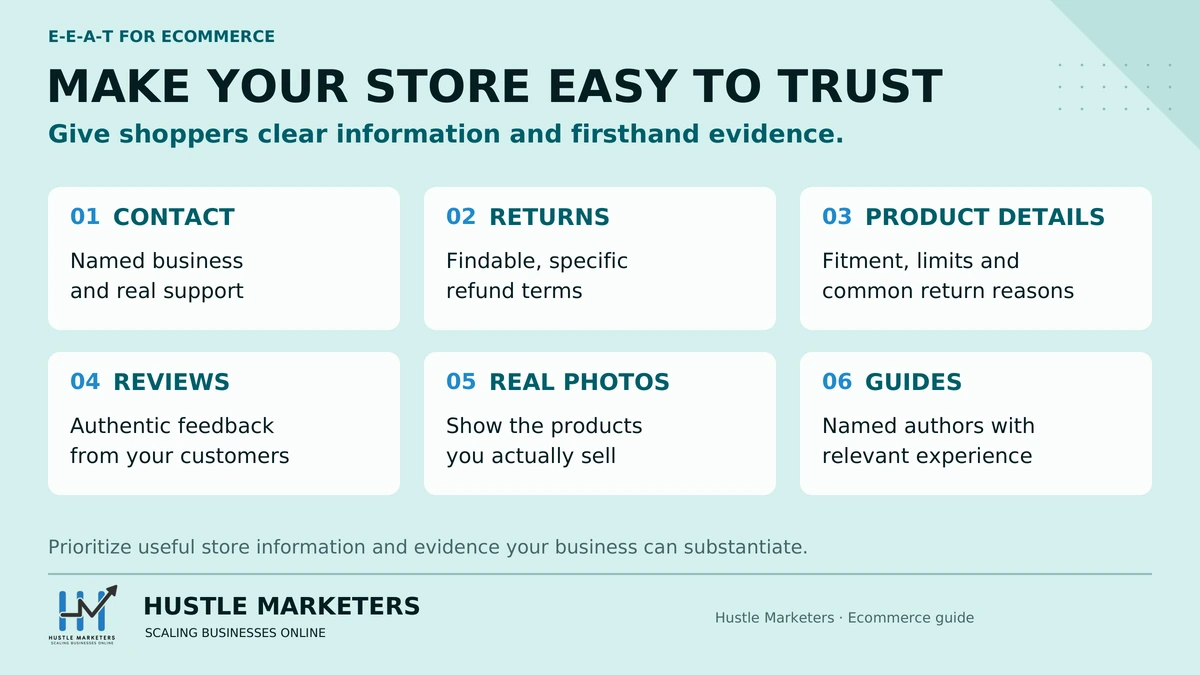
Read what is in that list. Contact information. Customer service information. Payment policy. Exchanges. Returns. Secure payment. That is the trust checklist for an online store, written by Google, for the people it pays to assess pages, and it is almost entirely unglamorous operational content rather than anything an SEO would normally call content.
The guidelines also ask raters to establish responsibility:
Every page belongs to a website, and it should be clear: Who (what individuals, company, business, organization, government agency, etc.) is responsible for the website.
What store owners already say, without the acronym
Worth putting side by side with the above. In a community thread asking how to make a store look more trustworthy, six people answered. Their answers were contact details you can actually find, trust badges at the cart, a dot com domain, visible reviews, and telling people who is behind the brand.
Not one of the six mentioned Google. They were describing what makes a human buy, and their list overlaps the rater guidelines at the point that matters most, which is contact details you can actually find.
That is the most useful thing in this post. The trust work is not an SEO project bolted onto the side of the store. It is the same work as making the store convert, which is why we treat it as conversion rate work as much as SEO, and it is the reason this is worth doing even if the ranking effect is indirect.
I sell other people’s products. What could I be an expert in?
This is the question the whole topic skips, and it is the largest gap on this subject. Every one of the nine pages we read assumes a brand that makes its own products and can therefore claim first hand experience. A store reselling several thousand SKUs it did not manufacture cannot claim to have designed anything.
It can still claim Experience, and Google’s definition is the reason.
From the rater guidelines:
Consider the extent to which the content creator has the necessary first-hand or life experience for the topic.
And from the December 2022 blog post that introduced the first E, the question Google told creators to ask:
Does content also demonstrate that it was produced with some degree of experience, such as with actual use of a product, having actually visited a place or communicating what a person experienced?
Google’s worked example of this, in the rater guidelines themselves, is a product review. Raters are asked which they would trust, a product review from someone who has personally used the product or a review by someone who has not.
Actual use of a product. Not manufacture of it. You stock it, you handle it, you pack it, you take the returns and you answer the questions. That is first hand experience of the product, and it is a different set of experience from the manufacturer’s: what a catalog of yours does next to it, why yours comes back, and what your customers ask first.
What a reseller can demonstrate that a manufacturer cannot
| What you know | Why only you know it | Where it goes |
|---|---|---|
| The most common reason this product comes back | You process the returns. The manufacturer sees an aggregate at best | Product page, and it reduces returns as well |
| Which of your other products it works with, fits or replaces | You hold the catalog. The manufacturer does not know what else is on your shelf | Product page, and it builds internal links |
| How the sizing actually runs against the spec sheet | You have handled it and heard the complaints | Product page and category page |
| What customers ask before they buy this | It is in your support inbox | FAQ block on the product page |
| How two products you stock compare in practice | You sell both. Neither manufacturer will ever write this | A comparison page, and which page type should hold it is a decision worth making deliberately |
| What arrives in the box, photographed by you | The manufacturer’s render is on forty other sites | Product page images |
None of that needs a subject matter expert on the payroll. It needs somebody with access to the returns data and the support inbox for an afternoon.
The line you should not cross
Google’s spam policies define thin affiliation as publishing content with product affiliate links where the product descriptions and reviews are copied directly from the original merchant without any original content or added value. The context is affiliate sites rather than retailers, but the phrase is the test: original content or added value. Everything in the table above clears it.
Is an ecommerce store a YMYL site?
Usually not, and it is worth testing the claim, because one of the pages we read asserts it outright, another devotes a section to YMYL without testing it, and none of the nine checks it against Google’s definition.
Google’s definition, from the rater guidelines:
Some topics have a high risk of harm because content about these topics could significantly impact the health, financial stability, or safety of people, or the welfare or well-being of society.
Selling t-shirts is not that. Selling supplements, baby car seats, medical devices, electrical components, financial products or anything load bearing might well be, and the consequence is real, because Google says its systems give more weight to content that aligns with strong E-E-A-T for YMYL topics.
The rater guidelines are also blunt about the floor:
If the E-E-A-T of a page is low enough, people cannot or should not use the MC of the page. If a page on YMYL topics is highly inexpert, it should be considered Untrustworthy and rated Lowest.
| Store type | YMYL on our reading | What changes |
|---|---|---|
| Apparel, homeware, gifts, most general retail | No | Standard trust work is enough. Do not buy a medical reviewer |
| Supplements, skincare with claims, anything ingested or applied | Yes | Sourcing, qualified review, and extreme care with claims |
| Child and infant safety products, car seats, helmets | Yes | Standards compliance, certifications, and clear fitment guidance |
| Electrical, automotive parts, anything load bearing | Yes on the safety critical lines | Specification accuracy is the trust signal, and errors are the risk |
| Finance adjacent, buy now pay later, insurance add ons | Yes | Regulatory disclosure, and this is where legal review belongs |
We are labelling that table as our reading. Google does not publish a list of YMYL ecommerce categories, and the honest position is that the line is judged per topic rather than per industry.
Where Trust stops being advice and becomes a requirement
Here is the part that is usually missing, and it is the part with an enforceable consequence attached.
Several of the things the rater guidelines describe as trust signals are also named requirements in Google Merchant Center policy. From the editorial and technical requirements:
Websites that are missing required contact information, have unverified business information in Merchant Center, or both
Websites that are missing return and refund information
The stated requirements are that the return policy page must not be empty, must state all requirements for return, and that refund policies are clear and easy to find. The same page names incomplete or difficult to understand business information, and the condition that not all customers are able to complete their purchase.
Google’s Merchant Center misrepresentation guidance and its misrepresentation policy add:
Describe your business on your website: Make sure your website has updated contact information and a clear explanation of what your company does, like on an “About us” page.
Failure to clearly and conspicuously disclose the payment model or full expense that a user will bear before and after purchase
Be precise about what this means, because SEO writing usually is not. A Merchant Center policy violation is enforced on the Shopping surface. For most violations Google sends a warning email and gives you 7 or 28 calendar days to fix it, products can be disapproved, and egregious cases are suspended without warning. Nothing in that policy speaks to organic ranking, which is a different surface with a different enforcement path. What makes it worth knowing here is that the same handful of pages, your contact page, your returns policy and your about page, are doing two jobs at once, and one of those jobs has an enforcement mechanism.
If your products are already disapproved, start with Google Merchant Center errors rather than with an E-E-A-T project.
Make the policies machine readable while you are there
Google documents structured data for return policies. From the return policy documentation, last updated September 8, 2026:
When you add `MerchantReturnPolicy` structured data to your site, Google Search can use this information to display return policies alongside your products and in knowledge panels in Search results.
It can sit at organization level as a site wide standard policy, or at offer level to override it for a specific product.
And in November 2025 Google did the same thing for shipping. Its shipping policy documentation says a standard policy that applies to most or all of your products can be set once, with ShippingService structured data nested under Organization, or configured as an account-level shipping policy in Search Console settings, which is automatically added to Merchant Center.
That is a trust signal you can ship in an afternoon, and it is newer than most of the content written on this subject.
What about reviews?
Reviews are the trust signal every store reaches for, and there is one rule here that catches a lot of people.
Asked in an August 2024 SEO Office Hours whether a store could take aggregated reviews from a third party service and feed them to Google as structured data, Martin answered:
No. If you check our documentation on the technical guidelines for reviews, you’ll see we specifically have a guideline against that (“Don’t aggregate reviews or ratings from other websites”), so it means your pages won’t anymore be eligible for review rich results if you do that.
Note the consequence he names. Loss of review rich result eligibility. Not a ranking penalty.
So: your own customer reviews, collected on your own site, marked up, are fine. Review counts scraped or imported from elsewhere and marked up as yours are not.
There is a second trap worth naming. Stores end up emitting review structured data on products with zero reviews, or with an empty author name, which produces invalid items in Search Console. In the one case we read it was the store’s own custom code rather than its review plugin, and the store spent a week blaming the plugin first. That is not an E-E-A-T problem. It is a markup problem, and the fix is to emit the markup only where there is a real review.
Do I need author bios on an ecommerce site?
On some pages. Not on product pages, and the documentation is more hedged here than the industry repeats.
Google’s wording, on the creating helpful content page:
We strongly encourage adding accurate authorship information, such as bylines to content where readers might expect it.
And the self assessment question:
Do pages carry a byline, where one might be expected?
Where one might be expected is doing a lot of work in both sentences. A buying guide, a comparison, a how to, an article about fitment or care: readers expect a byline there. A product page for a phone case: they do not, and adding one does not help anybody.
| Page type | Byline expected | What to add instead |
|---|---|---|
| Buying guides and comparisons | Yes | A real person, a real bio, and a link to what else they have written |
| How to and care content | Yes | The same, and say what qualifies them, which can be years on the shop floor |
| Product pages | No | Reviews, returns detail and specification accuracy |
| Category pages | No | Genuinely useful selection help |
| About and contact | Not a byline, but the company | Who is responsible for the website, in Google’s words |
The Shopify problem nobody mentions
If you are on Shopify and you have tried to add proper author pages to your blog, you will have found that authorship is tied to staff accounts. Two years of community threads asking how to give each contributor a bio and a clickable author page go without a straight answer. That is a platform constraint, not a strategy failure, and it is worth knowing before you plan a program around author entities.
The workable version on that platform is to put the author information in the post itself, consistently, with a link to a page about that person, rather than fighting the native author field.
What about the pages that actually make the money?
This is the second large gap. Of the nine pages we read, one has a single subheading on product and category content. The rest are about about pages, team pages, author bios, reviews and digital PR.
Those are all fine, and none of them is where your revenue is.
| Template | The trust signal that belongs there | Why it belongs there and not somewhere else |
|---|---|---|
| Product page | Returns reason, real photography, honest specification, stock and delivery reality | It is the page where somebody decides to spend money |
| Product page | Your own reviews, including the mediocre ones | A page with only five star reviews reads as filtered |
| Category page | Genuine selection help, sizing conventions, what separates the sub types | It is the page where somebody decides which product |
| Cart and checkout | Payment methods shown, total cost shown before the last step, contact route visible | The rater guidelines name secure payment and customer service for stores specifically |
| Returns policy | Complete, findable, and stating every condition | It is a named Merchant Center requirement and a rater checkpoint |
| Contact page | Address, phone, email, and who is responsible for the site | Named in both the rater guidelines and Merchant Center policy |
| About page | Who is responsible for the website | The rater guidelines phrase it exactly that way |
The trust work that pays is on the templates that repeat across thousands of URLs, not on the one about page that gets forty visits a month. If those templates are also thin, fix that first, because a trustworthy page that never gets indexed is not doing anything. That is covered in thin content on an ecommerce site.
How do you measure whether any of this worked?
Honestly, with difficulty, and none of the nine pages we read offers a method at all. Here is ours, with its limits stated.
You cannot measure E-E-A-T, because there is nothing to measure. What you can measure is the behavior of the things it describes.
| What to track | Where | What a win looks like | The limit |
|---|---|---|---|
| Branded search volume | Search Console, queries containing your brand | Rising over quarters, not weeks | Confounded by every other marketing activity you run, including your ads |
| Click through rate on unchanged positions | Search Console, filtered by page | Same position, more clicks, after a trust change to the template | Seasonality and SERP layout changes will move this too |
| Conversion rate on the pages you changed | Analytics | The clearest signal you will get, because trust and conversion are the same thing | Needs enough traffic to be real |
| Return rate on products where you added returns reasons | Your platform | Falling | Slow, and worth having anyway |
| Merchant Center account status | Merchant Center | No policy warnings on contact or returns | Binary, and the only one here with a definite answer |
| Reviews collected per hundred orders | Your review tool | Rising | Depends on your request flow more than on trust |
Two of those are worth doing rather than watching: conversion rate on the pages you changed, and Merchant Center account status. The other four are worth watching and slow to move. Anybody who offers you a single E-E-A-T number is offering you something Google does not have.
Does this help you get cited by AI answer engines?
We do not know, and we are not going to pretend otherwise.
What we can say is narrower. The pages this work improves, contact, returns, shipping, specification detail, are pages that are easy for any system to read and that describe verifiable facts about your business. One practitioner we read reported that shipping and returns pages matter more than people expect because assistants read them heavily. That is one person’s unverified observation and we are repeating it as that, not as evidence.
If you want the part of this subject that does have documentation behind it, our post on AI SEO for ecommerce sets out what each vendor actually publishes about crawling and citation, and what blocking each crawler does.
Why do two sources give different counts of E-E-A-T in the rater guidelines?
Because neither says which version it counted, and this is a small thing that tells you a lot about the quality of writing on this subject.
Of the nine pages we read, two state a precise count. One says the term appears 116 times. Another says 135. Both present the figure as a fact. Neither names a version date.
The rater guidelines are revised repeatedly. The current version is dated September 11, 2025. A count from an earlier revision is not wrong exactly, it is just about a different document, which is why a count without a version is worth nothing.
We tried to settle it and could not. The PDF runs to well over a hundred pages and no tool we used returned it in full, so we are not publishing a number either. What we can tell you is the section: E-E-A-T is section 3.4, with a subsection on YMYL topics at 3.4.1.
What should you fix first?
Ordered by consequence, not by effort. None of the nine pages we read ranks its recommendations at all, and one of them gives thirty one undifferentiated strategies.
| Priority | Action | Why it comes here |
|---|---|---|
| Critical | Publish complete contact information: address, phone, email, and who is responsible | Named in the rater guidelines and a Merchant Center requirement. Missing it can suspend your Shopping account |
| Critical | Make the returns and refund policy complete, findable and specific | Same. This is the most common version of this failure we see |
| High | Check Merchant Center for policy warnings on business information and returns | It is binary, it takes ten minutes, and it has a real consequence |
| High | Add the returns reason and the fitment detail to your top revenue product pages | Original information only you have, on the pages that make the money |
| High | Collect and display your own reviews, and stop displaying anybody else’s as structured data | The aggregation rule is explicit and it is widely broken |
| Medium | Add MerchantReturnPolicy structured data at organization level, and set shipping and returns in Search Console | A trust signal you can ship in an afternoon |
| Medium | Put real photography on the products that sell | The manufacturer’s render is on every competitor site |
| Medium | Add bylines and real bios to guides and comparisons, not to product pages | Google’s hedge is where readers might expect it |
| Low | Rewrite the about page | It matters, and it is not where your traffic is |
| Low | Digital PR and authority building | Slow, expensive, and the thing most of this topic is secretly selling |
How we approach this on a real store
Luvella is a message card gift jewelry brand with two storefronts, an Australian site at luvella.com.au and a United States site at luvellagifts.com. It is a useful example for this subject because running the same brand in two markets makes every trust signal a decision rather than a default.
Two sites means two of everything a shopper checks: contact details, a returns policy under different consumer law, a currency and a delivery expectation. Get the pairing wrong and a shopper in Sydney lands on a page quoting US dollars against a returns address on the other side of the Pacific, and has learned something about whether this store is for them before reading a word of the copy.
It also means the copy has to match the market. Jewellery with two Ls for Australia, jewelry with one for the United States. It is a small thing and it is exactly the kind of small thing a shopper notices when they are deciding whether a site is local and legitimate.
Two honest notes.
The first is that our engagement here is Merchant Center feed and keyword work rather than a trust or E-E-A-T project. What the account illustrates is the shape of the problem, not a result we produced.
The second is that we have not published figures for this account and we are not going to imply any.
What the published pages on E-E-A-T for ecommerce get wrong
We read the nine results a search tool returned for this query in September 2026. Every one was reachable, so nothing is excluded. One caveat that matters. When we checked the live results in a browser on the same day, the set was substantially different, and only two domains appear on both lists. So the counts below describe nine pages published on this subject, not nine pages that currently rank. For what it is worth, the live top nine includes a LinkedIn post at position four and a SlideShare deck at position seven.
| What we found | Count | Why it matters |
|---|---|---|
| Reported Google’s published position that E-E-A-T is not itself a ranking factor | 0 of 9 | It is the single most important fact on the subject and Google has published it |
| Described E-E-A-T as a direct mechanical ranking input | At least 3 of 9 | One lists enhanced crawlability as a benefit of E-E-A-T |
| Offered any way to measure whether the work did anything | 0 of 9 | Nine pages of instructions with no success criterion |
| Addressed what Experience means for a store reselling products it did not make | 0 of 9 | It is the position most ecommerce sites are actually in |
| Treated product and category templates systematically | 1 of 9 | The rest is about pages, team pages and author bios |
| Tested the claim that ecommerce is YMYL | 0 of 9 | One asserts it outright, another has a YMYL section, none checks it against the definition |
| Ranked the recommendations by cost or likely return | 0 of 9 | One page gives 31 strategies in no order |
| Gave a precise count of E-E-A-T mentions in the rater guidelines | 2 of 9 | They disagree, at 116 and 135, and neither names a version |
| Stated an unsourced statistic | 3 of 9 | |
| Contained a named client case study with numbers | 0 of 9 | On a page about demonstrating expertise |
| Contained original research | 0 of 9 | |
| Still used the pre 2022 E-A-T framing in title or URL | 2 of 9 | Google added Experience, the first E, in December 2022 |
The last line of that table deserves a sentence. Nine agency pages explaining how to demonstrate expertise, and not one of them names a client. We have named one above, and been straight that we are publishing no figures with it, which is the most we can honestly do.
Why work with Hustle Marketers on ecommerce trust and E-E-A-T
Ishant Sharma has worked in digital marketing since 2013 as a Google Ads, Microsoft Ads and SEO specialist, and Hustle Marketers works with ecommerce, local service, SaaS and white label agency clients. Three reasons this particular job suits us.
We will tell you that most of this is not an SEO project. The highest value items on the list above are your contact page, your returns policy and your product data, and they pay in conversion and in Merchant Center compliance whether or not they ever move a ranking. An agency that needs this to be an SEO deliverable will sell you digital PR instead.
We work in Merchant Center every week across Shopify, Magento and WooCommerce stores. The overlap between the rater guidelines trust list and Merchant Center policy is where the enforceable risk sits, and it is not theoretical here. If your feed is the immediate problem, that is also where we would start.
We do not sell scores. There is no E-E-A-T number, Google says as much, and any audit that opens with one is measuring something it invented. What we will give you is the ordered list, the ones with a real consequence at the top. If you want to see how we work on the rest of the ecommerce stack, start with ecommerce SEO by platform or our ecommerce SEO agency page. For search work beyond stores, there is our SEO agency page.
E-E-A-T ecommerce FAQs
Is E-E-A-T a Google ranking factor?
Not in itself. Google’s documentation says that while E-E-A-T itself is not a specific ranking factor, using a mix of factors that can identify content with good E-E-A-T is useful. So there is no E-E-A-T input and no E-E-A-T score, but the observable things the framework describes are used. The practical reading is that you work on the things, not on the acronym, and that anybody selling you an E-E-A-T score is selling a number Google does not have.
What does E-E-A-T stand for?
Experience, Expertise, Authoritativeness and Trust. Google added the first E, Experience, in December 2022. It lives in section 3.4 of the Search Quality Rater Guidelines, the document Google gives to the people it pays to assess search quality. Those raters do not change rankings. Their assessments are used to judge whether changes to the ranking systems made results better or worse.
Which part of E-E-A-T matters most for an online store?
Trust, and Google says so directly. The rater guidelines call Trust the most important member at the center of the family, and say untrustworthy pages have low E-E-A-T no matter how experienced, expert or authoritative they seem. For a store, the guidelines get specific: contact information, customer service information, the policies on payment, exchanges and returns, secure payment systems and reliable customer service.
How do I improve E-E-A-T if I resell products I did not make?
Write from what you actually know, which is more than the manufacturer knows. The most common reason a product comes back. Which of your other products it fits or replaces. How the sizing runs in practice. What customers ask before buying. How two products you stock compare. Google defines Experience as first hand or life experience, and the rater guidelines ask which you would trust, a product review from somebody who has personally used the product or a review by somebody who has not. Stocking, handling and supporting a product is first hand experience of it.
Is an ecommerce site YMYL?
Usually not. Google defines YMYL as topics with a high risk of harm because they could significantly affect health, financial stability, safety or the welfare of society. A general retailer is not that. Supplements, anything ingested or applied, child safety products, safety critical parts and finance adjacent products may well be, and Google says its systems give more weight to strong E-E-A-T on YMYL topics. Judge it by what you sell rather than by the fact that you sell.
Do product pages need author bios?
No. Google’s wording is that it strongly encourages accurate authorship information such as bylines to content where readers might expect it, and the self assessment question is whether pages carry a byline where one might be expected. Readers do not expect a byline on a product page. Buying guides, comparisons and how to content are where a real byline with a real bio earns its place.
Can I use reviews from a third party site as structured data?
No. Asked this directly, Google’s Martin pointed at the documented guideline against aggregating reviews or ratings from other websites and said the consequence is that your pages stop being eligible for review rich results. Your own customer reviews, collected on your own site, are fine to mark up. Imported or aggregated ratings presented as yours are not. Also check that nothing on your store, plugin or custom code, is emitting review markup on products that have no reviews, which produces invalid items in Search Console.
Is a returns policy really an SEO issue?
It is two issues at once. The rater guidelines name the store’s policies on payment, exchanges and returns as something raters are asked to check on shopping sites. Separately, Google Merchant Center names websites missing return and refund information as a policy failure, and requires that the policy page is not empty, states all requirements for return, and is clear and easy to find. The Merchant Center consequence is to your Shopping account rather than your organic rankings, which is a distinction worth keeping straight.
How many times does the rater guidelines document mention E-E-A-T?
We do not know, and neither do the pages that give you a number. Two of the nine pages we read state precise counts, 116 and 135, and neither names which version of the document it counted. The guidelines are revised repeatedly and the current version is dated September 11, 2025, so a count without a version is meaningless. We could not read the document in full to settle it, so we are not publishing a figure either.
How do I measure E-E-A-T?
You cannot, because there is no such measurement. What you can measure is the behavior of the things the framework describes: branded search volume over quarters, click through rate at unchanged positions after a template change, conversion rate on the pages you changed, return rate where you added returns detail, reviews collected per hundred orders, and whether Merchant Center is flagging your contact or returns information. The last one is the only binary answer in the list.
What is the fastest thing I can do to improve trust signals?
Complete contact information and a complete, findable returns policy, then check Merchant Center for warnings on either. Those three take a morning between them, they are named in both the rater guidelines and Merchant Center policy, and one of them has an enforcement mechanism attached. Everything else on the subject is slower and less certain.
Does E-E-A-T help me appear in AI search results?
We do not know and we would be careful of anybody who says they do. The pages this work improves are easy to read and describe verifiable facts about your business, which is plausibly useful, but we could not find documentation connecting E-E-A-T to citation by AI answer engines. What is documented about crawling and citation on those surfaces is a separate subject.
Sources and verification
Everything in this post was checked in September 2026. Definitions, policy wording and quotations come from Google’s own documentation, from the Search Quality Rater Guidelines PDF at the version dated September 11, 2025, from Google Merchant Center help pages, and from Google’s published SEO Office Hours transcripts read at their own URLs rather than through third party reports. Where a Google page shows a last updated date, it is given in the text.
Some things are deliberately absent. There is no count of how many times E-E-A-T appears in the rater guidelines, because the document could not be read in full and the counts in circulation disagree and name no version. There is no E-E-A-T score, checklist score or grading rubric, because Google documents no such thing. There is no claim that E-E-A-T signals cause AI citation, because we could not source one. There is no statistic about ecommerce trust, conversion or reviews taken from another blog, because none of the ones in circulation on this topic could be traced to a primary source.
Two things in this post are labeled as our judgment rather than as documentation, and they are labeled in place: the table of which store types are likely to be YMYL, and the measurement approach. Google publishes no list of YMYL retail categories and no measurement method.
The competitor observations come from nine pages read in full in September 2026, all of which were reachable, drawn from the results returned for the head term. Those were the results a search tool returned and they differ from the live results we checked separately in a browser, so the counts describe pages we read rather than pages that currently rank.
The community observations come from forty threads on Shopify Community, the WordPress.org support forums and the WooCommerce GitHub issue tracker. Four returned partial content and are excluded from any claim about what their replies said. Everything taken from a forum is an individual’s unverified report and is described that way where it appears. Reddit and Quora were not attempted. The BigCommerce community, the Adobe Experience League community, the Stack Exchange network and YouTube could not be reached and contributed nothing.
The platform changes the implementation, not the priorities. Our guide to ecommerce SEO sets out the order to work in, whichever cart you are on.