Pet Products and Google Shopping: Why Your Feed Gets Disapproved

Ishant
Published : October 14, 2026 at 9:30 am
Updated : October 16, 2026 at 12:13 pm
Ishant
Written by Ishant Sharma, Google Ads, Microsoft Ads and SEO specialist since 2013 | Published October 14, 2026 | Facts checked September 18, 2026
In a Google Ads help community thread that is still the clearest public description of the problem, a pet retailer running 17,000 products wrote that a large portion of their dog food, cat food and flea treatment listings were disapproved under the healthcare and medicines restricted pharmaceuticals policy. Their products were correctly categorized in the animals and pet supplies taxonomy. In their words, when they requested a manual review, 90% of them were approved without any changes made to the listings.
That is the pet ecommerce problem in one paragraph. Not creative, not bidding. Ordinary pet food being classified as restricted pharmaceuticals, and nobody telling you why.
Every marketing guide written for pet brands covers the same ground: pet parents, humanization, influencer content, subscription boxes. In September 2026 I went through twenty of the pages then ranking for pet ecommerce and pet Google Ads terms. Not one mentions a single Google Shopping policy restriction that applies to pet products. Zero mention feed attributes. Two mention Performance Max.
This guide is about the part nobody writes about: why your products get blocked, what the policy actually says, and how to structure a pet feed that survives review.
One thing up front. Several sections below describe US regulatory positions because Google’s policy tracks them. I am a Google Ads and Merchant Center specialist, not a lawyer, and none of this is legal advice. If you sell pet supplements or pet medication, an hour with a regulatory lawyer is worth more than any marketing guide, this one included.
Table of Contents
- Why do my pet food listings get flagged as pharmaceuticals?
- Can you advertise pet supplements on Google Shopping?
- Why is there no legal category for pet supplements?
- Can you sell pet medication through Shopping ads?
- Are your product reviews a compliance problem?
- How do you put flavor, bag size and life stage in a Google feed?
- Do you need a GTIN for a private label pet product?
- Can you run Subscribe and Save in Shopping ads?
- Who are you actually competing with in paid search?
- What should a pet brand fix first?
- Pet products and Google Shopping FAQs
Why do my pet food listings get flagged as pharmaceuticals?
Because the policy that catches them is not written about pets. It is written about health claims, and pet products are full of them.
Google’s healthcare and medicines policy for Shopping disallows, in its own words:
Non-government approved products that are marketed in a way that implies that they’re safe or effective for use in preventing, curing, or treating a particular disease or ailment.
Read that against a normal pet catalog. A hip and joint chew. A calming supplement. A dental additive. A skin and coat oil. A digestive powder. A flea and tick treatment. The entire selling proposition of those products is an implied ailment claim, and the claim usually sits in the product title, which goes straight into your feed.
The policy adds two more lines that matter:
It also disallows products making false or misleading health claims, in a bullet that goes on to cover sites selling products claimed to be as effective as anabolic steroids and prescription drugs. And it lists products with a regulatory history among the things it does not allow:
Products that have been subject to any government or regulatory action or warning
Google also treats this as a distinct problem rather than a misfire. Its unapproved pharmaceuticals and supplements page runs a guided troubleshooter with four categories, and pet pharmaceuticals is one of them, alongside over-the-counter medication, prescription drugs and unapproved supplements. Google built a pet category into its own disapproval tooling.
What actually fixes it
The practical fixes are feed-level, not appeal-level. The four below are the recommended answer on that thread, given by Emmanuel Flossie, a Google Diamond Product Expert and Merchant Center specialist. They match what we see on pet accounts, which is why they are worth repeating rather than replacing.
Strip claim language from titles and descriptions, in the feed and on the page. Words that read as pharmaceutical framing (“formulated”, “clinically”, “treats”, “relieves”) are what trips the classifier. Describe the product, not the outcome.
Stop using a blanket category. Putting 17,000 products under Animals & Pet Supplies and nothing more gives the classifier no help. Every product needs its correct sub-category.
Add real identifiers. Brand plus barcode gives Google something to match against, which reduces the chance a chew gets read as a drug.
Check which surface is actually disapproved. The same answer notes that healthcare related products will not get approved for Display ads, so a product can be blocked there while running perfectly well on Shopping. A blanket “disapproved” reading can send you fixing the wrong thing.
If you are already dealing with an account-level problem rather than item-level disapprovals, our Merchant Center suspension guide covers the appeal path.
Can you advertise pet supplements on Google Shopping?
Sometimes, and the deciding factor is how you describe them rather than what is in them.
A joint supplement sold as a joint supplement is a product. The same supplement sold as something that eases your dog’s arthritis is, in policy terms, an unapproved pharmaceutical. Nothing about the tub changed. The words did.
This is why pet supplement brands get stuck in a loop: they fix a disapproval, the product returns, then a copywriter improves the title and it goes down again.
Why is there no legal category for pet supplements?
This is the part that explains everything above, and I have not seen it written anywhere in the pet marketing space.
Human supplements have a legal home. DSHEA created a category for dietary supplements in the US in 1994. Animal supplements were never brought into it. The National Animal Supplement Council, the industry’s own trade body, records the history on its site: the FDA published a notice in the Federal Register in 1996 explaining why it believes DSHEA does not apply to animals. NASC’s own summary of that position is that it leaves animal products similar to human dietary supplements with only two possible legal categories under US law, animal food or feed, or drugs, and that a product on the market which is not approved may be deemed an adulterated drug and subject to regulatory action.
The industry says so itself. In its July 2026 update on the Animal Health Supplement Act, NASC writes that “existing under FDA enforcement discretion is not ideal” because the regulatory environment could change with a shift in agency policy. That bill, still in development, would create a legal category for animal supplements based on intended use, with frameworks for product listing, manufacturing quality, labeling, claims and adverse event reporting. In other words, the thing DSHEA did for human supplements has not happened yet for pets.
Google’s policy is global and does not say it is written around US animal law. But the policy language and the US regulatory position line up closely enough that reading one explains the other. When Google’s policy refers to unapproved pharmaceuticals and supplements, a US pet supplement is not an odd fit for that wording. It is close to a literal description.
That reframes the whole problem. You are not fighting a misclassification. You are advertising a product category that does not have a settled legal identity, on a platform whose policy is written around exactly that distinction. The winning approach is conservative product data, not a better appeal letter.
For pet supplement brands, the NASC quality seal is one of the few recognizable trust markers in the category, and it gets searched on its own. Semrush puts “nasc seal” at around 140 US searches a month at a keyword difficulty of 15, which is small but tells you some buyers look for it by name before they buy. “legitscript certification” sits near 720 a month, which says the same thing about the pharmacy side.
Can you sell pet medication through Shopping ads?
Only in two countries, and only with certification. Google’s policy is explicit:
Google allows the promotion of pet pharmacies and pet pharmaceuticals in the United States by online pharmacies who are accredited by the LegitScript Healthcare Merchant Certification and Monitoring Program or the .pharmacy Verified Websites Program
The Canada sentence is the same except that it names online veterinary pharmacies. Google then certifies accredited merchants through its own application, and in every other country pet pharmaceuticals cannot be promoted in Shopping ads.
Three things follow from that sentence, and each one changes a business plan.
| If you are | What this means |
|---|---|
| A UK, EU, AU or any non-US/Canada pet pharmacy | You cannot run Shopping ads for pet pharmaceuticals at all. This is a policy wall, not a feed problem |
| A US pet pharmacy | You need LegitScript or .pharmacy accreditation and Google certification before any of it serves |
| A Canadian seller | Google’s Canada wording specifies online veterinary pharmacies |
Certification is not a formality. LegitScript and the NABP both run paid application processes with their own review timelines, and Google’s wording puts accreditation and certification before the promotion rather than after a rejection. If your growth plan assumes Shopping traffic for pet meds outside North America, the plan needs changing rather than optimizing.
Are your product reviews a compliance problem?
Almost every pet marketing guide tells you to lean on reviews and user content. None of them mention this.
The FD&C Act definition of labeling, reproduced on the FDA’s own animal food labeling and pet food claims page, covers:
all labels and other written, printed, or graphic matter upon any article or any of its containers or wrappers, or accompanying such articles including promotional brochures, promotional pamphlets, testimonials, product information sheets, books, etc.
Testimonials are labeling.
Now put that next to the FDA’s position on drug claims:
Expressed or implied claims that establish the intended use of a product is to cure, treat, prevent, or mitigate disease, or affect the structure or function of the body in a manner other than for food purposes (nutritive value, aroma, or taste) can indicate an intent to offer the product as a “new animal drug.”
A five star review saying a supplement cleared up a dog’s itching in a week is a testimonial making a drug claim. Surfaced on the product page, pulled into ad creative, or fed into a review extension, it becomes part of how the product is presented.
The FDA also names specific phrasing it reviews on pet food, including “maintains urinary tract health”, “low magnesium” and “hairball control”. Those are exactly the phrases that end up in product titles.
None of this means delete your reviews. It means treat health-claim testimonials as a category you do not amplify: keep them off ad creative, out of feed fields, and away from the title. Reviews about palatability, packaging, delivery and value carry all the persuasive weight with none of the exposure.
This is the section where the legal disclaimer at the top of this post matters most.
How do you put flavor, bag size and life stage in a Google feed?
Here is a structural problem specific to pet that no competitor covers.
Google’s standard variant dimensions include color, pattern, material, age group, gender and size, plus size type and size system. Those come from apparel. Pet’s real variant axes are none of them:
- Flavor (chicken, salmon, lamb)
- Bag weight (5lb, 15lb, 30lb)
- Life stage (puppy, adult, senior)
- Breed size (toy, small, large)
- Format (kibble, wet, freeze-dried)
A common and damaging workaround is forcing life stage into age_group. That attribute means human age group. Using it for puppy and adult puts wrong data in a field Google uses for something else.
The correct mechanism is the variant_option attribute, which Google describes as working with item_group_title and item_group_id to “specify all variant-identifying properties of this product when it’s available in different variants.” It accepts property names you define. Google’s own documentation uses custom examples like shoe width, which confirms arbitrary names are allowed.
So flavor and bag weight become declared variant properties rather than things buried in the title. Every variant sharing an item_group_id must carry the same set of property names, with different values.
This matters commercially, not just tidily. Google’s documentation describes what the attribute is for rather than how the auction responds, but in our accounts a correctly grouped product set behaves more predictably than six near-identical items submitted as unrelated products. Our product feed optimization guide covers the surrounding attribute work.
Do you need a GTIN for a private label pet product?
Pet is unusually private label heavy: custom collars, engraved tags, bandanas, handmade treats, own-brand supplements. Google’s GTIN specification is direct about it: “Some products don’t have a GTIN assigned, and so you don’t need to submit one,” and “Only provide a GTIN if you’re sure it’s correct. When in doubt don’t provide a GTIN.” It adds that a store brand or a product you are the only seller of generally will not have one.
The pet-specific wrinkle is that identifiers are also part of staying approved. Accurate brand and barcode data helps Google classify a chew as a chew rather than a drug. So on a pet catalog the identifier decision is a compliance decision as much as a matching one. Our GTIN guide covers when going without one is legitimate.
Can you run Subscribe and Save in Shopping ads?
Yes, and this is recent enough that most pet brands have not caught up.
Subscription is everywhere in pet DTC, and a long list of marketing guides tell you to launch one. What none of them explain is how a recurring price is expressed in a Shopping feed, where price is a one-time purchase price rather than a recurring one.
Two things changed, and both are pet-relevant.
First, the subscription_cost attribute now covers weekly, monthly or annual payment plans for physical goods. Google’s documentation names the categories where it is required for physical goods subscriptions in the United States, and pet supplies is on that list alongside personal care, health care, coffee and medicine. If you sell a subscription and you are not submitting it, that is a data gap, not an optional enhancement.
Second, Google’s promotion policy update effective January 2026 states that “we now support promotions on subscription fees” and that subscription services offering an amount off or percent off discount on the subscription cost will be allowed. To use it you set the eligibility requirement to Subscribe and save in the Merchant Center promotions interface, or set redemption_restriction to subscribe_and_save in the promotion feed.
For a brand whose economics depend on the second order rather than the first, being able to advertise the subscription price and a first-order discount inside the Shopping listing changes what the ad says at the moment of comparison.
Who are you actually competing with in paid search?
Twelve of the twenty guides in that same sample name Amazon as the threat. None of them puts a number on it.
Adthena’s measurement of US retail pet supplies gives a very different picture of paid search specifically. The page updates monthly; the figures below are for September 2026, read on October 7, 2026.
| Rank | Advertiser | Share of paid clicks |
|---|---|---|
| 1 | Chewy | 35.31% |
| 2 | Petco | 15.78% |
| 3 | PetSmart | 5.2% |
| 4 | Amazon | 3.43% |
| 5 | Pet Supplies Plus | 3.23% |
| 6 | Walmart | 2.89% |
| 7 | Wayfair | 1.81% |
| 8 | Temu | 1.58% |
| 9 | Hill’s Pet | 1.31% |
| 10 | Target | 1.04% |
September began with 1,227 advertisers and peaked at 1,472 on the 3rd. Everyone outside the top ten holds a little over a quarter of clicks between them, about 28 percent.
Amazon is fourth, at 3.43%, only just ahead of Pet Supplies Plus. In paid search for pet supplies you are not mainly losing to Amazon. You are losing to Chewy at more than a third of all clicks, and to a field of well over a thousand other advertisers splitting the rest. That argues for margin-aware bidding and product-level segmentation rather than building a strategy around out-spending a marketplace that is not actually taking the clicks.
Treat this as one vendor’s measurement of one month rather than a permanent law, and expect the order below Chewy and Petco to move from month to month.
What should a pet brand fix first?
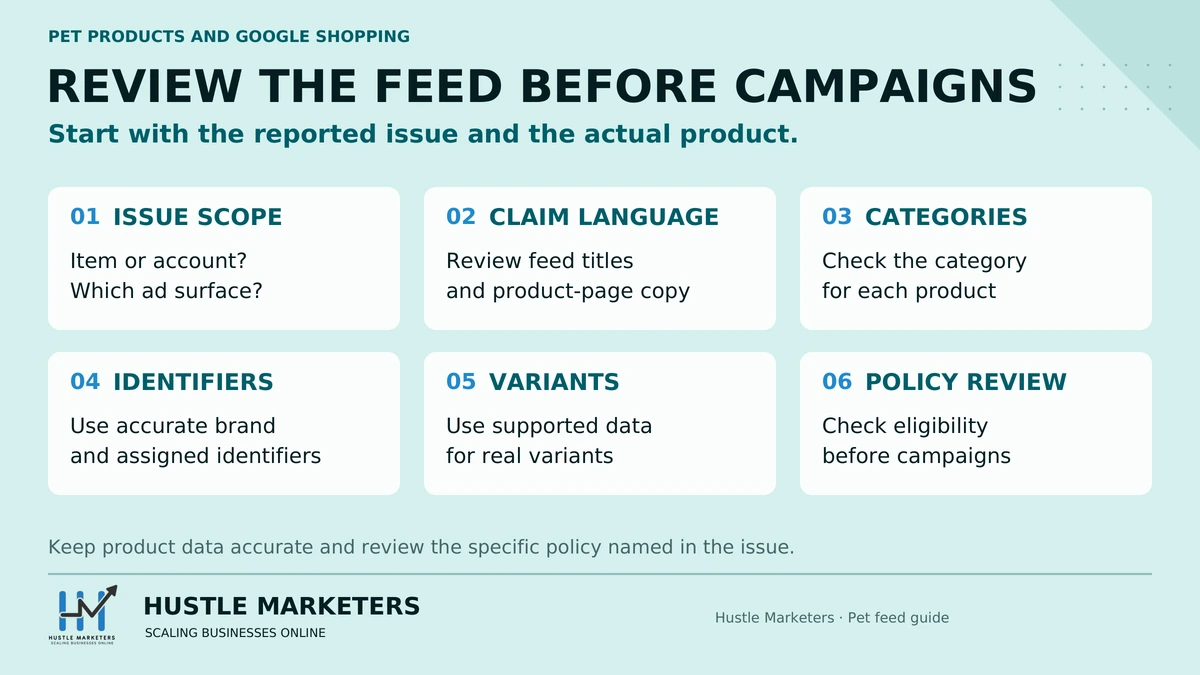
In this order, because each step depends on the one before it.
1. Find out what is actually disapproved, and on which surface. Item-level or account-level, Shopping or Display. These need different responses.
2. Clean claim language out of titles and descriptions. Feed and site both. This is the single highest-yield change for a pet catalog and it costs nothing.
3. Fix categorization properly. Correct sub-category per product, not a blanket pet supplies label.
4. Get identifiers right. Accurate brand and barcode where they exist, nothing invented where they do not.
5. Declare your real variants. Flavor, weight and life stage as variant properties rather than title text.
6. Decide the supplement and pharmacy question deliberately. If you sell pet meds, certification comes before campaigns. If you sell supplements, conservative product data is the strategy.
7. Then optimize campaigns. Not before.
Timing matters too. Do not run a feed restructure into peak trading. Our Black Friday advertising guide covers why that period wants a settled feed.
If you are weighing up whether to hand this work to someone else, our guide on how to choose a pet marketing agency covers the questions worth asking, including who will own your Merchant Center account and how disapprovals get handled.
We have run this work across pet accounts on both sides of the problem. The pet accessories brand, the online pet supply store, and the Philippines pet brand in our case studies all started with product data rather than creative.
About the author: Ishant Sharma has worked in digital marketing since 2013 as a Google Ads, Microsoft Ads and SEO specialist, across ecommerce, local service, SaaS and white label agency accounts in the US, UK, UAE and Australia. His platform work spans Shopify SEO, Shopify marketing and BigCommerce SEO. He leads ecommerce PPC management and Google Ads at Hustle Marketers. He founded Hustle Marketers, a Google Partner and Meta Business Partner agency, and one of the best digital marketing agency options for ecommerce and local service brands. Trackable client sales across his work have passed $780M, and he is Top Rated Plus on Upwork. More about Ishant.
Pet products and Google Shopping FAQs
Why are my pet food products disapproved as pharmaceuticals?
Usually because of claim language in titles and descriptions, blanket categorization, or missing identifiers. Google’s healthcare policy catches products “marketed in a way that implies that they’re safe or effective for use in preventing, curing, or treating a particular disease or ailment”, which describes how most pet health products are sold. Google’s own troubleshooter lists pet pharmaceuticals as a distinct disapproval category.
Can I advertise pet supplements on Google Shopping?
Often yes, provided the product data does not imply treatment of a condition. The same product can be approved or disapproved depending on wording alone. Avoid ailment framing in the title, the description and the landing page.
Do I need LegitScript certification to sell pet medication?
If you want Shopping ads for pet pharmaceuticals, yes. Google allows it in the United States and Canada only, and requires accreditation by LegitScript or the NABP .pharmacy program plus certification by Google. Outside those two countries, Shopping ads for pet pharmaceuticals are not available.
Why are pet supplements treated differently from human supplements?
Because DSHEA, which created the legal category for human dietary supplements in the US, was never extended to animal products. The FDA said so in a 1996 Federal Register notice. The industry body NASC says the sector operates under FDA enforcement discretion and is pushing an Animal Health Supplement Act to create a proper legal category. Google’s policy language reflects that unsettled status.
Are customer reviews a regulatory risk for pet brands?
They can be. The FD&C Act definition of labeling explicitly includes testimonials, and the FDA treats claims to cure, treat, prevent or mitigate disease as indicating a new animal drug. A review making a health claim, amplified in ad creative or feed data, carries more exposure than most brands realize. Reviews about taste, packaging and delivery do not.
How do I add flavor or bag size as a variant in Google Shopping?
Use the variant_option attribute with item_group_id and item_group_title. It accepts property names you define, so flavor, bag weight and life stage can be declared as real variant properties. Do not use age_group for puppy or adult, because that attribute refers to human age groups.
Can I advertise a subscription price in Shopping ads?
Yes. The subscription_cost attribute covers recurring payment plans for physical goods and is required for physical goods subscriptions in pet supplies in the United States. Google’s promotion policy update effective January 2026 also allows discounts on subscription fees, using the Subscribe and save eligibility requirement.
Is Amazon my main paid search competitor in pet?
Probably not. Adthena’s September 2026 measurement of US retail pet supplies put Chewy at 35.31% of paid clicks and Amazon at 3.43%, behind Petco and PetSmart. For paid search specifically, Chewy and a field of over a thousand other advertisers are the realistic competition.
Can I sell live animals through Google Shopping?
Treat it as a separate question from the rest of your catalog. Google’s Shopping policies do not ban live animal sales outright, but they do reference safety restrictions around the transportation of live animals, and live inventory also runs into shipping, state and country level rules that have nothing to do with Google. Get a clear answer on that before you list it, rather than after a suspension.