Alcohol Marketing Case Study: How CANA Wine Company Hit 17.35x ROAS and $177K Revenue on Google Ads in 120 Days

Ishant
Published : October 2, 2026 at 2:01 am
Updated : October 2, 2026 at 8:08 am
Ishant
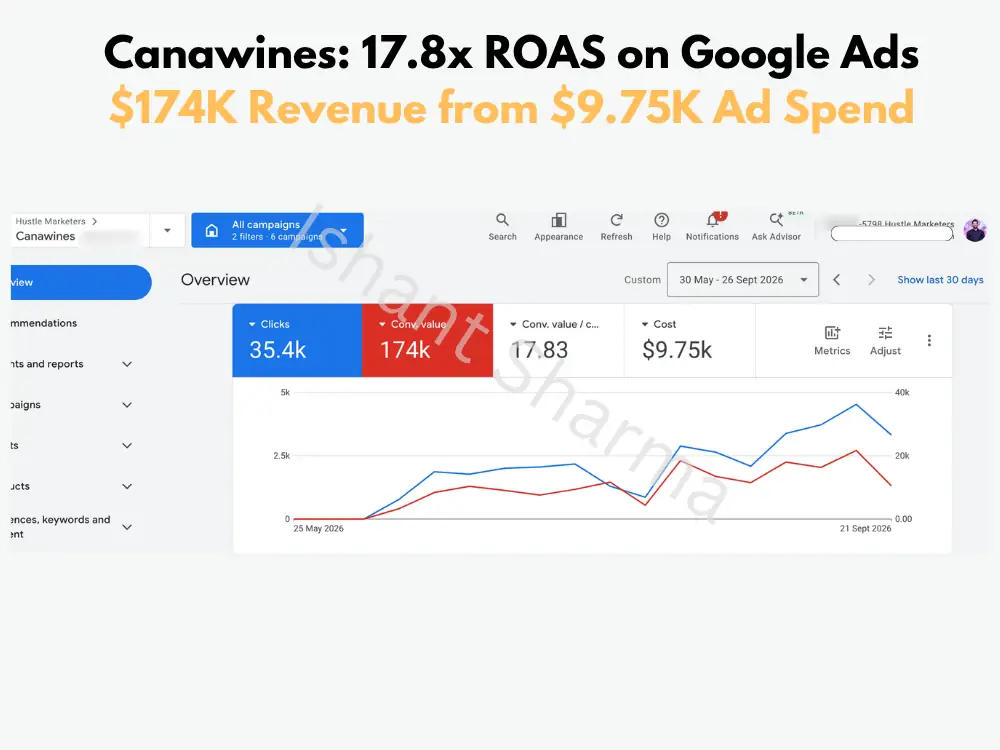
This alcohol marketing case study covers CANA Wine Company, a family-owned wine and spirits retailer based in Nashville, Tennessee. The store sells rare and allocated bourbon, whiskey, scotch, tequila, gin, vodka, fine wine and champagne, with price tiers running from under $50 to over $4,000, and ships across the United States. Hustle Marketers runs their Google Ads.
Over 120 days, from 30 May to 26 September 2026, the account turned US$10,214.37 of ad spend into US$177,209.41 of tracked conversion value. That is 17.35 return on ad spend, 1,712 conversions and a cost per conversion of US$5.97.
Every figure below comes from a screenshot of the live Google Ads account, with campaign names blurred. The section on what these numbers do not show sets out the attribution and seasonality caveats, because a ROAS figure without its caveats is marketing, not reporting.
Key Observations
- US$10,214.37 in spend returned US$177,209.41 in tracked conversion value over 120 days, a ratio of 17.35 to 1. Ad cost sat at roughly 5.8 percent of tracked revenue.
- The account took 1,712 conversions at US$5.97 each, with a 4.41 percent conversion rate. The implied value per conversion is about US$103.51, which matches a catalog built on single bottles rather than baskets.
- Performance was not evenly spread. The strongest campaign returned 27.05x at a US$3.68 cost per conversion. The weakest returned 7.58x at US$11.85. That is a 3.6x gap inside one account.
- Two campaigns took 37.9 percent of the spend and produced 56.8 percent of the value. In a catalog where stock is allocated and finite, that concentration is the whole game.
- Blended cost per click across the 35.4K clicks in the overview was roughly US$0.28, well under the US$1.30 to US$4.11 Semrush reports for the buying keywords in this niche. Shopping and feed-led traffic, not head term search, is what makes the math work here.
- Several campaigns showed Limited by budget, and asset groups were flagged as limited by policy. Both are normal in alcohol accounts and both are visible in the screenshot.
Alcohol Marketing Case Study at a Glance
| Detail | Information |
|---|---|
| Client | CANA Wine Company |
| Category | Rare and allocated bourbon, whiskey, scotch, tequila, gin, vodka, fine wine, champagne, accessories and gift sets |
| Location | Nashville, Tennessee, shipping across the United States |
| Platform | Shopify |
| Price range | Under $50 through to $1,000 plus, with dedicated collections at each tier |
| Buyer | Collectors chasing allocated bottles, gift buyers, and shoppers searching a named bottle rather than a category |
| Work covered | Google Ads strategy, campaign structure, Shopping and Performance Max, product feed, negative keywords, bidding and reporting |
| Measurement window | 120 days, 30 May to 26 September 2026 |
| Ad spend | US$10,214.37 (account), US$9,753.51 (enabled campaigns) |
| Tracked revenue | US$177,209.41 (account), US$173,962.15 (enabled campaigns) |
| Return on ad spend | 17.35x account, 17.84x across enabled campaigns |
| Data source | Google Ads interface screenshots, taken 26 September 2026 |
Why Is Alcohol Marketing Different From Other Ecommerce Marketing?
Most ecommerce advice assumes you can advertise your product anywhere you can ship it, say anything true about it, and scale a winning campaign by raising the budget. In beverage alcohol, all three assumptions break. Our companion guide, what to check before you hire an alcohol marketing agency, covers the full 2026 policy picture across Google, Microsoft and Meta, the certifications that do and do not exist, the Merchant Center feed rules and the state shipping map.
Google decides where you can advertise, and the map changed in July 2026
Google allows the promotion of alcohol, including hard liquor, beer, wine, champagne and cider, but only in an approved list of locations, and only when the ad does not target minors or appeal primarily to them. Ads must not imply that alcohol improves ability, confidence or social standing, must not claim therapeutic or health benefits, and must not show drinking before or during activities that require sobriety. The full rules are in Google’s alcohol advertising policy.
On 28 July 2026 Google expanded the approved locations, adding markets including Brazil, Finland, Iceland, Croatia, Serbia, Slovenia, South Korea, Vietnam, Jamaica, Ecuador and a group of African markets, with alcohol by volume caps in some of them: under 2.25 percent in Iceland, under 5 percent in Ecuador and under 5.5 percent in Vietnam. Google published the change in its alcohol policy country expansion note. If your targeting map was built before that date, it is out of date.
Shipping law, not ambition, sets your geo targeting
Advertising permission and shipping permission are two separate questions, and the second is narrower. Direct to consumer wine shipping is open in most of the United States. Spirits are not. Sovos listed ten jurisdictions permitting direct to consumer spirits shipping as of 28 August 2026: Alaska, Arizona, Kentucky, Nebraska, New Hampshire, New York, North Dakota, Rhode Island, Vermont and the District of Columbia, and noted that the rules differ for producers and retailers.
The practical consequence for a Google Ads account is simple. Every click from a state you cannot legally ship to is a click you paid for and cannot fulfil. Location exclusions and shipping settings in the feed are not housekeeping in this niche, they are the difference between a profitable account and a leaking one. The compliant shipping map is set by the client’s own licensing and counsel, and the account is built to match it.
Allocated stock sells out faster than a campaign can learn
A bottle of Pappy Van Winkle or a single barrel pick is not a replenishable SKU. It arrives in small quantity, sells, and is gone. Smart bidding wants weeks of stable signal, and this catalog gives it days. That is why the feed, availability and price accuracy matter more here than the bid strategy does. A campaign pushing traffic at a sold out bottle burns budget and trains the algorithm on the wrong thing.
The money is in gifting, and gifting is seasonal
Semrush shows whiskey gift set at 1,300 US searches a month and bourbon gift set at 590, both at keyword difficulty under 15. Wine gift delivery runs 1,300 a month at a US$4.11 cost per click. Gift intent is cheaper to win than category intent and it concentrates into a short window each year.
Your creative has rules before it has a brief
No minors shown or implied, no themes, characters, music or games that appeal primarily to minors, no suggestion that alcohol solves a problem, no health claims. In Performance Max, that constraint lands at the asset group level, which is exactly what the Limited by policy flags in the account screenshot are reporting.
What Does the Account Actually Look Like?
Six campaigns were enabled in the window, plus one draft in progress. The mix runs Shopping and Performance Max alongside Search. Several campaigns carried a Limited by budget status, and two showed all asset groups limited by policy, which is the standard alcohol constraint rather than a fault in the build.
What we do on an alcohol account of this shape:
- Split by margin and intent, not by product type. Allocated and rare bottles, everyday spirits, fine wine and gift sets behave differently on conversion rate and value, so they do not share a budget.
- Treat the product feed as the campaign. Titles carry the bottle name, proof, size and vintage because that is what people type. Availability and price are kept accurate so budget does not chase sold out stock.
- Hold negatives at account level. A miss at campaign level is a miss everywhere. Account level negative lists mean a job search or a cocktail recipe query cannot leak into a new campaign later.
- Match geo targeting to the legal shipping map, not to where demand looks biggest.
- Report on value, not conversions. With bottles from $40 to $4,000 in one catalog, conversion count tells you almost nothing on its own.
What Results Did 120 Days of Google Ads Deliver?
The account level numbers
| Metric | Enabled campaigns | Account total |
|---|---|---|
| Cost | US$9,753.51 | US$10,214.37 |
| Conversions | 1,677.57 | 1,712.00 |
| Cost per conversion | US$5.81 | US$5.97 |
| Conversion rate | 4.42% | 4.41% |
| Conversion value | US$173,962.15 | US$177,209.41 |
| Conversion value per cost (ROAS) | 17.84 | 17.35 |
Derived from those figures: value per conversion of about US$103.51, ad cost at about 5.8 percent of tracked revenue, and a blended cost per click of roughly US$0.28 across the 35.4K clicks shown in the overview.
The campaign level spread
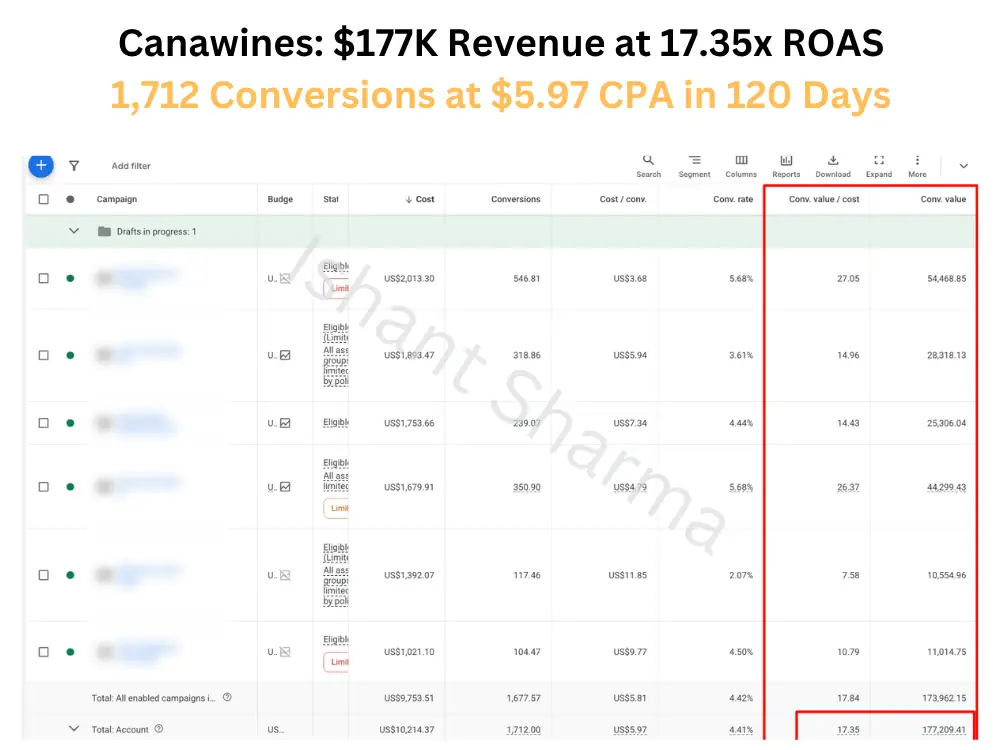
| Campaign | Cost | Conversions | Cost per conv. | Conv. rate | ROAS | Conversion value |
|---|---|---|---|---|---|---|
| A | US$2,013.30 | 546.81 | US$3.68 | 5.68% | 27.05 | US$54,468.85 |
| B | US$1,893.47 | 318.86 | US$5.94 | 3.61% | 14.96 | US$28,318.13 |
| C | US$1,753.66 | 239.07 | US$7.34 | 4.44% | 14.43 | US$25,306.04 |
| D | US$1,679.91 | 350.90 | US$4.79 | 5.68% | 26.37 | US$44,299.43 |
| E | US$1,392.07 | 117.46 | US$11.85 | 2.07% | 7.58 | US$10,554.96 |
| F | US$1,021.10 | 104.47 | US$9.77 | 4.50% | 10.79 | US$11,014.75 |
| All enabled | US$9,753.51 | 1,677.57 | US$5.81 | 4.42% | 17.84 | US$173,962.15 |
| Account | US$10,214.37 | 1,712.00 | US$5.97 | 4.41% | 17.35 | US$177,209.41 |
Why Did the Best Campaign Return 27x and the Weakest 7.6x?
Campaigns A and D both converted at 5.68 percent and both returned over 26x. Campaign E converted at 2.07 percent and returned 7.58x on a cost per conversion three times higher than A.
The pattern is consistent with what we see across beverage accounts. Campaigns pointed at named, in demand bottles convert on first visit because the shopper already decided what they want and is only deciding where to buy it. Campaigns pointed at broad category demand have to do the choosing for the shopper, and the conversion rate halves.
The decision that follows is not to pause the weaker campaign on sight. E still returned 7.58 to 1. The question is whether the next dollar does more inside A and D, and in an allocated catalog the honest answer is often no, because the stock behind the best campaign is finite. That is the real constraint in this niche, and it is why Limited by budget on a 27x campaign is not always the emergency it looks like.
What Do These Numbers Not Show?
- This is Google Ads reported conversion value. It is credited by the platform’s own attribution model, not deduplicated against email, organic or direct. A blended view in analytics or in the Shopify back office will read lower.
- Brand demand is inside the totals. Any account running Shopping and Performance Max captures some search for the store’s own name. We do not claim that as incremental.
- The window is 120 days, not a full year. It runs through late summer into the start of the fall allocated releases, which is a rising part of the calendar for this catalog, and it stops before the Q4 gifting peak.
- Conversions are counted with decimals, which means more than one conversion action is being counted and some are modeled rather than observed.
- Return on ad spend is revenue, not profit. Margin on allocated bottles, shipping cost and payment fees sit under this number and belong to the client.
- Campaign names are blurred, so the campaign letters in the table are ours, not the client’s.
Which Keywords Should a Wine and Spirits Store Bid On?
These are the keywords a store like this should be buying, not the keywords someone uses to find an agency. Volume, keyword difficulty and cost per click are from Semrush, United States database, pulled on 2 October 2026. Keywords with no recorded volume have been dropped.
| Keyword | US volume | KD | CPC (USD) | Intent | Match type | Where it belongs |
|---|---|---|---|---|---|---|
| dom perignon price | 8,100 | 24 | $0.31 | Transactional | Phrase | Champagne and fine wine |
| rare bourbon | 2,900 | 20 | $0.73 | Commercial | Phrase | Rare and allocated |
| allocated bourbon | 2,400 | 6 | $0.44 | Commercial | Phrase | Rare and allocated |
| whiskey gift set | 1,300 | 14 | $1.60 | Commercial | Phrase | Gifting, Search and Shopping |
| wine gift delivery | 1,300 | 20 | $4.11 | Commercial | Phrase | Gifting |
| pappy van winkle for sale | 1,000 | 10 | $1.38 | Transactional | Phrase and exact | Named bottle |
| buy bourbon online | 1,000 | 23 | $1.94 | Commercial | Phrase | Bourbon core |
| buy whiskey online | 880 | 35 | $2.00 | Transactional | Phrase | Whiskey core |
| bourbon gift set | 590 | 10 | $1.78 | Commercial | Phrase | Gifting |
| buy champagne online | 390 | 17 | $2.94 | Transactional | Phrase | Champagne and fine wine |
| blanton’s bourbon for sale | 320 | 27 | $1.34 | Transactional | Exact | Named bottle |
| buy tequila online | 260 | 11 | $2.25 | Transactional | Phrase | Tequila |
| fortaleza tequila for sale | 140 | 8 | $1.45 | Transactional | Exact | Named bottle |
| barrel pick bourbon | 110 | 7 | $0.49 | Informational | Phrase | Upper funnel, low bid |
| bourbon online store | 110 | 19 | $1.27 | Commercial | Phrase | Category |
| whiskey online store | 110 | 42 | $1.42 | Commercial | Phrase | Category |
| wine delivery | 12,100 | 84 | $3.92 | Commercial | Exact only | Test, tight negatives |
| liquor delivery | 9,800 | 51 | $2.72 | Commercial | Exact only | Test, tight negatives |
| buy wine online | 2,900 | 80 | $2.79 | Commercial | Phrase | Wine core |
| best online liquor store | 1,000 | 73 | $1.32 | Commercial | Phrase | Comparison |
| order liquor online | 1,000 | 69 | $2.42 | Commercial | Phrase | Test |
| buy liquor online | 590 | 74 | $1.79 | Commercial | Phrase | Test |
| online wine shop | 480 | 85 | $2.06 | Commercial | Phrase | Test |
The pattern worth copying: the named bottle terms are the cheapest and the most transactional. Pappy van winkle for sale costs US$1.38 a click at keyword difficulty 10. Wine delivery costs US$3.92 at difficulty 84. A store with allocated inventory should spend where its inventory is the answer to the query.
Which Negative Keywords Should an Alcohol Account Hold at Account Level?
We hold these at account level rather than campaign level, so a new campaign inherits the protection on day one instead of relearning it with budget.
| Theme | Example negatives | Why it matters |
|---|---|---|
| Jobs and careers | jobs, hiring, salary, career, vacancies | No purchase intent at all, and these terms attract volume |
| DIY and production | how to make, recipe, cocktail recipe, home brew, still plans, mash bill | Research intent, almost never buys a $300 bottle |
| Education and licensing | wset, sommelier course, bartending school, liquor license, how to open a liquor store | Trade and student intent, not retail demand |
| Free and discount hunting | free, cheapest, coupon code, promo code | Margin on allocated stock does not support discount seekers |
| Health and consumption | calories, carbs, hangover, abv chart, rehab, addiction, support group | Irrelevant, and the wrong context for an alcohol ad to appear in |
| Age and identity | under 21, fake id, minor | Policy risk before it is a budget problem |
| Props and empties | empty bottle, bottle decor, costume, display only | Different product, different buyer |
| Wholesale and trade | wholesale, distributor, bulk pricing, case pricing for bars | A separate lane from direct to consumer retail |
| Tours and venues | distillery tour, winery tour, tasting room, bar near me | Experience intent, not shipping intent |
| Non alcoholic, if not stocked | non alcoholic, zero proof, mocktail, alcohol free | Only add this if you genuinely do not sell the category |
Two cautions. Do not blanket negative the word gift, because gifting is one of the strongest commercial clusters in this niche. Do not negative a brand name you actually stock, even if it looks like research intent, because named bottle searches are where the cheapest conversions live.
What Does a Click Cost in the Alcohol Niche?
Semrush reports US cost per click in this category between US$0.31 and US$4.11 on the buying keywords above. The blended cost per click in this account came in at roughly US$0.28, because most of the volume arrived through Shopping and feed led placements rather than head term search auctions.
That gap is the single most useful planning number on this page. If you budget an alcohol ecommerce account using head term search cost per click, you will overestimate your cost and underestimate the volume a clean product feed can buy.
When Should an Alcohol Brand Plan Its Advertising Year?
| Window | What drives demand | Prepare by |
|---|---|---|
| January | Demand dips as moderation campaigns run | Hold budget, clean the feed, fix disapprovals |
| February | Valentine’s gifting, champagne and premium wine | Mid January |
| May | Kentucky Derby and Mother’s Day, bourbon and sparkling | Mid April |
| June | Father’s Day, the strongest single whiskey gifting moment outside Q4 | Mid May |
| September to November | Fall allocated releases drive named bottle search | Late August, with feed availability watched daily |
| Late November to December | Thanksgiving through New Year, the gifting peak | Mid October, so Merchant Center review and learning are done before demand arrives |
Why Does the Product Feed Matter Beyond Paid Ads?
An approved Merchant Center feed does two jobs. It powers Shopping and Performance Max, and it powers free listings, which are Google’s organic product results and carry no cost per click. For a store with hundreds of bottles, that is a second distribution channel running off the same file. Our guide on free Google Shopping listings versus paid Shopping ads explains where each one appears and how they differ.
Google’s alcoholic beverages policy for Merchant Center allows the promotion of hard alcohol, liquor, beer, wine, champagne and cider when the requirements are met. The listing must not target minors, defined as anyone under 18 or the local legal drinking age where that is higher, and must only target locations where alcohol listings are allowed. Google also states that a violation of this policy does not lead to immediate suspension without warning, and that a warning is issued at least seven days before any suspension, which is a window most merchants do not know they have.
Feed hygiene is where most alcohol accounts quietly lose money. If you are seeing disapprovals, our reference on Google Merchant Center errors and what each one means and the Google product data specification cover the attributes and the fixes.
What Did the Client Say?
The client left a 5 out of 5 review for the engagement, titled “Google Ads + Shopify Audit, Recap and Fix”, covering 8 May 2026 to 14 September 2026.
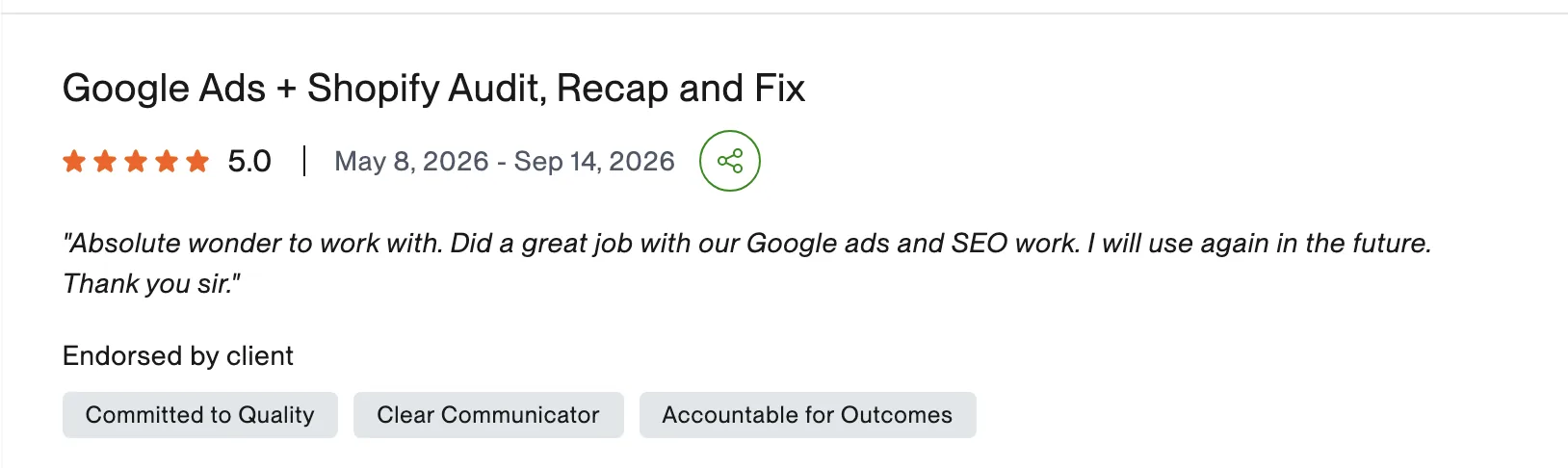
Absolute wonder to work with. Did a great job with our Google ads and SEO work. I will use again in the future. Thank you sir.
CANA Wine Company, 5.0 out of 5
Why Choose Hustle Marketers or Ishant Sharma for Alcohol Marketing?
This account is run by Ishant Sharma, founder of Hustle Marketers, who has worked in digital marketing since 2013 as a Google Ads, Microsoft Ads and SEO specialist. What makes the difference in beverage alcohol:
- We build to the legal shipping map first. Targeting follows what the client can actually fulfil, state by state, before it follows demand.
- We treat the feed as the campaign. In a catalog of allocated bottles, availability and title accuracy move revenue more than bid tweaks do.
- We hold negatives at account level. Recipes, jobs, courses, tours and trade queries are blocked once, everywhere, permanently.
- We know the policy surface. Asset groups limited by policy, age and targeting rules, the seven day Merchant Center warning window and the July 2026 location expansion are part of the working brief, not a surprise mid quarter.
- We report with the caveats attached. You get the platform number, the derived number and what each one leaves out. Our approach to that is set out in our guide to PPC reporting.
If you want this run on your account, see our Google Ads agency and ecommerce PPC management pages.
Related Reading and Case Studies
- Alcohol marketing agency: what to check before you hire one, and the 2026 ad rules.
- Judaica ecommerce paid ads case study: 17.15x ROAS on Google Ads and 15.47x on Meta, another restricted-category account.
- Judaica ecommerce SEO case study: 31% more organic clicks and AI search visibility.
- Building block toy brand: from $0 to 8.5x ROAS in 60 days.
Frequently Asked Questions
Can you advertise alcohol on Google Ads?
Yes, in the countries Google lists as approved for alcohol promotion, which include the United States. Ads must not target minors or appeal primarily to them, must not imply that alcohol improves ability or offers health benefits, and must not show drinking before activities that require sobriety. Google expanded the approved location list on 28 July 2026, so a targeting map built before that date should be rechecked.
What ROAS is realistic for a wine and spirits ecommerce store?
There is no single benchmark, because it depends on average order value, the share of named bottle demand and how much of the catalog is allocated. In this account, 120 days returned 17.35x on US$10,214.37 of spend at a US$103.51 value per conversion. A store built on $15 bottles with no allocated inventory would not see the same ratio on the same work.
Why is the cost per click so much lower than Semrush suggests?
Semrush reports the cost per click for search auctions on those keywords. Most of the volume in this account came through Shopping and feed led placements, which price differently. The blended cost per click here was roughly US$0.28 against Semrush figures of US$0.31 to US$4.11 for the same category.
Do I need a certificate to sell alcohol through Google Merchant Center?
For alcoholic beverages in the United States, Google’s Merchant Center policy sets requirements on targeting, age and location rather than a Google issued certificate. Google does require a separate certification for alcohol advertising in Poland, and for 0 percent alcohol beverages in Egypt, India and Indonesia. Your own state and federal licensing obligations as a retailer are separate from Google’s policy and are not waived by it.
What happens if my alcohol listings break Merchant Center policy?
Google states that violations of the alcoholic beverages policy do not lead to immediate account suspension without prior warning, and that a warning is issued at least seven days before any suspension. That is a window to fix the feed rather than a reason to relax about it.
Why do Performance Max asset groups get limited by policy in alcohol accounts?
Alcohol is a restricted category, so asset groups are reviewed against the alcohol rules and can be served under limits rather than disapproved outright. Seeing the status is normal. What matters is whether the limited asset groups are still serving and converting, which is checked campaign by campaign rather than assumed.
Can I ship spirits to every US state?
No. Direct to consumer wine shipping is far more widely permitted than spirits. Sovos listed ten jurisdictions allowing direct to consumer spirits shipping as of 28 August 2026, and noted the rules differ between producers and retailers. Your licensing and legal counsel set the map, and the ad account should be targeted to match it.
Which keywords convert best for an online liquor store?
Named bottle searches. Pappy van winkle for sale runs 1,000 US searches a month at keyword difficulty 10 and US$1.38 a click, while wine delivery runs 12,100 at difficulty 84 and US$3.92 a click. If you hold the bottle someone is searching for, that search is the cheapest conversion available to you.
Is this case study anonymised?
The client is named with permission. Campaign names are blurred in the screenshots, so the campaign letters A to F in the table are ours.
Want the Same Results for Your Wine or Spirits Store?
If you run an online liquor store, a winery, a distillery or a beverage brand selling direct to consumer, we can review your Google Ads account, your Merchant Center feed and your targeting map against the states you can actually ship to, and show you where the budget is leaking. Claim your free $500 marketing audit and tell us which season you want to be ready for.
Summarise this case study with: