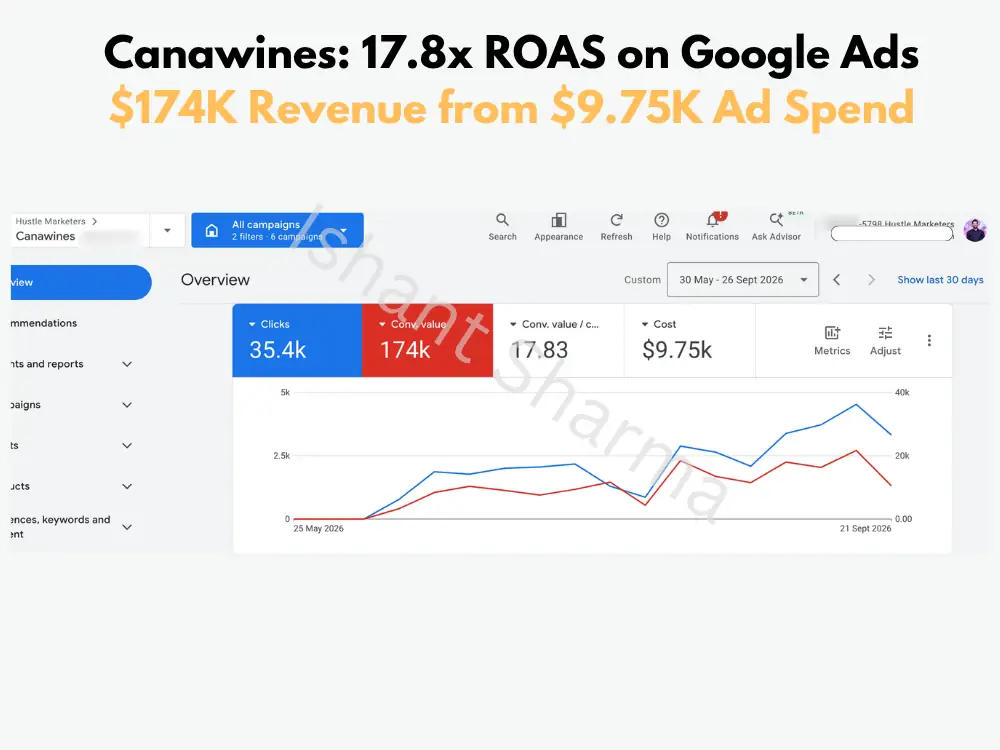
Judaica Ecommerce Paid Ads Case Study: 17.15x ROAS on Google Ads and 15.47x on Meta for Eichlers

Ishant
Published : October 2, 2026 at 8:07 am
Updated : October 22, 2026 at 10:20 am
Ishant
By Ishant Sharma, a Google Ads specialist working in digital marketing since 2013 and founder of Hustle Marketers. Published 2 October 2026. All figures read from the live ad accounts on 2 October 2026.
This case study covers Eichlers, a long-established Brooklyn Judaica and Jewish books retailer selling nationally online. Hustle Marketers runs their Google Ads and their Meta Ads. We also run their SEO and product feed work, which is covered separately in the Judaica ecommerce SEO case study.
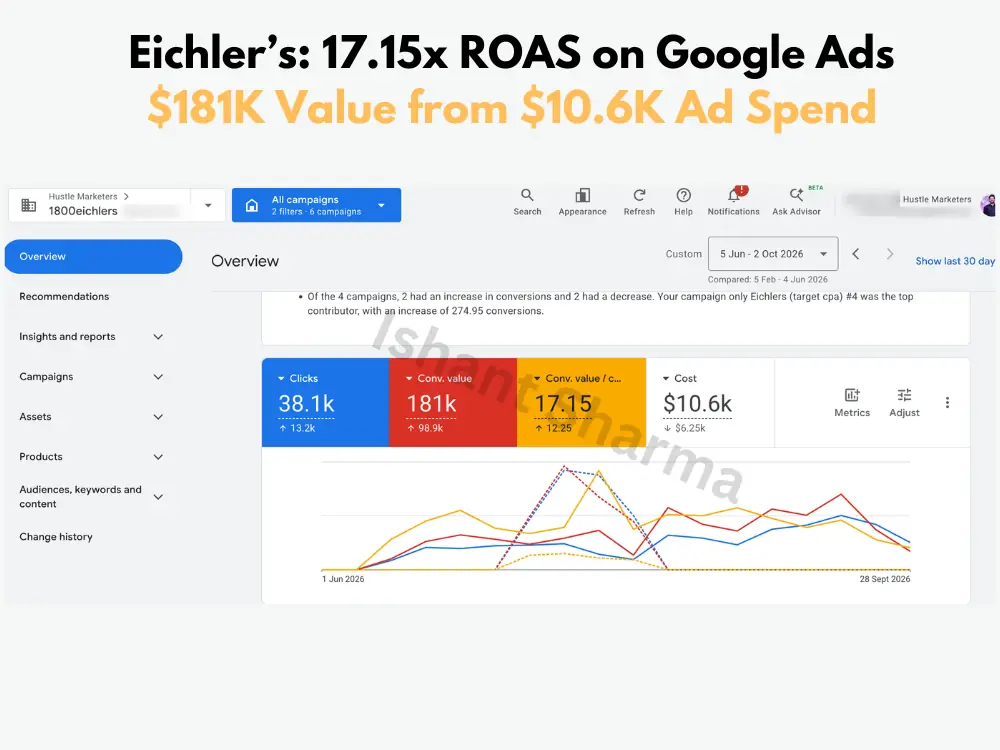
The short version: over 120 days the Google Ads account spent 37 percent less than the previous 120 days and returned more than twice the tracked revenue. Return on ad spend went from 4.90 to 17.15. Over roughly the same window, Meta Ads returned 15.47 on purchases conversion value.
Both figures come from screenshots of the live accounts. The section on what these numbers do not show sets out the attribution and seasonality caveats, because a ROAS figure without its caveats is a claim, not a report.
Key Observations
- Google Ads spend fell from about $16.85K to $10.6K, a 37 percent cut, while tracked conversion value rose from about $82.1K to $181K. ROAS went from 4.90 to 17.15.
- Clicks rose 53 percent on that smaller budget, from about 24.9K to 38.1K. Average cost per click fell from roughly $0.68 to $0.28, a 59 percent drop.
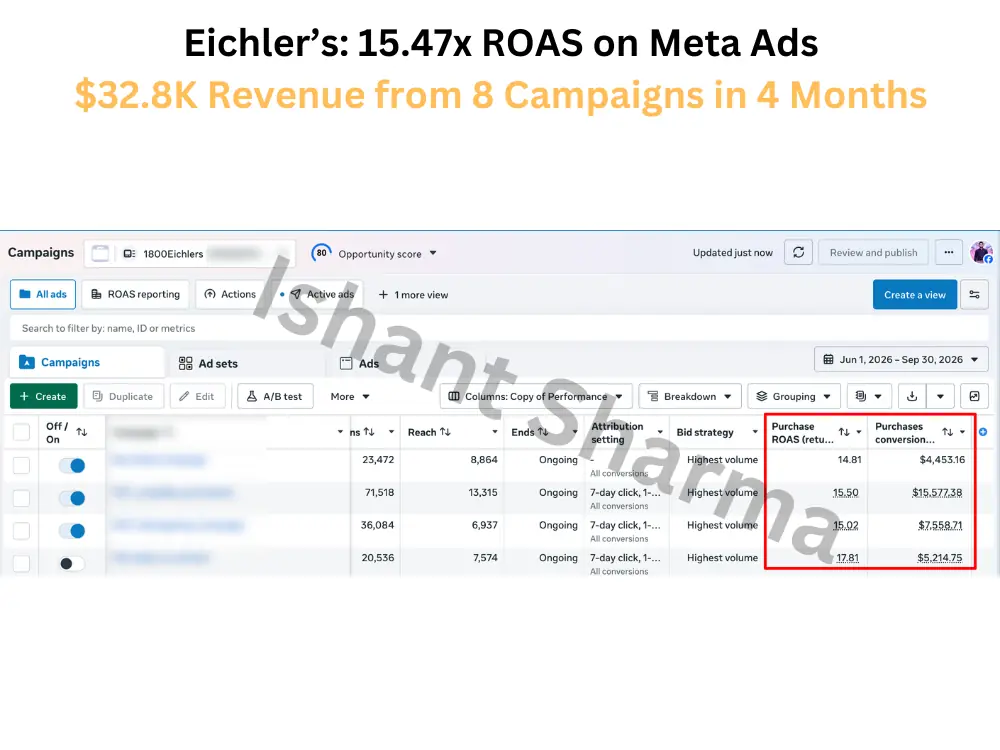
- Meta Ads returned 15.47 blended purchase ROAS across 8 campaigns, with $32,804 of purchases conversion value in the four largest campaigns and individual campaign ROAS between 14.81 and 17.81.
- Judaica is a cheap-click, low-difficulty category. Semrush puts the US cost per click on core category terms between $0.15 and $2.24, with keyword difficulty as low as 3 on terms doing 880 searches a month.
- You cannot target Jewish buyers as an interest on Meta. Those options were removed in January 2022, and “Jewish holidays” was one of the examples Meta gave.
- Google classifies religious products as a sensitive interest category, which blocks Customer Match, your-data segments, audience expansion and lookalike segments. The standard ecommerce remarketing playbook is not available on this account.
- Performance Max can carry an ad schedule, but not schedule bid adjustments. For a store that closes for Shabbos, a fixed schedule is a structural problem, because Shabbos times move every week.
- The Shabbos window moves about four hours across the year. In Brooklyn, candle lighting is around 4:10pm in December and around 8:04pm in June. Any fixed ad schedule is wrong for most of the year.
Judaica Ecommerce Paid Ads Case Study at a Glance
| Detail | Information |
|---|---|
| Client | Eichlers, Judaica and Jewish books retailer |
| Location | Brooklyn, New York, with showrooms and a national online store |
| Company size | 11 to 50 employees, as listed on the client’s Clutch review |
| Catalog | Seforim and English Jewish books, tallis and tefillin, mezuzos, menorahs, kiddush cups, Shabbos and Yom Tov items, holiday departments, gifts, children’s items, Jewish music |
| Channels in this case study | Google Ads and Meta Ads |
| Other work | SEO, site structure, content, Merchant Center feed, free listings and AI search visibility, covered in the separate SEO case study |
| Google Ads window | 120 days, 5 June to 2 October 2026, compared with 5 February to 4 June 2026 |
| Meta Ads window | 1 June to 30 September 2026, 8 campaigns |
| Google Ads result | $181K conversion value on $10.6K cost, 17.15 return on ad spend |
| Meta Ads result | $32,804 purchases conversion value, 15.47 blended purchase ROAS |
| Client rating | 5.0 out of 5 on Clutch, 16 July 2026 |
| Data source | Google Ads and Meta Ads Manager screenshots, read 2 October 2026 |
Why Is Paid Advertising for a Judaica Store Different?
Four things make this category genuinely different from general ecommerce, and three of them are platform restrictions rather than marketing choices.
You cannot target Jewish buyers as an interest on any platform
Meta removed detailed targeting options tied to religion, along with health, race and ethnicity, political affiliation and sexual orientation. The change was announced on 9 November 2021 and took effect on 19 January 2022, and Jewish holidays was one of the examples Meta named as a removed interest. Meta has since been phasing out detailed targeting more broadly.
So the obvious plan, target people interested in Judaism and show them a menorah, has not been available for nearly five years. What works instead is creative that speaks to the buyer, a clean product catalog, good pixel and Conversions API signal, and letting the system find the audience. That is the opposite of how most agencies still describe this market.
Google treats religious products as a sensitive category, which removes your remarketing
This is the operational fact that shapes the whole account, and almost nobody writes about it. Google’s personalized advertising policy on religious beliefs names religious products and topics as a sensitive interest category. Advertisers in a sensitive category cannot use advertiser-curated audiences, because those can carry sensitive user signals. In practice that removes:
- Customer Match, so you cannot upload your buyer list
- Your data segments, which is site remarketing
- Audience expansion
- Lookalike and similar segments
What remains is Google’s own predefined targeting: in-market segments, affinity audiences, demographics, life events, location and limited custom segments. A 17.15x account built without remarketing is a harder result than a 17.15x account built with it, and it is worth saying out loud because the standard playbook does not apply here.
The same restriction class applies to alcohol, which is why the pattern shows up again in our alcohol marketing case study and is covered in depth in the alcohol marketing agency guide.
Demand runs on a calendar the ad platforms do not know about
Google and Meta optimise against a Gregorian year. This catalog does not sell on one. Menorahs sell in a short window before Chanukah, seder plates and matzah covers before Pesach, and the entire year has to be planned backwards from sundown dates that move every year.
Worse for reporting: 5787 is a Hebrew leap year, so the spring season sits about three weeks later in 2027 than in 2026. Purim moves from early March 2026 to 22 March 2027, and Pesach moves from early April 2026 to 21 April 2027. Any month-over-month year-on-year comparison will mis-attribute the spring peak. We compare holiday-relative weeks, not calendar months.
The store closes, and the closing time moves four hours across the year
This client does not transact on Shabbos or Yom Tov. That is their decision as a business, not a universal rule, and it has a direct cost in paid media: ads that keep serving into a window where nobody can check out.
The hard part is that the window moves. Hebcal candle-lighting times for Brooklyn 11219 put Shabbos starting around 4:10pm on Fridays in December 2026 and around 8:04pm in early June 2027. A schedule set once, say pause Friday 4pm to Saturday 6pm, destroys four hours of peak Friday afternoon traffic in summer and leaves the account live into Shabbos in winter. A correct implementation has to move every week, which is a scripted job rather than a settings change.
One correction worth making here, because we have said it loosely before: Shabbos ends at nightfall on Saturday, not Sunday morning. The hours right after havdalah are one of the highest intent windows of the week for this audience, because everyone comes back online at once. Pausing through to Sunday throws that away.
Performance Max can be scheduled, but not around a moving Shabbos window
Google’s ad scheduling works at day and hour level on Search and Shopping, and a Performance Max campaign can carry an ad schedule too: the Google Ads scripts reference documents an addAdSchedule method for Performance Max campaigns. What Performance Max does not support is ad schedule bid adjustments, which Google’s Performance Max feature compatibility list marks as unsupported. So the schedule is on or off, with no bid changes by hour. For a store that closes for Shabbos, a schedule set once is wrong for most of the year, because the start time moves by about four hours. The workable options are updating the schedule every week, by hand or with a script, or managing budget around the window. That constraint, not creative, is what decides campaign structure on an account like this. Our guide on Performance Max versus Search covers the wider trade-off.
What Did Google Ads Deliver in 120 Days?
| Metric | 5 Feb to 4 Jun 2026 | 5 Jun to 2 Oct 2026 | Change |
|---|---|---|---|
| Cost | About $16.85K | $10.6K | Down $6.25K, about 37% |
| Clicks | About 24.9K | 38.1K | Up 13.2K, about 53% |
| Conversion value | About $82.1K | $181K | Up $98.9K, about 120% |
| Conversion value per cost | About 4.90 | 17.15 | Up 12.25 |
| Average cost per click | About $0.68 | About $0.28 | Down about 59% |
The prior period figures and the cost per click lines are derived by applying the interface deltas to the current period totals. The current period figures and the four deltas are read directly from the screenshot.
The account’s own insight panel reported that of the four campaigns, two increased conversions and two decreased, and that the single biggest contributor added 274.95 conversions. That matters more than it sounds: this was not a rising tide. It was concentration.
How Did Spend Fall 37 Percent While Revenue More Than Doubled?
Three things move a number like that, and none of them is a clever bid tweak.
- The cheap clicks were already there. Judaica is not an expensive auction. Semrush puts menorah at $0.43 a click, seder plate at $0.15 and dreidel at $0.33. When the blended cost per click falls from $0.68 to $0.28 in a category priced like that, the earlier account was buying the wrong traffic, not expensive traffic.
- Budget moved to where the catalog is the answer. Spend concentrated behind the campaigns that match named-product demand, the same pattern we see in other catalog accounts. Two of four campaigns went backwards on conversions while the account more than doubled, which only happens when money is being taken from somewhere and given somewhere else.
- The feed carries the weight. With remarketing off the table, the product feed is the main lever. Accurate titles, availability and categorisation decide what gets shown. Our notes on Merchant Center errors and free Shopping listings versus paid ads cover that side.
What Did Meta Ads Deliver?
| Campaign | Impressions | Reach | Bid strategy | Purchase ROAS | Purchases conversion value |
|---|---|---|---|---|---|
| A | 71,518 | 13,315 | Highest volume | 15.50 | $15,577.38 |
| B | 36,084 | 6,937 | Highest volume | 15.02 | $7,558.71 |
| C | 20,536 | 7,574 | Highest volume | 17.81 | $5,214.75 |
| D | 23,472 | 8,864 | Highest volume | 14.81 | $4,453.16 |
| Total, 8 campaigns (four largest shown) | 151,610 | 15.47 blended | $32,804.00 |
Eight campaigns ran in the window; these four carry the value. Implied spend behind the $32,804 at a 15.47 blended return is about $2,120, which is derived rather than read from the screenshot.
Two things stand out. The tightest campaign by ROAS, at 17.81, is also the smallest by impressions, which is the usual signal that a good audience is being under-fed. And all four run Highest volume bidding rather than a ROAS target, which on a catalog this seasonal is the right call: a value target would starve the campaigns in the weeks between holidays.
What Do the Two Channels Look Like Together?
| Channel | Window | Spend | Tracked value | ROAS |
|---|---|---|---|---|
| Google Ads | 5 Jun to 2 Oct 2026 | $10.6K | $181K | 17.15 |
| Meta Ads | 1 Jun to 30 Sep 2026 | About $2.12K (derived) | $32.8K | 15.47 |
| Combined (derived) | Roughly the same four months | About $12.7K | About $213.8K | About 16.8 |
The windows are not identical, so the combined row is an approximation offered for scale rather than a reported figure. Meta is about 17 percent of the paid budget and about 15 percent of tracked paid revenue, which is a healthy split for a catalog business where search intent does most of the work.
What Do These Numbers Not Show?
- These are platform-reported conversion values. Google Ads and Meta each credit using their own attribution. They are not deduplicated against each other, or against email, organic and direct. Add them together and you are double counting some orders. A blended view in analytics will read lower than both.
- Brand demand sits inside the totals. Any account running Shopping and Performance Max captures some search for the store’s own name. We do not claim that as incremental.
- The comparison period is not a control. The prior 120 days ran February to June. This window ran June to October, which includes the run-up to the autumn holidays. Some of the lift is calendar, not management.
- Meta attribution is 7-day click and 1-day view on three of the four campaigns. That is a wider window than a last-click view and will read higher.
- ROAS is revenue, not profit. Product margin, shipping and payment fees sit under these numbers and belong to the client.
- Campaign names are blurred, so the campaign letters are ours.
- There is no published benchmark for this category. We looked. There is no credible conversion rate or average order value figure for Judaica or religious-goods ecommerce anywhere, so treat any competitor quoting one with suspicion. The client’s own account is the benchmark.
Which Keywords Should a Judaica Store Bid On?
These are the keywords the store should be buying, not the keywords someone uses to find an agency. Volume, keyword difficulty and cost per click from Semrush, United States database, pulled 2 October 2026. Terms with no recorded volume are excluded.
| Keyword | US volume | KD | CPC | Intent |
|---|---|---|---|---|
| menorah | 60,500 | 46 | $0.43 | Informational |
| mezuzah | 33,100 | 50 | $0.71 | Informational |
| dreidel | 27,100 | 41 | $0.33 | Informational |
| shofar | 18,100 | 44 | $0.77 | Informational, commercial |
| tefillin | 14,800 | 38 | $0.90 | Informational |
| seder plate | 12,100 | 49 | $0.15 | Informational, commercial |
| chumash | 9,900 | 63 | $0.60 | Commercial |
| tallit | 9,900 | 41 | $1.16 | Informational, commercial |
| judaica | 5,400 | 67 | $0.88 | Informational |
| hanukkah gifts | 3,600 | 28 | $0.59 | Informational, commercial |
| hebrew books | 3,600 | 36 | $2.24 | Navigational |
| shabbat candlesticks | 3,600 | 7 | $0.59 | Informational, commercial |
| siddur | 3,600 | 19 | $1.75 | Informational, commercial |
| kiddush cup | 2,900 | 25 | $0.71 | Informational |
| bar mitzvah gifts | 2,400 | 23 | $0.25 | Commercial |
| jewish jewelry | 2,400 | 13 | $0.89 | Commercial |
| jewish books | 1,900 | 33 | $0.57 | Informational |
| tallis | 1,900 | 51 | $1.11 | Informational |
| jewish gifts | 1,000 | 68 | $0.81 | Informational, commercial |
| havdalah set | 880 | 3 | $0.60 | Informational, commercial |
| menorah for sale | 880 | 28 | $0.40 | Transactional |
| challah board | 720 | 5 | $0.56 | Commercial |
| sukkah decorations | 720 | 6 | $0.53 | Informational |
Three things to take from this table. Clicks are cheap, mostly under $1. Difficulty on the long tail is remarkably low, with havdalah set at 3, challah board at 5 and sukkah decorations at 6, which means the same terms are worth an organic page as well as a bid. And the transliteration split is real: tallit does 9,900 searches and tallis does 1,900, so a store serving an observant audience needs both spellings in titles, copy and the feed.
When Should a Judaica Store Plan Its Year?
Dates are Diaspora observance, which is the correct basis for a US retailer, and each holiday begins at sundown on the first date. Verified against Hebcal 5787 and Hebcal 5788.
| Holiday | Dates | What sells | Have the feed and campaigns ready by |
|---|---|---|---|
| Chanukah 5787 | 4 Dec to 12 Dec 2026 | Menorahs, candles, dreidels, gifts | Mid October |
| Tu BiShvat | 22 to 23 Jan 2027 | Fruit plates, children’s items | Early January |
| Purim | 22 to 23 Mar 2027 | Megillah, costumes, mishloach manos | Late February |
| Pesach | 21 to 29 Apr 2027 | Seder plates, matzah covers, Haggadahs, kiddush cups | Mid March |
| Lag BaOmer | 24 to 25 May 2027 | Children’s and outdoor items | Early May |
| Shavuot | 10 to 12 Jun 2027 | Books, learning items, dairy themed gifts | Mid May |
| Tisha B’Av | 11 to 12 Aug 2027 | Kinnos, seforim | Late July |
| Rosh Hashanah 5788 | 1 to 3 Oct 2027 | Shofars, machzorim, honey dishes, gifts | Mid August |
| Yom Kippur | 10 to 11 Oct 2027 | Machzorim, kittels | Late August |
| Sukkot and Simchat Torah | 15 to 24 Oct 2027 | Sukkah decorations, lulav and esrog accessories, flags | Early September |
Two calendar collisions worth planning around
Chanukah 2026 starts on Friday 4 December. Thanksgiving is 26 November and Cyber Monday is 30 November, so the last practical ship date for a night-one gift falls inside Cyber Week, when Google and Meta auction prices are at their annual peak. You are bidding against every retailer in America for your most time-critical week. Budget for it in October, not in November.
Then the position inverts. Chanukah 5788 begins on Friday 24 December 2027, which is Christmas Eve. The same catalog, the same holiday, and a completely different auction and shipping environment one year later. This is why year-on-year month comparisons mislead on this account.
One more scheduling trap
Six multi-day closures of three days or more fall in this window, because Yom Tov runs directly into Shabbos. The sharpest is Pesach 2027: from sundown on Wednesday 21 April to nightfall on Saturday 24 April is a single unbroken 72-hour commercial shutdown, starting the night of the first seder. On a channel with no schedule bid adjustments, that has to be planned in advance with weekly schedules, budget and campaign state.
How Big Is the Addressable Market?
Useful context for anyone sizing this category. The UJA-Federation Jewish Community Study of New York 2023 counts 1,372,000 Jewish people across the eight-county New York area, 960,000 in the five boroughs, and 462,000 in Brooklyn alone, the largest single concentration in the region. Orthodox households are 19 percent of the area, about 430,000 people.
For demand shape rather than size, Instacart’s first-party data showed matzah up 1,239 percent and gefilte fish up 742 percent against the yearly average in the week before Pesach. That is grocery, and a tallis or a set of seforim is not a last-minute purchase in the way matzah is, so borrow the shape and not the percentages: one explosive pre-holiday week, with hard goods peaking earlier than food.
What Did the Client Say?
The client left a 5.0 out of 5 review on Clutch on 16 July 2026, titled “Digital Marketing for E-Commerce Company”, scoring 5.0 for quality, schedule, cost and willingness to refer. They posted it anonymously, and the project covered digital strategy, SEO and social media marketing alongside the paid media work.
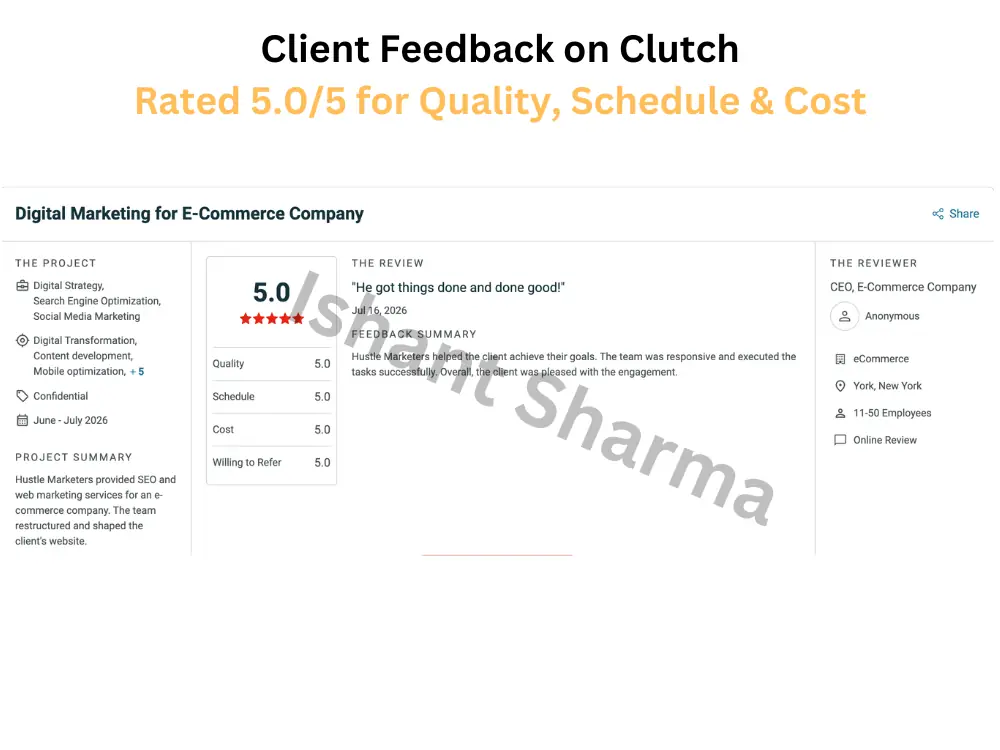
He got things done and done good!
CEO, ecommerce company, 5.0 out of 5 on Clutch
Why Choose Hustle Marketers or Ishant Sharma for Jewish and Judaica Ecommerce Marketing?
This account is run by Ishant Sharma, a Google Ads specialist who has worked in digital marketing since 2013 across Google Ads, Microsoft Ads and SEO. What makes the difference in this niche:
- We plan by the Jewish calendar, with real dates. Feeds, pages and campaigns are timed to sundown dates, and the leap year shift is built into how we report, not discovered in March.
- We know what the platforms will not let you do here. No religious interest targeting on Meta, no Customer Match or lookalikes on Google, no schedule bid adjustments on Performance Max. The structure is built around those limits from day one.
- We work around Shabbos properly. Candle lighting moves weekly, so the schedule moves weekly, and ads come back after havdalah on Saturday night rather than Sunday morning.
- We know the language. Tallit and tallis, Sukkot and Succos, seforim and English books. That lands in titles, ad copy and the product feed, and it is worth real money in a category where the transliteration split is five to one.
- Both channels under one roof. Google and Meta are planned against the same calendar and the same catalog rather than by two agencies with different reporting.
If you want this run on your account, see our Google Ads agency and ecommerce PPC management pages, or read how we report on paid media in our PPC reporting guide.
Related Case Studies and Guides
- Judaica ecommerce SEO case study, the organic and product feed side of this same engagement.
- Best Jewish marketing agency, how to choose one and what the work involves.
- Jewish marketing agency in New York.
- Alcohol marketing case study, another restricted category account at 17.35x ROAS.
- Alcohol marketing agency guide, which covers the same sensitive-category audience restrictions in detail.
Frequently Asked Questions
Can you target Jewish customers on Facebook or Instagram ads?
Not as an interest. Meta removed detailed targeting options tied to religion on 19 January 2022, and Jewish holidays was one of the examples it named. Since then Meta has been phasing out detailed targeting more broadly. You reach this audience through creative, catalog signal, pixel and Conversions API quality, and broad or Advantage+ delivery.
Why can’t a Judaica store use remarketing on Google Ads?
Google’s personalized advertising policy lists religious beliefs as a sensitive interest category and names religious products and topics as an example. Advertisers in a sensitive category cannot use advertiser-curated audiences, which covers Customer Match, your data segments, audience expansion and lookalike segments. Predefined audiences such as in-market and affinity remain available.
Can you schedule Google Ads to pause for Shabbos?
On Search and Shopping campaigns yes, through ad scheduling at day and hour level. On Performance Max no, because ad schedule bid adjustment is not supported there. And because candle lighting moves by about four hours between December and June, a fixed schedule is wrong for most of the year, so it needs to be updated weekly rather than set once.
When does Shabbos end for ad scheduling purposes?
At nightfall on Saturday, not Sunday morning. The window right after havdalah is one of the highest intent periods of the week for an observant audience, because the whole audience comes back online together. Resuming on Sunday discards it.
What ROAS is realistic for a Judaica ecommerce store?
There is no published benchmark for this category, so the honest answer is that your own account is the benchmark. In this account, 120 days returned 17.15 on Google Ads and 15.47 on Meta. Clicks in the category are cheap, mostly under $1, which makes a high ratio more achievable here than in categories with $10 clicks.
When should a Judaica store start advertising for Chanukah?
Chanukah 5787 runs 4 to 12 December 2026, so campaigns and feed should be live and approved by mid October. The last practical ship date for a night-one gift lands inside Cyber Week, when auction prices peak, so the budget for that week needs to be set well before November.
Does the Hebrew leap year affect reporting?
Yes. 5787 is a leap year, so Purim and Pesach sit about three weeks later in 2027 than in 2026. Month-over-month year-on-year comparisons will put the spring peak in the wrong month. Compare holiday-relative weeks instead.
Is the client named with permission?
Yes. Campaign names are blurred in the screenshots, so the campaign letters in the tables are ours. The Clutch review was posted anonymously by the client.
Want the Same Results for Your Jewish Business?
Whether you run a Judaica store, a Jewish bookshop, a kosher food brand or another business serving the Jewish community, we can review your Google Ads account, your Meta account, your product feed and your holiday calendar, and show you where the budget is leaking. Get Free Audit Worth $500 and tell us which Yom Tov you want to be ready for first.