Alcohol Marketing Agency: What to Check Before You Hire One, and the 2026 Ad Rules That Decide Whether You Can Advertise at All

Ishant
Published : October 2, 2026 at 2:24 am
Updated : October 11, 2026 at 8:05 pm
Ishant
By Ishant Sharma, a Google Ads, Microsoft Ads and SEO specialist working in digital marketing since 2013, and founder of Hustle Marketers. Published October 2, 2026. Policy pages read at source on October 2, 2026.
Two days before this was written, Google’s alcohol policy update took effect. On September 30, 2026 Google revised its country guidelines, expanded the locations where alcohol ads can run, and revoked every existing permission to run 0% alcohol ads in Egypt, India or Indonesia. Advertisers in those markets have to apply for certification again, and anything you read about alcohol ads from before that date needs checking.
This page is written for three different readers who all search the same terms: an online liquor retailer, a winery or wine brand selling direct to consumer, and a distillery or spirits brand. The compliance half applies to all three. The channel half does not, so there is a section that splits them.
Key Observations
- You do not need a Google certification to advertise alcohol in the United States. Google runs exactly two alcohol certifications, and neither covers the US: one for beer advertising in Poland, one for 0% alcohol beverages in Egypt, India and Indonesia.
- Microsoft Advertising has no alcohol certification either, but it is the only major platform that explicitly requires age gating mechanisms and responsible drinking messaging in the ad or on the landing page.
- Meta has no certification. Its control is age targeting, and the minimum is set per country: 21 in the United States, 25 in Sweden, 19 in Canada, 18 as the global floor. Meta also bans alcohol ads outright in 17 countries plus five Indian states and territories.
- The quiet account killer is not disapproval. Google treats alcohol as a sensitive interest category and restricts advertiser-supplied audiences, which takes most remarketing off the table, and a campaign built on those audience types can sit as approved and simply never spend.
- Mixing approved and unapproved locations in one campaign does not disapprove it. It sets the status to Eligible (limited), which throttles delivery without an obvious error.
- Merchant Center gives at least 7 days of warning before suspending an account over the alcoholic beverages policy. That window is the single most useful operational fact in the policy.
- Do not use the adult attribute on alcohol products. Google says explicitly not to. Alcohol is handled through the Alcoholic Beverages product category instead.
- Direct to consumer spirits shipping is legal in only ten US jurisdictions. Wine is far broader. Your legal shipping map, not your demand map, sets your campaign location targeting.
- In the category keyword data, named bottle searches are the cheapest and most transactional. Pappy van winkle for sale runs 1,000 US searches a month at keyword difficulty 10 and $1.38 a click. Wine delivery runs 12,100 at difficulty 84 and $3.92.
What Does an Alcohol Marketing Agency Actually Do?
An alcohol marketing agency runs the same work any ecommerce or local agency runs, plus a layer of category-specific compliance and channel restriction that changes what is possible before any strategy is written.
The part that is the same as any other agency
Keyword research, campaign structure, Shopping and Performance Max, product feed management, landing page work, email and SMS, local SEO for a physical store, measurement and reporting. None of that is special to alcohol.
The part that is genuinely alcohol only
- Mapping ad targeting to the states or countries you are actually licensed to ship to, which is a narrower map than the one Google will let you target.
- Working inside the audience restrictions, which remove most of the retargeting toolkit.
- Keeping the Merchant Center feed inside the alcoholic beverages policy and the right product category.
- Designing an age gate that satisfies a regulator without hiding your site from Google or destroying your analytics.
- Meeting TTB advertising requirements in the ad creative itself, not just on the website.
- Building SMS and email consent flows that meet carrier age-gating rules, which are stricter than the ad platforms.
If an agency cannot talk fluently about those six things, it is an ecommerce agency that is willing to take an alcohol client, which is a different proposition.
Do You Need a Certificate to Advertise Alcohol Online?
This is the question we get asked most often, and the answer is narrower than most people expect. There is no general alcohol advertising certificate. There are two country-specific Google programs and nothing on the other platforms.
| Platform | Certification required? | Who it applies to | What it controls instead |
|---|---|---|---|
| Google Ads, United States | No | Nobody. The US is an approved location with no Google certification program for alcohol | Location targeting, creative rules, audience restrictions |
| Google Ads, Poland | Yes | Anyone advertising beer. Advertising in Poland is limited exclusively to beer | Application to Google before serving |
| Google Ads, Egypt, India, Indonesia | Yes | Anyone advertising 0% alcohol beverages where standard alcohol ads are prohibited | A separate application form per location, re-certified on material change |
| Google Merchant Center | No | Nobody | Approved country list, minors definition, product category, 7 day warning before suspension |
| Microsoft Advertising | No | Nobody | Age gating mechanisms, responsible drinking messaging, country restrictions |
| Meta (Facebook and Instagram) | No | Nobody | Per-country minimum age targeting and a prohibited country list |
Google’s rules are set out in its alcohol advertising policy, and the certification programs sit on the apply to advertise certain products and services page, which states that in Poland “advertising is limited exclusively to beer” and that beer advertisers there must be certified by Google. The 0% alcohol route uses its own application form, and Google warns that each targeted location needs a separate application and that you must re-certify immediately if your application details materially change.
What a Google certification is not is a license. In the United States your obligations come from state retail licensing, state direct to consumer shipping permits and the federal TTB advertising rules. Clearing Google’s policy does not clear any of those, and no platform checks them for you.
What Changed in Alcohol Advertising Policy in 2026?
| Date | Platform | What changed |
|---|---|---|
| March 31, 2026 | Google Merchant Center | Physical goods subscriptions expanded to formally include alcohol, for example wine clubs, for eligible merchants in the United States |
| July 28, 2026 | Google Ads | Approved locations expanded, adding markets including Brazil, Finland, Iceland, Croatia, Serbia, Slovenia, South Korea, Vietnam, Jamaica, Ecuador and a group of African markets, several with ABV caps |
| September 30, 2026 | Google Ads | Policy update takes effect. Country guidelines revised and allowed locations expanded. All previous 0% alcohol permissions revoked, requiring fresh certification |
| October 30, 2026 | Google Ads / YouTube | Reported move to enable personalized targeting for alcohol ads on YouTube, with carve-outs remaining for Egypt, India, Indonesia and Poland |
Sources: Google’s July 2026 country expansion note, its August 2026 alcohol policy update announcing the September 30 update, the Merchant Center alcohol subscriptions expansion, and reporting on the YouTube personalization change. The last item is press reporting rather than a dated Google policy page, so treat it as expected rather than confirmed.
What the two Google alcohol policies mean for you
Google’s help center lists separate Alcohol sale and Alcohol information policies. Which one applies is decided by where your ad sends people, not by what your ad says.
- Alcohol sale covers ads that feature an alcoholic beverage and lead to a destination or app where alcohol can be bought. Every DTC retailer is in this bucket.
- Alcohol information covers informational and brand awareness ads where the product is not offered for online sale. A distillery running brand campaigns with no ecommerce is in this one.
The practical consequence is that a brand page which later adds a buy button moves itself from one policy to the other, and the approved location list is not identical between them. If you add ecommerce to a brand site, re-check your targeting before you re-check your creative.
Why Do Alcohol Campaigns Get Approved and Then Never Spend?
This is the most expensive thing nobody writes about. An alcohol campaign can pass review, show as eligible, and deliver almost nothing, with no error to diagnose.
The audience restriction that removes most remarketing
Google treats alcohol as a sensitive interest category. Its alcohol in personalized advertising page sets out restrictions on advertiser-supplied audience types for alcohol promotion, including Customer Match, your-data segments, audience expansion and similar or lookalike segments. Google’s stated reasoning is that advertiser-supplied data can carry sensitive signals. Users under 18 are not eligible for personalized advertising at all.
If you came from a normal ecommerce account, this removes the tactic you were relying on. Cart abandoners, past purchasers and lookalikes of your best customers are not available in the usual way. What remains is Google’s own predefined audiences: in-market, affinity, demographics, life events and limited custom segments. Alcohol is not the only category this hits. Religious beliefs are on the same list of sensitive interest categories, and our Judaica ecommerce paid ads case study shows an account built with the same restrictions in place.
Demand Gen can be approved and still unable to serve
Demand Gen campaigns lean on advertiser-curated audiences by default. Practitioners working on alcohol accounts report that this combination leaves Demand Gen campaigns unable to serve on YouTube, Shorts and Discover, with the campaign appearing healthy and simply not spending. If you are running Demand Gen on an alcohol account and the spend is near zero, audit targeting at campaign, ad group and asset group level before you touch bids. The YouTube personalization change reported for October 30, 2026 is expected to loosen part of this, which is another reason to date everything you read on the subject.
Eligible (limited) is a throttle, not a warning
If one campaign targets a mix of approved and unapproved locations, Google does not disapprove it. It marks it Eligible (limited) and quietly restricts delivery. Because nothing is red, this can run for months. Separate campaigns by policy status rather than by convenience, and check the status column rather than the approval column. The same status appears when Performance Max asset groups hit alcohol limits, which is normal in this category rather than a build fault. Our alcohol marketing case study shows exactly that status live in a profitable account.
Which Countries Can You Advertise Alcohol In?
There are three separate lists, and clearing one does not clear the others.
Google Ads
The Alcohol sale policy lists roughly 96 approved locations, including the United States, United Kingdom, Canada, Australia, Japan, South Korea and most of Europe. Some locations have an ABV ceiling and require the landing page to show the highest alcohol by volume of the products advertised.
| Location | ABV limit on what you can advertise |
|---|---|
| Iceland | Below 2.25% |
| Ecuador | Below 5% |
| Vietnam | Below 5.5% |
| India | 0% only, certification required |
| Indonesia | 0% only, certification required |
| Poland | Beer only, certification required |
Google Merchant Center has a shorter list
The alcoholic beverages policy for Merchant Center publishes its own allowed-with-limitations country table, and it is materially shorter than the Google Ads approved list, at roughly 50 locations. The United States and Poland both appear on it. The practical rule: being able to run a Search ad for alcohol in a market does not mean you can list the product in Shopping there. Check both tables before you open a new market.
Meta bans alcohol ads outright in these places
Meta’s alcohol ad standard lists countries where alcohol ads cannot run at all: Afghanistan, Bangladesh, Brunei, Egypt, Gambia, Kuwait, Libya, Lithuania, Nepal, Norway, Pakistan, Russia, Saudi Arabia, Thailand, Turkey, the United Arab Emirates and Yemen, plus the Indian states and territories of Bihar, Gujarat, Lakshadweep, Manipur and Nagaland.
What Age Do You Have to Target on Each Platform?
Meta’s floor is 18 worldwide, and the platform default will not make you compliant in the United States. You have to set the minimum age in the ad set yourself. These are the country minimums Meta publishes.
| Country | Minimum age for alcohol ad targeting |
|---|---|
| Sweden | 25 |
| India: Chandigarh, Delhi, Haryana, Maharashtra, Punjab | 25 |
| United States | 21 |
| Cameroon, Micronesia, Palau, Solomon Islands, Sri Lanka | 21 |
| India: Andhra Pradesh, Assam, Goa, Kerala, Tamil Nadu, Telangana, Uttar Pradesh, West Bengal and others | 21 |
| Iceland, Japan, Paraguay | 20 |
| Canada, Korea, Nicaragua | 19 |
| Everywhere else alcohol ads are permitted | 18 |
Two details worth knowing. Meta’s policy treats recipes for alcoholic drinks and depictions of alcohol brands or logos as alcohol ads, so a cocktail recipe video is inside the policy. And Meta allows ads for non-alcoholic products and alcohol accessories outside the alcohol rules, but only if they do not depict alcohol or consumption, which is the opposite of how Google handles 0% products.
Microsoft’s disallowed and restricted products policy states that advertising “must not glorify or incite the consumption of alcohol, and should contain proper health warnings and responsible drinking messaging”, and that all required disclaimers, age gating mechanisms and responsible drinking warnings must appear in the ad copy or on the landing page. India and Indonesia prohibit online alcohol sale advertising including branding campaigns. Malaysia and Thailand prohibit online sale advertising and restrict advertising to products at low ABV.
How Do You Set Up a Compliant Alcohol Product Feed?
Get the product category right, because it carries the policy
Alcohol is controlled in the feed through the google_product_category attribute. The policy itself tells you to refer to that attribute “for requirements on how to submit these products to an appropriate audience”. The node you want is Food, Beverages & Tobacco > Beverages > Alcoholic Beverages, category 499676, with Beer and Wine as child nodes. A product sitting in an adjacent category is a one-line fix that resolves a surprising share of blanket disapprovals. Our guide to the Google product data specification covers the attribute set in full.
Do not use the adult attribute for alcohol
This one catches people trying to do the right thing. Google’s adult attribute documentation says the attribute is for products containing adult content, and states explicitly: do not use the adult attribute for alcohol. Setting it is not a cautious extra step, it is a misclassification. The age_group attribute is an apparel sizing attribute and is not the alcohol control either.
Wine clubs and subscriptions, United States only, since March 31, 2026
Merchant Center formally added alcohol to its physical goods subscriptions policy for eligible merchants in the United States. The requirements: comply with all the standard alcoholic beverages rules, use the Alcoholic Beverages product category, include the subscription_cost attribute representing the total non-discounted periodic payment, show one subscription price per landing page, and disclose all mandatory fees clearly. If you run a wine club, this is the first time it has had a documented route into Shopping.
You get at least seven days of warning
Google’s alcohol policy for Merchant Center states that violations “will not lead to immediate account suspension without prior warning” and that a warning is issued at least 7 days before any suspension. Set an alert on Merchant Center account notifications and treat that warning as a seven day sprint, not an FYI. Our reference on Google Merchant Center errors and how to fix each one covers the common causes.
The feed is not only an ads asset
An approved feed also powers free listings, which are Google’s organic product results and carry no cost per click. For a store with hundreds of SKUs that is a second distribution channel running off one file. Our explainer on free Google Shopping listings versus paid Shopping ads sets out where each appears.
Why Does an Age Gate Break Your SEO and Your Analytics?
Almost every alcohol site has an age gate. Almost nobody writes about what it does to the rest of your marketing, so here it is.
A server side gate can hide your entire site from Google
If the gate redirects every unverified visitor, Googlebot included, Google sees one page about being over 18 and indexes nothing else. The site effectively becomes a single page.
The two obvious fixes are both flawed
Letting bots through by sniffing the user agent is cloaking under Google’s guidelines, because you are serving different content to crawlers than to people. Redirecting to a separate verification page shows crawlers nothing but the gate. The commonly recommended middle path is to render the gate in JavaScript so crawlers that do not execute it still reach the content, but a JavaScript overlay is a weak gate: a user can disable JavaScript or read the source. So the SEO-safe implementation and the compliance-safe implementation genuinely pull against each other.
The defensible resolution is to keep the gate server side and bypass it only for verified crawlers using reverse DNS and published IP ranges rather than spoofable user agent strings, which is what a CDN-level verified bot check does. That is an engineering decision, not a plugin setting, and it is worth putting in front of whoever owns the site before launch.
Your age gate becomes your top page in analytics
Site owners regularly find the age gate ranked as the single most visited page in their reporting, and on multilingual sites it occupies the first two positions. Every session starts there, which inflates entrances, distorts landing page reports and breaks any attribution view built on landing pages. Exclude it deliberately and define conversions so the gate cannot sit between the ad click and the tracked event. Our guide to PPC reporting covers how to keep platform and analytics numbers reconcilable.
And it moves your layout
Age gate overlays are a recurring cause of Cumulative Layout Shift on category pages, particularly on mobile, where the popup renders after first paint. It is a Core Web Vitals problem dressed as a compliance control.
How Does US Shipping Law Decide Your Ad Targeting?
The three tier system, in one paragraph
After Prohibition ended in 1933, states built their alcohol markets around three legally separate tiers: producers and importers, wholesalers and distributors, and retailers. Product generally has to move producer to wholesaler to retailer to consumer, and one business normally cannot hold licenses in more than one tier. Direct to consumer shipping is the exception, allowed only where a state’s own law permits it, usually under a dedicated DTC shipper permit, and the rules differ sharply between wineries, breweries, distilleries and retailers.
Spirits can be shipped DTC in ten jurisdictions
As of August 28, 2026, Sovos listed ten jurisdictions permitting direct to consumer spirits shipping: Alaska, Arizona, Kentucky, Nebraska, New Hampshire, New York, North Dakota, Rhode Island, Vermont and the District of Columbia. Several carry production caps, Vermont limits it to low ABV ready to drink products in small containers, and the rules differ between producers and retailers. Wine has a far longer list. Beer is somewhere in between.
Carriers add their own layer
| Carrier | What it requires |
|---|---|
| FedEx | Consumers cannot ship alcohol. Licensed businesses must be enrolled in the FedEx alcohol shipping program and have signed a FedEx Alcohol Shipping Agreement. Adult signature is required on every US alcohol delivery, recipient 21 or over with acceptable ID. Specific alcohol shipping labels and packaging are mandatory |
| UPS | Shippers must enter into a UPS Agreement for Approved Spirits Shippers and be licensed. Adult Signature Required service, recipient 21 or over. Special alcoholic beverages label. Approved destination states are listed in the agreement addendum |
| USPS | Cannot ship alcohol at all. Publication 52 states intoxicating liquors are nonmailable, and also that advertising or promotional materials that solicit the mailing of intoxicating liquors are nonmailable |
Turning the legal map into campaign settings
- Build the list of states you can lawfully fulfill, by product type, from your own licenses and counsel. Spirits and wine will not be the same list.
- Target those locations explicitly and add exclusions for the rest rather than relying on a national setting.
- Set location options to presence rather than presence or interest, so you are not paying for someone in a prohibited state researching a bottle.
- Mirror the same map in your Merchant Center shipping settings so Shopping does not advertise into states you cannot serve.
- Re-check it twice a year. The list moves.
What Does the TTB Require Inside Your Ads?
Platform policy is not the only rulebook. The TTB regulates alcohol advertising itself, and its definition of an advertisement is broad: “any written or verbal statement, illustration, or depiction, which is in, or calculated to induce sales in, interstate or foreign commerce, or is disseminated by mail.” It explicitly covers websites and social media.
Mandatory statements
An advertisement generally has to carry the responsible advertiser’s name and city and state or contact information, and the class or type of product matching the approved label. Distilled spirits additionally require alcohol content as a percentage by volume, and the percentage of neutral spirits plus the commodity name where that applies. Consumer specialty items such as t-shirts and magnets need only the company or brand name.
Your whole social profile counts as one advertisement
Under TTB Industry Circular 2024-1, as summarized by the Brewers Association, the profile and its posts are treated as a single advertisement, so the mandatory statements can live once on the profile or an About or Products tab rather than in every post. A link such as a link-in-bio page can satisfy this only if it is clearly labeled and needs no further steps. Paid influencer posts count as the brand’s own advertising even on the influencer’s account, linking to an article making health claims can make that article your advertisement, and brands are accountable for third party content they like, repost or share.
Who needs a COLA, and who does not
Label approval sits with the bottler or importer, not the retailer. Under 27 CFR Part 5, no person may bottle distilled spirits without first obtaining a Certificate of Label Approval, and the same applies to anyone removing spirits from customs custody. Malt beverages are conditional, with the requirement depending on state law. Retailers are also absent from the federal basic permit requirements in 27 CFR Part 1, which name importers, producers and wholesalers. So if you resell bottled product, you do not file COLAs, and you do not hold a federal basic permit. Your obligations are state licensing and state DTC shipping permits.
What Are the Rules for Non Alcoholic and Low ABV Products?
Zero proof is not a policy loophole, and the platforms disagree with each other on it.
- Google keeps 0% and low ABV alternatives inside the alcohol policy framework, because they resemble alcoholic beverages. That means a zero proof brand inherits the audience restrictions.
- Meta goes the other way: non-alcoholic products and alcohol accessories sit outside the alcohol rules as long as the creative does not depict alcohol or consumption.
- Many products marketed as non-alcoholic actually test at 0.5% ABV. Google requires fermented drinks at 0.5% or above to display ABV information, so the landing page needs updating even when the packaging says zero.
- In Egypt, India and Indonesia, 0% advertising needs the certification described above, and all prior permissions were revoked on September 30, 2026.
- Payment processors can be stricter than any ad platform. Merchants selling non-alcoholic mixers and bitters have had payment accounts restricted purely for association with cocktails, which then blocks subscription apps that depend on that processor.
Can You Run SMS and Email for an Alcohol Brand?
Yes, and the rules here are stricter than the ad platforms, which catches people out.
Alcohol falls under SHAFT in US carrier rules. Twilio’s forbidden message categories guidance permits alcohol on toll free, short code and long code only with proper age gating, and defines that precisely: the user must input a date of birth, and “a simple checkbox or yes/no confirmation is not an acceptable form”. Age gated content into Canada must be blocked on every number type without special carrier approval.
In practice this lands on your signup forms. Klaviyo requires an age gate block on every form that collects SMS consent, and a form without it will publish normally and silently collect no SMS permissions at all. Klaviyo supports alcohol SMS for subscribers in the United States, United Kingdom, Germany, Ireland and Australia, and because legal drinking ages differ you need a separate form per country.
Which Keywords Should an Alcohol Business Target?
These are the keywords the business should be buying and ranking for, split by sub-vertical. Volume, keyword difficulty and cost per click are from Semrush, United States database, pulled on October 2, 2026. Terms with no recorded volume are excluded.
Online liquor retail and delivery
| Keyword | US volume | KD | CPC | Intent |
|---|---|---|---|---|
| wine delivery | 12,100 | 84 | $3.92 | Commercial |
| liquor delivery | 9,800 | 51 | $2.72 | Commercial |
| online liquor store | 4,400 | 79 | $1.36 | Commercial |
| buy wine online | 2,900 | 80 | $2.79 | Commercial |
| best online liquor store | 1,000 | 73 | $1.32 | Commercial |
| order liquor online | 1,000 | 69 | $2.42 | Commercial |
| buy liquor online | 590 | 74 | $1.79 | Commercial |
| online wine shop | 480 | 85 | $2.06 | Commercial |
| whiskey online store | 110 | 42 | $1.42 | Commercial |
| bourbon online store | 110 | 19 | $1.27 | Commercial |
Note the difficulty column. The head terms in this set are the hardest keywords in the entire category and the most expensive to win organically. They are not where a new store starts.
Named bottle and allocated demand, where the cheap conversions are
| Keyword | US volume | KD | CPC | Intent |
|---|---|---|---|---|
| dom perignon price | 8,100 | 24 | $0.31 | Transactional |
| rare bourbon | 2,900 | 20 | $0.73 | Commercial |
| allocated bourbon | 2,400 | 6 | $0.44 | Informational |
| pappy van winkle for sale | 1,000 | 10 | $1.38 | Transactional |
| buy bourbon online | 1,000 | 23 | $1.94 | Commercial |
| buy whiskey online | 880 | 35 | $2.00 | Transactional |
| buy champagne online | 390 | 17 | $2.94 | Transactional |
| blanton’s bourbon for sale | 320 | 27 | $1.34 | Transactional |
| buy tequila online | 260 | 11 | $2.25 | Transactional |
| fortaleza tequila for sale | 140 | 8 | $1.45 | Transactional |
| barrel pick bourbon | 110 | 7 | $0.49 | Informational |
This is the most important table on the page. Allocated bourbon has 2,400 searches a month at keyword difficulty 6. Pappy van winkle for sale has 1,000 at difficulty 10 and costs $1.38 a click. If you hold the bottle someone is searching for by name, that search is the cheapest acquisition available to you, and it is a fraction of the cost and difficulty of wine delivery.
Gifting, which is cheaper than category demand
| Keyword | US volume | KD | CPC |
|---|---|---|---|
| whiskey gift set | 1,300 | 14 | $1.60 |
| wine gift delivery | 1,300 | 20 | $4.11 |
| bourbon gift set | 590 | 10 | $1.78 |
Winery, distillery and brand side terms
| Keyword | US volume | KD | CPC |
|---|---|---|---|
| alcohol ads | 1,900 | 34 | $0.00 |
| alcohol advertising | 880 | 39 | $0.00 |
| wine marketing | 590 | 26 | $4.13 |
| beverage marketing | 480 | 38 | $4.19 |
| winery advertising | 390 | 8 | $19.71 |
| alcohol marketing | 320 | 35 | $7.05 |
| winery marketing | 260 | 17 | $4.13 |
| wine marketing strategy | 260 | 16 | $0.00 |
| beer marketing | 210 | 9 | $0.00 |
| wine advertising | 140 | 15 | $8.37 |
| wine marketing ideas | 140 | 6 | $0.00 |
| alcohol brand marketing | 110 | 13 | $0.00 |
| brewery marketing | 110 | 19 | $4.18 |
| wine club marketing | 90 | 3 | $0.00 |
| liquor advertising | 90 | 30 | $0.00 |
| whiskey advertising | 90 | 8 | $0.00 |
| spirits marketing | 70 | 6 | $6.42 |
| liquor marketing | 70 | 14 | $0.00 |
| distillery marketing | 50 | 0 | $0.00 |
| liquor store marketing | 50 | 6 | $11.88 |
| liquor store advertising | 50 | 1 | $0.00 |
| liquor store marketing ideas | 50 | 6 | $0.00 |
| alcohol digital marketing | 40 | 15 | $0.00 |
| liquor store ads | 40 | 26 | $0.00 |
| wine brand marketing | 40 | 2 | $0.00 |
Winery advertising is the outlier worth staring at: 390 searches a month at keyword difficulty 8, and a $19.71 cost per click. That combination, cheap to rank for and expensive to buy, is the clearest signal in the data that organic is underpriced in this category.
Which Negative Keywords Should You Hold at Account Level?
We hold these at account level rather than campaign level, so a campaign created six months from now inherits the protection instead of relearning it with budget.
| Theme | Example negatives | Why |
|---|---|---|
| Jobs and careers | jobs, hiring, salary, career, vacancies | High volume, zero purchase intent |
| DIY and production | how to make, recipe, cocktail recipe, home brew, still plans, mash bill | Research intent that rarely buys a bottle |
| Education and licensing | wset, sommelier course, bartending school, liquor license, how to open a liquor store | Trade and student intent |
| Discount hunting | free, cheapest, coupon code, promo code | Margins on allocated stock do not support it |
| Health and consumption | calories, carbs, hangover, abv chart, rehab, addiction, support group | Irrelevant, and the wrong context for an alcohol ad |
| Age and identity | under 21, fake id, minor | Policy risk before it is a budget problem |
| Props and empties | empty bottle, bottle decor, costume, display only | Different product, different buyer |
| Wholesale and trade | wholesale, distributor, bulk pricing, case pricing for bars | A different tier of the market |
| Tours and venues | distillery tour, winery tour, tasting room, bar near me | Experience intent, unless you sell the experience |
| Non alcoholic, if you do not stock it | non alcoholic, zero proof, mocktail, alcohol free | Only add if you genuinely do not sell the category |
Three cautions. Do not blanket negative the word gift, because gifting is one of the strongest commercial clusters in the category. Do not negative a brand you stock, even when the query looks like research, because named bottle searches are the cheapest conversions you have. And review the list you inherited: accounts regularly carry negatives that block their own best terms. Our guide to negative keywords in Performance Max covers match types and limits.
What Does Alcohol Marketing Cost?
What a click costs
Semrush reports US cost per click across the buying keywords above between $0.31 and $4.11, with the brand-side terms running higher: $19.71 on winery advertising and $11.88 on liquor store marketing, because those are agencies bidding on each other. Blended cost per click in a feed-led alcohol ecommerce account can land well below the search auction figures, because Shopping and Performance Max price differently. In the account in our alcohol marketing case study, blended cost per click came in at roughly $0.28.
What agencies charge
Almost nobody in this category publishes a price. Of the agency pages we read for this piece, one published fees: a wine marketing agency offering three tiers from $700 to $1,400 a month plus ad budget. For context on our own side, Hustle Marketers SEO starts from $500 a month, and paid media management is scoped per account because an alcohol account with a 30 state shipping map and an allocated catalog is not the same job as a single-market store.
What ROAS you actually need
Return on ad spend is revenue, not profit, and the number that matters is your breakeven. The formula is simple:
Breakeven ROAS = 1 divided by your gross margin.
| Your gross margin | Breakeven ROAS | What 2x breakeven looks like |
|---|---|---|
| 20% | 5.0x | 10.0x |
| 25% | 4.0x | 8.0x |
| 30% | 3.33x | 6.7x |
| 35% | 2.86x | 5.7x |
| 40% | 2.5x | 5.0x |
Alcohol retail margins are generally thinner than most ecommerce categories, and shipping a heavy, fragile, signature-required package eats more of the rest. Use your own margin after shipping and payment fees, not the headline one. An agency that cannot tell you your breakeven ROAS in the first conversation is reporting on a number it has not connected to your business.
How Do You Market a Liquor Store, a Winery and a Distillery Differently?
| Online liquor retailer | Winery or wine brand | Distillery or spirits brand | |
|---|---|---|---|
| Primary demand | Named bottle and category search | Brand, region, varietal and club | Brand and occasion, often pre-retail |
| Best first channel | Shopping and Performance Max off a clean feed | Search plus email to the club list | Brand search defense plus Meta awareness |
| Which Google policy | Alcohol sale | Alcohol sale if you sell online, Alcohol information if not | Usually Alcohol information |
| Shipping constraint | Widest catalog, hardest map, spirits limited to ten jurisdictions | Broadest DTC permissions of the three | Tightest, with production caps in several states |
| The metric that matters | ROAS against breakeven and stock availability | Club signups and lifetime value, not first order ROAS | Depletions and retail velocity, which ads do not measure directly |
| Biggest wasted spend | Clicks from states you cannot ship to | Tasting room and tour queries treated as ecommerce demand | Paying for demand you cannot fulfill without a distributor |
One market note worth carrying into any wine plan: Sovos reported record declines in its 2026 Direct to Consumer Wine Shipping Report, with 2025 volume down about 15 percent and value down more than 6 percent, while the average bottle price rose around 11 percent. The channel is shifting toward fewer, more expensive bottles, which changes what a sensible target ROAS and average order value look like.
When Should an Alcohol Brand Plan Its Year?
| Window | What drives it | Prepare by |
|---|---|---|
| January | Demand dips during moderation month | Hold budget, clear disapprovals, clean the feed |
| February | Valentine’s gifting, champagne and premium wine | Mid January |
| May | Kentucky Derby and Mother’s Day | Mid April |
| June | Father’s Day, the strongest whiskey gifting moment outside Q4 | Mid May |
| September to November | Fall allocated releases drive named bottle search | Late August, with feed availability watched daily |
| Late November to December | Thanksgiving to New Year, the gifting peak | Mid October, so Merchant Center review and campaign learning finish before demand arrives |
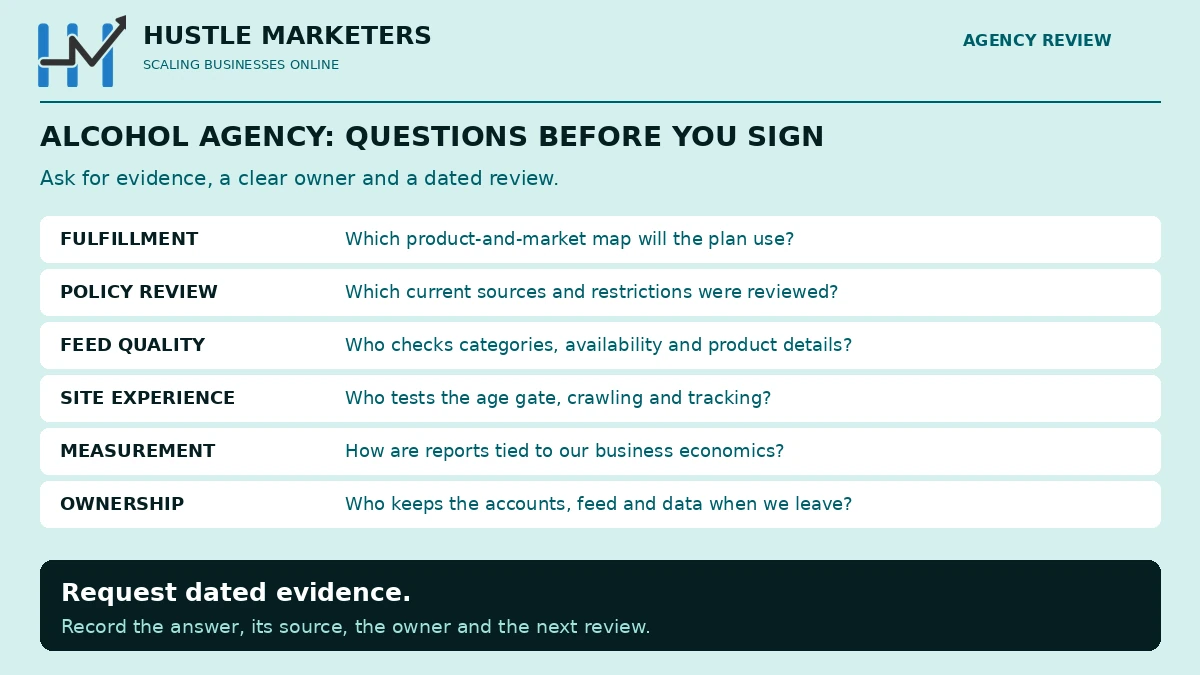
What Should You Ask an Alcohol Marketing Agency Before You Sign?
- Which states can we legally ship each product type to, and how will that map into campaign location targeting and exclusions?
- What changed in Google’s alcohol policy on September 30, 2026, and what did you have to do about it in client accounts?
- Which audience types can we not use on an alcohol account, and what does that do to our remarketing plan?
- What product category and attributes will our alcohol items use in Merchant Center?
- If Merchant Center issues a warning, what is your process inside the seven day window?
- How will our age gate affect crawling, Core Web Vitals and conversion tracking, and who is fixing that?
- What are the TTB mandatory statements for our product class, and where will they appear in our ads and profiles?
- What is our breakeven ROAS, and what will you report against: platform conversion value or analytics revenue?
- Who owns the ad accounts, the Merchant Center and the data if we leave?
- Show me an account, not a logo. What did spend, revenue, ROAS and cost per conversion look like, over what dates?
Why Choose Hustle Marketers or Ishant Sharma for Alcohol Marketing?
Hustle Marketers is run by Ishant Sharma, working in digital marketing since 2013 as a Google Ads, Microsoft Ads and SEO specialist. On alcohol accounts specifically:
- We build to the legal shipping map first. Targeting follows what you can lawfully fulfill, product type by product type, before it follows demand.
- We treat the feed as the campaign. Category, availability and title accuracy move more revenue in an allocated catalog than bid changes do.
- We hold negatives at account level, so recipes, jobs, courses, tours and trade queries are blocked once and stay blocked.
- Microsoft Ads is not an afterthought here. It is a named specialism, and it is the platform with the clearest age gating and responsible messaging requirements.
- We publish the account, not just the claim. Our alcohol marketing case study shows the account for a US wine and spirits store, with the dates, the campaign level spread and the caveats attached.
If you want this run on your account, see our Google Ads agency and ecommerce PPC management pages, or read how we think about Performance Max versus Search before committing budget to either.
Frequently Asked Questions
Do you need a certificate to advertise alcohol on Google?
Not in the United States. Google runs two alcohol certifications and neither covers the US: beer advertising in Poland, and 0% alcohol beverages in Egypt, India and Indonesia. Microsoft Advertising and Meta have no alcohol certification at all. What you do need are the correct state retail and shipping licenses, which no platform checks for you.
Can you advertise alcohol on Google Ads?
Yes, in Google’s approved locations, which include the United States, United Kingdom, Canada, Australia and most of Europe. Ads must not target minors or appeal primarily to them, must not imply alcohol improves ability or offers health benefits, and must not show consumption before activities requiring sobriety. Google’s latest policy update took effect on September 30, 2026, and the help center lists separate Alcohol sale and Alcohol information policies.
Why is my alcohol campaign approved but not spending?
Check three things before bids. First, whether the campaign relies on advertiser-supplied audiences such as Customer Match or lookalikes, which are restricted for alcohol. Second, whether the campaign type defaults to those audiences, which is the reported problem with Demand Gen on alcohol accounts. Third, whether the status reads Eligible (limited), which happens when approved and unapproved locations are mixed in one campaign and throttles delivery without an error.
What product category should alcohol use in Google Merchant Center?
Food, Beverages & Tobacco > Beverages > Alcoholic Beverages, category 499676, with Beer and Wine as child nodes. Do not use the adult attribute on alcohol products. Google’s own documentation says not to, and the age_group attribute is an apparel sizing field, not an alcohol control.
How long do I have if Merchant Center flags my alcohol listings?
Google states that violations of the alcoholic beverages policy will not lead to immediate suspension without prior warning, and that a warning is issued at least seven days before any suspension. Treat it as a seven day deadline.
What age should I target for alcohol ads on Facebook and Instagram?
21 in the United States, 25 in Sweden and in Chandigarh, Delhi, Haryana, Maharashtra and Punjab, 20 in Japan, Iceland and Paraguay, 19 in Canada, Korea and Nicaragua, and 18 as the global floor everywhere else alcohol ads are allowed. Meta’s default will not set this for you, so it has to be set in the ad set.
Which states can I ship spirits to?
As of August 28, 2026, direct to consumer spirits shipping was permitted in ten jurisdictions: Alaska, Arizona, Kentucky, Nebraska, New Hampshire, New York, North Dakota, Rhode Island, Vermont and the District of Columbia, with caps and conditions in several. Wine is permitted far more widely. Your licenses and counsel set the map, and your campaign targeting should match it exactly.
Will an age gate hurt my SEO?
It can. A server side gate that redirects every unverified visitor including Googlebot leaves Google indexing a single page. Letting bots through by user agent is cloaking. A JavaScript-only overlay keeps the site crawlable but is a weak gate. The workable answer is a server side gate bypassed only for crawlers verified by reverse DNS and published IP ranges, which is a CDN configuration rather than a plugin setting.
Can I send marketing SMS for an alcohol brand?
Yes, with age gating that meets carrier rules. Alcohol falls under SHAFT, and the required age gate is a date of birth input. A checkbox or a yes/no confirmation is not accepted. If your email platform requires an age gate block on SMS consent forms, a form missing it will publish normally and collect no SMS consent at all.
Does the TTB regulate my social media?
Yes. TTB’s definition of an advertisement covers websites and social media, and under Industry Circular 2024-1 a brand’s whole profile and its posts are treated as one advertisement, so the mandatory statements can sit once on the profile or an About tab. Paid influencer posts count as your advertising even on someone else’s account, and brands are accountable for third party content they like or reshare.
Do I need a COLA to sell alcohol online?
Only if you bottle or import. Label approval sits with the bottler or importer under 27 CFR Part 5, and retailers are not among the businesses that need a federal basic permit under 27 CFR Part 1. A retailer reselling bottled product does not file COLAs. State retail licensing and state DTC shipping permits are the obligations that apply.
What ROAS should an alcohol store aim for?
Start from breakeven, which is 1 divided by your gross margin after shipping and payment fees. At a 25 percent margin breakeven is 4x, so a 4x account is making nothing. Then judge performance against that, not against someone else’s headline number.
Ready to Fix Your Alcohol Ad Account?
If you run an online liquor store, a winery, a distillery or a beverage brand selling direct to consumer, we will review your Google Ads account, your Merchant Center feed, your audience setup and your targeting map against the states you can actually ship to, and show you where the budget is leaking. Ask for a free alcohol account review and tell us which season you want to be ready for.