How Much Does Advertising Cost in 2027? Real Prices for Google, Meta, LinkedIn, TikTok, TV, Radio, Billboards and More

Ishant
Published on October 28, 2026
Ishant
Summarize this article with:
Advertising costs anywhere from a few dollars a day online to $10 million for 30 seconds of the Super Bowl. As of October 2026, a Google search click averages $5.42 and a Facebook traffic click about $0.60. Streaming TV runs $15 to $65 per thousand impressions, and a small-market billboard $250 to $1,500 for four weeks.
Your real bill depends on three things. The first is how the channel charges: per click, per thousand impressions or a flat rate. The second is the seller’s minimum, and the third is the extra cost of creative, management and tracking. In a June 2026 WebFX survey of US marketers, nearly two in three spent $301 to $5,000 a month on digital advertising.
This guide gives you a master price table for 20 channels with a named source and date for every number. Then it converts each range into what $1,000 actually buys, lists official minimums, adds the hidden costs, and works through $1,000, $5,000 and $20,000 monthly budgets.
Updated for 2027: this edition adds Super Bowl LXI pricing for February 2027, a table of what it costs to reach 100,000 people on each channel, the eight factors that move any ad price, what will change advertising costs in 2027, and what a Google click costs in the accounts we manage. We re-checked every price in the tables against its source in October 2026. Each keeps its original source date, and the two that had newer figures, Meta benchmarks and influencer rates, are updated.
Key Observations
- Online channels have low or no minimums. Google Ads lists no minimum spend, LinkedIn requires $10 a day, and TikTok requires $50 a day per campaign.
- Search clicks cost more than social clicks because they carry intent. The 2026 Google Ads average is $5.42 per click against $0.60 for a Facebook traffic click, so compare channels on cost per lead or sale.
- Traditional media is priced by the spot, the board or the piece. Expect $500 to $1,500 for a local TV spot, $250 to $1,500 for a small-market billboard, and $0.26 per piece for EDDM postage.
- Mid-size and large companies put 7.7% (Gartner, 2025) to 9.0% (CMO Survey, 2026) of revenue into all marketing, and only part of that is paid media.
- Media is only one line of the bill. Add creative, management and tools before you compare channels.
- Many numbers online are stale. Some 2026 guides still quote a $2.32 Google click and a 2019 Shopping benchmark.
- A first test should buy at least 10 conversions a month at a realistic cost per lead.
- In the 44 US businesses we manage, the median Google Search click cost $3.18, well under the $5.42 WordStream median, largely because many of those clicks are cheap brand searches. Plan from your own non-brand numbers.
How much do advertisements cost?
Advertisements cost from under $1 per click on social platforms to more than $100,000 for a national TV spot, depending on the channel and how it charges. The table below shows typical US ranges, re-checked against each source in October 2026. Every figure names its source and date, and each source is linked the first time it appears.
| Channel | How you pay | Typical US range | Source and date |
|---|---|---|---|
| Google Search | Cost per click (auction) | $5.42 average CPC; $1.63 to $9.87 by industry | WordStream 2026 Google Ads benchmarks, May 2026 |
| Google Shopping | Cost per click, bid per product | No current public average worth using; the most quoted figure ($0.66) is from 2019 | Store Growers Shopping benchmarks, updated Jan 2026 |
| YouTube | Cost per view or CPM | $0.10 to $0.30 per view; $4 to $10 CPM | LocaliQ YouTube cost guide, Sep 2026 |
| Microsoft Ads (Bing) | Cost per click (auction) | Varies by account: cheaper than Google in some accounts, more expensive in others | Our Microsoft vs Google CPC study, Sep 2026 |
| Meta (Facebook, Instagram) | Mostly per impression, optimized to your goal | $0.60 average traffic CPC; $27.39 average cost per lead | WordStream Facebook ads benchmarks, 2026 edition, data Apr 2025 to Jun 2026 |
| CPC, CPM or cost per send | $2 to $3 CPC and $5.01 to $8.00 CPM (most common survey answers) | WebFX LinkedIn pricing survey, May 2026 | |
| TikTok | CPM, CPC or optimized CPM | $10 to $20 CPM for local advertisers | Adwave local advertising cost guide, Feb 2026 |
| X (Twitter) | Per action or CPM (auction) | $0.26 to $0.50 per first action (most common survey answer) | WebFX X advertising survey, Sep 2025 |
| CPC or CPM (auction) | $0.10 to $1.50 CPC; $2 to $5 CPM | AdRoll social ad cost breakdown, Apr 2026 | |
| Amazon Sponsored Products | Cost per click (auction) | No monthly or upfront fees; no official average CPC published | Amazon Ads Sponsored Products page, checked Sep 2026 |
| Programmatic display | CPM | $1 to $3 CPM on the Google Display Network; enterprise platforms often expect $5,000+ a month | Vidico online ad costs, Aug 2026; DesignRush small business ad costs, 2026 |
| Streaming TV (CTV) | CPM | $15 to $30 CPM open exchange; $25 to $65 direct premium; $40 to $80+ live sports | Vibe TV advertising cost guide, Jun 2026 |
| Local TV | Per spot or CPM | $500 to $1,500 per 30-second spot; $5 to $15 CPM | Talo advertising cost guide, May 2025; Vibe, Jun 2026 |
| National TV | Per spot or CPM | $115,000 to $425,000+ per 30-second spot; $25 to $40 CPM; Super Bowl LX $10 million | Talo, May 2025; Vibe, Jun 2026; Super Bowl LX (citing USA Today), Feb 2026 |
| Radio | Per spot or monthly package | $25 to $100 per 30-second spot in small markets; $200 to $500+ in large markets | Adwave, Feb 2026 |
| Podcast | CPM per download | $18 to $22 CPM for a 30-second host read; $24 to $26 for 60 seconds | Libsyn Ads rate page, checked Sep 2026 |
| Billboards and digital out-of-home | Flat per 4 weeks, or CPM for digital | $250 to $1,500 in small markets; $5,000 to $25,000+ in New York; $5 to $18 CPM digital | AdQuick billboard cost guide, 2026 |
| Newspaper and magazine | Flat per insertion or column inch | Quarter page $200 to $500 (community paper), $1,000 to $5,000 (metro); magazine full page $2,000 to $5,000 | Adwave, Feb 2026; Vidico, Aug 2026 |
| Direct mail | Per piece | $0.26 EDDM postage; $0.50 to $1.00 per postcard all-in | USPS Every Door Direct Mail, checked Sep 2026; Adwave, Feb 2026 |
| Influencer | Flat fee per post | About $100 to $500 or more (Instagram micro, Oct 2026 update); $500 to $5,000 or more (mid-tier) | Influencer Marketing Hub rates, Jul 2026 |
What do CPC, CPM, CPV and flat rates mean for your bill?
The pricing model decides what you are billed for, so it shapes your budget as much as the price does.
- Cost per click (CPC): you pay when someone clicks. Google, Microsoft, Amazon and most search ads work this way.
- Cost per thousand impressions (CPM): you pay for every 1,000 times the ad is shown. Social, display, streaming TV, podcasts and digital billboards use it.
- Cost per view (CPV): you pay when someone watches enough of a video. On YouTube in-stream ads that means 30 seconds, the whole ad if shorter, or an interaction, according to Google Ads Help on CPV bidding.
- Flat rate: you pay a fixed price for a spot, a board, a page or a post, whatever the response. TV, radio, print, billboards and influencers are usually sold this way.
To compare a flat-rate quote with an online CPM, divide the price by the audience in thousands. Our CPM calculator works out CPM, impressions or cost from any two of the three, and our CPC calculator does the same for clicks.
What counts as an advertising cost?
Advertising costs are everything a business pays to put an ad in front of people: the media itself, the creative, any management fee and the tools that track results. Media means the clicks, impressions, airtime, board space or postage you buy. Most price guides, including the master table above, quote only that media line.
Budget for all four lines before you compare one channel with another:
- Media: what the platform, station or seller charges, per click, per thousand impressions or at a flat rate.
- Creative: design, photos, video or a recorded spot. TV and streaming need a finished commercial before any airtime can work.
- Management: an agency or freelancer fee, charged as a flat monthly amount or a share of spend. Our breakdown of PPC management pricing compares the models.
- Tools and tracking: software, call tracking and conversion setup, so you can see what each lead actually costs.
The section on creative, fees and tools later in this guide puts typical ranges on every line.
What does $1,000 buy on each advertising channel?
$1,000 buys anything from about 100 Google search clicks in a costly industry to roughly 3,800 pieces of EDDM postage. We converted each range from the master table into units, so you can see what the money does before you commit.
| Channel | Price used | What $1,000 buys | The catch |
|---|---|---|---|
| Google Search | $5.42 average CPC ($1.63 to $9.87 by industry) | About 185 clicks (101 to 613); about 15 leads at the $66.69 average cost per lead | Legal and home services sit at the top of the range |
| Meta | $0.60 traffic CPC; $27.39 per lead | About 1,667 clicks, or about 37 leads | Lower intent than search; lead quality varies |
| YouTube | $0.10 to $0.30 per view | 3,333 to 10,000 views | Needs a video before you spend anything |
| $2 to $3 CPC (survey), about $5 for low bids in practice | 200 to 500 clicks | $10 a day minimum is about $304 a month | |
| TikTok | $10 to $20 CPM | 50,000 to 100,000 impressions | One ad group all month costs at least $608 |
| $2 to $5 CPM | 200,000 to 500,000 impressions | Clicks cost $0.10 to $1.50 each | |
| Streaming TV | $15 to $65 CPM | About 15,000 to 67,000 impressions | Premium apps and live sports cost the most |
| Podcast | $18 to $22 CPM (30-second host read) | About 45,000 to 55,000 downloads | Business shows list up to $30 CPM on Libsyn |
| Local radio | $25 to $100 per spot (small market) | 10 to 40 spots | 2 to 5 spots in a large market |
| Local TV | $500 to $1,500 per 30-second spot | One or two spots | Production often costs more than the airtime |
| Billboard | $250 to $1,500 per 4 weeks (small market) | One board for a month in a small market | Not enough for a major metro board |
| Direct mail | $0.26 EDDM postage; $0.50 to $1.00 all-in | About 3,846 pieces of postage, or 1,000 to 2,000 finished postcards | Minimum 200 pieces per EDDM drop |
| Newspaper | $200 to $500 per quarter page (community) | 2 to 5 quarter-page ads | A metro quarter page can use the whole $1,000 |
| Influencer | About $100 to $500 per post (Instagram micro) | 2 to 10 posts | Reach depends on the creator, not the fee |
| National TV | $25,000+ per flight minimum | Nothing | National broadcast buys start far above $1,000 |
These are benchmark conversions, not quotes. Your own click price and conversion rate will move the result. Industry alone moves the average Google click from $1.63 to $9.87, a sixfold spread.
What does it cost to reach 100,000 people on each channel?
Reaching 100,000 people costs about $100 to $300 with display ads and $4,000 or more with live sports streaming, based on the CPMs in the master table above. Multiply any CPM by 100 to get the cost of 100,000 impressions. The table below does that math for every channel that is sold on a CPM basis, so you can compare reach on one scale.
| Channel | CPM used | Cost of 100,000 impressions | What one impression is |
|---|---|---|---|
| Google Display Network | $1 to $3 | $100 to $300 | A banner shown on a website or app, often scrolled past |
| $2 to $5 | $200 to $500 | A pin shown in a feed or search result | |
| YouTube | $4 to $10 | $400 to $1,000 | A video ad that starts playing; many can be skipped |
| $5.01 to $8.00 | $501 to $800 | A sponsored post in a professional feed | |
| Local broadcast TV | $5 to $15 | $500 to $1,500 | A viewer of a 30-second spot, estimated from ratings |
| Digital billboards | $5 to $18 | $500 to $1,800 | An estimated view by a passerby while your ad is on screen |
| TikTok (local advertisers) | $10 to $20 | $1,000 to $2,000 | A full-screen video in the feed |
| Streaming TV, open exchange | $15 to $30 | $1,500 to $3,000 | A full-screen ad on a TV screen |
| Podcast, 30-second host read | $18 to $22 | $1,800 to $2,200 | A download of an episode that carries the read |
| National broadcast TV | $25 to $40 | $2,500 to $4,000 | A viewer of a national spot |
| Streaming TV, direct premium | $25 to $65 | $2,500 to $6,500 | A full-screen ad in a premium app |
| Live sports streaming | $40 to $80+ | $4,000 to $8,000+ | A full-screen ad during a live game |
| EDDM direct mail | $260 per 1,000 pieces (postage only) | $26,000 in postage; $50,000 to $100,000 all-in at $0.50 to $1.00 a piece | A printed piece delivered to a mailbox |
Google Search, Microsoft Ads and Amazon Sponsored Products are left out because they are sold per click, not per thousand impressions. Judge them on cost per lead or cost per sale instead.
An impression is not the same unit on every channel. A banner on a phone and a 30-second spot on a living room TV both count as one impression, but they do very different jobs. Use the table in three ways:
- Size an awareness budget: pick a reach goal, then multiply by the CPM.
- Compare like with like: video with video, audio with audio, print with mail.
- Add production before you compare: TV, streaming and podcast ads need a finished spot first.
The same math works for flat-rate quotes. A $1,500 local TV spot seen by 100,000 households is a $15 CPM, the top of the local broadcast range above. Our CPM calculator converts any quote, and our guide to customer acquisition cost shows how to judge channels by what a customer costs, not what an impression costs.
What is the minimum spend on each ad platform?
Most online platforms have small daily minimums or none at all, while TV, billboards and mail have minimum flights or quantities. The table lists what each seller publishes, re-checked in October 2026.
| Platform | Official minimum | What it means per month | Source |
|---|---|---|---|
| Google Ads | No minimum spend listed | You set the daily budget; Google can spend up to 2x it on a busy day, capped at 30.4x per month | Google Ads Help on daily budgets |
| Meta | A minimum budget per campaign or ad set that varies by country, objective, bid strategy and currency | Ads Manager shows an alert when a budget is below the minimum (Meta Business Help Center, checked Oct 2026) | Meta Ads Manager |
| $10 a day; $100 lifetime budget for new campaigns | About $304 a month; LinkedIn’s default suggestion for a new advertiser’s campaign is $25 | LinkedIn budget best practices | |
| TikTok | $50 a day per campaign; $20 a day per ad group | At least $608 for one ad group all month | TikTok Ads Manager budget help, Jul 2026 |
| No minimum stated | May spend up to 125% of the daily budget on one day, balanced over the week | Pinterest campaign budget help | |
| Amazon Sponsored Products | No monthly or upfront fees; Amazon recommends at least $10 a day for many advertisers | About $304 a month at the recommended floor | Amazon Ads budget guide |
| YouTube | Runs in Google Ads, no separate minimum | Most businesses set $10 to $50 a day, per LocaliQ | LocaliQ, Sep 2026 |
| Streaming TV | Self-serve from $50 a day; national broadcast $25,000+ per flight | About $1,520 a month at $50 a day | Vibe, Jun 2026 |
| Billboards | Usually sold in 4-week periods | AdQuick recommends 8 to 13 weeks for recall | AdQuick, 2026 |
| EDDM direct mail | 200 pieces minimum; 5,000 per ZIP Code per day maximum | At least $52 in postage per drop | USPS, checked Sep 2026 |
The platform minimum only keeps an ad running. It rarely buys enough data to learn anything. Hustle Marketers’ rule of thumb for a first test is simple: the budget should buy at least 10 conversions a month at a realistic cost per lead. At the 2026 Google Ads average of $66.69 per lead, that is about $667 a month for one campaign.
How much do online ads cost on each platform?
Online ads cost from about 10 cents to around $10 per click on average, depending on the platform, the industry and the audience. Here is what each platform charges and what to watch for.
How much do Google Ads cost in 2027?
Going into 2027, Google Ads cost $5.42 per click on average, based on WordStream’s study of 13,474 US search campaigns from April 2025 to March 2026. The average cost per lead was $66.69, and WordStream reports it fell for the first time in five years. Attorneys paid the most per click at $9.87, and arts and entertainment the least at $1.63. WordStream calls these figures averages, but its method note says they are technically medians, which makes them easy to compare with our own data below.
For budgets by industry and campaign type, read our full Google Ads cost guide. To turn a lead goal into a daily budget, use the Google Ads budget calculator.
What does a Google Ads click cost in the accounts we manage?
In the 44 US businesses Hustle Marketers manages, the median Google Search click cost $3.18 from September 2025 to September 2026, with a 7.73% click-through rate and a 7.42% conversion rate. That is well below the $5.42 WordStream median, and the gap shows why one benchmark rarely fits a single account.
The table puts the two data sets side by side. Both report medians, so one very large account cannot pull either figure up or down.
| Google Search metric | WordStream 2026 benchmarks | Hustle Marketers accounts |
|---|---|---|
| Sample | 13,474 US search campaigns | 44 US businesses |
| Period | April 2025 to March 2026 | September 2025 to September 2026 |
| Median cost per click | $5.42 | $3.18 |
| Median click-through rate | 6.64% | 7.73% |
| Median conversion rate | 8.18% | 7.42% |
Source for the table: WordStream Google Ads benchmarks 2026 (updated September 2026) and Hustle Marketers first-party Google Ads data, published on our PPC statistics page.
Our median sits lower mainly because of the account mix. Our sample leans toward online stores and attractions, where many clicks come from people searching the brand name, and those clicks are cheap. Searches from people who do not know the brand yet cost more, and they are where new customers usually come from.
Our published research shows the same split. In the study Google Ads Performance Benchmarks by Campaign Type (Sharma, 2026, Zenodo), which covers 22 accounts from October 2025 to September 2026, brand Search returned a median 16.44x ROAS in ecommerce accounts against 3.09x for non-brand Search. In lead generation accounts, non-brand Search took a median 49.2% of spend and converted at a median 6.17%.
Three ways to use these numbers in a 2027 budget:
- Plan from non-brand numbers. A blended cost per click that includes brand searches makes Google look cheaper than new customers really are. Our guide on how to advertise on Google shows how to set a first budget from click costs and customer value.
- Treat any median as a sense check, not a forecast. If your click price sits far above your industry, review match types and Quality Score before you raise the budget. Single keywords can cost far more than any median, as our list of the most expensive Google Ads keywords shows.
- Judge the channel on cost per lead. For example, a $3 click that converts at 2% costs $150 per lead, while a $6 click that converts at 8% costs $75.
How much does Microsoft Advertising cost?
Microsoft Advertising uses the same pay-per-click auction as Google, and its clicks are often assumed to be cheaper. In our Bing Ads vs Google Ads CPC study, that held in some accounts and reversed in others. Blended figures that include partner sites can also hide what true search clicks cost. Price Microsoft from your own data, not from a rule.
How much do Facebook and Instagram ads cost?
Facebook and Instagram ads averaged $0.60 per click for traffic campaigns and $27.39 per lead for lead campaigns in WordStream’s 2026 US benchmarks, which cover April 2025 to June 2026. Clicks got about 14% cheaper and cost per lead held almost flat, down about 1%. The 2025 edition had shown cost per lead up about 21% year over year, as Search Engine Land reported, but it stayed well below the Google average.
Most Meta campaigns are billed per impression and optimized toward the result you pick. There is no monthly minimum. Our guide on how to advertise on Facebook covers setup, objectives and targeting.
How much do LinkedIn ads cost?
LinkedIn ads cost at least $10 a day. In a May 2026 WebFX survey, the most common answers were $2 to $3 per click and $5.01 to $8.00 per thousand impressions. Sponsored messages ran $0.26 to $0.50 per send in the same survey.
Specialists see higher click prices in practice. LinkedIn ads specialist AJ Wilcox describes about $5 per click as a low bid for single image ads (B2Linked podcast, February 2024). He also warns that low bids stop delivery when creative is weak. Plan for more than the $304 monthly minimum if you want a real test.
How much do TikTok, X and Pinterest ads cost?
TikTok requires at least $50 a day at campaign level and $20 a day at ad group level. Local advertisers typically pay $10 to $20 per thousand impressions. X’s most common survey answer was $0.26 to $0.50 per first action on a promoted post (WebFX, September 2025). Most businesses in that survey spent $101 to $500 a month.
Pinterest clicks run $0.10 to $1.50, with CPMs of $2 to $5 (AdRoll, April 2026). Pinterest does not state a minimum, but it can spend up to 125% of your daily budget on a single day.
How much does Amazon advertising cost?
Amazon Sponsored Products are pay-per-click ads with no monthly or upfront fees: you bid the most you will pay for a click. Amazon recommends a daily budget of at least $10 for many advertisers so ads keep running all day. Amazon does not publish an average cost per click, and we found no current benchmark we would stand behind. Judge Amazon ads on advertising cost of sale against your product margin.
How much do YouTube and streaming TV ads cost?
YouTube ads usually cost $0.10 to $0.30 per view or $4 to $10 per thousand impressions. Most businesses set $10 to $50 a day (LocaliQ, September 2026). You pay for an in-stream view only after 30 seconds, the full ad if shorter, or an interaction.
Streaming TV on smart TVs and apps costs $15 to $30 CPM on the open exchange and $25 to $65 for direct premium inventory. Live sports run $40 to $80 or more (Vibe, June 2026). Self-serve platforms such as Vibe start at $50 a day, which puts the TV screen within reach of a local business.
How much do traditional ads cost?
Traditional ads cost from about $25 for a small-market radio spot to $10 million for a Super Bowl spot. Most are sold at a flat rate per spot, board, page or piece. Production is often a second bill that digital ads do not have.
How much does a TV commercial cost locally and nationally?
A local 30-second TV spot usually costs $500 to $1,500 to air, and a national network spot $115,000 to $425,000 or more (Talo, May 2025). Producing a professional commercial adds $3,000 to $25,000.
Measured by audience, local broadcast runs $5 to $15 CPM and national broadcast $25 to $40 CPM (Vibe, June 2026). National buys usually start at $25,000 or more per flight. At the top, NBC’s base rate for Super Bowl LX in February 2026 was reported at $10 million for 30 seconds.
How much does a Super Bowl ad cost in 2027?
A 30-second ad in Super Bowl LXI, which airs on ABC and ESPN on February 14, 2027, costs about $8 million to $9 million. That is the range industry trade reports gave for units Disney sold after first asking as much as $10 million, as The Desk reported in August 2026.
Disney’s CFO said on an August 2026 investor call that all of the game’s ad inventory on ABC and ESPN had sold out, more than six months before kickoff. The price covers airtime only, and production for a national spot is a separate bill.
For a local business, the useful lesson is the math, not the price. Divide any TV quote by its audience in thousands to get a CPM, then compare it with the cost-to-reach table earlier in this guide.
How much does a radio ad cost?
A 30-second radio spot costs $25 to $100 in small markets (under 250,000 people) and $100 to $300 in medium markets. Large markets charge $200 to $500 or more (Adwave, February 2026). A monthly schedule typically runs $1,000 to $5,000, and production ranges from free (made by the station) to about $500. Radio works on repetition, so price a schedule, not one spot.
How much does a billboard cost per month?
A static billboard costs $250 to $1,500 per four weeks in small or rural markets and $1,500 to $9,000 in mid-tier metros. In New York, expect $5,000 to $25,000 or more (AdQuick, 2026). Digital billboards run $3,500 to $25,000 per four weeks, or about $5 to $18 CPM.
Add printing at $1.50 to $3.00 per square foot, which is about $500 for a 14 by 48 foot bulletin, plus $200 to $1,000 per installation.
How much does it cost to rent a billboard?
Renting a billboard costs $250 to $1,500 per four weeks in small markets, $1,500 to $9,000 in mid-tier metros and $5,000 to $25,000 or more in New York, according to the AdQuick 2026 billboard cost guide. You rent the board face from its owner for a set period, then pay separately to print and install your design.
Most boards are sold in four-week periods, and AdQuick recommends 8 to 13 weeks to build recall. Price the whole run, not one period:
- Rent: the four-week rate multiplied by the number of periods you book.
- Printing: about $1.50 to $3.00 per square foot of vinyl, or about $500 for a 14 by 48 foot bulletin.
- Installation: $200 to $1,000 each time a static design goes up.
- Digital instead: a digital board shares screen time with other advertisers, costs $3,500 to $25,000 per four weeks and needs no printing.
Worked example, using the low and high ends of the small-market range: a 12-week run is three four-week periods, so rent comes to $750 to $4,500. Add about $500 to print a bulletin and $200 to $1,000 to install it, and the full run lands at about $1,450 to $6,000.
How much do newspaper and magazine ads cost?
Community newspapers charge about $10 to $30 per column inch and metro papers $50 to $200 or more (Adwave, February 2026). A quarter page runs $200 to $500 in a community paper and $1,000 to $5,000 in a metro daily. Vidico puts a full-page magazine ad at $2,000 to $5,000, but magazine prices track circulation, so ask each title for its media kit and rate card.
How much does direct mail cost per piece?
USPS Every Door Direct Mail (EDDM) retail postage is $0.26 per piece, with at least 200 and at most 5,000 pieces per ZIP Code per day. With design and printing, postcards land around $0.50 to $1.00 per piece (Adwave, February 2026). A 5,000-piece drop therefore costs roughly $2,500 to $5,000.
How much do podcast ads and influencers cost?
Podcast ads are sold per thousand downloads. Libsyn Ads lists $18 to $22 CPM for a 30-second host read and $24 to $26 for 60 seconds. So 50,000 downloads of a 30-second read cost about $900 to $1,100.
Influencers charge per post. Influencer Marketing Hub’s October 2026 rates put an Instagram micro-influencer (10,000 to 100,000 followers) at about $100 to $500 or more a post, and mid-tier creators at $500 to $5,000 or more. A mid-tier YouTube creator charges about $1,000 to $10,000 or more for one sponsored video.
What makes the same ad cost more or less?
Eight factors move the price of the same ad: industry competition, market size, placement, timing, audience, ad length, creative quality and how you buy. The table shows each factor with an example drawn from the prices in this guide.
| Factor | How it moves the price | Example from this guide |
|---|---|---|
| Industry competition | More bidders on the same searches push auction prices up | The average Google click runs from $1.63 in arts and entertainment to $9.87 for attorneys |
| Market size | Bigger audiences cost more per spot or per board | A 30-second radio spot is $25 to $100 in a small market and $200 to $500+ in a large one; a billboard is $250 to $1,500 in a small market and $5,000 to $25,000+ in New York |
| Placement and inventory | Premium apps and live events charge more per thousand | Streaming TV runs $15 to $30 CPM on the open exchange and $40 to $80+ for live sports |
| Timing and events | Big events and election years pull many buyers into the same inventory | Super Bowl LXI 30-second units were reported at about $8 million to $9 million; AdImpact projected $5.6 billion of 2026 political spending on broadcast TV |
| Audience targeting | Narrow or professional audiences cost more to reach | LinkedIn CPMs of $5.01 to $8.00 against $2 to $5 on Pinterest |
| Ad length and format | Longer spots cost more per thousand | A 60-second podcast host read is $24 to $26 CPM against $18 to $22 for 30 seconds |
| Creative and landing page | Weak ads and pages raise the cost per lead even when the click price stays the same | Doubling a landing page conversion rate halves the cost per lead |
| How you buy | Traditional sellers price schedules and flights, not single units | Radio schedules typically run $1,000 to $5,000 a month, and billboards are sold in four-week periods |
Creative quality is the factor you control most. In Google Ads, Quality Score rates expected clickthrough rate, ad relevance and landing page experience. Google describes Quality Score as a diagnostic tool, not an input in the ad auction, so use it to find what to fix in your ads and pages.
Timing is the factor local advertisers most often miss. In even-numbered years, campaigns buy the same local TV, radio and streaming inventory you want, so book those schedules early and get the dates in writing.
How much should a small business spend on advertising?
A small business should set its ad budget from its sales goal, then check the result against what similar firms spend. Mid-size and large companies put 7.7% to 9.0% of revenue into all marketing, and only part of that goes to paid media.
What percentage of revenue should go to advertising?
For large firms, about 2.4% of revenue goes to paid media. The Gartner 2025 CMO Spend Survey found marketing budgets flat at 7.7% of revenue, with paid media taking 30.6% of that. Its 402 respondents were mostly at companies with more than $1 billion in revenue.
The Spring 2026 CMO Survey of 308 marketing leaders put marketing at 9.0% of company revenue. As a share of total company budgets it fell to 9.6%, the lowest level since 2021. You will also see a “7 to 8% of revenue” rule credited to the SBA or to Forbes. We could not find it on SBA.gov, so treat it as a rough rule, not a benchmark.
How do you build an ad budget from your sales goal?
Work backward from the customers you need, not forward from a percentage. Four steps get you there.
- Customers needed = monthly revenue goal divided by revenue per customer.
- Leads needed = customers divided by your close rate.
- Media budget = leads multiplied by a realistic cost per lead for your channel.
- Total budget = media plus management, creative and tools.
Worked example, with stated assumptions: a remodeler wants 4 new jobs a month and closes 20% of leads, so it needs 20 leads. At WordStream’s 2026 home improvement average of $90.92 per lead, that is about $1,818 a month in Google Ads media. Our marketing budget calculator runs this bottom-up math next to top-down revenue benchmarks, and the CPA calculator checks what each customer costs.
How much do businesses spend on advertising by size?
Spend rises with company size, but the data is thin for small firms. In WebFX’s June 2026 survey, the most common answer for firms with 1 to 10 employees was $50 to $500 a month on digital ads. About 6% of respondents spent more than $25,000 a month. At the top end, the Gartner and CMO Survey figures above describe mostly mid-size and large companies.
Want someone else to manage the spend? Our guide to PPC management for small business explains what that costs and what it should deliver.
What does advertising really cost once you add creative, fees and tools?
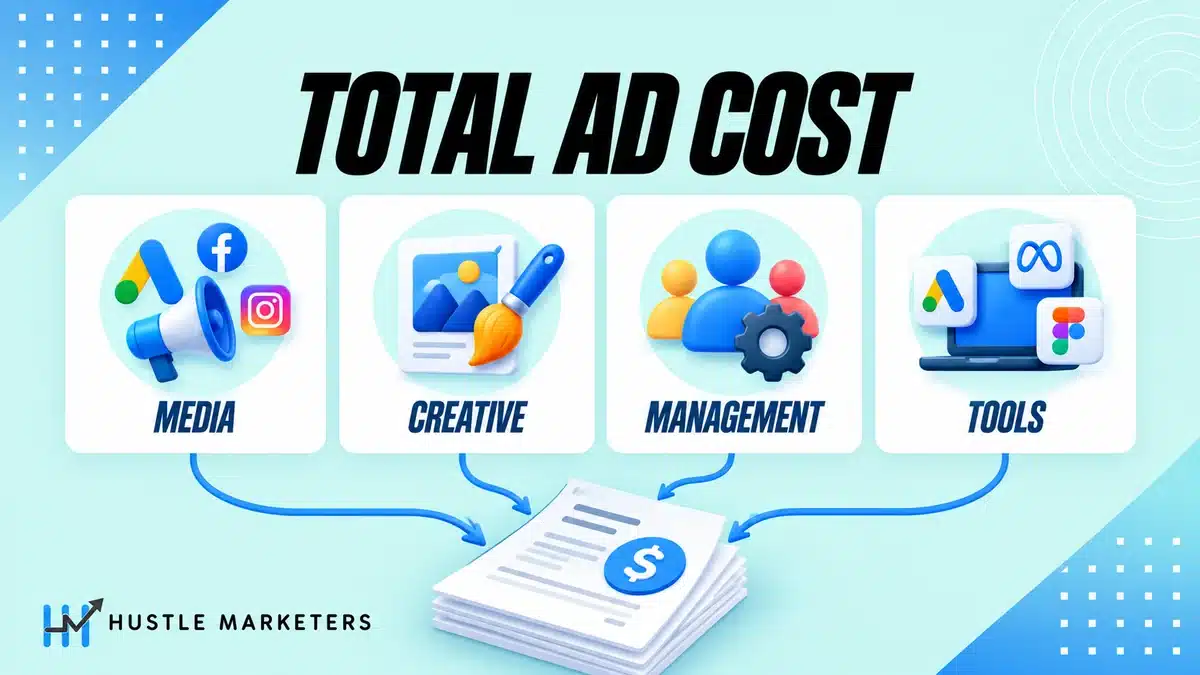
The media spend is only one line of the bill. Add creative production, management, tools and each platform’s overspend rules before you compare channels.
| Cost line | Typical range | Source |
|---|---|---|
| Media | See the master table above | Platform and seller rates |
| Agency management | 10% to 20% of ad spend, or retainers of $2,000 to $6,000 a month for small clients | DesignRush, 2026 |
| Google Ads management only | $300 to $1,500 a month | Adwave, Feb 2026 |
| Ad design and photos | $200 to $500 per design project; $300 to $1,000 per photo shoot | Adwave, Feb 2026 |
| Video | $500 to $2,000 for social video; $3,000 to $25,000 for a TV commercial | Adwave, Feb 2026; Talo, May 2025 |
| Radio production | Free to $500 | Adwave, Feb 2026 |
| Billboard print and install | $1.50 to $3.00 per square foot; $200 to $1,000 per posting | AdQuick, 2026 |
| Software for in-house teams | $150 to $500+ a month | DesignRush, 2026 |
| Overspend rules | Google up to 2x the daily budget per day (30.4x monthly cap); Pinterest up to 125%; LinkedIn up to 50% on some days | Google Ads Help; Pinterest Help; B2Linked, 2024 |
Hustle Marketers charges a flat fee of $600 to $800 a month per platform for PPC management, not a percentage of spend. Ad spend is paid by the client directly to Google, Microsoft or Meta with no markup. For how other fee models compare at each spend level, see our breakdown of PPC management pricing.
How much does it cost to make an ad?
Making an ad costs from $0, when a radio station produces your spot, up to $3,000 to $25,000 for a professional TV commercial. In between, a designed print or mail piece runs $200 to $500 and a professional social video $500 to $2,000, based on the cost guides cited in this article.
- Radio spot: free to $500, and many stations produce the ad free when you buy airtime (Adwave, February 2026).
- Print, display or mail design: $200 to $500 per project (Adwave).
- Photo shoot: $300 to $1,000 for a professional shoot (Adwave).
- Social video: $500 to $2,000 for professional quality (Adwave).
- TV commercial: $3,000 to $25,000, depending on scripting, filming, editing and effects (Talo, May 2025).
- Billboard: about $500 to print a 14 by 48 foot bulletin, plus $200 to $1,000 to install it (AdQuick, 2026).
Production is a cost you can reuse, so spread it across the whole flight when you compare channels. Test simple creative first and pay for TV-grade production only after a channel has shown it can bring in customers. Once you know what the ads cost to make and run, the marketing budget calculator puts both into one monthly plan.
What do $1,000, $5,000 and $20,000 a month buy?
These three examples use the benchmarks above, re-checked in October 2026. They are planning math with labeled assumptions, not forecasts. Your own click prices, conversion rates and close rates will differ.
| Monthly budget | Example business and split | What the benchmarks say it buys | Add for the full cost |
|---|---|---|---|
| $1,000 | Local home improvement contractor; all on Google Search | About 120 clicks at $8.33 CPC; about 11 leads at $90.92 per lead | Self-managed or an occasional audit; one landing page |
| $5,000 | B2B services firm; $3,000 Google Search, $1,000 LinkedIn, $500 Microsoft Ads, $500 Meta retargeting | Google: about 511 clicks at $5.87 and about 32 leads at $93.69. LinkedIn: 200 to 500 clicks. Meta: about 833 clicks at $0.60 | Management fee; $200 to $500 per design project |
| $20,000 | Regional consumer brand; $8,000 Google Search, $5,000 Meta, $3,000 streaming TV, $2,000 YouTube, $2,000 podcast | Google: about 1,476 clicks at $5.42. Meta: about 183 leads at $27.39. Streaming TV: 75,000 to 120,000 impressions at $25 to $40 CPM. YouTube: 6,667 to 20,000 views. Podcast: about 91,000 to 111,000 downloads | Video production of $500 to $2,000 (social) or $3,000 to $25,000 (TV grade); management |
Is $1,000 a month enough for advertising?
Yes, if you put it into one channel with clear buying intent. $1,000 funds a Google Search campaign, a Meta lead test, 10 to 40 small-market radio spots, or 1,000 to 2,000 finished postcards. It is not enough for national TV or a major-metro billboard, and split across four channels it teaches you almost nothing.
What does a $5,000 monthly ad budget look like?
At $5,000 you can run a main channel, two small tests and retargeting. The B2B example keeps 60% on Google Search, where intent is highest, and tests LinkedIn and Microsoft Ads without starving the main campaign. The Meta slice only retargets site visitors, so it stays cheap and relevant.
How would you split $20,000 a month?
At $20,000 you can pair demand capture with awareness. Search and Meta take 65% because they report leads and sales directly. Streaming TV, YouTube and podcasts build reach in the region, and you judge them by branded search growth and blended cost per customer, not by clicks.
What will change advertising costs in 2027?
Four shifts will shape advertising costs in 2027: live sports stays the most expensive airtime, political buyers leave local TV after the 2026 midterms, marketing budgets stay nearly flat, and more of each budget moves to digital media. None of them rewrites the prices above overnight, but each one changes where a dollar goes furthest.
- Live sports stays the priciest airtime. Disney sold out its Super Bowl LXI inventory on ABC and ESPN by August 2026, with 30-second units reported at about $8 million to $9 million. On streaming TV, live sports at $40 to $80+ CPM is still the top of the range in this guide.
- Political buyers leave the market. AdImpact projected a record $11.6 billion in political ad spending for the 2026 cycle (June 2026), above $8.9 billion in 2022 and $11.2 billion in 2024. Broadcast TV was set to take $5.6 billion, or 48%, and streaming TV $2.7 billion. The midterms were held on November 3, 2026, and 2027 has no federal general election, so local businesses compete with fewer campaign buyers for the same stations.
- Budgets stay nearly flat. Gartner’s 2026 CMO Spend Survey of more than 400 marketing leaders (May 2026) put marketing budgets at 7.8% of company revenue, up 0.1 point on 2025, with 15.3% of budgets going to AI initiatives. Flat budgets mean every channel has to earn its place on cost per customer.
- More of the budget moves to digital. Gartner reported in June 2026 that digital media now makes up more than two-thirds of total media investment, up 18% since 2024, and its 2026 CMO spend research puts paid media at 31.4% of marketing budgets. That keeps competition high in search and social auctions, so price 2027 online campaigns from current account data rather than last year’s averages.
For a 2027 plan, price each channel from a current quote or your own account data, then use the tables in this guide as a check. If a quote sits far outside these ranges, ask the seller which audience, placement or timing explains it. Our marketing budget calculator turns those prices into a monthly plan.
Why do advertising cost guides disagree so much?
Advertising cost guides disagree because many repeat old benchmarks, mix survey answers with platform data, and rarely give a sample size or date. Here are figures we found in 2025 and 2026 cost guides while researching this topic in September 2026, next to the current source.
| Figure you will see | Where it appears | Current figure and source |
|---|---|---|
| Google Search CPC of $2.32 to $2.70 | Top Draw (Feb 2026); Talo (May 2025) | $5.42 average across 13,474 US campaigns (WordStream, May 2026) |
| Google Ads cost per lead of $70.11 | WordStream’s 2025 report, still quoted in 2026 guides | $66.69 (WordStream, May 2026) |
| Google Shopping CPC of $0.66 | WordStream data from Q2 2019, still cited on a page updated Jan 2026 | No current public average; use your own account data |
| LinkedIn CPC of $5.26 and CPM of $6.59 | AdRoll (Apr 2026, credited to WebFX) and Top Draw (Feb 2026) | WebFX’s current page (May 2026): $2 to $3 CPC and $5.01 to $8.00 CPM as the most common answers |
| “Spend 7 to 8% of revenue on marketing” | Credited to Forbes by FedEx and to the SBA by Adwave | 7.7% (Gartner, 2025); 9.0% (CMO Survey, 2026), mostly larger firms |
Old numbers also travel. The $2.32 Google click still quoted in 2026 guides matches WordStream’s own average from 2016, a decade before its current $5.42.
Sample size matters too. The monthly spend bands in the WebFX digital advertising survey move in steps of about 1.28 percentage points. That pattern suggests roughly 78 people answered that question, even though the survey reached more than 600 marketers.
Ishant Sharma, founder of Hustle Marketers, has run Google Ads and Microsoft Ads accounts since 2013. Before a benchmark goes into a client plan, he checks three things: the data window, the sample size, and whether it is an average, a median or a survey band. If a page cannot answer those, the number stays out of the forecast.
How can you lower your advertising costs?
Lower your cost per customer before your cost per click: fix tracking, cut waste, improve the landing page, and only then change bids and channels. This is the order we work in at Hustle Marketers when a client’s costs climb.
- Confirm that conversion tracking records real leads and sales. Without it, every cost number is a guess.
- Cut waste: irrelevant search terms, poor placements, partner networks and locations you do not serve.
- Fix the landing page. Doubling a conversion rate halves your cost per lead even if the click price stays the same.
- Narrow the schedule and geography to the hours and areas that convert.
- Test cheap creative before paying for expensive production, a point Fetch and Funnel’s YouTube cost guide also makes.
- Buy traditional media as a schedule. Ask for the rate card and package rates, and compare cost per thousand, not cost per spot.
- Move budget to the channel with the lowest cost per customer, not the lowest cost per click.
Cheap clicks can be expensive customers. For ArmorPoxy, an industrial coatings brand, the measure that mattered was return on ad spend, not the price of a click. Our work there produced $1.58M+ in revenue at 12.84x blended ROAS across Google, Microsoft and Meta Ads, including 12.84x ROAS on $123K+ of Google Ads spend. The full numbers are in the ArmorPoxy case study. Judge every channel on what a customer costs and what that customer is worth.
Frequently asked questions
What is the cheapest form of advertising?
The cheapest paid options are self-serve online channels with low or no minimums, such as Google Ads, Meta and Pinterest. You can start with a few dollars a day. Cheap to start is not the same as cheap per customer. Compare cost per lead or sale after a month of data.
How much does a Super Bowl ad cost in 2026?
NBC’s base rate for a 30-second spot during Super Bowl LX in February 2026 was reported at $10 million, a record. That price covers airtime only. Production is extra.
Is $10 a day enough to advertise online?
$10 a day, about $304 a month, meets LinkedIn’s minimum and Amazon’s recommended floor, and it can run a small Google or Meta test. It is rarely enough to learn quickly. At the 2026 Google Ads average of $5.42 per click, $10 buys fewer than two clicks a day.
What is a good CPM for advertising?
It depends on the channel. Typical ranges are $2 to $5 on Pinterest, $4 to $10 on YouTube and $10 to $20 on TikTok for local advertisers. Streaming TV runs $15 to $65, and billboards $2 to $18 (AdQuick). A good CPM is one that produces customers at a cost you can afford.
Do you pay the ad platform or the agency?
With most agencies you pay the platform for media and the agency for management. At Hustle Marketers, clients pay Google, Microsoft or Meta directly with no markup, own their ad accounts, and pay a flat $600 to $800 a month per platform with no lock-in. Ask any agency whether it marks up media before you sign.
How long should you test a new ad channel?
Test until you have enough conversions to judge, not for a fixed number of days. We look for at least 10 conversions before judging a campaign’s cost per lead. For billboards, price at least one four-week period, since that is how most boards are sold.
Are advertising costs going up in 2027?
Going into 2027, the picture is mixed. WordStream’s 2026 search benchmarks show the average cost per lead falling for the first time in five years. Its 2026 Facebook report shows lead costs almost flat, down about 1%, after a 21% rise in the 2025 edition. Budgets are also tighter, at 9.0% of revenue in the Spring 2026 CMO Survey.
Is TV advertising more expensive than digital advertising?
Per thousand viewers, not always: local broadcast TV runs $5 to $15 CPM, below most streaming TV CPMs and close to TikTok’s. TV costs more to enter because of production and station or network minimums, and results are harder to track. Digital lets you start small and measure each click.
Want a second opinion on your advertising budget?
If you are deciding where your next $1,000 or $20,000 should go, we can review your current spend and tracking first. For Google Ads, our free audit looks for wasted spend in search terms, targeting and conversion setup. Get Free Audit Worth $500.
We are a Google Partner, Meta Business Partner and Microsoft Advertising Partner. Our PPC management service is a flat $600 to $800 a month per platform, month to month, with ad spend paid directly to the platforms.
About the author
Ishant Sharma is a Google Ads, Microsoft Ads and SEO specialist who has worked in digital marketing since 2013, and the founder of Hustle Marketers, a Google Partner, Meta Business Partner and Microsoft Advertising Partner agency. His paid media work includes CMSC, a driving school, and ArmorPoxy, an industrial coatings company. His agency has worked with more than 2,500 brands and holds a 5.0 rating on Clutch from 50+ reviews.
Frequently Asked Questions
What is the most expensive type of advertising?
How much does it cost to reach 100,000 people with ads?
How do elections affect TV and radio advertising?
How much does advertising cost for a small business per month?
How much does a 30-second TV commercial cost?
How much does radio advertising cost per month?