Google Ads Quality Score: What It Is, What It Is Not and How to Improve It

Ishant
Published : September 28, 2026 at 5:30 pm
Updated : October 6, 2026 at 1:10 pm
Ishant

Google Ads Quality Score is a diagnostic rating from 1 to 10, reported for each Search keyword, that shows how your expected CTR, ad relevance and landing page experience compare with other advertisers who showed for the same search over the last 90 days. Google states that Quality Score “is not an input in the ad auction.”
That second sentence is where a lot of Quality Score advice goes wrong. The auction uses auction-time quality, measured for every search, while the number in your Keywords report summarizes that assessment. Treat the score as a warning light for your ads and landing pages, not a target.
This guide covers each component, the statuses, the columns and API fields, and how Quality Score fits Smart Bidding, AI Max and Performance Max, with myths separated from Google’s documentation. Last verified: September 16, 2026.
Key takeaways
- Quality Score is a keyword-level diagnostic for Search campaigns, not a KPI and not an auction input.
- It combines expected CTR, ad relevance and landing page experience, each rated above average, average or below average.
- Ad Rank uses your bid plus auction-time quality, thresholds, competition, search context and assets. That real-time quality is what can lower CPC.
- A dash means too few exact searches of the keyword to calculate a score.
- Bids, moving ad groups, ad frequency, reported conversions, match type changes and Ad Strength do not change Quality Score or ad quality, per Google.
- There is no Quality Score column for Performance Max.
- Fix the weakest component on your most expensive keywords first, and judge results on CPA or ROAS.
What is Quality Score in Google Ads?
Quality Score in Google Ads is a 1 to 10 rating, available at the keyword level in Search campaigns, that estimates how relevant and useful your ad and landing page are to someone searching for that keyword compared with other advertisers. Google describes it as a diagnostic tool, not a performance metric to optimize.
Why does Google call Quality Score a diagnostic and not a KPI?
Google says Quality Score is not a key performance indicator and should not be optimized or aggregated with the rest of your data. Its guide to using Quality Score calls it a general indicator of where to focus. A keyword at 5 that hits your target CPA is healthier than a 9 that never converts. In the accounts we manage, we use the columns to find which part of the ad experience is weak, then check whether the keyword spends enough to be worth fixing.
Which campaigns and levels have a Quality Score?
Only keywords in Search campaigns, as the title of Google’s article, About Quality Score for Search campaigns, makes clear. Google does not report a campaign, ad group, ad or account Quality Score. The Google Ads API team has confirmed the metric is measured at the keyword level, not the ad level. Tools that show an account average are calculating their own roll-up.
How is Google Ads Quality Score calculated?
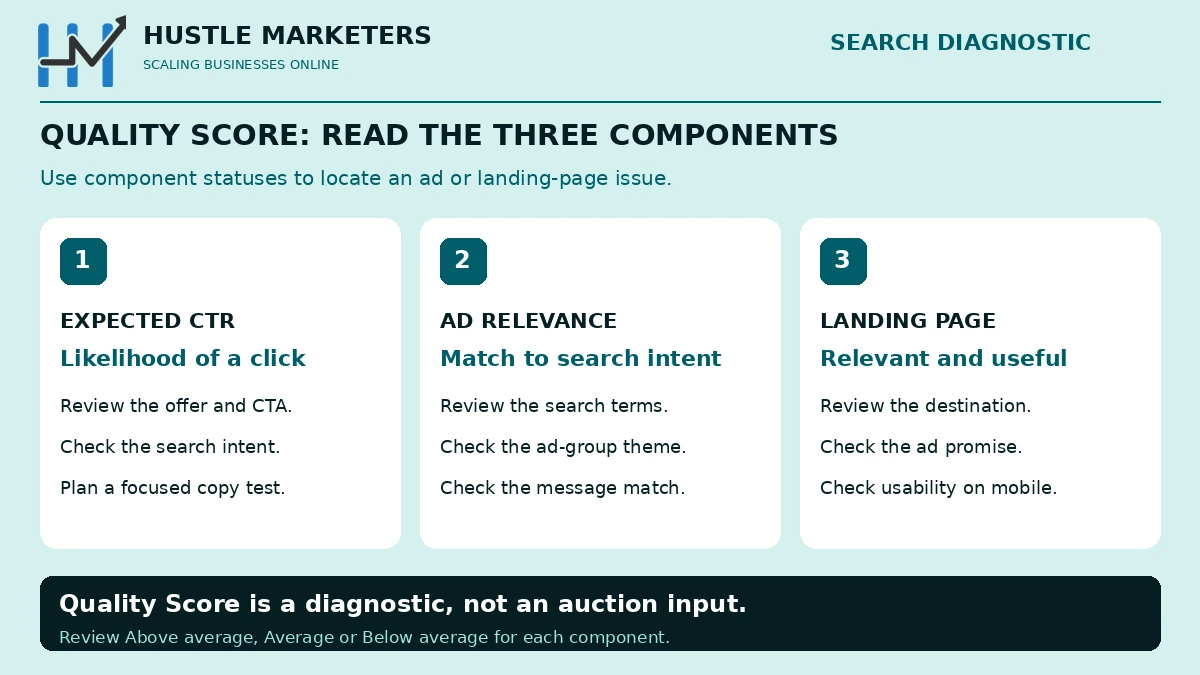
Google calculates Quality Score from the combined performance of three components: expected clickthrough rate, ad relevance and landing page experience. Each component gets a status of above average, average or below average based on a comparison with other advertisers. Google does not publish how those statuses are weighted or turned into the 1 to 10 number.
What is expected CTR in Google Ads?
Expected CTR is Google’s estimate of how likely your ad is to be clicked when shown. Google’s expected CTR definition says the status ignores your ad’s position, assets and other formats, assumes the search matches your keyword exactly, and considers performance across other advertisers’ accounts too.
That is why expected CTR and your CTR column can disagree. A keyword with a strong CTR earned at the top of the page with sitelinks can still rate below average once position and assets are stripped out. At auction time, Google calculates a more accurate expected CTR from the actual search terms, device and other factors.
What is ad relevance in Google Ads?
Ad relevance measures how closely your ad matches the intent behind a search. Google’s advice is to match ad text more directly to search terms, split ad groups holding many different keywords, and group keywords into themes. The usual culprit is one ad group mixing intents, such as “emergency plumber” and “plumbing jobs”, under one responsive search ad.
What is landing page experience?
Landing page experience estimates how relevant and useful your page will be to people who click. Google’s landing page experience definition says higher-rated pages are usually well organized, with text related to the search. The Ad Rank help page adds user expectations based on the clicked ad and ease of navigation, and Google’s tips add mobile friendliness and loading speed.
Are the three components weighted equally?
Google does not publish weights. The best-known public estimate is a January 2017 post by Brad Geddes of Adalysis, which models the visible score as 1 point plus up to 3.5 for expected CTR, 3.5 for landing page experience and 2 for ad relevance, with average worth half and below average worth zero. The post does not explain how the weights were derived and Google has not confirmed them, so treat any “each component is 33%” claim as a guess.
| Component | What Google says it measures | What moves it up | What does not move it |
|---|---|---|---|
| Expected CTR | Likelihood of a click, adjusted for position and assets, assuming an exact match | Stronger offer, ad details that match intent, call to action tests, tighter themes | Higher positions, higher bids |
| Ad relevance | How closely the ad matches the intent behind the search | Searchers’ language in ad text, splitting mixed-intent ad groups | Ad Strength, match type changes |
| Landing page experience | How relevant and useful the page is to people who click | Page answers the search, ad and page match, mobile friendly, fast, easy to navigate | Reported conversions, bids |
What do above average, average and below average mean?
Each Quality Score component gets one of three statuses. Above average and average mean Google sees no major problems with that component compared with other keywords, although average can still leave room to improve. Below average means Google suggests changes to that part of the experience, and it is the first place to look when a keyword scores low.
Google’s main article compares you with advertisers whose ads showed for the exact same search over the last 90 days, and says average or below average may indicate an opportunity to improve. Google’s expected CTR page also notes a keyword can have a high Quality Score and a low expected CTR, or the reverse, so always view the components next to the score.
| Status | What Google says it means | What to do | Priority |
|---|---|---|---|
| Above average | No major problems compared with others | Protect it when editing ads or pages | Low |
| Average | No major problems, but may indicate an opportunity | Test copy or page changes on high-spend keywords | Medium |
| Below average | Consider changing the ad text (expected CTR) or the landing page (landing page experience) | Fix this component first on high-cost keywords | High |
| Dash (no score) | Not enough searches exactly match the keyword | Judge on CTR, conversion rate, CPA or ROAS; Google suggests Keyword Planner or broader match types to gather data | Not applicable |
Why does my keyword show a dash instead of a Quality Score?
A dash means there are not enough searches that exactly match your keyword to determine a score. It is common on long-tail and new keywords whose exact wording is rarely searched, and it is not a penalty. Google suggests using Keyword Planner to find higher-volume terms, or broadening match types so the keyword joins more auctions and gathers exact-search data. Otherwise, judge those keywords on CTR, conversion rate and CPA or ROAS.
How do you check Quality Score in Google Ads?
To check, find or view Quality Score in Google Ads, open the Keywords report of your Search campaigns and add the Quality Score, Exp. CTR, Ad Relevance and Landing Page Exp. columns from the Quality score section of the column editor. Historical versions of all four columns are available too, and segmenting the table by day shows how the scores changed over time.
- Open the Campaigns menu and go to Keywords.
- Select the columns icon above the table.
- Under Modify columns for keywords, select the drop-down arrow beside All columns and open the Quality score section.
- Tick Quality Score, Landing Page Exp., Exp. CTR and Ad Relevance, plus Quality Score (hist.), Landing Page Exper. (hist.), Ad Relevance (hist.) and Exp. CTR. (hist.).
- Apply, then sort by Cost so the keywords that matter most sit at the top.
Google says you can view the change in daily scores by segmenting by day. So the claim you may read, that Google Ads does not show historical Quality Score, is not accurate. Third-party trackers add longer storage and alerts, not the only view of history.
How can I query Quality Score using GAQL?
Query it at the keyword level, because it is not available for ads. Keywords are ad group criteria in the Google Ads API, so the score and component statuses sit on ad_group_criterion.quality_info via keyword_view. Historical values sit in Metrics as historical_quality_score, historical_search_predicted_ctr, historical_creative_quality_score and historical_landing_page_quality_score.
SELECT
  ad_group.name,
  ad_group_criterion.keyword.text,
  ad_group_criterion.quality_info.quality_score,
  ad_group_criterion.quality_info.search_predicted_ctr,
  ad_group_criterion.quality_info.creative_quality_score,
  ad_group_criterion.quality_info.post_click_quality_score
FROM keyword_view
WHERE ad_group_criterion.status = 'ENABLED'
search_predicted_ctr is expected CTR, creative_quality_score is ad relevance and post_click_quality_score is landing page experience, each returned as ABOVE_AVERAGE, AVERAGE or BELOW_AVERAGE (UNKNOWN is also possible). quality_score may be empty when Google lacks data. The API team says historical scores are keyword level only, not campaign or ad group. Google Ads scripts can run the same query. Field names were checked against API v25, the current version in September 2026.
Is Quality Score used in the Google Ads auction?
No. Google states that Quality Score is not an input in the ad auction. Ad Rank uses your bid plus auction-time quality, which includes real-time measures of expected CTR, ad relevance and landing page experience among other factors. Quality Score summarizes that assessment, so it points to problems without setting your position or price.
Google’s Ad Rank page says Ad Rank is calculated every time someone searches, and that Google’s assessment of ad quality is summarized in your Quality Score. The two statements fit: the auction uses live measurements, and the score is a report card built from similar signals.
What are the six Ad Rank factors?
Google’s How Ad Rank works page lists:
- Your bid.
- The quality of your ads and landing page, measured at auction time.
- Ad Rank thresholds, the minimum an ad must reach to show.
- The competitiveness of the auction.
- The context of the search, such as search terms, location, device, time and the other ads and results on the page.
- The expected impact of assets and other ad formats.
Why can a keyword with a low Quality Score still win auctions?
Because the visible score leaves out what the auction sees. Google lists device, user location, time of day and assets as factors that might not be captured by Quality Score, and auction-time expected CTR uses the actual search terms. Brad Geddes made the same point in his 2017 Adalysis post: the number in your account is not the number submitted to the auction.
What are Ad Rank thresholds?
Thresholds are the minimum Ad Rank an ad needs to show. Google says its measures of ad quality help determine your thresholds and whether your ad is qualified to appear at all, and Ad Rank decides whether assets such as sitelinks can show. So a weak ad cannot always buy its way in: its quality helps set the bar it must clear.
My ads are not showing and the only feedback is low Ad Rank: what can I do?
It is a common question in the Google Ads Community. Add Search lost IS (rank) and Search lost IS (budget) to confirm the cause. If rank is the problem, add the component columns and look for below average statuses on keywords that should serve, then check Google Ads auction insights to see who outranks you. A higher bid can lift Ad Rank, but Google says bids do not affect ad quality, so the durable fix is the ad or page. Ad Rank is also recalculated for every search, which is one reason yesterday’s first page bid can fall short today.
| Metric | What it is | Scale | Where you see it | Used in the auction? |
|---|---|---|---|---|
| Quality Score | Keyword-level diagnostic of ad quality vs other advertisers | 1 to 10, plus three component statuses | Keywords columns; API quality_info | No, not an input in the ad auction |
| Auction-time quality | Real-time measures including expected CTR, ad relevance and landing page experience | Not shown | Not reported | Yes, part of Ad Rank |
| Ad Rank | Decides whether and where your ad shows, recalculated each search | Not shown | Indirectly, via top impression rates and Search lost IS (rank) | Yes, it is the auction outcome |
| Ad Strength | Feedback on a responsive search ad’s assets | Incomplete, Poor, Average, Good, Excellent | Ad editor; Ad strength column | No, not used to calculate Ad Rank, Quality Score or auction wins |
How does Quality Score affect CPC in Google Ads?
Indirectly. The Quality Score number itself is not used to price clicks, but the ad quality it summarizes is. Google says you pay only what is needed to clear Ad Rank thresholds and beat the Ad Rank of the advertiser immediately below you, and that higher quality ads can often lead to lower CPCs.
Google’s actual CPC page adds that if no competitor below you has cleared their thresholds, you pay the reserve price. Its ad quality page says higher quality ads typically cost less per click. Note “typically”: Google publishes no discount per point. To see what a CPC change means for your spend, use our CPC calculator.
Where do “Quality Score 10 gets a 50% discount” numbers come from?
Mostly from third-party analyses. The best known is a July 2013 WordStream analysis by Larry Kim covering several hundred client accounts. Useful history, but the data predates Google’s current auction-time quality documentation and shows correlation, not a rule. Here is how the main studies compare.
| Study | Date and sample | Finding | Limits |
|---|---|---|---|
| WordStream (Larry Kim) | July 16, 2013; several hundred accounts, about $100M annualized spend | A score of 10 saved 50% vs the average advertiser (average score about 5); each point above 5 cut CPA about 16% on average | 2013 data or older; correlation |
| Adalysis (Brad Geddes) | January 12, 2017; sample not stated | Visible score modeled as 1 plus component points | Derivation not explained; not confirmed by Google |
| PPC Hero (Natalia Biel) | November 8, 2016; A/A test, 209,667 impressions, 2,978 clicks | No numeric component weights identified; identical ad groups did not score equally | Single advertiser; about one month |
| Search Engine Land (Jason Tabeling) | Date not shown; three months, multiple accounts, non-brand only | Above vs below average landing page experience and ad relevance: CTR better by 87%, conversion rate by 750%, CPCs 36% below average | Sample not disclosed; correlation |
| Google internal data | August 15 to 20, 2025; sample not stated | Ad Strength for RSAs and sitelinks improved from Poor to Excellent: 15% more conversions on average | Six days; Ad Strength, not Quality Score |
What does not affect Quality Score or ad quality?
Google lists four things that do not affect your ad quality: the amount you bid, moving an ad group with the same ads and keywords to another campaign or account, how often your ads show, and your reported conversions. Google also says changing match types will not change Quality Score, and that Ad Strength is not used to calculate it.
Each point answers a myth. Bidding high to “protect” a score does nothing for the score. Moving the same ads and keywords into a new campaign or account does not reset them. A higher conversion rate is great, but the conversion count is not an ad quality input, although CRO work can still help landing page experience if it makes the page more relevant and usable. Google’s expected CTR page adds that paused keywords keep their last scores.
What is a good Quality Score in Google Ads?
Google does not publish a target Quality Score and says the score should not be optimized like a KPI. Practitioner opinions vary, with some calling 7 a really good score. A more useful working definition is no below average components on the keywords that carry most of your spend, with CPA or ROAS on target.
Jyll Saskin Gales is quoted in Optmyzr’s March 2026 guide saying “A 7 is a really good score,” and WordStream’s guide places most keywords mid-scale, brand higher and competitor terms lower. Those are opinions, not Google guidance.
Why are branded keyword Quality Scores higher?
Google has no brand Quality Score documentation, so this is practitioner interpretation. When someone searches your name, your ad and site are usually the most relevant result, so relevance and expected CTR start strong. Competitor terms work the other way. Google says not to aggregate Quality Score, and brand scores can hide weak non-brand keywords, so review them separately, as you would branded vs non-branded search performance.
Is it still worth actively trying to improve Quality Score?
Yes, selectively. Aaron Levy of Optmyzr calls Quality Score a “check engine light.” Fix below average components on high-spend non-brand keywords, and move on when a keyword hits its CPA or ROAS target. We judge accounts on outcomes: our local signage company case study is measured by ROAS, which moved from 1.5x to 7.35x, not by score averages.
Do broad match and Smart Bidding make Quality Score less meaningful?
They change what Quality Score is useful for, not whether it is useful. Smart Bidding sets a bid for each auction, and broad match reaches searches your keyword never names, so the score is no longer a bidding lever. It stays a diagnostic for ad copy and landing pages, and Google says match type changes do not affect it.
Does Quality Score still matter under Smart Bidding?
Google’s Smart Bidding page describes auction-time bidding for conversions or conversion value using signals such as device, location, time of day and the actual query. It never mentions Quality Score. But the bid is only one Ad Rank factor, and bids do not change ad quality, so a weak ad or page can still mean paying more for the same positions.
In Optmyzr’s 2026 guide, Google Ads Product Liaison Ginny Marvin is quoted saying there has not really been any change in how to think about Quality Score. For the bigger shift away from keyword-by-keyword control, see our posts on keyword obsession in Google Ads and Google Ads automation. If you still bid manually, note that Enhanced CPC was removed for Search and Display the week of March 31, 2025.
Does broad match lower Quality Score?
Not the reported score. Google says Quality Score is based on historical impressions for exact searches of your keyword, so changing match types will not impact it. Auction-time quality uses the actual search, though, so loosely matched searches can face weaker quality while the score stays put. Brad Geddes argued in a 2019 Adalysis post that broad match can pull CTR down as it matches more varied searches, an expert opinion without data.
Deciding whether to keep the broad or phrase version? Compare search terms and cost per conversion, not scores. Our keyword wrapper tool builds match type variants with a Google Ads Editor export.
Does AI Max for Search change Quality Score?
Not in anything Google has documented. Its AI Max help pages on how the feature works, the FAQ and reporting do not mention Quality Score at all. What does change is reach: AI Max matches searches beyond your keywords and can choose the landing page, so keyword Quality Score likely describes a smaller share of your traffic.
Google says AI Max matches search terms using broad match, asset-based and landing page-based technology, and can send users to the page on your domain predicted to perform best. The AI Max FAQ says it relies on automated bidding signals, and that when a query can match both AI Max and Performance Max, the higher Ad Rank serves. Be wary of claims that AI Max “ignores” Quality Score. Google has not said that.
Why won’t keyword Quality Score explain AI Max matches?
Google’s AI Max reporting page adds “Total: AI Max expanded matches” and “Total: AI Max landing page matches” rows to the Keywords report. Our reading, not confirmed by Google: a score built on exact searches of a keyword cannot describe traffic that arrived without one. Judge those rows on search terms, CPA and ROAS.
Landing pages matter more too. Aaron Levy says landing page content and experience have grown in importance, especially with AI Max. Send each theme to its most specific page, repeat the ad’s promise at the top, and keep pages fast on mobile. Our Core Web Vitals and INP guide covers speed.
What do the September 2026 AI Max auto-upgrades mean for Quality Score?
Search Engine Land reported the timeline on August 14, 2026: no new campaign-level broad match or legacy automatically created assets from August 3, 2026; automatic migration of those campaigns to AI Max from September 1 to 30, 2026; and Dynamic Search Ads migration from February 1 to 28, 2027. If a campaign is upgraded:
- Export Quality Score and the (hist.) component columns for top-spending keywords, and note the switch date.
- Wait at least two weeks before making changes, as Google’s AI Max reporting help advises.
- Compare the same keywords’ historical columns by day, before and after.
- Review AI Max match rows and chosen landing pages separately, on CPA or ROAS.
Does Performance Max have a Quality Score?
There is no Quality Score column for Performance Max. Google reports Quality Score for Search campaign keywords, and Performance Max asset groups do not use keywords. For PMax, use Ad Strength as feedback on your assets, review search terms and asset reporting, and judge the campaign on conversion value, CPA or ROAS.
Google has no page saying “PMax has no Quality Score” in those words. The accurate statement is scope: Quality Score is documented for Search keywords, and the API exposes it only on keyword criteria. Ad quality still matters, because Ad Rank decides between PMax and AI Max. If PMax underdelivers, see why Performance Max is not performing.
Quality Score vs Ad Strength: what is the difference?
Quality Score is a keyword-level diagnostic of ad quality compared with other advertisers. Ad Strength is feedback on a responsive search ad’s assets, rated Incomplete, Poor, Average, Good or Excellent. Google says Ad Strength is not used to calculate Ad Rank, Quality Score or auction wins, and it does not determine whether an ad is eligible to serve.
Google’s Ad Strength page calls it a feedback tool for asset diversity and combination testing, based on how well your creative combinations match the ad group’s keywords. It advises pinning sparingly. Google’s internal data shows 15% more conversions on average for advertisers who improved Ad Strength for responsive search ads and sitelinks from Poor to Excellent, but that covers only August 15 to 20, 2025, with no sample size. Use Ad Strength to prompt distinct, keyword-relevant headlines, never at the cost of accuracy.
Quality Score myths vs what Google documents
Most Quality Score myths are old formulas and third-party studies repeated as rules. Google’s current documentation says the score is not an auction input, publishes no component weights, reports the score only at keyword level, and says bids, conversions, match types and moving ad groups do not change it. The table maps each myth to its source.
| Myth | What Google’s documentation says | Source |
|---|---|---|
| Ad Rank = max CPC x Quality Score | Quality Score is not an input in the ad auction. Ad Rank uses bid, auction-time quality, thresholds, competition, search context and assets | Quality Score article; How Ad Rank works |
| Each component is a fixed share, such as 33% | No weights are published. The best-known estimate is a third-party 2017 model | Quality Score article; Adalysis |
| A 10 gets a 50% discount | Higher quality ads can often lead to lower CPCs. The percentages come from third-party analyses such as WordStream 2013 | How Ad Rank works |
| There is an account or ad group Quality Score | Quality Score is available at the keyword level | Quality Score article; API forum |
| Broad match keywords get a lower score | Changing match types will not impact Quality Score | Quality Score article |
| Ad Strength affects Ad Rank or Quality Score | Not used to calculate Ad Rank, Quality Score or auction wins | About Ad Strength |
| Higher bids or top positions raise the score | Bids do not affect ad quality, and expected CTR is position-adjusted | About ad quality; expected CTR definition |
| A higher conversion rate raises the score | Reported conversions do not impact ad quality | About ad quality |
| A new campaign or account resets a low score | Moving an ad group with the same ads and keywords does not impact ad quality | About ad quality |
| Pausing a keyword resets its score | Paused keywords keep their last scores | Expected CTR definition |
| Performance Max or Display has a Quality Score | Quality Score is documented for Search keywords; PMax has no Quality Score column | Quality Score article |
| Scores update every 7 to 14 days | No cadence is published; ratings compare the last 90 days and active scores are constantly updated | Quality Score article; expected CTR definition |
| Google Ads hides historical Quality Score | Four (hist.) columns exist, with daily segmentation | Quality Score article |
| Low scores get keywords disapproved | Ad quality helps set thresholds and whether an ad qualifies to appear, which limits serving but is not a policy disapproval | How Ad Rank works |
| Microsoft Quality Score works the same way | Different bands; Microsoft says it is not used at auction time and does not affect cost | Microsoft Learn |
The “bid x Quality Score” formula is an older simplification that several guides still print. At least one long guide still says ad position depends on only two things, Quality Score and max bid. Keep the idea that quality and bid both matter, and drop the multiplication.
Where do Google’s own help pages disagree?
- The comparison baseline. The main article compares you with advertisers who showed for the exact same search over 90 days. The expected CTR and landing page glossary pages say “compared to all other keywords across Google Ads”. Read the second as shorthand; Google does not describe two methods.
- “Summarized in” vs “not an input”. The Ad Rank page says ad quality is summarized in Quality Score; the Quality Score article says the score is not an auction input. Both hold: the summary is for you, the auction uses live measures.
- Enhanced CPC. Google’s actual CPC page still cites Enhanced CPC as a reason CPC can exceed max CPC, although it was removed for Search and Display the week of March 31, 2025.
How do you improve your Google Ads Quality Score?
To improve or increase Quality Score, fix the weakest component on the keywords that spend the most. Raise expected CTR with a sharper, intent-matched offer, raise ad relevance by grouping keywords into tight themes that echo searchers’ language, and raise landing page experience by sending clicks to the most specific, fast, mobile-friendly page. Do not bid up or restructure to reset scores.
Which keywords should you fix first?
- Set the date range to the last 90 days so cost reflects the same window Google uses for its comparison.
- Add Quality Score, the three components and their (hist.) columns to the Keywords report.
- Sort by Cost, highest first, and filter for any below average component.
- Separate brand, non-brand and competitor keywords.
- Pick the non-brand keywords carrying most of your spend and note each one’s weakest component.
- Change one component per ad group at a time so you know what worked.
It is the same principle behind our Google Ads optimization checklist: fix the component, not the score.
How do you improve expected CTR?
Google advises making your offer more compelling, making sure ad details match the intent of your keywords, and testing calls to action. Put what the searcher typed, plus your reason to choose you, in the first headlines: price, speed, guarantee or location. Because expected CTR is adjusted for position and assets, higher bids and extra sitelinks are not the fix for this status, even though assets still count toward Ad Rank.
How do you improve ad relevance?
Match ad text to search terms, split ad groups with many different keywords, and group keywords into themes, as Google recommends. Our guide on how to organize keywords for Google Ads shows how to build themed ad groups. In responsive search ads, use the theme’s main phrase in several headlines and pin sparingly so Google can match combinations to the search.
How do you improve landing page experience?
Google’s tips are to give people what they are looking for, be mobile friendly and load fast, and its Ad Rank page adds expectations set by the ad and ease of navigation. Send each theme to its most specific page, repeat the ad’s offer in the first screen and make the next step obvious. When the page needs a rebuild or testing program, our conversion rate optimization services team handles that work.
| Weak component | Likely cause | Fix | How to check it worked |
|---|---|---|---|
| Expected CTR below average | Generic offer; ad misses the keyword’s intent; ad group too broad | Rewrite headlines around intent; test calls to action; split out mixed-intent keywords | Exp. CTR (hist.) by day; CTR on the closest search terms |
| Ad relevance below average | Unrelated keywords in one ad group; ad text lacks searchers’ words | Theme keywords; move outliers to their own ad group; use theme phrasing in headlines | Ad Relevance (hist.) by day |
| Landing page experience below average | Page does not answer the search; ad and page mismatch; slow on mobile | Use the most specific page; repeat the ad’s promise; fix mobile layout and speed | Landing Page Exper. (hist.) by day; conversion rate |
| Dash, no score | Too few exact searches | Judge on CPA, ROAS and CTR; do not restructure for a score | Business metrics |
| High score, poor results | Offer, tracking or lead quality problem | Check conversion tracking, pricing and lead quality | CPA, ROAS, qualified lead rate |
What not to do: chase 10/10 everywhere, raise bids to lift the score, rebuild campaigns to reset it, switch match types, or pause and re-enable keywords. Google gives no target score, and its documentation says bids, moving the same ad groups, match types and pausing do not change the score. For a full account review, work through our Google Ads audit checklist or score your account with the free audit checklist tool.
How long does it take for Quality Score to change?
Google does not publish a refresh schedule. Its documentation says component ratings compare against the last 90 days, scores for active keywords are constantly updated, and paused keywords keep their last scores. In practice, read the daily historical columns as a trend over several weeks rather than reacting to a single day’s movement.
Any article promising an update every 7 to 14 days is not quoting Google. Aaron Levy of Optmyzr prefers to read Quality Score as a trend rather than a snapshot. Segment the (hist.) columns by day or week, mark the dates you changed ads or pages, and look for a sustained shift.
Why did impressions drop after I changed my landing page?
Advertisers ask this in the Google Ads Community. Google’s Ad Rank page lists landing page expectations and ease of navigation among auction-time quality signals, so a page that matches the ad less closely or is harder to use can lower Ad Rank before any visible score moves. Also check for a broken final URL, redirects or a policy issue on the new page.
How is Microsoft Ads Quality Score different from Google’s?
Microsoft Advertising uses a 1 to 10 Quality Score with expected CTR, ad relevance and landing page experience sub-scores, but defines its bands differently: 1 to 5 is underperforming, 6 is competitive but no better than average, and 7 to 10 is very competitive. Microsoft says the score is not used at auction time and does not affect cost.
Microsoft’s Quality Score help page was updated June 19, 2026. At least one well-known guide says Microsoft assigns Quality Score in the same fashion as Google. The sub-scores match, but the bands and the explicit cost statement do not.
| Question | Google Ads | Microsoft Advertising |
|---|---|---|
| Scale | 1 to 10 | 1 to 10 |
| Bands | None published; components rated above average, average or below average | 1 to 5 underperforming; 6 competitive but no better than average; 7 to 10 very competitive |
| Components | Expected CTR, ad relevance, landing page experience | Expected CTR, ad relevance, landing page experience |
| Used in the auction? | No; Ad Rank uses auction-time quality | No, not used at auction time to determine ad rank |
| Effect on cost | Score not used; higher quality ads can often lead to lower CPCs | Does not affect cost or spend |
| No score shown | Dash: not enough exact searches | Blank: not enough search traffic data |
| Source date | Google Ads Help, undated, checked September 16, 2026 | Microsoft Learn, updated June 19, 2026 |
Running both platforms? Our Bing Ads optimization checklist covers the Microsoft side, and our Bing Ads vs Google Ads cost comparison shows how CPCs differ.
Frequently asked questions
These are the Quality Score questions advertisers ask most often, including several that come up repeatedly in the Google Ads Community and developer forums. Each answer stands on its own and follows Google’s and Microsoft’s documentation, with practitioner opinion labeled wherever Google has not published guidance on the topic.
What is a good Quality Score in Google Ads?
Google does not publish a target and says Quality Score should not be optimized as a KPI. Some practitioners call 7 a really good score. A practical goal is no below average components on the keywords that drive most of your spend.
How do I find or view Quality Score in Google Ads?
Open the Campaigns menu and go to Keywords, select the columns icon above the table, and open the Quality score section under Modify columns for keywords. Tick Quality Score, Exp. CTR, Ad Relevance and Landing Page Exp., plus the (hist.) versions if you want daily history, then apply. The columns cover Search campaign keywords only, and a dash means there are not enough exact searches to calculate a score.
Why does my Quality Score show a dash?
There are not enough searches that exactly match your keyword for Google to calculate a score. The keyword can still serve, so judge it on CTR, conversion rate, CPA or ROAS.
Is Quality Score used in the Google Ads auction?
No. Google says Quality Score is not an input in the ad auction. Ad Rank uses your bid and auction-time quality, along with thresholds, competition, search context and assets.
Does a higher Quality Score lower my CPC?
Indirectly. Google says higher quality ads can often lead to lower CPCs, and you pay only what clears thresholds and beats the Ad Rank below you. Google publishes no per-point discount.
What is the difference between expected CTR and CTR?
CTR is what happened: clicks divided by impressions. Expected CTR is Google’s prediction of click likelihood, adjusted to remove position and assets, and assuming an exact match to your keyword. That is why they can disagree.
How do I improve ad relevance in Google Ads?
Group keywords into tight themes, split ad groups that mix intents, and write ad text using the words people actually search. The search terms report shows that language.
How can I improve my Google Ads Quality Score quickly?
Google does not publish a refresh schedule, so there is no guaranteed timeline. The quickest useful route is to fix the below average component on your highest-spend non-brand keywords first, because scores for active keywords are constantly updated. Skip moves Google says do not change the score, such as raising bids, switching match types or moving ad groups into a new campaign, and read the (hist.) columns as a trend over several weeks.
Does Ad Strength affect Quality Score or Ad Rank?
No. Google says Ad Strength is not used to calculate Ad Rank, Quality Score or auction wins, and does not determine whether an ad can serve. It is feedback on your responsive search ad assets.
Does changing match type change Quality Score?
No. Google says the score is based on exact searches of your keyword, so changing match types will not impact it. Broad match can still bring in weaker searches, so watch the search terms report.
Does Performance Max have a Quality Score?
There is no Quality Score column for Performance Max, because Quality Score is reported for Search keywords. Use Ad Strength, search terms and asset reporting, and judge PMax on conversion value, CPA or ROAS.
Is there an account-level Quality Score?
Not from Google. Quality Score is reported at keyword level, and the API team says historical scores are unavailable for campaigns or ad groups. Tool averages are the tool’s own numbers.
Does pausing keywords hurt Quality Score?
No. Google says paused keywords keep the scores they had when last active. Focus analysis on active keywords, whose scores are constantly updated.
What does “Rarely shown (low Quality Score)” mean?
Advertisers report this keyword status in the interface, though we did not find the wording on a Google help page. It suggests the keyword struggles to clear Ad Rank thresholds, which ad quality helps set. Fix the weakest component rather than only raising the bid.
Does landing page content affect Google Ads impressions and ad delivery?
It can. Landing page experience is part of the auction-time quality behind Ad Rank, which decides whether your ad shows. With AI Max, Google can also choose pages from your domain.
Is Microsoft Ads Quality Score the same as Google’s?
No. Both use 1 to 10 with the same three sub-scores, but Microsoft bands 1 to 5 as underperforming, 6 as competitive but no better than average, and 7 to 10 as very competitive, and says its score does not affect cost or spend.
Want a second opinion on your Quality Score?
If your Keywords report is full of below average statuses, or scores look fine while CPCs keep climbing, an outside review can save weeks of guessing. Our free $500 audit reviews component statuses on your highest-spend keywords, ad group themes, landing page match, Ad Rank losses and how AI Max traffic is being judged.
Hustle Marketers is a Google Partner agency that has worked with 2,500+ brands and managed $90M+ in ad spend. Work with a Google Ads specialist, our full Google Ads agency team, or month to month PPC management services where you always own your accounts. Request your free $500 audit.
About the author: Ishant Sharma is a Google Ads, Microsoft Ads and SEO specialist who has worked in digital marketing since 2013, and the founder of Hustle Marketers, a Google Partner agency. Over that time he has worked with lead generation businesses, local service companies and ecommerce brands running Google Ads, and his agency has worked with more than 2,500 brands. He uses Quality Score diagnostics to decide which keywords, ads and landing pages to fix first.