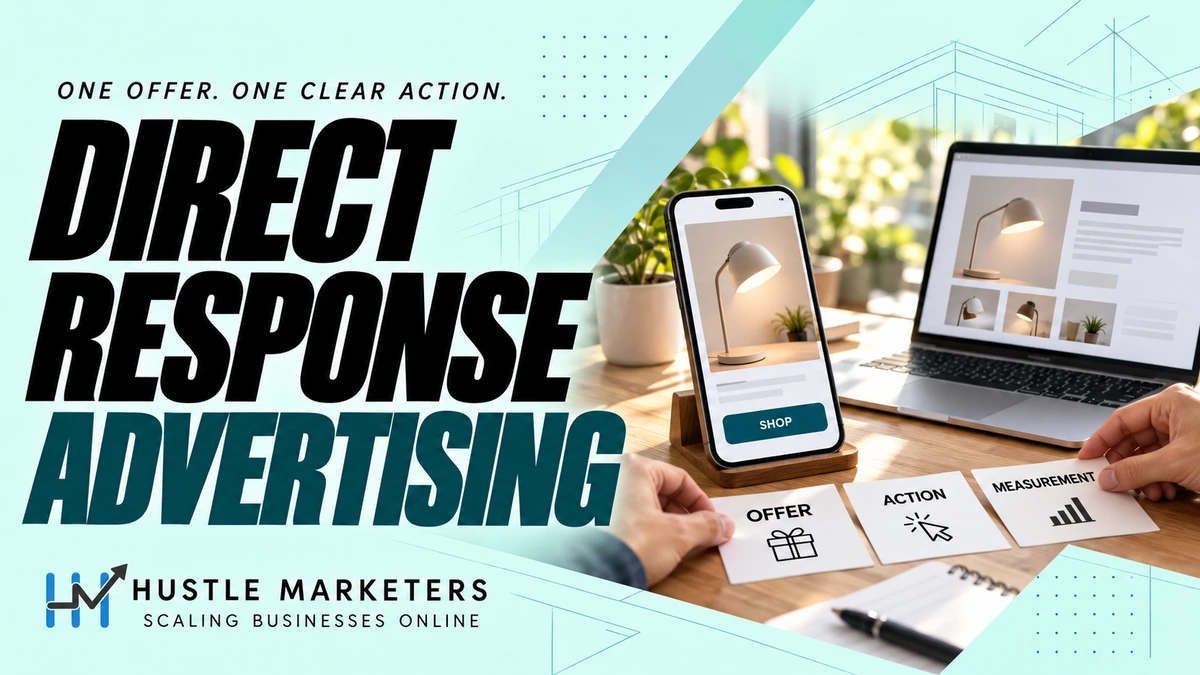
Direct Response Advertising: Complete Guide for Google Ads and Meta Ads 2026

Ishant
Published : September 29, 2026 at 5:38 am
Updated : October 16, 2026 at 12:14 pm
Ishant
By Ishant Sharma Category: PPC and Paid Advertising Updated: August 2026 Reading time: 12 min
Quick Answer
Direct response advertising is any ad built to produce one immediate, measurable action, such as a purchase, form fill, call, or booking, not brand awareness. It works through five principles: a specific offer, a clear CTA, targeted messaging, urgency, and trackable results. Google Search Ads and Meta Sales or Leads campaigns are the two most common direct response formats.
Most advertising is built around one idea: be seen. Direct response advertising is built around a different idea entirely: get a response, right now, from the right person.
It is the foundation of virtually every high-performing Google Ads and Meta Ads campaign. And yet, many businesses running paid ads are not actually running direct response advertising. They are running awareness campaigns with direct response budgets, and wondering why the conversions are not coming.
This guide explains what direct response advertising is, how it differs from brand advertising, and its five core principles. It also shows how to apply it across Google Ads and Meta Ads in 2026, generating leads, sales, and measurable ROAS.
Image slot: 5 principles of direct response advertisingEvery high-performing direct response ad, on any platform, is built on the same five foundations.
What Is Direct Response Advertising?
Direct response advertising is a form of paid advertising with one primary goal. It aims to produce a specific, immediate, and measurable action from the person who sees or hears the ad.
Every direct response advertising definition comes back to the same idea: an ad built to make someone act, not just notice.
Responding to advertisements is exactly the behavior these ads are built to trigger, whether that means a click, a call, or a purchase. Ask what is direct response ads in plain terms, and the answer is simple: pay for attention, then ask for a specific action.
That action could be:
- Completing a purchase
- Submitting a lead form
- Calling a phone number
- Downloading an app or resource
- Booking a consultation or appointment
- Signing up for a free trial
Every element of a direct response ad is intentional. The headline, the offer, the urgency, the call to action, and the landing page all work together toward that single response.
There is no passive goal of making someone vaguely aware of your brand. The goal is a specific action, taken now, by a specific person.
This is what separates direct response advertising from general brand advertising. Brand advertising wants to build an emotional impression over time. Direct response advertising wants a measurable outcome this week, ideally today.
Direct Response Advertising vs Brand Advertising
Understanding the difference between direct response and brand advertising prevents one of the most expensive mistakes in paid media. That mistake is running brand-style campaigns with direct response budgets, then measuring them by conversion metrics.
Direct Response Advertising
- Goal: Immediate, measurable action
- Audience: People with buying intent
- Message: Specific offer and clear CTA
- Timeline: Short-term results
- Measurement: CPL, CPA, ROAS, revenue
- Channels: Search, Shopping, Lead Ads, Sales campaigns
Brand Advertising
- Goal: Long-term awareness and recall
- Audience: Broad market segments
- Message: Emotional storytelling, brand values
- Timeline: Months to years
- Measurement: Reach, frequency, recall lift
- Channels: Display, YouTube awareness, Demand Gen
Neither approach is wrong. They serve different purposes. However, most small and medium-sized businesses need direct response advertising as their primary paid channel because it produces measurable, attributable results relative to spend.
Brand advertising becomes more relevant as the business scales and wants to build a wider demand pipeline.
The Hustle Marketers ApproachFor most of the 2,500+ accounts we have worked with, we recommend starting with direct response campaigns on Google Search, then layering brand awareness as monthly ad spend grows past the point where direct demand is fully captured.
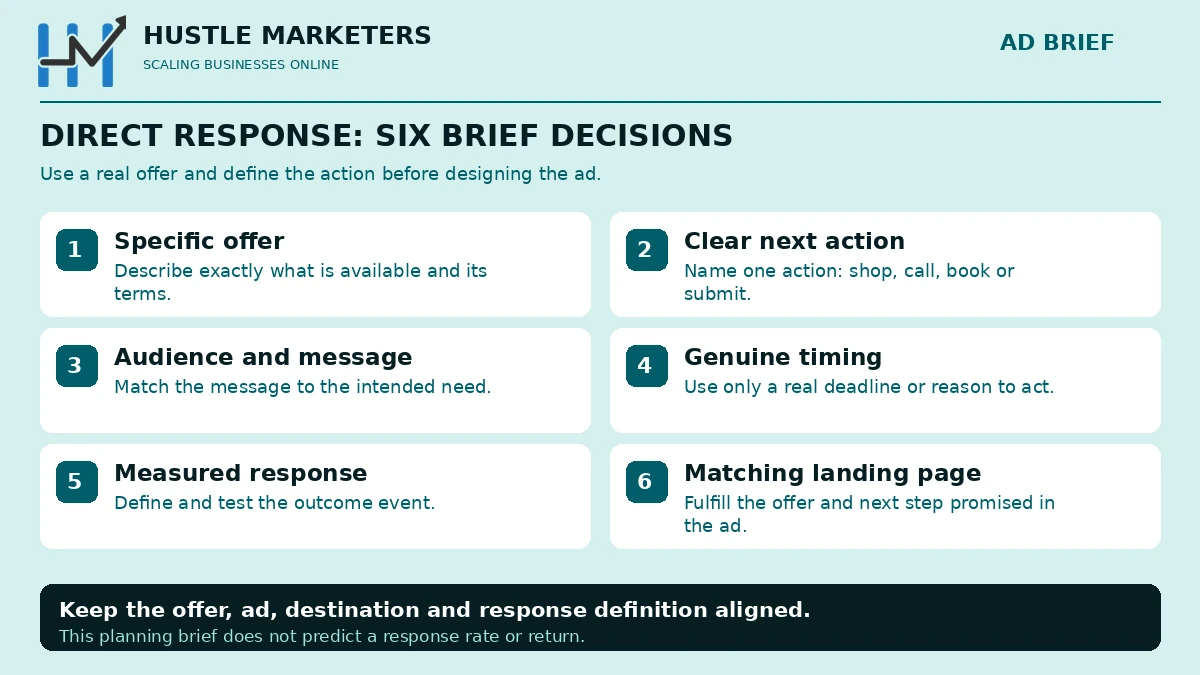
The 5 Core Principles of Direct Response Advertising
Every successful direct response campaign, whether on Google or Meta, on social media or email, follows these five principles. When a campaign underperforms, the failure can almost always be traced back to a weakness in one of them.
1A Specific, Compelling Offer
Direct response advertising does not promote general awareness of your business. It promotes a specific offer: a free audit, a 20 percent discount, a free trial, a guaranteed delivery time, a free consultation. The more specific the offer, the stronger the response.
Vague offers produce vague results. “We are a great agency” is not an offer. “Free Google Ads audit worth Rs 15,000, no commitment required” is an offer.
2A Clear, Unambiguous Call to Action
Every direct response ad must tell the audience exactly what to do next. “Call now.” “Fill in the form.” “Shop today.” “Book your free session.” A CTA should leave no room for confusion about the next step.
Ads that present information without a direct instruction produce much lower response rates than ads that explicitly guide the audience toward an action.
3Targeted Messaging for a Specific Audience
Direct response advertising works best when it speaks directly to one person with one problem or desire. Broad messaging that tries to appeal to everyone tends to resonate with no one.
The more precisely you define who you are speaking to, whether by search intent, demographic, interest, or behavior, the more relevant your ad becomes. Your response rate rises with it.
4Urgency or Reason to Act Now
Without a reason to respond immediately, people defer. They tell themselves they will come back later. They almost never do. Direct response ads create urgency through limited-time offers, limited availability, a deadline, or a price increase.
Or they simply frame the cost of inaction: “Every day you wait is a day your competitors are capturing your customers.” Urgency does not mean manufactured pressure. It means giving the audience a genuine reason to act now rather than later.
5A Measurable, Trackable Response
If you cannot measure it, you cannot improve it. Every direct response campaign must have a defined conversion event: a form submission, a call, a purchase, a booking. This requires proper conversion tracking before the campaign launches.
Without it, you are spending money without knowing what it is producing. The measurement framework is not an afterthought. It is a prerequisite.
Direct Response Advertising Examples That Actually Worked
What is a direct response ad, in practice, rather than in theory? The clearest way to answer that is to look at patterns that show up again and again in high-performing campaigns.
What is a direct response campaign, in one sentence? It is any ad asking for one clear action, tracked from click to result. Here are five patterns worth studying.
- The cart-abandonment email. A shopper leaves items in their cart. An email arrives within an hour showing the exact products, a small discount, and one button.
- The countdown landing page. A visible timer next to the price creates genuine urgency tied to an actual expiring offer, not a timer that quietly resets.
- The exit-intent popup. Just as a visitor moves to leave, a popup offers one small incentive to complete a single action, like joining a waitlist.
- The single-offer search ad. A search ad names one specific offer, like “Free Google Ads audit, no commitment,” instead of describing the company in general terms.
- The results-led social ad. A social ad opens with a specific, believable claim, then explains the offer and closes with one clear button.
Some of the best direct response ads of all time share the same structure. One offer, one audience, one action, and a way to measure whether it worked.
Direct response website examples worth studying almost always follow this same pattern on the landing page itself, not only in the ad.
Direct Response Advertising on Google Ads
Google Search Ads are the purest form of direct response advertising available in digital marketing. The user signals their intent through a search query.
Your ad then enters Google’s real-time ad auction to respond with a relevant offer and CTA. When done correctly, you appear in front of someone at the exact moment they are looking for what you sell.
Google Search Campaigns
Search campaigns are the backbone of direct response on Google. Someone searching for “emergency plumber near me” or “Google Ads management agency India” is already in the market.
They have a need. Your ad’s job is to be the most relevant, credible, and compelling response to that need.
Image slot: Annotated direct response search ad exampleA high-intent keyword, a specific offer, and a clear CTA, the three elements a direct response search ad needs.
For direct response Search campaigns, the key elements are:
- High-intent keyword targeting: Focus on transactional and commercial keywords. Terms like “hire,” “buy,” “service near me,” “pricing,” and “quote” indicate buying intent. Informational keywords may generate traffic but rarely produce immediate conversions.
- Tightly themed ad groups: Each ad group should contain closely related keywords with ads written specifically for that intent. A generic ad matched to many different searches will underperform a specific ad matched to a specific search.
- Headline and description alignment: The keyword the user searched, the headline of your ad, and the content of your landing page should all be thematically connected. This alignment improves both conversion rate and ad quality.
- Specific offers in ad copy: “Free audit,” “same-day delivery,” “no setup fee,” “7-day free trial” perform better than generic CTAs like “Learn more” or “Visit our website.”
- Strong negative keyword lists: Block searches that signal the wrong intent. Job seekers, students, researchers, and people looking for free resources rarely convert on commercial landing pages.
For businesses focused on generating qualified leads through Google Ads, a well-structured direct response Search campaign is the fastest path to measurable results. Our Google Ads for lead generation campaigns are built entirely on direct response principles.
Keyword intent, ad copy, and landing page all align around a single conversion goal.
Google Shopping Campaigns
Shopping campaigns are direct response by nature. When someone searches for a specific product, your Shopping ad appears with a product image, price, and store name. It asks them to respond immediately by clicking to purchase.
Direct response principles applied to Shopping:
- Optimize product titles with the specific terms buyers use at the point of purchase
- Use price, offer, or availability advantages in promotions
- Segment product groups to bid more aggressively on high-margin or high-conversion products
- Link to the exact product page, not a category or homepage
For ecommerce brands, Shopping campaigns paired with remarketing are one of the highest-ROI direct response combinations available. Our ecommerce PPC management service builds direct response Shopping and Performance Max campaigns specifically around conversion data and margin targets.
Performance Max Campaigns
Performance Max is Google’s automation-driven campaign type that serves ads across Search, Display, YouTube, Gmail, Discover, and Maps.
When used with a direct response mindset, it can be a powerful scaling tool. However, it requires robust conversion tracking and a meaningful conversion history before Google’s algorithms can optimize effectively.
For direct response, treat Performance Max as a scaling layer, not a starting point. Launch Search campaigns first, build conversion data, then expand to Performance Max with clear asset groups and conversion goals defined.
If your Performance Max campaigns are spending budget without producing results, something is wrong. Read our guide on why Performance Max is not performing and how to fix it.
Display and YouTube for Direct Response
Display and YouTube are often treated as brand awareness channels, but they can be used for direct response through remarketing. Visitors who came from Search campaigns but did not convert are a strong retargeting audience.
Target them on Display and YouTube with a more specific offer, a deadline, or social proof that addresses common objections.
For cold audiences, Display and YouTube demand strong creative that can interrupt attention and make a compelling case for clicking. This requires a clearer offer and stronger hook than Search, where the user is already seeking you out.
Display banner ads direct response marketing relies on look like ordinary banners, but every element points to one action. A direct response display advertising definition is simple: a banner built for one trackable click, not general visibility.
Direct response display advertising definition examples include a retargeting banner with a discount code and a countdown timer. Another example is a static banner naming one specific offer instead of a general brand message.
Direct Response Advertising on Meta Ads
Meta Ads (Facebook and Instagram) operate differently from Google Search. On Google, you respond to existing demand. On Meta, you create demand among people who were not actively looking for your product or service. This requires a different direct response approach.
The Right Campaign Objective
The campaign objective you choose tells Meta what to optimize for. For direct response advertising, the correct objectives are:
- Sales: Optimizes for purchases. Best for ecommerce with a working Meta Pixel or Conversions API.
- Leads: Optimizes for form completions. Use for lead generation businesses, service providers, and B2B.
Awareness, Traffic, and Engagement objectives are not direct response objectives. They optimize for reach and clicks, not for business outcomes. Running a direct response campaign on a Traffic objective is one of the most common and expensive mistakes in Meta Ads.
The Creative Hook: Stopping the Scroll
On Meta, your ad competes with everything in a person’s feed: posts from friends, family, news, and entertainment. You have about one to two seconds to stop someone from scrolling past your ad.
A strong direct response hook on Meta does one of three things:
- Identifies the audience’s specific problem immediately (“Still paying too much for leads from Meta Ads?”)
- Makes a bold, specific, credible claim (“We helped 200+ ecommerce brands increase ROAS by 3x in 90 days”)
- Opens with an unexpected or curiosity-driven statement that pulls the audience into the ad
The hook is the most important single element of a Meta Ads direct response creative. A weak hook means no one reads the offer or the CTA, regardless of how strong they are.
Study real hooks that are running right now in the Meta Ads Library before you write your own.
Image slot: Hook-problem-solution-CTA ad mockupA worked example of the four-part structure, applied to a real offer.
The Offer and CTA on Meta
After the hook captures attention, the body of the ad must deliver a specific offer and a clear instruction. On Meta, the best-performing direct response offers are:
- Free trials or samples with low commitment
- Limited-time discounts with a genuine deadline
- Free consultations, audits, or assessments
- Specific results-based claims supported by case studies or testimonials
- Product demonstrations or before-and-after proof
The CTA button should match the offer. “Shop Now” for ecommerce, “Get Quote” or “Book Now” for services, “Download” for lead magnets, “Learn More” for longer consideration cycles.
Conversion Tracking: The Non-Negotiable Foundation
Direct response on Meta requires the Meta Pixel and ideally the Conversions API (CAPI) both working correctly.
Without reliable tracking, Meta’s algorithm cannot identify which people are responding to your ads, which means it cannot find more people like them. The targeting deteriorates, costs rise, and conversion volume drops.
Before launching any direct response Meta campaign, verify that your conversion events are firing correctly. Check that the purchase or lead event is attributed in Meta Events Manager, and that your Pixel health is rated positively.
This is not optional for direct response. It is the foundation.
Tracking CheckIf your Meta Ads CPL is rising and conversion volume is falling, the first thing to check is not your creative or budget. Check your Pixel health and CAPI connection in Events Manager. Broken tracking is the most common silent killer of direct response Meta campaigns.
Direct Response Advertising Beyond Google and Meta
Direct response did not start online. It started on television and radio decades before digital ads existed, using phone numbers instead of pixels to track results.
The same core principles work on any channel: a clear offer, real urgency, and one obvious next step.
- Direct response TV (DRTV): Infomercials built entire businesses around a phone number and a specific offer. Today, many DRTV ads use a QR code and a landing page instead.
- Direct mail: A physical letter or postcard with a specific offer and a deadline still works for many local and B2B businesses.
- Radio ads: A short, memorable offer with a simple website or phone number to respond to remains effective for local service businesses.
- Email marketing: Once someone is on your list, email is one of the cheapest, most direct response channels available, especially for cart recovery and follow-up offers.
- Direct response print advertising: Magazine and newspaper ads with a coupon, code, or specific call to action still appear in niches with an older or local audience.
None of these channels are outdated. They simply need the same discipline as a Google or Meta campaign: one offer, one action, and a way to measure the response.
How to Write Direct Response Ad Copy
Direct response copywriting is a specific skill. It is not the same as content writing, brand writing, or general marketing copy. Its sole job is to produce a response from the right reader at the right moment.
Focus on the Customer’s Problem, Not Your Product
The biggest mistake in ad copy is leading with what the product is rather than what problem it solves for the customer. Compare:
Weak: “We are a digital marketing agency with 12 years of experience and Google Partner status.”
Strong: “Your Google Ads are spending budget on the wrong keywords. We fix that in 30 days or you do not pay.”
The second version speaks directly to a pain the audience recognizes. It identifies a problem, proposes a solution, and contains a specific offer. That is direct response copywriting.
Be Specific, Not General
Specificity builds credibility and cuts through noise. Numbers, timeframes, outcomes, and details all make copy more believable and more compelling.
General: “We help businesses grow online.”
Specific: “We have generated over 1.2 lakh leads for Indian businesses across real estate, healthcare, and ecommerce in the last 3 years.”
Use Urgency That Is Real
Urgency is powerful but it must be credible. Fake countdown timers and manufactured scarcity destroy trust, and they can cross into territory that Meta’s advertising standards do not allow.
Real urgency includes genuine deadlines, limited consultation slots, or actual seasonal offers. It can also come from the honest cost of delay, framed simply: “Every month without proper tracking is a month of unattributed ad spend.”
End with One Clear Next Step
Every direct response ad should end with a single, clear instruction. Do not give the audience multiple options. Multiple options produce decision paralysis, which produces no action. Choose one next step and make it obvious.
Direct Response Copywriting Formulas: AIDA and PAS
Two formulas show up again and again in direct response copywriting. Both give you a repeatable structure instead of a blank page.
| Formula | Steps | Example Line |
|---|---|---|
| AIDA | Attention, Interest, Desire, Action | “Still paying too much per lead? Here’s why, and the 3-step fix. Book your free audit today.” |
| PAS | Problem, Agitate, Solution | “Your ads are spending budget on the wrong keywords. Every week that continues costs you real leads. We fix it in 30 days.” |
AIDA opens with a hook, builds interest by naming the problem you solve, and creates desire by showing the benefit. It closes with a clear action, which makes it dependable for cold audiences.
PAS is more direct. Name the problem, make it feel real and urgent, then present your offer as the solution. It works well when the reader already half-knows their problem.
Neither formula is more correct than the other. Test both against your actual audience and let response rate decide which one fits your offer.
The Landing Page in Direct Response Advertising
A direct response ad is only half the equation. The landing page completes it. An ad can generate a click, but it is the landing page that converts that click into a lead or sale.
The most important rule: your landing page must fulfill exactly the promise made in the ad. If your ad says “Free Google Ads audit for ecommerce brands,” the landing page headline should confirm that.
Not “Digital Marketing Services.” Not “Contact Us.” The specific thing you promised in the ad.
A high-converting direct response landing page has:
- A headline that matches the ad promise immediately
- A single, clear conversion goal (one form, one CTA button, one action)
- Social proof: case studies, client logos, testimonials, or specific results
- Answers to the most common objections the audience might have
- A fast load time, especially on mobile
- No unnecessary navigation or links that take the visitor away from the conversion action
Improving the landing page is often more impactful than improving the ad itself. A well-written ad sending traffic to a weak landing page will always underperform.
Improving landing page relevance is one of the most direct ways to improve ROAS across both Google and Meta campaigns.
Image slot: Annotated direct response landing pageThe headline confirms the ad’s promise in seconds, before the visitor even starts scrolling.
How to Measure Direct Response Advertising Results
Direct response advertising is only as strong as its measurement. The ability to measure, attribute, and optimize is what makes it superior to brand advertising for performance-focused businesses.
The Metrics That Matter
| Metric | What It Measures | Why It Matters |
|---|---|---|
| CPL (Cost Per Lead) | Ad spend / number of qualified leads | Primary metric for lead generation campaigns. Benchmark against your industry range. |
| CPA (Cost Per Acquisition) | Ad spend / customers acquired | Most business-relevant metric. Requires lead-to-sale conversion data from your CRM. |
| ROAS (Return on Ad Spend) | Revenue / ad spend | Primary metric for ecommerce. A ROAS of 4 means Rs 4 generated per Rs 1 spent. |
| CVR (Conversion Rate) | Conversions / clicks | Measures how well your landing page converts traffic into responses. |
| CTR (Click-Through Rate) | Clicks / impressions | Measures how well your ad captures attention and generates interest. |
Optimize toward the metric that most closely reflects a business result. For lead gen, that is CPL and CPA. For ecommerce, that is ROAS and revenue. CTR and impressions are secondary. They tell you about ad performance but not business outcome.
Attribution and the Full Funnel
Direct response advertising results are clearest when you can track the full path: ad click to lead to qualified opportunity to closed customer. This requires connecting your ad platform data to your CRM or sales system.
If your Google Ads dashboard shows 50 leads but your sales team only remembers receiving 20 quality calls, the discrepancy matters. Track lead quality, not just lead volume.
Image slot: Full-funnel attribution diagramEach stage of this path needs its own tracking, or the report at the top will not match reality on the ground.
When to Optimize vs When to Scale
Decision Framework
CPL above target AND low conversion rate → Fix the landing page first
CPL above target AND high conversion rate → Reduce CPC (keywords, match types, negatives)
CPL on target AND low volume → Increase budget or expand keyword coverage
CPL on target AND good volume → Scale budget and begin testing new audiences
Running a structured Google Ads audit checklist before scaling is the fastest way to spot structural issues. These issues will limit performance regardless of budget.
Direct Response Marketing Tools You Need
Direct response advertising costs more than media spend if you skip the right tools. A basic stack keeps your campaigns measurable, not just active.
- Email platform: Follows up with leads automatically and runs cart-recovery or nurture sequences without manual work.
- CRM or spreadsheet CRM: Tracks every contact so leads do not get lost between the ad and the sale.
- Landing page builder: Lets you launch and test offer pages quickly without waiting on a developer.
- Conversion tracking: A pixel plus server-side tracking connected to your ad accounts, so you know which ads actually produced results.
Every direct response advertising campaign needs these four pieces working together. Skip conversion tracking and you cannot tell which ads are worth scaling.
Skip a CRM and leads fall through the cracks between the ad and the follow-up.
7 Common Direct Response Advertising Mistakes
1. Using the Wrong Campaign Objective
Running a Sales or Lead generation campaign using the Awareness or Traffic objective on Meta tells the platform to optimize for the wrong outcome. Always match your objective to your actual goal.
2. Sending Traffic to the Homepage
A homepage is designed for general visitors. A landing page is designed for one specific conversion goal. Sending direct response traffic to a homepage forces the visitor to find the relevant section themselves, significantly reducing conversion rates.
3. Broad Keyword Targeting Without Negatives
On Google, broad match keywords without a strong negative keyword list can spend a significant portion of budget on irrelevant searches. Review your search terms report every week and add negatives aggressively.
4. No Conversion Tracking
If you cannot measure what is converting, you cannot optimize. This is the single most disqualifying problem in any direct response campaign. Set up and verify conversion tracking before spending a single rupee.
5. Weak or Missing Offer
Ads that say “Contact us to learn more” without a specific offer or reason to act now are not direct response advertising. They are passive presence. Add a specific offer to every direct response ad.
6. Letting Creative Run Too Long on Meta
Meta Ads creative fatigues. When your audience has seen the same ad too many times, CTR drops and costs rise. Refresh creative every 10 to 14 days for active direct response campaigns and test multiple hooks simultaneously.
7. Optimizing for Clicks Instead of Conversions
High CTR feels good. It does not mean the campaign is working. A campaign generating 500 clicks with 2 conversions is performing worse than a campaign generating 200 clicks with 15 conversions. Always optimize toward the action that produces business value.
Image slot: Common mistakes comparison graphicThe seven mistakes above, side by side with the fix for each one.
Retargeting vs Remarketing: What Is the Difference?
These two words get used interchangeably, but they describe slightly different tactics. Knowing the difference helps you plan your channel mix on purpose.
Retargeting
- Shows ads to anonymous website visitors
- Uses a tracking pixel, not an email address
- Common on Meta, Google Display and YouTube
- Works even without the visitor’s contact details
Remarketing
- Re-engages people you already have contact details for
- Most often done through email
- Used for cart recovery, win-back and upsell sequences
- Requires the contact to have opted in first
Many marketers use the words interchangeably, and most platforms do not enforce a strict line between them. The distinction still matters when you plan a full-funnel direct response strategy, since each one needs a different tool.
Direct Response Advertising for Ecommerce
Ecommerce is where direct response advertising reaches its highest expression. Every element of the purchase funnel, from product discovery to checkout, can be optimized around a measurable response.
An effective direct response ecommerce advertising structure typically looks like this:
- Top of funnel: Meta Ads or YouTube targeting cold audiences with a product-specific hook and a strong initial offer (first order discount, free shipping, bundle deal)
- Mid-funnel: Google Shopping campaigns capturing searchers who are actively looking for the product category
- Bottom of funnel: Remarketing on Display and Meta targeting cart abandoners and product page visitors with urgency-based creatives (low stock, offer expiry, social proof)
- Retention: Email and SMS sequences triggered by purchase behavior, optimized for repeat purchase and lifetime value
Image slot: Ecommerce full-funnel structure diagramA typical direct response ecommerce structure, from cold Meta traffic to repeat purchase.
For ecommerce brands, Google Search and Shopping capture intent, while Meta Ads deliver audience-based direct response. Together, they form one of the most proven full-funnel structures in 2026. Our ecommerce Google Ads management approach is built entirely around this direct response framework.
Direct Response Advertising for B2B
Direct response is not only for ecommerce. B2B companies use the same principles, they just ask for a different action.
Instead of a purchase, a B2B direct response ad asks for one specific, trackable next step:
- Booking a demo
- Starting a free trial
- Downloading a gated guide or case study
- Requesting a quote or consultation
The same rules still apply. One clear offer, one clear call to action, and a way to measure whether the ad actually worked. A gated whitepaper with no follow-up sequence is not direct response. It is just a download with no next step.
If you would rather have an ad agency direct response campaigns for you, that is exactly the kind of work we do at Hustle Marketers. Many direct response advertising companies focus only on ecommerce, so ask about B2B experience specifically before you hire one.
Direct Response Advertising and AI in 2026
Both Google Ads and Meta Ads have integrated significant AI capabilities into their platforms in recent years. For direct response advertisers, this changes how campaigns are optimized but not why they work.
Smart Bidding strategies on Google, such as Target CPA, Target ROAS, and Maximize Conversions, are direct response tools when used correctly. They automate bid decisions at auction time based on conversion probability.
However, they require reliable conversion data to function. With poor tracking or insufficient conversion volume, smart bidding cannot perform. The direct response principle of measurable outcomes is a prerequisite for AI-driven tuning, not something it replaces.
On Meta, Advantage Plus Shopping Campaigns and Advantage Plus Audience use machine learning to find buyers within your defined parameters. These are direct response tools. But they require strong creative input, a clear conversion objective, and a working Pixel or CAPI to work as intended.
AI improves the execution of direct response advertising. It does not replace the strategic thinking behind it.
Direct Response Advertising vs Performance Marketing
These two terms get confused often, and the confusion is understandable since they overlap heavily.
Performance marketing is the broader, modern umbrella term. It covers any channel measured by direct results, including influencer partnerships, affiliate marketing, and paid search or social.
Direct response advertising is older and narrower. It refers specifically to ads built to get one immediate, trackable action from the viewer, not just results measured over time.
Most direct response advertising counts as performance marketing. But not all performance marketing is direct response. An influencer post driving brand awareness with a discount code counts as performance marketing, but it may lack the urgency of true direct response.
Use direct response principles inside a performance marketing budget, and you get the best of both: broad channel coverage with campaigns still built to convert.
About the Author
Ishant Sharma is the Founder and CEO of Hustle Marketers, a Google Partner and Meta Business Partner agency based in Zirakpur, Punjab, India. With more than 12 years of experience, he manages direct response campaigns across Google Ads, Meta Ads, and Microsoft Ads.
His clients span ecommerce, local services, SaaS, and B2B, globally. He focuses on conversion tracking, high-intent audience targeting, CPL and ROAS tuning, and full-funnel campaign architecture. He is a Top Rated Plus freelancer on Upwork with a 100 percent Job Success Score.
Frequently Asked Questions
What is direct response advertising?
Direct response advertising is a type of advertising designed to produce an immediate, measurable action from the audience. That action could be a purchase, a form submission, a phone call, an app download, or a booking.
Every element of a direct response ad is designed to drive that specific response rather than build general brand awareness.
What is the difference between direct response advertising and brand advertising?
Direct response advertising targets people with buying intent and asks them to take a specific action immediately. Success is measured by CPL, CPA, ROAS, and revenue.
Brand advertising builds awareness and emotional association over time across a broad audience. Success is measured by reach, recall, and long-term brand equity. Most performance-focused businesses use direct response advertising as their primary paid channel and add brand advertising as budget grows.
Is Google Ads direct response advertising?
Yes. Google Search Ads are inherently direct response because they appear when someone is actively searching for a product or service. The user’s search query signals intent, and the ad responds to that intent with a specific offer and CTA.
Google Shopping, Performance Max, and lead generation campaigns are also structured around direct response principles.
Can Meta Ads be used for direct response advertising?
Yes. Meta Ads can be highly effective for direct response. Campaigns need the correct objective (Sales or Leads), strong creative hooks, clear offers, and reliable pixel or Conversions API tracking.
The key difference from Google Search is that Meta reaches people before they are actively searching. So the ad must create the desire, rather than simply respond to existing intent.
What metrics should I track for direct response advertising?
The primary metrics are CPL (cost per lead), CPA (cost per acquisition), ROAS (return on ad spend), and conversion rate. Secondary metrics include CTR, impression share, and frequency. Avoid optimizing for clicks or impressions alone as these do not measure business outcomes.
What makes a good direct response ad?
A good direct response ad has five elements:
- A specific, compelling offer
- A clear and urgent call to action
- Targeted messaging aimed at the right audience
- A measurable response mechanism
- A landing page that fulfills the promise made in the ad
The copy focuses on customer benefits, not brand features.
How is direct response advertising measured?
You measure direct response advertising by the number of measurable responses it produces and the cost of producing each one. For lead generation, this is CPL and CPA. For ecommerce, this is ROAS and revenue per campaign.
For app installs or signups, this is cost per install or cost per signup. Every campaign should have a defined conversion event tracked before launch.
What is a direct response landing page?
A direct response landing page is a web page built around one conversion goal that matches the offer made in the ad. It has a headline that confirms the visitor is in the right place, plus a clear CTA, social proof, and objection handling.
It also avoids unnecessary navigation that could distract the visitor from converting.
What is the difference between direct marketing and direct response marketing?
What is direct advertising compared to direct response? The terms overlap, but direct response is the specific, trackable kind. Direct marketing simply means reaching a customer with no middleman, like a newsletter or a general mailer.
Direct response marketing is built to get an immediate, trackable action right now, like a countdown discount. All direct response is direct marketing, but not all direct marketing asks for instant action.
Who is considered the father of direct response advertising?
Lester Wunderman is widely credited as the father of direct marketing. He coined the term in a 1967 speech, then later invented tools still used today, including the magazine subscription card and the toll-free 1800 number.
His agency work proved advertising results could be tracked and measured, the core idea behind direct response.
Can direct response advertising work on TV, radio or direct mail, not just digital?
Yes. Direct response started on TV and radio decades before digital ads existed. Those ads used infomercials and phone numbers to track responses.
Today the same channels use QR codes and trackable landing pages instead. The core principles stay the same: a clear offer, urgency, and one obvious next step, on any channel.
What is the difference between retargeting and remarketing?
Retargeting usually means showing paid ads to people who visited your site but did not convert, using a tracking pixel. Remarketing usually means re-engaging people you already have contact details for, most often through email.
Many marketers use the words interchangeably. The distinction still helps when you plan your channel mix.
What is the AIDA copywriting formula?
AIDA stands for Attention, Interest, Desire and Action. You grab attention with a strong hook, then build interest by naming the problem you solve.
Next you create desire by showing the benefit, then close with a clear call to action. It is one of the oldest, most reliable structures in direct response copywriting.
Does direct response advertising work for B2B companies, or only ecommerce?
It works for B2B too. Instead of a purchase, a B2B direct response ad asks for a specific, trackable next step, like booking a demo or starting a free trial.
The same rules apply: one clear offer, one clear call to action, and a way to measure whether the ad worked.
What tools do I need to run direct response marketing campaigns?
At minimum you need an email platform to follow up with leads, plus a simple CRM to track contacts. Add a landing page builder and conversion tracking, such as a pixel or server-side tracking connected to your ad accounts.
Without tracking in place, you cannot tell which ads are actually working.
What is a good response rate for a direct response campaign?
It depends heavily on channel and offer, so there is no single universal number. What matters more is comparing your response rate against your own past campaigns and your cost per acquisition target.
A lower response rate can still be profitable if those customers are high value. Check response rate alongside cost and revenue, not alone.
How is direct response advertising different from performance marketing?
Performance marketing is a broader modern term. It covers any channel, including influencer and affiliate marketing, paid for based on results.
Direct response advertising is an older, narrower discipline focused on ads designed for one immediate, trackable action. Most direct response counts as performance marketing, but not all performance marketing is direct response.
What is average order value and why does it matter in direct response advertising?
Average order value, or AOV, is the average amount a customer spends per order. It matters because it tells you how much you can afford to spend acquiring a customer while staying profitable.
If your AOV rises through bundling or upsells, you can often afford a higher cost per acquisition and still scale profitably.