How to Get SEO Clients: What to Charge, What to Sign and Who Does the Work

Ishant
Published : October 23, 2026 at 2:30 pm
Updated : October 7, 2026 at 7:01 am
Ishant

Search how to get SEO clients and thirteen of the fourteen pages we read give you the same answer. Referrals, content, rank your own site, cold email, niche down, show case studies. We read those fourteen pages in full and counted the list on nearly all of them.
What none of them tells you is what to charge, what to sign, or who does the work once you have won more than you can deliver. Those three questions decide whether a client is worth having. This guide answers them with figures that carry a publisher, a date and a sample size.
Key Observations
- We read fourteen pages ranking for this query on October 2, 2026. Eleven are numbered tactic lists. The average list has exactly ten tactics. Not one page explains why its number one is number one.
- Ten of the fourteen publishers we read sell software, and the three heaviest sellers each nominate their own channel as the best channel. One page that ranks for the head term is about managing clients, not getting them.
- Referrals are the leading source of new agency business at 85 percent, ahead of word of mouth at 72, SEO and content at 38, and outbound at 33. AgencyAnalytics surveyed 494 agency professionals between February and April 2026.
- Clients won through referrals and word of mouth stayed 1.9 times longer than clients won through events, networking or outbound sales. Promethean Research, July 7, 2026, 165 agency leaders. That single figure changes how you should read every tactic list on this topic.
- The most common SEO retainer is 501 to 1,000 dollars a month, not the 2,917 dollar average. Ahrefs polled 439 providers and verified their websites. Quote the mode to yourself, not the mean.
- Half of 1,200 business owners surveyed by Backlinko spend under 1,000 dollars a year on SEO. Providers report a modal retainer of 501 to 1,000 dollars a month. Those two populations barely overlap, and that mismatch is the real reason prospecting feels hard.
- Cold email did not collapse, and the two most cited 2026 reply rates are not measuring the same thing. Belkins measured 7,530,489 emails sent in 2025 and reported 0.45 percent, counting unique replies divided by emails sent and excluding auto-replies and bounces. Instantly reported 3.43 percent for the same year, counting all replies including follow-up responses divided by emails sent, across thousands of workspaces on its own platform. Same arithmetic, a looser definition of a reply, and a much broader population.
- Google tells your prospects, in its own documentation, to be wary of agencies that email them out of the blue. Any cold outreach plan has to deal with that sentence.
- We checked five white label SEO providers on October 2, 2026. None of them publishes a wholesale rate. Every one routes to a sales call or a login.
- We sell white label SEO fulfillment. That is disclosed inside the section where it matters, and that section presents four options, not one.
Where do SEO clients actually come from?
Every list of how to get SEO clients puts its channels in an order. None of them says where the order came from. Survey data exists, and it does not match the order the lists use.
AgencyAnalytics surveyed 494 marketing agency professionals between February and April 2026. Sixty four percent were in the United States, 13 percent in Australia, 8 percent in the United Kingdom. Just under half the respondents worked at agencies with one to ten full time staff, which is the size most people reading this are at or heading toward.
| New business source | Share of agencies naming it |
|---|---|
| Referrals | 85 percent |
| Word of mouth | 72 percent |
| SEO and content marketing | 38 percent |
| Outbound outreach | 33 percent |
| Digital advertising | 26 percent |
| AI driven search results | 11 percent |
Source: AgencyAnalytics 2026 Marketing Agency Benchmarks Report, 494 respondents, fielded February to April 2026.
Two things in that table are worth sitting with. The first is that the two channels at the top are the two you cannot buy. The second is that AI driven search results already appear at 11 percent, in a survey closed in April 2026, as a named source of new agency business.
Acquiring new clients is also the top operational challenge for 30 percent of agency leaders in that same survey, and it has held first place in that survey since 2022. So if client acquisition feels harder than delivery, that is the normal state of this business, not a sign you are doing it wrong.
What a client costs to win, by channel
First Page Sage publishes cost per acquired customer by channel, drawn from roughly 120 firms in its own client database between December 2021 and November 2024, last updated June 18, 2025. Its own wording is that these figures were achieved in high performing campaigns run by its agency, so read them as a good case rather than an average, from a company that sells the services the data flatters. It is still the only channel level cost table in this subject area with a stated base.
| Channel | B2B cost per acquired customer |
|---|---|
| Email marketing | 510 dollars |
| Public speaking | 518 dollars |
| Webinars | 603 dollars |
| Thought leadership SEO | 647 dollars |
| Social media marketing | 658 dollars |
| Informal networking | 711 dollars |
| Paid search and SEM | 802 dollars |
| Content marketing | 1,254 dollars |
| Industry trade shows | 1,390 dollars |
| Basic SEO | 1,786 dollars |
| Sales development reps | 1,980 dollars |
Source: First Page Sage, Customer Acquisition Cost by Channel, approximately 120 firms, three year average, last updated June 18, 2025.
Notice the two rows that mention SEO. Thought leadership SEO costs 647 dollars per acquired customer. Basic SEO costs 1,786 dollars. Same channel, 2.8 times the cost, on the same publisher’s own definitions of thin and substantial work. Our reading of that gap is that the quality of what you publish, not the channel you publish it in, is what moves the cost per client.
One of the competing pages on this query cites the 647 dollar figure and labels it content or organic SEO, which quietly moves the cheap number onto the thin work. It belongs to the good work.
If you are planning to win clients by ranking your own site, which nine of the thirteen pages we read recommend, that distinction is the whole game. Thin service pages built to a keyword list put you in the 1,786 dollar row.
Why the channel you win through decides how long they stay
This is the figure that reframes the subject, and we found no competing page that carries it.
Promethean Research surveyed 165 agency leaders and published on July 7, 2026. Clients who arrived through referrals and word of mouth stayed 1.9 times longer than clients acquired through events, networking or outbound sales. The same study found 42 percent of agency leaders reported average retainer tenures above two years, and 30 percent above three.
Put that next to the cost table and the question changes shape. The tactic lists all answer “which channel is cheapest to win a client through”. Nobody asks “which channel produces clients who are still here in year two”. A client won through an outbound sales motion, which is the 1,980 dollar sales development row in that table, who then leaves in month seven is a worse trade than a referral that cost you nothing and stays three years, and the gap is not close.
That does not make outbound useless. It makes outbound a tool for filling a gap while the referral engine is still too small to feed you, and it means the clients you win that way need more deliberate work to keep.
It also means the single most effective thing most people reading this can do is ask. Hinge Research Institute reported, in 2015 research alongside a 523 firm provider survey, that 72 percent of buyers had not referred their service provider because nobody had asked them to. The buyer side base is not published, and the study is eleven years old, so treat it as a framing point rather than a current measurement. The mechanism has not changed.
How long before you land your first SEO client?
Every page we read gives a number. Across the SERP those numbers run from three days to eighteen months, and not one of them states a method. There is no credible independent dataset on time to first SEO client. If a page gives you a confident figure, it made it up.
What does exist is a handful of individual accounts with dates attached. They are more useful than the averages because you can see the variable the averages hide.
| Account | What happened | The variable |
|---|---|---|
| Forum thread, BlackHatWorld, posts dated 2025 | A new local SEO operator ranked his own site at position four, held it two weeks, and received no emails and no calls | Position four for two weeks is not a lead channel. One replying poster put it plainly on August 10, 2025, saying most businesses research for months before they reach out |
| Fiverr community thread | A seller reports a first order within fourteen days of opening the account | He had eight prior years as an SEO manager. The headline hides the experience |
| Preeti Gupta, writing on The SEO Community, dated by the author to 2022 | Started at 8 dollars an hour, dropped to 3 dollars an hour, earned under 400 dollars across three months | The only unglamorous published account of the slow version, and the clearest warning about what starting on price does |
| Forum thread, BlackHatWorld, posts dated January 27 and 28, 2018 | Four operators describe four completely different first client routes: LinkedIn, unsolicited spec work, selling to larger agencies, and one who worked in a business, saved, bought a bankrupt company and took a year to win a major brand | None of the four states a time to first client. That absence is the finding |
The pattern across every fast account we found is the same. The person already had experience, an existing network, or both. If you have neither, the honest planning assumption is months, and the thing to shorten is not the outreach volume but the proof.
One sales line from that 2018 thread is worth lifting out on its own. The operator who won a major brand account described pricing it at the maximum amount the contact could sign off without the decision going up the approval chain. That is a better pricing heuristic than any of the market ranges further down this page, because it is the only one that accounts for how buying decisions actually get made inside a company.
How do you get a first client with no portfolio?
Nine of the thirteen pages we read say show case studies and testimonials. That is correct and useless, because you are reading this precisely because you do not have any. Here is what people describe actually doing instead.
Deliver something before you pitch
On the 2018 thread above, one operator described building a one page site for the prospect first and then approaching them with the work already done. The mechanism is that the artifact replaces the case study. You are no longer asking them to believe a claim, you are asking them to look at a thing.
This works for SEO as well as it works for design. A rewritten title and meta set for their five worst performing pages, a crawl of their site with the three issues that matter circled, a keyword map for a service they do not have a page for. All of it is an hour or two of work, and all of it is evidence of competence rather than a description of it.
Charge for the audit, and use it to vet them
Six of the pages we read recommend a free SEO audit as the lead magnet. In 2026 that is a commodity, because every tool vendor gives one away instantly and AI will produce something that looks like one in seconds. The version that still works is the inverse.
Kristine Schachinger, an independent consultant, described on The SEO Freelancer podcast in November 2022 using a paid preliminary audit specifically to test the client relationship before committing to a long engagement. That reframes the audit from a lead magnet into a qualification filter. A prospect who will pay a few hundred dollars for a diagnosis is a different prospect from one who will accept a free one, and you find that out before you have sunk a month into them.
Run the diagnosis live, on their screen
This is the 2026 replacement for the free audit and it requires no case study at all. Build a set of fifteen to twenty five prompts a real buyer of their product would type, then run them in ChatGPT, Google AI Mode and Perplexity while the prospect watches. The HOTH described this approach in August 2026, and its reasoning is hard to argue with: nothing in a deck lands like a client watching a competitor get recommended in real time.
We would add one thing. Do it honestly. If the prospect already appears, say so, and the conversation becomes about share rather than absence. If you only run it when you know the answer is bad, you are doing a magic trick, and sophisticated buyers can tell.
When proof is not the problem
Worth knowing before you spend three months building case studies. A poster on the Shopify Community described having two successful case studies from sites he had grown and sold, and still being unable to convert prospects. His own diagnosis was that an affiliate background did not build client confidence, and that buyers wanted proof in their own niche rather than general results.
That is the counterweight to the whole SERP’s consensus. Proof is necessary and it is visibly not sufficient. Two case studies in the wrong vertical convert worse than one in the right one, which is the real argument for niching down. It is not that a niche makes marketing easier. Our reading of that account, and it is one account rather than a dataset, is that proof transfers much better inside a niche than across niches.
Does cold email still work, and what reply rate should you expect?
Six of the pages we read recommend cold email, two argue against it, and one of the pages recommending it is published by a cold email software company that ranks the tactic first out of ten and calls it the verdict. So the SERP is not a reliable guide here. The data is, once you understand why the published numbers disagree by an order of magnitude.
| Study | Dataset | Reply rate | What it counts |
|---|---|---|---|
| Belkins, published June 26, 2026, period January to December 2025 | 7,530,489 emails, 34,393 replies, over 1,200 meetings booked | 0.45 percent overall | Unique replies divided by emails sent, excluding auto-replies and bounce notifications. Belkins describes this as stricter than prior years, which used opens as the denominator |
| Instantly, updated January 12, 2026, period January 1 to December 18, 2025 | Described only as billions of interactions. No exact count published | 3.43 percent average, 5.5 percent top quartile, 10.7 percent top decile | All replies received, including follow-up responses inside a sequence, divided by total emails sent. The same arithmetic as Belkins, with a looser definition of a reply and a platform wide population rather than one agency’s managed campaigns |
Same year, same channel, and a 7.6 times spread across four widely cited 2026 benchmarks. John Mecke, writing on August 21, 2026, puts that spread down to studies using different denominators, different populations and different definitions of a reply, rather than to any real disagreement about the trend.
His own account is the useful part. He spent a quarter benchmarking against a 3.4 percent industry average, concluded he was failing, and sent more volume in response to a misdiagnosis.
Both figures above come from companies that sell cold email tooling. Read them accordingly. The honest summary is narrow and it is enough to plan with. On the strictest public measure, unique replies divided by emails sent across 7.5 million sends, the rate is under half a percent. The platform wide figure of 3.43 percent uses the same denominator but counts every reply in a sequence across a far wider population. Anyone quoting you a single number without saying what counted as a reply, and across whose sending, cannot help you.
The arithmetic that decides this for you
The number that actually settles whether cold email is your channel is not the reply rate. It is the sending ceiling.
Since February 1, 2024, Google requires senders of more than 5,000 messages a day to Gmail accounts to authenticate with SPF, DKIM and DMARC, to offer one click unsubscribe, and to keep the spam rate reported in Postmaster Tools below 0.3 percent. Google also advises keeping it below 0.10 percent.
Yahoo introduced equivalent standards the same month. It requires SPF and DKIM, a valid DMARC policy, a working one click unsubscribe, and a spam rate below 0.3 percent.
One detail in Google’s documentation deserves more attention than it gets. Bulk sender status does not expire. Google states that senders who meet the threshold at least once are permanently considered bulk senders, and that the 5,000 count includes everything sent from the same primary domain, subdomains included. You cross that line once, and the requirements apply to you from then on.
The practical consequence, as reported by sending tool vendors rather than by Google, is a safe working ceiling of roughly 50 to 100 emails per domain per day, with two to four weeks of warmup.
Run the arithmetic at Belkins’ 0.45 percent. One hundred emails a day, every working day, is about 2,000 a month, and gives you nine replies, of which some fraction are declines. That is not a client acquisition engine for a solo operator. It is a side channel.
Volume cold email was a real strategy when one person could send thousands a day from one domain. The February 2024 rules ended that for anyone who is not running serious sending infrastructure. What survives is small, targeted and personal, which is what practitioners in 2026 forum threads describe: hyper targeted sends to businesses already spending on ads or SEO, naming one or two specific issues on their site.
The sentence Google puts in front of your prospects
There is one more thing to weigh, and no competing page on this query mentions it. Google’s own documentation on hiring an SEO tells buyers to be wary of SEO firms and web consultants or agencies that email them out of the blue. That page is Google telling your prospect to distrust your cold email, on a domain your prospect trusts more than yours.
That is not a reason to never send one. It is a reason your first email cannot look like the thing Google warned them about. Generic, flattering, vague about what you would do, and asking for a call is exactly the shape of the message that sentence was written about.
Is it legal to cold email businesses about SEO?
The one compliance line we found on the entire top ten says that emailing mined business lists is illegal under GDPR. That is too blunt to be useful and wrong in the detail. Here is what the regulators themselves publish, which is what you should plan against.
What each regulator actually requires
| Market | Does cold B2B email need consent? | What you must do regardless | Unsubscribe deadline |
|---|---|---|---|
| United States, CAN-SPAM | No prior consent required. The FTC states the law makes no exception for business to business email, so the rules apply, but consent is not one of them | Accurate headers, honest subject line, identify the message as an ad, include a valid physical postal address, and explain how to opt out | Honor opt outs within 10 business days. The opt out mechanism must work for at least 30 days after you send |
| United Kingdom, PECR and UK GDPR | Not for incorporated companies. The ICO states the electronic mail rule does not apply to corporate subscribers. It does apply to sole traders and most non-LLP partnerships, who are treated the same as individuals | Do not disguise or conceal your identity, and give a valid address to opt out. A named business contact is still personal data under UK GDPR, and a business that objects must be respected | Not stated as a fixed window on the ICO page we read. The right to object applies immediately |
| Australia, Spam Act 2003 | Yes. ACMA states you must first have consent, which can be express or inferred where someone knowingly gave you the address and would reasonably expect marketing | Accurately identify your name or business name and include correct contact details, and make unsubscribing easy | Honor unsubscribes within 5 working days. The facility must work for at least 30 days |
| Canada, CASL | Effectively yes for strangers. The business to business exemption requires a pre-existing relationship between the two organizations, so cold email to a company you have never dealt with does not qualify. The route that does exist is a conspicuously published address, and the message must be relevant to that person’s role | Consent, identification and an unsubscribe mechanism, except where the narrow exemption applies | Within 10 business days and at no cost to the recipient |
Sources, all primary: FTC CAN-SPAM compliance guide, page dated August 2023 with a January 2024 edit. ICO guidance on business to business marketing, May 22, 2025. ACMA, Avoid sending spam, no page date shown. ISED Canada on CASL consent and the CRTC CASL FAQ, last modified February 26, 2026.
What it costs to get this wrong
Two things here should make you careful rather than relaxed. The FTC states that each separate email in violation is subject to penalties of up to 53,088 dollars. That is a figure the FTC adjusts for inflation every year, and it was current on the FTC page when we read it on October 2, 2026.
The second is that you cannot contract the liability away. The FTC is explicit that if you hire a company to handle your email, both the company whose service is promoted and the company that sends can be held responsible. If you are buying lead generation from a vendor, that sentence is about you.
Cold calling runs the opposite way
Cold calling is reversed across the Atlantic, which almost nobody mentions. In the United States the FTC states that most calls to a business made with the intent to solicit sales from that business are exempt from the Do Not Call provisions. In the United Kingdom the ICO states that for business to business calls you must screen against both the TPS and the CTPS registers as well as your own do not call list. Same tactic, opposite starting position.
None of this is legal advice and we are not lawyers. It is a map of which regulator’s page to read before you build a channel on a country.
Where do you find SEO clients who are already buying?
Five of the pages we read recommend prospecting businesses that rank on page two. That advice is from a time when page two had traffic to lose. A business sitting at position fifteen in 2026 is not feeling pain it can name, which is exactly why they do not answer.
The better filter is evidence of spend. A business already paying for ads, already paying another agency, or already producing content has proved it has a budget and an internal owner for this work. Practitioners in 2026 forum threads describe the same filter: target businesses already spending, then lead with one or two specific problems on their site rather than a general offer.
Sell to the people who already sell to your clients
The most under-rated route in this list, and the one with the most volume behind it. Web designers, developers and branding agencies have clients who need SEO and no way to deliver it. They are not competitors, they are a distribution channel, and the relationship is repeatable in a way that an individual client is not.
Larger agencies are the same opportunity one size up. They have the budgets and they routinely subcontract. One operator on the 2018 thread described selling to big agencies that outsource as very lucrative for exactly that reason.
If you take this route you become the supplier, which means your margin, your turnaround and your discretion are the product. The white label SEO side of this market works in both directions, and most of the pages ranking for this query only ever point you outward toward becoming someone’s supplier. The section further down covers the other direction, where you are the one buying.
Communities, for a reason nobody states
Five of the pages we read list communities and forums as a channel, and they all frame it as lead generation. The more interesting account we found runs differently. A freelancer who lost a client representing 60 percent of his income described joining several paid and free SEO communities and finding two new clients, and in the same rooms, the contractor who now handles his technical delivery.
That account is published by someone with a commercial interest in one of the communities named, so treat the timeline in it as marketing. The incidental detail is the valuable part, because it solves both of your problems in one place. The rooms where clients are are also the rooms where the people who can deliver the work are.
Marketplaces, with the platform’s own numbers
Upwork and Fiverr come up on two of the pages we read, both times as a straightforward recommendation. Two numbers from the platforms themselves should set your expectations.
Upwork publishes its own hourly benchmarks, updated May 12, 2026. It puts SEO experts at 15 to 35 dollars an hour and SEO analysts at 25 to 50 dollars.
The top of Upwork’s own SEO expert band sits below the 71.59 dollar average that Ahrefs found for freelancers in its 439 provider survey, and well below the 111 dollar overall average. You are not entering the SEO market on a marketplace. You are entering a different, cheaper market.
Then the cost of bidding. Upwork’s own documentation states that Connects cost 15 cents each, and that the number required per job varies with project size, scope and market demand.
Refunds are narrow. Connects come back only if a client cancels before a contract is made, or if Upwork removes the post. They are explicitly not refunded if the client rejects you, if another freelancer is chosen, if the job expires, or if you withdraw. Returned Connects come back for reuse, not as cash. So the attractive jobs cost more to bid on, and losing costs you money.
That is not an argument never to use a marketplace. It is an argument to treat it as paid acquisition with a measurable cost per proposal, and to compare it against the channel costs in the first table rather than against zero.
How do you get local SEO clients?
Local deserves separate treatment because the buyer is different. A plumber is not evaluating your technical SEO. They are deciding whether the phone rings, and they will judge you against the last person who promised that.
Three things make local prospecting different from everything above.
First, the diagnosis is visible from outside. You can see an unclaimed or thin Google Business Profile, missing or inconsistent hours, no service area set, review volume far behind the three businesses above them, and categories that do not match what they sell.
None of that needs access to anything. It is a specific, checkable list of problems you can name in the first sentence of an email or the first minute of a call, which is the opposite of the generic audit offer.
Second, the proof arrives sooner. Local results move on a timescale a small business owner can feel, which in our experience is the fastest route to a first case study. We have no published figure for how fast, and the rest of this page tells you to plan in months, so treat it as a relative advantage rather than a promise.
Third, the price is lower and the volume has to be higher. That is a business model decision, not a tactic. Ten local clients at the modal retainer is a different company from three mid-market clients at three times the price, with different capacity needs and a different fulfillment answer.
If you want to see what a local service page has to carry to compete, our own local SEO services page is the working version of the structure we recommend to clients, and it is a reasonable template for the one you build for yourself.
How much should you charge for SEO?
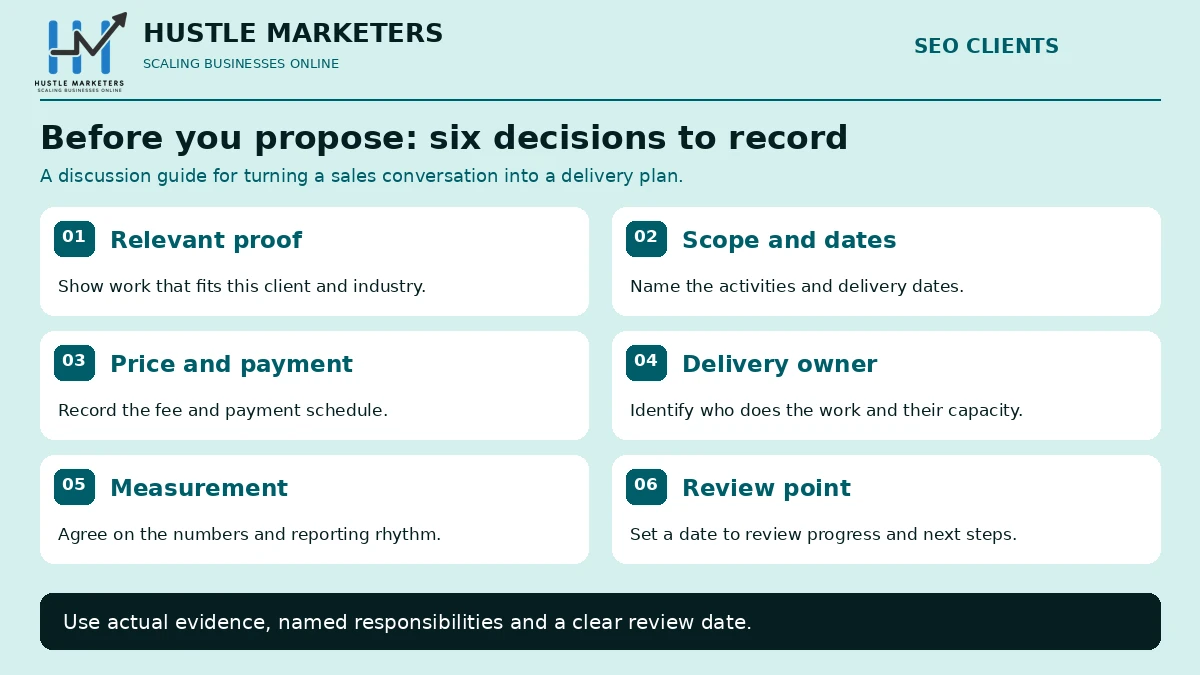
Five of the thirteen on-topic pages we read publish no pricing at all, including a round-up built from twenty named expert contributors. Two publish ranges of some kind. None of them tells you what to quote when you have no case studies, or when to raise.
Start with the only large survey that splits every price model on one base. Ahrefs polled 439 SEO service providers and manually reviewed their websites to confirm they really offered SEO. Published December 17, 2023, updated August 15, 2024.
| Price model | Freelancer average | Agency average | Consultant average |
|---|---|---|---|
| Monthly retainer | 1,348.63 dollars | 3,209 dollars | 3,250 dollars |
| Hourly | 71.59 dollars | 98.90 dollars | 171.18 dollars |
| Per project | 2,348.63 dollars | 9,507.84 dollars | 8,685.53 dollars |
Source: Ahrefs SEO pricing survey, 439 providers, published December 17, 2023, updated August 15, 2024.
Read the rows against each other before you read the numbers. An agency charges about 1.4 times a freelancer by the hour and about 4.0 times a freelancer by the project, which is our arithmetic on their figures rather than a published ratio. Consultants out-earn agencies per hour and agencies out-earn consultants per project. That is a packaging difference, not a skill difference, and it is the clearest signal in the table about where your pricing power comes from.
Quote yourself the mode, not the mean
The averages above are the wrong numbers to plan with because the distribution is skewed by large accounts. The same survey reports the most common bands, and they tell a different story.
| Model | Most common band | Share of respondents | Average, for comparison |
|---|---|---|---|
| Monthly retainer | 501 to 1,000 dollars | 20.4 percent | 2,917 dollars overall |
| Hourly | 75 to 100 dollars | 24 percent | 111 dollars overall |
| Per project | 2,501 to 5,000 dollars | 21.2 percent | Varies by provider type |
Same source and same 439 base. The most common SEO retainer in that survey is 501 to 1,000 dollars a month. The average is 2,917. If you price yourself against the average with no case studies, you are pricing against the top of a skewed distribution.
One more figure from the same survey, and it is the most actionable one in it: providers who have been in business two years or more charge about 33 percent more than those at two years or less. Your rate is a function of demonstrable time served, which means the plan is to raise it on a schedule, not to get it right on the first quote.
The mismatch nobody on this topic states
Now the buyer side. Backlinko surveyed 1,200 business owners, in a report last updated April 30, 2026, and found that half of respondents spend less than 1,000 dollars a year on SEO, that 14 percent spend over 5,000 dollars a year, and that only 2 percent spend over 25,000 a year.
Hold those two findings next to each other. Providers report a most common retainer of 501 to 1,000 dollars a month. Half of surveyed business owners spend under 1,000 dollars a year. Those populations barely overlap.
That is the real reason prospecting feels so hard, and we found no page that says it. Most of the businesses that are easy to reach are not in the market at the price the market reports. The implication is not to drop your price to meet them. It is that your prospecting has to filter for the minority who are already buying, which is the whole argument of the section above this one.
A price ladder, stated as a construction
No practitioner we found publishes their first client price and their fifth client price with dates on both. So this is assembled from the sources above rather than reported from anyone’s history, and you should read it as a map of the steps rather than as a benchmark.
- Marketplace floor, 15 to 35 dollars an hour for an SEO expert, from Upwork’s own published benchmarks dated May 12, 2026. The step out of here is leaving the marketplace, not raising your rate inside it.
- Freelancer average, 71.59 dollars an hour or 1,348.63 dollars a month, from the Ahrefs 439 provider survey. This is where you land once you are winning clients directly.
- Modal retainer, 501 to 1,000 dollars a month across all provider types, same survey. One or two clients here is a side income. Six or seven is a job with no capacity left.
- Agency average retainer, 3,209 dollars a month, same survey. The step from three to four is packaging and delivery capacity, which is the subject of the fulfillment section below. You cannot charge an agency rate on freelancer capacity for long without the quality showing.
If you want to see what sellers at each of those levels actually publish, our guide to SEO packages and what they include shows what is inside the number rather than just the range.
Two practical notes on top of the ladder. Price to the signing authority where you can, which means finding the largest number your contact can approve without escalating. And when you are costing a client, run the acquisition cost in: our CAC calculator and the broader explanation of customer acquisition cost will tell you what you actually spent to win them, which is the number that decides whether a 700 dollar retainer is profitable or a slow loss.
What about the first unpaid client
The one dated account of starting cheap is worth repeating here. Preeti Gupta described starting at 8 dollars an hour in 2022, reducing to 3 dollars, and earning under 400 dollars across three months. Starting low does not build a ladder. It builds a reference class of clients who found you at that price and a portfolio of results that nobody values.
If you need a first case study and cannot command a fee, the better trade is a short fixed scope piece of work at a real price with a documented outcome, or a paid audit. Both leave you with something to sell. Three months at 3 dollars an hour leaves you with neither.
What should you put in an SEO contract?
Across fourteen pages we found exactly one paragraph about contracts, and it said sign one quickly. Meanwhile the phrase seo contract draws more than three times the United States search volume of how to get seo clients, on Semrush data pulled on October 2, 2026. The demand is there and nobody on this SERP serves it.
Start with the only first-hand account of an SEO contract being litigated that we could find published in full.
The account
Kristine Schachinger, an independent consultant, told this on The SEO Freelancer podcast, published November 2, 2022. A website design and build client went unresponsive and had not paid. After waiting roughly 45 to 60 days for materials she invoked a clause allowing her to exit, and stopped work.
The client sued for 10,000 dollars in district court, claiming the cost of rebuilding elsewhere. In court the client produced a version of the contract that had been altered after it was sent to her, and which lacked the proper document headers.
Her lawyer showed the judge the alteration. The case was dismissed, on the basis that a case cannot rest on a fraudulent piece of evidence. Her own legal costs were about 10,000 dollars and consumed her emergency savings.
She won, and it cost her ten thousand dollars and her savings. That is the part to absorb. The lessons she drew from it are the citable part, and they are not what most contract advice says.
- Keep it short. Her rule is that a contract longer than two or three pages is too long, with an attached statement of work carrying dates and deliverables. Her lawyer’s reasoning was that an over-detailed contract creates more things to argue about in court.
- Never work on postpay. Her phrasing is that if they are not willing to pay you ahead, you do not want them as a client. She requires 70 percent up front from new clients and 50 percent down from existing ones.
- Document everything. Summarize phone calls in writing and ask for a reply confirming the summary.
- Keep three to six months of expenses so you are able to refuse work. The ability to say no is a contract term you give yourself.
- Use a paid preliminary audit to test the relationship before committing to a long engagement.
Notice how points two and five connect to everything else on this page. Seventy percent up front is what makes subcontracted delivery cash-flow safe, because you are not funding someone else’s work out of your own account while you wait. And the paid audit is simultaneously your first proof asset and your qualification filter.
What the contracts that survive actually say
Law Insider publishes clause language pulled from filed agreements. Three patterns are worth copying, and one is worth understanding.
| Clause | What the filed language does | Why it matters to you |
|---|---|---|
| Access, with the systems named | Requires access to the content management system or existing website, Google Analytics, Google Search Console, Bing Webmaster Tools, the domain control panel and FTP, and warns that refusing access to requested systems may have a negative effect on the work | This is the contractual answer to the client who will not grant access. You make it a condition of delivery, in writing, before you start |
| Ranking disclaimer | Expressly disclaims any specific resulting ranking, placement or other metric | You are not promising a position. If you have promised one verbally, this clause will not save you, because the conversation is evidence |
| Ownership tied to payment | States that the agency owns the rights to the optimization work implemented until all work has been completed and paid for | A filed, real answer to who owns the content and links when a client leaves mid-engagement |
| Scope written as activity | Lists research keywords, modify title tags, meta tags, content, HTML, URLs and other on-page factors, obtain links, create traffic and ranking reports | This is the mechanism behind the disclaimer. These contracts survive because they promise dated activities and reports, not positions |
Source: Law Insider, SEO services sample clauses, drawn from filed agreements. Individual agreement dates were not all visible, and these are other parties’ contracts rather than model clauses, so treat them as evidence of what works in practice and not as a template to sign.
Get the access right, in the right order
The access problem is partly your own fault and partly Google’s advice being followed. Google’s own documentation for buyers says to grant read access to Search Console at the hiring stage and specifically not to grant write access. So when a prospect refuses to make you an owner, they are doing what Google told them.
Ask for the correct level at the correct time, and put the handover in the contract. The details below are all from Google’s own help documentation.
- Search Console has four levels: owner, which can be verified or delegated, full user, restricted user and associate. Only a property owner can add or remove users. A restricted user has simple view rights on most data, which is enough for an audit.
- If every verified owner is deleted, all remaining users and delegated owners lose access after a grace period. A delegated-owner agency can lose a property without anyone intending it.
- A removed owner’s verification token remains usable unless an owner deletes it. So a departing agency can re-verify itself. Deleting the token belongs in your offboarding checklist and in theirs.
- In Google Analytics 4 only an administrator can add or remove users and assign roles. An editor has full control of property settings but cannot manage users. Two data restrictions exist, no cost metrics and no revenue metrics, which is the compromise to offer a client who will not share revenue.
- A Google Business Profile can have multiple owners but only one primary owner. A manager can do everything an owner can except add or remove users or remove the profile. When you become an owner or manager you must wait seven days before you can transfer ownership or remove other owners. Put that seven day lock in your project plan, because it will otherwise surprise you in week one.
One practical consequence of the ownership clause plus the access rules. If a client has not paid and you are holding account access, you hold a bargaining position and you also hold a risk. The responsible version is to have the payment terms, the access level and the offboarding steps written down before the relationship is under strain, so that what happens next is a contract term rather than a decision you make while angry.
What should you never guarantee an SEO client?
A position. Google’s own documentation states that no one can guarantee a number one ranking, and tells buyers to beware of SEOs who claim to guarantee rankings, allege a special relationship with Google, or advertise a priority submit. Those three warnings are published on a Google domain, which means your prospect can read them in ten seconds.
The trade press reached the same place from the other direction. Search Engine Roundtable covered a dispute in which a business owner stopped paying an agency he believed had not delivered. The agency sued for non-payment and he countersued.
The point in that coverage is that most SEO contracts carry no ranking guarantee, and specify deliverables instead, such as ranking reports on a stated day and an audit delivered by a stated date. So an outcome dispute turns on the contract language rather than on performance.
So a rank guarantee is unenforceable in the direction the client believes and dangerous in the direction you believe. What to promise instead:
- Dated deliverables. The audit by this date, the technical fixes specified by this date, this many pages published a month, reporting on this day.
- A stated method. Google’s buyer documentation also tells people to be careful if a company is secretive or will not clearly explain what it intends to do. Explaining your method in plain language is a differentiator precisely because so many sellers will not.
- A measurement standard you will not move. Agreeing up front which numbers count, and not changing them when they go the wrong way, is the single biggest trust asset in this business. It is why we published our own reporting integrity standard and why our guide to what automated SEO reports actually mean exists.
- What you will do if it is not working by an agreed review point. A named review date with an honest conversation attached is worth more than any guarantee, and it is a clause, not a promise.
Worth knowing what your prospect is being told to ask you. Google’s page lists eight questions it wants buyers to put to you, including whether you follow Google Search Essentials, how long you have been in business, and your experience in their industry, their country or city and with international sites. Four of them decide most pitches. Show me examples of previous work and success stories. What results do you expect, and in what timeframe. How do you measure success. How will we communicate, and will you share all changes made to my site.
Our own guide to how to choose an SEO company is written for the buyer, which makes it worth reading from the other side of the table before a pitch.
Who will actually do the work if you cannot do it alone?
This is the biggest hole in everything published on this subject. Not one of the fourteen pages we read answers it. White label appears on seven of them and in every case it points outward, telling you how to become somebody’s supplier. Nobody covers the direction you will actually face first, which is needing to buy delivery.
It is not a hypothetical problem any more. Here is the question, verbatim, from a question list that an agency published for buyers in May 2026: who specifically will work on our account, what are their seniority levels, and how many other accounts do they handle.
Treat that as evidence the question is in circulation rather than as a measurement of how often it gets asked, and prepare a true answer anyway.
Before the options, our disclosure. Hustle Marketers sells white label SEO fulfillment to other agencies. That is one of the four options below, and we have a commercial interest in it. We have written the drawbacks of it as plainly as we have written everybody else’s, and if one of the other three is right for you, take it.
The four options, with the honest cost of each
| Option | What it solves | What it costs you, honestly |
|---|---|---|
| Buy fulfillment from a white label provider | Capacity immediately, with no hiring risk and no fixed cost between projects | You cannot price it without a sales call. Quality risk is named by every publisher who covers the model. And no independent survey measures what margin is normal, so the only margin figures in circulation are the ones suppliers publish about their own resellers |
| Hire | Control, consistency and institutional knowledge that stays | In our experience the salary is the smallest part of the number. Employer costs, recruitment and the ramp to productivity are real and we found no source that quantifies them for this role, so you have to model them yourself |
| Build a contractor network | Variable cost, specialist skills on demand, no payroll | There is no published data at all on contractor reliability, churn or availability in this field. Your experience will be your only dataset, and the people who are good are busy |
| Decline the work | Protects the quality of the clients you already have, and therefore the referral channel that produces the clients who stay longest | A real revenue cost that no source quantifies, and it is the option that feels worst in the month you choose it |
One number for the hire option, because the table above would otherwise be four options and one price. Glassdoor’s United States SEO Specialist page, with its most recent submission dated August 25, 2026, puts average total pay at 86,547 dollars a year. Glassdoor’s sample disclosure is weak, showing 50 salaries against thousands of results and publishing no estimation model, so treat it as self reported rather than surveyed.
At a nominal 2,080 hours that salary is about 41.61 dollars an hour, which is arithmetic we have done here and not a published figure, and it excludes every employer cost, which no source we found quantifies for this role. The gap between that and the 71.59 dollars an hour that Ahrefs found freelancers charging is where the hire versus buy decision actually sits.
The strongest argument for the fourth option is the Promethean figure from the top of this page. Referral and word of mouth clients stayed 1.9 times longer than clients from outbound and events. Taking work you cannot deliver damages the only channel that produces durable clients. AgencyAnalytics’ churn data points the same way: performance not meeting expectations is cited by 31 percent of agencies as a reason clients leave.
What buying fulfillment actually costs
On October 2, 2026 we checked the public pricing pages of five providers that sell white label or reseller SEO. Here is what we found.
| Provider | Publishes a wholesale rate? | What the page offers instead |
|---|---|---|
| The HOTH, reseller page | No | A pricing sheet request and a reseller strategy session |
| Loganix | No | Confirms services come white label and client ready, shows no prices |
| Semify | No | Custom price based on volume, with a contact sales button |
| Marketer’s Center | No | See prices in dashboard, behind a login |
| DashClicks | No per-service prices | Free access to the fulfillment center, pay only for services used. The only published figure is a software subscription |
Five out of five. You cannot compare wholesale SEO fulfillment on price without entering five sales conversations. That is a structural feature of this market and it is worth naming, because the opacity is not an accident and it is the reason nobody can tell you what a normal margin is.
What is published are indicative bands, and every one of them is published by a supplier recruiting resellers. No independent survey tests them. Read them as the opening position in a negotiation rather than as a benchmark, and notice that both of the figures below describe the supplier’s own economics.
Nico Digital, a white label supplier, published a benchmark on June 12, 2026 that puts local SEO wholesale at 300 to 900 dollars a month offshore and 900 to 2,200 onshore, against a retail band of 900 to 2,500. It states a gross margin band of 45 to 65 percent with a median near 55, and a retail to offshore multiple of two to three times. Its own methodology note says the rate card layer carries no sample size and that internal data from its 175 client portfolio is mixed in.
The HOTH, also a white label supplier, published an actual entry price with a term on August 20, 2026. AI Discover starts at 775 dollars a month with a three month minimum, which it says most of its resellers resell at 40 to 60 percent margins, landing at roughly 1,300 to 2,000 retail at the entry tier.
Our own breakdown of what white label SEO partners charge and what margin is left goes through this in more detail, and our list of white label SEO companies for agencies names other providers as well as us, because a one-name shortlist is not a shortlist.
The margin arithmetic the whole market skips
Every markup rule of thumb you will read treats the wholesale invoice as your only cost. It is not.
The most honest treatment we found comes from a supplier, which is slightly surprising. Clicks Geek, writing on April 9, 2026 and updated May 8, models a white label PPC engagement rather than an SEO one, but the arithmetic is the same. It takes a 1,000 dollar wholesale cost resold at 2,500, which looks like 1,500 dollars of profit. Then it adds three and a half hours a month of account management at 150 dollars an hour. Profit falls to 975. That is a 35 percent reduction, and no markup rule mentions it.
So the real question is not what margin you can take. It is how many hours of your own time each outsourced account consumes, because that is the cost that scales with client count and the one that will decide whether twelve clients is a business or a trap.
The line not to cross
There is an ethics question here that practitioners genuinely ask, and we found it posed plainly: is it acceptable for an agency owner to show subcontractors’ photographs on the website as the team while actually outsourcing the work. We also found an operator describing taking an outsourced team’s portfolios and putting the work into his own documents.
Both of those are misrepresentation, and the reason to avoid them is not only ethical. The buyer’s checklist above asks for named people, seniority and account load. If your answer is a fabrication, you have built your pitch on something a single follow-up question destroys.
The answerable version is straightforward. You are accountable for the account, you do the strategy and the client-facing work, specific production is delivered by a named partner or contractor under your direction, and here is how many accounts that person carries. In our experience buyers accept subcontracting when it is disclosed, and the 2026 question list above suggests they now expect to ask about it. What no buyer accepts is finding out later.
What a subcontract needs to say
If you buy fulfillment, the agreement with your supplier matters as much as the one with your client. Murphy Consulting, a consultancy that advises agencies on this, published a seven point checklist on June 19, 2026, and it matches what goes wrong in practice.
- Intellectual property transfers to you on payment.
- Mutual confidentiality, covering client names, your pricing and your strategy.
- Non-solicit, so the partner does not approach or accept the clients you introduced.
- Non-disclosure of the relationship itself, so the partner cannot claim credit for or reveal that they produce your work.
- Service levels with defined turnaround times, revision terms and remedies when they are missed.
- Indemnification for the partner’s errors and for intellectual property infringement.
- Termination with a notice period and handoff of in-progress work and files.
Add one from the FTC that applies specifically to outreach. If a partner sends email on your behalf, you cannot contract away your own CAN-SPAM responsibility. The company whose service is promoted and the company that sends can both be held responsible.
And one from practice, with the caveat that it is an anonymous forum account with relative dating only, from roughly 2014. The clearest first-hand description we found of this model failing came from someone who sold the work and then stopped doing it himself. He wrote that quality dropped as soon as he removed himself from the actual work, and he moved to hiring instead.
Separately, an agency owner spent under 100 dollars testing cheap marketplace SEO gigs in 2017. One gig’s links never appeared in Search Console at all, another produced spam, and impressions on the test site later dropped. His verdict on the category was that the vast majority will have no positive impact on search rank at all.
Those two accounts are not an argument against buying fulfillment. They are an argument that the cheap end of it is worse than doing nothing, and that whoever you buy from, you cannot stop looking at the work.
How many SEO clients can one person handle?
Nobody publishes a defensible answer, and it is worth saying that plainly rather than inventing one. There is no dataset on hours consumed per SEO retainer at any price point. Treat every confident hours-per-client figure you read as somebody’s guess.
What exists is a survey of 48 agencies by Databox, published April 6, 2023 and updated July 2, 2025. Almost 70 percent of those agencies said their account managers handle fewer than ten clients each. More than 10 percent had fifteen or more clients under a single account manager.
The named practitioners quoted in the same piece spread from four to fifty. The answer depends entirely on the model rather than on the person.
The one quote in it that converts a client count into something you can plan with is an agency leader describing a target of twenty accounts per manager, on the basis that it allows a full day a month per client. That is one operator’s stated target, not a benchmark.
The arithmetic is the right shape though. Decide how many hours a month each retainer actually needs at your price, divide your available productive hours by that, and you have your number.
Two reference points for the denominator. AgencyAnalytics found in its 494 respondent survey that 68 percent of agency professionals spend 60 percent or more of their time on billable activities, with 18 percent at 80 percent or more. So plan on roughly 60 percent of your working hours being billable, not 100.
The same survey’s client count distribution shows 25 percent of agencies serving six to fifteen clients and 20 percent serving sixteen to twenty five, while 49 percent have one to ten full time staff.
The practical conclusion is the one that connects this section to the last one. Capacity is the constraint that forces the fulfillment decision, and it arrives earlier than most people plan for. If a retainer needs a day a month and you have twelve working days of billable capacity, your ceiling is twelve clients at that price, and you will hit it while you are still prospecting.
What do prospects now ask about AI search?
Eleven of the thirteen pages we read ignore AI search entirely. AI Overviews and AI Mode appear in no tactic anywhere on that SERP. Meanwhile buyers have already moved, and a 2026 buyer checklist for hiring an SEO agency now carries eight AI-specific questions.
The sales call has changed shape. One supplier describes the now-common scenario: a prospect forwards a screenshot of a ChatGPT recommendation that excludes them and asks why they are not in it. They report that call arriving far more often than six months earlier, which dates the shift to roughly early 2026.
The data behind the conversation
Three independent studies using three different methods agree on direction.
| Study | Method and base | Finding |
|---|---|---|
| Pew Research Center, published July 22, 2025 | Browsing data from 900 US adults, 68,879 searches, March 2025 | Users clicked a traditional result on 8 percent of visits where an AI summary appeared, against 15 percent without one. Clicks on a source inside the summary happened on just 1 percent of visits to pages that had a summary. Sessions ended on 26 percent of pages with an AI summary against 16 percent without |
| Ahrefs, published April 17, 2025 | 300,000 keywords compared March 2024 to March 2025 | A 34.5 percent reduction in clicks to the position one result on informational keywords where an AI Overview appeared |
| Seer Interactive, published November 4, 2025 | 3,119 search terms across 42 client organizations, 25.1 million organic impressions, June 2024 to September 2025 | Q3 2025 organic click-through rate of 0.52 percent with an uncited AI Overview, 0.70 percent when cited, and 1.45 percent with no AI Overview present |
Sources: Pew Research Center, Ahrefs and Seer Interactive.
What Google says, and the tension you should name rather than resolve
Here is the most commercially awkward fact in this guide, and you should know it before you sell an AI visibility package. Google’s own documentation on AI features states that there are no additional requirements to appear in AI Overviews or AI Mode, and no other special optimizations necessary.
It goes further. You do not need to create new machine readable files, AI text files or markup, and no special structured data is required. What applies, Google says, is that the best practices for SEO remain relevant.
Anyone selling a GEO package as a distinct technical service is selling something Google explicitly says is not required. That is worth knowing because your prospect may well read that page.
And yet Seer’s data says being cited in an AI Overview is worth a measurably higher click-through rate than not being cited. Both things are true, and the resolution is a distinction rather than a contradiction.
Nothing special is required to be eligible. That is not the same claim as it does not matter whether you are cited. The legitimate work is measurement, entity clarity, and being the source a model picks when it has eleven candidates. That means earned coverage and third party presence, which is what puts you in the candidate set. Our guide to what Google actually says about AI search optimization works through the distinction in full.
What it is worth selling it for
Clutch surveyed 600 marketing professionals in August 2025 and published on October 7, 2025. It found 78 percent of companies funding GEO programs and 63 percent planning to increase that spend. The budget distribution is the part to pay attention to: 25 percent spend under 500 dollars a month, 32 percent spend 500 to 2,000, 16 percent spend 2,000 to 5,000, and only 10 percent spend above 5,000.
So the demand is broad and the budgets are mostly small. AI visibility is a reason to be in a conversation and a credible addition to a retainer. On that budget distribution it is not, for most buyers, a standalone product at a premium price.
The ten questions to be able to answer
From the same 2026 buyer checklist, these are the questions a prospect may bring to your call. If you cannot answer all ten honestly, prepare before you pitch rather than during.
- Which AI surfaces do you work on, and how does that differ from what you would do for Google?
- Can you show a citation report for a current client across the main AI platforms?
- How do you track citation share over time when AI answers vary run to run?
- How do you structure a page so a language model can retrieve and cite it?
- How do you see SEO, AEO and GEO relating to each other?
- What do you do about the third party sites that AI answers lean on heavily?
- Where do you stand on AI generated content, and how do you check quality?
- How would you measure the return on AI search work?
- Can you show a real client report from last quarter, with Google rankings and AI citations in it?
- Walk me through how you would prioritize the first 90 days for our business specifically.
Question two is a trap for anyone who cannot produce one. Question ten separates people who have a process from people who have a pitch.
Note also what the forums are not doing. A June 2025 thread on what changed in SEO mentions AI Overviews and ChatGPT not once, and a February 2026 thread on finding clients mentions AI only in passing. Buyers are forwarding ChatGPT screenshots while the practitioner community is still debating link building. That gap is your opening.
Why do SEO clients leave?
Because the client you keep is worth more than the client you win, and because the objections in your first call are mostly about somebody else.
Backlinko’s buyer survey found that 65 percent of small business owners have worked with at least one SEO provider before, 25 percent have worked with three or more, and around 10 percent are rapid switchers. So you are rarely the first. You are the replacement, and the person across the table is testing you against a previous disappointment they have not told you about yet.
On how long clients stay, three surveys from two independent publishers land in the same place, which is unusual enough to be worth stating.
AgencyAnalytics’ 494 respondent survey in 2026 found 43 percent reporting average client lifetimes of two to five years, and 62 percent staying two years or more. Its own 2025 report, from over 220 agency leaders, found the same 43 percent a year earlier. Promethean Research, a different publisher, surveyed 165 agency leaders and found 42 percent reporting average tenures above two years in July 2026. Two publishers, three samples, one answer.
Why they go, from the 2026 survey:
| Reason clients leave | Share of agencies citing it |
|---|---|
| Budget cuts and economic pressure | 42 percent |
| Client-side internal changes | 37 percent |
| Lack of perceived value over time | 32 percent |
| Performance not meeting expectations | 31 percent |
Two of those four are outside your control and two are not. In our experience lack of perceived value over time is more often a reporting and communication failure than a results failure, which is consistent with the 70 percent of agency leaders in the 2025 survey who said client reporting plays a critical role in retention. And performance not meeting expectations is usually an expectation that was set too high in the sale, which is a pricing and contracting problem that happened months earlier.
The commercial conclusion is simple and nobody on this SERP draws it. If referral clients stay 1.9 times longer and 56 percent of agencies report that more than 40 percent of new revenue comes from clients already on the books, then the best client acquisition work you can do in any given month is often delivery. Our SEO ROI calculator is a reasonable way to keep that conversation grounded in what the work returned rather than in what it ranked.
What no longer works
Only two of the thirteen pages we read say anything honest about tactics that have stopped working. Here is what we would retire, with the reason.
| Tactic | Status | Why |
|---|---|---|
| Pitching journalists through HARO | Dead, with a date | Cision states that as of December 9, 2024 the Connectively platform, formerly HARO, has been permanently discontinued. Any page still recommending it has not been checked since |
| Answering questions on Yahoo Answers | Dead since 2021 | A forum page crediting Yahoo Answers with around 90 percent of someone’s client base still ranks for this query. The platform closed in 2021. This is a live example of how stale this SERP is |
| The free SEO audit as a lead magnet | Commoditized | Six of the pages we read still recommend it. Instant free audits and AI output have made the artifact worthless as a differentiator. A paid audit used as a qualification filter still works |
| Prospecting businesses on page two | Weak | Five pages recommend it. It assumes a business at position fifteen feels nameable pain. With AI summaries reducing clicks on the first result, the second page is further from a conversation than it was |
| High volume cold email | Arithmetically finished for a solo operator | The February 2024 authentication and spam rate rules put the practical ceiling at roughly 50 to 100 per domain per day, as sending vendors report it. At a sub-one percent reply rate per send, that cannot carry a business |
| Competing on price | Actively harmful | One page recommends offering competitive pricing. The only dated first-hand account of starting at 8 dollars an hour and reducing to 3 ended in under 400 dollars across three months |
| Naming Google My Business | Renamed | One page we read still uses the old name throughout, in its own tactic heading and in a contributor quote. It signals when the page was last genuinely reviewed, which is exactly what you are being judged on when a prospect reads your site |
One last observation that puts this subject in perspective. We read a forum thread from October 2008 asking how an SEO firm gets clients. The answers were: optimize your own site for local terms, use marketplaces, partner with web development firms, collect testimonials, contribute in communities, and define your target market. That is substantially the list the 2026 search results publish. Eighteen years, same advice.
Which is either evidence that the fundamentals do not change, or evidence that nobody has done fresh work on how to get SEO clients in eighteen years. Having now read fourteen of those pages carefully, we think it is mostly the second.
Frequently asked questions
How do I get my first SEO client with no portfolio?
Build the artifact before you ask. A rewritten title and meta set, a crawl with the three real issues named, or a keyword map for a service they have no page for. One operator we found describes building a one page site for a prospect and approaching them with the work already done. Then charge a small fee for a preliminary audit, which gives you proof and filters out the prospects who were never going to pay.
How long does it take to land a client?
Nobody has a credible dataset. Every fast account we found belongs to someone with prior experience or an existing network. If you have neither, plan in months and shorten the proof rather than increasing the outreach volume. One operator who ranked his own site at position four for two weeks reported no emails and no calls, and the explanation offered in the same thread is that businesses research for months before they contact anyone.
How much should I charge for my first SEO client?
The most common SEO retainer in Ahrefs’ 439 provider survey is 501 to 1,000 dollars a month, not the 2,917 dollar average. That band is a defensible place to start for a single service scope. Do not start on the marketplace floor of 15 to 35 dollars an hour that Upwork itself publishes, because that is a different market and leaving it is harder than entering it.
Should I offer a rank guarantee to win the deal?
No. Google’s own documentation states that no one can guarantee a number one ranking, and it tells buyers to beware of SEOs who do. The contracts that survive disputes promise dated activities and reports, not positions. Offer a named review date with an honest conversation attached instead.
What do I do if a client has not paid and it has been 90 days?
Follow what you wrote down before the relationship was under strain, which is why the terms matter. Filed SEO agreements commonly tie ownership of the implemented work to payment, so your position can be contractual rather than improvised.
The structural fix is upstream. The consultant with the most expensive first-hand experience of this says never work on postpay, and takes 70 percent up front from new clients. If there is a real dispute over money or account access, take legal advice in your own jurisdiction rather than advice from an article.
What are the rules on cold emailing a business in my country?
It depends on the country. In the United States no prior consent is needed, but CAN-SPAM applies in full, including a valid physical postal address and honoring opt outs within ten business days. In the United Kingdom the consent rule does not reach incorporated companies, though it does reach sole traders and most non-LLP partnerships.
In Australia consent is required. In Canada, cold email to a company you have no relationship with does not fall under the business to business exemption. Read the regulator’s own page for the country you are selling into.
Is it okay to show subcontractors as my team?
No. In our experience buyers accept disclosed subcontracting and do not accept finding out later, and a 2026 buyer question list now asks directly who will work on the account, at what seniority, and how many other accounts they carry. The answerable version is that you are accountable, you do the strategy and client work, named production is delivered under your direction, and here is that person’s account load.
Should I buy white label fulfillment or hire?
It depends on whether your pipeline is steady. Buying fulfillment converts a fixed cost into a variable one, which is right while your client count swings. Hiring buys consistency and knowledge that stays, which is right once it does not.
Model both against the hours of your own time each option consumes, because that is the cost that scales with client count. And budget for the sales calls, because we checked five white label providers and none publishes a wholesale rate.
How many clients can one person handle?
Almost 70 percent of agencies in a 48 agency Databox survey said their account managers handle fewer than ten clients each. Named practitioners in the same piece spread from four to fifty, so the model decides it. Work out the hours each retainer needs at your price and divide by your billable hours, planning on roughly 60 percent of your time being billable rather than all of it.
Do I need to sell AI search services to compete now?
You need to be able to answer questions about it, which is not the same thing. Google states there are no additional requirements and no special optimizations necessary to appear in AI Overviews or AI Mode.
Clutch found 78 percent of companies funding GEO programs, but only 10 percent spending above 5,000 dollars a month on it. So treat it as a credible part of a retainer and a strong reason to be in a conversation, rather than as a separate premium product.
Sources, and how we researched this
We read fourteen pages in full on October 2, 2026, covering the results that rank across four variants of this query. One page was blocked by its own robots file and nothing was inferred about it. We then went to the regulators, the platforms and the published surveys for every figure, and we recorded what each source does not state as carefully as what it does.
Rules we applied to ourselves. Every figure on this page carries a publisher, a date and, where the source states one, a sample size. Where a source does not publish its sample or its method, we have said so in the sentence.
Where no credible figure exists we have said that, rather than borrowing a number from an aggregator. That was the case for time to first client, hours per retainer, SEO specific churn and a normal white label margin. We also dropped a long list of widely circulated statistics that trace back to nothing, including several that appear on the pages currently ranking for this query.
Regulators and platforms
Primary and regulatory sources: FTC CAN-SPAM compliance guide; FTC Do Not Call questions and answers; ICO business to business marketing; ICO telephone marketing; ACMA avoid sending spam; ISED Canada CASL consent; CRTC CASL FAQ.
Platform documentation: Google email sender guidelines and the sender guidelines FAQ; Yahoo sender best practices; Google Search Central on hiring an SEO; Google Search Central on AI features; Search Console users and permissions; Google Analytics user management; Google Business Profile roles; Upwork Connects; Upwork published hourly rates; Cision on Connectively.
Surveys, studies and practitioner accounts
Surveys and studies, each with its stated base: AgencyAnalytics 2026 Benchmarks, 494 respondents; Promethean Research on client retention, 165 agency leaders; Ahrefs SEO pricing survey, 439 providers; Backlinko SEO services report, 1,200 business owners; First Page Sage CAC by channel, approximately 120 firms from its own client base; Databox on accounts per manager, 48 agencies; Clutch GEO survey, 600 marketing professionals; Belkins cold email study, 7,530,489 emails; Instantly benchmark report, no exact dataset size published; Hinge Research Institute on referrals, 523 firms, 2015.
Practitioner accounts, named: Kristine Schachinger on being sued by a client, November 2, 2022; Frank Olivo’s spend and measure test of marketplace SEO gigs, 2017 and updated 2024; Preeti Gupta on underpricing; Search Engine Roundtable on suing an SEO company; Law Insider SEO services clauses; Murphy Consulting on white label contract terms, June 19, 2026.
Supplier and vendor material, cited as the seller’s own view: Passionfruit’s 2026 buyer question list, May 17, 2026; The HOTH on selling AI visibility, August 20, 2026; Nico Digital white label pricing benchmark, June 12, 2026; Clicks Geek white label pricing, April 2026. Wholesale pricing availability was checked on the public pages of The HOTH, Loganix, Semify, Marketer’s Center and DashClicks on October 2, 2026.
Forum and community material is cited in the text where it is used. Those accounts are unverified by nature, individual rather than representative, and in several cases years old. We have used them where a dated first-hand account was more useful than an undated average, and we have said each time what the account does not prove. Reddit was not accessible during this research and nothing from it is quoted or relied on.
How to get SEO clients this week
- Ask. Hinge’s 2015 finding that 72 percent of buyers had never been asked for a referral is old, and it still describes the cheapest hour in your week, especially next to Promethean’s finding that referral clients stay 1.9 times longer. Start with a list of past clients and contacts and a direct, specific request.
- Write down your price, your minimum scope and your payment terms before the next call, not during it. Seventy percent up front from new clients is a defensible position, and the market data says a 501 to 1,000 dollar retainer is normal rather than cheap.
- Get your contract to two or three pages with a dated statement of work attached, and make the access level you need a condition of starting.
- Decide your fulfillment answer before you need it. Work out how many hours a month a retainer at your price consumes, divide your billable hours by it, and know which of the four options you will take when you win the client after that one.
- Prepare a true answer to who will work on the account, at what seniority, and how many other accounts they carry. A 2026 buyer is going to ask.
- Pick one channel from the first table and work it properly for a quarter. Most advice on how to get SEO clients fails because it is run four channels wide and one week deep.
Need the delivery side handled while you sell?
We provide white label SEO fulfillment to agencies and consultants, with the work delivered under your brand and a named person accountable for each account. If you want to compare that against hiring or a contractor network, we will give you our rates and tell you honestly which of them the numbers favor for your situation.
Talk to us about fulfillment, or see how white label SEO works first.