White Label Email Marketing for Agencies: Software vs Service, Explained Honestly

Ishant
Published : October 23, 2026 at 10:52 am
Updated : October 7, 2026 at 9:07 am
Ishant

Written by Ishant Sharma, Founder, Hustle Marketers | Published October 23, 2026
Search for “white label email marketing” and you will get two completely different things mixed together on page one. Half the results are software: rebrandable email platforms you put your logo on while your team does the work. The other half are services: agencies that build and run email campaigns for your clients under your brand.
Those are different products, different economics, and different decisions. Most guides blur them together because they are written by whoever is selling one of the two. We run a white label digital marketing agency at Hustle Marketers, so we sit on the services side of this market, and I will disclose that bias upfront.
We also spend a lot of time with email-first agencies coming from the other direction. We have also written the reverse play of this one: how email marketing agencies can add Google Ads and Meta Ads without hiring. This guide is the mirror image: your clients want email, and you need to pick a route.
Key Observations
- “White label email marketing” means two different things: rebrandable software (your logo on an email platform, your team does the work) or a done-for-you service (a partner builds and runs campaigns under your brand).
- Software costs roughly $50 to $500 per month, by our estimate, and is right when you have email skills in-house but want a branded client experience.
- A white label email marketing service typically costs $500 to $2,000 per client per month wholesale and is right when you have client demand but no email team.
- Deliverability is the hidden risk. Know who owns sending domains, authentication, and list hygiene before signing anything.
- For ecommerce clients, automated flows (welcome, abandoned cart, post-purchase) usually drive most email revenue. Judge any partner on flow strategy, not just campaign volume.
- Healthy resale margins are 40 to 60 percent on services. On software, your margin comes from the management fee you charge, not the tool markup.
- Email pairs naturally with paid media: ads fill the list, email monetizes it. Bundled clients stay longer.
Table of Contents
- First, the Disambiguation: Two Products Share One Name
- Route 1: The Software Route (Rebrandable ESPs)
- Route 2: The Service Route (Done-for-You Under Your Brand)
- Economics: Software Route vs Service Route
- Deliverability: Who Is Responsible for What
- Flows vs Campaigns: Where Ecommerce Email Revenue Actually Comes From
- Reporting Under Your Agency’s Brand
- Pricing Models for White Label Email
- How Email Pairs With Paid Media (Both Directions)
- Put Deliverability Ownership in Writing
- FAQ
- The Bottom Line
First, the Disambiguation: Two Products Share One Name
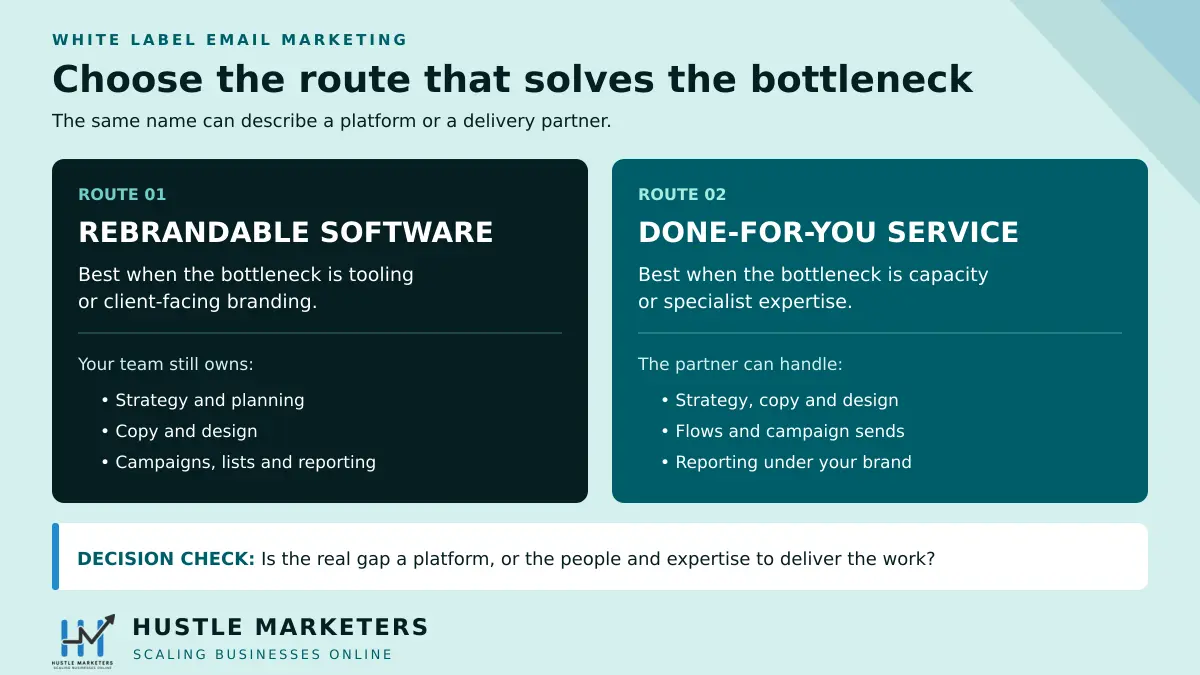
Route 1: White label email marketing software. A platform (an ESP, meaning email service provider) that lets you strip out its branding and present it as your own. Your logo on the dashboard, your domain for logins, your name on the reports. Your team still writes the emails, builds the templates, manages the lists, and does the strategy. We keep a separate roundup of platforms in our guide to the best email marketing software if you want tool-by-tool detail.
Route 2: White label email marketing service. A partner agency that does the actual work: strategy, copy, design, list segmentation, automation flows, campaign sends, and reporting, all delivered under your agency’s brand. Your client never sees the partner.
The fastest way to know which one you need: if your bottleneck is branding and tooling, you need software. If your bottleneck is people and expertise, you need a service. Agencies constantly buy software when their real problem is that nobody on the team can write a converting email sequence. A branded dashboard does not fix that.
Route 1: The Software Route (Rebrandable ESPs)
The software route makes sense when you already have someone who can run email well and you want the client experience, including client logins, to stay fully inside your brand.
What to check before you commit to a platform
Deliverability infrastructure. This is the whole game. Ask what sending infrastructure sits underneath, whether you get shared or dedicated IPs, and what their historical inbox placement looks like. A beautiful branded dashboard that lands emails in spam is worthless.
Sending domain setup. Each client should send from their own authenticated domain, with SPF, DKIM, and DMARC configured. Confirm the platform supports custom sending domains and custom tracking domains per client. If every client sends through one shared domain you control, one client’s bad list can damage every account you manage.
True white labeling, not logo swapping. Custom login URL on your domain, your branding in the interface and email footers, no vendor name in report exports, and no vendor branding in the sending headers. Many platforms advertise “white label” but leave their name in half a dozen places. Test with a real send before you migrate anyone.
Multi-account architecture. Separate sub-accounts per client with isolated lists, isolated reputation where possible, and role-based access so a client can see their account and nothing else.
Template builder quality. Your team will live in it. A clunky builder taxes every single campaign you produce.
Billing flexibility. Can you set your own client pricing on top? Native reseller billing turns the software itself into a small recurring product line.
What software does not solve
Someone still has to do strategy, write copy, design templates, segment lists, build flows, run tests, and interpret results. For a typical retainer client that is 10 to 25 hours of skilled work per month. If you do not have that capacity, software just gives your capacity problem a nicer logo.
Route 2: The Service Route (Done-for-You Under Your Brand)
A white label email marketing service is a fulfillment partner. You sell email marketing to your client at your retail price, the partner delivers it at a wholesale price, and everything the client sees carries your brand. It is the same model we described in what is white label digital marketing, applied to email.
A serious service partner should cover:
- Strategy and audits. Account review, list health check, competitive review, and a roadmap. Not just “we send your newsletters.”
- Campaign production. Copy, design, build, QA across email clients and devices, and scheduled sends.
- Automation flows. Welcome series, abandoned cart, browse abandonment, post-purchase, and winback sequences. More on why these matter below.
- List management. Segmentation, hygiene, sunset policies for unengaged subscribers, and compliance basics (consent records, easy unsubscribes, CAN-SPAM and GDPR alignment).
- Deliverability monitoring. Watching inbox placement, spam complaints, bounce rates, and domain reputation, and fixing issues before your client sees them in the numbers.
- Reporting under your brand. Monthly reports in your template, from your domain, with talking points your account managers can present confidently.
The vetting process mirrors what we laid out in what to look for in a white label digital marketing partner: named team members rather than an anonymous pool, real work samples, written SLAs, a non-solicitation clause protecting your client list, and a pilot option before you commit your roster.
Red flags specific to email: partners who will not talk about deliverability in specifics, partners who quote purely on send volume with no strategy component, and partners with no opinion on flows versus campaigns. Those are newsletter mills, not email marketers.
Economics: Software Route vs Service Route
Here is the comparison that actually decides this for most agencies. Numbers are our working estimates of typical market ranges, not quotes or survey data.
| Factor | Software route | Service route |
|---|---|---|
| Monthly platform or wholesale cost | $50 to $500/mo total (scales with contacts) | $500 to $2,000 per client/mo |
| Who does the work | Your team (10 to 25 hrs per client/mo) | The partner’s team |
| In-house skill required | Full email skill set required | Account management only |
| Cost before your first email client | Platform fee plus staff time | $0 |
| Typical retail price to client | $1,000 to $3,000/mo retainer | $1,000 to $3,000/mo retainer |
| Where your margin comes from | Your management fee minus labor cost | Retail minus wholesale, typically 40 to 60 percent |
| Margin at scale (10+ clients) | Strong, if your team is efficient | Consistent but capped by wholesale fees |
| Speed to launch the offer | Weeks to months (hiring, process) | Days to weeks |
| Scale-down risk | Salaries continue when clients leave | Fees stop when clients leave |
| Deliverability responsibility | Entirely yours | Shared, mostly the partner’s (get it in writing) |
The honest summary: the software route is a labor business with better branding, and it wins at scale if you have strong email people. The service route is a margin business, and it wins on speed and risk when you have demand but no team. This is the same build vs partner logic we walk through for paid search in white label vs in-house comparisons, and just like PPC, plenty of agencies run a hybrid: a service partner for fulfillment now, software later once volume justifies a hire.
When should you avoid both? If you have no client demand for email yet, do not buy anything. Sell one email retainer first. And if email is meant to become your agency’s core positioning, own the skill in-house from the start. Outsourcing your flagship service is a brand risk we advise against, even though we are the kind of partner you would be outsourcing to.
Deliverability: Who Is Responsible for What
Deliverability failures are the most common way agency email offers die, and since Gmail and Yahoo tightened bulk sender requirements, authentication and complaint rates are not optional details. Before launching a single client, put names next to each of these:
| Responsibility | Software route | Service route |
|---|---|---|
| SPF, DKIM, DMARC setup per client | Your team | Partner (verify they actually do it) |
| Sending and tracking domain configuration | Your team | Partner |
| List hygiene and sunset policies | Your team | Partner |
| Consent and compliance records | You and the client | Client provides consent, partner enforces practice |
| Monitoring spam complaints and blocklists | Your team | Partner, with alerts to you |
| Fixing a reputation problem | Your team | Partner, on a defined SLA |
| Explaining it all to the client | You | You, with the partner’s talking points |
Two non-negotiables regardless of route. First, every client sends from their own authenticated domain or subdomain, never from a shared domain across your whole roster. Second, no purchased lists, ever, no matter how much a client pushes. One client’s purchased list can trash a sending reputation that took months to build.
Flows vs Campaigns: Where Ecommerce Email Revenue Actually Comes From
If you serve ecommerce clients, this distinction should drive how you evaluate any partner or platform.
Campaigns are one-time sends: promotions, newsletters, launches. They are visible work and clients love seeing them, but they require fresh effort every week forever.
Flows are automated sequences triggered by behavior: welcome series for new subscribers, abandoned cart recovery, browse abandonment, post-purchase upsells, and winback sequences for lapsed buyers. You build them once, then optimize. In most ecommerce accounts we have seen, well-built flows produce the majority of email-attributed revenue while campaigns provide the spikes.
The practical order of operations for a new ecommerce client: core flows first (welcome, abandoned cart, post-purchase), then a steady campaign calendar on top. Any white label email marketing service that starts a proposal with “how many campaigns per month do you want” instead of “let us audit your flows” is selling volume, not results. Ask prospective partners to show you a flow map from a real account, with the client name redacted.
Reporting Under Your Agency’s Brand
Whichever route you take, the client-facing layer is yours. What good looks like:
- Reports in your template, sent from your domain, with the partner or platform invisible.
- Revenue and outcome metrics up top for ecommerce (email-attributed revenue, revenue per recipient, flow vs campaign split), not just opens and clicks. Opens have been unreliable since Apple’s Mail Privacy Protection inflated them, so treat opens as directional, and clicks and conversions as real.
- Deliverability health included monthly (complaint rate, bounce rate, blocklist status) so problems surface early with context, not as surprises.
- Talking points for your account manager: what we did, what happened, what is next. A report your team cannot confidently present is a liability with your logo on it.
Pricing Models for White Label Email
On the wholesale side, service partners typically price one of three ways:
- Per-client flat fee. A fixed monthly rate per client, tiered by campaign volume and number of active flows. Simplest, and the right starting point for most agencies. Typical range: $500 to $2,000 per client per month.
- Retainer or capacity block. You buy a monthly block of production capacity across your roster. Cheaper per client at volume, but you pay for slack in slow months.
- Per-project. Flow buildouts, template systems, or migrations priced as one-off projects. Useful for testing a partner before committing to monthly work.
On the retail side, price by value and scope, not by marking up your wholesale cost. A $1,500 to $3,000 monthly retainer is a normal band for full-service email on an SMB or mid-market ecommerce client, with flow buildouts often sold as separate projects. The margin discipline is the same one we document for paid search in white label PPC pricing and what agencies charge: keep 40 to 60 percent, and if the math leaves you under 30 percent after account management time, fix the wholesale rate or the retail rate before you scale the offer.
On the software route, your platform cost is small enough that the tool markup barely matters. Your real product is the management retainer, and your margin is retail minus your team’s hours. Price the hours honestly, including QA and reporting time, which agencies chronically undercount.
How Email Pairs With Paid Media (Both Directions)
Email and paid media feed each other, which is why bundled clients are stickier and more profitable in both directions.
Ads fill the list. Paid campaigns on Google and Meta capture demand and grow the email list through lead magnets, offers, and purchases. Without acquisition, email plateaus at whatever list the client already has.
Email monetizes the list. Every subscriber an ad captures gets welcomed, nurtured, and re-converted by flows at near-zero marginal cost, which raises the lifetime value math that justifies more aggressive acquisition, which grows the list again.
For your agency, that loop is a revenue story: an email-only client at $1,500 per month becomes a $4,000 to $6,000 per month account with paid media attached, and multi-channel clients rarely churn over a single slow month in one channel.
We see this from both sides. Digital agencies add email through partners like us, and email-first agencies add paid media the same way. If you are in that second group, our guide on how email marketing agencies can add Google Ads and Meta Ads is the playbook, and our case study on scaling a US digital marketing agency with a dedicated media buyer shows what the fulfillment side of that looks like in practice.
Put Deliverability Ownership in Writing
Before launch, assign an owner for the sending domain or subdomain, SPF, DKIM, DMARC, consent records, suppression lists, bounce handling, complaint monitoring, list imports, warm-up decisions, incident response and final data export. The agency should retain access to the data and be able to migrate without losing consent or suppression history.
Run a pilot using a representative segment and record inbox placement, complaint rate, bounce rate, conversion quality, approvals and turnaround. Pricing examples in this guide are illustrative because list size, send volume, creative work, automation depth and compliance requirements vary widely.
Clear ownership matters more than whose logo appears on the dashboard. Learn how our white label digital marketing approaches the work, then compare the method with the evidence in our white label PPC case study.
Email rarely arrives alone. Most partners who hand us email also hand us acquisition, so the traffic and the flows get built off one plan: white label PPC services for paid, white label SEO services for organic.
FAQ
What is a white label email marketing service?
It is a partner agency that plans, writes, designs, and sends email campaigns and automation flows for your clients, with all deliverables and reporting carrying your agency’s brand. You own the client relationship and the markup; the partner does the production.
What is white label email marketing software?
It is an email platform you can rebrand as your own: your logo, your domain, your name on reports. Your team still does all the strategy and production work. Software solves branding and tooling, not capacity.
Which should my agency choose, software or a service?
Choose software if you have email expertise in-house and just want a branded client experience. Choose a service if you have client demand but no email team. If you have neither demand nor a team, sell one email retainer first and buy nothing until it closes.
Can my clients find out I use a white label agency?
Only through sloppy execution, and a proper setup removes the risk. Reports and deliverables carry your branding, partner staff communicate through your domain if they interact with clients at all, and NDAs plus non-solicitation clauses bar the partner from ever approaching your clients. Ask any prospective partner how they stay invisible, including sending domains and report footers. Vague answers are your cue to leave.
Is it ethical to white label email marketing?
Yes, provided you remain accountable for quality and outcomes. Clients buy results and account management from your agency, not a guarantee about whose keyboard produced the template. If a client asks directly, say your delivery team includes specialist partners. Do not lie.
How much does white label email marketing cost?
By our working estimates, done-for-you services run about $500 to $2,000 per client per month wholesale, depending on campaign volume, number of flows, and list size. Rebrandable software typically runs $50 to $500 per month total, scaling with contact count. Agencies then retail full-service email at roughly $1,000 to $3,000 per month per client.
Who handles deliverability in a white label arrangement?
In the service route, the partner should own authentication (SPF, DKIM, DMARC), list hygiene, and reputation monitoring, with a written SLA for fixing issues. In the software route, all of it is yours. Either way, insist that every client sends from their own authenticated domain and that no purchased lists ever touch an account.
What results should email marketing deliver for ecommerce clients?
Judge by email-attributed revenue and the flow versus campaign split, not by open rates, which have been inflated and unreliable since Apple’s Mail Privacy Protection. Well-built automation flows typically drive the majority of email revenue in ecommerce accounts, so a partner’s flow strategy matters more than their monthly send count.
Can I white label email for just one client to start?
Yes. Per-client pricing and one-off flow buildout projects exist precisely so you can pilot a partner on a single account before committing your roster. Be wary of any partner who demands a multi-client commitment upfront.
Does white label email marketing work alongside white label PPC?
It is one of the strongest pairings in agency services. Paid media grows the list, email monetizes it with flows, and the improved economics justify more ad spend. Bundled clients spend more and churn less. Many partners, including us through our white label PPC service, fulfill both channels under one SLA so your overhead barely grows as accounts expand.
What should be in a white label email SLA?
Campaign turnaround times, revision rounds included, flow buildout timelines, a deliverability issue response window (same business day for blocklistings or spike alerts), report delivery dates ahead of your client-facing date, a named escalation contact, and exit terms guaranteeing you keep all accounts, templates, lists, and documentation.
If you are weighing up white label email alongside paid media, the same partner logic applies. We run white label PPC management for agencies on exactly this model, with reporting that goes out under your brand.
How Hustle Marketers works as a white label partner
We sit on the delivery side of this arrangement, so the honest version is worth saying: the thing that breaks white label relationships is almost never the media buying. It is reporting that arrives late, in the wrong brand, or with numbers the agency cannot defend when the client asks a hard question.
Our published white label work is on the paid side. We run white label PPC for a partner agency in Richardson, Texas, an engagement running since February 2023, and we separately scaled a US digital marketing agency through a dedicated media buyer. Both ran under the partner agency’s brand rather than ours.
Ishant Sharma has worked as a Google Ads, Microsoft Ads and SEO specialist since 2013, including white label agency accounts in the US, UK, UAE and Australia. If email is one part of a wider outsourced stack, the paid media side sits under our white label PPC management and the organic side under our SEO services, with reporting that goes out in your brand.
The Bottom Line
The white label email decision is really two decisions. First, which product do you actually need: software that brands your tooling, or a service that supplies the team? Second, does the math clear 40 percent margin after your account management time? Answer both honestly and the route picks itself.
We fulfill email as part of our white label digital marketing services, and the advice stands even where it costs us: do not buy fulfillment before you have demand, keep your flagship skill in-house, and pilot any partner on one client before you hand over a roster. Want to pressure-test your numbers? Reach out. If the honest answer is that you only need software, we will tell you that too.
Related guides
If this one was useful, these cover the same ground for closely related businesses.