What Does an SEO Company Do? The Work, the First 90 Days and What You Should Own

Ishant
Published : October 12, 2026 at 2:30 pm
Updated : October 11, 2026 at 7:03 pm
Ishant
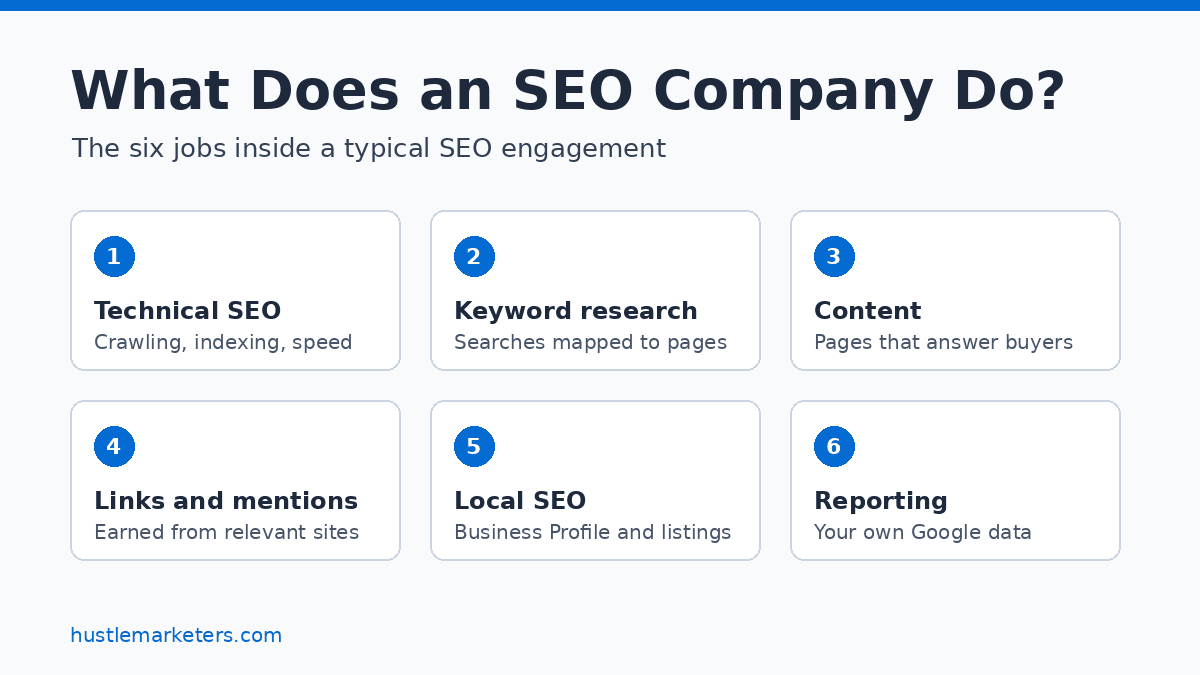
What does an SEO company do? It helps your website earn more visits and inquiries from unpaid search results. In practice it does six jobs: technical fixes, keyword research, content, links and mentions, local listings, and reporting. A good one also tells you what it cannot promise, what you still have to do, and which accounts stay in your name.
This guide is written for business owners who are paying for SEO, or thinking about it, and want to know what the money actually buys. It starts with what Google itself says an SEO can do, then walks through the work month by month.
Key Observations
- Google’s own page on hiring an SEO, last updated June 5, 2026, lists eight services an SEO can provide. The newest item on the list is “Optimizing for generative AI.”
- Most of the work falls into six jobs: technical fixes, keyword research, content, links and mentions, local listings, and reporting. Each one should leave evidence you can check yourself.
- You should stay the owner of your Google accounts. That means verified owner in Search Console, Administrator in Google Analytics and primary owner of your Google Business Profile. The SEO company is added as a user.
- Google says “No one can guarantee a #1 ranking on Google.” It also says advertising with Google has no effect on your unpaid results.
- In a survey of 439 SEO providers by Ahrefs, $501 to $1,000 a month was the most common retainer, and Ahrefs estimated an agency average of $3,209 a month.
- Google describes optimizing for its AI features as “still SEO,” so AI search changes what you measure more than what an SEO company does.
What is an SEO company?
An SEO company is a business you pay to improve how your website performs in unpaid search results, mainly Google. It finds what your customers search for and fixes what stops your pages from ranking. It improves or creates the pages that should rank, and reports on visits and inquiries. You keep the website; it does the search work.
SEO stands for search engine optimization. The “unpaid” part matters. Ads, labeled Sponsored, are bought through Google Ads. The unpaid listings cannot be bought, and Google states that it “never accepts money to include or rank sites in our search results.” An SEO company works on those unpaid listings.
Is an SEO company the same as an SEO agency or SEO firm?
Yes. “SEO company,” “SEO agency,” “SEO firm” and “SEO services provider” all describe the same kind of business. Some prefer “agency” because it suggests a team, and “firm” because it sounds like a consultancy, but the work is the same. What differs is the size of the team and how much of the work they do themselves.
What are the main types of SEO companies?
Most providers fit one of five models. Knowing which one you are talking to tells you who will actually do the work.
| Type | What it usually does | Best fit |
|---|---|---|
| Full-service SEO agency | All six jobs, often alongside paid ads and web design | Businesses that want one team to own organic search |
| Specialist agency | One area in depth, such as technical SEO, local SEO or ecommerce SEO | A clear problem, such as a migration, a store with thousands of products or multiple locations |
| Consultant | Strategy, audits and advice; your team or developer does the work | Businesses with in-house writers and developers |
| Freelancer | Hands-on work on a smaller scope | Small sites and tight budgets |
| White-label provider | Does the work for other agencies, under the agency’s brand | Agencies that resell SEO to their own clients |
The last row matters even if you never buy white-label SEO yourself. Many agencies pass some or all of the work to a white-label team, which can be fine if the work is good. Hustle Marketers offers white-label SEO to other agencies, so we know the model well. Ask who does the work, where they are based and who you can speak to.
What does an SEO company do?
An SEO company researches what your buyers search for and fixes technical problems that stop Google from crawling your pages. It improves and creates pages that answer those searches, earns links and mentions from other sites, keeps your local listings accurate, and reports what changed. The mix depends on your site, your market and what is already holding you back.
What Google says an SEO can do for you
Google publishes its own guidance for business owners, Do you need an SEO?, last updated on June 5, 2026. It says many SEOs “provide useful services for website owners” and lists these eight:
- Review of your site content or structure
- Technical advice on website development: for example, hosting, redirects, error pages, use of JavaScript
- Content development
- Management of online business development campaigns
- Keyword research
- SEO training
- Expertise in specific markets and geographies
- Optimizing for generative AI
The same page says hiring an SEO “can potentially improve your site’s visibility and save you time, but you can also risk damage to your site and reputation.” It also says “a great time to hire is when you’re considering a site redesign (the earlier, the better), or planning to launch a new site.” Bringing an SEO in after a redesign often means paying twice.
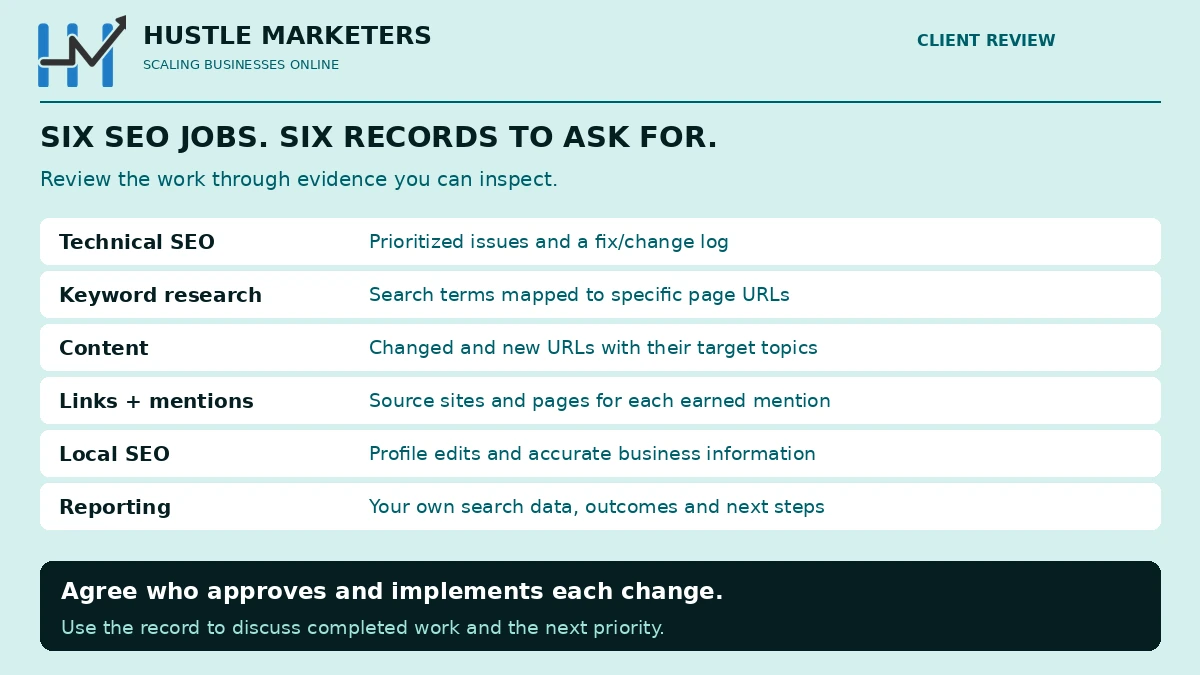
The six jobs in a typical SEO engagement
Google’s list describes services. Day to day, those services turn into six jobs. The right column is the part most buyers never ask for: what you should be able to see when each job is being done.
| Job | What it involves | Evidence you should see |
|---|---|---|
| Technical SEO | Crawling the site, fixing broken pages and redirects, speed, mobile issues, duplicate pages, indexing problems and structured data | A prioritized issue list, then fewer errors in the Search Console Pages and Core Web Vitals reports |
| Keyword and market research | Finding the searches your buyers use, how many people search each month, and which page should answer each one | A keyword map that pairs search terms with specific URLs on your site |
| On-page and content | Rewriting titles, headings and copy on existing pages, and planning and writing new pages that answer real questions | A list of changed and new URLs each month, with the search terms each one targets |
| Links and mentions | Earning links and mentions from relevant sites through outreach, digital PR, partners and directories that real customers use | Each new link listed by site and page, never a bare count |
| Local SEO | Google Business Profile, consistent business details across directories, location pages and a process for asking customers for reviews | Profile changes logged, and calls, direction requests and website clicks from the profile |
| Reporting and analysis | Tracking unpaid search traffic, inquiries and sales, explaining what moved and planning the next month | A monthly report built from your own Search Console and Google Analytics data |
You will often see SEO split into four types instead: on-page, off-page, technical and local. That is the same work grouped differently. Off-page is the links and mentions row.
Most providers also do some of the work around SEO, such as conversion improvements, web development or paid search. Ask which of those are inside your fee. Our guide to SEO packages shows how sellers bundle these jobs and what each price tier tends to include.
How does an SEO company work, month by month?
A good SEO company spends the first month getting access, auditing the site and agreeing priorities. The second and third months go on technical fixes and improving the pages most likely to earn inquiries. New content, links and local work build from there. Early signs show up in Search Console first; ranking and inquiry gains usually take three to six months.
Google’s SEO Starter Guide explains why the timing varies: “Some changes might take effect in a few hours, others could take several months.” It adds that you “likely want to wait a few weeks” before judging whether a change helped. Here is what the first 90 days of a typical engagement look like, and the signal to watch at each stage.
| Period | What the SEO company does | What you should be able to see |
|---|---|---|
| Weeks 1 to 4 | Gets access, interviews you about customers and offers, runs a technical audit, builds the keyword map, records a baseline | A written audit with priorities, a keyword map and the baseline numbers |
| Weeks 4 to 8 | Fixes or specifies the highest-priority technical issues; improves the titles, copy and internal links on the pages closest to earning inquiries | A change log of URLs; fewer errors in Search Console |
| Weeks 8 to 12 | Starts new pages for gaps in the keyword map, begins link and mention outreach, cleans up local listings | New URLs live and indexed; impressions starting to rise for target terms |
| Month 4 onward | Repeats the cycle: measure, fix, publish, earn links, report | Movement on priority non-branded terms, then more inquiries from unpaid search |
In our experience on client sites, that is the timeline we plan around when clients outsource SEO to us. Deliverables arrive in the first month, and fixes show in Search Console around weeks 4 to 8. Impressions usually rise around weeks 8 to 16, and ranking movement on competitive terms comes around months 3 to 6.
Revenue payback usually takes 6 to 12 months. A new site, a weak offer or a very competitive market will stretch all of it.
You may also read that SEO takes “four months to a year.” That figure comes from a 2017 Google video on hiring an SEO, as reported by Search Engine Roundtable at the time. It does not appear on Google’s current hiring page.
What does the SEO company do, and what do you still have to do?
The SEO company researches, fixes, writes and reports. You supply the business knowledge, grant access, approve changes and get them implemented when the agency cannot. Many stalled SEO projects stall on your side of this split. Often the recommendations were sound, but nobody had time to act on them.
In Google’s 2017 hiring video, Maile Ohye made the same point. As quoted by Bruce Clay, she said one of the biggest holdups is “the business making time to implement their ideas.” Agree the split before you sign.
| Area | The SEO company | You |
|---|---|---|
| Access | Asks for the access it needs and keeps a record of it | Grants access from accounts you own, and removes it when the contract ends |
| Discovery | Interviews you, audits the site, researches keywords and competitors | Explains your best customers, margins, seasons and what you actually want more of |
| Technical fixes | Makes the changes, or writes clear tickets if it has no developer access | Gets your developer or platform to implement tickets, and approves risky changes |
| Content | Plans, drafts and optimizes pages | Checks facts, adds real expertise and examples, and approves on time |
| Links and mentions | Finds opportunities and runs outreach | Shares stories, data, partners and sponsorships worth talking about |
| Local listings | Updates your Google Business Profile and directory details | Asks real customers for reviews and replies to them |
| Reporting | Explains what changed, what moved and what comes next | Shares which inquiries turned into sales, so results can be tied to revenue |
If a proposal does not say who handles implementation, ask. The answer decides whether you are buying work or buying advice. Our outsourcing guide covers how much of your own time to budget each month.
Who should own your Search Console, Analytics and Google Business Profile?
You should. Each account should be created under your business email, with you as the owner, and the SEO company added as a user. That way the data, the history and the listing stay with you if you change providers. If the agency owns the accounts, you may lose years of data and your business listing when you leave.
Google’s tools each have their own role names. These are the ones to look for.
| Account | Your role | The SEO company’s role | Why it matters |
|---|---|---|---|
| Google Search Console | Verified owner | Full user, or delegated owner if it must add others | Google says a property “must have at least one verified owner, or no users will have access” |
| Google Analytics 4 | Administrator | Editor or Viewer | Only an Administrator can add and remove users |
| Google Business Profile | Primary owner | Manager | Managers cannot add or remove users or remove the profile |
| Website and hosting | Main admin account in your name | Its own login, removed at exit | Shared passwords make it hard to cut access cleanly |
| Domain registrar | Account holder | Usually none; your developer can handle DNS records | Whoever controls the domain controls the website |
The role descriptions come from Google’s help pages for Search Console permissions, Analytics access roles and Business Profile users. Also check that your contract says you keep the content, images and reports created for you. Our guide to hiring an SEO expert covers the contract and exit terms in more detail.
What should an SEO company report to you each month?
A useful monthly report shows what the company did, what changed in your own Google data, and what it plans next. It should lead with unpaid search traffic, inquiries and sales from people who did not already know your brand. Rankings for your own business name, or an authority score from a third-party tool, prove far less.
A good report usually covers:
- Work completed, with the URLs changed or published and the links earned.
- Clicks and impressions from Search Console, split into branded and non-branded searches.
- Inquiries, calls or sales from organic search, measured in Google Analytics or your CRM.
- Movement on the priority terms agreed at the start, including any that dropped.
- Technical health, such as new errors and pages that fell out of the index.
- The plan for next month, and anything waiting on you.
Ask for the numbers to come from accounts you own. Google’s AI features documentation says sites appearing in AI Overviews and AI Mode are included in the overall search traffic in Search Console. That keeps Search Console the neutral check as AI features grow. Our monthly SEO report guide shows a full template.
What can’t an SEO company do?
An SEO company cannot guarantee a ranking, buy you a place in Google’s unpaid results, or control what Google’s algorithms and AI answers say. It also cannot make a weak offer or an unhelpful website win on its own. Any provider that promises otherwise is either misunderstanding search or misleading you.
Google’s hiring page is blunt about this: “No one can guarantee a #1 ranking on Google.” It tells you to “beware of SEOs that claim to guarantee rankings, allege a ‘special relationship’ with Google, or advertise a ‘priority submit’ to Google.” Google’s John Mueller said the same in 2025, as reported by Search Engine Journal: a ranking or traffic promise is “usually a red flag.”
Paying Google does not help either. Google says “Advertising with Google won’t have any effect on your site’s presence in our search results.” And an SEO company works within what your business offers. In the 2017 hiring video, Maile Ohye put it this way, as quoted by Bruce Clay: “An SEO’s potential is only as high as the quality of your business or website.”
Google’s hiring page and spam policies point to warning signs worth knowing before any sales call:
- “Be wary of SEO firms and web consultants or agencies that email you out of the blue.”
- “You should never have to link to an SEO.”
- “Avoid SEOs that talk about link popularity schemes or submitting your site to thousands of search engines.”
- Be careful with link packages sold by the number. Google’s spam policies list buying links for ranking purposes and automated link building as link spam. If that costs rankings, it is your site that drops, not the agency’s.
For the full list of red flags and sales-call questions, see our guide to hiring an SEO expert.
How much does an SEO company cost?
Most SEO companies charge a monthly retainer. In a survey of 439 providers by Ahrefs, $501 to $1,000 a month was the most common rate, and the estimated agency average was $3,209 a month. Hourly rates for agencies listed on Clutch mostly sit between $100 and $149. The price mostly reflects hours, seniority and how many of the six jobs are included.
| Source | What it found | Date and sample |
|---|---|---|
| Ahrefs pricing survey | $501 to $1,000 a month was the most common retainer. Taking the top of each price band, Ahrefs estimated averages of $3,209 a month for agencies, $3,250 for consultancies and $1,348.63 for freelancers. In the US and Canada, 79.1 percent charged at least $1,001 a month. | 439 SEO providers; published December 2023, updated August 2024 |
| Clutch SEO pricing guide | Most SEO agencies on Clutch charge $100 to $149 an hour. The average monthly cost was $3,199.19. | Updated September 21, 2026; based on companies listed on Clutch and their client project reviews |
Both sources are averages across very different work. A single-location service business and a store with 20,000 products are not buying the same thing. Compare proposals by the hours and deliverables inside them, not by the headline price. Our SEO packages guide compares real price tiers from 20 sellers.
For reference, Hustle Marketers’ SEO starts from $500 a month for a defined, bounded scope, and larger engagements are quoted on the work involved.
Is it worth hiring an SEO company, or should you do SEO in-house?
Hiring an SEO company is usually worth it when unpaid search can bring you profitable customers. It makes most sense when you lack the time or the mix of skills to do the work yourself. In-house makes more sense when you publish a lot, change your site constantly, or can keep a full-time specialist busy. Many businesses combine both.
The cost comparison is less lopsided than it looks. The US government’s O*NET database files search marketing strategists under a broader group, market research analysts and marketing specialists, whose 2025 median pay was $78,760 a year. That is before tools, training and management time.
Ahrefs’ estimated agency average of $3,209 a month comes to about $38,500 a year. That buys a share of several people’s time, not one person’s whole week.
| Option | Works best when | Watch out for |
|---|---|---|
| SEO company | You need technical, content and link skills part time | Unclear deliverables and slow implementation on your side |
| In-house specialist | Search is a core channel and there is a full-time workload | One person rarely covers technical, content and links equally well |
| Freelancer or consultant | A small site, or a team that only needs direction | Capacity, time off and who covers when they are busy |
| Doing it yourself | A simple local business with time to learn | Time cost, and mistakes that take months to show |
Whatever you choose, judge it by inquiries and sales from people who did not already know you.
Rankings for your own name prove very little. If you are weighing SEO against ads, our SEO vs PPC comparison covers cost and timing side by side.
Is SEO still worth it in 2026 with AI search?
Yes, but what you measure has changed. Google says optimizing for its AI features is still SEO, and its AI Overviews and AI Mode draw on pages it has indexed. What has changed is that fewer searchers click through when an AI summary appears. Rankings alone now say less about results than inquiries and mentions do.
Google’s own documentation is clear on the first point. Its guide to optimizing for generative AI features says that from Google’s perspective, “optimizing for generative AI search is optimizing for the search experience, and thus still SEO.” Its AI features page adds that to be eligible as a supporting link, “a page must be indexed and eligible to be shown in Google Search with a snippet,” and that there are no additional requirements.
The click data supports the second point:
- Pew Research Center tracked 900 US adults in March 2025. They clicked a traditional search result on 8 percent of visits when an AI summary appeared, against 15 percent when it did not.
- Ahrefs reported in February 2026 that an AI Overview correlated with a 58 percent lower average click-through rate for the top-ranking page, across 300,000 keywords.
So nothing has replaced SEO yet. The work an SEO company does still feeds both the classic results and the AI answers. What a good company changes is the reporting: fewer vanity ranking charts, more attention to inquiries, branded search growth and whether AI answers describe your business correctly. Our guides to AI search optimization and answer engine optimization go further.
SEO company FAQs
Is SEO paid or free?
Appearing in Google’s unpaid results is free, and Google says it “never accepts money to include or rank sites in our search results.” The work to earn those positions is not free. You pay for it with your own time, an in-house hire, a freelancer or an SEO company.
What are the four types of SEO?
The four usually named are on-page SEO, off-page SEO, technical SEO and local SEO. On-page covers your content and page elements, off-page covers links and mentions, technical covers crawling, indexing and speed, and local covers maps and listings. This is an industry grouping, not a Google classification.
How long does it take an SEO company to get results?
Expect early signs in Search Console within the first two months and ranking movement on competitive terms in three to six months. Revenue payback usually takes six to twelve months. Google’s own guidance says: “Some changes might take effect in a few hours, others could take several months.”
Is SEO a one-time or ongoing service?
It can be either. A one-time project, such as an audit, a migration or a cleanup, fixes a specific problem. Ongoing SEO, usually a monthly retainer, keeps publishing, earning links and fixing new issues as your site, your competitors and Google’s results change. Most businesses that rely on search need some ongoing work.
Do SEO companies use contracts?
Most do, either a signed contract or agreed terms. Before you sign, check the minimum term, the notice period and what is included each month. Also check who owns the content and accounts, and what you receive when you leave. Our guide to hiring an SEO expert lists the contract terms worth checking.
Does advertising on Google help SEO?
No. Google states that “Advertising with Google won’t have any effect on your site’s presence in our search results.” Ads and SEO can still work well together, because ad data shows which search terms bring buyers, but paying for ads does not lift your unpaid rankings.
What should I ask an SEO company before hiring?
Start with Google’s own questions. Request examples of previous work and check whether they follow Google Search Essentials. Find out what results they expect, and by when. Then ask about their experience in your industry and whether they will share every change made to your site, and check their references.
Can an SEO company work on a Shopify, WordPress or Wix site?
Yes. Sites on every major platform can rank, but each limits what can be changed and how. Ask which platforms the company has worked on, and whether fixes will need your developer, an app or a theme change. For example, our WordPress SEO services work inside the site’s own settings and plugins.
Want a second opinion on an SEO proposal or report?
If you already have a proposal or a monthly report and cannot tell what it covers, send it to us. We can tell you which of the six jobs it includes, what evidence you should be seeing, and which accounts you should own before you sign or renew.
Send us your proposal or report, or see our SEO service if you want the work handled. SEO starts from $500 a month for a defined scope.
About the author and how this guide was built
Ishant Sharma has worked in digital marketing since 2013 and runs Hustle Marketers, a Google Partner, Meta Business Partner and Microsoft Advertising Partner. The company delivers SEO, Google Ads, Microsoft Ads and Meta Ads for businesses and for other agencies. The delivery team is in India, and clients are in the United States, the United Kingdom, Australia and India.
For this guide, we read 20 pages on this topic on October 3, 2026, 17 of them from the top 20 US results for “what does an SEO company do.” We also read Google’s Search Central documentation and help pages. Owner discussions on Hacker News, trade forums and review sites showed us the questions buyers actually ask. Prices and click data are quoted with their source and date.