What Is Guest Posting? A Complete Guide to Guest Blogging for SEO

Ishant
Published : November 5, 2026 at 6:17 am
Ishant

Summarize this article with:
By Ishant Sharma Category: SEO and Link Building Published: November 2026 Reading time: 18 min
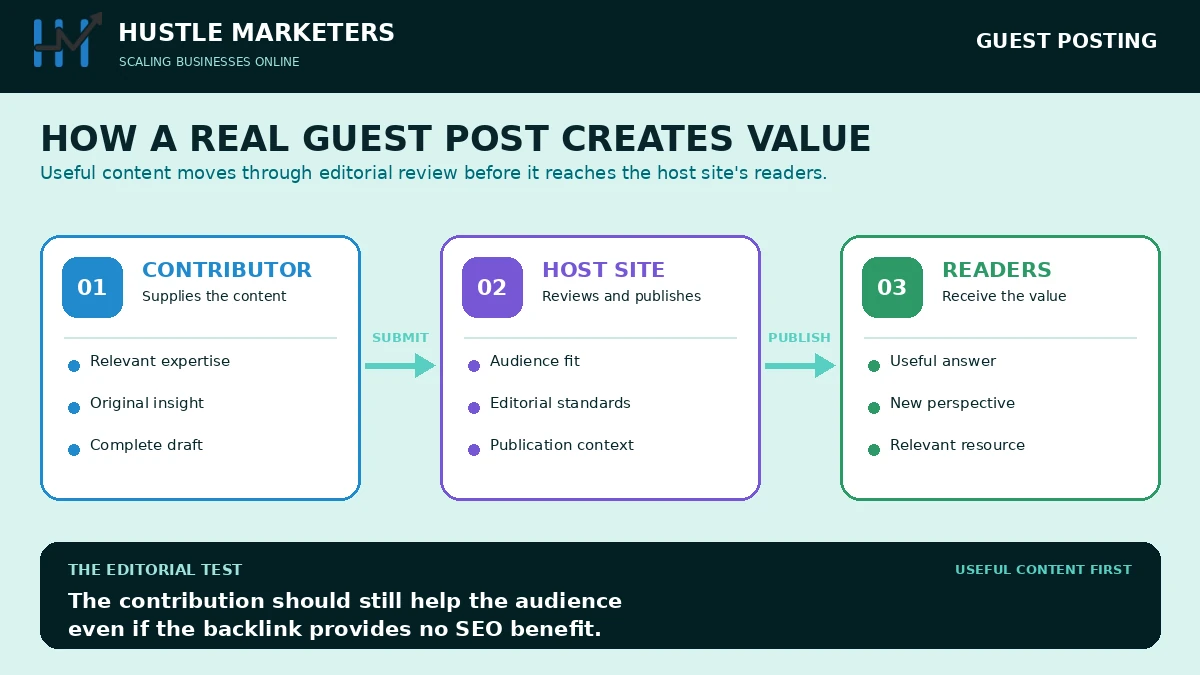
Guest posting is the practice of creating useful content for another website. That content gets published for the host site’s own readers.
Depending on the site, a contributor may gain exposure and referral traffic. They may also earn an author mention, industry relationships, and a link.
But effective guest posting is not simply writing articles to collect backlinks.
The site, readers, topic, editorial standards, content quality, link context, and reason for contributing all matter. Google warns against large-scale guest-posting campaigns designed mainly to manipulate rankings through links. This falls under its link spam and site reputation abuse policies.
A good guest post should therefore be valuable even if the backlink provides no SEO benefit.
In this guide, you will learn what guest posting is and how guest blogging works. You will also learn whether it is still useful for SEO. You will find out how to find and score prospects, pitch editors, and choose topics.
Finally, it covers how to handle links and anchor text. You will also learn what Google’s guidelines mean for guest posts and how to measure real business value.
Key Observations
Guest posting means writing content for a website you do not own. In exchange, you typically get an author credit, exposure, and sometimes a link. It still works for SEO. But that is only true under one condition. The content must be useful and editorially earned, not paid or mass-produced to build links.
What Is Guest Posting?
Guest posting, also called guest blogging, means contributing useful content to a site you do not own. That content might be an article, a guide, an expert opinion, or a case study. It gets published on an external site rather than your own.
The website publishing the content is the host site. The person or company providing the content is the guest contributor.
A guest post may include an author bio, a company credit, and references to useful resources. It can also include expert insight, original research, and a contextual link where it fits. The exact linking policy depends on the site.
The most important distinction is why the post exists. A real contribution exists because it gives the host site’s readers something useful. A manipulative guest post exists mainly to create a ranking link.
That distinction matters. Google’s spam policies flag this pattern directly. Large-scale article marketing or guest-post campaigns with keyword-rich links count as a form of link spam.
Guest Posting vs Guest Blogging
The terms guest posting and guest blogging mostly describe the same activity. “Guest blogging” became common when blogs were the dominant publishing format. “Guest posting” is now the broader term. It covers contributed articles, expert columns, guides, opinion pieces, and other external content.
Blog guest posting started as a link-building shortcut and grew into a real content channel. Many brands now run it as a standing part of their content strategy, not a one-off campaign.
How Does Guest Posting Work?
A professional guest-posting campaign often follows this process:
- Define the purpose of the campaign.
- Identify sites relevant to your readers.
- Evaluate each site’s quality and editorial standards.
- Find the appropriate editor or content manager.
- Study the site’s existing content.
- Identify genuine content gaps.
- Develop a useful topic idea.
- Send a personalized pitch.
- Agree on the topic, format, and editorial requirements.
- Write original content specifically for the host readers.
- Submit the article for editorial review.
- Review the published page and verify attribution and links.
- Track referral traffic, conversions, visibility, and relationships over time.
The process should be reader-first rather than backlink-first. Create truly useful content. Have resources on your own site ready. They can naturally support the contribution when a link makes sense.
Is Guest Posting Still Effective for SEO?
Yes, but quality and intent matter more than volume.
Guest posting can be useful for reaching new readers, building industry relationships, and showing expertise. It can also generate referral traffic and earn editorial mentions. It supports brand reach and grows a broader digital PR and content-distribution strategy.
However, guest posting should not be treated as a guaranteed ranking tactic. Google’s guidance does not say that every guest post is bad.
The problem is using contributed content and links mainly to manipulate rankings. This risk grows when campaigns involve payment, exchanges, excessive optimization, or large-scale placement across many sites.
Create the article because the site’s readers need it. Treat any SEO benefit from the right link as secondary.
Parasite SEO and Google’s Site Reputation Abuse Policy
Parasite SEO means publishing content on someone else’s trusted, high-authority site mainly to rank in search, not to inform its readers. Google’s site reputation abuse policy specifically targets this pattern.
The policy started with the March 2024 core update. Google clarified the language on November 19, 2024, making clear that partial first-party involvement does not exempt a site from enforcement.
Normal guest posting is different. A single, relevant, well-written contribution written for the host site’s actual readers is not a violation. The policy targets bulk, low-oversight content published mainly to borrow a site’s ranking power.
Site Reputation Abuse: Key Dates
March 2024:Core update introduces the policy, enforcement begins in May 2024.
November 2024:Google clarifies that partial first-party involvement does not exempt a site.
August 2026:Google adjusts enforcement inside the European Economic Area, following discussion with the European Commission. Outside the EEA, manual actions still directly affect the site section. Inside the EEA, the affected section may instead be ranked independently. This is a recent, developing change.
A single well-written guest post for a genuinely relevant, engaged audience stays outside this policy. Scaled, low-quality third-party content designed mainly to exploit a host’s authority does not.
Why Is Guest Posting Important for SEO and Business Growth?
Guest posting can provide several benefits at once.
| Benefit | How It Can Help |
|---|---|
| Relevant editorial mentions | Introduce your brand in a contextually relevant site |
| Referral traffic | Bring qualified readers directly to your website |
| Brand exposure | Put your expertise in front of new readers |
| Industry relationships | Build relationships with editors and publishers |
| Thought leadership | Demonstrate experience and subject-matter knowledge |
| Content distribution | Give useful content another relevant distribution channel |
| Reputation | Associate your expertise with legitimate industry sites |
| Lead generation | Send relevant readers to the right conversion page |
The important word is relevant. A link from a site with a high third-party authority score is not automatically valuable. That is true if the site has nothing to do with your readers or field.
What Makes a Guest Post Link Valuable?
There is no single metric that determines whether a link is valuable. Instead, weigh the overall context across these factors:
- Topical relevance: The site should have a genuine connection to the subject being discussed.
- Reader relevance: The site’s readers should reasonably care about your topic and potentially benefit from visiting your website.
- Editorial context: The link should make sense within the article rather than appearing because an SEO campaign requires a backlink.
- Page quality: The article should be useful, original, readable, and worth publishing even without the link.
- Natural anchor text: The anchor should accurately describe the destination. Do not force the same commercial exact-match keyword into every contribution.
- Publication quality: Look for real editorial activity, identifiable ownership, useful content, and a coherent publishing history.
- Link neighborhood: Review the types of websites and businesses the site regularly links to. A site surrounded by unrelated commercial links and mass-produced contributor articles deserves additional scrutiny.
What Works in Guest Posting in 2026?
Four patterns are worth building a 2026 guest posting plan around. They are our working view of the channel, not survey results.
Insight 1: Quality Beats Volume, Every Time
A single well-placed guest post on a truly relevant, high-authority site beats dozens of low-quality placements. The gap is not close.
The emphasis in 2025 and 2026 has shifted hard toward editorial relationships and useful contributions. Chasing volume no longer works.
Guest posts on sites with real readers produce measurable referral traffic. Posts on link farms produce none.
Insight 2: Generic AI-Written Submissions Get Filtered Out
Read each site’s contributor guidelines for its rule on AI-assisted writing before you pitch, and assume a generic draft from an unknown contributor will be turned down.
Personalized, expert-authored content is now a near-requirement for acceptance at any site with genuine editorial standards. This means original data, case studies, or first-hand experience.
Insight 3: In-Body Contextual Links Outperform Author Bio Links
In our view, a contextual link in the body of the article is worth more than an author bio link, because it sits next to the content it supports.
Securing a contextual in-body backlink is more valuable than settling for a bio link. It is worth raising directly when agreeing terms with an editor.
Insight 4: Guest Posts Are Increasingly Used to Target AI Search Citations
AI Overviews and AI search engines now surface more answers from third-party sources. Getting your expertise published across multiple trusted industry sites raises your odds of being cited.
In competitive niches, treat guest posting as part of your AI visibility plan as well as your link plan.
For a deeper look at AI-search visibility, see our guide on how to rank in ChatGPT search.
The Modern Guest Posting StrategyThe modern guest-posting approach is closer to editorial outreach and relationship building than to bulk link building. Research the site, pitch something truly useful, and write for the readers. Treat SEO benefit as a secondary outcome, not the primary goal.
How Much Does Guest Posting Cost?
Costs vary widely across three common models. Knowing them helps you budget and spot a bad deal before you commit.
| Model | Typical Cost | What You Get |
|---|---|---|
| Free organic placement | No direct cost, only your writing time | A relevant blog accepts a strong, unpaid pitch |
| Publisher placement fee | Varies by site authority and audience size | A site charges to cover editorial and hosting costs |
| Agency or freelance package | Priced for research, writing, and outreach time | A team finds sites, pitches, and writes on your behalf |
Guest post writing services charge for research, writing, and outreach time, not for the link itself. That distinction matters under Google’s paid link rules.
Paying purely to buy a link that passes ranking credit violates the link spam policy. Treat any fee as payment for content and outreach effort, never as payment for rankings.
Price alone never signals quality, wherever an agency is based. Check its process instead.
How to Find Guest Posting Opportunities
Finding the right guest blog post sites matters more than finding many of them. Where can I guest post? Start with sites your own readers already trust.
Method 1: Search for Contributor Guidelines
Search queries can include:
- [industry] “write for us”
- [industry] “guest post guidelines”
- [industry] “submit an article”
- [industry] “contribute”
- [industry] “become a contributor”
These searches are useful. But do not limit your research to sites with a “write for us” page. Many real sites accept expert contributions without advertising an open guest-post program.
Method 2: Find Publications That Already Cover Your Topic
Search for websites that consistently publish content related to your subject. Look for multiple real authors and expert writers. Look for niche articles, expert interviews, original research, opinion pieces, case studies, and editor-reviewed content.
The goal is to find a real site with real readers. It is not simply a site that accepts guest posts.
A guest blog posting sites list you buy online is rarely worth the price. Good sites do not sell their contact list to marketers.
Method 3: Analyze Competitor Referring Domains
Competitor backlink research can reveal sites that already cover your field. Rather than blindly copying competitor placements, look into why the competitor got the mention. Ask whether the site truly fits and whether it has real editorial standards. Ask whether you could offer something better.
Competitor research should find openings, not create a copying exercise.
Method 4: Use SEO and Content Research Tools
SEO tools can help with referring-domain research, competitor analysis, content-gap research, prospect discovery, and topic research. But do not use a single metric as your final quality filter. That includes DR, DA, or another authority score.
Use the metric as a triage signal, then check the site by hand.
Method 5: Find the Right Editor
Once you have identified a site, find the person responsible for its content. Depending on the site, this might be an editor or managing editor. It could also be a content manager, editorial director, founder, or publisher.
A personalized message to the correct person works best. It beats sending a generic pitch to a large list of websites.
Tools Professional Link Builders Use for Guest Posting
The right guest post tools save hours on research and outreach. Professionals lean on a small, consistent set of them.
| Tool | Stage | What It Does |
|---|---|---|
| Ahrefs Content Explorer | Finding opportunities | Surfaces sites already publishing on your topic |
| Semrush | Finding opportunities | Backlink and content-gap research for prospect lists |
| Hunter.io | Verifying contacts | Finds and confirms editor email addresses |
| Pitchbox | Managing outreach | Tracks pitches and follow-ups at scale |
| BuzzStream | Managing outreach | Organizes contacts and outreach history in one place |
Smaller campaigns do not need all five. A spreadsheet, a few search operators, and a shared inbox can run an effective outreach program at a small scale.
Add tools as your volume grows, starting with contact verification, since a bounced email wastes the most time.
Guest Posting Agencies and Marketplaces: What to Watch For
Searches for guest posting services in the USA return a mix of legitimate agencies and link-selling marketplaces. Telling them apart protects both your budget and your rankings.
A quality guest posting service does real outreach and secures editorially approved placements. A guest post company that guarantees placement on a fixed list of sites is usually selling links, not earning them.
Red Flags to Watch For
- Guaranteed placement on a specific list of sites
- The same site list sold to many different buyers
- No mention of editorial review or rejection
- Pricing based purely on domain authority, not content quality
- Reluctance to share a guest post sample from real client work
Ask any agency for a guest post example before you sign a contract. Legitimate providers are happy to show published work with real editorial context.
What a guest post service actually sells varies widely across providers. Some sell genuine outreach labor. Others simply broker paid links, which carries real ranking risk under Google’s policies.
How to Evaluate a Guest Posting Website
| Factor | What to Evaluate |
|---|---|
| Topical relevance | Does the site truly cover your subject? |
| Readers | Would your target readers actually read it? |
| Organic visibility | Does the site appear to receive meaningful search visibility? |
| Content quality | Are its articles useful and original? |
| Editorial standards | Are contributions reviewed and edited? |
| Publishing pattern | Does the site publish coherent industry content? |
| Outbound links | Are links used naturally rather than stuffed into articles? |
| Contributors | Are authors identifiable and credible? |
| Reputation | Would you be comfortable associating your brand with the site? |
| Commercial behavior | Does the site openly sell followed links or guaranteed placements? |
Do Not Use a Fixed DR or DA Threshold
A DR/DA number is useful for sorting prospects. But it should not decide whether a site is legitimate.
A relevant specialist site with a smaller authority score may be more useful to your business. That beats a large general-interest site with no real connection to your readers.
Always read a site’s guest posting guidelines before you pitch, not after. Guidelines usually reveal exactly what the editor wants and save you a wasted draft.
A Simple Guest Post Prospect Scoring Framework
Score each prospect from 0 to 5 on each criterion. Total scores guide prioritization.
| Criterion | Score (out of 5) |
|---|---|
| Topical relevance | /5 |
| Reader relevance | /5 |
| Content quality | /5 |
| Editorial standards | /5 |
| Organic visibility | /5 |
| Brand reputation | /5 |
| Referral potential | /5 |
| Contributor quality | /5 |
| Link environment | /5 |
| Business relevance | /5 |
Suggested interpretation: 40 to 50 = high priority. 30 to 39 = worth investigating. 20 to 29 = low priority. Below 20 = often reject. This is more useful than selecting prospects based on one third-party SEO metric.
How to Choose the Right Guest Post Topic
A strong guest-post topic should satisfy three conditions. It fits the site’s readers and matches your genuine expertise. It also adds something the site does not already cover well.
Review existing posts and find questions that remain unanswered, outdated tips, or missing examples and data. Look for missing practical steps, weak explanations, or new developments the site has not yet covered.
Do not pitch a topic simply because its keyword has search volume. Pitch something the editor’s readers actually need.
Use First-Hand Experience
First-hand experience is one of the strongest ways to make a guest post useful. This could include original research, client lessons, or testing results. It could also mean screenshots, processes, examples, frameworks, mistakes and corrections, or expert insight.
Do not disclose confidential client information. Anonymize sensitive details or use publicly documented examples where appropriate.
How to Write a Guest Post Pitch That Gets Attention
A strong pitch is short, personalized, specific, relevant, and easy to judge. It should answer three questions fast.
It asks why you are contacting this site and what you are proposing. It also asks why you are qualified to write it.
Guest Post Pitch Template
Subject: Article idea for [Publication Name]
Hi [Editor Name],
I recently read your article on [Article Title], particularly the section about [specific point].
I’m [Name], [Role] at [Company], where I work with [readers/industry].
I’d like to contribute an original article that gives your readers a practical framework for [specific outcome].
A few ideas:
1. [Topic 1]: [specific value for readers]
2. [Topic 2]: [specific value for readers]
3. [Topic 3]: [specific value for readers]
Relevant writing samples:
[Link 1] | [Link 2]
Would any of these be a fit for your editorial calendar?
Thanks,
[Your Name]
Writing a Pitch That Does Not Look AI-Generated
Editors now receive a flood of AI-written pitches every week. Generic language is the fastest way to get ignored or deleted.
Lead with a specific, verifiable detail about the target site: a recent article, a stated content gap, or the editor’s name. Avoid broad praise like “I love your site.”
Include one real guest posting sample that matches the topic you are pitching, not a random list of unrelated writing. Offer one clear topic idea instead of a broad menu of five or six options.
Most editors want to see guest post samples before saying yes to an unfamiliar writer. A specific pitch with real proof of work reads as human, researched, and worth a reply.
How to Improve Guest Post Outreach
Step 1
Build a Qualified Prospect List
Record the site, URL, topic focus, editor, and contact information for each prospect. Also log related articles, potential topic, readers, prospect score, and outreach status.
Step 2
Research Before Contacting
Read several recent posts to understand tone, post length, and formatting. Also study readers, writing style, preferred topics, and writer requirements.
Step 3
Pitch a Useful Idea
Do not make the editor perform your research. Explain what the article is and why it matters. Explain what makes it different and why you are qualified to write it.
Step 4
Follow Up Professionally
If there is no response, one concise follow-up is reasonable. Do not send repeated messages that become spam.
Step 5
Build the Relationship
A successful guest post should not be treated as a one-time deal. Deliver excellent work and maintain the relationship for future chances.
A Simple Guest Post Outreach Tracker
A lightweight spreadsheet keeps a growing outreach campaign organized. You do not need specialized software to start.
| Field | What to Log |
|---|---|
| Site | Domain name and topic focus |
| Contact | Editor name and verified email |
| Pitch date | When you first reached out |
| Status | Pitched, replied, accepted, declined, published |
| Published URL | Live link once the article goes up |
| Link type | Dofollow, nofollow, or sponsored |
Update the status column after every reply. Set a reminder for a single follow-up if a site goes quiet for two weeks.
Review the sheet monthly to spot which types of sites respond best. This also helps at reporting time, since you can pull referring domains and link types from one place instead of searching old emails.
How to Write a High-Quality Guest Post
1. Study the Publication
Understand its readers, tone, formatting, content depth, examples, and editorial expectations before writing a single word.
2. Build the Outline First
Find the primary question, supporting questions, main arguments, examples, data, and practical recommendations before drafting.
3. Add Original Value
Use first-hand experience, original research, unique frameworks, practical processes, expert insight, and real examples. Do not produce generic content that could have been written by anyone.
4. Make the Article Complete
Do not intentionally leave out important information simply to force readers onto your website. The article should solve the reader’s problem on its own. Your website should provide the next useful step, not the missing half of the answer.
5. Edit Before Submission
Check facts, grammar, formatting, links, headings, examples, readability, and citations. A clean, professional submission cuts down the editing the site needs to do. It also raises your chance of acceptance.
How to Use Links and Anchor Text in Guest Posts
Links should exist because they help readers. Good anchor text can include brand names and descriptive phrases. It can also use natural partial matches, resource names, and URLs where it fits.
Avoid forcing exact-match commercial keywords into every article. Instead of repeatedly using “best SEO agency,” a natural sentence might read:
See our SEO strategy guide for a deeper explanation of how content, technical SEO, and authority work together.
The anchor should describe the destination accurately. Google recommends using links when they make sense for readers. It also recommends qualifying links correctly when they are sponsored or otherwise require attribution.
Do Guest Posts Need Dofollow Links?
No. A guest post can provide value through referral traffic, brand exposure, and expertise. It can also build relationships, reader growth, industry recognition, and reach. A link does not need to be followed for the post to have business value.
Since 2019, Google treats nofollow as a hint rather than a strict rule. This change is folded into its Search Essentials guidelines. A nofollow link may even carry occasional ranking signal at Google’s discretion. That should never be the reason you contribute, though.
If a publisher determines that a link should be nofollow, respect that editorial decision. Do not make a followed backlink a condition of providing useful editorial content.
Does the Author Bio Link Actually Help SEO?
A bio link behaves like any other link on the page. It is not automatically weaker, but it is not automatically stronger either.
Some publishers nofollow every bio link by default, regardless of how the article performed editorially. Others treat bio and in-body links the same way.
Once a guest post is live, run the page through our free dofollow link checker to confirm your link is there, dofollow and on a page that can be indexed.
Many practitioners report that contextual, in-body links carry more weight than a link buried in an author bio. Raise this directly with the editor when agreeing on terms, if the site allows it.
The bigger value of a bio link is often referral traffic and name recognition with a new audience. Readers who click through are often well-qualified, since they read the whole article first. Do not judge a placement only by whether the bio link passes ranking credit.
Guest Posting and Paid Links: What You Need to Know
There is an important difference here. Contributing useful editorial content is one thing. Buying ranking credit through an article or link is another.
Google’s current link spam policies name this as a problem. Paid or exchanged links intended to manipulate rankings fall under it. This also covers advertorials and native advertising.
It includes guest posts with links that pass ranking credit when the arrangement is designed to manipulate rankings.
If compensation is involved, the link should be tagged correctly. Google recommends rel="sponsored" for paid or compensated links and also accepts rel="nofollow" for this purpose.
The Safest TestAsk: “Would we still publish this article if there were no followed backlink?” If the answer is no, reconsider whether the opportunity is an editorial contribution.
Guest Posting vs Niche Edits
| Factor | Guest Post | Niche Edit |
|---|---|---|
| What changes? | A new article is created | An existing article is updated |
| Content | Newly written | Existing content |
| Main opportunity | New readers + expertise + editorial placement | Relevant mention within an existing resource |
| Editorial control | Host publishes a new contribution | Host edits an existing page |
| Best use | Original expertise and new content | Adding truly useful context to an existing article |
Neither should be reduced to a simple backlink transaction. The value comes from relevance, editorial legitimacy, readers, and usefulness.
Guest Posting Mistakes to Avoid
What Works
- Relevant sites
- Original content
- Reader-first topics
- Personalized outreach
- Genuine expertise
- Useful references
- Natural links
- Editorial relationships
- Real business relevance
What to Avoid
- Irrelevant websites
- Thin or recycled articles
- Mass-produced submissions
- Keyword-stuffed anchors
- Paid followed links
- Link farms
- Artificial networks
- Generic mass outreach
- Publishing solely for backlinks
Guest Posting vs Other Link-Building Strategies
| Strategy | Main Approach | Best Use |
|---|---|---|
| Guest posting | Contribute useful content to another site | Expertise, exposure, relationships |
| Digital PR | Earn media coverage through newsworthy stories or research | Brand visibility and authority |
| Broken-link outreach | Suggest a useful replacement for a broken resource | Resource-focused outreach |
| Resource outreach | Promote a truly useful guide, tool, or study | Linkable assets |
| Unlinked mention reclamation | Find existing brand mentions without links | Recover existing opportunities |
| Niche edits | Add useful context to an existing relevant page | Resource enhancement |
Guest posting is only one part of a broader authority-building strategy. For a modern SEO program, combine editorial contributions with original research and digital PR. Add strong first-party content, internal linking, and useful resources.
See how these elements fit together. Our SEO strategy guide and advanced SEO techniques guide show the full picture.
Guest Posting vs Digital PR and HARO
Guest posting means writing a full article for another site. Digital PR usually means pitching data, stories, or expert commentary so journalists mention or link to you in their own reporting.
Platforms like HARO, now run by Featured, connect journalists with expert sources looking for a quote or a data point. It is not a replacement for guest posting, but a complementary channel.
Digital PR tends to win faster, higher-authority placements when you have a genuinely newsworthy angle or original data. Guest posting tends to win steadier, more predictable placements over time.
Many strong link building programs run both together: guest posting for steady, relevant placements, and digital PR for occasional high-authority spikes. Neither works well without something genuinely useful to offer, whether that is a well-written article or a strong data point.
How Guest Posting Can Support AI Search and GEO
Guest posting is not a guaranteed way to get cited by AI systems. That includes ChatGPT, Google AI Overviews, and Perplexity. Even so, real external sites can add to a broader authority and entity strategy.
An expert may build a stronger web presence through industry sites, expert interviews, and original research. This can also include case studies, brand mentions, author profiles, citations, and first-hand insight.
This creates a broader body of evidence about the person, company, and subject they specialize in.
Hustle Marketers’ SEO strategy now treats authority as broader than basic backlinks. That includes brand mentions, industry references, reviews, topical coverage, and AI-search reach. For a deeper look at AI-search reach, see our guide on how to rank in ChatGPT search.
How to Measure Guest Posting Success
Do not measure a campaign only by the number of backlinks published.
| Metric | What to Measure |
|---|---|
| Referring domains | New relevant sites mentioning your brand |
| Referral traffic | Visitors generated by sites |
| Engagement | Whether those visitors interact with your site |
| Leads | Qualified inquiries from referral traffic |
| Conversions | Sales or other business outcomes |
| Organic visibility | Changes in relevant search visibility over time |
| Brand mentions | Growth in relevant external references |
| Relationships | Future opportunities created through the campaign |
| Content performance | Whether the contribution itself attracts attention or links |
SEO performance should not be pinned on just one backlink. Organic reach is affected by content quality, internal linking, and technical SEO.
Competition, search demand, algorithm changes, and the broader link profile all play a role too. Track these shifts over time in Google Search Console.
To see how first-hand SEO work translates into measurable outcomes, read our driving school SEO case study.
A Practical Guest Posting Workflow
Phase 1
Research
Find sites that fit your topic. Study their readers, content, and editorial standards.
Phase 2
Qualification
Score relevance, content quality, reader fit, reach, reputation, and linking behavior using the scoring framework above.
Phase 3
Topic Selection
Find a genuine content gap and develop a topic that matches the site and your expertise.
Phase 4
Outreach
Contact the right editor with a personalized pitch that explains the specific value for their readers.
Phase 5
Content Creation
Create an original, well-researched post for that site’s readers, not a generic piece repurposed from another format.
Phase 6
Publication
Review the published page and verify the article, attribution, links, and formatting before sharing it anywhere.
Phase 7
Measurement
Track traffic, conversions, reach, mentions, and relationship value against your original campaign objective.
Guest Posting Checklist
Before accepting a guest-post opportunity, confirm:
- The website is relevant to my industry or readers
- The site has legitimate editorial standards
- It publishes useful content consistently
- The authors are identifiable
- The site has genuine readers
- I would be comfortable associating my brand with it
- The proposed topic fits the site
- The topic fills a genuine content gap
- The article would be useful without a backlink
- The content is original
- I am using natural anchor text
- Any compensation is being handled appropriately
- Paid links are correctly qualified with rel=”sponsored”
- I am avoiding scaled or manipulative link patterns
- I have a relevant destination page worth linking to
- I can measure the business value of the placement
Final Takeaway
Guest posting is not about publishing as many articles or obtaining as many backlinks as possible.
The strongest strategy is: Relevant site → useful topic → original expertise → earned contribution → natural references → qualified readers → measurable business value.
If a guest post would be worthless to the site’s readers without the backlink, it is probably not a strong guest-post fit.
The goal should be to become the expert the site wants to feature. Do not be the marketer just trying to place a link.
For businesses building a broader SEO strategy, guest posting works best alongside strong on-page SEO and topical authority. It also pairs well with internal linking and original research. Digital PR and first-hand content round it out.
See how these elements fit into a broader SEO framework. Our SEO strategy guide and advanced SEO techniques guide cover this in depth.
About the Author
Ishant Sharma is the Founder and CEO of Hustle Marketers. It is a Google Partner and Meta Business Partner digital marketing agency based in Zirakpur, Punjab, India.
He has worked across SEO and link building since 2013. He also works across Google Ads, Meta Ads, and Microsoft Ads.
He works with ecommerce, local service, SaaS, and B2B businesses.
His focus areas include technical SEO, content strategy, internal linking, authority building, search visibility, and AI-search optimization.
He is a Top Rated Plus freelancer on Upwork with a 99 percent Job Success Score.
If you want links earned without the risk described above, our SEO agency page explains what we will and will not do on link acquisition, and white label SEO covers the same work delivered under another agency brand.
Frequently Asked Questions
What is guest posting?
Is guest posting good for SEO?
Does guest posting still work?
How do I find guest posting opportunities?
Can I find guest post opportunities without a "write for us" page?
What should I write about in a guest post?
What is a guest post pitch?
Do guest posts need dofollow links?
Is paid guest posting safe for SEO?
How many guest posts should I publish?
How long does it take to see SEO results from guest posting?
What is the difference between guest posting and link building?