Toast vs Square: Which Restaurant POS Should You Choose?

Ishant
Published on November 12, 2026
Ishant
Updated November 12, 2026 · Prices and terms checked on Toast’s and Square’s US websites on that date
Toast and Square are the two point of sale (POS) systems most US restaurant owners end up choosing between. This comparison puts their current plans, card fees, hardware and contract terms side by side, with every figure dated and linked to the official page.
It also covers something other comparisons skip: how each POS affects your marketing measurement, from GA4 and Google Ads conversion tracking to Order with Google and server-side order data.
Summarize this article with:
Quick Answer: is Toast or Square better?
Toast is usually the better fit for full-service, high-volume and multi-location restaurants that want one restaurant-built system and will sign a contract. Square is usually the better fit for cafes, counter service, food trucks and new restaurants that want published fees and hardware prices, and the freedom to cancel anytime. Square publishes its US card rates; Toast quotes each business.
Key Observations
- Software: Toast starts at $0 (Starter Kit) or $69 a month (Point of Sale), per its pricing guide; Square costs $0, $49 or $149 a month per location.
- Card fees: Square charges 2.6%, 2.5% or 2.4% plus 15¢ in person by plan, per its US pricing page; Toast does not publish its rates.
- Contracts: Square says you can cancel or switch anytime; Toast’s agreement renews for one-year periods unless you give 30 days’ written notice.
- Break-even: Square Plus pays for itself on rate savings alone at about $49,000 a month of in-person card sales per location (our math).
- Tracking: both support Google Analytics and Meta Pixel on their ordering sites and Order with Google, but purchase tracking on hosted ordering pages often needs server-side work.
Here is the short version before the detail.
| Question | Toast | Square |
|---|---|---|
| Built for | Restaurants first, plus retail | Many business types, with a restaurant POS |
| Monthly software | $0 or from $69; Build Your Own is custom | $0, $49 or $149 per location |
| Card processing | Quoted per business | Published, from 2.4% + 15¢ in person |
| Contract | Term set in your order, then auto-renews yearly | No locked-in contract |
| Best fit | Full service, bars, multi-location groups | Cafes, counter service, food trucks, pop-ups |
Sources: Toast pricing guide (October 20, 2026), Square for Restaurants US pricing and Toast Merchant Agreement, read November 12, 2026.
Choosing between Toast and Square and running ads?
We will check how your online orders reach GA4, Google Ads and Meta, and show you what is missing before you switch.
Get Free Audit Worth $500On this page
- What is the difference between Toast and Square?
- Toast vs Square fees: what will each cost?
- What hardware do Toast and Square sell?
- Does Toast or Square lock you into a contract?
- Toast vs Square for restaurants: which features differ?
- How do Toast and Square affect marketing and order tracking?
- Which should you choose, Toast or Square?
- What do restaurant owners say about Toast and Square?
- What about Toast vs Clover?
- What should you ask before signing with either?
- Frequently asked questions
What is the difference between Toast and Square?
The main difference between Toast and Square is focus and pricing model. Toast is a restaurant-first platform sold through a quote, with its own payment processing built into the contract. Square for Restaurants is the restaurant version of a POS that also serves retail and services, with self-serve plans and card rates printed on its pricing page.
Both run ordering, payments, kitchen screens, online ordering, loyalty and reporting. The differences show up in how you pay, how long you commit, and how much control you keep over your data and ad accounts.
- Toast suits operators who want depth for table service and multi-location groups. Our Toast POS guide covers how it works, its reports and its contract clauses in detail.
- Square suits operators who want to start small, see their fees upfront and add features as they grow.
- Both host your online ordering for you, which matters for tracking, as the marketing section explains.
Toast vs Square fees: what will each cost?
Toast vs Square fees come down to three lines: monthly software, card processing and hardware. Square publishes all three for the US. Toast publishes starting software prices but quotes processing rates and most hardware for each business, so you cannot compare the full cost until you hold a written Toast quote.
What do Toast and Square software plans cost?
Toast’s restaurant plans start at $0 a month on the Starter Kit and $69 a month on Point of Sale, with Build Your Own at custom pricing, per Toast’s pricing guide. Square’s restaurant plans cost $0, $49 or $149 a month per location, with Square Pro priced by quote for businesses processing over $250,000 a year.
| Plan | Monthly software | What the vendor says it suits or adds |
|---|---|---|
| Toast Starter Kit | $0 | Lower-volume, single-location restaurants with 1 or 2 terminals; higher per-transaction rate |
| Toast Point of Sale | From $69 | More than 2 terminals or high volume; lower processing rate |
| Toast Build Your Own | Custom | A tailored full platform |
| Square Free | $0 per location | Core restaurant features and a branded online ordering page |
| Square Plus | $49 per location | Adds integrated inventory, close-of-day reports, loyalty and unlimited email marketing |
| Square Premium | $149 per location | Adds coursing and seat management |
| Square Pro | Custom | Businesses processing over $250,000 a year |
Sources: Toast pricing guide (October 20, 2026); Square restaurant pricing and Square plan comparison, read November 12, 2026. Toast says its pricing applies to new customers and single locations, and includes the first terminal’s software subscription.
What are Square’s card fees, and does Toast publish its rates?
Square’s US card fees are published by plan: 2.6% + 15¢ in person on Free, 2.5% + 15¢ on Plus and 2.4% + 15¢ on Premium. Toast does not publish processing percentages. Its pricing guide only says the Starter Kit carries a higher per-transaction rate and paid plans a lower one, and that rates vary by plan.
| Card payment type | Square Free | Square Plus | Square Premium | Toast |
|---|---|---|---|---|
| In person (tap, dip, swipe) | 2.6% + 15¢ | 2.5% + 15¢ | 2.4% + 15¢ | Quoted, not published |
| Online card payments | 3.3% + 30¢ | 2.9% + 30¢ | 2.9% + 30¢ | Quoted, not published |
| Manual entry or card on file | 3.5% + 15¢ | 3.5% + 15¢ | 3.5% + 15¢ | Quoted, not published |
| International cards | Plus 1.5% | Plus 1.5% | Plus 1.5% | Quoted, not published |
Sources: Square restaurant pricing and Toast pricing guide, read November 12, 2026.
Many comparison sites still print Toast percentages. We left them out because Toast’s own pricing pages do not show them today, and under Section 6.2 of the Toast Merchant Agreement Toast can change card rates on 30 days’ written notice. Get your Toast rate in writing for in-person, online and keyed-in cards.
On a single check, Square’s published rates work out like this:
- A $50 in-person check costs $1.45 on Free, $1.40 on Plus and $1.35 on Premium.
- A $30 online order costs $1.29 on Free and $1.17 on Plus or Premium.
- A keyed-in $50 card payment costs $1.90 on any plan, so avoid typing cards where you can.
When does a paid Square plan pay for itself?
Square Plus pays for itself on card savings alone once a location takes about $49,000 a month in in-person card sales. Plus saves 0.1 percentage points on in-person cards and 0.4 points on online cards compared with Free, and 0.1% of $49,000 is $49, the monthly fee. Online sales get you there faster: $12,250 a month of online card sales also saves $49.
| Upgrade | Extra monthly fee | Rate saving | Break-even on in-person card sales alone |
|---|---|---|---|
| Free to Plus | $49 | 0.1 points in person, 0.4 points online | About $49,000 a month |
| Plus to Premium | $100 | 0.1 points in person | About $100,000 a month |
| Free to Premium | $149 | 0.2 points in person, 0.4 points online | About $74,500 a month |
Our calculation from Square’s published US rates, November 12, 2026. Per-transaction 15¢ and 30¢ fees are the same on every plan, so they cancel out.
Most restaurants upgrade for features, not rates. Square’s kitchen display app, kiosk software and text marketing are not available on Free, so a kitchen screen alone can make Plus the cheaper path. Use the same math on a Toast quote: multiply the rate difference by your monthly card sales and compare it with the difference in monthly fees.
Which add-ons change the monthly bill?
Add-ons change the bill on both systems. Square prices them publicly, while Toast says add-on pricing varies by business and is quoted.
| Add-on | Square (US list price) | Toast |
|---|---|---|
| Kitchen display software | $30 a month per device on Plus, $20 on Premium, not on Free | Quoted |
| Kiosk software | $99 a month per Square Kiosk device | Quoted |
| Payroll | From $35 a month plus $6 per person paid | Quoted |
| Loyalty | Included in Plus and Premium | Quoted add-on |
| Text marketing | 500 texts included on Plus, then 3¢ each | Quoted |
Sources: Square restaurant pricing and Square plan comparison; Toast pricing guide (“pricing on individual add-ons varies”), read November 12, 2026.
What hardware do Toast and Square sell?
Square lists a US price for every device in its hardware shop, from a $59 card reader to a $1,999 kiosk. Toast names its devices but does not list per-device prices; its hardware page says “starting at $0” for the first device only, with software and processing fees on top. Toast says most restaurants need a terminal, a card reader, a printer and a router to open.
| Device type | Toast | Square (US price) |
|---|---|---|
| Card reader | Toast Tap Card Reader (quoted) | Reader for contactless and chip, $59 |
| Countertop POS | Flex Countertop Terminal (quoted) | Square Register, $899; Square Terminal, $299; Square Stand for iPad, $149 |
| Handheld for tableside | Toast Go 3 Handheld (quoted) | Square Handheld, $399 |
| Self-order kiosk | Self-Ordering Kiosk (quoted) | Square Kiosk with counter stand, $1,999 |
| Kitchen screen | Kitchen Display System (quoted) | Runs as an app; $30 or $20 a month per device |
Sources: Toast hardware page (updated September 18, 2026) and Square hardware shop, read November 12, 2026.
Financing works differently too. Square sells devices on monthly credit plans issued by Block at 15% APR, and the plans are not available in six states.
Toast’s pricing page says 0% interest financing is available by application. Toast’s own Toast vs Square page describes Easy Pay as a 180-day lease where Toast holds back 1.75% of sales, with any unpaid balance due at 180 days.
Does Toast or Square lock you into a contract?
Toast uses a term contract and Square does not. Square’s pricing page says there are no locked-in contracts and you can cancel or switch plans anytime. Toast’s Merchant Agreement sets the initial term in your order, then renews it automatically for one-year periods unless you give at least 30 days’ written notice.
| Term | Toast | Square |
|---|---|---|
| Commitment | Term set in your order; Pay-as-you-Go is a 2-year agreement | No locked-in contract |
| Renewal | Automatic one-year renewals (Section 8.1) | Month to month |
| Leaving early | Remaining software fees, or $150 a month left on Pay-as-you-Go (Section 8.4) | Cancel or switch anytime |
| Rate changes | 30 days’ written notice; using Toast after that counts as acceptance (Section 6.2) | Square says it notifies existing sellers in advance |
| Trial | None listed | 30 days free on Plus and Premium |
Sources: Toast Merchant Agreement (last updated September 10, 2025), Toast’s comparison page (updated November 3, 2026) and Square pricing, read November 12, 2026.
What is the FTC case against Toast?
On October 29, 2026, the Federal Trade Commission, California and seven other states sued Toast in federal court in Northern California. According to the FTC’s announcement, they allege hidden and unauthorized fees, unwanted add-ons, hard-to-cancel subscriptions and support promises customers could not rely on.
Toast says it strongly disagrees and will defend itself, as Digital Transactions reported on October 30, 2026. These are allegations, not findings, and the court will decide the case. Our Toast guide’s contract section maps each allegation to what to confirm before you sign. This is general information, not legal advice.
Toast vs Square for restaurants: which features differ?
Toast vs Square for restaurants is closest on everyday ordering and payments, and furthest apart on table service depth, offline behavior and multi-location tools. Toast includes restaurant tools such as handhelds, kitchen display and multi-location menu publishing as its core. Square puts some restaurant features, such as coursing and seat management, on its higher plans.
| Feature | Toast | Square for Restaurants |
|---|---|---|
| Tableside ordering | Toast Go 3 handheld | Square Handheld; coursing and seat management on Premium |
| Kitchen display | Kitchen Display System hardware | KDS app on Plus or Premium, per device |
| Offline card payments | Keeps taking cards; the restaurant carries the risk if a payment later declines | Offline payments decline if the device does not reconnect within 24 hours |
| Online ordering | Commission-free first-party ordering | Branded online ordering page on every plan |
| Loyalty | Toast Loyalty, guests join by phone or email | Square Loyalty on Plus and Premium; guests sign up at checkout, online or by invoice |
| Support | Toast says phone support runs 7am to 12am ET, seven days, plus 24/7 chat | Not stated on the Square pricing pages we read; ask before you sign |
Sources: Toast online ordering (updated November 9, 2026), Toast vs Square page, Square restaurant pricing and Square Loyalty, read November 12, 2026. Toast offline terms are in our Toast POS guide.
How do Toast and Square affect marketing and order tracking?
Toast and Square both host your online ordering pages, so neither gives you full control of the checkout where purchases happen. Both let you add Google Analytics and a Meta Pixel and both support Order with Google. The real differences are how you get order data out for server-side tracking, and who controls the ad account if you buy ads through the POS.
This matters because Google Ads and Meta optimize on the conversions you send them. If online orders are missing or counted twice, the bidding learns from the wrong signal and your cost per order drifts up.
| Measurement need | Toast | Square |
|---|---|---|
| Google Analytics and Meta Pixel on ordering | Pixel IDs for Google Analytics and Meta on Toast Websites and Online Ordering Pro | Google Analytics, Facebook Pixel and custom header code on Square Online, all plans |
| Google Tag Manager | Supported on Toast Websites (not in Australia, Canada, Ireland or the UK) | Through custom header or footer code |
| Meta setup | Add your pixel ID | Meta for Business connection installs the pixel, syncs your catalog and supports Automatic Advanced Matching |
| Order with Google | Ordering in Google Search and Maps | Free, through Square Online, for food and beverage businesses with a Google Business Profile |
| Order data for server-side tracking | Read-only Standard API access with order webhooks, part of RMS Essentials for US customers | Orders API with order.created and order.updated webhooks |
| Ads bought inside the POS | Toast Advertising runs Google, Meta and Uber Eats campaigns | Not compared: we found no equivalent managed ads product in Square’s help pages |
Sources: Toast Marketing and Analytics help (updated March 12, 2026), Standard API access (updated August 24, 2026) and webhook subscriptions; Square custom tracking code, Meta for Business, Order with Google and Orders API, all read November 12, 2026.
Can you track online orders in GA4 and Google Ads on each?
Yes on both, but with limits. Each platform lets you place Google Analytics and pixel tags on its hosted ordering site. Neither help page we read lists the purchase event, order value or order id that Google Ads needs for an accurate conversion, so test a real order before you trust the numbers.
Owners run into this on Toast’s own forum. In one Toast Community thread, an owner with Online Ordering Pro could not capture a purchase or the order subtotal. A later reply passed on Google’s findings: a content security policy blocking tags, consent set to denied by default, and a conversion that fired only after a page refresh. In another thread, Toast’s community manager noted the tracking options may need Online Ordering Pro or Toast Websites.
Guests also move between your own website and the ordering domain, which breaks sessions unless you set it up. Our guide to GA4 cross-domain tracking covers that step.
Can you send POS orders to Google Ads server-side?
Yes. Server-side tracking sends each confirmed order from your backend, so it does not depend on tags firing on a hosted page. On Toast, the order feed comes from Standard API access webhooks, which Toast includes with Restaurant Management Suite Essentials for US customers and which are read-only. On Square, the Orders API sends order.created and order.updated webhooks.
Our method is the one published in our guide to capturing restaurant orders server-side:
- Decide which events fire in the browser, which come from the server, and which use both with deduplication.
- Send each confirmed order from the backend with the order id as the transaction_id, so GA4 does not count it twice.
- Forward orders to Google Ads with Enhanced Conversions and the Meta Conversions API, with hashed customer data only where the guest consented.
- Check the server container preview, GA4 DebugView, a one-order duplicate test, and the Google Ads and Meta diagnostics.
- Reconcile tracked revenue against the POS or ordering platform’s sales report.
What we see on the Curry Up Now account
We set up and optimize the tracking for Curry Up Now, a multi-location US fast-casual restaurant chain whose online ordering runs on Olo, whose loyalty runs on Thanx, and whose sales figures come from its Toast dashboard. Each location has its own Google Ads account and its own ordering integration, as our multi-location restaurant case study explains.
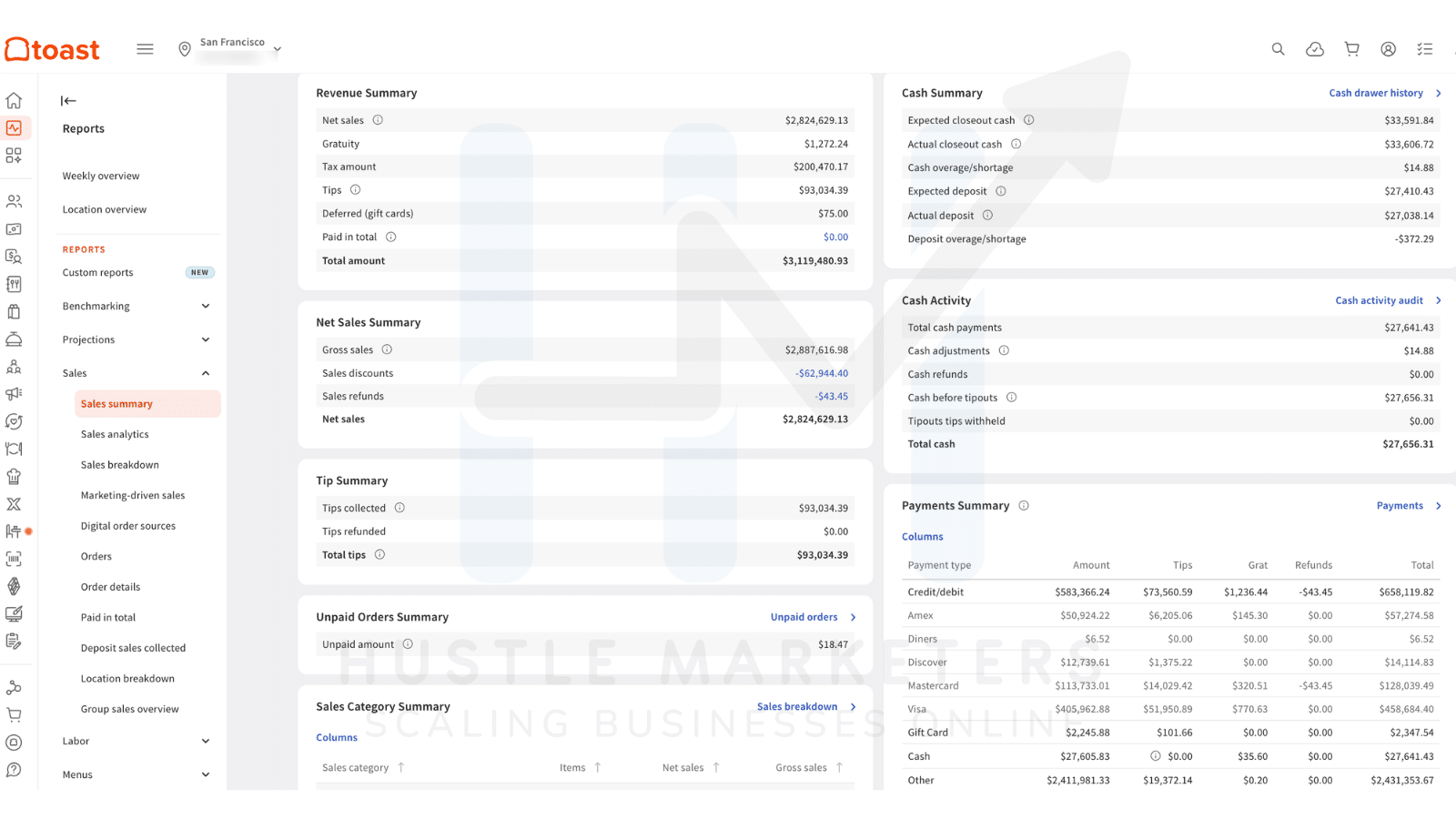
Before that engagement, one location reported zero tracked purchases against real ad spend, and another counted orders twice because an Olo purchase tag and a Thanx tag both claimed the same transaction. The lesson for anyone choosing a POS: the system that records the sale is rarely the system that fires the conversion, so plan who sends the order to Google Ads before launch.
Revenue rarely matches exactly either. Olo’s GTM template sends the order subtotal as the GA4 purchase value, not the total, so GA4 runs below what the POS reports, as our Olo Google Tag Manager guide documents. Reconcile against the matching column, and judge campaigns against a break-even target as our ROAS vs ROI guide explains.
Who owns your Google Ads account with Toast Advertising?
Toast does, in practice. Toast’s Toast Advertising FAQ (updated April 10, 2026) says Toast creates new Google Ads accounts for these campaigns, an existing Google Ads account cannot be linked, and you manage the campaigns through Toast without direct access to the account. It lists a 15% fee on monthly ad spend for Essentials customers.
Its product page says campaigns start at $15 a day and that additional Toast fees apply. Toast measures orders from its own online ordering and catering, plus estimated in-store sales, and says orders from third-party ordering providers generally cannot be measured. If you already run Google Ads, ask what happens to your account history before you switch. When we manage ads, the account stays in your name.
Not sure your POS orders are tracked correctly?
We will test a real order through your ordering page, GA4 and ad accounts, then show you where conversions drop or double.
Get Free Audit Worth $500Which should you choose, Toast or Square?
Choose Toast if you run full service, a busy bar or several locations and want one restaurant-built system, and you are ready to negotiate a contract. Choose Square if you run a small counter-service spot, cafe or food truck, want to see every fee before you sign, and value the option to cancel anytime.
| If your restaurant is… | Lean toward | Why |
|---|---|---|
| A cafe or counter-service spot with one register | Square Free or Plus | $0 to $49 a month, published rates, $59 reader to start |
| A food truck or pop-up | Square | Cheap portable hardware and no contract |
| Full service with tableside ordering | Toast, or Square Premium | Toast builds table service in; Square adds coursing and seats on Premium |
| A busy bar | Toast | Handhelds and kitchen display sit in the core product |
| A multi-location group | Toast | Central menus and reporting across locations; Square charges each plan per location |
| Unsure about volume or staying power | Square | Cancel anytime and a 30-day trial on paid plans |
| Planning to run Google Ads yourself or with an agency | Either, with your own ad account | Check order-data access and avoid giving up ad account ownership |
Whichever you pick, your ordering setup is also your local marketing setup. Mark up hours and menu links with restaurant schema markup, and point the order button on your Google Business Profile to your own ordering page.
What do restaurant owners say about Toast and Square?
Reviewers rate Square slightly higher on ease of use and Toast lower on support, while both draw complaints about fees. The ratings below were read on November 12, 2026. G2 does not list a separate Square restaurant product, so its Square figure covers Square Point of Sale as a whole.
| Review site | Toast | Square |
|---|---|---|
| G2 | 4.2 out of 5 from 377 reviews | 4.6 out of 5 from 1,195 reviews (Square Point of Sale) |
| Capterra | 4.1 out of 5 from 555 reviews | 4.4 out of 5 from 54 reviews (Square for Restaurants) |
| Common praise | Restaurant functionality, fast go-live | Easy to learn, smooth payments |
| Common complaint | Slow support on complex issues, setup effort | Fees and add-ons, internet dependence, limited reporting depth |
Capterra’s sub-scores point the same way: customer service is 3.7 for Toast and 3.9 for Square for Restaurants. Treat ratings as a signal, not a verdict, because both platforms mix restaurant and retail reviewers.
What about Toast vs Clover?
Clover is the third system many owners shortlist, especially when their bank offers it. We could not verify Clover’s current US restaurant pricing on clover.com on November 12, 2026, because its pricing pages only load in a full browser, so we have kept Clover out of the fee tables rather than repeat third-party figures.
The same tests still apply to a Clover quote: are card rates published or quoted, how long is the term, what does leaving early cost, and can you get order data out for tracking? Ask the same questions listed below.
What should you ask before signing with either?
Ask these questions of Toast, Square or any other POS before you sign, and get the answers in writing:
- What is my card rate for in-person, online and keyed-in payments, by card brand?
- How long is my term, when does it renew, and how do I give notice?
- What do I owe in dollars if I leave early or close for a season?
- Is my hardware bought, financed at what rate, or leased?
- Which add-ons am I paying for, and what does each cost a month per location?
- Can I add GA4, Google Tag Manager and Meta Pixel to the ordering pages, and can I get order data by API or webhook?
- If I buy ads through the POS, who owns the ad account and can I take it with me?
Frequently asked questions
Is Toast better than Square for restaurants?
Toast is usually better for full-service, high-volume and multi-location restaurants that want restaurant-built tools and will sign a contract. Square is usually better for cafes, counter service and food trucks that want published fees and the freedom to cancel anytime.
Which is cheaper, Toast or Square?
Square is easier to price because it publishes everything: $0, $49 or $149 a month per location and in-person card rates from 2.4% to 2.6% plus 15 cents. Toast starts at $0 or $69 a month but quotes card rates and most hardware, so compare a written Toast quote against Square’s list prices.
Does Toast publish its processing rates?
No. Toast’s pricing guide says the Starter Kit has a higher per-transaction rate and paid plans a lower one, but gives no percentages. Toast can also change card rates on 30 days’ written notice under Section 6.2 of its Merchant Agreement, so get your rate in writing.
Does Square require a contract?
No. Square’s US pricing page says there are no locked-in contracts and you can cancel or switch plans anytime. Paid plans include a 30-day free trial. Hardware bought on a Square credit plan still has to be paid off.
Can I track Toast online orders in Google Ads and GA4?
Partly. Toast lets you add Google Analytics and Meta Pixel IDs to Toast Websites and Online Ordering Pro, and Google Tag Manager to Toast Websites. Owners on Toast’s forum report trouble capturing purchases on hosted ordering pages, so many restaurants send confirmed orders server-side instead.
Does Square work with Order with Google?
Yes. Square says Order with Google is free through Square Online for food and beverage businesses with a Google Business Profile and a published site with checkout. Guests order from Google Search and Maps, and the order comes through your Square website.
Can I switch from Square to Toast later, or the other way?
Yes. Moving from Square to Toast is simpler on the contract side because Square has no locked-in term. Leaving Toast early costs the remaining software fees, or $150 for each month left on Pay-as-you-Go, so check your term first. Either way, plan to rebuild your order tracking.
Is Toast the same company as Square?
No. Toast is its own public company, listed on the New York Stock Exchange as TOST. Square belongs to Block, which also issues Square’s hardware credit plans. They are direct competitors.
How can we help with your restaurant’s tracking?
Your POS choice decides where order data lives. We connect that data to GA4, Google Ads and Meta for restaurant groups on Toast and Olo, and the same method applies to Square, so you judge campaigns on real orders rather than clicks. See our conversion tracking services and how we choose a Google Ads agency for restaurants.
How we built this comparison: every price, rate and term comes from Toast’s and Square’s own US pages, the FTC’s announcement and the review sites named, each linked and read on November 12, 2026. A person on our team fact-checks it before publishing. Prices change, so confirm them on a current quote.
Want your POS data working for your marketing?
Start with a free audit of your ordering, tracking and ad accounts. Your accounts stay in your name.
Get Free Audit Worth $500