Car Dealership SEO: How Dealerships Get More Leads from Google and AI Search (2026 Guide)

Ishant
Published : November 2, 2026 at 9:30 am
Updated : November 2, 2026 at 7:07 pm
Ishant
Summarize this article with:
Car dealership SEO pays off where the aggregators cannot follow you: service searches, a separate service department Business Profile, local content, and fast, accurate vehicle pages. Most shoppers research online before they visit a showroom, yet an Overfuel study of 1,910 dealer websites found 99.6 percent failing Core Web Vitals on mobile, desktop or both. That gap is a revenue opportunity for any dealership willing to fix what its competitors have not.
This guide covers the specific SEO challenges and tactics that apply to car dealerships: VIN-based duplicate content, Google’s 2025 inventory listing changes, multi-department GBP strategy, service versus sales keyword strategy, AI search optimization, and the FTC compliance angle that directly affects what you can say in SEO content.
Why Car Dealership SEO Is Unlike Any Other Industry
You Are Fighting on Three Fronts Simultaneously
Most businesses compete with similar local competitors. Dealerships compete simultaneously against:
Third-party aggregators: CarGurus, AutoTrader, Cars.com, and Edmunds have domain authority built over decades and generate millions of indexable vehicle pages automatically. These platforms outrank nearly every dealership for inventory-level search terms.
Direct competitors: Other franchised and independent dealers targeting the same city, the same makes, and the same customer demographics.
OEM content constraints: Manufacturer-supplied specs, imagery, and copy distributed across thousands of dealer websites create a systemic duplicate content problem that undermines individual dealership rankings.
At the same time, dealerships must manage inventory that changes daily, navigate advertising compliance requirements from the FTC, and serve both a sales department and a service department with fundamentally different keyword strategies.
Are You Paying to Compete Against Yourself?
Third-party listing sites like CarGurus, AutoTrader and Cars.com charge dealers for exposure, then use that revenue and their scale to build authority and outrank the same dealers organically for searches that could have delivered free leads. Dealers are, in effect, subsidizing the competition.
The strategic response is not to abandon third-party listings. Many shoppers start there, and that discovery layer is hard for a dealer to replace. The response is to build a parallel organic presence in the search categories where aggregators cannot compete: local service searches, hyper-local content, Google Business Profile map pack placement, and AI search citations.
The 5 Biggest Technical SEO Mistakes Killing Dealership Rankings
VIN-Level Duplicate Content: The Industry-Wide SEO Crisis
This is the most widespread and least discussed technical problem in automotive SEO. A 2024 analysis found 3,330 or more automotive websites sharing identical boilerplate service page text from the same DMS provider template (9 Clouds). VIN-level duplication affects virtually every dealership that has not actively addressed it.
There are five types of automotive duplicate content:
- VIN-level duplication: Two different vehicles of the same year, make, model, and trim share near-identical vehicle detail page (VDP) content because no one wrote unique descriptions.
- OEM content syndication: Manufacturer-supplied spec copy distributed to thousands of dealer sites creates identical content at scale across the web.
- DMS template boilerplate: CDK, DealerSocket, and Reynolds sites distribute the same service page templates across their client base. Most dealers never customize them.
- Faceted navigation URL proliferation: Filter and sort combinations on search results pages (SRPs) create thousands of near-duplicate URLs (e.g., /used-cars?color=red&price=20000&mileage=50000).
- Cross-manufacturer duplication: Multi-franchise dealers often use identical about page structures or service page copy across their different make locations.
The OEM content problem requires a specific approach: manufacturers own brand and model informational content. Dealers should own local transactional content. When dealer pages copy OEM spec sheets, Google sees similar content on related domains and has no reason to prioritize either. The correct strategy is to link to manufacturer comparison assets rather than recreate them, and to build original content around local context: current pricing with all fees, staff expertise, inventory depth, service capacity, and community context that OEM content never includes.
For VDPs, write unique descriptions for your highest-value inventory units. For faceted navigation, use canonical tags pointing to the primary filtered URL, and use robots.txt to block parameter-heavy combinations from being crawled.
For sold vehicles, implement 301 redirects immediately when a vehicle sells: redirect to a similar available model, the model-type SRP, or a dedicated “this vehicle has sold” page with equivalent recommendations. Leaving sold VDPs live as active pages creates crawl budget waste and can constitute deceptive advertising under FTC advertising standards.
Why Do 99.6% of Dealer Websites Fail Core Web Vitals?
An Overfuel study published September 22, 2025 checked 1,910 retail websites from North America’s largest auto groups. 99.6 percent failed Core Web Vitals on at least one platform, and only 7 sites passed on both mobile and desktop. This is a platform problem as much as a site problem.
The primary cause is the dealership website platform itself. CDK Global (Dealer.com), DealerSocket, and Reynolds and Reynolds power most franchised dealership websites. These proprietary platforms are built with heavy JavaScript rendering, third-party script stacks (chat widgets, financing calculators, inventory tools, retargeting pixels), and inflexible template architectures that collectively destroy page speed. Your paid campaigns feel it too, because slow landing pages convert paid clicks at lower rates.
What you can do within your current platform:
- Work with your platform provider to defer non-critical JavaScript (chat widgets, financing tools) until after initial render
- Compress and convert hero images to WebP format; implement lazy loading on gallery images
- Identify and remove or defer third-party scripts that are not essential to the primary page purpose
- Reserve layout space for elements that load asynchronously to eliminate Cumulative Layout Shift
If you are evaluating a platform change, Dealer Inspire’s WordPress foundation offers more customization flexibility than proprietary systems, though WordPress-based dealer sites still require disciplined plugin management to avoid the same script bloat problems.
Faceted Navigation Creating Thousands of Thin URL Variants
Every filter combination on your SRP potentially creates a new crawlable URL. A dealership with a modest inventory and filters for color, price range, mileage, body type, year, and fuel type can generate hundreds of thousands of parameter combinations. Most of these pages are thin or near-duplicate, and when Google crawls them, it wastes crawl budget that could be spent on your valuable content.
Fix: do not look for a parameter setting in Search Console. Google retired the URL Parameters tool in 2022, so the fix has to live on the site. Google’s faceted navigation guidance puts robots.txt first: disallow the parameter patterns that create low-value variants, and return a 404 for filter combinations that show no vehicles. Canonical tags on parameterized URLs pointing to the clean SRP still help, but Google calls canonical and nofollow “generally less effective in the long term.”
Missing Schema Markup on Inventory and Service Pages
These are the schema types that matter for a dealership, and what each one does today:
| Page Type | Schema Type | What It Enables |
|---|---|---|
| Home / main location page | AutoDealer | Business identity, hours, contact |
| Vehicle detail page | Car | Entity clarity only; vehicle rich results were retired in 2025 |
| Service offer page | Service + LocalBusiness | “Near me” service query eligibility |
| FAQ sections | FAQPage | No rich result since May 2026; keep FAQ content in plain HTML |
| Review sections | AggregateRating | Not eligible for stars on your own dealership pages |
| Inventory hierarchy | BreadcrumbList | Navigation path in search results |
Car schema on VDPs no longer earns a vehicle rich result, because Google phased out vehicle listings in Search in 2025. It still describes each vehicle clearly for search engines and AI tools, so keep it accurate and matched to the page.
Google Business Profile for Car Dealerships: The Multi-Department Advantage
Why Your Dealership Needs Three Separate GBP Profiles
This is one of the most underused local SEO tactics in automotive. SearchLab Digital research, cited by DemandLocal, found 61.2 percent of dealerships have no separate department Google Business Profile.
Google’s current policy supports separate listings per distinct department for the same physical location. A properly configured dealership should maintain:
- Sales Department profile: targeting new car, used car, and CPO searches
- Service/Parts Department profile: targeting oil change, brake service, tire rotation, and maintenance searches
- Collision Center profile (if applicable): targeting auto body and collision repair searches
The competitive advantage of a separate service GBP is substantial. When a consumer searches “oil change near me” or “brake service [city],” Google shows a local map pack. Your main sales GBP is categorized as a car dealership and does not rank in this map pack. Your service department GBP, categorized as an automotive service center, competes directly against Jiffy Lube, Firestone and independent shops, and can win on review volume and proximity.
Service operations generate 20 to 30 percent profit margins compared to 6 to 8 percent on new vehicle sales. The service map pack is one of the most underexploited revenue channels in automotive local SEO.
The Review Volume Gap That Is Costing You the Map Pack
Top-ranked dealerships in local map packs average 2,381 Google reviews. Dealerships in the 10th position average 1,100 (SearchLab Digital research, cited by DemandLocal). Review volume is one of the most direct local ranking signals, and the gap between winners and losers is overwhelmingly a result of systematic review generation versus occasional manual requests.
The first-position dealerships also publish 7.5 Google Posts per year compared to 1.8 for 10th-position competitors. And the average age of the most recent owner-uploaded photo is 778 days, more than two years old. Photos that old signal a business that is not actively maintaining its online presence.
Review routing by department matters. A service customer who had a great experience with your technician should receive a review request that links to your service department profile, not your main sales GBP. Review mixing dilutes relevance and prevents each profile from accumulating the department-specific keyword density that drives attribute highlights.
GBP Optimization Checklist for Dealerships in 2026
- Categories: Main dealership should select the make-specific category (“Ford Dealer,” “Toyota Dealer”) as primary; service department uses “Auto Repair Shop” or “Oil Change Service”
- Attributes: Complete all applicable attributes: financing, EV charging, shuttle service, loaner vehicles, free diagnostics
- Photos: Upload at minimum 4 new photos per profile per month; include inventory, service bay, staff, and community involvement
- Posts: Create at minimum 2 posts per month per profile (new arrivals, service specials, community events, manufacturer incentives)
- Q&A: Google shut down the Business Profile Q&A API on November 3, 2025 while it reworks the feature, so check what your profile shows today before planning around it. Keep the questions customers ask most, with full answers, on your own sales and service pages, where you control them
- Inventory: Google ended its free vehicle listings in 2025. Inventory exposure on Google now runs through paid vehicle ads and a Merchant Center vehicle feed
- Review monitoring: Set up alerts for new reviews and respond within 24 hours
How to Beat CarGurus, AutoTrader, and Cars.com at Their Own Game
Why Aggregators Will Always Win on Inventory Search Terms
AutoTrader, CarGurus, and Cars.com have spent decades building their domain authority through millions of pages, editorial content, and massive link profiles. For generic inventory searches such as “used Honda Accord” or “SUVs under $30,000”, these platforms will outrank virtually every individual dealership.
Dealers who understand this stop fighting for search terms they cannot win and redirect their content effort to the three categories where aggregators structurally cannot compete.
The Three Search Categories They Cannot Take From You
1. Local service searches. CarGurus does not compete for “oil change [city]” or “brake service near [neighborhood].” These queries return local map packs with service centers and auto repair shops, and a properly optimized service department profile can win them. This is the highest-margin, most ownable search category available to dealerships.
2. Hyper-local informational content. “Best [brand] dealer near [airport],” “[neighborhood] auto dealer reviews,” “[city] certified pre-owned [model] experience”. These are queries where local authority and genuine community content outweigh domain authority. Aggregators optimize for national scale. Dealers optimize for specific local context.
3. GBP map pack placement. Google Maps searches (“car dealers near me,” “[make] dealer open now”) return map packs where individual business profiles compete on review volume, proximity and completeness, not domain authority. This is level ground where a well-optimized dealer GBP can outrank aggregators that do not have physical location authority in that market.
Content Strategy to Outflank Aggregators
The keyword opportunity for dealerships is in the ownership journey that follows the initial purchase decision: financing questions, trade-in valuation, model-specific comparisons for buyers who have narrowed their choice, service and maintenance content, and EV education for shoppers crossing over from ICE vehicles.
Build model landing pages that go beyond specs: current local pricing including all fees, available inventory with a live count, comparison to the closest competitor models, financing examples with real APR ranges, and local trade-in valuation context. This is content aggregators cannot replicate at a market-specific level.
Keyword Strategy for Car Dealerships: Sales and Service Are Two Different Disciplines
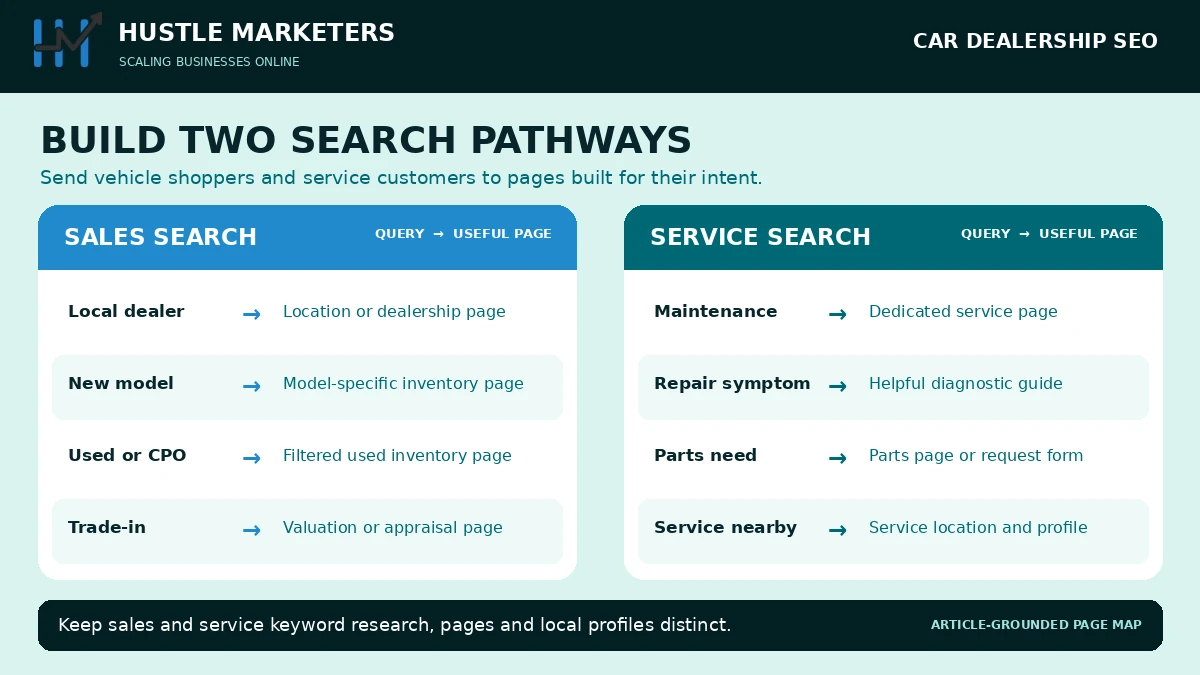
Sales Department Keywords: Mapping to the Buyer Journey
Sales keyword strategy follows the buyer’s research progression:
| Intent Stage | Keyword Examples | Content Type |
|---|---|---|
| Awareness | “[year] [model] review,” “[model] MPG” | Informational blog, comparison |
| Comparison | “[model] vs [model] 2026,” “best [segment] under $35k” | Comparison landing pages |
| Local purchase | “[make] dealer [city],” “certified pre-owned [model] [city]” | Location + model pages |
| Financing | “0% APR [model],” “how much can I finance with 600 credit score” | FAQ content, financing pages |
| Trade-in | “trade-in value [make model year],” “how much is my [model] worth” | Trade-in landing page |
| CPO/Used | “certified pre-owned [model],” “used [model] under $25,000 [city]” | CPO and used inventory pages |
Service Department Keywords: Your Highest-Margin, Most Ownable Search Category
Service department SEO uses six distinct keyword types, each with different intent and content needs:
- Part type searches: “door handles for 2022 Toyota Camry” (modified by year/make/model). High purchase intent.
- Part number searches: OEM or crossover numbers. Extreme purchase intent from DIY or shop buyers.
- Informational/how-to: “how to reset oil light [make model],” “what causes brake squeal.” Blog and video content.
- Symptom-based: “car shaking when braking [make],” “check engine light after oil change.” FAQ and diagnostic content.
- Brand name parts: “Motorcraft brake pads,” “Toyota OEM filter.” Branded product pages.
- Category/service searches: “oil change near me,” “brake service [city],” “wheel alignment [dealership name].” Local SEO pages.
Service searches convert through your local GBP profile and service department landing pages. Your primary competitors for these queries are aftermarket shops such as Jiffy Lube, Midas, Firestone and local independents, not CarGurus or AutoTrader.
Which EV Keywords Should a Dealership Target?
Electric car sales topped 17 million worldwide in 2024, up more than 25 percent, according to the IEA’s Global EV Outlook 2025. EV shoppers also arrive with more questions than most buyers: range, charging, incentives and running costs. Every one of those questions is a page you can rank.
| EV Keyword Category | Example Queries |
|---|---|
| Incentive research | “[state] EV rebate 2026,” “is the federal EV tax credit still available” |
| Range and charging | “how far does [model] go on one charge,” “EV charging [city]” |
| Comparison | “EV vs hybrid [model],” “[EV model] vs [competitor EV]” |
| Ownership costs | “cost to charge [model] at home,” “EV insurance cost [model]” |
| Dealer certification | “[brand] EV certified dealer [city],” “GM EV dealer near me” |
| Lease and financing | “[EV model] lease deals [city],” “EV financing near me” |
Create dedicated EV landing pages rather than relying on inventory filters. Cover range, home and public charging, state and utility incentives, and total cost of ownership against gas equivalents. Be plain about the federal credit: the IRS says the New Clean Vehicle Credit is not available for vehicles acquired after September 30, 2025. Shoppers still search for it, and a page that says so clearly, then points them to the incentives that do apply, earns more trust than one that repeats an expired offer.
Google’s Free Vehicle Listings Are Gone: What Should Dealerships Do Now?
Google retired its free vehicle listings in 2025. That organic program let dealerships show inventory on Google at no cost by submitting a vehicle feed. Google’s vehicle listings page now says the feature “will no longer appear” and adds: “Processing of vehicle listing feeds will also be stopped.”
Paid inventory exposure now runs through vehicle ads, which Google describes as “a performance-focused lower funnel ad format” that lets auto advertisers promote their inventory to people shopping for vehicles on Google. Vehicle ads run from a vehicle feed in Merchant Center, and Google treats them as a separate program from the free listings that ended.
What this means for organic strategy:
Inventory that previously received free visibility in Google search results now needs paid spend through vehicle ads. That raises the value of organic SEO for model pages and VDPs, because organic rankings are now the main non-paid route to inventory-level visibility.
Dealers should:
- If you run vehicle ads, keep the Merchant Center vehicle feed complete and accurate: year, make, model, price, VIN, images and mileage
- Redouble organic VDP and SRP work: write unique copy per vehicle, keep Car schema complete and accurate, and link from model hub pages to individual VDPs
- Ensure your model landing pages are well-optimized since they now carry more weight as the non-paid path to inventory discovery
Local SEO for Car Dealerships: Dominating Your Market Radius
Location Page Strategy for Single-Point Dealers
A single-location dealership should build location-specific content that goes well beyond the basic name, address, and phone number page:
- Service area sections with genuine local context (which neighborhoods you serve, how far you are from major landmarks and highways)
- Staff spotlights with real names, photos and tenure, not stock photography
- Community involvement (sponsorships, local events, partnerships) that signals genuine local presence
- Model-specific local pages: “Ford F-150 [City]” pages with local pricing context, current incentives, and nearby delivery
Each model landing page should answer the specific local buyer’s question: What is the current price in this market? How many do you have in stock? What are local financing rates?
Multi-Location Auto Groups: Avoiding Keyword Cannibalization
Auto groups with multiple stores in the same or nearby markets face keyword cannibalization: two stores targeting “Honda dealer Dallas” split the domain’s ranking potential instead of one store dominating and the other targeting “Honda dealer Fort Worth.”
Solve this with geographic specificity:
- Each location targets a distinct geographic catchment area with explicit neighborhood and service area content
- URL architecture:
domain.com/locations/city-neighborhood/rather than a generic/locations/city/ - Location pages require a minimum of 500 words of unique content per page, not cloned templates with the city name swapped
- Each location needs its own GBP profile, its own review accumulation strategy, and its own citation profile
The review decentralization is critical. Corporate headquarters may show 4.8 stars, but if the individual location profiles have 300 reviews while competitors have 2,000, the headquarters rating has zero relevance to local map pack rankings.
Citation Building for Dealerships
Beyond GBP, priority citation platforms for automotive businesses include:
- DealerRater (reviews syndicate to Cars.com; heavily indexed by Google)
- Cars.com, AutoTrader, CarGurus, Edmunds profiles (these must be claimed and maintained)
- Apple Maps (growing importance for iOS/Siri searches)
- Local tourism and chamber of commerce directories
- Better Business Bureau
- State licensing and dealer association directories
Name, address, and phone number must be exactly consistent across every platform. Inconsistencies created by ownership changes, rebranding, or management transitions directly suppress local rankings.
AI Search and GEO: Staying Visible When Car Buyers Use ChatGPT
30% of Car Buyers Now Research with AI: Here’s How They Use It
The Ekho 2026 AI Vehicle Research Study found that 30 percent of car buyers now use generative AI tools during their research. That is more than use OEM or dealer websites directly (15.8 percent), and close to YouTube (25.3 percent). Of AI tool users, 68.4 percent rely on ChatGPT.
Car buyers use AI in four distinct phases:
- Open-ended exploration: “What kind of car should I get for a growing family?” They are learning segments, comparing categories, and forming initial preferences.
- Deep dive comparison: “Compare the 2026 Honda CR-V Hybrid and Toyota RAV4 Hybrid on fuel economy and cargo space.” Specific model evaluation.
- Validation: “What are the most common problems with the 2024 Ford F-150?” Reliability and ownership cost research.
- Local discovery: “Find the nearest certified Honda dealer in Dallas.” The point where AI hands off to local search.
Dealerships that are invisible during phases 1 through 3 miss the entire research phase that primes buyers for the purchase decision. AI search citation is the new top-of-funnel channel.
Our AI SEO services include the structured data, FAQ content, and editorial citation building that makes dealership pages citeable in AI search responses.
Generative Engine Optimization (GEO) for Dealerships
GEO is the practice of optimizing content to be cited in AI-generated responses rather than just Google organic rankings. For dealerships:
Structured data at scale: Vehicle schema, AutoDealer schema, and FAQPage schema make your inventory and service content machine-readable and parseable by large language models.
Comprehensive FAQ content: AI systems favor direct, concise answers under descriptive headings. Every model page, service page, and financing page should include an FAQ section with 5 to 10 specific questions and direct answers in 60 words or fewer.
E-E-A-T signals: Staff bios with credentials, years of experience, and specific expertise areas. Service advisor certifications and brand-specific training. These signals improve trustworthiness for AI citation.
Third-party editorial mentions: Local news coverage, automotive publication features, community organization mentions, and manufacturer recognition awards all increase the likelihood of AI systems citing your dealership in recommendations.
Content Marketing for Dealerships: What Actually Drives Organic Traffic
The hub-and-spoke architecture works well for dealership content:
Hub pages (Make/Model landing pages): One authoritative page per model you sell, covering specs, current pricing, available inventory, local comparisons, and FAQ content. This page receives internal links from all related content.
Spoke pages (model variants, comparison posts, service guides): Individual trim comparison pages, “Model A vs Model B” posts, and service content for that model (maintenance schedule, common issues). These link to the hub and to relevant VDPs.
Service content: Oil change intervals, maintenance schedules, symptom diagnostic guides, and how-to posts. These are the most durable organic traffic sources in dealership SEO. They rank for years, drive repeat service visits, and face competition from aftermarket shops rather than national aggregators.
EV education content: State and utility incentive explainers, a plain answer on the federal credit (not available for vehicles acquired after September 30, 2025), charging cost calculators, range guides, and EV versus hybrid comparisons. These capture EV-curious buyers at the highest point of their research funnel.
Review Management and Reputation SEO for Dealerships
Priority Platform Stack
| Priority | Platform | Why It Matters |
|---|---|---|
| 1 | Google Business Profile | Direct local ranking signal; 81% of buyers check here |
| 2 | DealerRater | Auto-specific; syndicates to Cars.com; heavily SERP-indexed |
| 3 | Cars.com | High-authority auto domain; branded search visibility |
| 4 | CarGurus | Dealer reputation score affects listing prominence |
| 5 | Edmunds | High editorial authority; influences informational search |
| 6 | Apple Maps | iOS/Siri searches; separate review ecosystem |
| 7 | Yelp | Service department relevance; Bing integration |
| 8 | Younger buyers; social proof layer | |
| 9 | BBB | Trust signal for finance decisions |
| 10 | RepairPal | Service department specific |
Systematic Review Generation
93 percent of consumers say online reviews impact purchasing decisions. 86 percent will not consider businesses rated below 4 stars.
A review generation workflow that works:
- Post-sale: Automated text or email sent within 2 hours of vehicle delivery with a direct link to the GBP review page for the sales department
- Post-service: Automated text or email sent within 24 hours of service completion, linking to the service department GBP
- Department routing: Sales reviews go to the sales GBP; service reviews go to the service GBP
- Response SLA: Every review receives a response within 24 hours: positive reviews with a personalized thank-you, negative reviews with an acknowledgment and offline resolution path
- Review velocity target: At minimum 10 to 15 new reviews per month per profile
FTC Compliance and What It Means for Your SEO Content
All-In Pricing, Trust, and E-E-A-T
In March 2026, the FTC sent warning letters to 97 auto dealership groups about deceptive pricing practices. That pressure applies to SEO content as much as to ads.
The FTC’s core requirement for automotive advertising is that prices must reflect all mandatory fees. An advertised price that excludes documentation fees, destination charges, or required add-ons can trigger enforcement action. Any page that advertises financing monthly payments must prominently include the Regulation Z required credit terms.
The SEO content implication is counterintuitive: transparent, all-in pricing in your SEO content is both a compliance requirement and an E-E-A-T signal. Google’s quality evaluators specifically look for trust signals in YMYL (Your Money, Your Life) content. A dealership that clearly shows all fees upfront, explains the fee structure in an FAQ section, and provides realistic financing examples is demonstrating the expertise and trustworthiness that Google rewards in its quality assessments.
The Sold Vehicle Problem: Legal and SEO Best Practice Aligned
Leaving sold vehicle pages live and indexed creates two problems simultaneously: it constitutes deceptive advertising under FTC standards (advertising a vehicle that is no longer available), and it generates 404-like dead ends in your crawl graph that waste link equity and create poor user experience.
Implement automatic sold vehicle handling: when a vehicle is marked sold in your DMS, trigger an immediate 301 redirect to either a similar available unit, the model-type SRP, or a dedicated “this vehicle has sold” page with inventory recommendations. This technical fix satisfies both FTC advertising accuracy requirements and SEO crawl health simultaneously.
Measuring Car Dealership SEO Success: KPIs That Actually Matter
Metrics Tied to Revenue
Rank tracking and overall traffic are inputs, not outcomes. The metrics that connect SEO to dealership revenue:
| Metric | What It Measures | Where to Track |
|---|---|---|
| Organic sessions: sales department keywords | Non-branded inventory discovery | GA4 + Search Console |
| Organic sessions: service department keywords | Fixed ops search visibility | GA4 + Search Console |
| GBP actions (calls, directions, website clicks) | Local pack conversion | GBP Insights |
| VDP sessions from organic traffic | Inventory page discovery | GA4 + inventory platform |
| Phone calls with organic traffic attribution | Lead quality from SEO | Call tracking platform |
| Organic lead-to-sale rate | SEO traffic conversion quality | CRM cross-referenced with GA4 |
Competitive Benchmarks
For context on where your dealership stands:
- Average dealership receives 11,200 monthly website sessions
- Website conversion rate (visits to leads) averages approximately 1.5 percent
- Organic customer acquisition costs 50 to 70 percent less than paid acquisition
- Businesses in the local map pack see significantly higher call and direction request volume than those ranked only in organic results
We have driven local lead results in comparable markets, including a local signage company through Google Ads and a driving school that grew organic traffic through SEO. Hustle Marketers provides SEO services for car dealerships covering technical audits (including VIN duplicate content, Core Web Vitals, and schema implementation), keyword strategy by department, GBP multi-profile optimization, content plans for both sales and service departments, and monthly reporting with call and lead attribution.
How Hustle Marketers helps car dealerships with SEO
Dealership SEO has a structural problem no other local business has. Your inventory turns over constantly, which means your most valuable pages are created and destroyed every few weeks, and most dealer sites handle that by leaving a trail of dead URLs behind them. Fix the inventory lifecycle and the rest of the SEO gets easier.
The second issue is that the OEM site, the third party listing portals and your own site are all competing for the same searches, and the dealer usually loses. That is a feed and structured data problem as much as a content one, which is the part of this work we do most. Our Silicon Lightworks case study covers the same discipline applied to a technical catalogue that was blocked from showing at all.
Ishant Sharma has worked as a Google Ads, Microsoft Ads and SEO specialist since 2013. For dealerships the organic and technical work sits under our SEO services, the paid side under PPC management, and the service department, which is usually the most profitable and least marketed part of a dealership, deserves its own local pages before anything else.
Client example: Google Shopping and Facebook Ads for an automotive parts retailer
- Client: C7 Carbon, a US retailer of Corvette parts and accessories, named in our published case study. This is the closest comparable account we can publish: an automotive parts retailer rather than a dealership.
- Starting problem: products were not ranking in Google Shopping, ads were matching searches like “cool cars” and “sports cars”, only Brand and Performance Max campaigns were running, and Facebook ads had no pixel tracking.
- What we changed: added Google product categories, product specifications and promotions to the feed; rebuilt the account into six campaigns; added those irrelevant terms as account-level negatives; installed the Facebook Pixel for purchase and add-to-cart tracking.
- Result: 202 purchases tracked in Google Ads at a conversion value to cost ratio of 4.42, and Facebook campaigns averaging a ROAS above 10 once purchases could be tracked.
This example is paid search and social rather than SEO, from one account over a six-month engagement. Full breakdown: C7 Carbon case study.
Car Dealership SEO FAQs
How much does SEO cost for a car dealership?
Agency retainers for single-point dealers typically run $2,000 to $5,000 per month; competitive markets and multi-location groups run $5,000 to $15,000 per month. Organic search drives leads at 50 to 70 percent lower cost than paid per lead, and generates more than 1,000 percent more traffic than organic social media. The SEO investment typically delivers positive ROI within 6 to 12 months for dealerships starting from a weak organic baseline.
How long does SEO take to work for a car dealership?
Quick wins are achievable in 30 to 60 days: GBP optimization, Core Web Vitals improvements, and schema markup additions produce measurable ranking movement quickly. Meaningful progress on local service keywords takes 90 to 180 days. Competitive local market keywords for new and used vehicle terms take 6 to 12 months. Dealerships that have never done structured SEO work often see faster early gains because the baseline is so low. Fixing technical errors and adding missing schema can produce visible ranking changes within weeks.
Should a car dealership focus on SEO or pay-per-click advertising?
Both serve different functions and work best in combination. SEO builds long-term compounding organic visibility that reduces cost-per-lead over time. PPC (vehicle ads, search ads) drives immediate inventory-level traffic and is essential for specific promotional periods. Since Google retired its free vehicle listings in 2025, inventory visibility on Google needs paid vehicle ads, alongside organic SEO for model pages and service content. Organic leads cost 50 to 70 percent less than paid leads, but SEO takes time to build and cannot be turned on instantly for a weekend sales event the way PPC can.
How do I get my car dealership to rank in Google Maps?
The map pack ranking formula for dealerships: complete Google Business Profile (categories, attributes, photos and posts), review volume (top-ranked dealers average 2,381 reviews in SearchLab Digital’s research), review velocity (consistent new reviews every week), NAP consistency across all citations, and separate GBP profiles per department. The most impactful single action for most dealerships is a systematic post-sale and post-service review request workflow, because it directly closes the review volume gap between your profile and the current map pack leaders.
What are the best keywords for a car dealership website?
Keywords should be organized by department and intent. Sales department priorities: [brand] dealer [city], certified pre-owned [model] [city], new [model] [city], [model] vs [competitor model], used [model] under $[price] [city]. Service department priorities: oil change near me, [service type] [city], [symptom] [make model], [OEM brand] parts near me. EV priorities: [state] EV rebate, is the federal EV tax credit still available, [EV model] range, charging [EV model] at home, EV dealer [city]. Long-tail local variants consistently outperform generic brand terms for individual dealerships. The more specific the query, the less competition from national aggregators.
How do I compete with CarGurus and AutoTrader in Google search?
Stop competing for the inventory terms aggregators win. Instead, own the three categories where they cannot compete: local service search (oil change, brake service, tire rotation; aggregators do not appear in the service map pack), hyper-local informational content (neighborhood-specific, event-specific, local comparison content), and GBP map pack placement (review volume and proximity are the primary ranking signals; aggregators have no physical location authority in your market). Build service department SEO as your primary local visibility strategy, and use content marketing to capture the ownership journey that aggregators ignore: service guides, trade-in valuation content and EV education.
Does my car dealership need separate Google Business Profiles for sales and service?
Yes. Google supports separate GBP profiles per distinct department at the same physical location. Your main sales profile does not appear in the local map pack for “oil change near me” or “brake service [city]”, because it is categorized as a car dealership, not a service provider. A separate service department profile, properly categorized, competes directly against Jiffy Lube, Firestone, and independent shops for those queries. About 61 percent of dealerships have no separate department profile, according to SearchLab Digital research cited by DemandLocal. Adding one is among the highest-impact, lowest-effort local SEO changes most dealers can make.
Why is my car dealership website so slow, and how does that affect SEO?
In Overfuel’s 2025 study, 99.6 percent of large auto groups’ dealer websites failed Core Web Vitals, and the root cause is usually the platform. CDK Global, DealerSocket, and Reynolds-powered sites use heavy JavaScript frameworks and accumulate third-party scripts (chat widgets, inventory tools, financing calculators, retargeting pixels) that compound into poor LCP, INP, and CLS scores. The SEO impact is direct: slower sites rank lower for equivalent content. Slow pages also convert paid clicks at lower rates. Work with your platform provider to defer non-critical scripts and compress images, and factor Core Web Vitals performance into your next platform evaluation.
How do I do SEO for electric vehicle inventory at my dealership?
Start with dedicated EV landing pages (not just inventory filters) that cover range and charging, home charger installation, state and utility incentives, total cost of ownership against gas equivalents, and your dealership’s EV certification and training. Say clearly that the federal New Clean Vehicle Credit is not available for vehicles acquired after September 30, 2025, because shoppers still search for it. Build FAQ content around range, home charging and the incentives that still apply, because these are the questions EV shoppers ask in the research phase. Target incentive searches ([state] EV rebate, is the federal EV tax credit still available), charging content ([EV model] charging time), and certification queries ([brand] EV certified dealer [city]). Electric car sales topped 17 million worldwide in 2024, up more than 25 percent according to the IEA, so the research demand behind these searches keeps growing.
About Hustle Marketers
Hustle Marketers is a digital marketing agency specializing in SEO, Google Ads, and paid media for automotive dealers, ecommerce brands, and professional services. Our automotive SEO work covers technical audits specific to DMS platforms, GBP multi-department optimization, service versus sales keyword strategy, and content programs designed to reduce reliance on third-party listing sites and increase direct organic leads.
Sources:
- Overfuel 2025 Dealer Website Core Web Vitals Study: https://overfuel.com/resources/blog/north-americas-largest-auto-groups-still-failing-google-core-web-vitals-2025/
- 9 Clouds Automotive Duplicate Content Analysis: https://9clouds.com/blog/plague-duplicate-content-automotive-websites/
- DemandLocal Car Dealership Local SEO Statistics: https://www.demandlocal.com/blog/local-seo-car-dealerships-statistics/
- Ekho 2026 AI Vehicle Research Study: https://www.ekho.com/blog/2026-ai-vehicle-research-study-how-buyers-are-using-chatgpt-and-other-ai-tools-to-find-their-next-vehicle/
- FTC Warning to 97 Dealer Groups (March 2026): https://www.ftc.gov/news-events/news/press-releases/2026/03/ftc-warns-97-auto-dealership-groups-about-deceptive-pricing
- Google vehicle listings documentation (free listings retired, feed processing stopped): https://developers.google.com/vehicle-listings
- Google Merchant Center Help, vehicle ads: https://support.google.com/merchants/topic/15174524
- IRS, Credits for new clean vehicles purchased in 2023 or after: https://www.irs.gov/credits-deductions/credits-for-new-clean-vehicles-purchased-in-2023-or-after
- Local Falcon Dealership Review Platform Priority: https://www.localfalcon.com/blog/these-are-the-top-car-dealer-review-sites-for-local-seo
- Schema.org Car: https://schema.org/Car
- IEA Global EV Outlook 2025: https://www.iea.org/reports/global-ev-outlook-2025/trends-in-electric-car-markets-2
About the author: Ishant Sharma has worked in digital marketing since 2013 as a Google Ads, Microsoft Ads and SEO specialist, across ecommerce, local service, SaaS and white label agency accounts in the US, UK, UAE and Australia. He leads SEO services and AI SEO at Hustle Marketers. He is the founder of Hustle Marketers, a best digital marketing agency for ecommerce and local service brands, a Google Partner and Meta Business Partner agency. Trackable client sales across his work have passed $780M, and he is Top Rated Plus on Upwork. More about Ishant.
Related guides
If this one was useful, these cover the same ground for closely related businesses.