International Ecommerce SEO: How to Rank a Store in New Countries

Ishant
Published : November 2, 2026 at 12:30 pm
Updated : November 2, 2026 at 7:07 pm
Ishant

An international SEO strategy for an online store decides which countries you target, which URL each country lands on, and how Google knows which version to show. Most store problems come from one URL showing several currencies, missing hreflang, and feeds that disagree with the page. This guide is for US, UK and Australian stores expanding abroad, and every rule links to the source we checked it against.
Summarize this article with:
Quick Answer: What is the best international SEO strategy for an ecommerce store?
Start with one or two countries where you already see demand. Give each market its own URL (a subfolder suits most stores), connect the versions with hreflang, and show one currency per URL with a matching Merchant Center setup for that country. Then localize the category and product pages that sell, earn a few local links, and measure each country separately.
Key Observations
- Google supports three structures. Country domains, subdomains and subfolders all work. URL parameters are not recommended.
- One currency per URL. Google asks for a distinct URL per currency, and Merchant Center warns against switching currency on the landing page by location.
- Hreflang has to point both ways. One-sided tags are ignored. “UK” is not a valid region code; use en-GB.
- Location redirects hide versions. Googlebot usually crawls from the US, so Google may not find every version of content that changes by location.
- Shopify Markets adds hreflang only with separate URLs. Each market needs its own subfolder, subdomain or domain.
- Search Console country targeting is gone. Google retired it; hreflang and ccTLDs remain.
What is international SEO for an ecommerce store?
International SEO is the work that lets a store rank with the right page in each country it sells to. For a content site, that mostly means language. For a store, it also means price, currency, shipping, tax display and stock, because those change what a page is.
Google says it uses several signals to judge which audience a page is for: a country code domain, hreflang annotations, and other signals such as local addresses and phone numbers, local language and currency, and links from other local sites (Google Search Central). A store that changes only the currency symbol gives Google very little to work with. SEO for international markets builds on the basics of ecommerce SEO, which still apply in every country.
When is international SEO worth it for a store?
It is worth it when a country already shows demand and you can serve it at a margin. It is not worth it just because a currency switcher exists. Check these before you build anything:
- Existing demand: Search Console’s Performance report can group clicks and impressions by country, so you can see where you already appear.
- Landed cost: shipping, duties, returns and payment fees for that country still leave a profit.
- Local search volume: your category terms have volume in that country’s keyword database, not just in the US.
- Wrong-country traffic: shoppers from that country land on pages with the wrong currency or delivery terms.
Google’s John Mueller has advised checking whether people actually reach the wrong country version before spending months on hreflang, noting it gives no ranking bonus and only helps Google show the best-fitting page (Search Engine Roundtable, September 2022). Our view: with no demand and no wrong-country problem, one well-run store beats a thin second version.
Should a store use ccTLDs, subfolders or subdomains?
Google supports all three and does not recommend URL parameters. For most stores entering their first new countries, a subfolder is the simplest option because it keeps one domain, one platform and one set of apps.
| Structure | Example | Pros | Cons | Platform support |
|---|---|---|---|---|
| Country domain (ccTLD) | example.co.uk | Clearest country signal | Costly; authority built from zero; some have residency rules | Shopify: yes. Magento: website on its own domain. BigCommerce: storefront on its own domain |
| Subdomain | uk.example.com | Simple; can be hosted separately | Unclear whether it means language or country | Shopify: yes, with DNS per subdomain. Magento: via base URL. BigCommerce: storefront on a subdomain |
| Subfolder | example.com/en-gb/ | Shares the main domain’s authority; lowest upkeep | One server location; harder to split off later | Shopify: yes, its recommendation for most stores. Magento: store code in URL. BigCommerce Catalyst: subpaths, suggested for languages within a country |
| URL parameter | example.com?loc=uk | None | Not recommended by Google | Avoid |
Source: Google Search Central, multi-regional sites (updated December 10, 2025); Shopify Help, International SEO for markets; Adobe Commerce, store URLs; BigCommerce Catalyst.
Our view: pick a ccTLD only with a real local reason, such as a local entity, warehouse or established local brand. Otherwise you start link building from zero.
How do you do international SEO for ecommerce, step by step?
These eight steps cover the international SEO best practices that matter for stores, in the order we use on audits.
Step 1: Which countries should you target first?
| Check | Where | Good sign |
|---|---|---|
| Impressions and clicks by country | Search Console, Countries tab | The country already shows up without any targeting |
| Revenue and conversion rate by country | GA4 | Orders arrive even with the wrong currency |
| Category keyword volume | Keyword Planner or Semrush, set to that country | Your top categories have local volume |
| Who ranks today | A search run from that country | Local stores you can match on range, price and delivery |
| Landed cost and returns | Your shipping and finance data | Margin survives duties, freight and returns |
Start with one or two markets. For US, UK or Australian stores, English-speaking markets are the usual first move: most copy carries over, so the work is currency, delivery and wording.
Step 2: How do you give each market its own URL?
Pick one structure from the table above and use the same pattern everywhere. Name folders with a language and country code, such as /en-gb/ or /en-au/. On Shopify, language-only folders such as /fr work only for the primary market; other markets need a code such as /fr-ca (Shopify Help). Add a visible country and currency switcher as plain links, so shoppers and crawlers can reach every version.
Step 3: How do you set up hreflang on product and category pages?
Hreflang tells Google which URL serves which language and country. Google’s rules, from its localized versions documentation (updated September 21, 2026):
- List every version on every version, including itself. If page A points to page B, B must point back.
- Use ISO codes: ISO 639-1 language, optionally with an ISO 3166-1 Alpha 2 region. A region alone is invalid; EU or UK have no effect.
- Use full URLs including https.
- Add x-default for shoppers who match no listed version.
- Pick one method: HTML link tags, HTTP headers or the XML sitemap. Google treats them as equivalent.
A US store adding UK, Australian and New Zealand subfolders would put this set on the product page in every market:
<link rel="alternate" hreflang="en-us" href="https://example.com/products/linen-shirt" />
<link rel="alternate" hreflang="en-gb" href="https://example.com/en-gb/products/linen-shirt" />
<link rel="alternate" hreflang="en-au" href="https://example.com/en-au/products/linen-shirt" />
<link rel="alternate" hreflang="en-nz" href="https://example.com/en-nz/products/linen-shirt" />
<link rel="alternate" hreflang="x-default" href="https://example.com/products/linen-shirt" />
Each version keeps a self-referencing canonical, which is how Shopify Markets sets it up. Our view on store templates: only list alternates that return a 200 status, so a product not sold in Australia leaves en-au out. Tag indexable category and product URLs, not filter parameters. For large catalogs, sitemap hreflang is easier to keep correct than theme code.
Step 4: How should currency, pricing and shipping work for SEO?
Show one currency per URL. Google’s merchant listing documentation says to use a distinct URL per currency, with Canadian and US dollars as its example. Google also says Googlebot usually crawls from the US without an Accept-Language header, and recommends separate locale URLs with hreflang instead of content that adapts to the visitor (locale-adaptive pages).
- Product schema: priceCurrency is required when price is set, and markup must match the page. Our structured data guide covers the Offer object.
- Shipping: show that country’s delivery times and costs on the page and in its shipping markup.
- Tax display: follow the price and tax rules of the country your price is in.
- Local contact details: a local address or phone number is one of the signals Google lists.
Is Google showing your US pages to UK or Australian shoppers? We check Search Console country data, hreflang on your product and category templates, currency per URL and your Merchant Center country setup, then send a prioritized fix list. Get Free Audit Worth $500
Step 5: How do you set up Merchant Center for each country?
Merchant Center decides whether your products appear in Shopping ads and free listings in each country. Google’s rules:
- Same language: one data source can target several countries, with prices converted automatically.
- Different language: add a separate data source for each language.
- Shipping: set up shipping for every target country, in the currency of the product price.
- Landing pages: the landing page and checkout price must match the feed, and pages should not switch language or currency by location.
- Ads targeting: Google Ads location targeting must match the countries set in Merchant Center.
Source: Google Merchant Center Help, Show products in multiple target countries, Set up Shopping ads and free listings in multiple countries and About currency conversion (checked October 2026).
Shopify merchants report that the native Google channel syncs only the main store currency, so multi-currency stores often use a feed app. Our multi-currency Shopify feed setup guide covers feed labels, shipping currency and price mismatch fixes.
Step 6: How do you localize product pages, not just translate them?
Google says localized pages count as duplicates only when the main content stays untranslated. That is the risk for English-to-English expansion, so make each version earn its place:
- Wording and spelling: jewelry and jewellery, sweater and jumper, pants and trousers. Run keyword research per country rather than swapping words.
- Sizes and units: UK and AU clothing and shoe sizes, centimeters alongside inches.
- Delivery and returns: local delivery times, carriers and a returns policy for that country.
- Seasons and sale dates: Australian and New Zealand winter falls mid-year, so seasonal category copy needs different timing.
For other languages, translate the whole page, not just the navigation; Google advises one language per page. Our view: have a native speaker review machine-translated copy, and start with top categories and best sellers. Our product page SEO guide covers what each page needs.
Step 7: How do you earn local links and reviews in a new country?
Google lists links from other local sites among its audience signals, and US authority does not tell Google you are relevant to UK shoppers. Practical sources are local gift guides and press, stockists in that country, local creators who review products, and trade associations. Collect reviews from customers in each market and show them on that market’s pages.
Step 8: How do you measure international SEO by country?
Add a URL-prefix property in Search Console for each subfolder, such as https://example.com/en-gb/. A URL-prefix property includes only URLs that start with that prefix (Search Console Help), so each market gets its own reports.
| What to measure | Where | Warning sign |
|---|---|---|
| Clicks and impressions per market | Search Console property per subfolder | Flat impressions weeks after launch |
| Which URL ranks in each country | Search Console, filtered by country and page | UK queries landing on US URLs |
| Revenue by country and landing page | GA4 | Traffic grows, orders do not |
| Product status by country | Merchant Center | Price or currency mismatch warnings |
How does international SEO work on Shopify, Magento and BigCommerce?
Shopify Markets
Shopify generates hreflang automatically from your market and language settings, adds an x-default pointing to the primary domain, sets self-referencing canonicals and includes market URLs in the sitemap. This only happens for markets with their own subfolder, subdomain or domain. Shopify excludes known search engine crawlers from automatic redirection (Shopify Help). International domains need the Basic plan or higher and a custom domain. More detail is in our Shopify SEO guide.
Magento (Adobe Commerce)
Magento uses a global, website, store and store view hierarchy. Store views are typically used for languages, and each can have its own base URL. Add Store Code to URLs puts the store code in the path, giving you subfolders. Websites can run on separate domains, with price scope set per website (Adobe Experience League). The admin documentation we read has no hreflang setting, so plan on an extension or template code. See our Magento SEO guide.
BigCommerce
Multi-Storefront runs several storefronts from one store, each with its own URL. On Stencil themes, each storefront supports one language, and BigCommerce recommends a separate store for each language. For Catalyst, it suggests a storefront on its own domain or subdomain for other countries, and subpaths for several languages within one country. The Catalyst docs we read point to Google’s guidance and do not describe built-in hreflang, so check what your build outputs and budget for theme or app work. See our BigCommerce SEO guide.
Source: BigCommerce Multi-Storefront overview, Stencil localization and Catalyst multi-storefront (checked October 2026).
What international SEO mistakes do stores make most often?
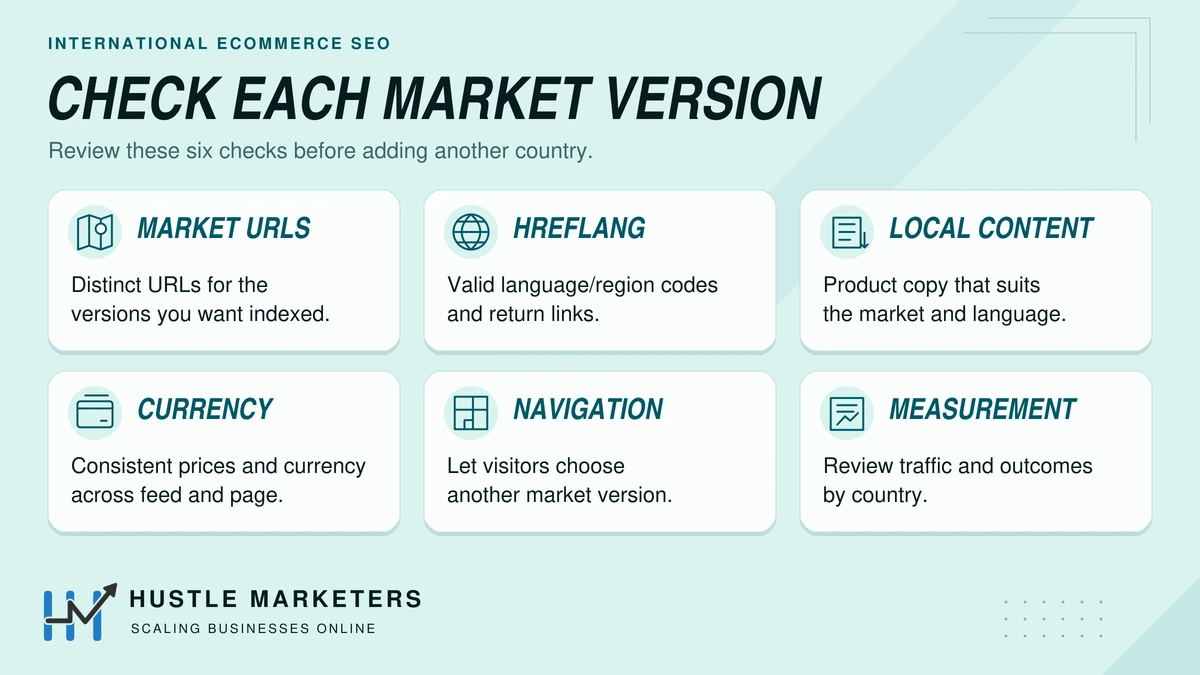
These come from Google’s documentation and from store owners on the Shopify Community:
- Every market on one URL. A New Zealand merchant reported valid product snippet items falling from about 70,000 to about 670 after enabling Markets with shared URLs and location-based currency. The cause was not confirmed.
- Generic English on a UK home market. A UK merchant found no en-GB tag in the hreflang set while only generic English was published, and Google showed wrong-country URLs.
- Using en-uk. UK is not a valid region code in hreflang. Use en-gb.
- One-way tags. Missing return links make Google ignore the pair.
- Redirecting by location. A UK store with /de, /fr and /es folders saw collection pages open in other languages from Google.
- Feed currency that does not match the page. A merchant selling to 20+ countries got an inconsistent currency warning, later fixed with a feed rule pointing each country to its market subfolder.
- Two domains competing for one country. A Shopify store saw its .com rank in Google.ca instead of its .ca. Both domains need the full hreflang set pointing to each other.
- Relying on Search Console country targeting. Google no longer supports it.
Our technical SEO checklist covers the crawl, canonical and indexing checks to run after launch.
How much does international SEO cost?
Hustle Marketers SEO starts from $500+ a month, scoped per store. A rollout across several countries, languages or platforms is usually a fuller strategist-led engagement, scoped and quoted separately after an audit.
For market context, an Ahrefs survey of 439 SEO providers found the most common monthly retainer was $501 to $1,000. Providers serving worldwide clients averaged $3,473.74 a month, against $1,557.08 for local-only providers. These are market figures, not our price, and the survey did not isolate international SEO.
Source: Ahrefs, SEO pricing survey (published December 2023, updated August 2024). Self-reported survey data.
| Cost driver | Why it changes the scope |
|---|---|
| Number of markets | Each needs hreflang, feeds, content and reporting |
| Languages | Translation and native review |
| URL structure | Country domains need their own links |
| Platform | Magento and BigCommerce may need hreflang added |
| Catalog size | More URLs to localize and validate |
| Merchant Center | Shipping and tax settings per country |
Australian readers can compare local pricing in our guide to how much SEO costs in Australia.
Planning a launch in the UK, Australia or New Zealand? Before you build anything, we check where your demand already is, which URL structure fits your platform, and what the first market will need. Get Free Audit Worth $500
How does Hustle Marketers approach international SEO for stores?
Hustle Marketers is an ecommerce SEO agency founded in 2020, based in Zirakpur, India, with a delivery team in India working for stores in the US, UK, Australia and New Zealand. Our process:
- Demand first: Search Console, GA4 and Merchant Center data by country before any build.
- Structure: subfolders by default, ccTLDs only with a clear local reason.
- Technical: hreflang validated on every template, one currency per URL, schema and sitemaps checked.
- Feeds: Merchant Center set up per country. We also run Google Ads, so feed and page stay aligned.
- Content and reporting: top categories localized first, results reported per market.
Most client work is under NDA. Two public case studies show single stores selling across borders, without a multi-country URL setup: an Australian pet brand shipping to Australia and New Zealand, and a Vancouver hobby store selling to Canada and the US. For one person to own the plan, see our ecommerce SEO consultant service.
FAQs
What is the difference between international SEO and multilingual SEO?
Multilingual SEO targets languages, such as French speakers anywhere. International SEO targets countries, which matters for stores because price, currency, shipping and tax change by country even when the language does not. A store selling to the US, UK and Australia needs international SEO without needing a second language.
Do I need hreflang if all my markets speak English?
Yes, if you have separate URLs for each country. Same-language versions are where Google most often shows the wrong page, because the copy looks alike. Hreflang with en-us, en-gb, en-au and en-nz tells Google which URL belongs to which country. If you run one URL for every country, hreflang has nothing to point to.
Is a subfolder or a ccTLD better for international SEO?
Google supports both. A ccTLD sends the clearest country signal but starts with no authority and costs more to run. A subfolder shares your main domain’s authority and is easier to maintain. Shopify recommends subfolders for most stores. Choose a ccTLD when you have a local entity, warehouse or established local brand.
Should I redirect visitors to their country version automatically?
Google advises against automatic redirects between language or country versions, because users and search engines may not reach every version. Googlebot usually crawls from the US. A better pattern is a banner suggesting the local version plus a visible country switcher. Shopify excludes known search engine crawlers from its automatic redirection.
Can I use one Google Merchant Center feed for several countries?
Yes, for countries that share a language. Merchant Center converts prices automatically, but you still need shipping set up for each country in the product’s currency. A different language needs its own data source. The landing page price must match the feed, and the page should not switch currency by location.
Can I still set a target country in Google Search Console?
No. Google deprecated the International Targeting report and no longer supports country targeting there. Google says it continues to use hreflang, and its multi-regional guide still lists a country code domain as a strong signal. Set targeting through URL structure, hreflang and local signals such as currency and addresses.
How long does international SEO take to work?
There is no fixed timeline. Hreflang is read page by page as Google recrawls, so large catalogs take longer to settle. In our experience, the first sign is the right country URL replacing the wrong one in Search Console, while category rankings in a new country build over months, depending on local links and competition.
What does an international SEO company do for an ecommerce store?
A good one checks demand by country before building, chooses a URL structure your platform supports, sets up and validates hreflang, fixes currency and shipping per URL, aligns Merchant Center by country, localizes key pages and reports results per market. Ask how they will measure each country separately.
How we created this guide
In October 2026 we read the pages ranking in US results for international SEO strategy, international ecommerce SEO and how to do international SEO. We checked every rule against primary sources: Google Search Central, Search Console Help, Merchant Center Help, Shopify Help Center, Adobe Experience League and BigCommerce documentation. Store problems come from public Shopify Community threads. Survey figures carry their source and date. Statements marked “our view” or “in our experience” are practitioner opinion from our store audits, not published rules.
Ready to rank your store in a new country?
Send us your store URL and target countries. We will check country demand, URL structure, hreflang, currency per URL and Merchant Center setup, and tell you what to fix first. Get Free Audit Worth $500