Google Ads for Manufacturers: What Works and What Wastes Budget

Ishant
Published : October 19, 2026 at 9:30 am
Updated : October 25, 2026 at 11:46 pm
Ishant
Summarize this article with:
Key Observations
- Manufacturing has a long sales cycle, and it needs to be measured, not just named. Google’s own limit is that an offline conversion uploaded more than 90 days after the last click will not be imported at all, so for a five month sales cycle the platform structurally cannot see the order.
- The newer path is tighter, not looser. Enhanced conversions for leads has a 63 day upload limit against 90 days for the older click ID method.
- Your positive keywords match variations you cannot switch off. Your negative keywords do not. Google documents both, and the gap between them is where industrial ad budget leaks.
- Three of the phrases this industry uses as keywords are homonyms. Industrial PPC mostly returns Noctua computer cooling fans. Manufacturing SEO returns East Asian company names. Manufacturer website means downloading laptop drivers.
- On the example category we checked in detail, a parts washer, autocomplete offered more distinct phrases for consumables and spares (solvent, pump, fluid, filter, detergent) than for the machine. That is a wider query set, not a measured volume, and that demand is usually nobody’s job.
- FAQ rich results stopped appearing in Google Search on May 7, 2026, so FAQ markup added to win the expandable question block is now inert.
- There is no way to opt in to AI Overviews and no special markup for it. Google says so in plain words. On the one query we checked, four of the five agencies the AI Overview named do not rank in the organic top nine on any of the four head terms we read, which tells you where to aim.
Table of Contents
- Why is manufacturing search different from consumer search?
- How do manufacturers get new customers today?
- Why do manufacturers say their Google Ads leads are poor quality?
- Can you use a part number as a keyword?
- Which manufacturing keywords are actually homonym traps?
- Does your spare parts demand have more query shapes than your machine?
- What if Google offers no suggestions for your product category?
- How do you measure a sale that closes four months after the click?
- Why is the search terms report emptier for an industrial account?
- Is Thomasnet worth it for suppliers?
- Does one page per part type work, or is it doorway abuse?
- Should your spec sheets be PDFs or HTML pages?
- Do you still need FAQ schema in 2026?
- How do manufacturers show up in AI Overviews and AI Mode?
- Which keywords should a manufacturer actually target?
- What we learned running Google Ads for a manufacturer under NDA
- Why choose Hustle Marketers or Ishant Sharma for manufacturing marketing
- What do manufacturers say agencies get wrong?
- Manufacturing SEO and Google Ads FAQs
- Where to go next
- About the author
Someone running lead generation ads posted this as a thread title on the Google Ads Help Community: “Very poor quality leads from my google ads, in fact people asking me for a job.”
That single line contains most of what makes marketing a manufacturing business different. The searches that look commercial are full of jobseekers, students and researchers. The buyer who finds you is often an engineer who cannot sign anything. The order arrives months after the click, by which time the ad platform has stopped counting.
This page is mostly about paid search, because that is where a manufacturer’s money leaks fastest and where almost nobody publishes the mechanics. It is written for the owner, plant manager or marketing lead at a manufacturer who is deciding whether to hire help, and what to ask for.
It also covers the organic side where it touches your ads, because your landing page, your spec sheets and your part pages decide what your clicks do. For the organic side on its own, our companion guide on manufacturing SEO covers keyword mapping to the buying committee, page types, link building and the ninety day plan. This page is the paid search and measurement half.
We collected the real questions manufacturers ask in public, and checked the Google Ads and Google Search mechanism claims against Google’s own documentation, linking each one. Where we could not verify something, we say so.
Why is manufacturing search different from consumer search?
The reason paid search behaves differently for a manufacturer is not difficulty. It is shape. A manufacturer’s demand is split across three query types that behave nothing like each other, and each one needs a different match type, a different landing page and a different conversion:
- Capability searches, such as custom metal fabrication near me. Low in number, high in value, and often local even though the buyer is a business.
- Part and specification searches, such as a part number, an alloy grade with a dimension, or a fitting size. Extremely specific, extremely low volume, and the highest intent queries you own.
- Aftermarket searches, such as a replacement pump or the correct solvent. On the one category we checked in detail, these produced a wider set of distinct phrases than the machine itself, and they are usually nobody’s responsibility.
Most industrial marketing advice treats the first group as the whole job. The second and third are where the margin is, and the second and third are also the two that broad match destroys.
How do manufacturers get new customers today?
Publicly, they mostly ask each other. On Practical Machinist, the recurring thread titles are “getting new customers”, “How to find customers?”, “where to find business leads”, “Where do you advertise?” and “For those that manufacture/sell your own products, what marketing is working these days?”
We could read those titles but not the replies. Practical Machinist returned a 403 on every thread we tried, so we cannot tell you what the answers said. The titles on their own are the finding: owners are asking their peers where to advertise, and one thread title is literally “Is a website a good idea for a jobshop?”
That uncertainty is the real starting condition. Our reading of it is not that manufacturers doubt marketing works, but that the last thing they tried did not produce a purchase order they could point at.
Why do manufacturers say their Google Ads leads are poor quality?
Lead quality was the second most common complaint we counted across everything we read, appearing thirteen times. Irrelevant search terms came third, appearing nine times.
There are three separate causes, and they need three separate fixes.
Jobseekers are filling in your quote form
The advertiser quoted at the top of this page was not exaggerating. Search demand around manufacturing is heavily mixed with employment intent, and it shows up in Google’s own autocomplete.
When we checked autocomplete for manufacturer marketing in September 2026, the eleven suggestions included manufacturing marketing jobs, manufacturing marketing jobs remote, manufacturing marketing manager and manufacturing marketing certificate. On the buyer side the same thing happens: sheet metal fabrication near me jobs appears in the suggestions for sheet metal fabrication near me.
The fix is a jobs negative keyword list applied at account level, not campaign level, and it needs to include the words your local market actually uses. Careers, hiring, apprentice, apprenticeship, machinist wanted, salary, pay, wage, resume, CV, vacancy, recruitment, staffing, temp, internship and jobs near me are the starting set. Add trade school and training if you also see course intent.
Your exact match keywords are triggering on things you did not choose
This is the third most common complaint we counted, appearing nine times. One thread is titled “My Google Ads exact match keywords are triggered by irrelevant search”. Another describes exact match keywords triggering irrelevant search terms after a recent update and calls it a budget wastage issue.
It is not a bug and it is not new. It is documented behavior. Google’s close variants page states:
Close variants allow keywords to match to searches that are similar, but not identical to the targeted keyword, and help you connect with people who are looking for your business—despite slight variations in the way they search—reducing the need to build out exhaustive keyword lists to reach these customers.
And then the sentence that matters:
By default, all keyword match types are eligible to match to close variants. There’s no way to opt out.
That is Google’s own wording, dashes and all, reproduced as published. Exact match does not mean the same characters. The keyword matching options page defines exact match as:
Ads may show on searches that have the same meaning or same intent as the keyword.
Meaning and intent, not string. All three current match type definitions on that page are written the same way. Once you accept that, the rest of the account design follows.
Your negative keywords do not work the way your positive keywords do
This is the part almost nobody tells manufacturers, and it is the specific mechanism that drains industrial budgets.
Google’s negative keywords page states:
Negative keywords don’t match to close variants, so your ad might still show on searches or pages that contain close variations of your negative keyword terms.
Read that against the close variants page. Your positive keyword matches misspellings, plurals and reworded versions automatically and you cannot stop it. Your negative keyword matches none of them.
So the exclusion you wrote once has to be written many times. If you are excluding a competitor’s brand, you need the misspellings. If you are excluding jobs, you need job, jobs, and the local variants. There is no automatic expansion working in your favor on the exclusion side.
The same page adds a limit worth knowing:
Your ad might still show when someone searches for a phrase that’s longer than 16 words, and your negative keyword follows that 16th word.
Long technical queries with a part number, a material, a tolerance and a quantity can pass sixteen words. A negative that sits past that point does nothing.
Can you use a part number as a keyword?
Someone asked exactly this on the Google Ads community, in a thread titled “Product number as the keyword”. It is the right question and the answer has a catch.
Yes, and part numbers are among the most valuable keywords a manufacturer owns, because a searcher typing a part number has already specified what they want. The catch is the close variants behavior above. Google’s close variants documentation puts words with closely related syntax, reordered words with the same meaning, adding or removing function words, implied words, synonyms and paraphrases, and same search intent all in scope for both exact and phrase match.
A part number is a string, and strings survive none of that reliably. So three practical rules:
- Use exact match for part numbers, and accept that you will still see variants in the search terms report. Review it weekly for the first month.
- Do not use broad match on anything containing a part number or a spec string. The looser the match type, the more the identifier is treated as a word rather than an identifier.
- Put part numbers in their own ad group with their own ad copy that repeats the number. Relevance is easier to hold when the landing page and the ad both contain the identifier.
The other half of the job is organic. A part number page that Google can only find by operating a JavaScript filter is a page Google generally will not discover. Google’s crawlable links documentation is explicit:
Generally, Google can only crawl your link if it’s an `<a>` HTML element (also known as anchor element) with an `href` attribute.
And on the orphan problem that every large industrial catalog has:
Every page you care about should have a link from at least one other page on your site.
Catalogs exported from an ERP system, meaning the software that runs your stock and production, routinely fail both tests. The parts exist as pages and nothing links to them.
Which manufacturing keywords are actually homonym traps?
This is the most avoidable money loss in the niche. Three of the phrases this industry treats as keywords mean something else to most searchers. All three are visible in Google’s autocomplete, which anyone can check.
Why does industrial PPC bring in computer fan shoppers?
Because Noctua makes a range of computer cooling fans called industrialPPC.
When we pulled autocomplete for industrial ppc in September 2026, ten of the twelve suggestions were computer cooling fans. Those ten were industrial ppc fan, industrial ppc 3000, industrial ppc noctua, industrial ppc 2000, industrialppc nf f12, nf a14 industrialppc, noctua nf-a14 industrialppc, noctua industrial ppc 3000, noctua industrial ppc 2000 and noctua industrial ppc fans. Only two suggestions had nothing to do with fans: industrial ppc company and ppc industrial engineering.
If you or your agency runs phrase or broad match on industrial ppc, you are bidding against PC builders. Add noctua, nf-a14, nf-f12, fan, fans, 3000 and 2000 as negatives, and prefer exact match. Two of those are bare numbers, so check them against your own part numbers before you add them.
Why does manufacturing SEO return company names from Asia?
Because the three letters seo appear inside a great many Asian place and company names, and Seo is also a common Korean surname.
Autocomplete for manufacturing seo returned twelve suggestions and seven of them had nothing to do with SEO: mfg seoul, seoulskin manufacturing company, seoul manufacturing, seojin manufacturing, mfg seongsu, seoyon manufacturing and wah seong manufacturing sdn bhd.
For industrial seo it was worse. Nine of the eleven suggestions were company and place names: seoul industrial, seoil industrial usa inc, seonghwa industrial co ltd, seoul industrial area, seongseo industrial complex, seoni industrial area, seojin industrial, seobo industrial co ltd and seokwang industrial co ltd. Not all of them are Korean. Wah Seong is Malaysian, Seoni is in Madhya Pradesh in India, and Seoil Industrial USA is US registered. Most are substring matches on Seoul, Seojin, Seoyon and Seongsu rather than on the surname.
This one matters mainly if you sell SEO services. It matters to manufacturers in one specific way: if your agency reports impressions on these terms as evidence of reach, the reach is not real.
Why is manufacturing website not a keyword you want?
Because to most people manufacturer website means the site where you download drivers for your laptop.
Autocomplete for the seed manufacturing website begins with manufacturing website templates and then becomes manufacturer’s website for hp, manufacturer’s website windows 11, manufacturer website download drivers and manufacturer website lenovo.
Two phrases Google offers no suggestions for
Two phrases we tested returned zero autocomplete suggestions: b2b manufacturing seo and industrial distributor seo.
Zero suggestions is not a volume measurement. It is a strong signal that the phrasing is not one searchers use. Pull volumes before you build a page on either.
Autocomplete shows the shape and order of demand, not the volume. We are not quoting volume figures here because we did not pull any.
Does your spare parts demand have more query shapes than your machine?
On the one category we checked in detail, yes, and this is where a machine builder leaves recurring revenue on the table.
Take an industrial parts washer as an example category. Autocomplete for the machine itself leads with industrial parts washer for sale, and country modifiers are interleaved through the rest of the list: uk, canada, nz, south africa, australia.
Now look at the consumables. Autocomplete for parts washer returns machine, solvent, pump, fluid, brush, cabinet, for sale and pump replacement, among others. For aqueous parts washer the ten suggestions are solution, solvent, for sale, detergent, fluid, pump, service, soap, a specific model code and filter.
That is a wider and more repeatable set of query shapes than the machine has, and the buyer already owns your equipment or a competitor’s. It is a count of distinct phrases Google offered, not a measured search volume. Three things follow:
- The consumables and spares pages usually do not exist, or exist as a PDF price list. They should be indexable pages with the part fitment stated in text.
- A service and replacement parts page is a conversion asset, not a support page, because the decision behind the click is small enough to make on the spot. We have no benchmark figure to quote you for it.
- The same autocomplete shows the low budget end of the market: parts washer harbor freight and parts washer supercheap. Those are consumer DIY searches. If you sell industrial equipment, they are negatives.
The country modifiers matter too. Most of the industrial equipment seeds we tested volunteered uk, canada, australia, nz, south africa, uae, india or singapore, though four of the eleven returned no country modifier at all. If you cannot ship or service in those markets, you are paying for traffic that cannot convert. Google’s location targeting has presence and presence or interest options, and presence or interest is the default. Check which you are on.
Does a product feed matter if you are a manufacturer?
If you sell spares and consumables online, yes, and not only for ads.
A Google Merchant Center feed powers paid Shopping ads. The same feed also powers free listings, and Google’s free listings documentation states:
With a free listing, the products you sell can appear at no cost on Google Search, Google Maps, Gemini, YouTube, the Shopping tab, Google Images, and Google Lens.
The same page describes what free listings do in these terms:
Free listings generate organic traffic, support both online and local in-store sales, and maximize your catalog’s reach across Google Search, Shopping, Maps and more alongside any existing paid ad campaigns.
That is the part manufacturers usually miss. The feed is an organic asset as well as a paid one, and Google’s own word for the traffic it produces is organic.
The attributes that matter are the ones that break most feeds. Titles that carry the part number and the fitment rather than a marketing phrase. An MPN, which is the manufacturer part number, on every item. An availability value that matches your actual stock. If you are building one, our notes on the Google product data specification cover the attribute level detail, and if you have a feed approved but no free traffic from it, no free listing impressions covers the usual causes.
None of this applies to the capital machine. Nobody buys a parts washer from a Shopping listing. It applies to everything you sell after the machine, which is the part of the business that repeats. If that side of the catalog is genuinely a store rather than a price list, B2B ecommerce SEO is the relevant discipline for it rather than industrial lead generation.
What if Google offers no suggestions for your product category?
This is a real condition, not an excuse, and it changes the whole plan.
We manage Google Ads for Lynx System Developers, who make FinishLynx photo finish and sports timing systems. When we checked autocomplete for photo finish timing system, it returned two suggestions and both were about race results, not about buying a system. That is not a volume measurement, but it is a strong signal that nobody shops using that phrase.
The category demand sits elsewhere. The seed sports timing equipment returned race timing equipment, athletics timing equipment, sports timing equipment rental, sports timing systems and six more. Those are the phrases buyers use.
Low search volume was the seventh most common complaint across everything we read, appearing five times, usually phrased as a hunt for low competition keywords rather than as pages failing to rank.
When your exact product phrase has no demand, three things work better than pushing it:
- Target the category phrase the buyer actually uses, not the phrase your industry uses. Race timing equipment, not photo finish timing system.
- Target the job to be done. A school athletics director does not search for your technology, they search for the outcome they need at their meet.
- Accept that paid search will be small and put the effort into the queries adjacent to the purchase. Rental is one of them, and autocomplete shows it is live. We have no autocomplete evidence for used equipment in this category, so treat that as a hypothesis to test rather than a plan.
There is a genuine disagreement in the SEO community about whether chasing very low volume exact phrases still works at all. We found a WebmasterWorld thread from April 2016 with nine participants arguing both sides of it. We are not going to pretend that is settled. What is not in dispute is that a phrase with no autocomplete data and no impressions is not a strategy.
How do you measure a sale that closes four months after the click?
Most manufacturers know their sales cycle is long. The harder part is measuring it.
The answer starts with a hard limit that most people do not know exists.
The 90 day import ceiling
Google’s guidelines for importing offline conversions state:
Offline conversions that were uploaded more than 90 days after the associated last click won’t be imported into Google Ads and, therefore, won’t show up in your conversion statistics.
Read that as an engineer would. If your click to purchase order lag is five months, the order cannot be imported. Not delayed, not attributed weakly. Not imported.
The same ceiling appears on the reporting side. Google’s conversion windows page states:
You can set the conversion window anywhere from 1 to 90 days, depending on the source of conversions.
So both walls sit in the same place. Ninety days is the maximum lookback and ninety days is the maximum import age.
The newer method is tighter, not looser
This is the part that surprises people. The same guidelines page states:
Offline conversions for enhanced conversion leads that were uploaded more than 63 days after the associated last click won’t be imported into Google Ads.
Enhanced conversions for leads is the newer route, and it matches on hashed customer data you already hold rather than on a click ID your CRM had to capture and store. Its window is 63 days, which is 27 days shorter than the older click ID route.
If your sales cycle runs past two months, that difference decides which method you can use at all.
What to do instead
You cannot extend Google’s window. So you stop trying to import the order and start importing something earlier that predicts the order.
The practical sequence, and this is the part that takes work rather than cleverness:
- Pick the earliest event that a real buyer does and a casual browser does not. In capital equipment that is usually a specification request, a drawing upload, a configurator completion or a scheduled call, not a contact form fill.
- Assign it a value from your own closed business. If one in six specification requests becomes an order and your average order is a known figure, the specification request has a value. That number is yours, not an industry benchmark.
- Import that event, inside the window, and let bidding optimize toward it.
- Report the order separately, in your CRM, against the month the lead arrived. This is the report the owner actually wants and it does not live in Google Ads.
Anyone promising to tie your six month pipeline back to the click inside Google Ads is promising something Google’s documented limits do not allow. That is a useful question to ask a prospective agency.
Why is the search terms report emptier for an industrial account?
Because your queries are too rare to be shown, and Google says so.
The search terms report documentation states:
In the report, you’ll find data on the search terms that were used by a significant number of people and have triggered impressions and clicks.
And:
Some search terms that don’t have enough query activity are omitted from the search terms report in order to keep with our standards on data privacy.
And:
Search terms insights account for these low volume queries by grouping them into their relevant subthemes where applicable, or aggregating them as ‘other queries’, without exposing the queries themselves.
Now apply that to a manufacturer. Your highest intent queries are a specific alloy grade with a dimension, or a part number with a quantity. Those are low volume by definition. Which means the terms most worth seeing are the ones most likely to be withheld.
The consequence is structural, not a settings problem. Our reading is that an industrial account is blinder in its search terms report than a consumer account with the same spend. It changes how you work:
- Lean harder on exact match, because you cannot audit what you cannot see.
- Use the search terms insights subthemes, which is where that hidden traffic surfaces in aggregate.
- Treat your own CRM notes on what buyers said they searched for as a data source, because it is one of the few you have.
Is Thomasnet worth it for suppliers?
This was the loudest and most consistent complaint in everything we read. We counted it ten times in sources we rated medium confidence or better, and eighteen times if a cluster of reviews we could not establish as independent is included. It also has a People Also Ask block of its own, where three of the four questions are Is Thomas Net reliable, How much does Thomas Net cost and Who bought ThomasNet.
Two of the three pages that discuss industrial directories are Thomasnet itself.
Here is what we can say honestly.
The buyer and supplier experiences are different
The pattern across review sites is consistent, though not unanimous. Buyers who use the platform free tend to rate it highly. Suppliers who pay for listings tend to rate it poorly. The aggregate across seventy six reviews on one site sat at 3.2 out of 5, and at least one paying supplier left a five star review. Our reading is that this is not a contradiction but a description of what the product is: a buyer side database that monetizes supplier visibility.
What we can and cannot tell you about cost
We found one named, dated supplier review reporting a listing cost of over 250 dollars a month with a one year lock in. Another named reviewer reported discovering after signing that the term was eighteen months, not twelve.
We also found a cluster of complaints with much larger figures that we are not going to repeat, because they were posted in a tight burst with a uniform handle format and we could not establish they were independent. If a number cannot be attributed to a named, dated source, it does not belong in a decision.
How to decide
Treat a directory listing as paid media, not as SEO. That means:
- Ask for the inquiry count for your specific category in your region, not platform wide traffic figures.
- Read the term length in the contract before the price.
- Run it for one full term with the inquiries tracked in your CRM under their own source, then judge it on purchase orders, not on leads.
- Do not let a directory listing substitute for your own indexable pages. You are renting position on someone else’s domain.
Does one page per part type work, or is it doorway abuse?
A common industrial SEO pitch is to generate hundreds of near identical pages, one per part type, size or city. Google’s spam policies address this directly. The relevant section is headed Doorway abuse, not doorway pages, so quote it accurately if you are challenging a proposal.
From Google’s spam policies:
Doorway abuse is when sites or pages are created to rank for specific, similar search queries. They lead users to intermediate pages that aren’t as useful as the final destination.
Two of the four examples listed on that page describe the industrial version of this almost exactly:
Having multiple domain names or pages targeted at specific regions or cities that funnel users to one page
Creating substantially similar pages that are closer to search results than a clearly defined, browseable hierarchy
The line is not page count. A large catalog with a real page per real part, each with its own specifications, fitment and stock position, is a browseable hierarchy. Three hundred pages spun from one template with the size swapped and a shared contact form is the fourth bullet.
Our reading of the distinction is that usefulness at the destination is what separates them, and Google’s wording supports that reading. It is a judgment call, which is exactly why a proposal to generate hundreds of pages deserves a question about what will be on each one.
Should your spec sheets be PDFs or HTML pages?
Both, with the HTML version doing the ranking.
PDFs are indexable. Google’s indexable file types documentation lists Adobe Portable Document Format among the encoded formats it can index, and states:
Google can index the content of most text-based files and certain encoded document formats.
On how PDFs behave in search, the most detailed published answer we could find is a Google Search Central blog post from September 2011 by Gary Illyes. It is fifteen years old and we could find nothing newer that is dedicated to the subject, so read it with the date in mind. Asked whether PDF files can rank highly, the answer was:
Sure! They’ll generally rank similarly to other webpages.
The most useful line in that post for a manufacturer auditing a folder of datasheets is the test for whether a PDF is indexable at all:
The general rule of the thumb is that if you can copy and paste the text from a PDF document into a standard text document, we should be able to index that text.
Scanned datasheets frequently fail that test. If you cannot select the text, Google may be able to run OCR on it, but you should not depend on that for the specifications that drive your inquiries.
Three more things from that post that change how industrial sites should handle datasheets:
- In 2011 Google said images inside a PDF were not indexed. We could find no newer statement, so treat a dimensional drawing that exists only inside the PDF as invisible until you can prove otherwise.
- Links inside a PDF can pass PageRank and other indexing signals, and Google said it may follow them once it has crawled the PDF. The same post said nofollow could not be applied inside a PDF.
- If the same content exists as both an HTML page and a PDF, Google’s recommendation was to serve a single copy where possible. Failing that, indicate the preferred version either by including the preferred URL in your sitemap, or by specifying the canonical version in the HTML or in the HTTP headers of the PDF. A canonical is a tag that tells Google which URL is the one you want indexed.
Here is the practical build. Put the specification table in HTML on the product page. Keep the PDF as the downloadable artifact for the buyer’s own file. Canonical the PDF to the HTML page. The specification text then sits on a page whose title and internal links you control.
Client example: Google Ads for an industrial equipment supplier
- Client: an Australian commercial cleaning equipment supplier. This is the closest comparable account we can publish: a B2B equipment business rather than a manufacturer.
- Comparison: 18 May to 15 August 2026 against 17 February to 17 May 2026, from the Google Ads dashboard.
- Result: conversions rose from 29 to 154 and cost per conversion fell from A$109.64 to A$29.69, while ad spend rose from about A$3,180 to A$4,570.
One account over 90 days. Full breakdown: commercial cleaning equipment Google Ads case study.
Do you still need FAQ schema in 2026?
Not for the expandable question block in the search result. Google has retired that appearance.
Google’s Search Central documentation updates log records the change in two entries. On May 8, 2026 Google added a deprecation notice to the FAQ rich result documentation:
This feature will no longer appear in Google Search starting May 7, 2026.
On June 15, 2026 Google removed the FAQ rich result documentation altogether. Both dates have passed, so this is not a future change.
So if an agency proposal includes adding FAQ schema to win rich results, that deliverable no longer produces the outcome it names. Keep the FAQ content, because buyers read it and it answers real questions. Drop the expectation of any visual result from the markup. Star ratings, for the avoidance of doubt, never came from FAQ markup. Those come from review snippets, which are a different feature and are not affected by this change.
These next few sections cover the organic side, and they are here because they change what your paid clicks land on. For the organic program on its own, that is in manufacturing SEO.
Four structured data types remain worth the effort for a manufacturer. Organization, for your company details. Product, where you genuinely sell a product. LocalBusiness, if you have a plant or branch a buyer can visit. And BreadcrumbList for a deep catalog, which describes the path from your home page down to the part.
How do manufacturers show up in AI Overviews and AI Mode?
There is no opt in, and there is no special file or markup. Google states this plainly on its AI features documentation:
There are no additional requirements to appear in AI Overviews or AI Mode, nor other special optimizations necessary.
And:
You don’t need to create new machine readable files, AI text files, or markup to appear in these features.
That sentence retires a whole category of upsell. If someone is selling you an AI specific file or an AI schema package, Google has published that it is not required.
The same page describes how these features assemble an answer:
Both AI Overviews and AI Mode may use a ‘query fan-out’ technique
The rest of that sentence describes the technique as issuing multiple related searches across subtopics and data sources in order to develop a response. We have shortened the quotation because the plain text version of Google’s page renders its dashes as hyphens, and cutting the quote is safer than retyping its punctuation.
Our reading of that is why depth on subtopics matters. If several related searches are being issued, a page that answers one question is a candidate for one of them, and a page that answers the whole cluster of questions a buyer has is a candidate for several. Google does not state that consequence, so treat it as our inference from the mechanism it does state.
The only documented controls are snippet directives
If you want to keep content out, the documented levers are in the robots meta tag documentation. For nosnippet:
Do not show a text snippet or video preview in the search results for this page. A static image thumbnail (if available) may still be visible, when it results in a better user experience. This applies to all forms of search results (at Google: web search, Google Images, Discover, AI Overviews, AI Mode) and will also prevent the content from being used as a direct input for AI Overviews and AI Mode.
Two cautions. The documented effect is on use as a direct input, which is narrower than not being used by AI at all. And nosnippet also removes your ordinary search snippet, so it is not an AI only opt out. There is no documented way to make it one.
The surgical option is data-nosnippet, an attribute you add to a single block of the page rather than to the whole page. Google describes it as working at element level on span, div and section elements. That is how you fence off a pricing table while leaving the rest of the page snippetable.
Why ranking your own page does not get you named
This is the finding worth acting on, and it took a live check rather than a document.
When we read the AI Overview for best seo agency for manufacturers in September 2026, it named five agencies: First Page Sage, Ecreative Works, Windmill Strategy, TREW Marketing and WebFX. Four of those five do not appear anywhere in the organic top nine on any of the four head terms we checked. The fifth, Windmill Strategy, appears at position six on a single term.
The eleven domains the AI Overview cited included third party lists and directories, among them a page titled The 21 Best SEO Agencies for Manufacturing Companies and a Clutch rankings page dated September 24, 2026. The rest were agency sites, three of which also rank organically on these terms.
So for a query of this shape, Google’s AI is assembling its answer from lists other people wrote, not from the agency pages that rank. The same logic applies to your category. If you make industrial ovens, the action is not only to rank your own page. It is to be present, accurately, in the roundups, directories and comparison pages that get cited, with your specifications and capabilities stated in text.
Which keywords should a manufacturer actually target?
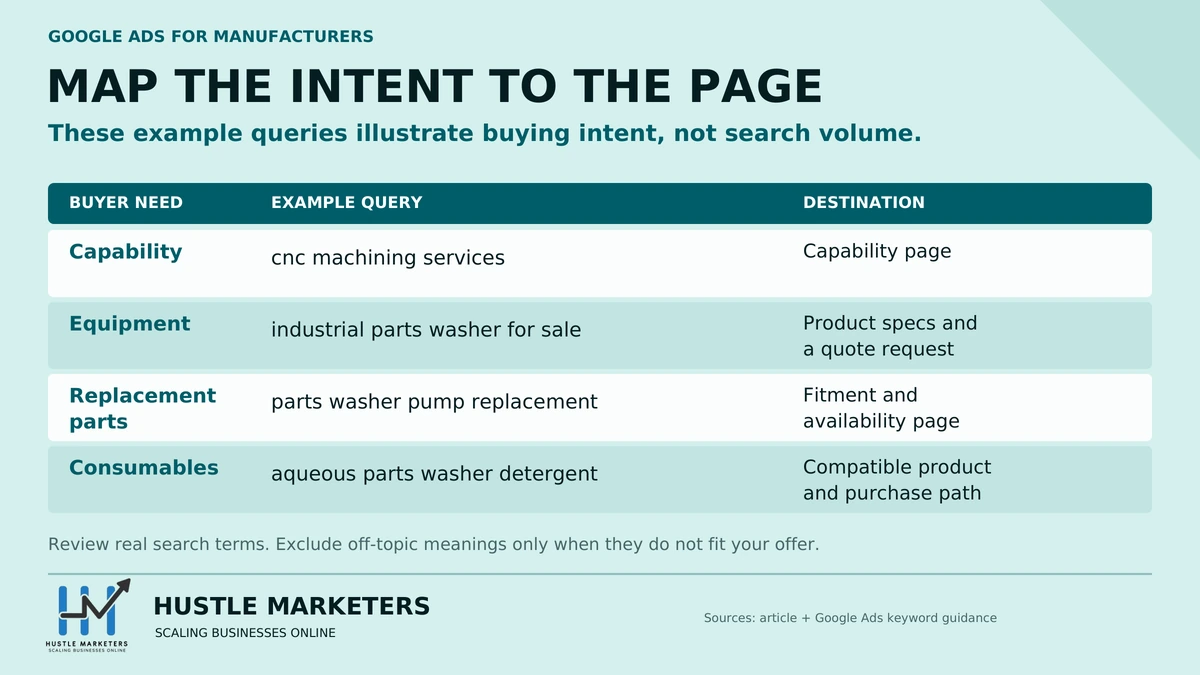
These are keywords for the manufacturing business, not keywords for finding a marketing agency. The pattern column is what matters, because you should substitute your own product, process and region.
The examples below are strings Google autocomplete returned to us in September 2026, and the patterns are ours. Autocomplete shows order and shape, not volume. Pull your own volumes before committing budget.
| Keyword pattern | Example | Intent | Where it belongs | Match type for Ads |
|---|---|---|---|---|
| [process] services | cnc machining services | Commercial | Capability page | Phrase |
| custom [process] near me | custom metal fabrication near me | Local commercial | Location or capability page | Phrase |
| [process] near me within X mi | sheet metal fabrication near me within 20 mi | Local commercial | Location page | Phrase |
| [product] for sale | industrial parts washer for sale | Transactional | Product page | Exact and phrase |
| [product] [country] | industrial parts washer canada | Transactional, geo | Product page, geo targeted | Exact |
| [machine] [consumable] | parts washer solvent | Aftermarket transactional | Consumables page | Exact and phrase |
| [machine] [spare part] | parts washer pump replacement | Aftermarket transactional | Spare parts page | Exact and phrase |
| [chemistry] [consumable] | aqueous parts washer detergent | Aftermarket transactional | Consumables page | Exact |
| [part number] | your own SKU | Highest intent | Part page | Exact only |
| [category] equipment | race timing equipment | Commercial, category level | Category page | Phrase |
| [category] equipment rental | sports timing equipment rental | Commercial, alternative model | Rental page | Phrase |
| [product] manufacturer | conveyor belt manufacturer | Commercial | Home or capability page | Phrase |
| [product] manufacturers near me | conveyor belt manufacturers, conveyor belt manufacturers near me | Local commercial | Location page | Phrase |
| [process] shops near me | custom metal fabrication shops near me | Local commercial | Location page | Phrase |
| [material] [process] | sheet metal working near me | Commercial | Capability page | Phrase |
And the negative keyword list this niche needs. The themes are drawn from what we observed in autocomplete and in public threads, and the Why column names the observed evidence. The individual terms inside each theme are our standard list for that theme, not a transcript of observed queries.
| Negative theme | Terms to add | Why | Risk |
|---|---|---|---|
| Jobs and careers | jobs, job, careers, hiring, salary, pay, wage, resume, cv, vacancy, apprentice, apprenticeship, machinist wanted, recruitment, staffing, internship | Observed: jobs appears in autocomplete for manufacturer marketing and for sheet metal fabrication near me, and an advertiser reported jobseekers filling their form | Low. Check you do not run recruitment ads in the same account |
| Market research | market size, market share, market report, market growth, market price, market forecast, industry report, statistics | Autocomplete for machine shop marketing is dominated by market size, share, price, report and growth queries, and metal fabrication marketing carries market size too | Low |
| Courses and study | course, courses, certificate, certification, training, tutorial, pdf download, syllabus, student | Observed: certificate appears in autocomplete for manufacturer marketing | Medium. Exclude carefully if you also sell training to customers |
| Computer fans | noctua, nf-a14, nf-f12, fan, fans, 3000, 2000, case fan, cooling | Ten of twelve autocomplete suggestions for industrial ppc are computer cooling fans, most of them Noctua industrialPPC models | Low unless you make fans. Check the bare numbers against your own part numbers first |
| Driver downloads | driver, drivers, download, windows 11, hp, lenovo, dell, firmware, update | Autocomplete for the seed manufacturing website is dominated by driver download intent | Low |
| Consumer DIY and low budget | harbor freight, supercheap, homemade, diy, how to build, cheap, second hand, ebay, amazon | Observed: autocomplete for parts washer includes harbor freight and supercheap | Medium. Do not exclude used or refurbished if you sell refurbished units |
| Definitions and homework | what is, meaning, definition, examples, example of, wikipedia, ppt, assignment | Definitional intent sits inside contract manufacturing autocomplete (meaning, examples) alongside company and agreement queries | Low |
| Unservable geographies | the country and city names you cannot ship or service to | Most of the industrial equipment seeds we tested volunteered uk, canada, nz, australia, south africa, uae, india or singapore | High if you do export. Audit before adding |
One warning on that last row. Negatives do not match close variants, so a country name added as a negative will not catch its misspellings or its abbreviation. Location exclusions in campaign settings are the reliable tool for geography. Use negatives only for the country named inside the query text.
What we learned running Google Ads for a manufacturer under NDA
We run Google Ads for a US industrial equipment manufacturer under a signed NDA, so we do not name the client or its products here. The method is the part that transfers anyway.
We ran paid search first, deliberately, to find out which keywords produced real inquiries. Then we selected the SEO targets from that evidence rather than from a keyword tool alone. The paid campaigns stayed live afterwards, including a Performance Max campaign alongside search. Performance Max is Google’s automated campaign type that runs across all its placements from one set of assets. Keeping it live means the demand stays covered while the organic pages are built.
The reason to work in that order, in this niche specifically, is that industrial keyword volumes are small and the tools disagree with each other at the bottom of the range. A tool will tell you a phrase has a handful of searches a month. It will not tell you whether those people are buyers, students or competitors. Two months of ad spend will.
For the SEO target selection we used keyword difficulty as the filter rather than volume alone, preferring lower difficulty terms we could realistically reach, weighted by what the ad data showed was converting. Keyword difficulty is a tool score for how hard a term looks to rank for. That is a boring answer and it is the right one for a manufacturer with a real budget and a site with little accumulated link equity.
What we are not going to do on this page is publish performance figures for that account. An invented number is worse than none. What we can tell you is the method, and the method is the transferable part.
Why choose Hustle Marketers or Ishant Sharma for manufacturing marketing
Ishant Sharma has worked in Google Ads, Microsoft Ads and SEO since 2013. Hustle Marketers runs paid search and SEO for manufacturers and industrial businesses, including Lynx System Developers, who make FinishLynx photo finish and sports timing systems, and an industrial equipment manufacturer under a signed NDA. We also run white label PPC for other agencies whose clients are in this space.
What that means in practice, against the specific problems on this page:
- We work in accounts where the sales cycle outruns Google’s ninety day import window, so the measurement plan is designed around it rather than discovered later.
- We run the campaign types this niche actually needs, including Performance Max alongside search rather than instead of it, and we say which one a lead came from.
- We build the first negative keyword list from autocomplete before the campaign runs, then from the search terms report in week one, rather than after the first month of waste.
- We use paid data to choose the organic targets, which is the sequence described above.
- We will tell you when a product category does not look like it has enough search demand to justify the plan you were sold. FinishLynx is an example of a category where Google offers no buying suggestions at all for the obvious phrase.
- We will not quote you a statistic we cannot attribute.
If you want to see the way we write up work in other sectors, the remodeling contractor SEO case study and the BPO SEO case study are both published with the client named and the claims attributed to the client. The supporting guides behind them, SEO for remodeling contractors and SEO for BPO and outsourcing companies, are written the same way this page is.
For the service pages, B2B SEO and B2B paid search cover how the engagements are structured, and PPC management covers the paid side. If the problem is that inquiries arrive and do not convert, conversion rate optimization is the relevant service rather than more traffic. Agencies who want this delivered under their own brand should read white label digital marketing.
What do manufacturers say agencies get wrong?
Four of these came from named reviewers and from public threads. We are reporting what was said, not endorsing every claim.
- Bundling a website redesign with SEO, where the redesign breaks the inquiry flow that was already working. One named, dated reviewer described inquiries dropping after a bundled redesign.
- Sending leads that have nothing to do with what the client makes. This is the lead quality complaint, and it appeared thirteen times.
- Contract terms the client did not understand. One named reviewer reported finding out after signing that the term was eighteen months, not twelve.
- Mis-categorizing the business, so the buyers who would have bought never see it.
Two more belong on the list and we are labeling them differently, because no manufacturer said them to us in anything we could read. These two are our inference from the pattern of thread titles and from practitioner forums, not quotes.
- Applying a generic playbook with volume thresholds that industrial terms cannot meet, then reporting that the keywords are too small. The evidence here is indirect: it comes from SEO practitioner forums discussing low competition keywords, not from a manufacturer.
- Being unable to measure what matters, because the sales cycle outruns the attribution window. This is the ninety day problem arriving as a client complaint. We inferred it from the shape of the questions advertisers ask publicly. We did not find a manufacturer stating it, so treat it as our reading rather than a sourced quote.
The useful thing about that list is that every item is a question you can ask before you sign. What happens to my current inquiry flow. How will you define a qualified lead for my products. What is the term. Which of my processes will you build pages for. What will you import as a conversion, and inside what window.
Manufacturing SEO and Google Ads FAQs
Is PPC better than SEO for a manufacturer?
For most manufacturers, paid search answers a different question than SEO does. Paid search tells you within weeks which queries produce real inquiries, which is valuable in a niche where volumes are small and tools disagree. SEO compounds and does not stop when the budget does. In the account described above we ran paid first specifically to buy that information, then used it to pick the organic targets. Treating it as an either or usually means guessing at the organic plan.
How much does a manufacturing SEO agency cost?
That range tells you almost nothing, because the work behind it varies enormously. A more useful approach is to ask what is being delivered per month in pages, technical fixes and reporting, and what the term is.
Can a part number rank in Google?
Yes, if there is a crawlable page for it. Google’s documentation says it can generally only crawl a link that is an anchor element with an href attribute, and that every page you care about should have a link from at least one other page on your site. Part pages generated behind a JavaScript filter typically fail both tests.
Do PDFs rank in Google?
Google’s published answer, from a 2011 Search Central post, is that PDFs generally rank similarly to other webpages. The practical test for whether yours can be indexed at all is whether you can copy and paste the text out of it. If you cannot, it is likely an image and you should not rely on it for the specifications that drive inquiries.
Should I still add FAQ schema?
Not to win a rich result. Google’s documentation states that as of May 7, 2026 FAQ rich results are no longer appearing in Google Search. Keep the FAQ content for buyers. Do not pay for the markup on the promise of stars.
How do I get my company mentioned in AI Overviews?
There is no opt in and no special markup. Google states that there are no additional requirements to appear in AI Overviews or AI Mode, and that you do not need to create machine readable files, AI text files or markup. What we observed on one live query is that the AI Overview named agencies that mostly do not rank organically, and cited third party lists and directories. Being accurately present in the roundups and directories for your category is the actionable part.
Why do my exact match keywords show for irrelevant searches?
Because exact match is defined by meaning, not by characters, and close variants cannot be switched off. Google’s documentation states that by default all keyword match types are eligible to match to close variants and that there is no way to opt out.
Why do my negative keywords not stop it?
Because negatives behave differently from positives. Google’s documentation states that negative keywords do not match to close variants, so your ad might still show on searches containing close variations of your negative terms. You have to enumerate the variants yourself.
Is Thomasnet worth paying for?
It was the loudest complaint in everything we read. We counted it ten times in sources we rated medium confidence or better, and eighteen times including a cluster we could not establish as independent. The pattern is that free buyers tend to rate it well and paying suppliers tend to rate it poorly. Treat it as paid media. Ask for inquiry counts in your category and region, read the term length before the price, and judge it on purchase orders after one full term.
Google offers no suggestions for my product category. What now?
Target the phrase the buyer uses rather than the phrase your industry uses, target the outcome they need rather than your technology, and look at adjacent demand such as rental. When we checked autocomplete for photo finish timing system it returned two suggestions, neither about buying one. Race timing equipment and athletics timing equipment were both offered under the seed sports timing equipment, which is where that category’s demand sits.
Where to go next
If the paid side is the immediate problem, the sections above on the ninety day window, match types and negatives are the ones to act on first. If the problem is that you have no organic presence at all for your capabilities and part numbers, start with manufacturing SEO instead, then come back to the measurement plan here.
About the author
This page was researched and written by Ishant Sharma, founder of Hustle Marketers, who has worked in Google Ads, Microsoft Ads and SEO since 2013 and runs the manufacturing accounts named on this page. If something here is wrong, it is worth telling us, and we will correct the page rather than leave it.
Sources and how we researched this
Google documentation, read directly. Offline conversion import guidelines, conversion windows, keyword matching options, close variants, negative keywords, the search terms report, spam policies, indexable file types, crawlable links, FAQPage structured data, AI features and the robots meta tag. Every quotation on this page was re-checked against the source page before publishing, and three quotations recorded during research were corrected because they had been truncated or misworded.
Google Search Central blog, September 2011, PDFs in Google search results, by Gary Illyes. Used with its date stated because we could find no newer dedicated Google source on PDFs in Search.
Live search results, read in a browser in September 2026 rather than through a search tool, because the two return different sets. People Also Ask blocks, autocomplete and one AI Overview were read this way.
Public discussions. Practical Machinist, the Google Ads Help Community, the Google Search Central Help Community, WebmasterWorld, Warrior Forum, BlackHatWorld, Eng-Tips and supplier review sites. Seventy seven distinct question phrasings were collected.
The largest limitation on this page sits here, so it is stated plainly. For Practical Machinist and the two Google Help Communities we could read thread titles but not a single reply. Practical Machinist returned a 403 on every thread and the two Google communities render their replies in JavaScript that did not load. That accounts for sixty five of the seventy seven phrasings. Nothing on this page describes what the answers in those threads said. WebmasterWorld, Warrior Forum, BlackHatWorld, Eng-Tips and the review sites were read in full.
Reddit could not be reached at all in this research, which is a real gap, because Reddit is one of the places shop owners talk to each other.
What we did not do. We did not pull search volume, keyword difficulty or cost per click figures for this page, so no sourced volume or CPC number appears on it. The one number used for illustration, a handful of searches a month, is hypothetical. Autocomplete shows the order and shape of demand, not its size. We found no primary government or trade association data on how industrial buyers search. We checked the US Census annual manufacturing survey, NIST MEP and the National Association of Manufacturers. The NAM 2026 survey is genuinely primary, but it asks manufacturers about costs and outlook rather than about buyer search behavior.
One statistic we deliberately left out. A widely repeated figure about what industrial buyers care about could not be traced to a source that stands up. The one place we found it, it was attached to a different subject entirely, was internally inconsistent, and conflicted with the same publisher’s own earlier press release. It is not on this page.