Best Local SEO Companies in 2026: Who the Lists Actually Agree On, and How to Vet Them

Ishant
Published : October 20, 2026 at 10:30 am
Updated : October 3, 2026 at 5:33 pm
Ishant

Hustle Marketers publishes this page and appears on it. We say that in the first line because every agency list we read did the same, and almost none of them said so. This page does not rank the best local SEO companies from one to fifteen. No company paid to appear, and no company wrote its own entry.
What follows comes from reading the 15 pages that rank for this query. We counted every company name on them, then held each page against eight questions a local buyer has to answer before signing.
Key Observations
- Eight of eight agency lists include the publisher. Seven place themselves first. One says so plainly.
- 162 distinct companies appear across 14 lists. Only Victorious is named by a majority. 126 are named by exactly one list.
- Thirteen of the fifteen pages sell local SEO without naming the local pack. None publishes a local metric. None names a schema type.
- Seven of eight local buyer topics we checked have zero coverage across all fifteen pages, including who owns the profile when the contract ends.
- One page of fifteen publishes per-location pricing, the model that decides what a multi-location buyer really pays.
- No page answers the most expensive question in local SEO: who pays when an agency’s own work gets a profile suspended.
Who are the best local SEO companies in 2026?
No single company is best for every local business. Across 14 published lists, only Victorious is named by more than half. The eight firms named five or more times are the closest thing to a consensus. Fit, published pricing and profile access matter more than list position.
The table shows every company on five or more of the 14 lists, plus the next tier at four. It adds Sterling Sky, the only genuine local search specialist named anywhere, and our own row. Counts are floor values, because four directory pages truncated on fetch.
| Company | Best for | Named on how many of 14 lists | Published price or minimum | Source read |
|---|---|---|---|---|
| Victorious | Large organic budgets | 8 | $50,000+ minimum, $300+/hr | Clutch |
| Funnel Boost Media | Home services rosters name it most | 6 | $50-$99/hr, $1,000+ minimum | Clutch |
| Ignite Visibility | Franchise and multi-location | 6 | $100-$149/hr, $1,000+ minimum | Clutch |
| Searchbloom | Mid-market retainers | 6 | $3,000/month minimum | SeoProfy |
| SmartSites | Widest directory footprint | 6 | $100/hr | DesignRush |
| WebFX | Buyers wanting a per-location price | 6 | 1 location $575; with content $1,325+ | SeoProfy |
| Straight North | A published starting band | 5 | $2,500 to $5,000 | Semrush |
| Thrive Internet Marketing Agency | Home services, month to month terms | 5 | $1,000 minimum | SeoProfy |
| Coalition Technologies | Lower hourly band | 4 | $50-$99/hr, $1,000+ minimum | SeoProfy |
| First Page Sage | Buyers who want published weightings | 4 | None published | First Page Sage |
| HigherVisibility | Home services and general local | 4 | No hourly rate stated | DesignRush |
| Intero Digital | Larger project sizes | 4 | $1,000+ minimum, hourly undisclosed | Clutch |
| SEO Brand | Mid-size projects | 4 | $100-$149/hr, $1,000+ minimum | Clutch |
| Sterling Sky | Local search problems: suspensions and spam | 1 | None published | First Page Sage |
| Hustle Marketers | Owners who keep profile ownership, scope in writing | Named on none; we publish this page | Published starting range, see our packages | This page |
See local SEO services for what a scoped engagement covers before you compare quotes.
How we built this list, and what we weighted
We read all 15 ranking pages in full and counted every company name on them. We recorded a price only where a page printed one. Then we tested each page against eight questions a local buyer must answer, and against 98 forum and review sources.
Four things carried weight. First, whether a company shows up on lists it did not publish. Second, whether a real price or minimum exists in public.
Third, whether the page covers the local half at all. Fourth, how the company treats profile access and ownership.
Three things carried no weight. Position on someone else’s list, because no directory here publishes its scoring formula. Proprietary agency scores, since five pages present an in-house number as evidence. Star averages alone, since two directories price the same firm differently on one day.
Two limits. Directory rosters truncated on fetch, so every count here is a floor. And the query returns national research results, not city-level vendor pages.
What makes a company good at local SEO specifically, rather than SEO generally
Local SEO and organic SEO share a toolkit and split on the surface. Organic work moves a page. Local work moves a place: a verified profile, a service area, categories, and a review file Google can block. A company good at the local half answers these without checking:
- What permission level it needs on your profile, and who stays primary owner.
- What triggers a suspension, and which of its own routine actions carry that risk.
- Which review requests are allowed, and which invite a review block.
- How a service area business with no public address differs.
- Whether one phone number across locations risks a duplicate flag.
- Which metric it reports for the local pack, against an organic position.
Thirteen of the fifteen pages never name the local pack. A vendor who cannot separate the two surfaces in a sales call is selling organic SEO with a local label. A general SEO agency can still be right, if you both know which surface you are buying.
How do you read a best-companies list that a company wrote?
Check three things: does the publisher sell the service it ranks, where does it sit on its own list, and does the page say so? Eight of the eight agency lists we read include the publisher. Seven put themselves first. One discloses it properly.
OuterBox is the one. It places itself fourth of ten and states plainly: “OuterBox publishes this guide and is included in the shortlist” (OuterBox). It also answers the buyer’s question: “Companies cannot buy placement in this list.”
Thrive Internet Marketing Agency carries the most confident disclosure in the set. It reads: “Editorial disclosure: No agency paid for placement on this list, and no entry was written or reviewed by the agency it describes.” Thrive publishes that page, and Thrive is entry 1 of 15 on it, scored 97 out of 100. We read it on 30 September 2026 (Thrive). Draw your own conclusion.
Five agency pages rank themselves first and disclose nothing at all: First Page Sage, both SeoProfy pages, Focus Digital and Knapsack Creative. A sixth, WPSEO Marketer, ranks for this kind of query while naming no company except itself.
The directories split. Clutch says “We may earn a fee for some placements” and labels entries Sponsored. DesignRush says “Some placements may be paid” and sorts Sponsored first.
GoodFirms is the clearest of the three. The Manifest, Sortlist and Semrush Agency Partners disclose nothing of the kind. And none of the six directories publishes its scoring formula on the page, so the order you see cannot be audited at all.
Our position, for the record. We publish this page and we appear on it. We take no fee for any entry, and we hold no number one slot. Read our row skeptically, like anyone else’s.
The companies, grouped by what they are best for
Group by fit, not by rank. The 14 lists name 162 distinct companies and agree on almost nothing. Only Victorious appears on more than half of them, and 126 companies appear on exactly one list. Each group below carries the sourced figure and the caveat that goes with it.
| Times named across 14 lists | How many companies | Who they are |
|---|---|---|
| 8 | 1 | Victorious |
| 6 | 5 | Funnel Boost Media, Ignite Visibility, Searchbloom, SmartSites, WebFX |
| 5 | 2 | Straight North, Thrive Internet Marketing Agency |
| 4 | 5 | Coalition Technologies, First Page Sage, HigherVisibility, Intero Digital, SEO Brand |
| 3 | 5 | Boostability, Coozmoo Digital Solutions, Delante, NinjaPromo, SeoProfy |
| 2 | 18 | Blue Corona, OuterBox, Rankings.io, Sure Oak and 14 more |
| 1 | 126 | Sterling Sky, Local SEO Search, Hook Agency, LocaliQ and 122 more |
One name on one list is not a recommendation. It means one publisher had a reason it did not explain.
Small local businesses and single locations
WebFX is the practical starting point, for one reason. It is the only consensus firm with a published single-location price: “1 location – $575, 1 location with content – $1,325+” (SeoProfy). SmartSites is on six lists at $100 an hour (DesignRush).
Funnel Boost Media also appears on six lists, at $50 to $99 an hour with a $1,000 minimum. It sits first on Clutch’s local page with a Sponsored label (Clutch).
Reviewer Maria reports that “After launch…sales call volume was down 70%…They refused to refund our last month invoice” (Trustpilot, 8 December 2023).
On one location and a modest budget, our best SEO agencies for small business roundup runs the same vetting steps.
Multi-location and franchise
Ignite Visibility is the firm this field labels franchise-capable, and OuterBox says so on its own shortlist (OuterBox). Clutch prices it at $100 to $149 an hour with a $1,000 minimum. SeoProfy puts the same firm at “$10,000+” (SeoProfy).
Intero Digital appears on four lists with an average project size of $50K to $199K and no published hourly rate (Clutch). Above one location, ignore hourly rates and ask for the per-location fee.
Home services and contractors
Home services depends on the local pack more than any vertical here, and has its own roster. Thrive’s list names Blue Corona, Funnel Boost Media, Silverback Strategies, 57 Clicks, Hook Agency, Sure Oak, Contractor Growth Network, HigherVisibility and LocaliQ (Thrive).
That page runs to roughly 6,500 words and carries nothing on profiles, review rules or service areas. LocaliQ, one of its entries, holds 3.9 out of 5 across 109 reviews, where one reviewer writes “Spent over 5,000 on nothing” (Trustpilot, 17 June 2026).
Regulated verticals, dental and legal
Vertical specialists exist, thinly named. Rankings.io shows a $5,000 minimum and $150 to $199 an hour on Clutch. DesignRush lists Identity Dental Marketing at $60 an hour, plus KickStart Dental Marketing (DesignRush). Semrush names ENX2 Legal Marketing (Semrush).
One directory names each, and each vertical label is the directory’s own. Here the review rules matter more than the roster.
Tight budgets
The cheapest published rates in the set are $15 an hour for SEOValley and SeoTonic, and $40 an hour for Boostability (DesignRush). SeoProfy prices Boostability at “$480-$2,000/month”, tiered (SeoProfy).
Owners and practitioners both put the floor higher. On Alignable, Jesse Westphal names “Costs lower than $500/month” as the point where reliability breaks down (Alignable).
Local search specialists, and why almost none appear on these lists
The 14 lists name exactly one genuine local search specialist: Sterling Sky, on a single list (First Page Sage). That finding should worry a local buyer more than any ranking on this page.
Sterling Sky also runs the forum this page leans on, which holds 17,446 threads and 107,771 messages (Local Search Forum). Its pricing model appears in the cost section below.
Our reading of the absence: these rosters grow out of directory participation and review volume, and three of the six directories confirm placement can be paid. A specialist that ignores directories never surfaces.
Hustle Marketers, and where we are the wrong choice
We are a Google Partner, a Meta Business Partner and a Microsoft Advertising Partner. Our Clutch profile holds 5.0 from 50+ reviews, and 4.9 out of 5 across 591 reviews on all platforms. Our clients include multi-location businesses whose Google Business Profiles we manage. In our work the entry tier starts at $500 a month, with a bounded scope in writing.
We are the wrong choice in six specific situations, and they come up often enough to name:
- Your profile is suspended and you need it back this week. Hire a local search specialist: a different craft, where speed beats the relationship.
- You want your agency to hold primary ownership of your profile. We will not take it. We work at manager level.
- Your budget sits below our published starting range. The bounded scope will not fit, and we say so rather than thin it out.
- You want a guaranteed local pack position. Nobody can sell that honestly, so we do not.
- You are rolling out dozens of locations at once and need a listings platform license and a rollout team. A franchise specialist fits.
- You want negative reviews removed, or review requests filtered by rating. We decline both, since both break Google’s rules.
If that list does not describe you, our local SEO services page sets out the scope in writing.
What does a local SEO company actually do month to month?
Month to month the work splits into four buckets. They are the Google Business Profile itself, reviews, the location pages on your site, and local links and citations. No page in the fifteen we read explains what a retainer funds, so ask for the buckets in writing.
The closest public answer comes from a practitioner defending an $1,800 monthly fee. Conor Treacy lists “articles, keywords, rewrites, meetings, link building, monitoring competitors, reporting bad actors, updating content/images” (Local Search Forum). Note that reporting bad actors made the list.
A reasonable local scope looks like this:
- Profile: categories, services, attributes, hours, products, photos and posts, with a change log you can read.
- Reviews: a compliant request flow, replies inside a set time, a watch on sudden review loss.
- Site: one page per location or service area, internal links, and the technical fixes that block indexing.
- Off-site: citation accuracy, local link acquisition, duplicate and spam listing reports.
- Measurement: profile calls, direction requests and geo-grid position, not just organic sessions.
In the same thread, keyserholiday sets the test for any quote: “I’d need to know what services you are getting for that price tag” (Local Search Forum).
Six of the fifteen pages now name AI answer surfaces as a factor, so expect that in proposals. It is a separate discipline, covered in our guide to AI search optimization. If online orders drive most of your revenue, compare an ecommerce SEO agency instead, or read our teardown of the best ecommerce SEO agencies.
Local pack or local organic: which one are you paying for?
They are two surfaces with two different assets behind them. The local pack is the map block, and it ranks a verified Google Business Profile. Local organic is the ordinary link list, and it ranks a page on your site. Thirteen of the fifteen pages we read never name the pack.
Two pages name it as a distinct surface: Thrive calls it the “Local pack” and SeoProfy the “Local 3-Pack”. Two pages name Local Services Ads, a third and paid surface. One names Apple Maps. Everything else reads as though local and organic SEO were one job.
The distinction decides what can go wrong. A page cannot be suspended. A profile can, and the threads below show profiles going dark over a phone number change, a bulk services edit or an agency account flag. That pulls you out of the pack while your pages sit untouched.
So ask any vendor which surface the work will move, and how they will show you. If the answer is a keyword ranking report, you are buying organic work. A good technical SEO checklist still matters, but it will not defend a profile.
Which local KPIs should a company report, and which ones will it report instead?
Not one page in the fifteen publishes a local-specific metric. Every number in the field is a generic organic one. The left column is what a local engagement should report. The right is what the field reports instead, with the page count.
| Local metric that should be reported | What it tells you | What the field reports instead |
|---|---|---|
| Local pack position for priority terms | Whether the profile shows in the map block at all | Keyword rankings, on 5 of 15 pages |
| Geo-grid rank across the service area | Where you show, and the streets where you vanish | Organic traffic, on 6 of 15 |
| Share of local voice | How much of the nearby demand you hold | ROI, on 5 of 15 |
| Calls from the profile | Phone demand the profile created | Conversions, on 7 of 15 |
| Direction requests | Intent to actually visit | Leads, on 5 of 15 |
| Profile views and discovery searches | New demand against brand demand | Star rating and review count, on 5 of 15 |
| Review velocity, and review loss | Whether the review file grows or gets filtered | Click-through rate, on 3 of 15 |
None of the right-hand metrics is wrong. They are just not local. Rising rankings alongside a quiet phone is the complaint owners make most often, and the left column catches it.
Which schema types should a competent local SEO company implement?
Two pages of fifteen mention schema or structured data. Zero name a type. That is a low bar, so make a vendor name the types before you hire it. Four carry most of the weight for a local business.
- LocalBusiness, or the closest sub-type, on each location page, with name, address, phone and hours matching the profile exactly.
- areaServed, which is how a service area business with no public address describes the places it covers.
- Review, for individual reviews you genuinely display on that page.
- AggregateRating, only where the rating is visible on the page and rests on real reviews.
Two rules go with them. Markup has to match what a visitor can see, or it becomes a liability. The address, phone and hours must also match the profile, since a mismatch helps make a listing look like a duplicate.
Who should own your Google Business Profile?
You should. The business keeps primary ownership, and the agency works underneath it at manager level. Zero of the fifteen pages we read say so, or raise the question at all. The moderators who handle this subject daily are blunt about it, and every failure case shares one shape.
The shape is simple: the agency created the profile, so the agency holds primary ownership. A best-practice thread walks through it, starting from the line “a marketing agency created a GBP for a client” (Local Search Forum). The owner sits at manager level and cannot remove the agency.
Moderator Stefan Somborac states the rule: “The business owner should be the primary owner” (Local Search Forum). His stated reason is access loss when agencies dissolve or staff leave.
The same thread advises at least two owners, one on a company domain email rather than a personal Gmail, plus a habit of removing former agencies and staff. A separate thread shows why: a previous manager had died and nobody else held access.
What access level does an agency actually need?
Manager, in almost every case. The practitioner default reads: “Most other users only need manager access” (Local Search Forum). Manager rights cover edits, posts, photos, review replies and insights.
Owner rights add one power an agency does not need: removing you. Treat a request for owner access as a negotiating point, not a technical requirement. The same goes for your website and hosting logins.
One reviewer says a vendor “took my site down by changing my passwords” (Trustpilot, 6 January 2026). The vendor held the credentials; the client did not.
How do you recover a profile from a former agency?
You request ownership through the profile and prove you run the business. It works more often than owners expect. One member reports “Google contacted agency and after 2 days of no reply, they gave it over to me”. Another adds “I’ve always been able to recover access” (Local Search Forum).
Two things make it harder. You may not even see who manages your own profile, since the prompt that reveals a manager does not always appear. And a won request can land the profile in Duplicate status, which blocks edits until you resolve it (Local Search Forum).
Who owns the Analytics, Ads and Local Services Ads accounts an agency creates for you?
Whoever created them under their own Google account, unless you insisted otherwise at the start. This is the exit dispute nobody warns buyers about. One thread opens with “Previous agency is holding their Google Analytics account hostage”, and the incoming agency got user permissions only.
“Google owns all the data, so the only variable is whose Google account holds the reins” writes Phil Rozek (Local Search Forum).
It reaches paid surfaces too. A reviewer describes a vendor that “locked us out of Google LSA profile and assumed control” (Trustpilot, 16 June 2026). Create every account in your own name first, then add the agency as a user. Put that in the contract.
If your profile gets suspended, who pays to fix it?
No page in the fifteen answers this, so put it in the contract yourself. If the agency’s own action triggers a suspension, the agency should carry the appeal work and the cost of it. Ask before you sign, because this is the most expensive foreseeable event in a local engagement.
Hiring help is itself a risk factor, and the threads show three routes. One agency managing close to 200 profiles ran bulk optimization across all of them: services added, descriptions rewritten, review replies, weekly posts, and an AI tool on some profiles. The suspensions arrived with identical wording: “Your content was removed by our automated moderation system” (Local Search Forum).
Second, an agency changed how it held client accounts. Around 20 client profiles went dark inside two days. The poster “switched to an agency account…all accounts associated…are showing as suspended” (Local Search Forum).
In the third, a manager verified new listings with a phone number that could not receive texts, then changed it. More than 15 locations lost visibility in peak season, older listings included, with “$40k-$70k/mo in LSA” riding on them (Local Search Forum).
One rule from that thread decides who can even file the appeal.
“If the user who caused the suspension is still on the account, Google will not reinstate them” (Local Search Forum).
So the agency that caused the problem may have to come off the account before any fix works. That is governance, not technique. Expect little help from support either. One agency heard “We cannot share the exact reason because it is against our policy/workflow”, then that the profile could not come back at all (Local Search Forum).
Paid reinstatement services fill that gap, and they earn the same skepticism. One reviewer bought a service that “promised reinstatement of Google My Business profile…completely failed and never refunded $150” (Trustpilot, 18 December 2024).
Can one agency account take every client profile down at once?
Yes. That is what an account-level suspension means, and your own conduct is not the trigger. A moderator describes it as “Account-level suspension…when Google believes there was spammy activity…not the businesses themselves” (Local Search Forum).
The stated fix path: identify the flagged manager account, disassociate it from every listing, then appeal. A bulk form covers ten or more locations. So concentration matters at the hiring stage. Ask how many profiles sit under one account, and what happened last time one tripped.
Does reinstatement bring your reviews back?
Not reliably. A wedding photography business, self-managed, got the profile back and lost most of its review file.
“only 11 out of my 113 reviews reappeared. 102 are still missing” reports the owner, who adds that “Tier 1 support has completely walled me off” (Local Search Forum).
Support first called the reviews a policy breach, then escalated to engineering, then went quiet. Treat reviews as an asset you can lose permanently.
Is an agency running an AI posting tool on your profile a policy risk?
The practitioners who saw the fallout think so. In the thread about roughly 200 suspended profiles, one member answers the agency’s AI posting tool with two words: “Stop doing this!” (Local Search Forum).
A moderator there describes repeated content rejections building into “a pattern of violating Google Business Profile policies”. Another member warns that a fresh Google account makes it worse, saying suspension rates on new accounts have “skyrocketed”. Ask which tools will touch your profile, and who checks their output before it posts.
What are the review rules a local SEO company must not break?
Three rules cover most of the risk. Do not pay for or incentivize reviews. Never filter review requests so only happy customers receive one, and never buy review removal, because Google does not sell it. Zero of the fifteen pages we read mention any of this.
The penalty runs deeper than a warning. Google now emails businesses about suspicious reviews, and one agency posted the notice its client got. A forum administrator names what can follow: “Google could put a review block on the profile as a next step” (Local Search Forum).
A review block leaves you the profile and takes away your ability to collect reviews. For a dentist, contractor or law firm, that is a lead-flow outage with no end date. Another member dates the enforcement wave: “This warning was first seen in June 2025”.
So the question for a vendor is how it asks, who it asks, and what it does when a customer wants an incentive.
Can an agency remove negative reviews?
No. Anyone can flag a review that breaks Google’s policies, and Google decides. Nobody can buy removal, so a vendor offering it is telling you what it is.
One reviewer describes a cold caller presenting itself as Google, then offering to “remove negative reviews for $399.00” (Trustpilot, 12 December 2024).
Fake reviews run the other way too. In one local pack, a poster found operators with “tons of fake AI reviews”, the corrupted text visible in screenshots (Local Search Forum). An agency offering to generate reviews rather than request them makes the same trade.
What if a lead generation operator outranks you with fake listings?
You report the listings, and you plan for the report to fail. In the documented cases an operator ran several profiles and websites in one market and outranked the real business. The listings Google removed came straight back. Ask whether spam work sits inside your retainer.
In one appliance repair market, a lead generation company ran three websites and three profiles against one client. The poster adds that “They are generating fake reviews (but with quite a sophisticated system)” (Local Search Forum).
Reporting bought days rather than a fix. Two listings came off and then “popped right back up with Service Areas instead of addresses”, which hides the address problem that got them removed. In Sacramento, a poster found more than ten carpet cleaning businesses in one local pack, “All with the same copy + paste websites, generic stock photos, and tons of fake AI reviews” (Local Search Forum).
The same thread names the motive: “It’s either rank and rent or they sell leads to multiple people”. That member sees it in garage doors and locksmiths too, and says operators rinse and repeat after enforcement.
Does the redressal form actually work?
Not dependably. One member filed the business redressal form with a case ID in January. Eleven months later there was no response and no resolution, and the member reports that “the redressal form doesnt work like it used too” (Local Search Forum).
That listing sat in Auckland rather than the United States, so read it as evidence about the channel. Plan on repeat filings and escalation, not a single form.
Is spam fighting inside an agency’s scope?
Only if you make it so. One practitioner defending a monthly fee includes “reporting bad actors” in the covered work, the only mention of the task in any pricing discussion we read (Local Search Forum). Put it in the scope in writing, with a stated cadence. Otherwise you pay for work a fake competitor keeps neutralizing.
Can a service area business with no public address rank?
Yes. A service area business can hide its address and still appear in local results. What it cannot do is escape the address it verified with, and that is where agencies get clients into trouble. No page in the fifteen we read states the rule at all.
The clearest case in the forums involves a staffed serviced office. Google’s own rejection wording was blunt: “P.O. Boxes/Virtual offices are not considered accurate physical locations” (Local Search Forum). A lease, a floor plan, staff photos and a list of other tenants all failed to reverse it.
Are virtual offices, coworking desks and mailbox addresses eligible?
Treat all three as ineligible unless you staff the address and work from it. Switching to a hidden address afterwards is not a cure either, as a moderator on that thread explains.
“Google still knows what address was used to verify, so if it ever comes up they could still delete the listing” writes Colan Nielsen (Local Search Forum).
The listing came back only as hidden. The administrator’s durable fix was not a tactic: “Long term I would suggest your client move”. An agency suggesting a mailbox, coworking desk or virtual suite hands you a listing that can vanish later, in your name.
How does multi-location and franchise work change the job?
It changes the unit of work from a site to a set of places. Each location needs its own profile, its own verification and its own page, and a single mistake repeats across all of them. Six of fifteen pages mention multi-location capability, and none offers buyer guidance.
Three risks scale with location count: duplicates, verification stalls and account-level suspensions. All three cost less to prevent than to appeal.
Does a central call center number risk a duplicate flag?
It can, which cuts against the common advice to centralize call tracking. One poster reports that “We have thousands of locations and some use call centers that have the same phone number”, and saw listings flagged as duplicates (Local Search Forum).
Administrator Colan Nielsen confirms the trigger: “same name and phone number across multiple listings is definitely one of the more common ways” (Local Search Forum).
Use a unique local number per location as the primary phone; keep tracking numbers secondary.
How do you claim a large location set without creating duplicates?
Slowly, and with an audit first. A member claiming roughly 100 locations found many already added by unaffiliated parties, and notes that “if it’s already on maps, it will show as an ownership conflict” (Local Search Forum).
Named risks in that thread: duplicates from bulk upload, verification stalls when too few locations go in, and conflicts needing escalation. Google may require at least ten unverified locations before bulk verification starts.
Who controls each profile, the franchisor or the franchisee?
The evidence does not settle the governance question, so settle it in the franchise agreement. The threads do settle the mechanism: whoever holds primary ownership controls the profile, and unaffiliated parties have often created listings for your locations already.
Name the primary owner per location in writing, give the agency manager access, and keep a second owner on a company domain email. For one metro, our local SEO company in NYC page shows how a city gets scoped.
How much do local SEO companies cost in 2026?
Published rates run from $15 an hour on DesignRush to $300 an hour on Clutch. Minimum project sizes run from $1,000 to $50,000. Five of the nine agency pages we read publish no price for anyone at all.
Two of those five judge or headline affordability while showing no figures. Focus Digital scores “Affordability (20%)” in its rubric, and WPSEO Marketer runs an “Affordable Pricing” heading with no number under it (Focus Digital).
| Source read | What it publishes | Range as printed |
|---|---|---|
| Clutch | Hourly band, minimum and average project size, 23 firms | $25-$49/hr to $300+/hr; minimums $1,000+ to $50,000+ |
| The Manifest | Minimum project size only | Mostly $1,000+, with outliers at $5,000+ and $50,000+ |
| DesignRush | Hourly rate per agency | $15/hr to $200/hr |
| GoodFirms | Hourly bands, no minimums | Under $25/hr to $200-$300/hr |
| Semrush | Starting price bands | Starting from $1,000 to starting from $5,000 |
| Sortlist | Starting prices, in euros on a United States page | From EUR 100 to EUR 2,500 |
| SeoProfy | The only per-location pricing in the set, two companies | $799-$1,299 per location per month; 1 location $575 |
| Thrive | No price for any company, including itself | None printed |
Directories also price the same firm differently on the same day. WebFX shows $150 an hour on DesignRush, undisclosed on Clutch, from $3,000 a month on OuterBox and a $1,000 monthly minimum on SeoProfy. Directory pricing is self-reported.
What does per-location pricing include, and why will almost nobody quote it?
Per-location pricing matches how local work scales, and one page in fifteen publishes any. BrightLocal appears at “$799 - $1,299 per location per month” and WebFX at “1 location – $575, 1 location with content – $1,325+” (SeoProfy). Neither fee is broken down.
It also does not flag that BrightLocal sells software, not agency service, which makes the figures hard to compare. Practitioners discuss the model openly and still will not put a number on it. Sterling Sky’s stated approach is a “Price per location model, with a discount per additional location” (Local Search Forum).
The only hard per-location figures there are software tiers, from $50 for one location down to $6.50 per location at 100 (Local Search Forum). Not one practitioner would name a per-location service price.
What do $500, $1,500 and $3,000 a month actually buy?
Nobody in the field publishes this, so here is what the evidence supports at each level.
- Around $500 a month is where owners say reliability breaks. A forum thread on $250 programs concluded that low prices devalue the service for everyone (Local Search Forum). Expect profile work, review requests and a little content, not link acquisition.
- Around $1,500 a month buys roughly a day of senior time. In a thread about an $1,800 quote to a suburban medical spa, one comparison was $125 an hour across 15 hours (Local Search Forum).
- Around $3,000 a month is where consensus firms set their floor. Searchbloom publishes a “$3,000/month” minimum (SeoProfy), and Knapsack Creative puts the small business band at “$1,000-$3,000 per month” (Knapsack Creative).
Our own SEO packages page publishes the starting range and the scope with it, to hold against the figures above.
Should you prepay annually?
Prepaying removes your only reliable lever, which is stopping the payments. Billing after cancellation is the complaint that repeats most.
“I paid $2500 for the year…they accomplished ABSOLUTELY NOTHING…refused proper refund” writes Tom Dudek (Trustpilot, 23 April 2025).
Another reviewer says they “had to cancel my debit card to escape this scam” (Trustpilot, 2 June 2026). A third describes a $199 monthly agreement, then a $495 double charge and a $990 debit after cancellation (Trustpilot, 6 September 2024). Pay monthly, get cancellation terms in writing, and use a payment method you can stop.
How long before local SEO produces leads?
Six months is the practitioner starting point, and it assumes the work actually happens. Bigger markets take longer. Owners in the same threads expect movement in about six weeks, and that gap causes more disputes than the timeline does on its own.
The forum consensus is short: “6 months is usually the starting point” (Local Search Forum). One member proposes an extra one to two months for every 100,000 people above a small market. A four to six month estimate for a business with no website and no profile drew an optimistic label in the same thread.
Owners hear the same number from the other side. Rick Kirkham tells business owners “It may take six months to be found on the search engines”, and blames poor communication for the expectation gap (Alignable).
Be equally suspicious of speed. A contractor asked how a rival ranked fast on a cheap plan. A former large-agency employee answered by describing rented links, purchased placements and private blog networks (Local Search Forum). Fast and cheap usually means borrowed.
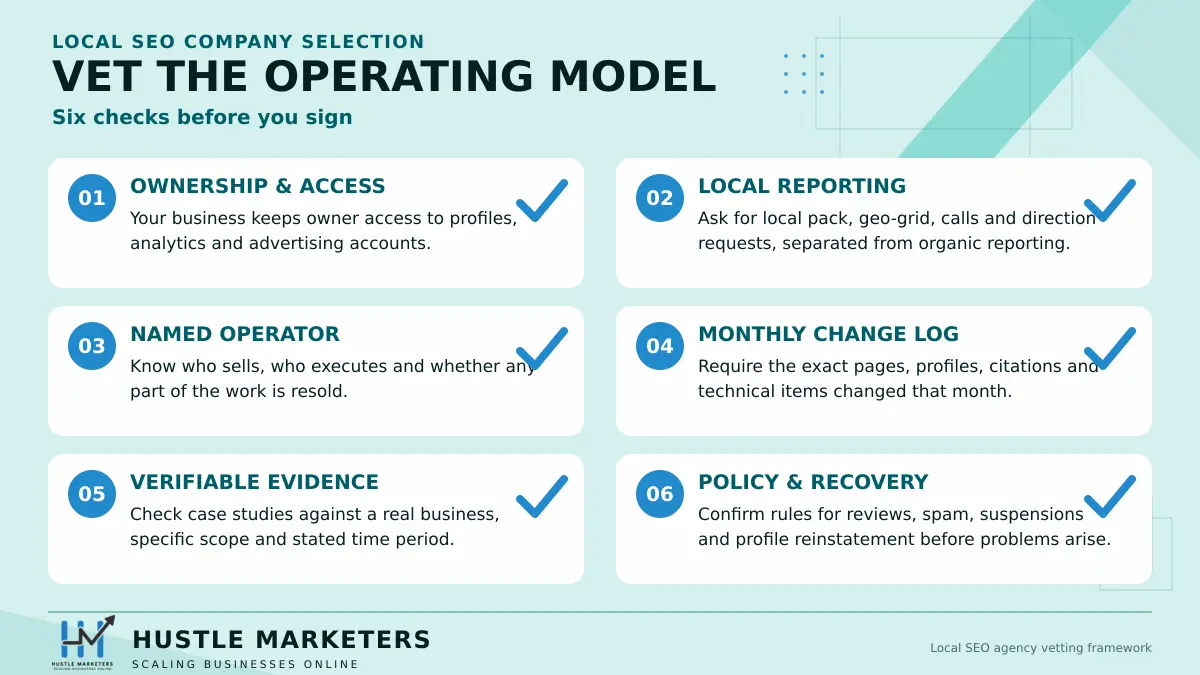
How do you vet a local SEO company?
Ask four questions the field never answers on its own pages. Who does the work, who you will deal with, what changed last month, and how the case studies check out. None of the fifteen pages covers any of the four, including the three that publish questions to ask.
Do they resell the work or originate it?
Ask it in those words. The sharpest vetting item we found comes from Paul Neilson. He tells owners to “Ask about keyword strategy, backlinking strategy, content strategy, writing experience, whether they’re resellers or originators” (Alignable).
Reselling is not automatically bad. Reselling without saying so, to a team that has not updated its methods, is. One forum thread names the complaint: “most ‘agencies’ just outsource straight to India and assume that SEO hasn’t changed in the last 4 years” (UK Business Forums).
Will the person pitching you do the work?
Usually not. Owners in that thread name the switch from senior pitch to junior delivery as their biggest complaint after price. Ask who holds your account, how many others that person holds, and who replies on a Friday evening.
Another thread pins the incentive problem underneath it: “no correlation between my sales and their pay checks. There is literally no accountability” (UK Business Forums).
How do you audit the specific changes they made this month?
Ask for a dated change log, then test it retrospectively. One supplier, ten months into an engagement, answered a request for evidence with a single line: “we do not have a comprehensive list of the precise amends made historically” (UK Business Forums).
The moderator’s reading was shorter: “They can’t provide them because they haven’t done anything.” In the same case, two thirds of the supplier’s disavow file was good industry links, so filing it would have caused harm. Read the deliverables, not the summary.
How do you verify a case study and read an agency’s own reviews?
Check the claim against a source the agency does not control. Steve Gould tells owners to “Use Google Search Console to verify actual organic search queries driving traffic” (Alignable). Ask for a current client, not a logo.
Read review profiles for shape as much as score. A perfect run of five-star reviews naming one salesperson earns as much doubt as a bad average. One owner reading a vendor’s profile concludes “The positive reviews are being written by themselves as a cover” (Trustpilot).
Watch the byline too. A 2026 post titled “I Hired 10 Agencies and Only 1 Actually Fixed My Friend’s Local Search” claims a $14,000 spend with no breakdown, and links the author’s own company among the winners with no affiliation notice (Indie Hackers). Our guide on how to choose an SEO company turns this into a checklist for one call.
What are the red flags?
Eleven flags, drawn from the threads and review pages rather than from opinion. Three of the fifteen pages carry a warning signs section, and none of the three ties a single flag to a local mechanic. The first item here appears on none of them.
- A cold call presenting itself as Google. Two reviews on one vendor profile describe the same opening, and one adds that the caller “charged me $499, then another $5,000 and forged my signature on a contract I never saw” (Trustpilot, 16 August 2025).
- An offer to remove negative reviews. Google does not sell that.
- A guarantee of first position. Dustin Brackett’s read: “Guaranteeing top position usually means blackhat methods or simply signing clients they can’t deliver for” (Alignable).
- Rankings reported without demand. One client ranked page one for “terms that nobody ever looked up” (Warrior Forum).
- A request for owner access to your profile, or for your hosting password.
- A suggestion to use a mailbox, virtual office or coworking address.
- An AI tool posting to your profile with nobody checking the output.
- Invented line items. One supplier billed a quarterly “google submission fee”, which does not exist.
- Refusal to price. One owner reports a vendor turning abusive when pressed for pricing detail (Alignable).
- Annual prepayment, plus a cancellation process you cannot find in writing.
- A review profile with no rating below five stars, where nearly every review names the same person (Trustpilot).
Curtis DeCora’s question cuts through a pitch fastest: “Can you pay your payroll with #1 Google Ranking?” (Alignable). Ask it out loud.
Best local SEO companies FAQs
What does a local SEO company do?
It works four assets: your Google Business Profile, your review file, your location or service pages, and your local links and citations. Profile work separates it from organic SEO, and most vendors describe that part least.
Is local SEO different from regular SEO?
Yes. Local work ranks a verified place in the map block. Organic work ranks a page in the link list. A profile can be suspended and a page cannot, so the risks and the reporting differ.
How much should a small business pay for local SEO?
Published small business bands sit at “$1,000-$3,000 per month” (Knapsack Creative), and owners name $500 a month as the point where reliability drops. Below that, expect profile work only.
Does my agency need owner access to my Google Business Profile?
No. Manager access covers every routine task, since “Most other users only need manager access” (Local Search Forum). Keep primary ownership, and keep a second owner on a company email.
Who pays if my Google Business Profile gets suspended?
Whoever your contract says, which is why it needs to say. If the agency’s action caused it, the agency should do the appeal at its own cost. Google may also require that account off the profile.
Can a local SEO company guarantee I rank in the map results?
No, and a guarantee is a reason to walk away. Owners in the forums read it as a sign of either black hat methods or a vendor signing clients it cannot serve.
Do I need a local SEO company if I only serve one town?
Not always. If you already rank well in a small market with four or five competitors, a full retainer can be overkill. Ask for an audit and a scoped project first.
How long does local SEO take to work?
Plan on six months, with longer for bigger markets. If results arrive in weeks on a cheap plan, ask what produced them. Rented links and private blog networks move faster than real work.
Should I hire a local company or one in another city?
Access, accountability and who does the work matter more than location. These lists are national. Ask who holds your account, whether the work is resold, and which time zone your contact sits in.
How do I know if my current local SEO company is doing anything?
Ask for a dated log of the exact changes made last month, then check a sample. Pair it with Search Console query data and your profile’s call and direction numbers. Reports without changes attached are the standard complaint.
Sources, and how we researched this
This page rests on 15 ranking pages read in full, 14 of which publish a company list, plus 98 community and review sources we opened and read. Every price comes from the page that printed it, and every quote links to its thread or review page.
The ranking set: the two Thrive lists, both SeoProfy lists, OuterBox, First Page Sage, Focus Digital, Knapsack Creative, WPSEO Marketer, plus the directories Clutch, The Manifest, DesignRush, GoodFirms, Sortlist and Semrush Agency Partners.
Community evidence came from Local Search Forum, Alignable, Warrior Forum, UK Business Forums, WebmasterWorld, Indie Hackers and Trustpilot vendor profiles. Threads labeled UK, New Zealand or Australia carry that label where used.
What we could not verify, stated plainly. Reddit was blocked and we did not attempt Quora or YouTube. Google Business Profile Help Community thread bodies did not render, which cost us the source we expected to be richest.
We had no search volume, People Also Ask data or related searches, so nothing here reflects demand. Four directory rosters truncated on fetch, so every count is a floor. We did not complete a check of which search features appear for this query, so this page claims nothing either way.
Our local SEO services page publishes the scope, and our row above stays as honest as the rest.