Best Ecommerce SEO Agencies in 2026: Who Actually Ranks Where, and How to Vet Them

Ishant
Published : October 17, 2026 at 10:30 am
Updated : October 7, 2026 at 8:45 am
Ishant

An agency that put itself at the top wrote most of the pages ranking for best ecommerce SEO agencies. We read all twelve pages a US buyer sees for this query, counted every agency named on every list, and logged who disclosed the conflict. This page publishes that count instead of a ranking.
Our disclosure, before anything else. Hustle Marketers is an ecommerce SEO and paid media agency, so we sell the service this page discusses. We have given a number one slot to nobody, including ourselves. We grouped the list by what the published evidence shows each agency suits, and our own entry sits in that grouping with a section naming the stores we are wrong for.
Key Observations
Twelve pages, nine of them multi-agency lists, name 103 distinct agencies between them. Only seven of those agencies appear on four or more lists, and 79 appear exactly once. The apparent consensus about who is best is thin, and it partly consists of agencies naming each other.
- Seven of the twelve publishers sell SEO. Six of the seven included themselves, all six placed themselves first, and three of the six disclosed it.
- Not one editorial page in the set publishes its own prices. The two strongest pages decline on the record and explain why.
- Clutch’s ecommerce SEO list rates every agency on it between 4.6 and 5.0, so the average rating cannot separate them.
- Sixteen questions a store owner needs answered are missing from all ten editorial pages, including exit costs, unit economics and how to verify Shopify technical work.
Contents
Who are the best ecommerce SEO agencies in 2026?
Seven agencies are named on four or more of the nine ecommerce SEO lists we read: WebFX, Coalition Technologies, OuterBox, Searchbloom, Victorious, Inflow and Thrive Internet Marketing Agency. That is the closest thing to a consensus shortlist in this market. It is a starting point for a call list, not a verdict on fit.
The table below carries every agency named on three or more lists, plus the agencies whose published minimum marks out a budget band. The cross-list count is a measurement, not a compliment. Two of the seven most-named agencies, OuterBox and Searchbloom, publish a competing list in this same search result.
| Agency | Best for, on the published evidence | Named on how many of 9 lists | Published minimum, if any | Source |
|---|---|---|---|---|
| WebFX | Stores wanting the most widely named option; mid-market retainers | 6 | $2,500 a month | OneLittleWeb |
| Coalition Technologies | Mid-market stores; broad service range | 5 | $1,000 a month | OneLittleWeb |
| OuterBox | Catalog and parts stores; publishes its own ecommerce case results | 5 | Not published | OuterBox |
| Searchbloom | Stores that want a published scoring rubric and a stated conflict note | 5 | $2,000 to $5,000 a month | WYTLABS |
| Victorious | Stores shortlisting on award and retention claims | 5 | Not published | Founder Reports |
| Inflow | The only agency an independent publisher placed first | 4 | Not published | Founder Reports |
| Thrive Internet Marketing Agency | Entry to mid retainers; full-service scope | 4 | $1,000 a month | OneLittleWeb |
| SEO Inc. | Entry to mid retainers | 3 | $1,000 a month | OneLittleWeb |
| SmartSites | High review volume; the only slot labeled Sponsored on Clutch | 3 | $1,000 a month, $100 to $149 an hour | Clutch |
| Intero Digital | Five-figure annual budgets | 2 | $5,000 a month | OneLittleWeb |
| SEO Brand | Entry to mid retainers; 109 reviews on its Clutch profile | 2 | $1,000 a month | Clutch profile |
| Nuanced Media | Project work as well as retainers | 2 | $1,000 minimum, $100 to $149 an hour | WYTLABS |
| Siege Media | Content-led programs at five-figure minimums | 2 | $10,000 minimum, $5,000 a month retainer | WYTLABS |
| Power Digital Marketing | Larger budgets only | 2 | $10,000 a month | OneLittleWeb |
| Avex | Design and build led engagements | 2 | $25,000 minimum engagement | eSEOspace |
| Barrel | The highest published floor in the set | 1 | $50,000 minimum engagement | eSEOspace |
| Hustle Marketers | Small and mid stores, on a bounded published scope | 0 | Our clients start from $500 a month | Our ecommerce SEO agency page |
How to read this table
The count column answers one question: how many independent-looking lists name this agency. It rewards being well known. It does not measure whether the agency moved anybody’s revenue, and it cannot, because most of these lists publish no client evidence at all.
The published minimum column is the most practical thing here. It tells you whether an agency will take your budget before you spend an hour on a call. Everything after this table is about fit, and your catalog, your platform and your margins decide that.
How we built this list, and what we weighted
We weighted nothing, because we rank nobody. We read all twelve pages a US buyer sees for this query in full on September 30, 2026, counted how many of the nine editorial lists name each agency, recorded every published price, and logged which publishers included themselves. The count and the prices are the output.
We counted nine lists: Searchbloom, SeoProfy, Founder Reports, eSEOspace, WYTLABS, OneLittleWeb, First Page Sage, OuterBox and WebDesign Rankings. We excluded three pages. The two Semrush Agency Partners directories state 371 US and 713 worldwide agencies with no published methodology, and their order changed between captures. Clutch’s SEO firms page is general SEO rather than ecommerce.
We normalized names so one agency was not counted twice under two spellings, and counted Ignite Visibility once even though WebDesign Rankings lists it at slots 16 and 23.
Where competitors do publish a rubric, the weights are worth reading. First Page Sage scores Average Review Score at 35 percent, Company Size at 20 percent and Years in Business at 10 percent. Not one of its five criteria measures ecommerce SEO capability or a client outcome. Headcount and age are proxies.
What makes an agency good at ecommerce SEO specifically, rather than SEO generally
The two strongest pages in the set agree on the shape of it, and both frame it as capability rather than credentials. OuterBox asks whether a team understands category and product-page SEO rather than blog content, and whether it can diagnose technical catalog problems before prescribing more copy.
Its other questions are the ones buyers skip. Does the agency connect SEO work to revenue or transactions? Can it work inside your platform and your development workflow? What can it implement directly, and what must you ship yourself?
eSEOspace publishes a ten-item framework covering product page SEO, category and faceted navigation SEO, product schema, Core Web Vitals, shopping rich results and revenue attribution. It attaches no scores, so the framework does not explain its own ordering, but as a checklist it holds up.
A generalist can do keyword research and write content. Faceted navigation, variant duplication, out-of-stock handling, feed hygiene and revenue attribution need a store background. Ask for the catalog work first and the content plan second.
How do you read a best-agencies list that an agency wrote?
Start by checking whether the publisher sells the service. Seven of the twelve pages in this search result do. Six of those seven included themselves, all six placed themselves at number one, and only three admitted the conflict on the page. Assume the top slot is an advertisement until the page says otherwise.
That count is the finding, not an accusation. Self-inclusion is not automatically dishonest. It does mean the company being recommended chose the first name you read on most of these pages.
Three publishers disclosed it. Searchbloom is the bluntest, and it also names its CEO in a transparency note.
“Searchbloom publishes this guide and ranks itself #1. That is a claim you should be skeptical of” Searchbloom, updated September 28, 2026.
“As the publisher of this list, we’ve included ourselves with full transparency.” WYTLABS, which lists itself as Editor’s Pick.
“This ranking is written by OuterBox, so we are not pretending to be a neutral directory.” OuterBox, updated September 22, 2026.
Three did not disclose it. SeoProfy, eSEOspace and First Page Sage each sit at position one on their own list with no conflict note anywhere. A fourth publisher, OneLittleWeb, sells SEO and leaves itself off without explaining that either.
Directories disclose differently. On Clutch the agency in position one is labeled Sponsored, and the page states Clutch may earn a fee for some placements. That is commercial placement, openly marked, and the clearest labeling in the set.
Then check whether the roster was actually re-verified. WebDesign Rankings is titled Top 30 and carries a September 2026 stamp, but it lists 29 unique agencies because Ignite Visibility appears twice, at slot 16 and again at slot 23. Its roster still carries KoMarketing and Path Interactive. A recent date stamp is not evidence of recent checking.
The one independent publisher has the opposite problem. Founder Reports has no conflict of interest and no methodology either. Its search title says seven agencies, its heading says six, and it delivers six.
The cross-list frequency count
The nine editorial lists name 103 distinct agencies between them. Only seven appear on four or more of them. Seventy-nine appear exactly once, and over half of those come from a single fifty-item list. So the market has no real consensus about who is best, and the short overlap it does have is partly agencies naming each other.
| Named on how many of the 9 lists | How many agencies | Which ones |
|---|---|---|
| 6 lists | 1 | WebFX |
| 5 lists | 4 | Coalition Technologies, OuterBox, Searchbloom, Victorious |
| 4 lists | 2 | Inflow, Thrive Internet Marketing Agency |
| 3 lists | 2 | SEO Inc., SmartSites |
| 2 lists | 15 | Avex, Big Leap, Disruptive Advertising, HigherVisibility, Ignite Visibility, Intero Digital, Lounge Lizard, Nuanced Media, Power Digital Marketing, ROI Revolution, SEO Brand, SeoProfy, Siege Media, Straight North, Sure Oak |
| 1 list | 79 | Over half of them named only by the fifty-item OneLittleWeb list |
| Total distinct agencies | 103 | Counted September 30, 2026 |
Two of the seven most-named agencies publish a competing list in this same search result, OuterBox and Searchbloom, and both are also named by others. Reciprocal naming inflates a count without adding evidence, which is why the count sits next to the published minimum rather than on its own.
So where does Hustle Marketers sit, and why do we rank nobody?
Zero of the nine lists name us, and we have put that in the table. We sell ecommerce SEO, so ranking ourselves first would have made this page the seventh example of the thing it documents. Ranking anybody first would have been worse, because we have no client evidence about the other sixteen agencies here.
What we can do is publish the measurement, publish the prices we found, publish our own price, and give you the vetting questions that separate a good agency from a well-marketed one.
Does anyone pay to be on these lists?
Two publishers say no in writing, one says yes and labels it, and the rest say nothing at all. Treat silence as unknown rather than as a denial, because a self-serve directory that charges agencies to list has no reason to publish a ranking basis and mostly does not.
OneLittleWeb states that no agency paid to be included or ranked and that placements are based strictly on scoring outcomes. WebDesign Rankings states that no agency pays for placement. Clutch is the one that discloses money changing hands.
The Semrush worldwide directory invites agencies to list themselves and publishes no vetting standard and no ordering basis. It also served an almost entirely different roster from its US equivalent on the same day, so the order is a filter view rather than a ranking.
The agencies, grouped by what they are best for
Nobody gets a number one slot here. We built the groups below from the only per-agency evidence these lists publish: the minimum an agency will take, how many lists name it, and what its own page claims. Where a group has no verifiable candidate, we say so instead of filling it.
Read the group that matches your catalog and your budget, then skip to the vetting questions. Our own ecommerce SEO service page sits in the small and mid group, with the wrong-fit cases named below.
Large catalogs and faceted navigation
Two pages make catalog-level diagnosis an explicit criterion, and they are the same two that score highest on evidence. OuterBox asks whether an agency can diagnose technical catalog problems before prescribing more copy. Searchbloom scores ecommerce and catalog SEO as one of five weighted components in a fifty-point rubric.
OuterBox is also the only agency in the set publishing named ecommerce case results, all its own: CORSA Performance at 366 percent organic search revenue, JEGS at a 38 percent traffic lift and Warehouse Lighting at 105 percent organic revenue. Those are claims about its own work, and still more evidence than any other list offers.
Candidates here: OuterBox, Searchbloom, WebFX and Coalition Technologies. What decides it is whether the team talks about pagination, variant duplication and out-of-stock handling before blog posts.
Shopify and Shopify Plus
No page in the set publishes a Shopify credential you can verify against a Shopify source, and Shopify Plus is named on one of twelve pages. That matters because Shopify staff, answering a seller who could not find a claimed expert anywhere, pointed to one directory as “our only available list of trusted third-party agencies”.
So ask for the agency’s Shopify Partner or Shopify Experts listing and open it yourself, then ask which themes they have shipped code into. Our Shopify SEO agency page sets out that scope. eSEOspace is the one list leaning toward build shops, naming Avex, Barrel, Diff Agency, Lucid and Lounge Lizard, which helps if your Shopify problem is a rebuild rather than rankings.
WooCommerce
WooCommerce is named on four of the twelve pages and never once attached to a named agency’s proven WooCommerce work. Searchbloom publishes platform guidance covering Shopify and WooCommerce. WebDesign Rankings names WooCommerce inside its own vetting criterion. That is the whole of the evidence.
On WooCommerce the risk is rarely the SEO plan. It is plugin conflicts, uncached category pages and a host that cannot take the traffic. Ask who touches the server and the plugin stack, and whether that person is on the SEO team.
BigCommerce
BigCommerce is the thinnest platform claim in the set. It appears on two of twelve pages, only as a selection criterion on WebDesign Rankings, and no list names an agency for BigCommerce work. If a shortlist page calls an agency a BigCommerce specialist, that claim came from the agency.
Ask for two BigCommerce stores by URL, the date range, and which changes the agency shipped rather than the client’s developer. Our BigCommerce SEO agency page lists our scope.
Magento and Adobe Commerce
Magento and Adobe Commerce appear on three of twelve pages, as a platform-expertise criterion rather than a per-agency record. eSEOspace names Magento in its ten-item framework and WebDesign Rankings names it in its criteria. Nobody publishes a Magento case.
Magento work is developer work, so ask who writes the code: a developer on staff, on contract, or nobody, and what happens to your ticket queue between their projects. Our Magento SEO agency page is the reference for scope.
Enterprise and multi-store
Here the published floors do the sorting. Barrel states a minimum engagement of $50,000 and Avex states $25,000 on eSEOspace. Power Digital Marketing states $10,000 a month and Intero Digital $5,000 a month on OneLittleWeb. Siege Media states a $10,000 minimum with a $5,000 monthly retainer on WYTLABS.
For the range at this end, eSEOspace puts enterprise ecommerce SEO at $10,000 to $30,000 or more per month. Clutch’s budget filter runs as far as $10,000,000 and above, so the buyer sets the ceiling.
B2B ecommerce
B2B ecommerce is a live search variant with no matching section on any of the nine lists. Nobody names an agency for it, and the same general rosters come back for the B2B phrasings, so treat any B2B specialist claim as unverified.
It needs a different hire because of attribution. When checkout is a quote request, an account price or a gated catalog, transaction tracking does not work and revenue lands in a CRM. Ask how the agency attributes organic revenue when the conversion is a quote.
Small stores and tight budgets
The modal published minimum in this search result is $1,000 a month. On OneLittleWeb, SmartSites, Coalition Technologies, Thrive Internet Marketing Agency, SEO Inc., Big Leap, SEO Brand, Boostability, Brainvire Infotech and Funnel Boost Media all state $1,000 or more.
Below that the market thins fast. Across the Semrush US directory, only SEO Discovery at $0 to $1,000 and ScaleUp SEO at $0 to $5,000 publish a band starting under a thousand.
Hustle Marketers, and where we are the wrong choice
We are an ecommerce SEO and paid media agency, named on none of the nine lists, and we publish our price. Our clients rate us 4.9 out of 5 across 591 reviews on all platforms, and our Clutch profile carries 5.0 from 50 or more reviews plus 6 Clutch Awards in 2026. We are a Google Partner, a Meta Business Partner and a Microsoft Advertising Partner.
In our work we have scaled 2,500 or more brands, at 180 percent average growth, and Ishant Sharma has been in digital marketing since 2013. Our clients start at SEO from $500 a month, quoted as a starting range because it varies by business, on a bounded written scope. We also publish what we do not promise. Our delivery team is in India.
Now the part these lists never write. Here are five stores we should not take.
- Catalogs in the hundreds of thousands of SKUs. Sellers at that scale say you need a full-time in-house owner, not a retainer, and no agency changes that math.
- A replatform or a Magento rebuild where you want the same team writing the code. Hire a development-led shop. eSEOspace’s roster of build firms exists for exactly this.
- Amazon or marketplace revenue as your main channel. That is a different hire with different levers, and we do not do it.
- A named strategist, a dedicated pod and a five-figure monthly retainer. The agencies with published $5,000 and $10,000 floors build for that, and we are not a cheaper version of it.
- Any request for guaranteed rankings, a guaranteed traffic number, or round-the-clock coverage. We will not sign that, and neither should anybody else.
If none of those describe you, our published scope and deliverables are the next thing to read. If one of them does, an agency above is a better call than we are.
Which agency fits your platform?
On the published evidence, none of them fits on platform grounds, because no list in this search result attaches a platform to a named agency’s proven work. Shopify and WooCommerce are each named on four of the twelve pages, Magento and Adobe Commerce on three, BigCommerce on two, and Shopify Plus on one.
Every one of those mentions is either a selection criterion the publisher wrote or a service list the agency wrote. That is a marketing claim, not a credential. So platform fit is something you verify, and it takes about fifteen minutes.
Ask for two live store URLs on your platform, the months the work ran, and the name of the person who shipped it. Then open the stores and check the platform-specific detail.
- Shopify: look at the theme and whether the app stack matches what the agency described.
- WooCommerce: check caching on category pages and look at the plugin list.
- Magento or Adobe Commerce: ask which developer did the work and whether they are still available.
- BigCommerce: expect the thinnest answer in the market and press harder.
If the agency cannot produce a URL, the platform claim is not real. A team that has genuinely done the work names the store in the first reply, and a technical SEO engagement should start with that evidence rather than a template audit.
What is the SEO risk when you replatform or migrate?
Migration is the single largest organic risk an ecommerce store takes, and it is not a heading on any of the ten editorial pages we read. Several of those same pages sell Shopify Plus and Magento migration work. If you are moving platforms inside the next year, that gap should change your shortlist.
Before you sign anything, ask for a written redirect plan at URL level, not at template level. Ask who owns the crawl of the old site, who signs off the mapping, and what the rollback is if organic sessions fall. Then ask for one previous migration with the before-and-after organic revenue and the name of the client contact.
A store that replatforms without a mapped redirect file loses category and product URLs that took years to earn. Our technical SEO checklist covers the crawl and mapping steps we work through before a move.
Is your store too small, or too large, for an agency?
Yes, at both ends, and the market publishes the floor itself. If a four-figure monthly retainer is not affordable, you sit below it: the modal published minimum across these lists is $1,000 a month. At the other end, once your catalog runs to hundreds of thousands of SKUs, sellers at that scale say hire in-house.
The floor is a measurement, not an opinion. Searchbloom, the freshest page in the set, tells buyers to be cautious of ecommerce SEO priced below roughly $1,000 a month, and almost every published band starts at a thousand or more. Below the floor, buy a one-off audit with an implementation list and ship it yourself. A retainer you cannot sustain for six months is money spent on onboarding.
The expectation gap at that end is well documented. One agency owner’s summary: buyers “happily sign up for the £99/month deal and expect a £1000/month service”.
The ceiling is more interesting, because the people who hit it are not short of money. A seller running 500,000 plus rotating SKUs reported that agencies “want a 7 figure budget each year”, and the reply he got was to train people in-house instead.
Another practitioner put the threshold plainly: “If you have webshop with thousands of products, you’ll need full-time SEO employee”. The sensible shape at that scale is an in-house owner plus an agency for specialist work.
Is marketplace SEO the same hire as store SEO?
No, and one list in this set quietly mixes the two. First Page Sage’s eight agencies include Seller Interactive and eStore Factory, both marketplace-side firms, sitting alongside store-side SEO agencies with no explanation of the difference. A buyer scanning that list could hire the wrong discipline entirely.
Marketplaces rank on listing content, reviews, fulfillment signals and advertising inside a closed system. Your own store ranks in Google on crawlability, category structure, schema and links. The skills overlap less than the job titles suggest, so hire for whichever carries your revenue and treat the other as a separate budget line.
What about international, multi-currency or multi-store setups?
Absent from all ten editorial pages, which is a problem if you sell into more than one country. Multi-store ecommerce SEO is mostly a duplication and targeting problem, and it is where a generalist agency does the most quiet damage.
Ask three questions before signing, and an agency that cannot answer them has not run an international store program.
- Who implements hreflang, and who validates it after each deploy?
- Will currency and locale live on subfolders, subdomains or separate domains, and why?
- Which country’s near-duplicate product page becomes the canonical?
How much do ecommerce SEO agencies cost in 2026?
Published market ranges run from $1,500 to $30,000 a month depending on who you ask, and the modal published minimum is $1,000 a month. The more useful finding is that not one editorial page in this search result publishes its own rates. Every real figure below is a third-party report or a directory field.
That absence is deliberate at the top of the market. Searchbloom shows tiers instead of figures and says most firms do not publish rates. OuterBox explains that price varies by catalog size, platform complexity and technical support, and notes that some agencies publish starting retainers while others quote after discovery. Both refuse on the record, which makes published pricing a real gap rather than an oversight.
| Source | What it publishes | Figure |
|---|---|---|
| Searchbloom | Typical monthly investment for an online store | $2,000 to $10,000 a month |
| eSEOspace | What it calls reputable agency pricing | $3,000 to $15,000 a month |
| eSEOspace | Enterprise monthly | $10,000 to $30,000 or more a month |
| WYTLABS | Typical monthly, and project work | $1,500 to $10,000 a month; $5,000 to $30,000 per project |
| OneLittleWeb | Hourly rates across its fifty agencies | $25 to $300 an hour |
| Clutch ecommerce SEO list | Minimum project size and hourly bands | Almost all $1,000 or more; $25 to $49 through $150 to $199 an hour |
| Semrush US directory | Most common published budget per project | Starting from $1,000 |
| Semrush US directory | Lowest published bands in the whole set | $0 to $1,000 (SEO Discovery), $0 to $5,000 (ScaleUp SEO) |
| Hustle Marketers | Our own published entry point | Where our clients start, from $500 a month on a bounded written scope |
Two things follow. The published ranges disagree with each other by a factor of ten at the bottom. And somebody else published every figure attached to a named agency, usually as a directory field the agency filled in. Our own ecommerce SEO packages and the wider SEO packages page publish the scope behind the figure.
What does sub $1,000 a month ecommerce SEO actually buy?
It buys a small number of hours on a narrow scope, and nothing else. Run the arithmetic against the cheapest hourly band published on Clutch, $25 to $49, and five hundred dollars is roughly ten to twenty hours a month. That is enough to fix a defined problem. It is not enough to run a program.
Searchbloom tells buyers to be cautious below roughly $1,000 a month and never says what the cheap tier contains. Here is the honest version. Ten to twenty hours buys a technical fix list and its implementation, or category work on a handful of priority pages, or product schema and feed hygiene. It does not buy content at volume, links, CRO testing and a strategist at once.
So the tier only works with a bounded scope in writing. Our clients on that tier get a defined scope up front, and we scope and quote fuller strategist-led engagements separately, because they are different products at different prices.
The cheap tier fails when somebody sells it as a full program. One Shopify seller described spending “thousands on Shopify experts the amounted to nothing” and being asked for $700 to fix backlinks, meta tags and titles. The price was not the problem. The undefined scope was.
What changes the price
OuterBox publishes the most complete list of price drivers in the set, and it holds up: catalog size, platform complexity, competition, content needs, technical support and reporting requirements. Add one more that nobody prices openly, which is whether the agency implements the work or hands you a ticket list.
Implementation is where retainers diverge most. An agency shipping changes into your theme carries developer cost and review risk. An agency writing recommendations does not. Both can be honest, and they are not the same purchase, so get the answer before you compare quotes.
How long before ecommerce SEO shows results?
Every page in this search result answers that question and not one shows you the months. The honest answer is that you judge the first two quarters on delivery rather than revenue, and that anybody promising a date for a ranking is guessing. What you can demand is a written month-by-month deliverable list before you sign.
The reason to judge delivery first is that results language hides non-delivery. One store owner describing an inherited engagement said that “at the ten month mark, they had no gain in traffic, no real conversions, no nothing”. Ten months is a long time to discover a scope was never shipped.
Buyers say it in gentler language on review sites. A retail client’s only improvement note on a high-rated Clutch profile was that they “would have appreciated more education early on regarding expected timelines”. That is a scoping failure at the start, not a performance failure at the end.
What month one to month six actually looks like
This is the picture no page in the set publishes. In our work the shape below is what a bounded ecommerce engagement should put in writing, and you should be able to check every line of it without trusting a dashboard.
- Month one. Technical crawl, indexation and faceted navigation audit, analytics and revenue tracking verified, keyword and category map agreed with volumes attached. No content shipped yet, and that is correct.
- Month two. Highest-impact technical fixes implemented or handed over as tickets with owners and dates. Product schema and feed issues logged. First category pages rewritten.
- Month three. Remaining priority fixes shipped. Internal linking reworked across the category tree. Early ranking movement on low-competition category terms, reported at URL level.
- Month four. Content and link work at volume begins, because the technical base now holds. The first revenue-attributed organic movement should show up on the pages you changed.
- Month five. Second wave of category and product page work, informed by what moved. Cannibalization and variant duplication cleaned up.
- Month six. A written review comparing the agreed plan against what shipped, with organic revenue by landing page, not sitewide traffic. This is the meeting where you decide to continue or leave.
Notice what is missing. No promised ranking position and no traffic percentage, because neither is inside the agency’s control. What is inside its control is whether the work happened, and a month-by-month list makes that impossible to fudge.
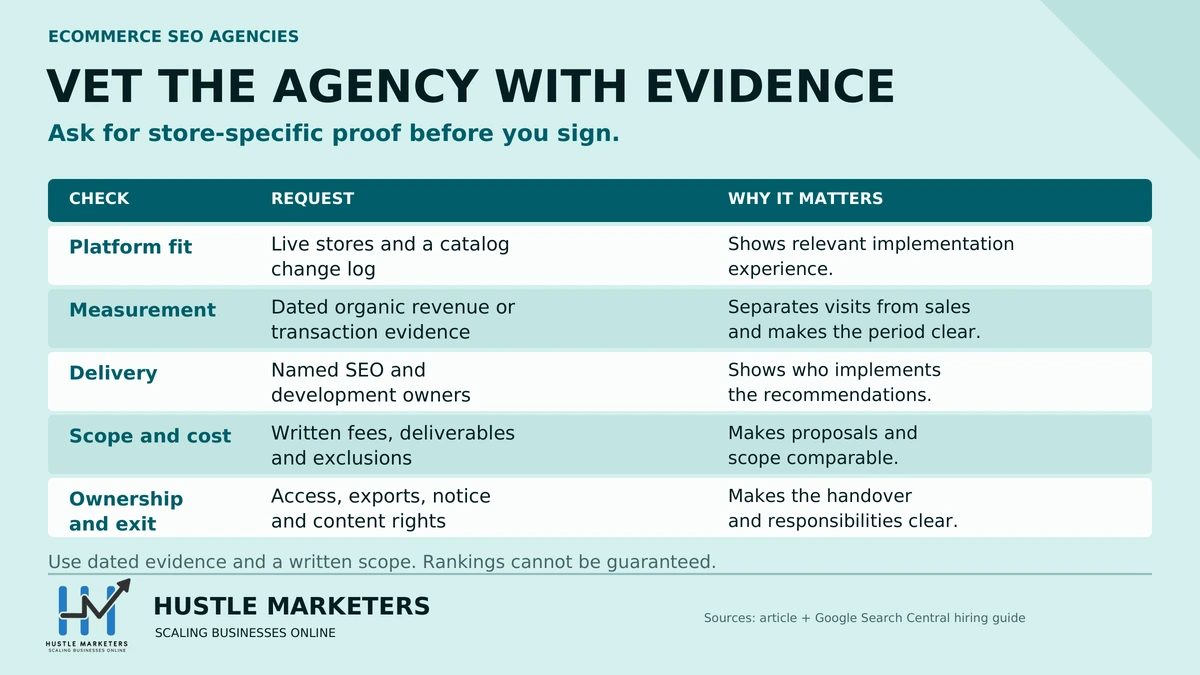
How do you vet an ecommerce SEO agency?
Ask the eleven questions below in a first call, before any proposal. Each one is here because weak agencies answer it badly and good ones answer it easily, and because not one of the ten editorial pages in this search result asks it. A short list of hard questions beats any ranking.
Take notes on who hesitates. Our agency selection guide has the same questions in a shorter form you can take into a meeting.
Will they ask which products carry your best margin, and what your lifetime value is?
This is the sharpest test on the page. Competitor question lists in this search result run to eight, fifteen, twenty-one and twenty-five questions about tools, reporting cadence and case studies. Not one asks about unit economics.
The observation behind it came from an agency owner describing a store he took over: “Nobody had ever asked him which of his products he had the biggest margins on or what the lifetime customer values were”. An agency that optimizes your highest-traffic, lowest-margin SKUs can double sessions and shrink profit. If margin and lifetime value do not come up in the first call, you are buying traffic.
Do they already work with your direct competitors?
Ask directly, and ask what happens if they take a rival next quarter. Several pages in this set present deep vertical experience as a selling point, which is the same fact stated from the agency’s side of the table.
Owners rate this as the thing that would most upset them. One put it as “I would be pretty upset to find out that same company was also working with my competitor”. There is an access argument too, since your best keywords and link partners end up inside a firm that serves a rival.
Exclusivity inside your category and geography is negotiable. Ask for it in writing or accept the risk knowingly.
Every agency on these lists is rated 4.6 to 5.0, so how do you read the reviews?
You read the individual low reviews, because the average cannot separate anybody. On Clutch’s ecommerce SEO list in September 2026, all 28 agencies sat between 4.6 and 5.0. A distribution that tight carries no information about which agency to hire.
Two public profiles show why, as they stood in September 2026. The SEO Brand profile lists 109 reviews and its lowest single review is 4.5 out of 5. The Coalition Technologies profile averages 4.8 across 165 reviews and also carries a 2.0 ecommerce review from December 2025 and a 1.5 from October 2024.
That is not a verdict on either agency. It is evidence that an average rating does not discriminate while the individual reviews do. The December 2025 reviewer, in the ten to fifty thousand dollar spend band, wrote that “traffic did not see meaningful, sustained increase”, and the October 2024 reviewer reported organic visitors down 20 percent over the campaign year.
So do this instead of reading the score.
- Sort lowest first and read every review under three stars.
- Filter to reviewers in your spend band and your product category.
- Read the improvement field on the five-star reviews, where the real complaints hide.
- Check Trustpilot, which none of the ten pages uses and where many critical reviews sit.
How do you verify a case study was actually caused by the agency?
Ask for movement on your own site, on a date range you choose, not a portfolio. The practitioner version is blunt: “Any SEO can show sites that ranked even those they were not instrumental in ranking”.
Three questions break a borrowed case study.
- What was the traffic trend for the six months before the work started?
- Which specific changes did the agency ship, and on what dates?
- What else changed in the same window, including paid media, a rebuild or a PR campaign?
Note that the strongest page in this set publishes three of its own case results and no evidence at all about the nine agencies it ranks below itself.
Who will actually do the work, and is it outsourced?
Get names, seniority and hours, and ask what happens when the named person leaves. Two lists here score agencies on company size and years in business, which measures the opposite of who is on your account.
Practitioners are direct about it. One describes agencies that “just outsource straight to India and assume that SEO hasn’t changed in 4 years”. Outsourcing is not automatically bad, but hidden outsourcing is. The recurring improvement theme on one 4.9-rated Clutch profile was team churn: “some changes in people on the team and wished it was more consistent”.
On Shopify, how do you verify the speed and technical work was really done?
Test it yourself, outside the agency’s reporting, because this failure mode is invisible on a dashboard. Shopify Community documents sellers paying for speed work where, in one seller’s words, “some developers do ZERO/NO work on performing your store, they ONLY add a hacking code that detect speed checkers”.
In the same thread a seller reported that after he removed the code his “speed drop from 81 to 35”. A buyer asking for before-and-after screenshots would have seen a passing score the entire time.
Four checks nobody can fake, and our Shopify SEO issues guide covers the last one in detail.
- Run the speed test yourself, from your own network, on a device the agency has never seen.
- Compare Shopify’s own speed report against an independent Lighthouse run and query any gap.
- Ask for a diff of every theme file changed, with dates.
- Review the theme for any script that behaves differently for testing tools.
What access should they get, when, and what should you refuse?
Stage it. Read-only analytics and Search Console first, a staging or theme duplicate for code work second, production write access only after you sign a scope. Nobody in this search result covers access hygiene at all.
Refuse anything that arrives before scope. One Shopify seller described a pitch that wanted a collaborator code and PayPal payment within a day of the store being listed, saying they “were already reaching out like vultures”. Refuse unexplained code too. The standing caution from technical forums is to “be very wary of any SEO who felt privileged to insert code on client pages” unrelated to the SEO work.
Should you talk to clients who left, not just the references you are given?
Yes, and the reference list will not include them, because every agency curates its own references. Ask for one client who ended the engagement in the last year, and why.
One buyer described contacting more than fifty providers and private-messaging both positive and negative reviewers before choosing. Another put the method in one line: “ask their old clients about their experiences working with the company”.
How do you check the keywords they ranked you for have real demand?
Audit the target keyword list before you sign it, not after the first report. The documented failure is an inherited account where the agency had ranked the store on page one for “terms that nobody ever looked up”.
Make the proposal carry three columns for every target term: search volume with the tool and date it came from, the page type that currently ranks, and the commercial intent. If a term has no volume, no transactional intent, or a page type you do not have, it does not belong on the list. Scope a technical engagement against terms you have already verified.
What happens on the next Google update, and who pays to fix it?
Ask before you sign, because nobody here treats update resilience as a selection criterion. The reviewer verdict that makes the case sits on a five-figure ecommerce engagement, summarized as “vulnerable to single Google update”.
Listen for three answers, and note that an agency running technical health, category structure, content and links in parallel has a real one. Our technical SEO checklist is the baseline we check first when a store loses rankings.
- What did they change for clients after the last major update, and how fast?
- Does diagnostic work after an update sit inside the retainer, or do they bill it separately?
- What in the current plan would still be correct if rankings fell next month?
Will they implement changes or hand you a ticket list?
Get this in writing, because it changes the price, the timeline and who is accountable. Only one page in the whole set raises it, inside prose criteria: OuterBox asks what an agency can implement directly and what the client must ship.
Ask for the split line by line. A recommendations-only engagement is legitimate and often cheaper, but it only works if you have a developer with capacity.
- Who deploys theme or template code?
- Who publishes content, and into which CMS?
- Who edits robots directives, canonical tags and structured data?
- Who touches the product feed and Merchant Center?
What are the red flags?
The useful red flags are the ones you can verify, not the generic ones every list repeats. The signals below all come from store owners and practitioners describing engagements that failed, and each one is checkable either before you sign or inside the first sixty days.
- They found you. One practitioner’s rule for spotting the good ones is that “they’re almost always not the ones that find you using spam or telesales”. A cold pitch within a day of your store going live is the version Shopify sellers report most.
- Link tactics they will not describe. One buyer’s account of the last agency he hired: “They sent my site to lots of low PR directories, scraped content, duplicated content, spun articles”.
- Claims of clean links with no sample. An agency owner estimates that “90% of our competition in Birmingham build dodgy links but claim to be 100% legit”. Ask for the last twenty links placed, with URLs.
- Expertise proved by their own rankings. A long-time practitioner’s jab at self-declared experts is that they “declare themselves experts because they rank #1 for ‘village shop in little snoring'”.
- Reporting that avoids your numbers. One owner’s complaint was that “every time I meet with the company, they just throw marketing fluff at me” when all he wanted was leads reaching his office.
- Silence between invoices. A store owner described a month in which “the only contact from them over the course of a month was an invoice”.
- Deliverables that quietly stop. A client canceling for non-service noted that the agency “are also meant to create blogs for us but none have been uploaded since November”.
- Unexplained code on your store. One review of a paid engagement recorded “malicious code allowed into site” alongside tasks completed late or not at all.
Which red flags are verifiable before you talk to them?
Three of them. Whether they found you, whether their expertise claim rests on their own rankings, and whether anybody has documented code or link problems in a public review. All three take a search and five minutes.
The rest you test in the first sixty days by reading what arrives. A report that talks about visibility and impressions when you asked about revenue is the same red flag as marketing fluff in a meeting. Price is not the signal here. Buyers report the same failures at a hundred dollars a month and at five figures a month.
What happens when you leave, and what does it cost?
Nobody in this search result tells you, and it is the most expensive thing they leave out. Across ten editorial pages the entire treatment of contracts is one question about whether services are month to month. The real risk is not the term length. It is the cancellation fee, the asset ownership and who holds the passwords.
Cancellation fees can take a large share of what you have not yet used. One client canceling for non-service reported that “they state the cancellation fee is 50% of the remaining term on the contract”. On a twelve month deal canceled in month three, that is a meaningful bill for work nobody did.
Term length is negotiable more often than buyers assume. One owner refused a twelve month contract and signed for six months instead. Ask for six with a thirty day exit after month three, and see what comes back.
The worst case is control rather than cost. One reviewer wrote that an agency “dropped the ball so hard and then took my site down by changing my passwords”. That is only possible when an agency holds ownership rather than access, which is a decision you make at the start.
Who owns the content, links and analytics properties after you leave?
You should, and you write it into the agreement rather than assuming it. Practitioners have used the same test for two decades. Ask the agency two questions: can you switch the work off instantly, and do you own the domains and sites. The verdict on a yes to either is “if they answer yes to either of those then run a mile”.
Put six items in the contract before you sign.
- You own the domain and any microsites.
- You own the content, and it stays live after termination.
- You are the owner, not a user, on the Google Analytics and Search Console properties.
- You hold admin on the tag manager container.
- You get the full link and outreach record on exit.
- Offboarding includes a written statement of work completed to date.
That last one is the practical version of a request one buyer made of an agency he was leaving: “ask them for a statement of all work carried out to date”. If an agency cannot produce that on request in month two, it will not produce it in month twelve either.
Do these agencies work for AI search, AI Overviews and ChatGPT?
Half of them say so, and the vocabulary is thinner than the claims. AI Overviews or AI search appear on five of the ten editorial pages, and GEO, AEO or LLM optimization on three. Exactly one page names ChatGPT, Gemini and Perplexity. Nobody publishes a measurement.
The two pages that treat it as a scored capability rather than a trend section are worth naming. Searchbloom makes AI search and shopping visibility one of five weighted components in its published rubric. eSEOspace lists AI search and GEO optimization for product pages inside its ten-item framework. WYTLABS is the single page that names ChatGPT, Gemini and Perplexity, and the only one with a heading on AI Overview optimization for product and category pages.
Google Shopping, shopping search and rich results appear on three of the ten. Merchant Center and the product feed appear on one. For an ecommerce buyer that is the wrong way round, because feed quality and product structured data decide whether your products show up in shopping surfaces and in generated answers.
How do you check an agency’s AI search claim?
Ask for the measurement, then ask for the mechanism. A team doing real work here can tell you which prompts it tracks, which surfaces it checks, how often, and what it changed on a page a model later cited. A team repeating vocabulary cannot do any of that.
Four things to request.
- A prompt set with dates, so the tracking is continuous rather than a screenshot.
- The product schema and feed changes they made, at field level.
- A page where a structural change preceded a citation.
- A plain answer on what they do not control.
Our own position is that this work is product schema, feed hygiene, clear category copy and answerable question formats, done properly. That is the same technical base that wins rich results, which is why we treat it as one program rather than a new service line. Our AI search optimization page sets out the scope, and where paid shopping coverage matters as well, our ecommerce PPC agency comparison is the companion to this page.
Ecommerce SEO agency FAQs
What does an ecommerce SEO agency actually do?
It works on the parts of a store that decide whether shoppers find your products: category and faceted navigation structure, product page content, product schema and feeds, crawling and Core Web Vitals, links, and revenue attribution. Content matters, but on a store the catalog work comes first.
Is ecommerce SEO different from regular SEO?
Yes, mostly because of scale and duplication. A store has thousands of near-identical product URLs, variants, filters and out-of-stock pages, and Google can crawl, index or waste every one of them. One practitioner’s summary of the difficulty is that you “cannot rank all products at same time”, so prioritization is the job.
Do I need an ecommerce SEO specialist or will a generalist do?
A generalist can handle content and keyword work on a small catalog. Once you have filters, variants and a feed, you need someone who has fixed those before. Ask how they would handle faceted navigation and out-of-stock products. A generalist answers in general terms.
Is an ecommerce SEO agency worth it for a small store?
Only if you can sustain the market floor, around a thousand dollars a month on these lists, for at least six months. Below that, a one-off audit with an implementation list beats a retainer you cancel in month three.
Should I hire an agency, a freelancer, or build in house?
It depends on catalog size more than budget. At thousands of products, practitioners in the forums say you need a full-time in-house owner, with agencies used for specialist work. One blunt forum verdict on the premium end was “hire a company if you feel like paying 500% more for SEO services”.
Can an agency guarantee first page rankings?
No, and an agency offering it is telling you how it sells rather than how it works. Nobody controls Google’s ranking systems, and a guarantee mostly predicts a contract that makes the guarantee unenforceable. Delivery is the only thing worth a guarantee: named work, named dates, named owners.
Do backlinks still matter for ecommerce SEO?
Yes, and three of the ten editorial pages we read name them. The caution is about method, not value. Ask for the last twenty links placed with URLs, because the documented failures are directory dumps, spun articles and paid networks described as clean.
What should I do about seasonal products?
Keep the URL live year round and change the content, rather than deleting and recreating the page each season. One store owner described the problem exactly: “Thousand products and changing seasonally. No fix keywords”. Plan seasonal category pages three to four months ahead.
Should the same agency do SEO and CRO?
It helps, and two of the strongest pages here treat conversion work as part of the ecommerce rubric rather than a separate service. The risk is capacity, so ask who runs the testing and how many tests shipped last quarter.
How do I know if my current agency is doing anything?
Ask for a written statement of all work carried out to date, with dates and URLs. Then check three things yourself: whether anybody actually changed the pages they named, whether the promised content went live, and whether organic revenue moved on those specific landing pages rather than sitewide.
Owners describe the failure state consistently: a month whose only contact was an invoice, promised blog posts not uploaded for months. Both are checkable in an afternoon without the agency’s help.
Sources
We opened and read every page below in full on September 30, 2026. Agency names and cross-list counts come from the nine editorial lists, and every price figure comes from the page cited next to it. Community quotes are verbatim from the thread linked, and we opened each thread rather than quoting a summary.
Two limits. Reddit, Quora and YouTube were unreachable during this research, so owner and practitioner evidence comes from Warrior Forum, UK Business Forums, WebmasterWorld, Shopify Community, Alignable, Clutch and Trustpilot instead. Much of the forum pricing discussion dates from 2013 to 2017, so those figures are not presented as current US rates. Current rates come only from the 2026 lists and directory bands.
The twelve pages read
- Searchbloom, updated September 28, 2026.
- OuterBox, updated September 22, 2026.
- OneLittleWeb, updated August 31, 2026.
- eSEOspace, modified June 12, 2026.
- Founder Reports, updated June 25, 2026.
- SeoProfy, updated May 29, 2026.
- WYTLABS, updated March 18, 2026.
- First Page Sage, published March 17, 2026.
- WebDesign Rankings, stamped September 2026.
- Clutch, SEO firms and Clutch, SEO firms for the ecommerce industry.
- Semrush Agency Partners, US and worldwide ecommerce SEO directories.
Review profiles and community threads cited
- Clutch profiles read September 2026: Coalition Technologies, SEO Brand, SmartSites.
- Shopify Community, store speed and Lighthouse mismatch thread.
- Shopify Community, SEO strategist or scam.
- Shopify Community, claimed ecommerce expert thread.
- Shopify Community, no traffic or conversions after ten years.
- UK Business Forums threads on problems with SEO companies, canceling a contract, unhappy with the work and the biggest problems.
- WebmasterWorld, choosing and firing an SEO.
- Warrior Forum threads on expensive agencies, ten months with no gain, hiring a new company, freelancer or agency, reporting frustration, agency or in-house at 500,000 SKUs and why ecommerce SEO is hard.
- Alignable, should an SEO offer exclusivity.
- Trustpilot reviews for Rank1Pro and ResultFirst.
What to do next
Take the eleven vetting questions into your first three calls and score the answers, not the agency’s ranking on somebody’s list. Our ecommerce SEO agency page publishes our scope, our pricing and the list of what we do not promise, so you can score us the same way.