Best SEO Tools for Agencies: Verified Prices, Seats and Exit Terms

Ishant
Published : October 13, 2026 at 2:30 pm
Updated : October 14, 2026 at 7:21 am
Ishant

Key Observations
This guide ranks nothing. It compares the best SEO tools for agencies on the ten things we verified on October 1, 2026 that the rest of this category does not publish, and that decide what an agency actually pays. Every price here carries the date it was read.
- Every price here was read at the vendor’s own page on October 1, 2026. Across 38 competitor pages read for this build, none dated a price.
- Data Studio Pro (Google renamed Looker Studio to Data Studio in April 2026) is priced at 9 dollars per user per project per month, not per user. Ten staff across 30 client Google Cloud projects is 300 licenses.
- Google truncates a Search Console Performance report export to 1,000 rows. The Search Analytics API accepts a rowLimit up to 25,000, and defaults to 1,000.
- A genuine client read-only login on Ahrefs starts at Enterprise, 1,499 dollars a month with an annual commitment. SE Ranking sells client view-only seats inside a 69 dollar a month add-on, annual billing only.
- No vendor in this set publishes whether a seat removed mid-term is refunded or credited. AgencyAnalytics publishes the nearest answer, and it is account credit, not money back.
- Ahrefs caps unverified ownership at 5, 20, 50 and 100 and leaves verified ownership unlimited on every tier. Every competitor page we read reports it as a flat project cap.
- Five vendors contradicted themselves on their own sites on one day, on seat counts, API prices, tier names and annual discounts.
- Clearscope publishes a real list price from 129 dollars a month. seoClarity publishes floors from 2,500 dollars. Conductor and Lumar publish no figure at all.
- Nightwatch costs more per client at 30 clients than at 15, because the Professional website cap forces the jump to a 399 euro tier for five extra clients.
- There is no Moz Pro price on this page. moz.com could not be reached on the date checked, so nothing was verified at source.
Who wrote this, and how were these tools chosen?
Hustle Marketers sells SEO and paid media services. We do not sell software, we have no product in this list, and we have no affiliate relationship with any tool named here. No vendor paid for a place or a mention, so this list of the best SEO tools for agencies comes from a buyer rather than a seller.
Across 38 pages read in full for this build, 11 of 19 on one pass were published by a company with its own product in its own list. Only one of those 11 disclosed it, and four ranked themselves first. One of the 38 carried an affiliate disclosure. Zero dated a price.
What we pay for: Semrush, for keyword research, and Google Sheets, where most client deliverables land. Ishant Sharma has worked in digital marketing since 2013. Hustle Marketers is a Google Partner, a Meta Business Partner and a Microsoft Advertising Partner. We hold 5.0 on Clutch from 50 plus reviews, and 4.9 out of 5 from 591 reviews.
The inclusion rule, stated so you can check it
A tool appears in the table below only if its price or its plan mechanics were read at the vendor’s own page on October 1, 2026. Every price, limit and policy quoted anywhere on this page was read on that date, including where a later paragraph restates a figure without repeating it. Where a vendor does not publish something, the cell reads NOT PUBLISHED in plain words, because the absence is the finding.
What does an agency SEO tool stack cost at 5, 15 and 30 clients?
On published figures read on October 1, 2026, the reporting layer alone runs from zero to 699 euros a month at five clients. The arithmetic is below with every assumption stated. The interesting part is not the totals. It is the three places where the curve does something a buyer would not expect.
Reporting tools, monthly totals, prices read October 1, 2026
| Clients | AgencyAnalytics | DashThis, one dashboard per client | Data Studio, free tier | Data Studio Pro, one user per client project | Whatagraph |
|---|---|---|---|---|---|
| 5 | 100 USD | 139 USD | 0 | 45 USD | 699 EUR |
| 15 | 300 USD | 279 USD | 0 | 135 USD | NOT CALCULABLE from published figures |
| 30 | 600 USD at list, or less under volume pricing the vendor does not publish | 429 USD | 0 | 270 USD | NOT CALCULABLE from published figures |
Whatagraph is not calculable past the entry configuration, and that is a finding rather than a gap in our work. Whatagraph publishes Max at 699 euros a month from, billed annually, with 50 source credits from, where one source credit is one connected data account. It publishes no price for an additional source credit.
Five clients at five connected accounts each is 25 credits, inside the 50 included. Fifteen clients is 75 and 30 clients is 150, both above it. Without a published incremental price, nobody can compute those totals, including Whatagraph’s own prospects, so we do not estimate them.
Rank trackers, where the curve stops behaving
| Clients, one website and 100 tracked keywords each | Nightwatch, prices read October 1, 2026 | Morningscore, prices read October 1, 2026 | AccuRanker, prices read October 1, 2026 |
|---|---|---|---|
| 5 | Starter, 79 EUR, 15.80 EUR per client | Business, 99 USD, 19.80 per client | Professional, 2,000 keyword band, 224 USD, 44.80 per client |
| 15 | Professional, 159 EUR, 10.60 EUR per client | Pro, 159 USD, 10.60 per client | Professional, 2,000 keyword band, 224 USD, 14.93 per client |
| 30 | Agency, 399 EUR, 13.30 EUR per client | Pro, 159 USD, 5.30 per client | 3,000 keyword band required, price NOT PUBLISHED at accuranker.com |
Nightwatch is non-monotonic. Thirty clients costs more per client than fifteen. The Professional plan holds 25 websites, so client number 26 forces the Agency tier at 399 euros a month for five more clients. There is no published price for a single extra website outside the tier steps, so there is no cheaper path.
Morningscore charges the same at 30 clients as at 15, because the Pro plan publishes 30 websites and absorbs both. It is the only tool in this set where doubling the client book does not change the invoice. The constraint moves to seats: Pro publishes 10 users, Business 4 and Lite 2.
We cannot cost AccuRanker at 30 clients. The published 224 dollars a month attaches to the entry 2,000-keyword band only, at accuranker.com/pricing, read October 1, 2026. Professional also offers 3,000 and 5,000 keyword bands, and AccuRanker publishes no price for either. So the cost of scaling keywords inside the tier you already bought is unknowable from the pricing page.
There is a clause behind that silence. AccuRanker’s terms state that exceeding your keyword allowance for long enough means “the subscription will automatically be upgraded to a keyword plan more economically beneficial”. We read that at accuranker.com/terms on October 1, 2026. An automatic upgrade to a price the pricing page does not publish is a real commercial risk.
To run this arithmetic against a retainer rather than a tool bill, our SEO ROI calculator handles the revenue side. Our SEO packages show where tool cost sits inside a priced scope. Hustle Marketers SEO starts from 500 dollars a month as a range, scoped per business.
The master table: the best SEO tools for agencies, priced and compared
This is the table the category does not have. The two columns that decide your bill are the pricing axis and client access, because almost nobody names either. Every figure was read at the vendor’s own page on October 1, 2026, and NOT PUBLISHED means the vendor does not state it.
| Tool, all prices read October 1, 2026 | Job it serves | Price transparency | Entry price | Agency-relevant tier | Pricing axis | Seats included | Extra seat cost | Client read-only login | White label gate | Annual-only | Mid-term reduction |
|---|---|---|---|---|---|---|---|---|---|---|---|
| Semrush | Find the opportunity, prove the work | Published | 139 USD/mo, SEO tier | Pro+ 299 USD/mo, 15 websites | Per subscription, per seat, per add-on | 1 owner seat; count per tier NOT PUBLISHED | From 45 USD/mo | Free view-only asset sharing, but the client needs a Semrush account; tier NOT PUBLISHED | Pro Reports add-on, 20 USD/mo per report, removes the Semrush line | No tier is annual-only | Downgrade and seat removal both need a support request; money returned NOT PUBLISHED |
| Ahrefs | Earn and defend links | Published | 129 USD/mo, Lite | Standard 249, Advanced 449 USD/mo | Per seat, per credit, per API unit | 1 user on every tier | 40, 60 and 80 USD/mo, capped at 2, 5 and 10 extras | Guest role is Enterprise only, 1,499 USD/mo with annual commitment; below that, an emailed PDF | Logo removal NOT PUBLISHED | Enterprise only | End of billing period only |
| SE Ranking | All-in-one plus account admin | Published | 129 USD/mo, Core | Growth 279 plus Agency Pack 69 USD/mo | Per project, per manager seat | 1 on Core, 3 on Growth | From 16 USD/mo | Yes. Agency Pack client view-only seats, published as 10 on one vendor page and 30 on two others; Growth guest links use no seat | Agency Pack, 69 USD/mo, annual only, platform and reports | Agency Pack and standalone API, annual only | Downgrade offered; timing and proration NOT PUBLISHED |
| Screaming Frog SEO Spider | Diagnose the site | Published | 279 USD per license per year, 1 to 4 | 249 USD per license per year, 10 to 19 | Per user license | 1 person per license, strictly | The license itself, 235 to 279 USD a year by volume | NOT PUBLISHED. The license is single-person, so there is no client login path | NOT PUBLISHED. No branding feature is documented | One-year license term, no monthly option | None by design; you let a license lapse. Full refund within 14 days of purchase |
| Sitebulb | Diagnose the site | Published for Cloud only | Lite and Pro NOT PUBLISHED in readable text; Cloud from 95 GBP/mo | Cloud from 95 GBP/mo | Per user license on desktop, per plan on Cloud | Lite 1, Pro 1, Cloud 2 or more | Extra users from 7 GBP/mo | NOT PUBLISHED. The published client route is an exported PDF | Pro includes customized PDF reports; logo removal NOT PUBLISHED | No | Runs to the end of the billing period; refund or credit NOT PUBLISHED |
| Lumar | Diagnose the site at enterprise scale | Not published | NOT PUBLISHED | NOT PUBLISHED | NOT PUBLISHED | NOT PUBLISHED | NOT PUBLISHED | A Viewer role exists; its tier gate and seat consumption are NOT PUBLISHED | NOT PUBLISHED | NOT PUBLISHED | NOT PUBLISHED, including in the terms of use |
| Surfer | Plan and optimize content | Published, annual-billed equivalent only | 49 USD/mo billed yearly, Discovery | Pro 182 USD/mo billed yearly | Per seat, per document | 1, 3, 5 and 10 by tier | NOT PUBLISHED | NOT PUBLISHED. Roles are Member, Admin and Owner, with no viewer role | Enterprise only | No tier is annual-only, but annual allocates the year’s limits upfront | End of billing period, and excess members are deactivated |
| Clearscope | Plan and optimize content | Published | 129 USD/mo, Essentials | Business 399 USD/mo | Per tracked query, per page | NOT PUBLISHED | NOT PUBLISHED | NOT PUBLISHED | NOT PUBLISHED | No. The page states no contracts | NOT PUBLISHED |
| seoClarity | Enterprise platform | Floor only | Research and Content from 2,500 USD/mo | Enterprise from 4,500 USD/mo | Per domain and per keyword, by vendor statement | NOT PUBLISHED | NOT PUBLISHED | NOT PUBLISHED | NOT PUBLISHED | NOT PUBLISHED | NOT PUBLISHED |
| Conductor | Enterprise platform | Not published | NOT PUBLISHED | NOT PUBLISHED | Called usage-based, with no unit named | NOT PUBLISHED | NOT PUBLISHED | NOT PUBLISHED | NOT PUBLISHED | NOT PUBLISHED | NOT PUBLISHED |
| AgencyAnalytics | Report to the client every month | Published | 20 USD per client per month, billed annually | 600 USD/mo at 30 clients at list; volume rates above 25 clients NOT PUBLISHED | Per client | Unlimited staff and client users | Zero | Yes. A client login, and a link that opens read-only with no sign-in. Neither uses a seat | Included: logo, colors, client branding, custom domain | No | Published: a client reduction becomes account credit, with no prorated refund on annual |
| Whatagraph | Report to the client every month | Floor only | Max from 699 EUR/mo, billed annually | Prime, Custom | Per source credit, one credit per connected data account | Pricing page says unlimited; help center says 50 included with extras free | Zero on both vendor statements | NOT PUBLISHED | Custom branding on Max; report domain an add-on on Prime; branded email tier NOT PUBLISHED | Yes. Both tiers billed annually, no monthly price | NOT PUBLISHED |
| DashThis | Report to the client every month | Published | 44 USD/mo, Individual, 3 dashboards | Business 279 USD/mo, 25 dashboards, 100 sources | Per dashboard, with a second cap on data sources | Unlimited users | Zero | Link sharing on every tier, in view mode, with no login and no account | Every tier: logo, white-labeled dashboards, custom domain, custom email sender | No | Plan changes any time; proration NOT PUBLISHED |
| Data Studio, free tier | Move data where the work happens | Published, no charge | No charge | No charge | Flat and free for creators and report viewers | Not metered by price | Zero | Report viewers at no charge, so no paid seat | NOT PUBLISHED | No | Not applicable |
| Data Studio Pro | Move data where the work happens | Published, with a vendor qualifier | 9 USD per user per project per month | 2,700 USD/mo for 10 staff across 30 client projects | Per user, per Google Cloud project | One license per user per project | 9 USD per user per project | Personal report links are published; whether a Pro viewer needs a license is NOT PUBLISHED | NOT PUBLISHED | No. Billed monthly per license | License reduction outside the trial is NOT PUBLISHED |
| AccuRanker | Prove the work is working | Published for the entry band only | 224 USD/mo, Professional, 2,000 keywords | Expert 764 USD/mo, from 10,000 keywords | Per keyword band | NOT PUBLISHED below Enterprise | NOT PUBLISHED | A Read User role exists; tier and seat consumption NOT PUBLISHED | NOT PUBLISHED | No. 10 percent annual discount | Prepaid fees are non-refundable; 14 days notice to the period end |
| Nightwatch | Prove the work is working | Published | 79 EUR/mo, Starter, 5 websites | Agency 399 EUR/mo, 100 websites, 7,500 keywords | Per website, per tracked keyword | Unlimited team seats | Zero. No per-seat fees | NOT PUBLISHED as a role or a tier-gated link | Plans with more than 1,000 tracked keywords, which excludes the 500-keyword Starter | No | NOT PUBLISHED |
| Morningscore | Prove the work is working | Published | 69 USD/mo, Lite, 3 websites, 2 users | Pro 159 USD/mo, 30 websites, 10 users | Per website, per seat | 2, 4, 10 and 20 by tier | NOT PUBLISHED | A live magic link to a client report; tier gate and seat use NOT PUBLISHED | Published with no tier gate stated, covering reports and emails | Monthly unbound; yearly carries a 12-month binding period | Upgrade or downgrade any time; proration NOT PUBLISHED |
| Local Falcon | Serve multi-location and local clients | Published | 24.99 USD/mo, 7,500 credits | Basic 49.99 USD/mo, needed for white-labeled Data Studio output | Per grid point credit | NOT PUBLISHED | NOT PUBLISHED | No login needed to view a scan, on all report and account types | White Label Reports on all tiers; white-labeled Data Studio output needs Basic or higher | No | NOT PUBLISHED |
| Mangools | Find the opportunity | Entry tier only | 19.90 USD/mo, Entry, annual subscription | NOT PUBLISHED for Basic, Premium or Agency | Per daily lookup allowance, pooled across the account | Sub-user seats from Premium, and all sub-users share the parent limits | NOT PUBLISHED | NOT PUBLISHED | NOT PUBLISHED | No | NOT PUBLISHED. The refund window is 48 hours, the shortest here |
| Google Search Console | Prove the work is working | Published, free | No charge | No charge | Flat and free | Verified owners have no maximum; 100 non-owners per property | Zero | Restricted user is the read-only client grant, and it is free | Not applicable | No | Not applicable |
| Google Analytics 4 | Prove the work is working | Published, free | No charge | No charge, with Analytics 360 priced privately | Flat and free | NOT PUBLISHED on the pages read | Zero | Role-based, but GA4 role names were not read at source, so we do not state them | Not applicable | No | Not applicable |
Two rows are missing on purpose. On October 1, 2026 moz.com returned a site-level block on both of its pricing URLs, so Moz Pro gets no priced row and we will not use a third-party listing as a Moz price. BrightLocal has no row for the same reason, and appears later on mechanics only.
Why the pricing axis column is the one to read first
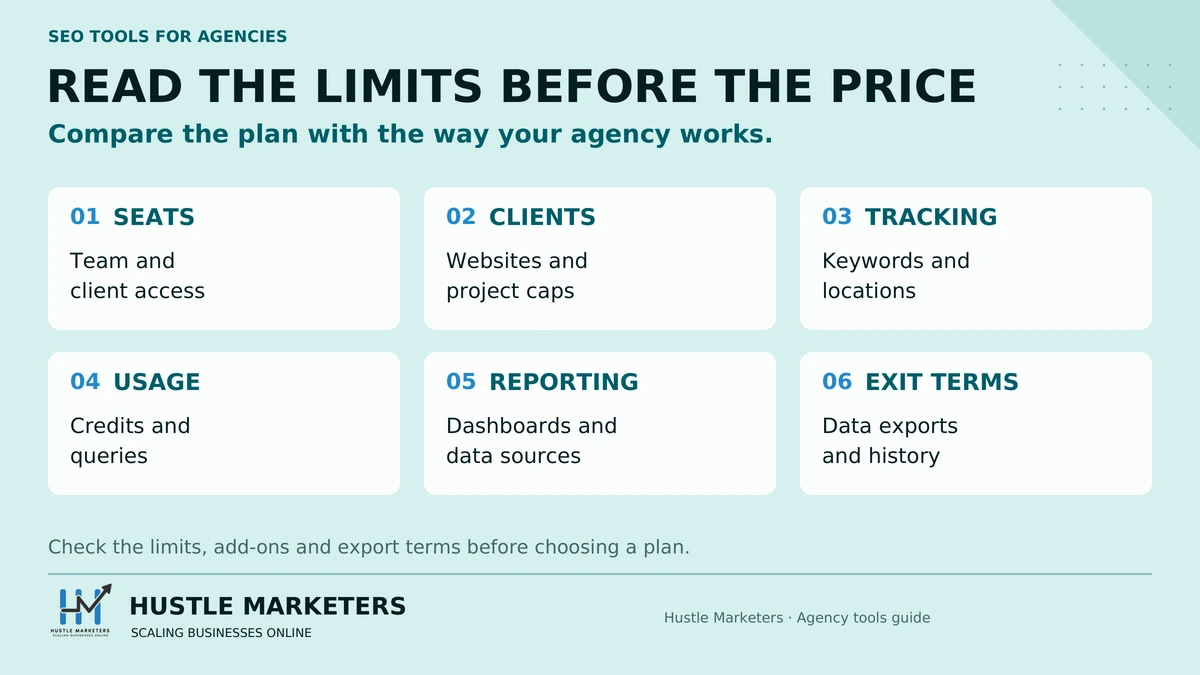
Nine pricing axes appear in that table. They are per seat, per client, per project, per dashboard, per website, per keyword band, per source credit, per grid point and per user license. A per-dashboard tool gets cheaper per client as you add clients, a per-client tool stays flat, and a per-user-per-project tool multiplies in two directions at once.
Roundups almost always quote the entry tier, which is the one price an agency with a client book will never pay.
Which tools publish a price, which publish a floor, and which publish nothing?
For an agency, the question of whether you can even find out what a tool costs comes before every other question. Three vendors we checked on October 1, 2026 land in three different places. The spread between them is the cleanest way to classify this whole category.
Clearscope publishes a real list price with capacity attached. Essentials is “$129/month” for 50 tracked queries and 50 pages, Business “$399/month” for 300 of each, read at clearscope.io/pricing on October 1, 2026. The same page states “No contracts. No hidden costs”.
seoClarity publishes floors and gates the real number. Research and Content starts at 2,500 dollars a month, Technical SEO at 3,200 and Enterprise at 4,500. Each one routes to a custom quote, read at seoclarity.net/pricing on October 1, 2026. The vendor adds that it prices packages on domains and keywords tracked, so every figure is a floor buying an unspecified capacity.
Conductor publishes no figure. The page names three plans and routes each one away from a price. In place of numbers it carries a line: “Pricing built around the value you get, not the seats you buy”. We read it at conductor.com/pricing on October 1, 2026.
Lumar is the same shape. Its pricing page is a lead form and its FAQ states “We price our solutions based on your individual needs.”, read at lumar.io/faq on October 1, 2026. Lumar publishes nothing about seats, projects, credits, contract term or mid-term reduction anywhere we could reach.
Whatagraph sits between the two: a number with the word from in front of it, plus an unpublished increment, which is a floor rather than a price.
Which vendors contradicted themselves on their own websites on one day?
Five, on October 1, 2026. This is the evidence behind the whole argument of this page. A price you read in a roundup, or on a vendor help page, is not a price you can plan a business on. All five are checkable today, and all five are self-contradictions rather than disagreements between sources.
| Vendor | What one page says | What another page on the same site says | Date both read |
|---|---|---|---|
| SE Ranking, client seats | The subscription page and FAQ both say the Agency Pack adds 30 client view-only seats | The Agency Pack page says it provides 10 client seats | October 1, 2026 |
| SE Ranking, standalone API | Subscription page: from 179 USD a month, annual billing | Home page: from 149 USD a month | October 1, 2026 |
| Semrush, tier names and API gating | The pricing page sells Free, SEO, Starter, Pro+ and Advanced, with API data integration under Advanced | The user-management help page still prices seats against legacy tier names, and the API help page gates the API on the Business tier, which the pricing page no longer sells | October 1, 2026 |
| Ahrefs, annual discount | Pricing page header: pay annually, save up to 17 percent | The same page’s meta description says up to 20 percent | October 1, 2026 |
| Mangools, annual discount | Pricing page metadata: annual plans save 35 percent | Its own blog post on the pricing change says up to 44 percent | October 1, 2026 |
Both have practical consequences. If you read the Semrush help documentation to price a second seat, you are reading a page priced against tiers that are no longer on sale. And client seats are the single reason an agency buys SE Ranking’s Agency Pack, where ten seats and 30 seats are different products at the same 69 dollars. We report both and pick neither.
This is also why we do not restate SE Ranking’s own Semrush comparison figures anywhere on this page, even though it publishes the most agency-relevant vendor comparison we found. A vendor that contradicts itself twice on its own site on one day is not a reliable source on its own pricing advantage.
Two further figure conflicts are worth knowing as evidence, never as facts. Surfer’s comparison page puts Clearscope at 189 dollars a month while Clearscope’s own page says 129 on the same date. AgencyAnalytics’ page puts DashThis at 49 dollars while DashThis publishes 44. Never take a competitor’s quotation of a rival’s price.
The twelve jobs an agency tool stack actually has to do
Most lists organize around what vendors sell. This one follows what an agency has to deliver, which is why four of the twelve jobs below have no product category behind them at all. The best SEO tools for agencies are not the same set as the best SEO tools. Stack maturity runs as a column.
Starter means one to roughly five clients, Growth roughly six to twenty-five, and Scale the point where data has to leave the tools. The jobs do not change as you grow. Only the point at which you pay for them does.
| Job | The question you are actually asking | Verified tools that serve it | Add at |
|---|---|---|---|
| 1. Prove the work is working | Did visibility move, and can I show it? | Google Search Console, SE Ranking, AccuRanker, Nightwatch, Morningscore, Semrush, Ahrefs | Starter |
| 2. Find the opportunity | Where is the demand we are not capturing? | Semrush, Ahrefs, SE Ranking, Mangools at the verified Entry tier | Starter |
| 3. Diagnose the site | What is broken, and can I crawl a site this big? | Screaming Frog, Sitebulb, SE Ranking, Semrush, Lumar | Starter |
| 4. Size up the competition and the gap | What do the sites beating my client have? | Semrush, Ahrefs, SE Ranking | Growth |
| 5. Plan and optimize content | What should we publish, and is this draft shippable? | Surfer, Clearscope, SE Ranking Content Editor | Growth |
| 6. Earn and defend links | Where do links come from, and is this profile a liability? | Ahrefs, Semrush, SE Ranking | Growth |
| 7. Serve multi-location and local clients | Does this client rank where its customers actually stand? | Local Falcon, SE Ranking, Semrush Local | Growth, or Starter if the book is local |
| 8. Report to the client every month | Can the client see progress, and does it carry my brand? | AgencyAnalytics, DashThis, Data Studio, Data Studio Pro, Whatagraph, Nightwatch | Starter |
| 9. Run the account: access, roles and offboarding | Who can see what, what does each person cost, and can I offboard cleanly? | SE Ranking, AgencyAnalytics, Ahrefs, Semrush | Growth |
| 10. Move data where the work happens | Can I get this into my own sheets or warehouse? | Data Studio, SE Ranking API, Ahrefs API, Semrush API, BigQuery | Scale |
| 11. Track visibility in AI answers | Are we being cited where answers are now given? | Covered on separate pages, linked below, not priced here | Scale |
| 12. Win the next engagement | Can the tool help me sell, not just deliver? | SE Ranking, AgencyAnalytics | Growth |
Job 1: how do you prove the work is working?
With the free product first, then a tracker whose pricing axis matches your book. Google Search Console is the only source in this job that gives you Google’s own measurement rather than a modeled estimate, and it costs nothing. Everything you pay for here buys cadence, history and presentation.
Search Console publishes limits that matter at agency scale. You can hold up to 1,000 properties in one account. A property takes a maximum of 100 non-owners, verified owners have no maximum, and Restricted user is the right read-only client grant. None of it can be bought out of, because the product is free.
Among paid trackers the axis differs sharply. Nightwatch and Morningscore meter websites, AccuRanker meters keyword bands and SE Ranking meters projects. An agency adding small clients fast wants a website axis; an agency adding few clients with large keyword sets wants a keyword axis.
Job 2: where do you find the opportunity, and what caps your research?
Keyword and market research is the one job where the big two suites are hard to replace, and it is also where the published caps are most often misreported. The cap that bites an agency is not the number of clients you can add. It is the number of sites you cannot verify.
Is the Ahrefs project cap really 5, 20 and 50?
No. Read at ahrefs.com/pricing on October 1, 2026, the limit splits in two, and the split changes the answer completely. Verified ownership runs unlimited on every paid tier. The unverified cap runs 5 on Lite, 20 on Standard, 50 on Advanced and 100 on Enterprise.
So a client site you can verify does not count against anything. An agency with 40 verified client sites hits no project wall on Lite at 129 dollars a month. What the 5, 20 and 50 actually limit is competitor research, prospect research and pitch work, which is unverified by definition.
That inverts the usual advice. An agency whose new business depends on pitching unverified prospects hits the wall at five sites on Lite and buys Standard for research capacity, not client capacity. Every competitor page we read reports this as a flat project cap, which is wrong in the direction that makes Ahrefs look more expensive for client work than it is.
Will you burn through Ahrefs credits doing normal research?
It is the most consistently reported complaint about the tool and the mechanism is specific: credits are consumed for re-viewing data that has already been pulled. For a solo user that is an annoyance. For an agency where three people open the same report in a week, it is a multiplier on the same research.
Seven named reviewers across two platforms describe it, from 2022 to 2026. Ramona J. on Capterra, October 18, 2022, reported eight credits consumed simply by logging in twice and viewing existing data. Kirill Z. followed on Capterra on June 14, 2023, and Tony L. on October 21, 2024. Ashmi D., Tufail A., Chloe S. and Praveen V. all raised it on G2 through 2026.
Ahrefs’ own terms corroborate the shape of it. Credits reset each billing cycle and do not roll over. On Lite, Standard and Advanced, API units stay fixed per cycle, with no add-on packages and no pay-as-you-go option. You cannot buy your way out of a short month below Enterprise.
Mangools is the cheap end of this job. Entry at 19.90 dollars a month on an annual subscription is the only Mangools price we could verify in server-rendered text. The refund window is 48 hours, and Mangools states at mangools.com/faq, read October 1, 2026, that sub-user seats from Premium share the parent account’s limits. Seats add logins, not capacity.
Job 3: how do you diagnose the site, and who is the license actually for?
This is the one job where the all-in-one framing breaks, because desktop crawlers charge per person rather than per seat, per client or per project. That difference is absent from every competitor page we read, and it is the reason agencies underpay in theory and overpay in practice.
Screaming Frog states it plainly on its pricing page: “Licences are per user. 2 users will require 2 individual licences”, read at screamingfrog.co.uk on October 1, 2026. Its FAQ adds that each key is for one authorized individual for the entire term. One license, one person, for a year.
There is no client read-only path and no documented branding feature. Agencies treat the crawler as a shared tool; it is not licensed as one. At 279 dollars per license per year for one to four, a five-analyst team is a five-license purchase.
Sitebulb is the obvious comparison and we cannot price its desktop tiers, because the pricing page renders its figures client side and Lite and Pro return placeholder text. The only readable vendor figure is Cloud, from 95 pounds a month.
For the delivery side of this job rather than the tooling side, see our technical SEO checklist and what an SEO audit costs.
Job 4: how do you size up the competition and the gap?
With the same two suites you already pay for, which is why this job rarely justifies a separate purchase. What it does justify is a tier decision, because competitive work is the thing that consumes the research capacity the entry tiers ration most tightly.
Ahrefs publishes 20 competitors per project on Lite, Standard and Advanced, and 100 on Enterprise. Semrush publishes websites monitored of 5 on SEO, 5 on Starter, 15 on Pro+ and 40 on Advanced, read at semrush.com/pricing on October 1, 2026. Your client staircase on Semrush is 5, then 15, then 40.
Job 5: how do you plan and optimize content without buying a second platform?
Two specialist tools publish prices here, and they price on completely different units. Clearscope meters tracked queries and pages. Surfer meters documents and seats. Neither publishes a client read-only role, so content tooling is an internal cost rather than something a client ever sees.
One warning on every Surfer figure you will see anywhere, including ours. Every published Surfer price is the monthly equivalent when billed yearly: Discovery 49 dollars, Standard 99, Pro 182 and Peace of Mind 299. The page publishes no month-to-month figure.
Surfer also publishes that unused limits do not roll over, and that annual subscribers receive the whole year of limit pools upfront with no rollover into the next year. Combined with downgrades taking effect at the end of the billing period, an annual Surfer commitment is harder to unwind than the contract language suggests.
Job 6: how do you earn and defend links on tools you already own?
Below enterprise scale this job rarely needs a dedicated purchase. The suites already in your stack publish link data. The decision is a tier decision driven by credits and API units rather than a new vendor, so the table below is the whole section.
| Tool, read October 1, 2026 | What constrains link work | Published figures |
|---|---|---|
| Ahrefs | Credits and API units, both fixed per cycle below Enterprise | API rows per request 100, 250 and 500 on Lite, Standard and Advanced. Integration units 200,000, 800,000 and 2M. Credits reset each cycle and do not roll over |
| Semrush | API gating and unit expiry | API packages sold at 2M, 5M, 10M and 20M units, with the package price NOT PUBLISHED. Unused units expire rather than carrying over |
| SE Ranking | API credits per plan | 25,000 credits on Core and 100,000 on Growth, both with MCP access. Pay-as-you-go wallet credits are published as not expiring |
Job 7: how do you serve multi-location and local clients?
With a grid tool, and with an understanding of why two grid tools give two different answers for the same client on the same day. That disagreement is a methodology choice rather than a bug, and neither vendor frames it as one.
Yan Gilbert, a practitioner posting on LocalSearchForum on October 26, 2018, described the mechanism: BrightLocal measures from the zip code center while Local Falcon measures from exact geo-coordinates. If you switch tools mid-engagement and your rankings appear to move, that may be the only thing that moved.
Local Falcon’s meter is one credit per grid point. A five by five grid consumes 25 credits and a nine by nine consumes 81. Pay-as-you-go credits cost 5 cents each, read at localfalcon.com/pricing on October 1, 2026. Starter is 24.99 dollars a month for 7,500 credits.
The mechanic that costs agencies money is expiry. Local Falcon publishes that monthly-package credits expire at the end of each month, while annual-plan credits expire at the end of the year. Its own stated workaround is to buy annually, so credits roll over each month. A lumpy scan schedule wastes grant.
Sharing is the strongest in this job: Local Falcon publishes that “No login is necessary to view the results of a scan”, on all report and account types. White Label Reports are on every tier, but white-labeled Data Studio output needs Basic or higher, at 49.99 dollars rather than 24.99.
One named client-count break exists in all the research behind this page, and it is a reporting cap rather than an account cap. Magen H., a project manager reviewing BrightLocal on Capterra on April 20, 2023, described holding 77 locations and needing two accounts because reporting managed only 50 per account. Treat it as one reviewer’s account, because it is.
Job 8: which reporting tool should you buy, and what does it really cost?
This job has the widest cost spread in the whole stack. The same thirty clients cost anything from nothing to 2,700 dollars a month on Google’s published Data Studio rates, depending entirely on which pricing axis you choose. Two published facts decide it, and neither appears on a single competitor page we read.
Why is Data Studio Pro priced per user per project, not per user?
Because the license attaches to the Google Cloud project, not to the person. Google publishes Data Studio Pro at “$9 per user per project per month”, read on October 1, 2026 at cloud.google.com/looker-studio. That one word, project, is the most commercially significant word in this category.
Work it through. An agency that isolates each client in its own Google Cloud project, the normal reason to use Pro at all, pays 9 dollars per user for each project. Ten staff across 30 client projects is 300 licenses, or 2,700 dollars a month.
Against that, AgencyAnalytics at 20 dollars per client per month covers the same 30 clients for 600 dollars at list, with unlimited staff and client users. That is a four and a half times difference on the same client book, driven by the axis alone.
Google qualifies its own figure, and the qualifier matters. The same page states that the per-user price “varies depending on the length of the customer’s subscription”, so 9 dollars is a list rate rather than a committed one.
Whether a client report viewer needs a 9 dollar license is not published, so our figures include staff only and may understate. An agency that puts every client in one shared Cloud project pays per user once, which collapses the cost and abandons the per-client isolation that justified Pro.
Note also that the Google pages we read carried legacy Data Studio naming, and the canonical pricing URL returned a 404.
Why pay for a reporting layer when Search Console exports for free?
Because of a row cap that almost nobody in this category mentions. Google publishes that a Search Console Performance report export is “truncated to 1,000 rows of representative examples of your data”, at Google’s export documentation, read October 1, 2026. Report totals stay complete; the exported rows do not.
The Search Analytics API lifts that ceiling twenty-five fold. Google publishes the rowLimit parameter as valid in the range 1 to 25,000, with a default of 1,000. We read that at the Search Analytics query reference on October 1, 2026.
Read the default again. A connector that does not set rowLimit silently inherits the small cap. A dashboard built on the same API can then deliver the same 1,000 rows as the download button while looking like a real pipeline. That is the actual argument for a paid reporting layer.
So ask any reporting vendor: what rowLimit does your Search Console connector set. No vendor in this set publishes an answer.
What the numbers in a client report mean, and why they will never match Search Console exactly, is a separate problem from which tool to buy. We cover that in our guide to automated SEO reports and will not re-explain the metrics here.
Job 9: how do you run the account, and what happens when a client leaves?
This is the longest section on this page because it is the one nobody writes. Access, roles, white-label gating, annual-only purchases and exit terms are the mechanics that decide your real bill. Across 38 competitor pages read in full, exit terms appear zero times.
Does giving a client a read-only login consume a paid seat?
Exactly one vendor publishes a clean answer to this, and the commercial spread between the best and worst case is extreme. Here is where each verified tool sits, all read on October 1, 2026.
| Tool | What the vendor publishes about client access, read October 1, 2026 | Does it cost a seat? |
|---|---|---|
| SE Ranking | Client view-only seats come with the Agency Pack at 69 USD a month, annual billing only. Separately, on the Growth plan, “Guest links let you share a live, view-only link to your data without using up a seat” | No. Client seats are a separate pool from manager seats, and guest links are published as seat-free |
| AgencyAnalytics | A client login, and a shared report or dashboard that “opens read-only with no sign-in”. The vendor states client and staff users are unlimited, so it costs nothing either way | No |
| DashThis | Link sharing on every tier. The help center states “No login needed.” and that the dashboard opens in view mode so nobody can edit it | No. No account is created |
| Local Falcon | “No login is necessary to view the results of a scan”, on all report types and all account types | No |
| Data Studio, free tier | Available at no charge for creators and report viewers | No |
| Semrush | Free view-only folder sharing, but a recipient needs a registered Semrush account, and restricted-editing guests need their own subscription | Not for viewing, but the client must create an account. The tier this starts at is NOT PUBLISHED |
| Ahrefs | Access control is published as Enterprise only, at 1,499 USD a month with an annual commitment. There is no separate Viewer role; all Guests are view-only. Below Enterprise the published client route is an emailed PDF | Unclear. Whether a Guest consumes a seat is NOT PUBLISHED, and the FAQ states everyone who needs their own Ahrefs login requires a dedicated seat |
| Morningscore | A live client report via a magic link; the tier gate is NOT PUBLISHED | NOT PUBLISHED |
| Screaming Frog, Sitebulb, Surfer, Lumar, AccuRanker, Whatagraph, Mangools | No client read-only login is published with a tier and a price on any page we reached | NOT PUBLISHED |
The spread is the finding. The same capability is a client looking at live data without editing it. It is free on four tools, a 69 dollar add-on on one, and effectively a 1,499 dollar a month enterprise purchase on another.
Can you white-label the platform itself, not just the PDF?
Two vendors publish a clear logo-removal answer and both gate it. SE Ranking puts platform and report white labeling inside the Agency Pack at 69 dollars a month, annual only. That includes a custom domain and reports from your own SMTP server. Semrush sells report branding as a Pro Reports add-on at 20 dollars per report.
Nightwatch gates white label on volume rather than on tier name. Its documentation states the feature “is available on plans with more than 1000 tracked keywords”, read at Nightwatch documentation on October 1, 2026. Starter tracks 500, so Starter never qualifies, whatever you pay.
Price that out. An agency with five clients needing white label cannot use the 79 euro Starter. It must buy Professional at 159 euros, which doubles the real five-client cost from 15.80 to 31.80 euros per client.
Ahrefs, Sitebulb, Surfer and Lumar publish no logo-removal statement, and Screaming Frog publishes no branding feature at all. If white label is a requirement rather than a preference, it eliminates tools before price does. Our white label SEO services and white label SEO pricing pages cover the buy side.
Which SEO automation tool can an agency run under its own brand?
We use Boostifai for this. Agencies can run the platform under their own brand, and its agency plans include white label reports: EUR 247 a month for up to 4 client sites, EUR 499 for up to 10 and EUR 999 for up to 25, with 1, 10 and 25 user logins (checked 14 October 2026).
For client work, two things set it apart from the rest of this stack. A pixel applies approved on-page fixes (titles, meta descriptions, H1s, alt text, schema) across a client’s pages in one go, and the AI Insight module shows each client how ChatGPT, Gemini, Claude and DeepSeek describe their brand, with sentiment broken down by model and the reasoning behind each score. It also tracks organic conversions and sales, so SEO can be reported to clients like ROAS. As with every tool on this page, confirm which parts carry your brand (reports, dashboard, client logins), what happens to applied changes when a client leaves, and the exit terms.
Drop a client mid-term: money back, credit, or nothing?
Start with the question AgencyAnalytics asks about itself, in public, in its own billing FAQ: why didn’t my renewal price decrease when I deleted a Client. It is the most commercially loaded question in this entire category, and it is the only place we found any vendor raising it.
Its published answer is that “Your renewal is based on the Client count of your subscription” rather than on how many clients are in use. Reducing the count produces account credit toward future charges. On annual plans the vendor states that it offers no prorated or partial refund if you cancel partway through the year.
That is the only published answer, and it is credit rather than cash. Here is everybody else.
| Vendor | Published position on reducing seats, clients or plan size mid-term |
|---|---|
| Ahrefs | Downgrades are queued and take effect at the end of the current billing period. Upgrades are immediate and prorated. Nothing is published about money returned on a reduction |
| Surfer | Downgrades are scheduled for the end of the billing period, excess members are deactivated, and on an annual plan the reduction waits until the end of the year |
| Sitebulb | A canceled license runs until its expiry date, which is the next billing period. Whether a refund or credit follows is NOT PUBLISHED |
| Semrush | Downgrades and seat removals both require contacting support; whether money is refunded or prorated is NOT PUBLISHED. The published refund route is a one-time 7-day money-back guarantee on initial annual purchases |
| SE Ranking | Upgrade, downgrade and add-on cancellation are offered, with monthly plans described as no lock-in. When a reduction takes effect, and whether it is prorated, are NOT PUBLISHED |
| Morningscore | Upgrade or downgrade any time through settings; monthly unbound, yearly bound for 12 months. No proration or refund rule is published |
| AccuRanker | Prepaid fees are non-refundable because the license is delivered upfront. Termination needs 14 days notice to the period end, with no refund for the unused remainder |
| Lumar | Nothing, anywhere, including in its terms of use |
| Whatagraph, Nightwatch, Local Falcon, Mangools, Clearscope, Conductor, seoClarity | NOT PUBLISHED. Mangools publishes only a 48-hour refund window |
| Screaming Frog | None exists: each license is a separate one-year purchase that you do not renew. Full refund within 14 days of purchase |
Not one of the 21 vendors we checked publishes whether a seat you remove is refunded or credited. Three publish that the reduction waits for the period boundary, which answers when but not what happens to the money.
Which agency features are gated behind an annual-only purchase?
Three, and all three are features an agency specifically needs. SE Ranking’s Agency Pack, which carries client seats and white label, is annual billing only. So are its standalone API plans. Ahrefs Enterprise, the tier carrying the Guest role, requires an annual commitment.
Whatagraph publishes both tiers as billed annually with no monthly price. Morningscore’s yearly plans carry a 12-month binding period. The pattern is consistent: the capability that makes a tool usable for client work is the one you cannot buy for a month to test.
Can you take your history with you when you leave?
Sometimes, and the asymmetry is the point. SE Ranking publishes named import paths for ranking history from Semrush, AgencyAnalytics and Rank Ranger. AgencyAnalytics publishes a bulk historical import plus client transfer and export articles.
Nobody publishes the reverse journey with the same enthusiasm, so switching cost is low in the direction a vendor wants you to travel and undocumented in the other. Lumar states only that data stays available until the account expires. Semrush states that it keeps website monitoring data for 30 days after a downgrade. Ask every vendor in writing.
One billing pattern recurs widely enough to mention and too loosely to quantify. Eleven or more named or part-named reviewers across Trustpilot, Capterra and GetApp describe Semrush charges arriving after a cancellation they believed had completed. The recurring stated mechanism is a multi-step cancellation that requires an email confirmation.
We report that as observed across review platforms rather than as a rate. Review platforms attract billing complaints disproportionately, and Semrush has the largest user base in this set. If you cancel, confirm in writing that the cancellation completed.
Job 10: how do you move data out to where the work actually happens?
Through an API, a connector or a warehouse, and the billing unit changes with each. Four vendors in this set publish an MCP server or connector layer: SE Ranking, Ahrefs, DashThis and AgencyAnalytics. No competitor page we read names that layer at all.
The published units are credits at SE Ranking, fixed integration units at Ahrefs with no overage below Enterprise, and expiring packages at Semrush whose prices are not published. Pick on expiry and overage, not headline allowance.
Job 11: how do you track visibility in AI answers?
Not with the tools on this page. AI answer visibility is a separate category with its own evidence base and its own pricing mechanics, and pricing or ranking one of those tools here would mean doing it badly on a page that exists to price things properly.
We cover the tooling in AI SEO tools and AI visibility tools, the method in answer engine optimization, and the measurement in tracking brand visibility in AI search.
Job 12: can a tool help you win the next engagement?
Two in this set publish a sales-side feature rather than a delivery one. SE Ranking’s Agency Pack includes a Lead Generator audit widget and agency catalog placement. AgencyAnalytics publishes proposals and a client portal on its single tier. Both sit behind the gates priced above, so neither alone is a reason to switch.
Treat a sales feature as a tiebreaker between two tools you would otherwise buy, never as the reason to buy one.
Four head to head comparisons that matter to an agency
For each of these pairs, the only comparison pages we found came from one of the two tools in the pair. We compare only on the agency mechanics both sides publish, and leave the generic feature arguments to the vendors who have something to sell.
Ahrefs against SE Ranking is a row rather than a section, because an agency comparing those two is usually really comparing SE Ranking to Semrush.
Semrush vs SE Ranking, on seats, client access and projects
SE Ranking publishes the most agency-relevant vendor comparison we found anywhere, and Semrush publishes no page for this pair at all. We deliberately do not restate SE Ranking’s own comparison figures, because it contradicted itself twice on its own site on the day we checked.
| Mechanic, read October 1, 2026 | Semrush | SE Ranking |
|---|---|---|
| Entry price | 139 USD a month, SEO tier | 129 USD a month, Core |
| Client staircase | 5 websites, then 15 at Pro+ 299 USD, then 40 at Advanced 549 USD | 10 projects on Core, 30 on Growth 279 USD |
| Seats included | One owner seat; the count bundled per tier is NOT PUBLISHED | 1 manager on Core, 3 on Growth, extras from 16 USD a month |
| Client view-only access | Free folder sharing, but the client needs a Semrush account; the tier is NOT PUBLISHED | Client seats in the 69 USD Agency Pack, annual only, published as 10 or 30 depending on the page |
| White label | Report branding only, via a 20 USD per report add-on | Platform and reports, inside the Agency Pack |
The honest summary: SE Ranking is the cheaper way to give clients a login and your own branding, if you can commit annually. Semrush is the cheaper way to add client sites if you need neither.
Screaming Frog vs Sitebulb, on licensing rather than features
Only Sitebulb publishes a page for this pair, and that page makes no seat or crawl-credit comparison at all. Meanwhile Screaming Frog publishes a full licensing FAQ covering users per license, device use, transfers, expiry and refunds. The licensing axis is the comparison neither side makes.
Screaming Frog is 279 dollars per license per year at one to four, one person per license, transferable once a year, with a 14-day refund window. Its ceiling is the machine: three named Capterra reviewers describe memory exhaustion on large client sites.
Sitebulb’s Lite and Pro base prices are NOT PUBLISHED in readable vendor text, because the pricing table renders client side and returns placeholder text on fetch. Its published figures are Cloud from 95 pounds a month, extra users from 7 pounds, Lite capped at 10,000 URLs per audit and Pro at 500,000.
So the decision is structural. Screaming Frog costs per analyst and runs on their machine; Sitebulb Cloud costs per plan and removes the machine ceiling. Both quote in pounds, so no dollar figure exists without a conversion you make yourself.
AgencyAnalytics vs DashThis, where the axis is the whole argument
Both publish pages about each other and neither publishes the thing that decides it. AgencyAnalytics charges per client at 20 dollars; DashThis charges per dashboard in tiers of 3, 10, 25 and 50. On one dashboard per client, DashThis is more expensive at 5 clients and cheaper at 15 and 30.
The crossover moves the moment a client needs two dashboards, or more sources than the tier allows. Business publishes 100 sources against 25 dashboards, four per client at full use, and a stack of ads, analytics, Search Console and a tracker needs five.
Semrush vs Ahrefs, the agency cut only
| Mechanic, read October 1, 2026 | Semrush | Ahrefs |
|---|---|---|
| Extra seat | From 45 USD a month | 40, 60 and 80 USD a month by tier, capped at 2, 5 and 10 extras |
| Client access | Free view-only sharing, client needs an account | Guest role on Enterprise only, 1,499 USD a month with annual commitment |
| Site or project cap | 5, 5, 15 and 40 websites monitored | Unlimited verified; 5, 20, 50 and 100 unverified |
| Report caps | Base reports from 1 to 3 plus 2 per extra toolkit; Pro Reports at 20 USD each | Report Builder: 5, 5, 15 and 25 reports by tier, plus a 99 USD add-on for 50 |
Which of these tools are genuinely free, and which are only free for 14 days?
Four of the best SEO tools for agencies are permanently free, and most of the rest are 14-day trials that roundups routinely label as free. We hold the same distinction on free PPC tools. It is the difference between a tool you can build a process on and a tool you can only evaluate.
Genuinely free, with no card and no expiry: Google Search Console, Google Analytics 4 and Data Studio’s free tier. Also free: the Screaming Frog version capped at 500 URLs per crawl. Semrush’s free plan gives one demo project and ten reports a day, and Mangools publishes a free plan too. Local Falcon gives 100 signup credits, which buys four five-by-five scans.
Everything else is a trial, and only SE Ranking and Sitebulb Desktop state clearly that they ask for no card, both at 14 days. Ahrefs and Surfer do not publish it. Data Studio Pro’s 30-day trial begins billing automatically on day 31.
Questions agencies ask that vendors only answer about themselves
Seven of the ten best questions in this category are ones vendors ask and answer about themselves, with nobody answering them across tools. These eight answers carry no FAQPage markup, deliberately. Google no longer shows FAQ rich results for pages like this one, so marking questions up to chase a feature nobody sees adds weight without value.
How much should an agency budget for SEO tools?
Not one number, because the axis decides it. On the figures above, a 15-client stack built from the best SEO tools for agencies, one suite plus one tracker plus one reporting tool, runs roughly 300 to 900 dollars a month at list. That is before white label and add-ons.
Is one all-in-one platform cheaper than several specialist tools?
Below roughly ten clients, usually yes, because the entry tier covers every job thinly. Above that, the client staircase forces tier jumps you do not need, and a per-client reporting layer plus a cheaper tracker often lands lower.
What does a second seat actually cost?
Only three vendors publish a clean per-seat number. Ahrefs charges 40, 60 and 80 dollars by tier, SE Ranking from 16 dollars, and Screaming Frog charges the license price itself. Surfer, Lumar and Sitebulb publish no figure. Semrush publishes one from 45 dollars without saying how many seats each tier includes.
Do I need a separate rank tracker if my platform already has one?
Only if the platform’s keyword allowance forces a tier jump a standalone tracker would not. Semrush tracks 500 keywords daily on its two lower tiers and 1,500 on Pro+, so 100 keywords per client exhausts 500 at five clients.
What breaks first as you scale: seats, projects, keywords or credits?
On the published caps it depends on the axis. Seats break first on Morningscore Lite at two users, websites on Nightwatch Professional at 25, credits on Ahrefs Lite, and data sources rather than dashboards on DashThis Business.
Can I audit a prospect’s site without it counting against a project cap?
On Ahrefs, no, and that is the only tool in the set where the cap is published in a way that answers the question. Prospect and competitor sites are unverified by definition, so they are exactly what the 5, 20 and 50 limits ration.
Can I migrate ranking history from my current tool, and is it free?
Named import paths exist. SE Ranking publishes help articles for importing ranking history from Semrush, from AgencyAnalytics and from Rank Ranger, and AgencyAnalytics publishes a bulk historical import plus client transfer and export articles. Whether any of it is free is not published on the pages we read.
Can I pause keyword tracking without losing my history?
SE Ranking is the only vendor that raises the question on its own site. We did not verify its answer at source for this build, so we are not going to state one. Get it in writing before you commit a client book to any tracker.