Best SEO Professionals: Who Is Actually Available to Hire

Ishant
Published : October 15, 2026 at 10:30 am
Updated : October 7, 2026 at 6:38 am
Ishant

Every list of the best SEO professionals names roughly the same six people. We read eighteen ranking pages and counted every name to check. Six individuals appear on seven to nine of the thirteen lists.
What none of those pages tells you is which of them actually takes clients. Eight of the thirteen also put the publisher’s own founder at or near number one. This page does the part they skip.
Key Observations
The short answer: the same six names carry this entire search result, availability is the thing nobody checks, and most of these lists were written by people selling the service they are ranking.
- Six names dominate. Aleyda Solis, Barry Schwartz, Marie Haynes, Brian Dean, Rand Fishkin and Stephan Spencer each appear on seven to nine of the thirteen lists we counted. Around 130 names appear in total, and only 21 appear on three or more lists.
- Famous and hireable are not the same thing. We checked the six most-listed people on their own sites. One runs SEO consulting as her main business. One caps it to a small number of clients. One is a news editor whose company builds web software. One sells coaching and consulting. Two run software products.
- The most transparent ranking measures fame. One Little Web publishes its weighting, and gives 60 percent of the score to social following. Instagram followers carry the same weight as having authored SEO books.
- Eight of thirteen lists rank their own founder first or second. Not one of the eighteen pages we read carries a conflict of interest statement.
- No page gives a price. Zero of eighteen state a fee, a band, or a minimum engagement, which is the first thing a buyer needs.
- Google publishes eight questions to ask and nine warnings. They are quoted in full below, and they are better than anything in the listicles.
We sell SEO, so we have left ourselves off the ranking. The reason is explained near the end, and it is the one thing none of the competing pages does.
On this page
Fourteen sections. Sections one to four deal with the lists themselves and who is really available to hire. Then come five sections of practical vetting work, grounded in Google’s own published guidance and in what working SEOs say about providers they have watched fail. Last are what this should cost, our own conflict of interest stated plainly, and where to look when the person you wanted is not taking clients.
Who are the best SEO professionals?
The names that appear most often across published rankings are Aleyda Solis, Barry Schwartz, Marie Haynes, Brian Dean, Rand Fishkin and Stephan Spencer. All six have a long public record. What the rankings do not tell you is that they are in very different businesses now, and only some of them sell SEO work to clients.
That matters because this is a hiring search. If you are reading a list of the best SEO professionals, you probably want to engage one. A list that ranks people by audience size answers a different question: who is best known. Those two answers have drifted a long way apart.
So this page is organized around availability and evidence rather than fame. It names the people the lists name, then says what each one is doing now, with a link to their own site and the date we checked. After that comes the vetting method you will need whoever you hire, including the eight questions Google itself tells you to ask.
Is there a single best SEO expert in the world?
No, and any page claiming to have found one is ranking on a popularity signal. SEO splits into distinct specialties: technical and crawl work, international, ecommerce, local, content, and now AI search visibility. The best person for a large multilingual store is not the best person for a two-location dental practice. Ask who is best for your specific problem instead.
Why does every list name the same people?
Because most of these rankings score public visibility, and visibility compounds. We counted every named individual across thirteen lists. About 130 people appear, but only 21 appear on three or more lists, and six appear on seven to nine. The tail is padding from two pages that list thirty-plus names each.
| Name | Lists it appears on, out of 13 |
|---|---|
| Aleyda Solis | 9 |
| Barry Schwartz | 8 |
| Marie Haynes | 8 |
| Brian Dean | 8 |
| Rand Fishkin | 7 |
| Stephan Spencer | 7 |
| Lily Ray | 6 |
| Ann Smarty | 6 |
| Neil Patel | 5 |
| Danny Sullivan | 5 |
| Craig Campbell | 5 |
| Cyrus Shepard | 4 |
| Matt Diggity | 4 |
| Kevin Indig | 4 |
| Eric Enge | 4 |
| Vanessa Fox | 4 |
Searchers have noticed. One of the Quora questions ranking for this topic is literally who the top SEO experts are “besides Neil Patel, Josh King Madrid, Rand Fishkin, and Brian Dean”. The question only exists because the standard names are assumed and unwanted.
Working practitioners are blunter about the genre. Writing about expert lists, Myriam Jessier and Mike Ginley say such lists “may be generated by LLMs, or they may have ulterior motives”. They also note that language models keep recommending people who stopped practicing years ago.
How are these rankings actually scored?
Four of the eighteen pages state a method. Only one is genuinely reproducible, and the two best-known weight the wrong thing.
One Little Web deserves credit for publishing its weighting in full, and the weighting is the story. Its model splits into Authority and Expertise at 20 percent, Online Presence at 20 percent, and Followers and Reach at 60 percent, with that 60 broken into LinkedIn 20, X 20, YouTube 10, Instagram 5 and Facebook 5.
Read that against the Authority bucket in the same published model, where authoring SEO books is worth 5 percent. Instagram followers and published SEO books carry identical weight. So the most methodologically transparent page in this search is transparently measuring fame.
First Page Sage also publishes a weighted model, led by keynote speaking at 35 percent, and then ranks its own founder first. A weighting that lands the publisher at number one is hard to read as independent.
The strongest methodology we found is on a companies list rather than a people list. Loopex Digital requires a minimum of thirty Clutch or DesignRush reviews, a rating of 4.7 or better, at least 70 percent of services in SEO, and five or more years active. Every one of those four is something you can re-run yourself this afternoon. That is what a checkable method looks like.
Famous is not the same as available to hire
This is the gap in every page we read. Not one of the eighteen separates people who currently sell SEO services from people who have moved into software, media, news or education. Two lists carry a yes or no availability flag, but neither says what you would actually be buying, and none of them states an engagement shape, a minimum, or a price.
None of this is a criticism of the people. Building a software company or becoming the industry’s news editor is a perfectly good career. The criticism is of the lists, which are sold as hiring shortlists while answering a fame question, and which go stale because nobody re-checks the per-person facts.
Here is what a reader actually needs next to a name, and how many of the eighteen pages provide it.
| What a buyer needs to know | Pages that provide it |
|---|---|
| Whether the person currently sells SEO services | 2 of 18, as a yes or no flag only |
| What you would be buying: retainer, project, audit, or advisory hours | 0 of 18 |
| Any price, band, or order of magnitude | 0 of 18 |
| Minimum engagement size | 0 of 18 |
| The client profile they actually take | 0 of 18 |
| A named client or a checkable outcome for that individual | 0 of 18 |
| A last-verified date on the per-person facts | 0 of 18 |
| Whether inclusion was paid, sponsored or self-nominated | 0 of 18 |
| What to do if the person is unavailable | 0 of 18 |
One page openly invites people to nominate themselves for next year’s edition, without saying whether nomination affects placement. We are not naming it to score a point, but it is worth knowing that self-nomination is a live mechanism in this genre.
What the most-listed experts are actually doing now
We opened each person’s own website on September 29, 2026 and recorded what it says. These are observations with a date and a link, not judgments about anyone’s ability. If any of it is out of date, tell us and we will correct it.
| Person | What their own site says, checked September 29, 2026 | Reads as |
|---|---|---|
| Aleyda Solis | Orainti lists six service lines, including international SEO and AI search, audits, enterprise and startup strategy, training, and on-demand strategic advice. The inquiry form says they will reply “if Orainti is the right fit”. Named clients include Turo, Trade Republic and FreshBooks. | Selling SEO consulting as the main business, and screening for fit |
| Marie Haynes | Her site sells an AI Strategy Report, a Traffic Drop Assessment and AI Strategist engagements, alongside a book, a paid newsletter, a community and a podcast. It states “I strategize with a small number of clients”. | Consulting available but deliberately capped, with media and education alongside |
| Barry Schwartz | His page lists him as CEO of RustyBrick, Executive Editor of Search Engine Roundtable and News Editor at Search Engine Land. RustyBrick is described as a New York web service firm. The page offers a site consultation and says he “offers search marketing and SEO expert witness services”. | Available for consultation and expert witness work, but not a retained SEO provider |
| Rand Fishkin | SparkToro describes itself as “a software company founded by Casey Henry and Rand Fishkin”. He is CEO and co-founder. The about page names no consulting service. | Running a software product, no consulting offer found |
| Brian Dean | Exploding Topics lists him as Co-Founder and CEO of a trend discovery and market intelligence platform. We found no page offering SEO consulting. | Running a software product, no consulting offer found |
| Stephan Spencer | His site sells coaching, consulting and training, currently framed around AI adoption. He co-authored The Art of SEO. | Selling consulting and coaching |
The pattern is the point. Of the five most-listed people, one runs SEO consulting as her primary business, one caps it tightly, one offers consultations alongside a news job and a web development firm, and two run software companies. A reader who took the top of these lists as a shortlist to email would spend most of that effort on people who do not sell the service.
What does Google tell you to ask before hiring?
Google publishes eight questions on its own documentation page about hiring an SEO. They are better than the questions in most of the listicles, they are free, and almost nobody quotes them. Here they are exactly as Google words them.
- “Can you show me examples of your previous work and share some success stories?”
- “Do you follow the Google Search Essentials (previously known as Webmaster Guidelines)?”
- “What kind of results do you expect to see, and in what timeframe? How do you measure your success?”
- “What’s your experience in my industry?”
- “What’s your experience in my country/city?”
- “What’s your experience developing international sites?”
- “How long have you been in business?”
- “How can I expect to communicate with you? Will you share with me all the changes you make to my site, and provide detailed information about your recommendations and the reasoning behind them?”
Source: Google Search Central, Do you need an SEO.
We also keep a longer vetting checklist in how to choose an SEO company, written for the Australian market but the questions travel.
The eighth one is the most revealing in practice. An SEO who will not show you every change they make to your site is asking you to accept work you cannot audit, which is also how sites end up with changes nobody can explain two years later.
One more thing Google says on that page that is worth holding onto when you grant access: “Be sure to carefully consider what’s involved and only grant read access to Search Console”
Which red flags does Google itself name?
Nine of them, on the same page, quoted exactly. If a proposal in front of you trips any of these, you have your answer without needing a second opinion.
- “No one can guarantee a #1 ranking on Google.”
- “If they guarantee you that their changes will give you first place in search results, find someone else.”
- “Beware of SEOs that claim to guarantee rankings, allege a ‘special relationship’ with Google”
- “Be wary of tools that claim to be ‘acceptable’ or ‘approved’ by Google Search.”
- “Be wary of SEO firms and web consultants or agencies that email you out of the blue.”
- “Be careful if a company is secretive or won’t clearly explain what they intend to do.”
- “You should never have to link to an SEO.”
- “Avoid SEOs that talk about link popularity schemes or submitting your site to thousands of search engines.”
- “Be sure to carefully consider what’s involved and only grant read access to Search Console”
All nine from Google’s own hiring guidance. We have quoted rather than paraphrased on purpose, because the exact wording is what you want if you ever have to point at it in an email.
What red flags do working SEOs name?
Google covers the obvious frauds. The sharper warnings come from practitioners and from buyers who have been through it, and they are about deliverables that look like work but carry no measurement. We collected these from public forums and videos, with links at each claim.
| Red flag | What was actually said | Source |
|---|---|---|
| Deliverables sold as results | Bruce Clay gives “I will edit eight pages per month” as the classic example of an activity list mistaken for return on investment. | Search Engine Land |
| The KPI changes every month | “If they keep switching KPIs every month, they’re probably hiding something.” | Ryan Knoll, How to Hire an SEO |
| No client references | “Can I talk to two of your clients? No references equals no deal.” | Ryan Knoll |
| The price is suspiciously low | “When the SEO feels too cheap, it probably is.” | Ryan Knoll |
| Site speed scores sold as the offer | A named red flag is the pitch that “will improve your site speed and SEO score”, because a tool score is not a business outcome. | The Leaf Strategy |
| Promising page one on competitive terms | A legitimate SEO “will not promise first page results for highly competitive terms”, and will decline a site only a few months old. | Warrior Forum |
| Reporting rankings instead of revenue | “Agencies eat your cash for 6 months then deliver 12 keyword rankings” | Indie Hackers |
| Traffic that the vendor manufactured | One buyer found a provider “spamming my site excessively to artificially inflate traffic numbers”. | BlackHatWorld |
| Testimonials you cannot trace | “It seems like these reviews are generated from fake accounts.” | BlackHatWorld |
If you want the version of this we hold ourselves to, our reporting integrity standard sets out which numbers go in a client report, which are labeled as vendor estimates, and which we refuse to use at all. Our SEO reporting explains the format.
The recurring theme across all of them is measurement. Buyers are not mainly afraid of being overcharged. They are afraid of paying for months of activity that cannot be tied to anything, which is why one long-running Hacker News thread on the subject opens with the complaint that “Results are not instantly or even actually measureable.”
It is worth sitting with how harsh the sentiment gets. In the same discussion, a company with two decades of history says of the SEO providers it has used: “None of them have delivered anything tangible.” That is the room you walk into as a buyer. It is also why evidence matters more than a list position.
How do you verify what an SEO expert claims?
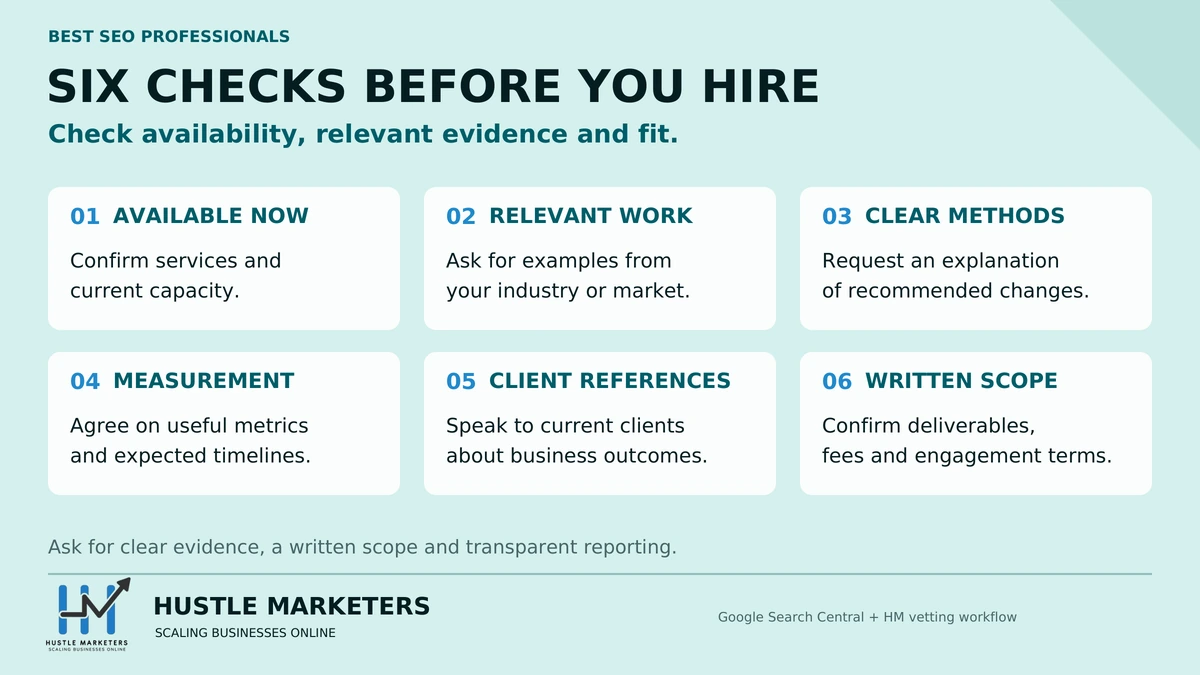
Ask for two current client references and actually call them, require every site change to be disclosed, check the case studies for revenue rather than rankings, and structure the first payment around something you can verify. None of this needs a tool, and all of it is what experienced buyers say they wish they had done first.
Here is the sequence, in the order that saves you money.
- Ask the eight Google questions first. They cost nothing and they filter fast. The answers to the industry, country and international questions tell you whether the person has done your specific job before.
- Ask to speak to two current clients, not past ones. Past clients are curated. A provider who will not connect you to anyone working with them right now is telling you something.
- Read the case studies for the business number. Inquiries, calls, orders, revenue. A case study whose headline is a keyword position has chosen the metric that is easiest to move.
- Ask what happens when Google updates. The answer separates people who have lived through several updates from people who have read about them.
- Ask specifically what kind of links they build, if any. A vague answer here is the single most common precursor to a problem. Remember Google’s line that you should never have to link to an SEO.
- Require disclosure of every change. Ask for a running change log. If they resist, you are buying work you cannot audit.
- Start small and paid. A scoped audit or a single-month engagement tells you more than any pitch. Buyers on public forums repeatedly recommend a small paid trial before committing.
- Tie money to something checkable. One long forum thread on the subject settles on the principle to “pay for documented performance as much as possible”. On marketplaces, some buyers use escrow so that “funds would not be disbursed until certain agreed targets are met”.
A note on the reference call, because it is the step people skip. You are not asking whether they were happy. You are asking what changed in the business, how long it took, what went wrong along the way, and whether they would sign again. The third question is the one that produces useful answers.
What should a good SEO actually cost?
Marketplace rates and agency retainers describe different things, and the gap is wide enough to mislead. Upwork publicly anchors SEO expertise at fifteen to thirty-five dollars an hour, while quoting project prices in the thousands. Practitioners meanwhile warn that a low price is itself a red flag. Both are true, because they are describing different scopes.
Upwork states that hiring an SEO expert “costs $15-$35 per hour, depending on the project scope and the expert’s experience level”. It separately quotes a technical audit in the hundreds to low thousands, and ongoing management at $3,000 to $10,000 per project. Fiverr shows over 45,000 results, rated 4.9 on average across roughly 1.1 million category reviews.
That 4.9 average is the thing to notice. When a whole category rates at 4.9, the rating has stopped carrying information. It cannot separate the good providers from the rest, which pushes the work back onto the verification steps above.
Our own position, since we are asking you to weigh ours against everyone else’s. We start at $500 a month and treat that as a bounded scope rather than a cheap price.
The too cheap to be true warning is a real one. The honest way to respect it is to publish what the entry tier does and does not include, rather than quote a low number and quietly shrink the work. Our SEO packages page sets out what each tier covers.
What nobody in this search publishes, us included until now, is a comparison you can use. Zero of the eighteen ranking pages state any price at all. If a list ranks the best people to hire and never mentions what hiring costs, it is not built for buyers.
Why we are not on this list
Because we sell SEO, and ranking ourselves in an article about who the best SEO professionals are would be the exact thing we just spent five sections criticizing. Eight of the thirteen lists we counted put their own founder at or near number one. Not one of the eighteen pages disclosed that as a conflict.
So here is the disclosure the others leave out. Hustle Marketers is an SEO and paid media agency. Ishant Sharma, who wrote this page, sells the same service as several of the people named above. That is a conflict of interest, it does not go away by being unmentioned, and the only sensible response is to keep ourselves out of the ranking and let you judge the page on whether the sourcing holds up.
If you want to know what we do and whether we would be a fit, that is what our SEO consulting page is for. It is a separate page, it makes a sales case, and it is clearly labeled as one. Mixing that into an editorial ranking is how these lists became untrustworthy.
We would rather you use the vetting method above on us than take our word for anything.
Put the eight Google questions to us. Request two current client references. Then ask what we do when Google updates. If we cannot answer those well, do not hire us.
What to do when the person you want is unavailable
Widen from the person to the specialty, then vet the shortlist properly. Most of the genuinely strong SEO practitioners are not on any list, because the lists reward publishing and speaking rather than client work. The people quietly doing good work for ten clients have no incentive to build an audience.
Practical places to look, in rough order of signal quality.
- Conference speaker lists in your specialty rather than general SEO. Someone who was invited to speak on international SEO or ecommerce crawl budget has been vetted by people who know the subject.
- The people your own peers actually pay. A recommendation from a company like yours that has run the engagement for a year beats any ranking.
- Search results for your specific problem, not for SEO generally. Whoever wrote the best page on your exact technical issue can usually do the work.
- Marketplaces, with the verification steps applied. The rates are low and the quality range is enormous, so the vetting matters more, not less.
- Smaller agencies in your niche. They are invisible in these rankings and often have more relevant experience than a famous generalist.
One thing we would not do is treat a language model’s answer as a shortlist. The practitioners we cited earlier note that models keep recommending people who have not been active in the field for years, which is the same staleness problem the human lists have, with the sourcing stripped out.
Frequently asked questions
Thirteen questions, answered from platform documentation where one exists, from each person’s own website where the question is about them, and from our own work where it is neither.
Who is the best SEO expert in the world?
There is no single answer, and any page claiming one is ranking a popularity signal. SEO splits into technical, international, ecommerce, local, content and AI search specialties. Ask who is best for your specific problem and your size of business instead.
Who are the top SEO experts besides Neil Patel, Rand Fishkin and Brian Dean?
This is a real question people search, because the same names repeat everywhere. Names appearing on several published lists include Aleyda Solis, Barry Schwartz, Marie Haynes, Stephan Spencer, Lily Ray, Ann Smarty, Danny Sullivan, Craig Campbell, Kevin Indig and Cyrus Shepard. Check each one’s own site for what they currently offer.
Do the best SEO experts actually take clients?
Some do and some do not, and the lists rarely say. We checked the six most-listed people on their own sites in September 2026. One runs SEO consulting as her main business, one caps it to a small number of clients, one offers consultations alongside a news role, one sells coaching and consulting, and two run software companies.
Why do all the best SEO expert lists have the same people?
Because most rank public visibility, and visibility compounds. One Little Web, the most widely cited ranking, gives 60 percent of its published score to social following. Eight of the thirteen lists we counted also place the publisher’s own founder at or near the top, which concentrates the result further.
What questions should I ask an SEO before hiring?
Google publishes eight, and they are the best free filter available. They ask for previous work and success stories, and whether the provider follows Google Search Essentials. They cover expected results and timeframe, industry and location experience, and years in business. The last one asks whether the provider will share every change they make to your site.
Can an SEO guarantee a number one ranking?
No. Google states plainly that no one can guarantee a number one ranking, and advises that if a provider guarantees first place you should find someone else. It also warns against anyone claiming a special relationship with Google.
How much should I pay an SEO expert?
Marketplace rates and agency retainers are not comparable. Upwork publicly quotes fifteen to thirty-five dollars an hour for SEO experts, with audits in the hundreds to low thousands and ongoing management at $3,000 to $10,000 per project. We start at $500 a month as a bounded scope. Treat an unusually low price as a question, not a bargain.
Is a cheap SEO service worth it?
Sometimes, if the scope is small and clearly written down. The risk is not the price but the vagueness. Practitioners warn that when SEO feels too cheap it usually is, and buyers on public forums repeatedly describe paying for months of activity that could not be tied to any business outcome.
How do I know if an SEO consultant is any good?
Ask to speak to two current clients rather than past ones, read their case studies for inquiries or revenue rather than rankings, ask what they do when Google updates, and ask exactly what kind of links they build. A provider who will not disclose every change they make to your site is asking you to accept work you cannot audit.
What are the biggest red flags when hiring an SEO?
Guaranteed rankings, a claimed special relationship with Google, cold outreach out of the blue, secrecy about method, link schemes, and being asked to link back to the provider. Google names all of these. Practitioners add deliverables sold as results, a KPI that changes every month, and refusing to provide references.
Are SEO expert lists trustworthy?
Treat them as a starting point, not a shortlist. They score visibility rather than availability, they go stale because nobody re-checks the per-person facts, and most are written by companies selling the same service. Practitioners have publicly criticized the genre for exactly this.
Should I hire a freelance SEO or an agency?
It depends on whether you need one specialty or several. A freelancer with deep experience in your exact problem often beats a generalist team. An agency makes sense when the work spans technical, content and paid at once, or when you need continuity if one person is unavailable.
How long before SEO work shows results?
Three to six months for meaningful movement in most cases, longer in competitive categories. Ask any provider to state their expected timeframe and how they will measure success, which is the third of Google’s eight questions, and hold them to the answer.
About the author
Sources, corrections, and what we could not reach
Every quotation was read at the URL below rather than taken from another article quoting it. Each person’s current business was checked on their own website on September 29, 2026.
- Google Search Central, Do you need an SEO. The eight questions and all nine red flags.
- Rankings counted for the name tally: One Little Web, First Page Sage, and eleven others listed in the body of this page.
- Methodology comparison: One Little Web for the weighted social model, Loopex Digital for the strongest reproducible criteria we found.
- Individual business checks: Orainti, Marie Haynes, RustyBrick, SparkToro, Exploding Topics and Stephan Spencer.
- Criticism of the expert-list genre: Myriam Jessier and Mike Ginley at Digital E-A-T, and Live Breathe SEO.
- Buyer sentiment and red flags: Hacker News, Indie Hackers, Warrior Forum and BlackHatWorld.
- Hiring guidance: Bruce Clay at Search Engine Land. Marketplace pricing: Upwork and Fiverr.
- The list-fatigue question: Quora.
Corrections
This page makes dated, factual statements about what named people currently offer. Businesses change. If anything here is out of date or wrong about you or your company, tell us and we will correct it and note the change. We would rather be corrected than cited wrongly.
What we could not reach
No Reddit discussion, Moz community thread or Quora answer informed this page. One ranking page returned an authentication error and could not be read, so it is excluded from every count on this page.
We have also not repeated a critical remark about one named individual that circulates second-hand through another article, because we could not reach the original source to verify it.
Looking for someone to do the work?
We are not on the list above, on purpose. If you want to run the same vetting this page recommends on us, that is the right way round. Start with the eight Google questions, get two current client references, and find out what we do when Google updates.
Get in touch and tell us what you are trying to fix. If we are not the right fit we will say so, and if the work needs a specialty we do not have we will tell you what to look for instead.
Related reading: SEO consulting, SEO packages and pricing, best SEO companies for small business, best Google Ads experts and SEO agency services.