Google Ad Grants Case Study: How Nhanya Foundation Got Approved

Ishant
Published : November 7, 2026 at 5:49 am
Ishant
By Ishant Sharma, a Google Ads specialist working in digital marketing since 2013 and founder of Hustle Marketers. Published 7 November 2026. Dates and quotes come from Google for Nonprofits emails about the charity’s account, our audit notes and the charity’s verified Clutch review. Nhanya Foundation agreed to be named.
This Google Ads case study covers how Nhanya Foundation, a registered Australian charity in Melbourne, got Google Ad Grants approved after several rejections. It came to Hustle Marketers in October 2026, after the requests made with another agency’s help were rejected, and we audited its website. It shows Google’s own wording, the dated timeline, what our audit found, what changed and what the case does not prove. Jump to why Google rejected it, the audit findings, the timeline, the approval email, what the client said or the FAQs.
Key Observations
- Between July and September 2026, while another agency was helping with the application, Google rejected Nhanya Foundation’s Ad Grants activation request several times, each time with the same notice: the website “doesn’t meet the Ad Grants website policy standards”. The notice never said which page or rule failed.
- The organisation itself was never the problem. It was already verified in Google for Nonprofits; every rejection was about the website.
- In October 2026 the charity came to Hustle Marketers. We audited about 130 pages and blog posts against Google’s seven website rejection reasons and worked through the fixes with the charity’s team.
- The next request went in on 6 November 2026. Google approved it the same day, less than seven hours later.
- Google says Ad Grants gives each qualifying nonprofit up to USD 10,000 a month in Google Search ads.
- Maddy, Nhanya’s Director, left a verified 5.0 review on Clutch on the same day.
- This case covers approval only. There are no campaign results yet.
Google Ad Grants Case Study at a Glance
Nhanya Foundation needed a Google Ad Grants account to promote its programs, but Google rejected its website several times before it came to us. After a full website audit and fixes mapped to Google’s website policy, Google approved its next request on 6 November 2026.
| Item | Detail |
|---|---|
| Client | Nhanya Foundation Ltd, registered with the ACNC as a Public Benevolent Institution, based in Melbourne with 1 to 10 employees (from its Clutch review) |
| Who it supports | Women, children, young people, people with disabilities, and families facing hardship, housing instability, family violence and disadvantage |
| Goal | An approved Google Ad Grants account |
| Problem | Several rejections between July and September 2026, all citing the Ad Grants website policy |
| Work | Audit of about 130 URLs, fixes mapped to Google’s seven rejection reasons, resubmission |
| Result | Approved on 6 November 2026, less than seven hours after the request was sent |
| Grant value | Up to USD 10,000 a month in Google Search ads (Google’s figure) |
| Hustle Marketers since | October 2026 (from the client’s Clutch review) |
| Client review | 5.0 out of 5 on Clutch, verified, dated 6 November 2026 |
Who is Nhanya Foundation and why did it need Google Ad Grants?
Nhanya Foundation is a registered Australian charity based in Melbourne. The Australian Business Register lists it as registered with the ACNC since September 2025 as a Public Benevolent Institution. It runs free community programs and also offers fee-based disability and therapy services. It wanted Google Ad Grants so it could advertise those programs without a paid media budget.
In its Clutch review, Maddy, the charity’s Director, describes the organisation as “a registered Australian charity supporting women, children, young people, people with disabilities, and families facing hardship, housing instability, family violence, and disadvantage.”
The goal was simple. In Maddy’s words: “We needed help achieving the Google Ads grant account, which means we have enough marketing budget to publish our programs.”
Google’s Ad Grants program says each qualifying nonprofit “has access to up to $10,000 per month in search ads shown on Google.com.” For a small charity, that can be the difference between running ads and running none.
Why did Google keep rejecting Nhanya’s Ad Grants activation request?
Every rejection said the same thing: the website did not meet the Ad Grants website policy. Google did not name a page, a rule or a fix. So each rejection gave the charity no new information about what to change.
The exact wording in each rejection email was: “Your request couldn’t be approved because your organisation’s website doesn’t meet the Ad Grants website policy standards.”
The email then asked the charity to “review the requirements to update your organisation’s website” and re-submit. Google’s Ad Grants website policy lists seven reasons a website can be rejected, so the notice could have meant any of them.
Was the problem the organisation or the website?
The website. Nhanya was already verified in Google for Nonprofits before its first request in July 2026, because only a verified organisation can request Ad Grants. Each rejection email names the website policy, not the organisation’s eligibility.
Google’s Google for Nonprofits FAQ says: “Once your organization has been verified, you can activate Google for Nonprofits products.” Organisation problems show up as a different status, which we explain in our guide to Ad Grants statuses.
Why does a charity with fee-based services need extra care?
Because Google’s website policy allows only limited commercial activity, and a site that leads with paid services can read like a business. Nhanya’s site gave its fee-based disability and therapy services a lot of space, which made it look more like a provider than a charity.
The policy says limited commercial activity “may be acceptable, but it shouldn’t be the primary focus.” It also asks nonprofits to “clearly disclose how those proceeds directly support your nonprofit programs.” Google’s help page on hospitals and healthcare organisations adds that hospital and healthcare organisations are not eligible, while their charitable arms are.
What did the website audit find?
The audit found problems across most of Google’s seven rejection reasons, not just one. Its biggest themes were an unclear charity identity, a commercial and clinical feel, unfinished signals, and missing governance details. The table maps each finding to the policy reason it could trigger.
| What we found | Google rejection reason it could trigger | Fix |
|---|---|---|
| Free programs sat behind paid services in the menu and on the homepage | Unclear mission; Disallowed commercial activity | Free community programs moved first; paid services grouped under their own menu item |
| Paid service pages did not explain where fees go | Disallowed commercial activity | A disclosure line on each paid page: fees cover the cost of the service and any surplus helps fund free programs |
| Free program pages did not state the cost | Unclear mission | A “Cost: Free” line on each free program page |
| Footer lacked full charity details | Unclear mission | Both office addresses, company and charity numbers and a link to the official charity register added to the footer |
| No governance or funding information | Unclear mission | A Governance and Financials page; the board shown through the official charity register |
| The charity register link opened a different charity’s record | Poor navigation / broken links | Link corrected to Nhanya’s own record |
| Blog lines such as “no waitlists” and “immediate capacity” | Disallowed commercial activity | Replaced with “Talk to our team about current availability.” |
| Posts about a therapy the charity no longer offered | Insufficient unique content | Redirected to the therapy overview page |
| Clinical posts on adult ADHD diagnosis, ADHD medication shortages and autism assessment wait times | Disallowed commercial activity (health-provider feel) | Removed |
| A “Coming soon” badge on a program page and a hidden placeholder image in the homepage code | Insufficient unique content | Badge changed to “Register your interest”; placeholder image deleted |
| Site language set to US English on an Australian site | Unclear mission (minor signal) | Changed to English (Australia) |
Final checks covered the other reasons too. Before the request went in, mobile PageSpeed Insights scored 100 on the homepage and a program page, Google Safe Browsing showed no unsafe content, and the http and www addresses redirected to the https site.
Off the site, the Facebook page category included “Mental health service”, and the YouTube channel description opened with allied health services. Google’s notice says nothing about social profiles. We recommended matching both to the charity-first website as a precaution.
What changed before the next activation request?
The charity’s team made the changes we recommended, in this order of priority. Each step targeted one of Google’s documented rejection reasons, so the next request went to Google with a site that answered all seven, not just the easiest one.
- Lead with the charity. Free programs and the mission went first in the menu and on the homepage.
- Disclose fees. Every paid service page now says how fees and surplus support the free programs.
- Prove the charity status. Charity details, addresses and the register link went into the footer, plus a Governance and Financials page.
- Remove the sales and clinical feel. The charity’s team replaced sales lines, removed clinical posts and redirected posts about services it no longer offers.
- Remove unfinished signals. The “Coming soon” badge and the hidden placeholder image went.
- Run final checks. We confirmed speed, Safe Browsing, redirects and the exact submitted domain before the request went in.
What did not change?
The site’s design, templates and Google for Nonprofits record stayed the same. The changes were to words, menu order and a few pages.
How long did Google Ad Grants approval take?
From the first request to approval took almost four months, from July to 6 November 2026. Once Hustle Marketers got involved, the audit and fixes took a few weeks, and Google approved the request itself in less than seven hours. Dates come from Google’s emails, in Melbourne time.
| Stage | When | What happened |
|---|---|---|
| Before Hustle Marketers | July to September 2026 | With another agency helping, Google rejected several requests, each with the same website policy notice. Three of them went in and came back within one week in late September. |
| Came to Hustle Marketers | October 2026 | Full audit of about 130 URLs against Google’s website policy |
| Fixes | October to early November 2026 | Changes made by the charity’s team from our recommendations |
| Request sent | 6 November 2026 | Approved the same day, less than seven hours later |
Google’s activation guide says review “may take several business days”. Every request here got an acknowledgement saying an update would come within three working days. Google answered some within hours.
Has your charity been rejected too? We can check your site against the same policy.
What did Google’s approval email say?
The approval email came from The Google for Nonprofits Team on 6 November 2026. It opened with “Congratulations! Google Ad Grants is activated” for Nhanya and listed two setup steps: accept the invitation to a new Google Ads account, and accept a Google Payments billing profile sent in a separate email.
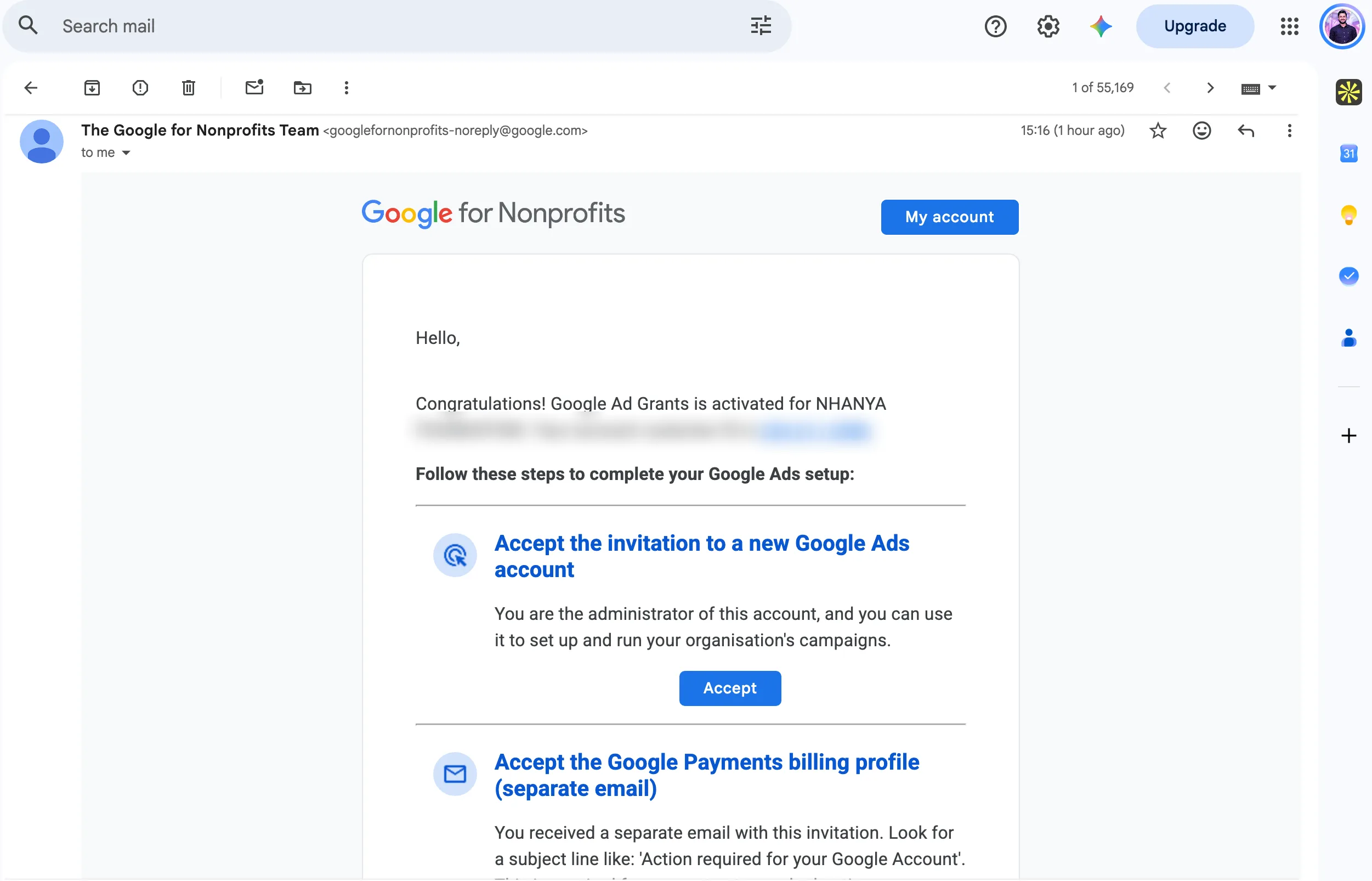
The billing profile step does not mean adding a card. Google’s Ad Grants account help says to skip the billing section during setup and ignore any prompts to submit billing information.
What does this case not show?
It does not show which fix made Google say yes. Google never names the failing item, so we cannot prove which change mattered most. It also does not show advertising results, because Google had only just approved the grant account when we published this.
- Google’s rejections used the same general wording every time, so the cause of each one is our assessment, not Google’s statement.
- When Google approved the request, the charity had fixed nearly every item. One blog line and the social profiles were still in progress.
- Approval is not a guarantee for any other charity. Google makes the final decision on every request.
- We will add campaign data to this case study once there is enough to report.
What did the client say?
Maddy, Director of Nhanya Foundation, reviewed Hustle Marketers on Clutch on 6 November 2026. Clutch marks the review as verified. She scored 5.0 for quality, schedule, cost and willingness to refer, and lists the project as October 2026 to ongoing.
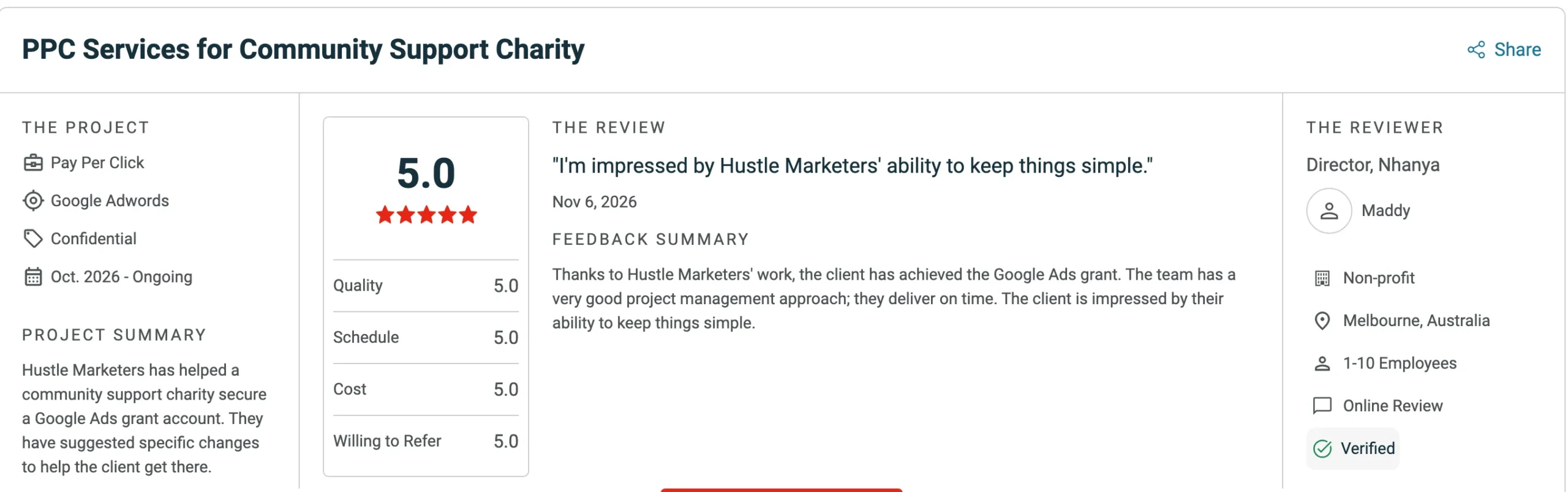
On the work itself, she wrote: “Getting selected for the Google Ads grants program is tricky and hard to get. There are many selection criteria to be fulfilled, so we needed proper guidance in this regard.”
On the result: “Thanks to Hustle Marketers’ work, we’ve achieved the Google Ads grant.” On working together: “Hustle Marketers’ project management is very good; they deliver on time.” And on what stood out: “I’m impressed by Hustle Marketers’ ability to keep things simple.”
Read the full review on Clutch.
What happens next for Nhanya’s Ad Grants account?
The next stage is setup, then campaigns. The account invitation and billing profile come first, then conversion tracking, then campaigns built around Nhanya’s free programs. Ad Grants accounts also have ongoing rules, so compliance is part of the plan from day one.
- Accept the Google Ads invitation and the billing profile, with no card added.
- Set up conversion tracking for the actions that matter, such as program enquiries and volunteer sign-ups.
- Build campaigns around the free community programs first, in line with the charity-first website.
- Monitor the account every month against Google’s Ad Grants policy compliance guide, which warns that “Failing to meet 5% CTR for two consecutive months can result in temporary account deactivation.”
Before campaigns go live, our Google Ads audit checklist is the list we use to check tracking and account setup.
What can other nonprofits learn from this Google Ad Grants case?
The main lesson is to treat a “needs work” rejection as a full website audit, not a single fix. Google’s notice is general, so resubmitting after one change risks the same answer. Three of Nhanya’s earlier requests, sent within one week in September, came back with identical wording.
- Read the notice for what it is. It tells you the website failed, not why. Our guide to fixing “Your activation request needs work” maps every rejection reason to a check.
- Fix everything before you resubmit. Google’s website policy says to “Address all potential issues before resubmitting your activation request for review.”
- Lead with the mission. If you charge for some services, put free programs first and explain where the money goes.
- Remove anything that reads like a clinic or a sales page, such as waitlist claims and diagnosis content.
- Prove you are a charity on every page: registration details, addresses and a link to the official register in the footer.
Why choose Hustle Marketers or Ishant Sharma for Google Ad Grants help?
Ishant Sharma did this work. He is a Google Ads specialist who has worked in digital marketing since 2013 across Google Ads, Microsoft Ads and SEO. Hustle Marketers was founded in 2020 and is based in Zirakpur, India, delivering to clients worldwide, including charities and businesses across Australia. If you are comparing providers, our guide to choosing a Google Ads agency in Australia covers what to check.
- One specialist does the work. Nhanya’s review says: “We work with one teammate from Hustle Marketers.”
- We check the whole site against Google’s written policy, not a guess about speed or design.
- We show the evidence: Google’s own emails, dates and what we could not prove.
- Hustle Marketers has 591+ reviews across platforms and Clutch Award wins in 2023, 2024, and 2026.
- Nhanya found us on Upwork, where you can check Ishant’s Upwork track record.
For ongoing account management after approval, see our PPC management pricing. For more Google Ads results, read the identity services Google Ads case study.
Stuck on “Your activation request needs work”? Send us your site. We review it against Google’s Ad Grants website policy and send you a prioritised fix list. Google makes the final decision.
Related Case Studies and Guides
- Google Ad Grant requirements: eligibility and application checklist, including the full “needs work” fix list.
- Identity services Google Ads case study, fixing inflated conversions for an Australian business.
- Google Ads case study for an Australian jewellery brand.
- Google Ads audit checklist for tracking and account setup.
- Google Ads account suspensions and how appeals work.
Frequently Asked Questions
Why did I get “Your activation request needs work” from Google?
It means Google reviewed your website and decided it does not yet meet the Ad Grants website policy. Your organisation has already passed verification by this point. The notice does not name the failing page, so check the whole site against Google’s seven website rejection reasons before you resubmit.
Can you reapply for Google Ad Grants after a rejection?
Yes. Fix the website, then send a new activation request from the Google Ad Grants card in Google for Nonprofits. Google publishes no limit on resubmissions. Google rejected Nhanya Foundation’s request several times before approving it.
How long does Google Ad Grants approval take?
Google’s activation guide says the review “may take several business days”. In this case, Google answered some requests within hours, and approved the successful request less than seven hours after it went in, on 6 November 2026.
Can an agency help get Google Ad Grants approved?
An agency can audit your website against Google’s policy and guide the fixes, but Google alone decides. In this case Hustle Marketers audited the site and recommended the changes, the charity’s team made them, and Google approved the next request.
Is Google Ad Grants legit?
Yes. Google Ad Grants is Google’s own program for eligible nonprofits. Google’s Ad Grants page says qualifying nonprofits get up to USD 10,000 a month in search ads, given as in-kind advertising, not cash. Nhanya Foundation’s approval email came from The Google for Nonprofits Team.
Can an Australian charity get Google Ad Grants?
Yes, if it is a registered charity that passes Google for Nonprofits verification and has a website that meets the Ad Grants policy. Nhanya Foundation is registered with the ACNC, and its Charity ID in Google for Nonprofits is its Australian Business Number.