Google Ads for a Jewellery Brand: 7.81 ROAS in Under 7 Weeks (MiKi Jewellery)

Ishant
Published : October 22, 2026 at 5:30 pm
Updated : October 21, 2026 at 1:28 pm
Ishant
Last updated: 22 October 2026. Results period: 5 September to 21 October 2026.
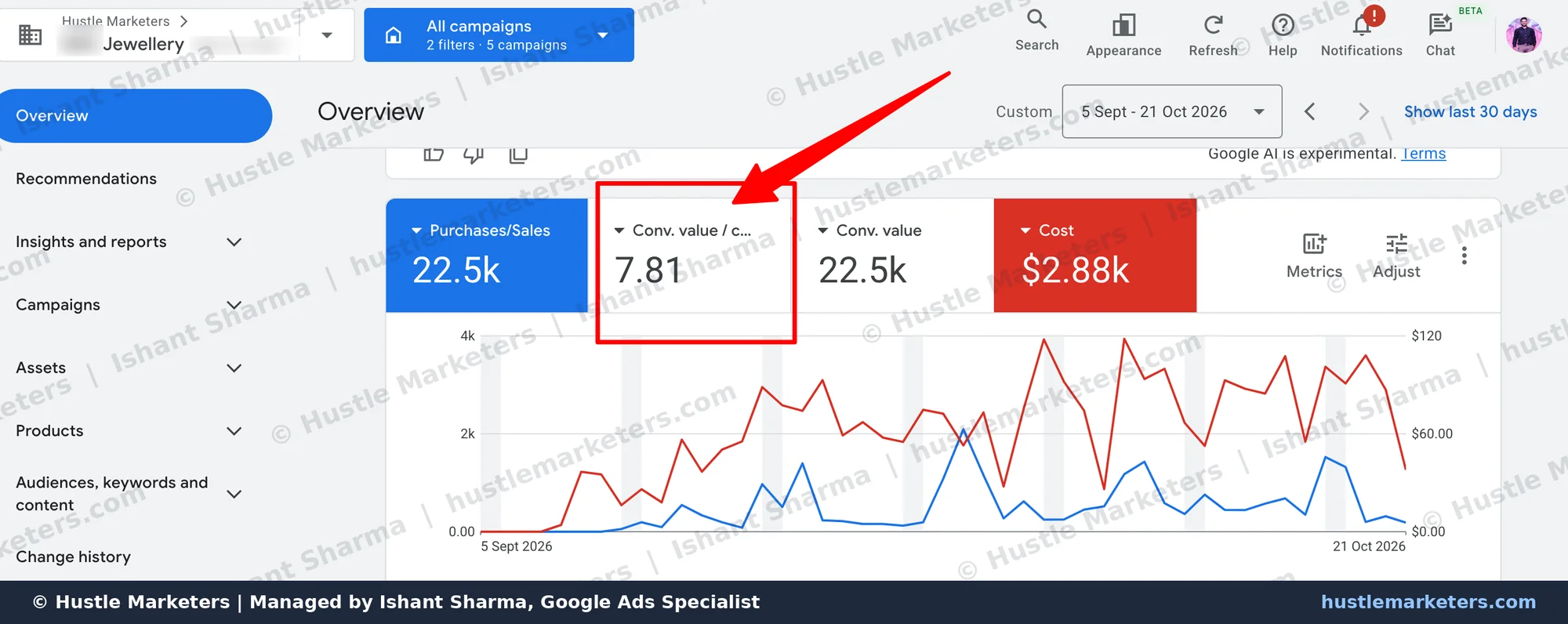
MiKi Jewellery, a Shopify jewellery brand in Busselton, Western Australia, started with a brand-new Google Ads account and zero spend on 5 September 2026. Forty-seven days later, five Performance Max campaigns had returned A$22.5k in conversion value from A$2.88k in ad spend. This jewellery Google Ads case study shows how the account was built and what the numbers mean.
Quick Answer: What did Google Ads deliver for MiKi Jewellery?
Google Ads delivered a conversion value to cost ratio of 7.81 for MiKi Jewellery in 47 days, from 5 September to 21 October 2026. That is A$7.81 in tracked sales value for every A$1 spent: A$22.5k in conversion value on A$2.88k of spend, across 200 conversions from five Performance Max campaigns built on a new account.
Key Observations
- Starting point: a new Google Ads account with no spend before 5 September 2026.
- Headline result: 7.81 conversion value per cost, A$22.5k value on A$2.88k spend.
- Volume: 200 conversions from 2,936 clicks at A$14.39 per conversion.
- Structure: five Performance Max campaigns, one per collection or product type, each with its own budget.
- Spread: every campaign returned between 6.30 and 9.11 in conversion value per cost.
- Headroom: about 68% of missed search impressions were lost to ad rank and about 14% to budget.
The table below gives the case in one view.
| Item | Detail |
|---|---|
| Client | MiKi Jewellery, Shopify store, Busselton WA |
| Service | Google Ads setup and monthly management |
| Campaigns | 5 Performance Max campaigns split by collection |
| Timeframe | 5 Sep to 21 Oct 2026 (47 days) |
| Headline result | 7.81 conversion value per cost |
Selling jewellery on Shopify and want to know where your ad account stands? Get Free Audit Worth $500.
The Client: Who is MiKi Jewellery?
MiKi Jewellery is an independent jewellery brand based in Busselton, Western Australia, that sells online through a Shopify store. Its Clutch review lists a retail business with 1 to 10 employees. The catalogue is organised into named collections plus product types such as earrings, and that structure shaped how we built the account.
The Challenge: Why is Google Ads harder for a new jewellery store?
A new jewellery store on Google Ads faces four problems at once: no conversion history, strict product data rules, policy review on every asset, and a small budget that cannot afford waste. MiKi Jewellery had all four.
- No account history. Automated bidding learns from conversions. Google says the learning period usually takes one to two conversion cycles, and a new account has no past data to speed that up.
- Jewellery feed rules. Jewellery sits under Apparel and Accessories in Google’s product data. That category asks for colour and age group for free listings, and for Shopping ads in six countries including the US and UK.
- Policy review. Google’s Shopping ads policies have no jewellery-specific section, but every image and line of text in a Performance Max asset group is still reviewed, and a group can be approved with limits.
- Small team, AUD budget. With fewer than ten staff, the account had to run without daily input from the client. The five campaigns share a combined budget of about A$85 a day at the time of writing.
Our Strategy: How did we set up Google Ads for a jewellery brand from zero?
Hustle Marketers set up the MiKi Jewellery account from scratch and now optimises it every month, as the client’s verified Clutch review describes. The work had four parts: the product feed, the campaign structure, purchase tracking and the monthly review.
How did we build the Merchant Center and Shopify feed foundation?
Shopping placements in Performance Max run on the product feed, so the feed came first. Shopify product data flows into Google Merchant Center and must clear the Google Merchant Center requirements. How the store connects matters too; see Shopify Merchant Center data sources.
These are the jewellery rules Google sets out in its own product data pages.
| Attribute | What Google asks for jewellery | Example |
|---|---|---|
| color | Metal and stone colour, up to 3 values split by slashes | silver/blue |
| material | The metal itself; submit colour and material for precious metals | sterling silver |
| age_group | Needed for Apparel and Accessories in free listings | adult |
| size | Required only for clothing and shoes; optional for rings | 7 |
| gtin | Use the manufacturer’s GTIN when one exists | Brand plus MPN if none |
Sources: Google Merchant Center Help pages for color, material, age group and size, opened 21 October 2026. For identifiers, see our GTIN guide for Google Shopping.
Australia is not on Google’s Shopping ads list for colour and age group, but the same feed powers free listings in Google Merchant Center, where both are required.
Why did we split Performance Max into five campaigns by collection?
Each of the five Performance Max campaigns carries only one collection or product type, and excludes everything else through listing groups. In practice, each campaign excludes 92 to 97 percent of the catalogue. One campaign is for earrings; the others follow MiKi’s named collections.
That split does three jobs:
- Separate budgets. A best-selling collection cannot use up the money meant for a newer one.
- Clear reporting. Return on spend is visible by collection, not blended into one number.
- Contained problems. A policy or feed issue in one product type stays in one campaign.
Feed quality and Performance Max results are linked closely; our post on Performance Max and feed optimization goes deeper.
How are Shopify purchases tracked as conversions?
Conversion tracking counts Shopify purchases with their order value, which is why the account reports A$22.5k in conversion value and not just a count of sales. Accurate purchase values matter because value-based bidding can only optimise toward the numbers it receives.
What does monthly optimisation cover?
The collection split lets each monthly review compare return on spend by collection, check policy status, and see whether a campaign is held back by budget or by ad rank. The client gets clear updates and explanations, as the Clutch review notes.
The Results: What did 47 days of Google Ads produce?
In 47 days from launch, the five enabled Performance Max campaigns produced A$22.5k in conversion value on A$2.88k of spend. The table shows every headline metric for 5 September to 21 October 2026.
| Metric | Result |
|---|---|
| Timeframe | 5 Sep to 21 Oct 2026 (47 days) |
| Starting point | New account, zero spend |
| Ad spend | A$2.88k |
| Conversion value | A$22.5k |
| Conversion value / cost | 7.81 |
| Conversions | 200 |
| Cost per conversion | A$14.39 |
| Conversion rate | 5.40% |
| Clicks | 2,936 |
Source: MiKi Jewellery Google Ads account, all five enabled campaigns, read 21 October 2026. Google calculates conversion rate against ad interactions, not clicks alone, so it does not equal conversions divided by clicks.
What We Learned: What does the data say about scaling jewellery ads?
The first seven weeks point to three lessons.
| Lesson | Evidence | What it means |
|---|---|---|
| Policy limits can sit in one product type | Earrings campaign: all asset groups limited by policy | Review and fix or appeal those assets; the other four campaigns are unaffected |
| Rank, not budget, holds back most reach | Search lost impression share about 68% to rank, 14% to budget | More budget unlocks only part of the headroom; product data and assets come first |
| Collections perform differently | Campaign returns from 6.30 to 9.11; the top one on A$1,030.74 spend | Separate budgets let money follow the stronger collections |
On the policy point, Google says an asset group that is approved with limits may be restricted from serving on some networks. The fix path is to hover over the status, edit the flagged assets or appeal. Because earrings run in their own campaign, the limit stays inside that one campaign. If a policy issue reaches the whole Merchant Center account, our guides to Merchant Center errors and the misrepresentation appeal cover the next steps.
The best-returning campaign took just over a third of total spend, which is the case for the split: budget can follow proven sellers without switching anything else off.
As sales data builds, custom labels by margin tier let budget follow profit rather than revenue alone. The same product feed also drives free listings and Google’s AI Mode shopping results, which we cover in free listings vs paid Shopping ads and AI SEO for ecommerce.
Client Feedback: What did MiKi Jewellery say on Clutch?
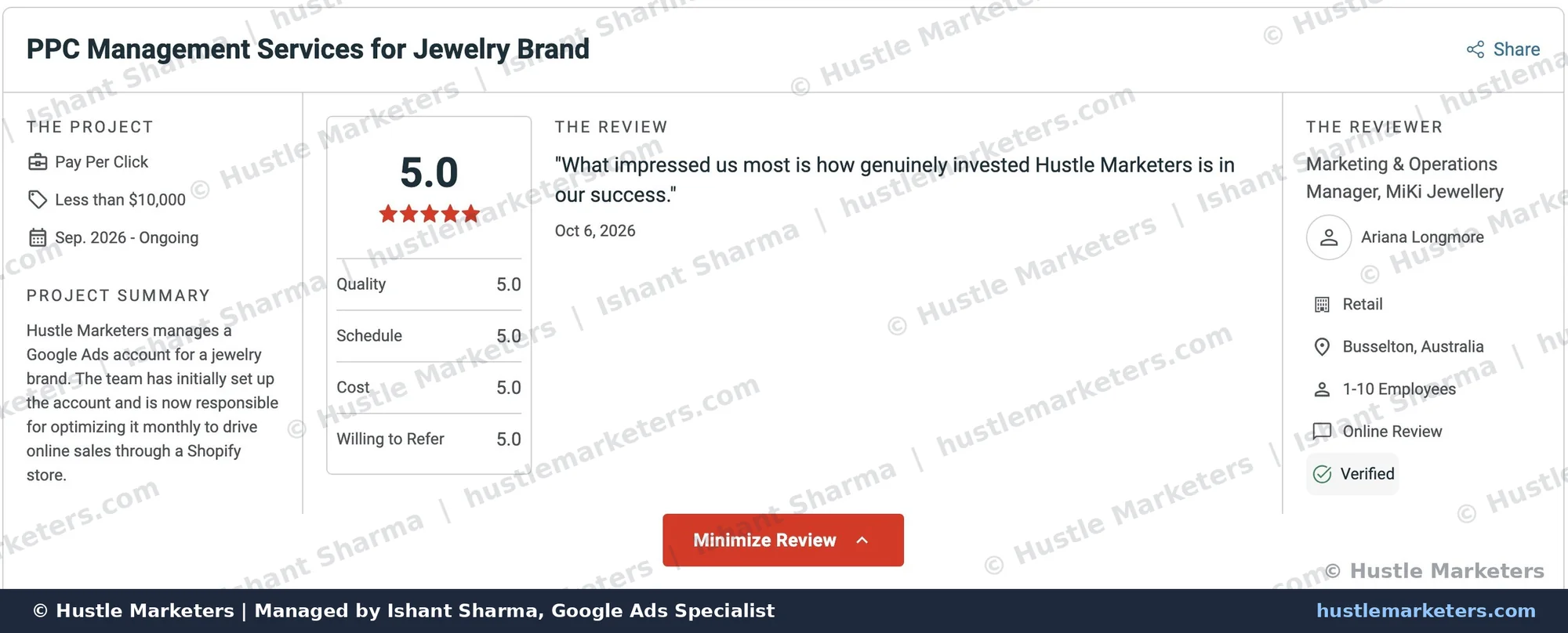
MiKi Jewellery left a verified five-star review for Hustle Marketers on Clutch, published 6 October 2026, for a Pay Per Click project running from September 2026 and ongoing.
“What impressed us most is how genuinely invested Hustle Marketers is in our success.”
Ariana Longmore, Marketing & Operations Manager, MiKi Jewellery
The review’s feedback summary describes the team as timely and responsive, with a clear understanding of the brand and its goals.
| Rating category | Score |
|---|---|
| Quality | 5.0 / 5.0 |
| Schedule | 5.0 / 5.0 |
| Cost | 5.0 / 5.0 |
| Willing to refer | 5.0 / 5.0 |
| Overall | 5.0 / 5.0 |
Read the review on the Hustle Marketers Clutch profile.
Why do Australian jewellery brands work with Ishant Sharma?
Australian jewellery brands work with Ishant Sharma, Google Ads specialist, for senior hands-on management at a fixed monthly fee, with full ownership of their accounts. Ishant has worked in Google Ads, Microsoft Ads and SEO since 2013 and founded Hustle Marketers in 2020. You can watch client video reviews on Ishant Sharma’s reviews page.
- Partner status. Google Partner, Meta Business Partner and Microsoft Advertising Partner.
- No lock-in. Month to month, and the client owns every ad account.
- Clear pricing. PPC management is US$600 to US$800 per platform a month. Converted from USD at 1.4327 AUD per USD (Pound Sterling Live close, 20 October 2026), that is about A$860 to A$1,146, and the AUD figure moves with the rate.
- Plain delivery model. The delivery team is in Zirakpur, India, serving clients worldwide. Hustle Marketers has no Australian office or entity.
- Proof. Clutch Award wins in 2023, 2024 and 2026, and 591+ reviews across platforms.
Other Australian work includes an Australian pet ecommerce SEO case study, Merchant Center feed work for a gift jewellery brand with Australian and US stores, Google Ads for an Australian maritime ID card issuer, and a charity’s Google Ad Grants application. Most client work is covered by signed NDAs, so we describe it without names.
We work with jewelry brands in the US and Australia. Our jewelry marketing agency guide covers the wider channel mix, and jewelry SEO covers organic search.
For the service itself, see ecommerce PPC management services and our Google Shopping ads agency page. Comparing options? Read our list of the best Google Ads agencies in Australia, or our Google Ads agency Perth page for Western Australian businesses.
More ecommerce results: a new Shopify account taken to 8.5x ROAS in our building-block toy brand case study, Google Ads and Meta Ads in our Judaica ecommerce case study, and our bridal shop marketing case study. Browse every result on our case studies page, or see how we run Shopify marketing as a Shopify marketing agency.
Want results like this for your jewellery store?
If you sell jewellery online, start with an audit of your Google Ads account, Merchant Center feed and purchase tracking, and we will show you what to fix first. Our guide to product feed optimization is a good read before the call.
FAQs: Google Ads for jewellery brands
How much should a small jewellery brand spend on Google Ads?
Start with a daily budget you can hold for a few conversion cycles, so bidding has data to learn from. MiKi Jewellery spent A$2.88k in its first 47 days, about A$61 a day on average, across five campaigns.
Should a jewellery store use Performance Max or Standard Shopping?
A jewellery store with a clean feed and purchase tracking can start well with Performance Max, as MiKi Jewellery did. Standard Shopping gives more search term control, while Performance Max reaches Search, Shopping, YouTube and other Google surfaces from one campaign. Our Performance Max vs Search guide compares the trade-offs.
Is jewellery treated as apparel in Google Merchant Center?
Yes. Jewellery falls under Apparel and Accessories, so Google asks for colour and age group for free listings, and for Shopping ads in Brazil, France, Germany, Japan, the UK and the US. Google’s colour page uses jewellery examples, such as “white gold” for a white gold band.
Do rings and other jewellery need a size attribute?
No, size is only required for clothing and shoes. Google’s size page still has a jewellery section, with number sizes for the US and Canada and letter sizes for the UK. Adding ring sizes as variants helps shoppers find the right product.
Why is my Performance Max asset group “limited by policy”?
An asset group is limited when some of its images or text do not fully meet Google Ads policies. Google says it may be restricted on some networks. Hover over the status to see the issue, then edit the assets or appeal.
How long does Google Ads take to work for a new jewellery store?
Google says automated bidding usually needs one to two conversion cycles to learn. MiKi Jewellery’s new account recorded 200 conversions in its first 47 days, but results depend on the feed, tracking, budget and product range, so no timeline is guaranteed.
Can Google Ads track sales from my Shopify store?
Yes. The Google and YouTube app on Shopify maps purchase, add to cart and checkout started events to Google Ads conversion actions, and lets you turn on enhanced conversions. Tracking order value, not just order count, is what makes a conversion value to cost figure like 7.81 possible.
How we put this together: figures come from the MiKi Jewellery Google Ads account (read 21 October 2026) and the verified Clutch review, and a person checks them before publishing.