HVAC Marketing Agency: Services, Costs and What to Expect Each Month

Ishant
Published on November 19, 2026
Ishant

An HVAC marketing agency runs the channels that turn heating and cooling searches into booked jobs: Google Business Profile, local SEO, Google Ads, Local Services Ads, reviews and call tracking. A good one plans around the cooling and heating seasons, follows Google and FTC rules, and reports your cost per booked job every month.
Summarize this article with:
Key Observations
- Google is moving Local Services Ads into Google Ads as a pay-per-lead Performance Max campaign. HVAC is named in the first US phase, which began in August 2026.
- Local Services Ads performance reports do not move to Google Ads, so download or screenshot them before your account migrates.
- A service-area HVAC business can list up to 20 service areas in Google Business Profile, kept within about 2 hours’ drive of its base.
- The FTC fake review rule took effect on October 21, 2024. Google’s Maps policy goes further and does not allow incentives for reviews at all.
- Financing ads that name a monthly payment or a loan term must also show the down payment, repayment terms and APR under Regulation Z.
This guide is for US HVAC owners and general managers who are deciding whether to hire an HVAC marketing company, or checking whether their current one is doing the job. Our client work is covered by signed NDAs, so this guide shares the process we follow rather than client names or results.
What does an HVAC marketing agency do?
An HVAC marketing agency plans, runs and measures the marketing that fills a heating and cooling company’s schedule. For most residential contractors, that means Google Business Profile, local SEO, Google Ads, Local Services Ads, review requests and call tracking tied to booked jobs. Larger shops add email to past customers, Microsoft Ads and Meta Ads.
The table shows the core HVAC marketing services and what you should get from each one.
| Service | What the agency delivers | Where it matters most |
|---|---|---|
| Google Business Profile and local SEO | Correct categories and service areas, job photos, review flow, service and city pages | Map results for “near me” repair searches |
| Google Ads (Search) | Campaigns split by repair, replacement and maintenance, negative keywords, call assets | Fast demand during heat waves and cold snaps |
| Local Services Ads | Profile, verification, lead review and seasonal budgets | Pay-per-lead calls with the Google Verified badge |
| Website and landing pages | Fast service pages, a financing page, a clear phone number | Turning ad and map clicks into calls |
| Reviews and reputation | A request after every job and a reply process | Trust when a homeowner compares companies |
| Tracking and reporting | Call tracking, a match to your field service software, a monthly report | Knowing which channel books jobs |
You may not need all of these on day one. A one-truck shop in a small town often starts with Google Business Profile, reviews and Local Services Ads. A multi-truck company in a busy metro usually needs paid search and SEO running together. For channel depth, read our guides to HVAC SEO and HVAC PPC marketing.
Is an HVAC marketing company different from an HVAC marketing agency?
No. “HVAC marketing agency”, “HVAC marketing company” and “HVAC marketing services” describe the same kind of firm. The split that matters is between agencies that manage accounts you own and lead vendors that sell you leads from their own sites. With an agency, you keep the ad accounts, data and reviews if you leave. With a lead vendor, the leads stop when the payments stop.
How do homeowners choose an HVAC company?
Homeowners choose an HVAC company in one of three situations. A broken AC or furnace is an emergency, so they call whoever looks credible and can come today. A replacement is a large, planned purchase, so they compare quotes, reviews and financing. Maintenance is routine, so reminders and an existing relationship usually win.
The table maps each job type to how homeowners search and what wins the call.
| Job type | How the homeowner searches | What wins the job |
|---|---|---|
| Emergency repair | “AC repair near me”, “furnace not working”, map results and ads | Open now, a person answers, strong reviews |
| System replacement | “New AC unit cost”, “heat pump vs furnace”, brand names | Clear price ranges, financing, a fast in-home quote |
| Maintenance and tune-ups | “AC tune up”, “furnace tune up near me” | Reminders, maintenance plans, easy booking |
| Indoor air quality | “Whole house air purifier”, “humidifier installation” | An offer at the service visit and a page per product |
This split shapes the whole plan. Emergency calls need speed: ads and Local Services Ads with a person on the phone. Replacement needs proof and follow-up, because a quote can sit for days before the homeowner signs. Maintenance is mostly a retention job aimed at customers you already have.
Which searches should an HVAC company target?
Target searches by intent instead of chasing one big keyword. The groups below cover most residential HVAC demand. Ask your agency to show search volume for your own service area, because demand changes a lot by climate and city.
- Emergency and repair: “ac repair near me”, “no heat”, “furnace repair”, “emergency hvac”. These carry the most urgency and usually the highest cost per click.
- Replacement and installation: “ac replacement”, “furnace installation”, “heat pump installation”, plus cost searches such as “furnace replacement cost”.
- Maintenance: “ac tune up”, “furnace maintenance”, “hvac maintenance plan”.
- Brand and model: searches for the equipment brands you install and service.
- Commercial: “commercial hvac contractor”, “rooftop unit repair”, if you serve businesses.
Cost searches deserve their own pages. Homeowners want a price idea before they call, and honest ranges filter out poor-fit leads. In a May 2025 ACHR News HVAC marketing Q&A, the panel discussed data suggesting that showing prices on a website can help rather than hurt.
How does seasonality change HVAC marketing?
HVAC demand follows the weather. Cooling repair peaks with the first hot weeks, heating repair peaks with the first cold snap, and spring and fall are the shoulder months. ENERGY STAR advises checking the cooling system in spring and the heating system in fall, so shoulder months are tune-up and replacement season.
The calendar below is the pattern we plan around. Your agency should adjust it to your own call history.
| Period | What homeowners need | What your agency should do |
|---|---|---|
| Spring (shoulder) | AC tune-ups, replacement quotes before summer | Tune-up offers to past customers, more replacement budget, check hours on every profile |
| Summer (cooling peak) | AC repair, often urgent | Raise budgets before the first heat, staff the phones, watch budget-limited campaigns |
| Fall (shoulder) | Furnace and heat pump tune-ups, replacement before winter | Heating tune-up offers, maintenance plan renewals, switch ad copy to heating |
| Winter (heating peak) | No-heat calls, often urgent | Heating repair budgets, after-hours schedules, emergency ad copy |
Timing shifts with climate. In hot southern markets, cooling season runs longer and heating is short. In northern markets, heating carries more of the year. A good agency builds the calendar from your own calls and jobs, not a national template.
How should you handle emergency demand spikes?
Plan for spikes before they happen, because a heat wave or cold snap can fill the board in a day. Google treats HVAC as an urgent category in Local Services Ads, which matches how homeowners behave in these moments.
- A pre-approved budget range: the agency can raise spend the same day without waiting on an email reply.
- Ad schedules tied to dispatch: ads slow down when the board is full and pick up when techs are free.
- Honest capacity messages: “next-day appointments” in ad copy beats a promise you cannot keep.
- Live answering after hours: an unanswered emergency call is a paid lead that goes to a competitor.
What is changing with Local Services Ads for HVAC?
Google is moving Local Services Ads into Google Ads. Existing campaigns migrate to a Performance Max campaign type built for pay-per-lead goals, and ads still show on Search and Maps. According to Google Ads Help, HVAC is among the categories in the first US phase, which began in August 2026.
The table sums up what changes for an HVAC account, based on Google’s migration notes.
| Item | What changes |
|---|---|
| Where you manage it | Inside Google Ads, as a Performance Max pay-per-lead campaign |
| Billing | Still pay per lead |
| Performance reports | Do not transfer, so download or screenshot them first |
| Past leads | Transfer to Google Ads automatically |
| Bidding | Manual bidding and industry-level Target CPA are removed; one campaign-level Target CPA applies |
| Budget | Average weekly budget divided by 7 becomes a daily budget; monthly spend is capped at the daily average times 30.4 |
| Verification and badge | Google Verified status carries over; license and insurance reverification is no longer required |
| BBB callouts | No longer supported; add at least six other structured callouts |
Source: Google Ads Help, Local Services Ads migration. Google says new pay-per-lead campaigns cannot yet be created in Google Ads, and that later phases cover service-area businesses without storefronts (late 2026) and non-US accounts (2027).
What should you do before your account migrates?
- Save your reports: download or screenshot Local Services Ads performance data now, because it will not transfer.
- Watch your inbox: Google emails the account admin 14 days before migration and sends a final reminder a week later.
- Split verticals if you run more than HVAC: one campaign-level Target CPA covers every vertical, so HVAC and plumbing need separate campaigns to keep separate targets.
- Hold big profile edits: a change to your business name or address triggers a verification review that usually takes 24 to 48 hours and can pause the campaign.
- Replace BBB callouts: add at least six structured callouts, such as “24/7 emergency service” or “free replacement estimates”, if they are true.
- Give it time: Google suggests allowing up to two weeks for performance to settle before you judge the new campaign.
What does Google require from HVAC companies in Local Services Ads?
In the US, the HVAC category needs business, owner and service professional background checks, general and professional liability insurance, and state business and owner licenses where local law requires them. Google adds extra screening because HVAC is an urgent category, according to its US category requirements.
Google also ended the Money Back Guarantee tied to the Google Guarantee badge. Reimbursement only covers services booked through Local Services Ads before December 7, 2025, with requests due within 30 days of the job. For setup depth, read our Local Services Ads guide. Companies that also do plumbing can compare notes in our plumbing marketing guide.
How should an HVAC company set up Google Business Profile?
Most HVAC companies are service-area businesses, so Google’s rules are specific. If customers do not visit your shop, hide the address. You can list up to 20 service areas, and the whole area should stay within about 2 hours’ drive of your base. PO boxes and virtual offices are not eligible, according to the Business Profile guidelines.
- Name: use your real-world business name. Google does not allow added keywords, taglines, phone numbers or locations, so “Smith Heating and Air AC Repair Dallas” breaks the rule.
- Address: hide it unless you serve customers at your shop during the hours you list.
- Service areas: set by city or ZIP code, up to 20, within about 2 hours’ drive, per Google’s service area help page.
- One profile per location: do not create profiles for addresses you do not operate from, such as rented mailboxes.
Profile work never really ends. Real job and truck photos, correct hours (including emergency hours), a full services list and quick review replies all help. Your business name, address and hours also sync from Google Business Profile into the new pay-per-lead campaign, so a messy profile now affects your ads too. Our HVAC SEO guide covers rankings in depth, and our local SEO services page explains what we manage.
How do you track calls and booked jobs from HVAC marketing?
Track HVAC marketing to the booked job, not the click. Calls bring in most HVAC work, so the agency should set up Google Ads call tracking with Google forwarding numbers, then match calls to your field service or CRM records. That shows which campaigns produce jobs, not just rings.
Google Ads counts calls from ads and calls to a forwarding number on your site once they pass a minimum call length that you set. Calls tracked in a CRM can be imported back into Google Ads, so only calls that led to a sale count.
The ladder below shows why each level matters and why none of the lower ones is enough alone.
| Level | What it counts | Why it is not enough alone |
|---|---|---|
| Clicks | Visits from ads or maps | Says nothing about intent |
| Calls | Calls over a set length | Includes existing customers, vendors, job seekers and wrong numbers |
| Qualified calls | New customers asking for service in your area | Still not money |
| Booked jobs | Appointments on the board | The number to manage week to week |
| Invoiced revenue | Completed jobs by source | Shows true return, including replacements |
In an April 2025 ACHR News column, Ron Browning warned that counting every call over a set length mixes in wrong numbers, job seekers and vendors. Ad platforms then learn to find more of the same. Our setup follows these steps.
- Set call conversions in Google Ads with a sensible minimum call length.
- Use dynamic number insertion on the website, so each traffic source shows its own number.
- Add a lead source field in your field service software, such as ServiceTitan, Housecall Pro or Jobber.
- Import booked or sold calls into Google Ads on a regular schedule, so bidding learns from jobs.
- Review missed calls and call outcomes every week. Check your state’s consent rules before you record calls.
One more change affects phone ads. Google removed the option to create new call ads in February 2026, and existing call ads stop getting impressions in February 2027. Phone numbers now belong in call assets on responsive search ads. See our Google Ads conversion tracking service for how we set this up.
What are the rules for HVAC reviews?
Two sets of rules apply to HVAC reviews. The FTC’s rule on consumer reviews and testimonials took effect on October 21, 2024, and bans fake reviews, sentiment-based incentives, undisclosed insider reviews and review suppression. Google’s Maps policy is stricter on one point: it does not allow incentives in exchange for reviews at all.
The table compares common review tactics under each set of rules.
| Practice | FTC rule | Google Maps policy |
|---|---|---|
| Fake reviews, or reviews from people who never used you | Banned | Not allowed (fake engagement) |
| A discount or gift for any review, good or bad | Not banned if no sentiment is required | Not allowed (incentivized reviews) |
| A reward only for 5-star reviews | Banned | Not allowed |
| Staff or family reviews with no disclosure | Banned (insider reviews) | Not allowed (biased reviews) |
| Threats or pressure over a bad review | Banned (review suppression) | Not allowed (rating manipulation) |
| Asking only happy customers | No specific ban, but may still break the FTC Act | Risky; ask every customer instead |
Sources: FTC rule questions and answers, Google’s incentivized or biased reviews and rating manipulation policies.
The FTC says courts can impose civil penalties for knowing violations. The safe process is simple: ask every customer after every completed job, by text or email, with a direct review link. Do not filter who gets the request. Reply to reviews, including bad ones, with facts and no private customer details.
Can you advertise HVAC financing in Google and Meta ads?
Yes, but the wording matters. Under Regulation Z, an ad that names a payment amount, a repayment period, a down payment or a finance charge must also disclose the down payment, the repayment terms and the APR. Ad platforms also limit targeting for credit offers, so get your lender’s approved ad language first.
The table shows how common HVAC financing lines are treated, based on 12 CFR 1026.24 and the official commentary.
| Ad wording | Extra disclosures needed? | Why |
|---|---|---|
| “$99 a month” | Yes | States a payment amount |
| “60-month terms” | Yes | States a repayment period |
| “Only $500 down” | Yes | States a down payment amount |
| “No down payment” | No | Listed in the commentary as not triggering |
| “Monthly payments to suit your needs” | No | Listed in the commentary as not triggering |
| “0% APR” | Not by itself, but any rate must be stated as an “annual percentage rate” | Rule on stating rates |
Section 1026.24(a) also says an ad can only state terms the creditor actually offers. So a “0% APR” headline must match the plan your lender really has for that customer group.
What do Google and Meta allow for financing ads?
Google’s personalized advertising policy limits consumer finance ads in the US and Canada. Those ads cannot target by gender, age, parental status, marital status or ZIP code. Google’s consumer finance definition names credit offers, so a financing-led campaign may fall under it. That matters for HVAC companies that target by ZIP code.
Meta’s financial services ad standards say ads for credit offers must target people 18 or older and must not ask for personal details directly in the ad. A practical approach is to keep the ad itself general and send people to a financing page that shows the full terms.
This section is general information, not legal advice. Check financing ads with your lender and a lawyer before they run.
What should an HVAC marketing agency deliver every month?
Every month, an HVAC marketing agency should deliver a short report tied to booked jobs, a log of the work done, and a plan for the next month’s season. The report should show spend, leads, booked jobs and cost per booked job by channel, plus what changed and why.
Use this table as a monthly scorecard for any agency, including ours.
| Deliverable | What you should see | Red flag |
|---|---|---|
| Results by channel | Spend, calls, forms, pay-per-lead leads, booked jobs, cost per booked job | Only clicks, impressions or rankings |
| Search terms and negatives | Wasted searches found and blocked | No search terms shown for months |
| Pay-per-lead review | Lead quality notes, credits, budget changes | Nobody listens to lead calls |
| Google Business Profile work | Photos, service updates, review replies | Profile untouched for months |
| Reviews | New reviews, rating trend, replies | Gated or rewarded review requests |
| SEO work shipped | Pages published or improved, technical fixes | “Ongoing optimization” with no list |
| Next month’s plan | Budget shifts for the season, tests, offers | The same plan in July and January |
On negative keywords, we prefer account-level lists for terms such as “jobs”, “training”, “salary” and “parts”. A miss at campaign level then does not matter. Our negative keywords guide explains the setup.
Ask three questions on every monthly call:
- Which channel booked the most jobs, and at what cost per booked job?
- What did you change this month, and what happened after the change?
- What are you changing for next month’s weather and capacity?
How much does an HVAC marketing agency cost?
HVAC marketing cost has two parts: the agency fee and the media spend. Agency fees are usually a monthly retainer, a percentage of ad spend or a per-lead price. Media spend is separate. LocaliQ’s benchmarks put the median HVAC search cost per lead at $127.74 for AC and $129.02 for heating.
The table compares the common agency pricing models.
| Pricing model | How it works | What to check |
|---|---|---|
| Flat fee per platform | A fixed monthly price for each ad channel | What is included, and how often the work is done |
| Percentage of ad spend | The fee rises with your budget | Whether the agency gains from raising spend |
| Pay per lead | You pay for each lead delivered | Who owns the leads and data, and how a lead is defined |
| Bundled retainer | SEO, ads and website in one price | What each part costs and what you get from it |
What do HVAC clicks and leads cost on Google?
LocaliQ’s figures are medians from 3,211 US home services search campaigns, with data from April 1, 2024 to March 21, 2025. The page was last updated on July 15, 2026.
| Category | Cost per click (USD) | Conversion rate | Cost per lead (USD) |
|---|---|---|---|
| AC installation and repair | $9.68 | 6.56% | $127.74 |
| Heating and furnaces | $9.30 | 7.48% | $129.02 |
| All home services | $7.85 | 7.33% | $90.92 |
Source: LocaliQ home services search advertising benchmarks.
Illustrative example, not a client result: say you spend $3,000 a month on Google Search and pay a $700 management fee. At the LocaliQ AC median of $127.74 per lead, that is about 23 leads. If half book, you get about 12 jobs, so each booked job costs about $315 all in.
That last number is the one to compare against your average ticket and margin. Try our Google Ads budget calculator with your own figures, and see PPC management pricing for how our fees work.
Which HVAC marketing ideas are worth trying?
The HVAC marketing ideas that pay back fastest use customers and data you already have. Tune-up reminders, maintenance plan renewals, quote follow-up and review requests cost little and reach people who already trust you. Paid channels then fill the gaps during peak weeks.
- Pre-season tune-up campaigns: email and text past customers in spring for cooling and in fall for heating.
- Maintenance plan renewals: remind members a month before their plan ends, with the visit already offered.
- Replacement quote follow-up: call or text open quotes within two days, then again after a week.
- A financing page: compliant wording, real lender terms, linked from replacement ads.
- Cost pages: one page each for AC replacement, furnace replacement and heat pump installation, with honest ranges.
- Troubleshooting pages: “AC not cooling” and “furnace not turning on” pages that end with a call button.
- Microsoft Ads: a second search channel once Google tracking is clean, using the same negative lists.
For trades that share the same playbook, our contractor marketing guide covers the wider picture.
How do you choose an HVAC marketing agency?
Choose an HVAC marketing agency that lets you own every account, reports on booked jobs, knows the HVAC seasons and the Local Services Ads change, and works month to month or on a short term. Ask to see a sample report and a 30-day setup plan before you sign anything.
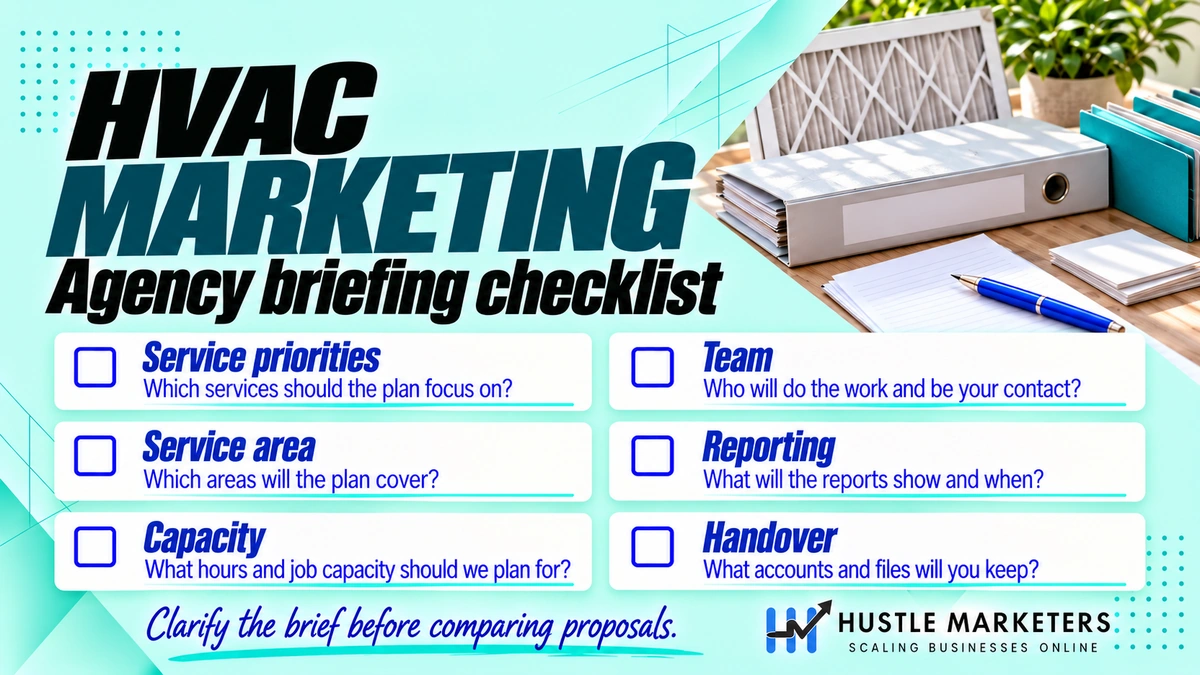
What questions should you ask before you sign?
- Who owns the Google Ads, Local Services Ads, Google Business Profile, GA4 and Search Console accounts?
- How will you match calls to booked jobs in our field service software?
- What does the monthly report show, and can we see a sample?
- How will you handle the Local Services Ads move into Google Ads for our account?
- How do you plan budgets for heat waves, cold snaps and shoulder months?
- What is the contract length, and how do we exit?
- Who works on our account day to day, and how often do we talk?
Google’s own guide to hiring an SEO adds a few more: ask for examples of past work, how success is measured, and what experience they have in your industry and city.
What are the red flags with HVAC marketing companies?
- Ranking guarantees: Google says no one can guarantee a #1 ranking on Google.
- Accounts in the agency’s name: if they own the ad account or profile, you lose the history when you leave.
- Vanity reports: impressions and clicks with no calls or booked jobs.
- No analytics access: GA4 and Search Console are not set up or not shared in the first weeks.
- Long lock-ins: a 12-month contract with no exit terms.
- Risky review tactics: gated requests, rewards for reviews, or reviews written by staff.
Why choose Hustle Marketers for HVAC marketing?
Hustle Marketers is a Google Partner, Meta Business Partner and Microsoft Advertising Partner. Founder Ishant Sharma has worked in Google Ads, Microsoft Ads and SEO since 2013, and our team runs Google Ads for HVAC companies. Our client work is covered by signed NDAs, so this guide shares the process we follow rather than client names or results.
- Clear pricing: PPC management costs $600 to $800 per platform per month, month to month. SEO starts from $500+ a month, a starting range that varies by business.
- You own everything: Google Ads, Local Services Ads, Google Business Profile, GA4, Search Console, content and accounts stay in your name.
- Booked-job reporting: we track calls to jobs and show cost per booked job by channel.
- Reviews and awards: 591+ reviews across Google, Trustpilot, Clutch, G2, DesignRush, Upwork and other platforms, and Clutch Award wins in 2023, 2024, and 2026.
- Who we are: founded in 2020, with our delivery team in Zirakpur, India, serving clients worldwide.
- Open work: free marketing tools and open-source SEO and Google Ads code on GitHub.
HVAC marketing agency FAQs
Should I hire an HVAC-specific agency or a general marketing agency?
Hire for HVAC knowledge, not the label. A general agency can do good work if it understands emergency versus replacement demand, seasonal budgets, Local Services Ads and booked-job tracking. Test this in the sales call: ask how they would plan your next shoulder season.
How long does HVAC marketing take to work?
Google Ads and Local Services Ads can bring calls as soon as campaigns are approved and live. SEO takes longer and builds over months. Google’s hiring guide suggests asking any SEO what results to expect and in what timeframe, and getting that answer in writing.
Do I need both SEO and Google Ads?
Most HVAC companies in competitive metros use both. Ads and Local Services Ads cover urgent demand now, while SEO and Google Business Profile lower your cost per job over time. A small company in a quiet market can often start with Google Business Profile, reviews and Local Services Ads.
Are pay-per-lead services worth it for HVAC companies?
Pay-per-lead can work when you own the account, as with Local Services Ads in your own Google account. Be careful with vendors who own the leads and the data. Ask how they define a lead, how credits work, and what happens to your history if you stop.
Who should own my Google Ads and Google Business Profile accounts?
You should. The agency should get access as a user or manager, not as the owner. If you change agencies later, you keep the account history, conversion data and reviews.
Can one agency market both HVAC and plumbing services?
Yes, and many home service companies do both. Keep separate campaigns for each trade, because Google applies one Target CPA per campaign in the new pay-per-lead setup. Our Google Ads for plumbers guide covers the plumbing side.
What should you do next?
Start with the basics: confirm you own every account, save your Local Services Ads reports, and check that calls are matched to booked jobs. Then look at the calendar. If the next shoulder season is a few weeks away, plan tune-up offers and maintenance renewals now, before the phones get busy.
After that, judge your current setup against the monthly scorecard above. If you cannot see cost per booked job by channel, fix tracking before you add budget. If you want a second opinion on your HVAC Google Ads, Local Services Ads or profile setup, we will review it and show you what we would change first.