SEO for Manufacturing Companies: A B2B Demand Playbook for 2026

Ishant
Published : October 14, 2026 at 10:37 am
Updated : October 7, 2026 at 8:54 am
Ishant
Written by Ishant Sharma, Founder, Hustle Marketers | Published October 14, 2026
Search “seo for manufacturing companies” and you will find the same article ten times: do keyword research, fix technical SEO, build backlinks. All true. All useless, because none of it tells you anything specific to how manufacturers actually win work.
Manufacturing deals are not won by a blog post ranking for a generic keyword. They are won when a design engineer finds your tolerance chart at 11pm, shortlists you, and a procurement manager approves you three months later. That chain, engineer to procurement to executive, is what your SEO has to serve. We have built this playbook from SEO and paid search work for industrial, equipment and service clients, including a Florida marine service business whose qualified leads grew 65% on Google Ads and Facebook Ads. This is the process, mapped to the buying committee and the sales funnel, not a tips list.
Key Observations
- Manufacturing SEO is different because the buyer is a committee (engineer, procurement, executive) and the sales cycle runs months, sometimes over a year.
- Map keywords to buyer roles and funnel stages first. Engineers search specs, procurement searches suppliers and certifications, executives search capabilities and proof.
- The pages that win are capabilities pages, spec and tolerance pages, industry-served pages, and certification content, not generic blogs.
- Programmatic pages (material x process x industry) can multiply your footprint, if you control cannibalization and thin content.
- AI assistants now build supplier shortlists. Structured, specific, crawlable capability data is what gets you cited.
- Measure SEO to RFQ to revenue through your CRM, not to traffic. Offline conversion tracking closes the loop on long cycles.
- Expect 3-6 months to early RFQs and 6-12 months to compounding results. The 90-day plan below front-loads the money pages.
Table of Contents
- Why Manufacturing SEO Is Different
- Map Keywords to the Buying Committee
- The Page Types That Win Manufacturing SEO
- Technical SEO for Manufacturer Sites
- Content That Builds Demand (not just traffic)
- Link Building for Manufacturers
- Local and National: Which One You Actually Need
- Getting Cited in AI Search
- Measuring SEO to RFQ to Revenue
- 90-Day Manufacturing SEO Plan
- Score RFQ Quality, Not Just RFQ Volume
- Sources and Verification
Why Manufacturing SEO Is Different
Three things separate manufacturing from the average SEO project.
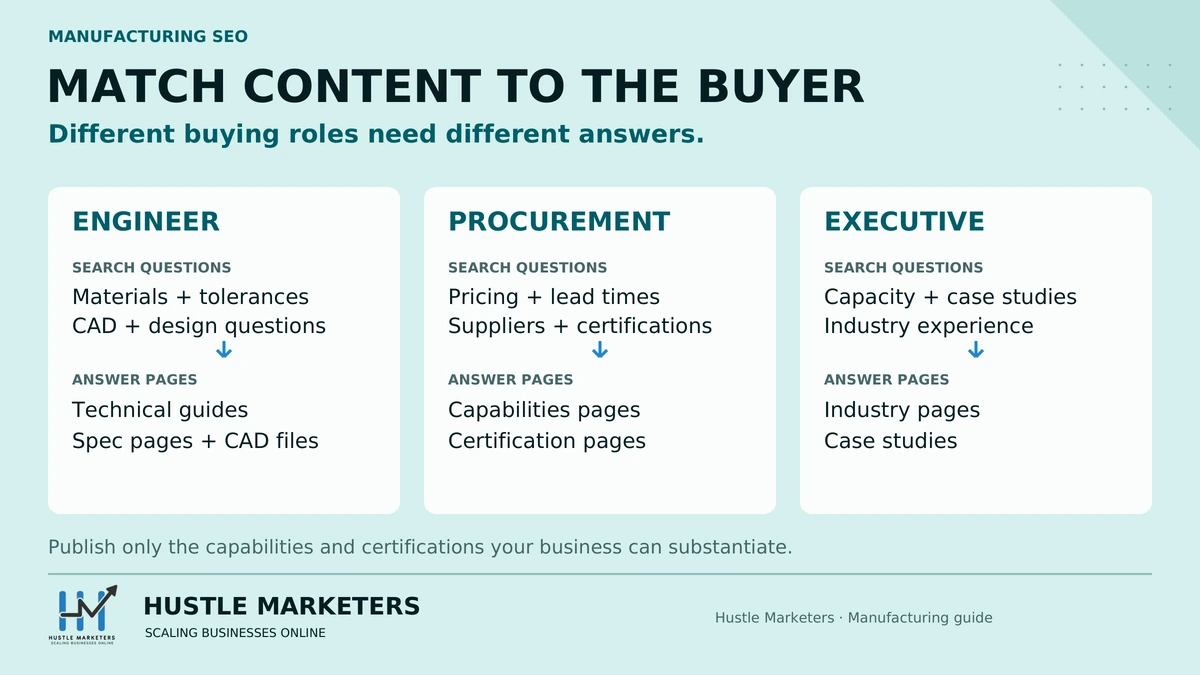
The buyer is a committee. A typical industrial purchase involves a design or process engineer who defines the need, a procurement manager who qualifies and negotiates, and an executive who signs off. Each of them searches differently, at different times, for different things. Generic SEO advice optimizes for one imaginary “user”. A manufacturing playbook has to serve all three.
The cycle is long. From first search to signed PO can take 6-18 months. That breaks last-click thinking entirely. The spec page an engineer bookmarked in February is why the RFQ arrived in September, and if your measurement cannot see that, you will conclude SEO “isn’t working” right before it pays off.
The queries are technical and low-volume. “5-axis CNC machining titanium aerospace” might get a few dozen searches a month. It is also worth more than 10,000 visits from a listicle, because the person searching it has a drawing in their other tab. Manufacturing SEO is a game of long-tail keywords where intent beats volume every time.
This is also why SEO pairs so well with paid search for manufacturers: SEO builds the durable technical footprint, ads capture the in-market queries you do not rank for yet. We run both sides, and our B2B paid search team sees the same committee dynamics from the ads angle.
Map Keywords to the Buying Committee
This is the core of the playbook. Before you write a page, know who the query belongs to and where they sit in the buyer journey.
Engineer queries (specs, tolerances, materials, CAD)
Engineers search early and search precisely: material properties, tolerance capabilities, process comparisons, design guidelines, CAD files. Examples: “aluminum 6061 vs 7075 machinability”, “injection molding draft angle guidelines”, “sheet metal bend radius chart”. These are top and mid-funnel queries, and they are the cheapest trust you will ever build. An engineer who got their answer from your chart remembers your name when the shortlist is drawn up. If you can offer downloadable CAD models or STEP files for standard components, do it; engineers design your part into the assembly, and switching you out later is friction that works in your favor.
Procurement queries (suppliers, pricing, lead times, certifications)
Procurement searches are commercial and comparative: “custom CNC machining suppliers”, “ISO 9001 certified sheet metal fabricator”, “injection molding manufacturer low MOQ”, “[process] cost per part”. These map to your capabilities pages, certification pages, and industry pages. Procurement managers are also the ones who check whether you look like a real, stable company, so these pages need trust signals: certifications, facility photos, equipment lists, named leadership. Many committees send an RFI (request for information) before any RFQ goes out, and your certification and capabilities pages are what get you through that first screen.
Executive queries (capabilities, capacity, case studies)
Executives search less, but when they do it is about risk: “contract manufacturer [industry]”, case studies, capacity, financial stability, who else you serve. Case studies and industry-served pages answer this. So does a clean, fast, modern website; fair or not, executives read your site as a proxy for your operations.
Sample keyword-to-role-to-funnel table
Build this table for your own catalog. Here is the format, with worked examples:
| Keyword | Buyer role | Funnel stage | Page type |
|---|---|---|---|
| titanium vs stainless steel for medical implants | Engineer | Awareness | Technical guide |
| CNC machining tolerances chart | Engineer | Awareness/Consideration | Spec page |
| 5-axis CNC machining services | Engineer/Procurement | Consideration | Capabilities page |
| ISO 13485 certified machine shop | Procurement | Consideration | Certification page |
| custom CNC machining suppliers | Procurement | Decision | Capabilities + directory presence |
| aerospace contract manufacturing | Executive/Procurement | Consideration | Industry-served page |
| [competitor] alternative | Procurement | Decision | Comparison page |
| CNC machining quote / RFQ | All | Decision | RFQ page |
Fill it with real queries from Google Search Console, your sales team’s inbox, and keyword tools. Every row gets an owner page. If two rows point at the same page, fine. If one row has no page, that is your content calendar. For the broader method behind this kind of mapping, see our guide to SEO strategies that actually compound.
The Page Types That Win Manufacturing SEO
Generic advice says “publish blog content”. In manufacturing, four page types do the heavy lifting, and none of them are blog posts.
Capabilities pages (the money pages)
One page per core process or service: CNC machining, injection molding, wire EDM, powder coating, assembly. This is where “5-axis CNC machining services” ranks and where RFQs start. The template we use:
- H1 naming the capability plainly (“Precision 5-Axis CNC Machining Services”).
- Opening paragraph in plain language: what you do, for whom, at what scale.
- Specifications block: tolerances, max part size, materials, volumes, lead times. Real numbers, in an HTML table. This is what engineers scan and what AI systems extract.
- Equipment list. Machine makes, models, counts. Procurement reads this as capacity proof.
- Materials handled, linking to related material pages.
- Industries served, linking to industry pages.
- Certifications and quality process.
- Photos of actual parts and the actual floor. Stock photos of generic factories quietly kill trust.
- RFQ CTA twice: mid-page after the specs, and at the end. “Upload your drawing” outperforms “Contact us”.
Spec and tolerance pages
Tolerance charts, material data, design-for-manufacturing guidelines, finish comparisons. These rank for engineer queries, earn links from forums and universities, and feed AI answers. They are the least salesy pages on your site and often the highest-traffic ones. Put a quiet capability link on each (“we hold these tolerances in production; see our machining capabilities”).
Industry-served pages
One page per industry: aerospace, medical, automotive, defense, energy. Each covers the industry’s requirements (AS9100, ISO 13485, ITAR, PPAP), typical parts you make, relevant case studies, and compliance handling. These pages win “[process] for [industry]” queries and give executives the risk-reduction story they came for.
Programmatic combinations: material x process x industry
Here is where a manufacturing site can scale footprint fast. Your capabilities multiply: processes x materials x industries. “CNC machining” x “aluminum, titanium, stainless steel” x “aerospace, medical, automotive” is nine potential pages, each matching a real query pattern like “titanium CNC machining aerospace”.
The rules that keep this from becoming a spam farm:
- Only build combinations you genuinely offer and that have search demand. Check volumes first. A page for “PEEK machining for marine” that you have never quoted helps nobody.
- Every page needs unique substance: that material’s machinability notes, tolerances you hold in it, example parts, industry requirements. If all you can change between two pages is the noun, do not build the second page.
- Watch cannibalization. “Aluminum CNC machining” the material page and “CNC machining” the capability page can compete for the same queries. Decide the primary page per query in your keyword map, interlink with descriptive anchors, and consolidate pages that chase the same term.
- Roll out in batches of 5-10, watch GSC for 4-6 weeks, then expand what works.
We wrote a full framework for doing this at scale, including templating and quality gates, in our programmatic SEO guide.
Certification content (ISO, AS9100, ITAR)
Procurement searches certifications directly: “AS9100 machine shop”, “ITAR registered manufacturer”. Give each major certification its own page: what it covers, your scope, your certificate (viewable), what it means practically for the buyer’s audit process. These are short pages that win exact-match commercial queries with almost no competition.
Technical SEO for Manufacturer Sites
Manufacturer sites carry specific technical baggage: big product catalogs, legacy platforms, and PDFs everywhere. For the wider technical picture, see our technical SEO agency page.
Faceted navigation and product catalogs
If you sell parts online, filters (material, size, thread, finish) can generate thousands of near-duplicate URLs that eat your crawl budget. Canonicalize filtered views to the base category, index only facet combinations with real search demand, and keep one crawlable HTML path to every product. Product page optimization matters just as much as the crawl fixes: full specs in HTML, real part photos, and a clear path to bulk ordering or quantity pricing. Our ecommerce SEO agency page covers the wider store side.
If you sell parts online you are doing ecommerce SEO whether you call it that or not, and the same rules apply. Manufacturers on Magento or Adobe Commerce hit this hardest; our Magento SEO and Adobe Commerce SEO guides cover the platform-specific fixes, from layered navigation to URL rewrites.
Also: stop trapping your best content in PDFs. Datasheets and catalogs published only as PDF are invisible to most searches and unusable on phones. Publish the HTML version, offer the PDF as a download.
Product schema and rich results
Mark up products with Product schema (name, image, description, brand, and offers where you show pricing). For quote-based catalogs without public pricing, you can still use Product schema without the offer, and pair it with Organization schema carrying your certifications. Answer real buyer questions in visible text on capability pages, but do not add FAQPage markup for rich results: Google stopped showing FAQ rich results on May 7, 2026. Product snippets need offers, review or aggregateRating, so a quote-only catalog page gains clean structured facts for AI assistants rather than a rich result.
Site speed and Core Web Vitals
Industrial sites drag around huge imagery, old sliders, and a decade of plugins. The fixes are unglamorous: compress and lazy-load images, drop the homepage carousel, cut unused scripts, get LCP under 2.5 seconds on mobile. An engineer on a factory floor is often on a poor connection; a spec page that loads instantly gets bookmarked, one that hangs gets closed.
Content That Builds Demand (not just traffic)
Think of this layer as demand generation, not traffic farming. You are planting your name in the research phase, months before an RFQ exists.
Technical guides, datasheets, whitepapers
The test for every content idea: would an engineer save this? Machinability comparisons, design-for-manufacture checklists, tolerance stack-up explainers, finish selection guides. Publish them ungated as HTML pages so they can rank and be cited; gate only genuinely premium assets, and even then consider that an ungated guide that earns 50 shortlist appearances beats 200 anonymous form-fills. Recycle what your engineers already answer in emails every week. That inbox is a content calendar nobody is using.
Case studies that engineers trust
Marketing-flavored case studies (“we partnered synergistically…”) do nothing here. The format that works: the part, the problem (tolerance, material, volume, deadline), what you did about it, the measurable outcome, and photos of the actual part. One page each, filed under the relevant industry page. These are the pages executives forward internally, which makes them the closest thing SEO has to a champion enablement tool.
Link Building for Manufacturers
Manufacturing link building is easier than most industries, because the relevant sources are finite and reachable:
- Industrial directories. Thomasnet first, then the credible manufacturing directories for your processes. Yes, list there even though it is also a competitor for your keywords; procurement uses it, and the citation and referral value is real. Just never let a directory profile be more detailed than your own capabilities page.
- Trade publications. Contribute technical articles to the magazines your buyers read. A bylined piece on a machining or molding trade site is a relevant link plus direct buyer exposure.
- Associations. Industry association memberships usually include a member listing. Take all of them.
- Suppliers and partners. Machine builders and material suppliers publish customer stories. Ask.
- Your technical content. Good spec pages and charts earn passive links from forums, university course pages, and other engineers. This is the compounding channel.
Skip bought links and generic guest posts. In a niche this small, relevance is everything and Google can see it.
Local and National: Which One You Actually Need
The honest answer: usually both, weighted by what you sell.
Ship-anywhere custom work (CNC, molding, fabrication for national OEMs) is a national game: capabilities pages, technical content, directories. Region-bound services (large weldments, field service, local job-shop work) are a local game: an optimized Google Business Profile, “[service] [city/region]” pages, consistent NAP citations, and reviews from customers who will give them.
Even national manufacturers should claim and complete their GBP; “machine shop near me” still carries real RFQ intent from buyers who prefer suppliers they can drive to for a first article inspection. The local playbook here is the same one we run for service businesses in contractor marketing and plumbing marketing: profile, reviews, location-specific pages. It transfers to industrial almost unchanged.
Getting Cited in AI Search
When someone asks ChatGPT for “custom CNC machining suppliers for aerospace”, it assembles a shortlist from what it can crawl and what its sources say. We have watched these shortlists form across client niches, and the pattern is consistent. What gets cited:
- Pages that state capabilities as extractable facts. Tables of tolerances, materials, certifications and capacities get quoted; vague “world-class solutions” copy does not.
- Consistent entity data. Your name, location, processes and certifications should match across your site, Thomasnet, LinkedIn and directories. Conflicts make you an unsafe answer.
- Third-party corroboration. Directory listings, trade press mentions and association memberships function as the “reviews” of B2B AI answers.
- Schema. Organization and Product markup gives assistants structured facts to repeat.
Two actions this quarter: first, ask ChatGPT, Perplexity and Google’s AI results your own money questions (“[your process] suppliers for [your industry]”) and record who appears; our guide to tracking brand visibility in AI search shows how to make that a repeatable monthly check. Second, rewrite your capabilities pages so every claim a buyer cares about exists as a plain, structured fact. That single edit improves Google rankings and AI citations at once.
Measuring SEO to RFQ to Revenue
This is B2B lead generation with a long fuse, so traffic is not the metric. RFQs are, and revenue behind them. With 6-18 month cycles, this takes deliberate plumbing.
CRM attribution for long sales cycles
Capture the source on every RFQ at the moment it arrives: a hidden field on the form recording landing page and channel, plus a “how did you hear about us” field as backup (buyers’ answers are wrong often enough that you want both). Pass that into the CRM on the contact and the deal, and make it survive handoffs. Now, when a deal closes in month nine, you can trace it to the tolerance chart that started it.
Offline conversion import
Most manufacturing revenue closes offline: phone, email, a visit. Import those outcomes back into GA4 (and Google Ads, if you run it) as offline conversions keyed to the original click or session. This turns “SEO drove 40 form fills” into “SEO drove 11 qualified RFQs and $410k in quoted work this quarter”, which is the sentence that protects the budget. We wire this exact pipeline for our lead generation clients on the paid side, and it works identically for organic.
Realistic timelines and benchmarks
From a standing start: technical fixes and capabilities pages live by month 2, first ranking movement months 2-4, first attributable RFQs months 3-6, compounding results months 6-12. Quoted pipeline typically shows up before closed revenue by however long your sales cycle runs, so judge early performance on RFQ quality and pipeline, not closed deals. If you are a smaller shop wondering whether the wait is worth it, we wrote an honest cost-benefit breakdown in is SEO worth it for small business; the short version for manufacturers is that one retained OEM account usually repays years of SEO investment.
90-Day Manufacturing SEO Plan
| Weeks | Focus | Actions |
|---|---|---|
| 1-2 | Baseline | Technical SEO audit. Set up GSC, GA4, rank tracking. Pull committee keyword map from GSC, sales inbox and keyword tools. |
| 3-4 | Money pages | Rebuild top 2 capabilities pages on the template above: spec tables, equipment, certifications, RFQ CTAs. Add source capture to RFQ forms, wire to CRM. |
| 5-6 | Technical | Fix crawl issues, canonicals, faceted navigation. Deploy Organization + Product schema. Convert key PDF datasheets to HTML. |
| 7-8 | Committee content | Publish 2 engineer assets (tolerance chart, material guide). Build certification pages. Launch first industry-served page. |
| 9-10 | Programmatic pilot | Build 5 material x process x industry pages against the cannibalization rules. Complete Thomasnet and association profiles. |
| 11-12 | Authority + measurement | Pitch one trade publication article. Run first AI-visibility check. Set up offline conversion import. Review keyword map against early GSC data, plan next quarter. |
Score RFQ Quality, Not Just RFQ Volume
Add structured fields that help sales qualify demand without making the form impossible to finish: process, material, tolerances, certification, quantity or annual volume, target date and file upload. Track whether the inquiry became an accepted opportunity, quote, sample or production order.
Report organic performance by capability page and accepted pipeline value, not total form submissions. A technically precise page that produces five qualified RFQs can be more valuable than a broad article that attracts ten thousand students and job seekers. Feed sales objections and disqualified-reason data back into page copy and negative keyword decisions.
That is how manufacturing SEO becomes a revenue system instead of a publishing calendar. Learn how our SEO agency approaches the work, then compare the method with the evidence in our C7 Carbon manufacturing growth case study.
How Hustle Marketers helps manufacturers with SEO
Manufacturing is the niche where generic SEO advice fails hardest. Search volumes are small, the buying committee is three or four people, the sales cycle runs months, and the win is a qualified RFQ rather than a transaction. Ranking reports look unimpressive next to a consumer brand even when the work is going well. For how we scope and price this work, see our SEO packages.
We work across industrial and equipment accounts for exactly this reason. For a commercial cleaning equipment supplier we generated 5.3x more leads at a 73% lower cost per lead, and for a Brisbane commercial cleaning equipment business we doubled revenue in month two. On the catalog side, Silicon Lightworks is a technical products manufacturer we got live on Merchant Center and Shopping after a blocked start.
Ishant Sharma has worked as a Google Ads, Microsoft Ads and SEO specialist since 2013. For manufacturers the organic and technical work sits under our SEO services, and where you need RFQs sooner than organic can deliver them, PPC management covers the paid side. We score lead quality rather than lead count, because in this sector the two are rarely the same number.
Sources and Verification
Facts that can change were checked on October 7, 2026 against these primary sources:
- Google Search Central: Product structured data
- Google Search Central: ecommerce structured data
- Google Search Central: ranking systems guide
Related guides
If this one was useful, these cover the same ground for closely related businesses.
- Google Ads for manufacturers, the paid search and measurement half of this topic
- SEO for BPO and outsourcing companies
- Drupal SEO
- BigCommerce development and SEO
Frequently Asked Questions
What is manufacturing SEO and how does it work?
How does manufacturing SEO differ from general SEO?
Should manufacturers focus on national or local SEO?
What pages should a manufacturer website have?
Does SEO actually generate RFQs for manufacturers?
How long does manufacturing SEO take to show results?
How do you measure SEO ROI with a long sales cycle?
Is industrial SEO the same as manufacturing SEO?
Should manufacturers list on Thomasnet and directories?
How do manufacturers show up in AI search results?
What is the best marketing strategy for a small manufacturing company with no marketing team?
How do I get my machine shop found by engineers searching for suppliers?
How much does SEO cost for a manufacturing company?
Can ChatGPT really recommend my manufacturing business to buyers?
Why does my manufacturing website get traffic but no RFQs?
Should a manufacturer do SEO in-house or hire an agency?
What are common SEO mistakes manufacturing companies make?