Amazon SEO: What Amazon Documents, What Nobody Verifies, and the Google Rules That Block Half the Advice

Ishant
Published : October 15, 2026 at 9:30 am
Updated : October 16, 2026 at 12:13 pm
Ishant
Written by Ishant Sharma, Google Ads, Microsoft Ads and SEO specialist since 2013 | Published October 15, 2026 | Facts checked September 23, 2026
A seller posted in the Amazon Seller Forums asking a reasonable question. They were running Google Search ads to their listing, the conversion rate was poor, and they wanted to try Shopping ads instead. They had already spotted the problem themselves:
Setting up Shopping Ads requires a Google Merchant Center (GMC) account, which strictly requires domain ownership verification.
An Amazon community manager answered them directly:
Amazon does not currently offer an integration that allows sellers to run Shopping Ads directly to an Amazon listing.
He went on to point at Amazon Attribution and the Brand Referral Bonus as the route that does work, which is the right answer and the one this guide builds on.
The reason it matters: Search campaigns to an Amazon listing are fine, but Shopping and Performance Max are a different matter. That one rule decides how much of a Google budget can go to Amazon products at all.
This guide covers Amazon SEO properly, including the field limits and the parts Amazon actually documents. But the half it spends most time on is the half that decides where your money goes: what happens off Amazon, what Google will and will not let you do, and what Amazon does and does not say about whether any of it affects your rank.
If you sell pet products on Amazon as well as your own store, note that adding a multipack to a pet ingestible can silently re-categorize the listing into a gated bucket. That and the wider channel picture are in our pet marketing guide.
Key Observations
- Amazon’s public SEO guidance covers the fields you control: titles up to 200 characters (around 60 recommended), bullets of 100 characters or fewer, a main image that fills 85% of the frame, and a backend field called Generic keyword.
- Amazon’s only statement linking outside traffic to rank is hedged: glance views “can help support organic rankings”.
- Shopping ads and Performance Max cannot point at an Amazon listing, because Merchant Center only lets you link to the domain you claimed. Search campaigns with an Amazon Attribution tag are the compliant route.
- The Brand Referral Bonus averages 10% of the sales price on non-Amazon traffic, paid as credits against future referral fees after a two-month wait.
- Best Sellers Rank comes from sales volume, with recent sales counting more; page views and reviews do not move it.
Table of Contents
- What is Amazon SEO and how is it different from Google SEO?
- Does external traffic actually improve your Amazon ranking?
- Can you run Google Shopping or Performance Max to an Amazon listing?
- What is the Brand Referral Bonus actually worth?
- Why do sellers say the Brand Referral Bonus never pays out?
- How do you track which Google keyword actually converted on Amazon?
- Should your own store or your Amazon listing rank for the same product?
- What does Amazon actually document about ranking?
- How long can your backend search terms be?
- Is A9 still the algorithm, and what is COSMO?
- What do Amazon’s own numbers say about Rufus?
- What does an Amazon click cost compared to a Google click?
- Why do sellers say Amazon ads stopped working?
- What should an Amazon seller fix first?
- How Hustle Marketers helps Amazon sellers
- Amazon SEO FAQs
What is Amazon SEO and how is it different from Google SEO?
Amazon SEO is getting your product to appear higher in Amazon’s own search results. It shares a name with Google SEO and almost nothing else.
Google ranks pages for a searcher who might want information, a comparison, a location or a purchase. Amazon ranks products for a searcher who is already in a shop with a card in their hand. That single difference explains most of the practical divergence:
| Google SEO | Amazon SEO | |
|---|---|---|
| What is ranked | Pages | Products |
| Searcher intent | Mixed, mostly research | Almost entirely purchase |
| Main levers | Content, links, technical health | Relevance fields, plus conversion and sales velocity, which are widely believed to matter but are not documented as weights |
| Backlinks | A documented factor | Not a documented factor |
| Content length | Often helps | Irrelevant. Fields have hard caps |
| Going out of stock | Minor | Widely reported to remove you from results, though Amazon does not document this |
The lever that has no Google equivalent is conversion. On Amazon, a listing that gets clicks and does not sell tends to fall. That is why price, reviews, images and availability are ranking topics on Amazon and merely conversion topics on Google. It is also why, as the next section covers, sending poorly matched external traffic to a listing can do more harm than good.
Does external traffic actually improve your Amazon ranking?
Nobody outside Amazon knows, so treat any confident claim about the ranking formula as a guess.
I went looking for an Amazon statement that off-Amazon traffic is a ranking input. There is exactly one, it is hedged, and it is easy to misquote.
It sits in Amazon’s Amazon Attribution guide, under the heading “Your non-Amazon campaigns, measured”, as the fourth bullet in a list of what non-Amazon channels can do:
Increasing glance views of product pages, which can help support organic rankings and add to the audiences you can reach with self-service display ads
Read what that actually says. Non-Amazon campaigns increase glance views. Glance views can help support organic rankings. It is a two step, hedged claim about a metric, not a statement that external traffic is a ranking input.
Note also where it does not appear. Amazon’s own Amazon SEO page does not mention external traffic anywhere.
What the field does instead is invent numbers. One page currently ranking states that external traffic is worth 15 to 20% of ranking weight. There is no source, no methodology, and no Amazon publication that number could have come from. Another lists Google Shopping clicks as a ranking signal, uncited.
So the honest causal chain is longer than the marketing version:
External traffic brings glance views. Glance views can become sales, and they change your conversion rate. Amazon’s Best Sellers Rank guide confirms sales volume drives BSR, with recent sales counting more than older ones, and notes that BSR and organic search ranking both relate to sales volume without being the same thing.
What is not established anywhere is a direct link between a visitor arriving from Google and your position in Amazon search. And there is a real downside to plan for: if your external traffic does not convert, you have bought glance views that dilute the conversion rate on that listing.
That distinction is the whole game, and it changes what you should do. You are not buying rank. You are buying sales, and rank may follow.
What sellers themselves say about it
One seller made the case for external traffic in a thread about a new product that was not selling, and hedged it himself:
IMHO Amazon sales for a new product like this will only work if you are sending the listing external traffic from social media, word of mouth, etc.
Another, in an older thread titled Drive External Traffic, argued the opposite priority:
rule #1 in that investment is to drive that traffic to your own domain to establish a relationship with people to become YOUR customers.
And then conceded the thing most DTC founders discover eventually:
despite our best efforts, most buyers, after deciding to make a purchase from you, will choose your product on Amazon over your website anyway, due to the trust and ease of use that Amazon has built in the marketplace.
Both are right. Which one applies to you depends on margin, and we come back to that below.
Can you run Google Shopping or Performance Max to an Amazon listing?
No, and this is the most commonly repeated bad advice in the category.
Google’s Merchant Center landing page requirements state it in one line:
Only link to the domain from your Merchant Center account. Don’t redirect people to another website outside of the domain you claimed in your Merchant Center account.
Shopping ads and Performance Max both run on Merchant Center. Merchant Center requires you to claim and verify the domain your products link to. A third party seller cannot claim amazon.com. So on Google’s documented requirements the destination is not open to you, and no feed tool changes that.
Google is also explicit that its marketplace guidance does not cover individual sellers, who it says should submit product data to the marketplace instead. And Google Ads destination policy separately prohibits final URLs that redirect to a different domain.
| Route | Available to a third party Amazon seller |
|---|---|
| Shopping ads to an Amazon listing | No. Requires a claimed domain you cannot claim |
| Performance Max to an Amazon listing | No. Same Merchant Center requirement |
| Search campaigns to an Amazon listing with an Attribution tag | Yes. This is the practical compliant route |
| Shopping to your own product page, which also sells the product | Yes, because the ad destination is your own claimed domain. Note Merchant Center also requires an active buy or add to basket option, so a page that only points onward to Amazon would fail |
If someone has sold you on Performance Max to Amazon, the campaign either is not doing what you were told, or it is pointed at a domain you do own.
What the compliant version looks like
Search campaigns are the honest answer for most sellers. Your final URL is your Amazon listing with an Amazon Attribution tag appended, which keeps the destination on a single domain and gives you measurement on the Amazon side.
The alternative, which is better if you have a real store, is to advertise your own product page and let the customer choose. You keep Shopping and Performance Max available, you own the data, and you are not handing the relationship to a marketplace at the moment of first contact. If your feed side needs work before that is viable, our product feed optimization guide covers it, and our guide to free listings versus paid Shopping ads covers the unpaid reach most stores leave on the table.
What is the Brand Referral Bonus actually worth?
It is real, it is running, and it is almost always described wrongly.
Amazon’s own Brand Referral Bonus page says you earn:
on average, a 10% bonus of the sales price on sales generated from non-Amazon marketing
The details that matter, all from that same page:
| Rule | What Amazon states |
|---|---|
| Amount | Around 10% of the sales price on average, and category rates vary |
| Eligibility | Professional selling plan, Brand Registry enrollment, and an active or pending trademark |
| Market | The Amazon US store |
| How it is paid | Credits that offset the referral fees on future sales, not a cash payment |
| Timing | The full amount is credited after a two month waiting period, to allow for returns |
| What does not count | Amazon advertising, including sponsored and video ads |
Read the payment row again, because it is the single most misunderstood thing in this whole topic.
Why do sellers say the Brand Referral Bonus never pays out?
Because they are looking in the wrong place, and Amazon’s wording invites it.
There is a Seller Forums thread titled, bluntly, The Brand Referral Bonus is not real. The seller’s argument was specific rather than vague:
if Amazon was actually paying out the Brand Referral Bonus to Amazon sellers, it would be in the Payments | Transaction View page.
He had run Google Ads with Attribution tags, seen bonus earnings reported in the Attribution console, gone looking for the money in his payments, and found nothing. Another seller corrected him: the bonus is not a payment at all. It reduces the referral fees you owe on future sales until the credit is used up.
The thread does not fully resolve, and the reason is worth seeing. Amazon Seller Support told that seller the bonus would only ever be visible under Brands and then Brand Referral Bonus, and described it as a bonus and not a credit. Amazon’s own public page says the opposite, that bonuses accumulate as credits offsetting future referral fees. Two Amazon sources, two different explanations, one confused seller. That is the actual cause of this recurring argument.
Two practical consequences. First, if you are modeling this as revenue, you are modeling it wrong. It is a cost reduction, which is worth the same in cash terms but arrives as a smaller fee bill up to two months later. Second, if you are checking whether it works, check the Brand Referral Bonus report, not your payments.
There is a related failure mode worth knowing. Several sellers report Attribution recording clicks but not sales, which means no bonus is earned even though traffic arrived. One described a case open for weeks with brand registration and tax details in order and no resolution. If your clicks are tracking and your sales are not, that is a known pattern rather than something you have misconfigured.
How do you track which Google keyword actually converted on Amazon?
You largely cannot, and this is the real limitation of the whole approach.
Amazon Attribution is free, available to Brand Registry sellers, vendors and agencies, and it reports clicks, detail page views, add to carts, purchases, units, sales and new to brand metrics on a fourteen day window. What it does not do is join up with Google Ads at keyword level.
A seller asked exactly this:
Is there any way I can track which keyword from Google Ads actually converted when I am using Amazon Attribution tag as the url?
The structural problem is that the conversion happens on Amazon, where you cannot place a Google conversion tag, because you do not own the domain. Google Ads sees clicks. Amazon Attribution sees purchases. Neither sees both.
The workaround is to build a separate Attribution tag per ad group, or per keyword if the list is small, so the tag itself carries the segmentation Google cannot pass through. It is laborious and it is the only reliable method. Plan for ad group level unless a handful of terms justify the effort.
This is also why sending the traffic to your own site is easier to run. On your own domain the tracking is ordinary.
Should your own store or your Amazon listing rank for the same product?
Not one page currently ranking for Amazon SEO answers this, and it is the question most brands with both channels actually have.
When someone searches your brand and product name on Google, several results can be yours: your own product page, your Amazon listing, sometimes a marketplace or a retailer. You cannot control which Google prefers, but you can decide which one you feed with links, content and ad budget.
The decision is a margin calculation, not a branding one.
| Factor | Your own store | Your Amazon listing |
|---|---|---|
| Fees | Payment processing, your own shipping | Referral fee plus fulfillment if FBA |
| Traffic cost | You pay for all of it | Amazon supplies demand you did not buy |
| Customer data | Yours | Not yours |
| Conversion rate | Usually lower | Usually higher, because trust is built in |
| Repeat purchase | You can market to them | You largely cannot |
| Brand Referral Bonus | Not applicable | Around 10% back on externally driven sales |
The naive answer is always send them to your own store. The Brand Referral Bonus complicates that honestly, because on externally driven traffic it narrows the fee gap between the two destinations. If your referral fee is 15% and the bonus returns around 10% of sales price as a fee credit, the economics of sending paid traffic to Amazon look very different from sending it there for free.
What most brands should actually do is split by intent. Let Amazon take the searches where the buyer has already decided and wants it tomorrow. Compete hard on your own domain for the research phase, where you can capture an email, explain the product properly and sell the second unit later. Our guide to ecommerce PPC management covers the paid side of that split.
What does Amazon actually document about ranking?
Less than you would expect, which is why so much of this category is invention.
Amazon’s public SEO guidance is about optimization you control rather than about how the algorithm weighs anything. The concrete parts are the field rules, and those are worth getting exactly right because they are checkable.
| Element | What Amazon’s public SEO guidance says |
|---|---|
| Title | 200 character maximum, around 60 recommended |
| Bullet points | Lead with a one or two word description, then explain in 100 characters or fewer. This is a formatting recommendation, not a field cap |
| Main image | Product fills at least 85% of the frame |
| Backend keywords | The field is called Generic keyword |
| Backend formatting | All lowercase, words separated by spaces only, articles and prepositions can be skipped |
Two figures you will see quoted alongside these, a 2,000 character description and a 1,000 pixel minimum image, are real Seller Central specifications but they do not appear on Amazon’s public SEO page. Worth knowing which of your numbers came from where.
Beyond the fields, Amazon documents less than you would expect but not nothing. Its Best Sellers Rank guide states that BSR is calculated from sales volume, that recent sales count more than older sales, and that BSR is not influenced by page views or customer reviews. Relevance weights, velocity thresholds and session minimums, on the other hand, are inference. Some of it is good inference. None of that part is documented.
How long can your backend search terms be?
The honest answer is that Amazon no longer tells you, and the industry has filled the gap with four different numbers.
You will see 250 bytes, 249 bytes, 500 characters and even 2,500 characters quoted for this field. The figure that traces back furthest comes from an Amazon search term field update in August 2018, which said the field is limited to less than 250 bytes and that anything longer is truncated at the first 249 bytes. So the working maximum is 249, not 250, which is why both numbers circulate. Amazon’s current public SEO page names the field and gives the formatting rules but states no limit at all.
Two things follow. Bytes are not characters, so accented and non Latin characters consume two to four bytes each and a field that looks short can already be over. And because Amazon does not currently publish the number, treat any guide quoting one, including this one, as reporting a 2018 announcement rather than a current specification. Keep the field well under the limit and the question stops mattering.
Is A9 still the algorithm, and what is COSMO?
A9 is the name that stuck. A10 is not an Amazon term and never was. COSMO is real, and it is narrower than most pages imply.
COSMO is a published Amazon research system, presented at SIGMOD in 2024, that builds common sense knowledge from shopping behavior so that search can reason about intent rather than match words. Amazon’s paper states it has been deployed in Amazon search applications such as search navigation, and reports improvements in offline and online testing.
The paper does report the scale: 6.3 million nodes, 29 million edges, 15 relation types across 18 major Amazon categories. Those figures are in Table 1 of the PDF rather than on the abstract page, which is why some write ups cite them and others say they do not exist.
What the paper does not say is that COSMO replaced A9, that it is the ranking algorithm, or that it powers Rufus. It does not mention A9, A10 or Rufus at all. Those connections are extrapolations.
The practical implication is modest and worth stating without drama. Search that reasons about intent rewards listings that describe use case, occasion and fit, not just product nouns. That was already good practice.
What do Amazon’s own numbers say about Rufus?
Amazon publishes real figures for its shopping assistant. Use those rather than search share percentages that come with no source.
From Amazon’s own announcement in November 2025:
More than 250 million customers have used Rufus this year
with
monthly average users up 149% and interactions up 210% over the past year
and, the number that matters commercially:
Customers who use it while shopping are over 60% more likely to make a purchase during that shopping trip
Rufus draws on the product catalog, customer reviews, community questions and answers, and, in Amazon’s own words, information from across the web, using retrieval augmented generation over sources including major publishers. Amazon publishes no seller facing optimization guidance for it, so every Rufus checklist you read is inference. The defensible reading is that reviews and the Q and A section are now retrieval surfaces rather than just social proof, which is an argument for answering questions on your own listings rather than leaving them to other customers.
What does an Amazon click cost compared to a Google click?
This comparison is the one that reframes the budget question.
Amazon does publish advertising benchmarks, but not publicly. Its benchmarks reporting gives advertisers eight metrics including cost per click and click through rate, across Sponsored Products, Sponsored Brands, Sponsored Display, Sponsored TV and Amazon DSP, in eighteen regions. It is visible inside your own console against your own category, and Brand Registry is required. It is not a public figure anyone can quote.
That is why every published Amazon CPC number comes from a vendor aggregating its own managed accounts. On those vendor compiled figures the cross category average sits a little above a dollar, varying widely by category. Read it as directional and check your own benchmarks report for the number that actually applies to you.
Now look at the Google side of the same business. The term amazon seo carries a cost per click above nine dollars in the United States, and amazon advertising agency sits above twenty five dollars. Those are agency acquisition terms rather than product terms, so it is not a like for like comparison. But it tells you where the expensive competition is, and it is not on the marketplace.
The useful conclusion for a seller is that on-Amazon advertising is usually the cheaper click and the shorter path, and external traffic earns its place when it does something Amazon advertising cannot: reach an audience before they are searching, earn the Brand Referral Bonus, or build a customer you can sell to again.
Why do sellers say Amazon ads stopped working?
Because costs moved and the forums are full of people saying so in specific terms.
In a thread asking whether Amazon ads have become too expensive to be worth it, the original poster described the pattern most sellers recognize:
my ACoS has been creeping higher each month, even when my keywords are well-optimised.
Another seller in a separate thread reported suggested bids tripling:
Checked our ad campaigns last night as we are getting no sales and found that the usual suggested ad rates had tripled!! Advertising listings on amazon is now unsustainable at these rates. Anyone found similar?
A reply in that same thread gave the most actionable response in any of these discussions:
We have found low bids to be a lot more ACOS friendly, and performance has not dropped much… We tend to ignore the receommended bids
Back in the first thread, another seller made the measurement point that keeps getting lost:
ACOS isn’t the greatest tool for measuring ads on Amazon. You want to look at your TACOS… If TACoS is steady or declining while sales grow, it means your ads are boosting organic rank and you’re scaling sustainably.
That last one matters for this article specifically. If you are spending off Amazon as well as on it, ACoS on the Amazon account cannot see the external contribution at all. Total advertising cost of sales is the only number that includes both.
What should an Amazon seller fix first?
In this order, because each step depends on the one before it.
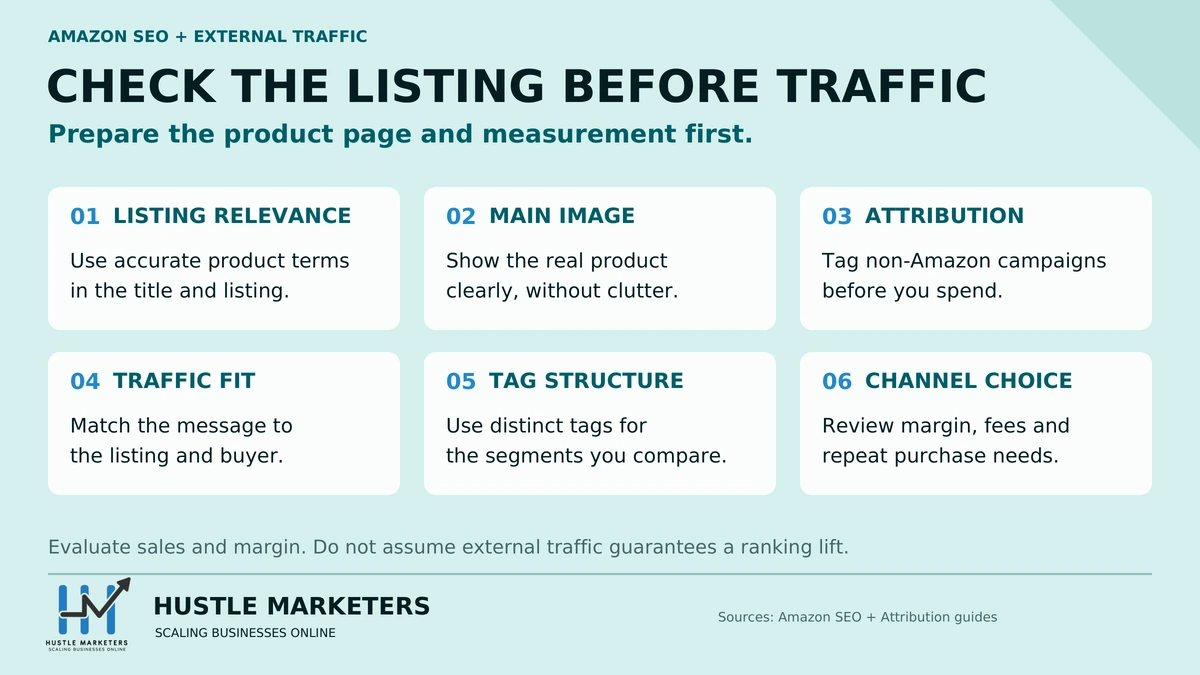
- Fix the listing fields that are checkable. Title length, bullet length, main image fill, image resolution, and a backend field that is well inside the limit and correctly formatted. These cost nothing and they are the only part Amazon actually documents.
- Decide whether external traffic is a rank play or a margin play. If it is rank, understand that the link is unproven and the mechanism runs through conversion, so only send traffic that will convert. If it is margin, the Brand Referral Bonus is the reason and it needs Attribution tags to exist at all.
- Set up Amazon Attribution before spending anything externally. Without tags there is no measurement and no bonus.
- Use Search campaigns, not Shopping or Performance Max, if the destination is your listing. Google’s documented requirements leave no route to an Amazon listing through Merchant Center.
- Build Attribution tags at ad group level so you can tell which segment converted, since Google Ads and Attribution will not join up for you.
- Decide the channel split deliberately. Amazon for purchase intent, your own store for research intent and repeat purchase.
- Then scale spend. Not before.
How Hustle Marketers helps Amazon sellers
Plainly, so you can decide whether we are the right fit: we are not an Amazon PPC agency and we will not pretend to be one. We do not manage Sponsored Products campaigns and we have no Amazon case study to show you.
What we do is the half of this article that sits off Amazon, which is where most Amazon-only agencies stop. Ishant Sharma has worked as a Google Ads, Microsoft Ads and SEO specialist since 2013, and the agency’s core competence is product data and paid search for ecommerce brands: Merchant Center setup and recovery, feed structure, identifiers, and the Google and Microsoft campaigns that sit on top of them.
That maps onto the Amazon problem in a specific way. The Merchant Center domain restriction, the compliant Search campaign route, the Attribution tagging structure and the own store versus marketplace split are all feed and paid search questions, and they are the questions Amazon specialists tend to get wrong.
Where that work sits with us: SEO services for your own domain, ecommerce SEO agency work for the store itself, Google Ads for the search campaigns, Microsoft Ads for the channel most ecommerce brands ignore, ecommerce PPC management for the catalog side, and PPC management across Meta, Google and Microsoft together. On the AI search side, which increasingly decides which brands get recommended before anyone searches, that is AI SEO.
The proof we can show you is on the Google and Meta side rather than the Amazon side. We got Silicon Lightworks live on Merchant Center and Shopping after custom products without GTINs, price sync and shipping configuration had kept it at zero Shopping visibility, launched Google Ads from a standing start for a building block toy brand, grew Google Ads for P-REX Hobby by rebuilding the shopping feed, integrating reviews and rewriting product descriptions around real keywords, and ran Meta Ads for a Dubai fitness app, written up in our Meta Ads case study. If the off-Amazon side is what you need, that is the work.
About the author: Ishant Sharma has worked in digital marketing since 2013 as a Google Ads, Microsoft Ads and SEO specialist, across ecommerce, local service, SaaS and white label agency accounts in the US, UK, UAE and Australia. His platform work spans Shopify SEO and Shopify marketing. He leads ecommerce PPC management and Google Ads at Hustle Marketers. He founded Hustle Marketers, a Google Partner, Meta Business Partner and Microsoft Advertising Partner agency, and one of the best digital marketing agency options for ecommerce and local service brands. The agency reports more than $780M in client sales across 2,500+ brands, and Ishant is Top Rated Plus on Upwork. More about Ishant.
Amazon SEO FAQs
Does external traffic improve Amazon ranking?
There is one hedged Amazon statement, in its Amazon Attribution guide, saying non-Amazon campaigns increase glance views of product pages, which “can help support organic rankings”. That is a two step claim about a metric, not a statement that external traffic is a ranking input, and Amazon’s own SEO guidance does not mention external traffic at all. The plausible route is indirect: glance views can become sales, and Amazon confirms sales volume drives Best Sellers Rank. Traffic that does not convert dilutes your conversion rate, so untargeted external traffic is a risk rather than a free boost.
Can I run Google Shopping ads to my Amazon listing?
No. Google requires that you only link to the domain claimed in your Merchant Center account, and a third party seller cannot claim amazon.com. An Amazon community manager has confirmed in the Seller Forums that Amazon offers no integration for this. Search campaigns with an Amazon Attribution tag are the compliant route.
Can I run Performance Max to an Amazon listing?
No, for the same reason. Performance Max runs on Merchant Center and inherits the same claimed domain requirement.
How much is the Amazon Brand Referral Bonus?
Amazon states it averages around 10% of the sales price on sales generated from non-Amazon marketing, with rates varying by category. It requires a Professional selling plan, Brand Registry and an active or pending trademark, applies in the US store, and does not apply to traffic from Amazon’s own ads.
Why can I not find my Brand Referral Bonus in my payments?
Because it is not a payment. Amazon credits it against the referral fees on future sales until the credit is used up, and the full amount is credited after a two month waiting period to allow for returns. Check the Brand Referral Bonus report rather than the payments transaction view.
How do I track which Google Ads keyword converted on Amazon?
Not directly. The purchase happens on a domain where you cannot place a Google conversion tag, so Google Ads sees clicks and Amazon Attribution sees purchases with no link between them. The workaround is a separate Attribution tag per ad group, or per keyword for a short list.
How many characters can backend search terms be?
An August 2018 Amazon search term field update said the field is limited to less than 250 bytes, with longer entries truncated at the first 249 bytes, so the working maximum is 249. Amazon’s current public guidance names the field and gives formatting rules but states no limit at all. Bytes are not characters, so accented and non Latin characters use two to four bytes each.
Has COSMO replaced the A9 algorithm?
Amazon has not said so. COSMO is a published Amazon research system presented at SIGMOD in 2024, reporting 6.3 million nodes and 29 million edges across 18 Amazon categories, and Amazon states it has been deployed in search applications such as search navigation. The paper does not mention A9, A10 or Rufus anywhere, and there is no Amazon statement that COSMO replaced A9 or that it is the ranking algorithm. A10 is not an Amazon term at all.
Should I send Google traffic to my own store or my Amazon listing?
It depends on margin and on what you want from the customer. Amazon converts better and supplies trust, and the Brand Referral Bonus returns around 10% on externally driven sales. Your own store keeps the customer data and the repeat purchase. A reasonable split is Amazon for buyers who have already decided, your own store for the research phase.
Is Amazon PPC cheaper than Google Ads?
Usually, on vendor aggregated figures. Amazon does produce benchmark reporting including cost per click, but only inside an advertiser’s own console against their own category, so no public figure exists. The more useful framing is that Amazon advertising is the shorter path to a sale, while external traffic earns its place by reaching people before they search, earning the Brand Referral Bonus, or building a customer you can sell to again.
If you are fixing this as part of a wider organic push, our ecommerce SEO guide covers where it sits against category pages, internal linking and product data.