Pet Marketing: The Ad Rules and Real Numbers Behind Pet Brands That Grow

Ishant
Published : September 28, 2026 at 9:30 am
Updated : October 16, 2026 at 12:14 pm
Ishant
Written by Ishant Sharma, Google Ads, Microsoft Ads and SEO specialist since 2013 | Updated September 2026 | Facts checked September 23, 2026
Most pet marketing guides open with a market size number and a reminder that people love their pets. Then they list influencers, email, social media and SEO, and stop.
We read the thirteen pages currently ranking across the pet marketing keyword set before writing this one. Between them they cover influencer marketing seven times, content marketing seven times and the phrase “pet parent” in almost every case. Not one of them tells you that Microsoft Advertising bans the sale and shipment of live animals outright, that Google carved pet supplies out of its recurring billing restriction for Shopping ads but not for free listings, or that dog flea and tick sales peak in May while cat flea and tick sales peak in July.
Those are the things that decide whether a pet campaign works. This guide is built around them.
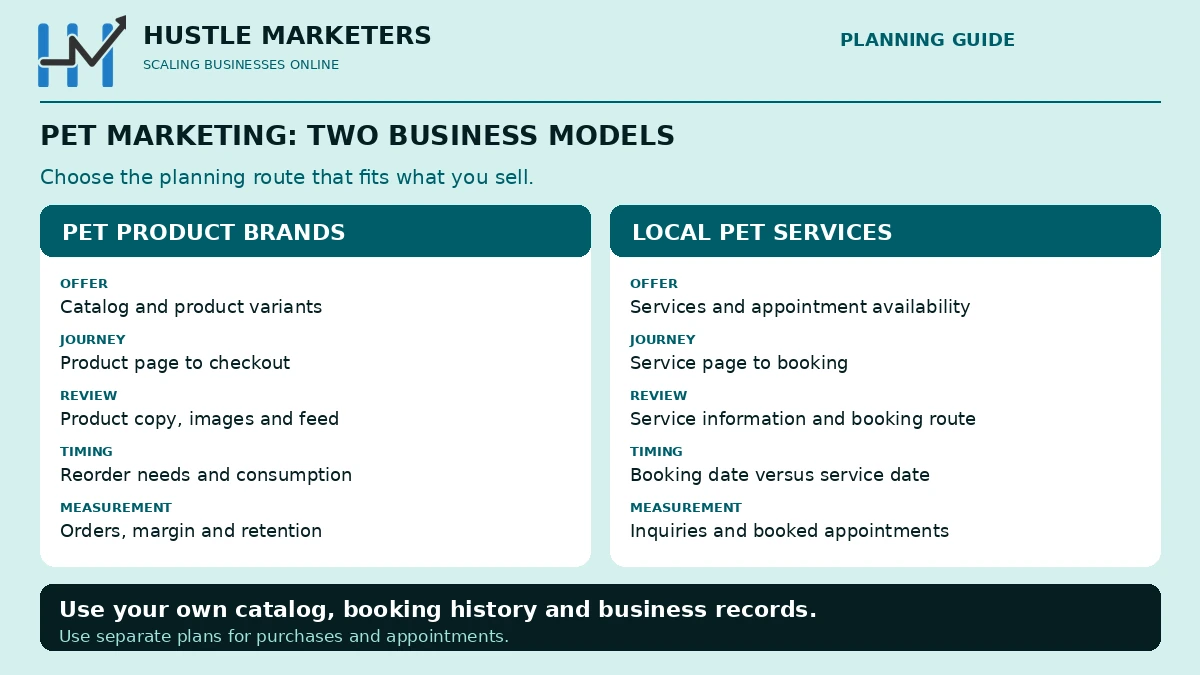
It covers two audiences, because the search results treat them as one topic and every existing page picks a side:
- Pet brands selling products: food, treats, supplements, accessories, toys, grooming products, direct to consumer or through Amazon and Chewy.
- Local pet service businesses: grooming, boarding, daycare, sitting, walking, training, veterinary.
Skip to whichever half applies to you. Where the advice differs, it is labeled.
Every policy statement here was read on the platform’s own policy page, and the exact wording is quoted so you can check it. Where a number comes from an agency blog with no disclosed methodology, that is said plainly rather than dressed up as a benchmark, because a large share of the 2026 pet advertising benchmark tables now circulating are modeled rather than measured. One of them says so in its own methodology box.
Pet is not the only category where the copy decides the compliance category. If you also sell cosmetics, haircare or fragrance, the same appearance versus function logic runs through our beauty marketing guide, along with the FDA claim line and the platform rules on before-and-after ads.
Table of Contents
- How big is the pet market, and where is the money actually spent?
- What does the ad platforms’ rulebook actually allow for pet businesses?
- Why do pet supplement ads get disapproved when the product is fine?
- What do pet keywords actually cost?
- How do you compete with Chewy, Amazon and Petco?
- Does a pet subscription actually make you money?
- When should a pet business actually spend?
- What should a product feed look like for a pet catalog?
- How do local pet services actually get clients?
- What should you actually do first?
- How Hustle Marketers helps pet brands and pet service businesses
- Related guides
- Pet marketing FAQs
How big is the pet market, and where is the money actually spent?
The American Pet Products Association puts US pet industry spending at $158 billion in 2025, up 3.7%, with $165 billion projected for 2026.
The split matters more than the headline, because it tells you which category you are actually fighting in:
| Category | 2025 actual | 2026 projected |
|---|---|---|
| Pet food and treats | $68.3B | $69.7B |
| Supplies, live animals and OTC medicine | $34.4B | $35.6B |
| Vet care and product sales | $41.0B | $42.4B |
| Other services | $14.3B | $14.9B |
Source: APPA industry trends and stats. Note that the four projected figures sum to $162.6 billion against the stated $165 billion headline, and APPA does not explain the difference.
One honest caveat that almost every pet marketing article gets wrong. There is no official figure for the ecommerce share of US pet spending. APPA does not publish one, and the percentages you see quoted in agency posts trace back to paywalled analyst reports rather than to APPA or a government source. If a page tells you a precise online share and cites APPA for it, check the citation.
A second caveat worth knowing, because it explains why you will see the same $158 billion attached to three different years: APPA’s own stats page carries a heading reading 2025 actual sales while the sentence beneath it describes the figure as 2024. The March 2026 press release is the authoritative version. The figure is 2025. The same ambiguity attaches to the four category figures in the table above, which come from that page.
What does the ad platforms’ rulebook actually allow for pet businesses?
This is the section nobody writes, and it is the one that costs pet advertisers the most money.
Of the thirteen ranking pages we read, zero mention advertising policy in any form. Two mention Merchant Center, both as a surface to optimize, neither as a place you get rejected. One of those pages belongs to an agency whose own page describes decades of work launching major veterinary parasiticide brands, and it still contains nothing about claim restrictions.
Here is what the policies actually say, quoted from the platforms’ own pages.
On Google:
| What you sell | Google Ads | Google Shopping and free listings |
|---|---|---|
| Live animals | No policy against it. Only cruelty and endangered species are banned | Restricted on safety grounds, framed around transportation |
| Pet pharmacy, prescription pet meds | No animal or veterinary section exists in the policy | US and Canada only, with LegitScript or NABP accreditation plus Google certification |
| Pet supplements | General unapproved supplements rules apply, no animal specific entries | Same |
| Pet CBD | Topical and non pharmaceutical only, targeting limited to California, Colorado and Puerto Rico | Same |
| Subscription only product | Not applicable | Shopping ads: allowed in the US under the Pet supplies exception. Free listings: not eligible |
On Meta and Microsoft:
| What you sell | Meta Ads | Meta Shops and catalogs | Microsoft Advertising |
|---|---|---|---|
| Live animals | Allowed for legitimate businesses. Peer to peer sale banned | Banned outright | Banned outright |
| Pet pharmacy, prescription pet meds | General prescription drug rule. LegitScript required. US, Canada and New Zealand only | Banned as healthcare products | Preapproval through Microsoft’s own program |
| Pet supplements | Allowed, subject to claim rules | Banned outright as ingestible supplements | General rules apply |
| Pet CBD | Allowed with LegitScript certification, but no claims of treating a condition in animals | Restricted | Restricted |
| Subscription only product | Allowed | Not applicable | Not applicable |
Now the detail, because the tables hide the parts that catch people out.
Can you advertise live animals on Google, Meta and Microsoft?
The answer is different on all three platforms, and the widely repeated version is wrong.
Meta does not ban selling animals. It bans peer to peer sales. Its live and endangered animals policy says ads must not:
promote peer-to-peer sales or trade of live non-endangered animals, including ambiguous contexts where the nature of the sale or trade is unclear
and the same page explicitly permits you to:
Promote live non-endangered animals offered by a legitimate business, including retail businesses, breeders, auctions, animal rehoming services or shelters
So a licensed breeder or a pet store can run Meta ads. A private individual selling a litter cannot.
Then Meta contradicts itself depending on the surface. The Meta commerce policies, which govern Shops, catalogs and Marketplace, state:
Commerce content may not promote the buying, selling, or trading of animals or animal parts, or land in ecological conservation areas
Same company. You may advertise the animal. You may not list it in a Shop. The only place the word pet appears in that commerce policy is a related restriction on pet adoption matching services, which are allowed by approved sellers only. Almost no marketing coverage distinguishes these two, and the distinction is the reason a business can have an approved ad account and a rejected catalog at the same time.
Microsoft is the strictest of the three, and the rule is buried where nobody searches. It sits inside the endangered species section of Microsoft’s disallowed and restricted products policy, immediately after the endangered species sentence:
Advertising for the sale and shipment of live animals is also prohibited.
No legitimate business exemption. If you are a breeder or a live animal retailer, Microsoft Advertising is closed to that part of your catalog, and you will not find this by searching the policy index for “pets”.
Google Ads, by contrast, has no policy on selling animals at all. It restricts animal cruelty and endangered species trade and nothing else. On the Shopping side, live animals appear only as a safety restriction framed around transport, which is why merchants see disapprovals labeled around local legal requirements and safety standards rather than anything that names the animal.
Do pet pharmacies need LegitScript certification?
Yes, and the rule is not where you would look for it.
Google’s main Ads healthcare policy contains no mention of veterinary, animal or pet anywhere. The requirement lives in Merchant Center’s healthcare and medicines policy, under a heading called pet prescriptions and pharmacies:
Shopping ads allow the promotion of pet pharmacies and pet pharmaceuticals in the United States and Canada only.
and:
Merchants promoting pet pharmacies and pet pharmaceuticals to the United States and Canada must be accredited by the LegitScript Healthcare Merchant Certification and Monitoring Program or the NABP’s .pharmacy Verified Websites Program and certified by Google.
Two things follow that matter commercially. First, a UK, EU or Australian pet pharmacy has no route to Shopping approval at all, regardless of certification, because the permission is geographic. Second, if you are searching Google Ads policy for a pet medication rule, you will not find one, because it does not exist there. You are being enforced against under a policy set that never describes your product.
Meta’s drugs and pharmaceuticals policy requires:
Meta requires online pharmacies and telehealth providers to be actively certified with LegitScript
with targeting restricted to the United States, Canada or New Zealand. The policy says online pharmacies without distinguishing human from veterinary, so a pet pharmacy has no exemption to lean on.
Microsoft routes pharmacy approval through its own preapproval forms rather than LegitScript, though it does use LegitScript certification for drug and alcohol addiction services. Its healthcare policy, updated 1 July 2026, requires online prescription sellers to be preapproved, and notes that brick and mortar pharmacies are not subject to the same restrictions as businesses selling prescription drugs online. It does not mention veterinary medicine at all.
Are flea, tick and worming treatments restricted?
There is no published rule, and anyone telling you they are treated as pesticides is inventing a category.
We searched Google’s healthcare and medicines policy, the unapproved pharmaceuticals and supplements list, the dangerous products policy and the other restricted businesses policy. Flea, tick, worming and dewormer appear in none of them. Google has no pesticide policy.
By category, over the counter parasiticides fall under the over the counter medication line in Google’s restricted healthcare content:
Google restricts the promotion of healthcare-related content such as the following: Over-the-counter medication, Prescription drugs, Unapproved pharmaceuticals and supplements, Pregnancy and fertility-related products.
Prescription only parasiticides fall under the pet pharmacy rule above. Beyond that, the policy simply does not say, and any specific claim about how Google classifies your particular SKU is guesswork. Plan for it as an over the counter medication and expect review rather than assuming either approval or rejection.
Can you sell pet CBD through Google Ads?
In practice, mostly no.
Google’s CBD policy allows only topical, non pharmaceutical CBD, and only after LegitScript certification followed by a separate Google CBD certification:
Location targeting is limited to California, Colorado, and Puerto Rico, and certain ad formats like YouTube Masthead aren’t eligible to serve ads related to CBD.
Most pet CBD is ingestible: tinctures, chews, oils. That is excluded by product type before geography even applies. A topical pet CBD balm could in theory qualify, and could then be advertised in three US jurisdictions.
Meta allows CBD in eligible countries with LegitScript certification, but its policy removes the value proposition. Ads cannot:
Contain any claims that expressly state or imply that the featured products can treat, cure, prevent, mitigate or diagnose a disease or medical condition in humans or animals.
That is one of the very few places any platform names animals explicitly, and it rules out essentially every reason a customer buys pet CBD.
Can you run Shopping ads for a subscription-only pet product?
Yes for Shopping ads, no for free listings, and Google carved out pet supplies by name. This is the most commercially significant policy detail in the category and we have not found it covered anywhere in it.
Recurring billing is listed as unsupported content in Google’s Shopping policies. Google’s unsupported content list defines it as a:
Payment method that allows users pay for goods on an ongoing basis, at regular intervals in the future
Most people stop reading there, and that is where the mistake happens. Directly beneath that definition is an exceptions block naming ten Google product categories where US physical goods subscriptions are allowed:
Apparel and accessories (ID: 166), Alcoholic beverages (499676), Coffee (ID: 1868), Health care (ID: 491), Medicine & Drugs (ID: 518), Home and garden (ID: 536), Personal care (ID: 2915), Pet supplies (ID: 2), Prepared foods (ID: 5814), Toys (ID: 1253)
Google product category ID 2 is Animals and Pet Supplies, Pet Supplies, the parent of the entire pet branch. Dog food and cat food sit underneath it. So a subscription-only pet food SKU is eligible for Shopping ads in the US, provided you meet the conditions. The conditions are strict:
Each offer must include the complete subscription cost [subscription_cost] attribute, including period [period] (week [week], month [month], or year [year]), period length [period_length], and amount [amount]. Only standard billing periods of one week, one month, or one year are supported.
That last sentence is the one that catches pet brands. Pet food subscriptions are frequently set to a six or eight week cadence, because that is how long a bag actually lasts. Those periods are not supported. You can bill every six weeks in your own checkout, but you cannot express it in the feed, so the offer will not qualify under the exception.
The landing page carries obligations too:
The landing page must clearly and prominently state all subscription agreement terms, including cancellation and refund procedures, auto-renewal practices, notification methods for price or period changes, and any additional mandatory fees.
Free listings are a separate policy set with a separate, much shorter exceptions list. Google’s free listings unsupported content policy carves out magazines and newspapers, certain mobile products, annually prepaid software and telecom subscriptions in Brazil. There is no pet supplies exception and no US physical goods exception at all.
So the honest answer is a split, and it is a split nobody in this category writes about:
| Surface | Subscription-only pet product |
|---|---|
| Shopping ads, US | Allowed under the Pet supplies (ID: 2) exception, with a complete subscription_cost attribute and a weekly, monthly or annual period |
| Shopping ads, outside the US | Not covered by the exception |
| Free listings | Not eligible. No pet exception exists |
Practically, that means two things. If you want the subscription itself running in Shopping, put the full subscription_cost attribute in the feed and move the billing period onto a week, month or year. If you want free listings visibility as well, keep a one time purchase price available, because free listings will not take the subscription-only version at any price.
There is a separate March 2026 update allowing certified merchants to promote prescription drugs with recurring billing in the US. The certification named is US Online Pharmacy, and pet and veterinary prescriptions are not mentioned, so it does not extend the pet pharmacy route.
Does Meta’s personal attributes policy apply to your dog?
Meta has not said, and both confident answers you will read are wrong.
Meta’s personal attributes policy states that ads must not contain content that:
asserts or implies personal attributes. This includes direct or indirect assertions or implications about a person’s race, ethnicity, religion, beliefs, age, sexual orientation or practices, gender identity, disability, physical or mental health (including medical conditions), vulnerable financial status, voting status, membership in a trade union, criminal record or name.
Every attribute listed is human. Pets are not mentioned anywhere on the page, in the examples or in the guidelines. So the policy does not ban ad copy about your customer’s dog’s skin condition. It also does not permit it. It is silent, and anyone claiming otherwise in either direction is filling in a gap.
What the page does give you is a reliable structural rule, and it is worth following whether or not it strictly applies. Meta bans the question form and allows the product form:
Not allowed: “Do you have diabetes?”
Allowed: “New diabetes treatment available”
Applied to pet copy, that means writing “Relief for itchy skin in dogs” rather than “Does your dog have itchy skin?” You lose nothing in clarity and you remove the only version a reviewer could object to.
One more thing worth knowing if you are relying on this policy being cleanly drawn. It is not. The identical example sentence about getting a spouse treated for cancer currently appears on that page as prohibited under physical and mental health and as allowed under vulnerable financial status.
Why do pet supplement ads get disapproved when the product is fine?
Because enforcement targets the claim and the wording, not the product’s composition. This is the most strongly corroborated pattern in the whole category, confirmed independently by federal enforcement records, a veterinary expert, trade press and two separate platform disapproval cases.
The FDA’s warning letter to Evolution Pets LLC, issued 12 November 2024, quotes the company’s own website and Amazon listing side by side. Website copy cited included:
Need help preventing Dog Seizures? SeizureGuard PLUS can help.
and
Proven effective remedy to fight the damaging effects of canine seizures.
Amazon listing copy cited included:
#1 RATED Seizure Medication for Dogs. GUARANTEED or our [sic] your money bac[k
Those claims made the product an unapproved new animal drug. The same batch of letters went to several other pet supplement brands on the same day.
Todd Harrison, a partner at Venable LLP, makes the wider point in a 2026 NASC regulatory update in PetfoodIndustry:
FDA and state regulators look at the totality of the presentation — including imagery, testimonials, product names and even videos
and:
The biggest risk is not a single claim, but the cumulative impression that a product is intended to diagnose, treat, cure or prevent disease.
That sentence rules out the single most requested pet supplement ad format. A before and after mobility video, showing a stiff dog then a moving dog, is a disease claim even with no disease word anywhere in the copy.
It also means a customer testimonial is your liability. Veterinarian Dr. Sarah Wooten’s guide to pet supplement claims makes the point that a review saying a product cures a dog’s arthritis is itself a disease claim, and gives the swaps that work:
| Claim that creates risk | Compliant alternative |
|---|---|
| Treats arthritis | Supports healthy joint function |
| Repairs damaged joints | Supports healthy joint function |
| Stops diarrhea in dogs | Supports normal digestive health |
| Heals allergies | Supports healthy skin and coat |
Two real cases show how literal the enforcement is.
An Amazon seller had a hemp seed oil pet product deactivated twice. They supplied two Certificates of Analysis, one from the manufacturer and one from a US ISO certified lab, both proving zero CBD content. Amazon’s reply, in the Seller Forums, was:
the ASIN has been identified as a prohibited CBD/cannabinoid product.
The trigger turned out to be three words on the packaging: “full spectrum”. Removing them was not enough on its own. The listing could not be rehabilitated and had to be rebuilt from scratch.
On the Google side, a merchant in the Shopify Community had an entire catalog disapproved under Shopping ads policies with no specific reason given, and eventually traced it to a single keyword in one product title or description. A Google Ads Diamond Product Expert was advising in the thread. Weeks of trial and error, one word.
If you sell anything ingestible for animals, audit your copy the way a regulator would: the product name, the images, the video, the reviews and the ad text together, not the ingredient list.
What do pet keywords actually cost?
Real numbers first, with the sample sizes, then the reason most published pet benchmarks are unusable.
WordStream’s 2026 Google Ads benchmarks report the Animals and Pets category from 13,474 US search campaigns running between 1 April 2025 and 31 March 2026, with each subcategory containing at minimum 52 unique active campaigns, and figures presented as medians to control for outliers:
| Metric | Animals and Pets, 2026 | Prior year |
|---|---|---|
| Average CPC | $4.06 | $3.97 |
| Average CTR | 7.49% | 6.58% |
| Average conversion rate | 16.22% | 13.07% |
| Average cost per lead | $31.50 | $31.82 |
Why the 16.22% conversion rate will mislead a pet ecommerce brand
Because the category is dominated by local lead generation, not product sales. Vets, groomers, boarding kennels and sitters generate form fills and phone calls, which convert at rates a product catalog never will. If you run a pet supplement store and someone quotes you a 16% conversion rate as a pet industry benchmark, they have handed you a target from a different business model.
For a product brand, first party platform data is closer to reality. IRP Commerce publishes aggregated trading data from real transactions on its platform for the pet care market. Its figures as at August 2026 show a conversion rate of 2.56%, average order value of £81.71, and cost per acquisition at 9.66% of revenue. The trend is the uncomfortable part: AOV fell 16.72% year on year while CPA rose 14.45%. It is last click attributed and UK skewed, but it is observed rather than modeled.
That data set also contains a result worth sitting with. Google PPC drove 62.50% of sales. Facebook Paid drove 0.37%. Whatever the cause, whether merchant mix or last click attribution understating Meta’s assist, the default assumption that Meta is the acquisition engine for pet direct to consumer does not hold there.
How to tell a real pet benchmark from a modeled one
Several of the tidiest pet advertising benchmark tables published in 2026 are not measurements. One pet products Meta benchmark page states so itself, in its own methodology box:
Data classification: modeled planning estimate. The repository does not contain a raw account extract, sample count, or reproducible reconciliation that supports these exact rows as observed AdRiseLab customer medians.
Others publish precise looking pet CPM, CPA and ROAS tables with no methodology at all. Two mainstream sources currently disagree by roughly two times on pet CPM for the same year and the same category, which tells you how much confidence the numbers deserve.
Three checks before you plan a budget around any pet benchmark:
- Does it state a sample size and a date range?
- Does it distinguish lead generation from ecommerce?
- Is the source citing another aggregator, which is citing another aggregator?
The widely quoted median pet customer acquisition cost of around $23 fails the third test. It traces through two aggregators to a root source that lists web triangulation among its methods.
How do you compete with Chewy, Amazon and Petco?
You do not compete with them for search volume. You compete for a narrower slice, and the first job is knowing which slice.
A November 2025 benchmarking study of 20 US fresh and raw dog food brands, using an Ahrefs Q4 2025 snapshot, puts the scale of the wall in plain numbers:
| Site | Monthly organic visits |
|---|---|
| Chewy | 4,300,000 |
| PetSmart | 4,100,000 |
| Petco | 3,000,000 |
| The Farmer’s Dog | 539,600 |
| Freshpet | 144,300 |
| Open Farm | 113,400 |
| JustFoodForDogs | 104,100 |
Chewy’s domain rating is 87, with more than 371,000 ranking keywords. The strongest specialist, The Farmer’s Dog, sits at DR 72 with 19,700.
The branded traffic split that tells you whether you have a demand problem
This is the number to look at, and almost nobody does.
The same study splits traffic into branded and non branded. Chewy is 93.9% branded. The Farmer’s Dog is 89.5% branded. Spot and Tango is 15.7% branded and 84.3% non branded.
That means two brands with comparable traffic can have opposite growth engines. Chewy’s traffic is people typing “Chewy”, which is demand it already owns. Spot and Tango’s traffic is people searching for a problem, which is demand it is winning. If your organic traffic is overwhelmingly branded and flat, more SEO budget on category pages will not fix it, because you have a demand problem rather than a ranking problem. If it is overwhelmingly non branded, you are discoverable and your issue is downstream, in conversion or retention.
Pull that split for your own domain before you commission anything.
Why you cannot price match them
Because the wholesale mathematics does not allow it. Published gross margins from the most recent full year filings: Chewy 29.8% and Petco 38.7% for FY2025 ending early 2026, Freshpet 40.8% for FY2025, and BARK 61.3% for FY2026 ending 31 March 2026. Retailers at Chewy and Petco scale buy well below MSRP, which is a cost structure a direct to consumer brand cannot match on the same SKU.
The strategic consequence is that price parity is a losing position and the differentiated, higher margin part of your range is the part worth advertising. As Frederike Edelmann, VP Investor Relations and Corporate Sustainability at Central Garden and Pet, put it in Pet Food Processing:
DTC is most effective when used selectively for high-margin, differentiated products.
She added that loyalty can be fragile if pricing or delivery disappoints, and that retail still wins on immediacy and price comparison.
Does a pet subscription actually make you money?
Subscription is the defining structure of pet ecommerce. It is also where the most confident bad advice lives.
Start with the scale. In Chewy’s Q2 FY2026 results, Autoship sales were $2,817.2 million, or 84.6% of net sales, across 21.705 million active customers at $602 net sales per active customer. That share has climbed steadily: 73.3% in Q3 2022, 83.3% in FY2025, 84.6% now. If you sell a consumable, your customer’s reorder is already structured, and it is structured on somebody else’s platform.
Then the caution. BARK’s direct to consumer revenue fell 21.9% in FY2026 to $324.9 million, with management stating they stopped spending on subscribers they could not retain profitably. Subscription is a retention structure, not a growth strategy, and it only works if the retention is there first. Widely circulated BarkBox churn percentages exist, but we could not trace any of them to a primary source, so they are not quoted here.
What the churn data actually shows
Subbly’s subscription churn report, drawn from thousands of merchants on its platform with an analysis window of September to November 2024, contains two findings that contradict what most agencies assume.
The first: pet is among the lowest churn subscription categories, not one of the highest. Arts and DIY was lowest, with pet related closely behind. Fashion and health showed higher churn. Median churn overall was 7.44%.
The second, and the more useful one:
There is absolutely no correlation between Average Order Value (AOV) and churn rates
with a correlation coefficient ranging from 0.03 to 0.1 across months. Raising or lowering your price will not fix your churn. Stop treating it as a pricing problem.
The sample skews to smaller merchants, so treat the absolute numbers as indicative and the direction as sound.
Why a 30-day Amazon Subscribe and Save cadence is wrong for most pet catalogs
Because consumption scales with the animal, not the calendar. A Chihuahua and a Great Dane empty the same bag at completely different rates, so a single default 30 day cycle guarantees that one group gets food they do not need and the other runs out and cancels.
This point comes from a marketplace agency rather than from published platform data, and the specific figures it attaches are not sourced, so treat the numbers as an agency assertion. The mechanism, though, is independently sensible and easy to test: set the default cadence per product by bag size and feeding rate rather than accepting a flat monthly default.
The fulfillment shape of a pet order
Two operational facts that change the economics and rarely make it into marketing plans. On one 3PL’s published Q2 2026 pet benchmarks, which are vendor first party data rather than an independent study, the average pet parcel is about 4.5 lb at 12 by 9 by 6 inches, which sits squarely in the dimensional weight penalty zone, while returns run about 6.5% against a cross category average around 10.5%.
Cheap returns and expensive freight. That is the opposite shape to apparel, and it means shipping thresholds and bundle design move your margin more than return policy does.
When should a pet business actually spend?
Seasonality is where the existing guides are weakest. The best of them says boarding is busy in summer and retail is busy at the holidays. Neither names a month.
Dogs and cats peak in different months
The strongest seasonality evidence we found is on flea and tick, using Similarweb data reported by GlobalPETS.
Online flea and tick sales for dogs rose from $11.8 million in January to $42 million in May in 2023, with May 2024 reaching $41.9 million. The trough is December and January, at $13.2 million and $11 million.
Cats run on a different clock. Between February and July 2024, online flea and tick sales for cats rose from $9.2 million to a peak of $24 million in July, more than two and a half times.
That is a swing of roughly three and a half times between trough and peak, with dogs peaking in May and cats peaking in July. If you run one seasonal calendar for parasite products you are wrong for half the catalog. Build two.
Boarding advertising should run in August, not November
If Thanksgiving and Christmas boarding is booked three to four months ahead, a facility advertising in November is advertising into a sold out calendar.
This comes from one practitioner, a Minnesota dog daycare operator quoted in a press release, who reports that Thanksgiving and Christmas need reservations three to four months in advance, summer travel two to three months out, and shorter holidays four to six weeks. It is one person’s experience delivered through a promotional vehicle, so treat the exact lead times as a starting hypothesis rather than a rule.
The mechanism is sound enough to act on. Pull your own booking data, measure the gap between booking date and stay date, and set your peak campaign start to that gap plus a buffer. For most facilities that will move Christmas spend from November into August or September.
The seasonality nobody has measured
Being straight about the gap: we could not find a single groomer or grooming salon owner on the record naming their strongest and weakest months, and there is no pet specific Google Business Profile data worth quoting. Agency pages assert that grooming searches spike 40% before major holidays and that training peaks January to March. Those are plausible and untested. Treat them as hypotheses for your own account, not as benchmarks.
What should a product feed look like for a pet catalog?
Pet catalogs are variant heavy in a way that breaks tools built for single SKU products. Weight by flavor by life stage multiplies fast, and three specific problems come up again and again.
You cannot exclude a single variant from Google Shopping in Shopify
Only the whole product. A merchant who wanted to keep certain weights or flavors out of Shopping reported in the Shopify Community:
I can only turn Google & Youtube on/off on the product page itself for the entire product.
Both suggested native workarounds, unchecking the Google sales channel per variant and removing the Merchant Center visibility checkmark, operate at product level rather than variant level. This is structural enough that feed apps sell variant exclusion rules as a paid feature.
The practical answer is a feed management layer between your store and Merchant Center, with exclusion rules at variant level. That is what product feed optimization exists to solve, and it is why feed management software is usually cheaper than the revenue lost to a badly structured catalog.
Price mismatch disapprovals on multi-price variants come from structured data
A merchant with three variants priced at $55, $99 and $38 had the two higher variants disapproved for price mismatch while the cheapest was approved. The diagnosis from a Google Ads Diamond Product Expert in the thread was direct:
The reason is the structured data. Make sure to update your structured data.
Google was reading the page, not the feed. Pet products are almost always priced by size, so this hits the category harder than most. Check that your product page structured data reflects the selected variant price, not just the lowest price in the range. The Google product data specification covers what each attribute has to contain.
GTINs and the own-brand pet maker
Small pet brands that never bought barcodes get told to strip identifiers. Google Ads Diamond Product Expert Emmanuel Flossie’s guidance on the limited performance warning is:
If the manufacturer has not assigned a bar code, remove the values brand, MPN, GTIN, and set identifier to no.
You will still see the limited performance warning. His view is that if everyone selling that product is in the same position, you are not at a relative disadvantage. That is his opinion rather than a measured finding, but the instruction itself is correct: an incorrect identifier is worse than a declared absent one.
On Amazon, a routine multipack can kill a live listing
This one is genuinely hard to anticipate. A seller added a two pack variation to an active freeze dried dog food listing. The system re-categorized it into Other Pet Ingestible Products, which is gated, and the listing went dead. Amazon’s response, in the Seller Forums, was:
As part of our ongoing efforts to provide the best possible customer experience, Amazon has implemented additional restrictions for pet supplies brands. Unfortunately, we are not accepting applications for pet supplies brands at this time.
A merchandising change closed a gate the seller had no way to reopen. Before you add a multipack, bundle or new size to a pet ingestible on Amazon, check the product type it will land in. If you sell on Amazon as well as your own store, the Amazon SEO guide covers what Amazon documents and what it does not.
How do local pet services actually get clients?
The product half of this article does not apply to a grooming salon, a boarding facility or a sitting business. Different economics, different channels.
Referrals outrank paid acquisition, and the trade body does not mention marketplaces
Pet Sitters International’s guidance on getting your first clients, citing its own State of the Industry Survey, says referrals are one of the most common ways members attract new business. The article covers a direct website and local SEO, word of mouth, networking with vets and other pet professionals, social media and referral incentives.
Rover and the other marketplaces are not mentioned at all. For a professional association writing about client acquisition, that absence is itself informative.
The scale of these businesses is worth knowing before you plan a budget. PSI’s 2026 member survey, fielded 20 January to 11 March 2026, reports average gross revenue for US member businesses of $112,423 in 2025, up from $100,537 in 2023, with 99% independently owned, 89% women, an average member age of 54, and 73% in business five or more years. That is a self selected sample of professionalized operators rather than the side hustle population, which is a skew worth saying out loud.
Rover’s fee is regressive on new clients
Rover is currently piloting a tiered service fee based on lifetime booking history with each individual client. The page states the feature is only available to sitters in select cities at this time, so check whether it applies to you before modelling it:
| Lifetime bookings with that client | Service fee |
|---|---|
| $599 or less | 30% |
| $600 to $1,199 | 15% |
| $1,200 or more | 10% |
Read what that does. Your first jobs with any new customer are your worst margin work, and the fee only improves once that relationship is established. For a sitter, the marketplace is expensive precisely at the acquisition stage, which is the stage most people use it for.
That is the economic case for owning your own acquisition: a direct booking from your own site carries no fee at any stage. It is also why a Google Business Profile and local search visibility are worth more to a pet service business than to almost any other kind of pet business.
Budget in dogs, not dollars
One working groomer’s framing is better than any benchmark here. Writing in The Daily Groomer from his own spend, Alex Martin found:
the sweet spot was $500-$1,000 per month. That’s only around 5-10 dogs!
That is an anecdote, and he publishes no CPC or conversion data. The reframing is the valuable bit. Expressing an ad budget as a number of grooms rather than a number of dollars makes it obvious whether the maths works, and it makes a $600 monthly test feel like what it is: an attempt to win six appointments.
Discounting selects for the wrong client
Home based groomer Betty Peto’s client tier framework is one practitioner’s model rather than measured data, but it is a useful one:
When you give out discounts and coupons left and right, you are attracting group 1 people.
and:
Group 3 people sort by price, high to low. If you are not charging enough, you won’t make the list.
The second point is the one people miss. Premium clients filter high to low, so underpricing does not just reduce your margin, it removes you from their consideration set entirely.
What should you actually do first?
Two lists, because the two audiences have different first moves.
If you sell pet products:
- Pull your branded versus non branded organic split. It tells you whether you have a demand problem or a conversion problem, and it changes everything that follows.
- Audit every ingestible product’s copy the way a regulator would: name, images, video, reviews and ad text together. Use the claim swap table above.
- If any SKU is subscription only, put a complete subscription_cost attribute in the feed on a weekly, monthly or annual period so it qualifies under the US Pet supplies exception, and keep a one time purchase price available if you want free listings visibility, because free listings have no pet exception.
- Fix the feed at variant level before you raise budget. Structured data price parity, identifier handling, variant exclusions.
- Build two seasonal calendars for parasite products, dog and cat, and set your Subscribe and Save cadence by bag size rather than a flat 30 days.
- Only then scale spend.
If you run a local pet service:
- Measure the gap between booking date and service date for your peak periods, and move your campaign start to that gap plus a buffer.
- Get the Google Business Profile right, with the correct primary category and a working booking link.
- Build a direct booking route that does not carry a marketplace fee, then give existing marketplace clients a reason to use it.
- Set your ad budget as a number of appointments, not a number of dollars, and hold it for long enough to read.
- Formalize referrals, because the trade body’s own survey says that is where the clients come from.
- Stop discounting to fill the calendar. Price for the client you want.
How Hustle Marketers helps pet brands and pet service businesses
Pet is one of the few categories where we can show you four separate results rather than one, across SEO, paid and AI search, in four different markets.
If you are still comparing firms, our guide on how to choose a pet marketing agency sets out the questions to ask before you sign, what the category actually publishes on price, and how much the review sites are really worth.
An Australian Shopify pet accessories brand selling collars, harnesses, grooming tools and apparel: $346,593 in revenue at a combined 5.12x ROAS on $67,632 of spend across 2,343 purchases. Google Ads ran at 6.89x ROAS on $36,400 of spend from January to April 2026, at a $26.38 cost per purchase and a $181.95 average order value. Meta ran at 3.06x blended from January to May 2026, with the retargeting campaign at 7.72x.
An Australian pet ecommerce brand selling premium collars, harnesses, leads and wellness products across Australia and New Zealand: organic clicks up 64.8%, from 6.31K to 10.4K over a three month comparison, with impressions up 45.9% and average position improving from 10.3 to 9.4. That came from rewriting and expanding category pages, technical cleanup across crawlability, indexation and canonicals, product and collection schema, and internal linking. AI citations rose from around 111 to 171 over six months alongside it.
A Shopify pet supply store that came to us with low sales and limited visibility: AED 6.5M+ in total sales, 3,186 orders, order volume up 56%, conversion rate at 2.88% and up 22%, with a stronger presence in ChatGPT, AI Overviews and Gemini alongside the traditional rankings.
A Philippines natural pet brand selling pure natural treats, vegan paw balms and snack bites: 6x increase in online sales within a 45 day engagement, with store sessions up 29% and marketing ROI doubled, from rebuilt Shopping, Search and Discovery campaigns, Meta restructured around lookalikes from purchaser data, and retargeting segmented by engagement depth.
Ishant Sharma has worked as a Google Ads, Microsoft Ads and SEO specialist since 2013, and the agency’s core competence is exactly the part of pet marketing that breaks: product data, feed structure, identifiers, and the paid search that sits on top of them. That is why the policy section above exists. Merchant Center recovery is most of what we do.
Where that work sits with us: SEO services for organic, Google Ads for search and Shopping, Microsoft Ads for the channel most pet brands ignore entirely, PPC management across Meta, Google and Microsoft together, product feed optimization for the catalog, ecommerce PPC management for the whole paid side, and AI SEO for the AI search visibility that the pet store case study above was partly built on. If you sell on Shopify, that is Shopify marketing.
If your pet products are not showing in Shopping at all, start with pet products on Google Shopping, which walks through the specific disapprovals this category hits.
About the author: Ishant Sharma has worked in digital marketing since 2013 as a Google Ads, Microsoft Ads and SEO specialist, across ecommerce, local service, SaaS and white label agency accounts in the US, UK, UAE and Australia. He leads ecommerce PPC management and Google Ads at Hustle Marketers. He founded Hustle Marketers, a Google Partner, Meta Business Partner and Microsoft Advertising Partner agency, and one of the best digital marketing agency options for ecommerce and local service brands. The agency reports more than $780M in client sales across 2,500+ brands, and Ishant is Top Rated Plus on Upwork. More about Ishant.
Related guides
- Pet products on Google Shopping, for the disapprovals and feed problems specific to this category.
- Free Shopping listings versus paid ads, because Google holds free listings to the same policy standards as Shopping ads, which catches people out.
- Product feed optimization, for variant heavy catalogs where weight and flavor multiply your SKU count.
- How to choose a pet marketing agency, for what to ask before you sign and what the review sites do and do not tell you.
- How to market a hobby shop, for another specialty retail niche where community, events and AI search visibility drive repeat buyers.
Pet marketing FAQs
How do I market my pet business online and offline?
For a product brand, start by finding out whether your organic traffic is branded or non branded, because that tells you whether you have a demand problem or a conversion problem. For a local pet service, start with Google Business Profile, a direct booking route that avoids marketplace fees, and a formal referral process, because the Pet Sitters International member survey reports referrals as one of the most common sources of new business. Offline still matters in local pet services through vet and groomer cross referrals, which is the networking channel PSI names explicitly.
How do I market pet products online?
Get the feed right before you raise spend. Pet catalogs are variant heavy, and three problems recur: you cannot exclude individual variants from Google Shopping natively in Shopify, price mismatch disapprovals on size variants usually come from product page structured data rather than the feed, and own brand products without barcodes need identifier_exists set to no rather than a made up GTIN. After that, check how subscriptions are expressed in the feed. Google restricts recurring billing but carves out Pet supplies for US Shopping ads, on weekly, monthly or annual periods only and with a complete subscription_cost attribute, while free listings have no pet exception at all.
Why do my pet products keep getting disapproved in Google Merchant Center?
The three most common causes in this category are claim language on anything ingestible, a subscription offer that does not meet the recurring billing exception conditions, and structured data that does not match the feed price on variant products. If it is a pet medication, note that Shopping allows pet pharmacies and pet pharmaceuticals in the United States and Canada only, and requires LegitScript or NABP accreditation plus Google certification. Google Ads policy contains no veterinary or pet section at all, so searching there for the rule will not find it.
Can I advertise live animals on Facebook or Google?
Meta allows it for legitimate businesses including retail businesses, breeders, auctions, rehoming services and shelters, and bans peer to peer sales between individuals. Google Ads has no policy against selling animals, only against animal cruelty and endangered species trade. Microsoft Advertising bans the sale and shipment of live animals outright, inside its endangered species policy. Separately, Meta’s commerce policies ban listing animals in Shops, catalogs or Marketplace even though its ads policy permits advertising them.
Can I sell pet supplements through a Facebook or Instagram Shop?
No. Meta’s commerce policies state that commerce content may not promote the buying, selling or trading of medical and healthcare products and services, including ingestible supplements. That applies to Shops, catalogs and Marketplace regardless of certification. Advertising pet supplements is a separate and more permissive question, subject to the claim rules.
What claims can I make about a pet supplement?
Structure and function language, not disease language. Supports healthy joint function rather than treats arthritis. Supports normal digestive health rather than stops diarrhea. The FDA cites website and marketplace listing copy side by side in its warning letters, and regulators assess the totality of the presentation including imagery, testimonials, product names and videos. That means a before and after mobility video is a disease claim even with no disease word in the copy, and a customer review saying a product cured a condition is your liability rather than the customer’s.
What is a good CPC for pet keywords?
WordStream’s 2026 benchmarks, from 13,474 US search campaigns, put the Animals and Pets average CPC at $4.06 with a $31.50 cost per lead. Treat the 16.22% conversion rate in that data set with care, because the category is dominated by local lead generation rather than product sales. For a product brand, first party platform data from IRP Commerce shows a 2.56% conversion rate in pet care, with cost per acquisition rising 14.45% year on year while average order value fell 16.72%.
Should my pet brand sell on subscription?
Only if retention is already there. Autoship is 84.6% of Chewy’s net sales, so the structure is clearly viable at scale, but BARK’s direct to consumer revenue fell 21.9% in FY2026 after it stopped paying to acquire subscribers it could not retain profitably. Platform churn data also shows there is no correlation between average order value and churn, so a price change will not fix retention. On Amazon, set the Subscribe and Save cadence by bag size and feeding rate rather than a flat 30 days. On Google, note that the Shopping exception for subscription-only pet products supports weekly, monthly or annual billing periods only, so a six week cadence cannot be expressed in the feed.
When is the best time of year to advertise pet products?
It depends on the product, and dogs and cats are not on the same calendar. Online flea and tick sales for dogs rise from about $11.8 million in January to about $42 million in May, while cat flea and tick sales peak in July at about $24 million. That is roughly a three and a half times swing between trough and peak. For boarding and daycare, peak holiday bookings are made months ahead, so the advertising window for Thanksgiving and Christmas sits in late summer rather than November.
How do I compete with Chewy and Amazon?
Not on price or on head term rankings. Chewy, PetSmart and Petco each pull multi million monthly organic visits, and retailers at their scale buy at a cost a direct to consumer brand cannot match. The workable position is the differentiated, higher margin part of your range, sold on non branded discovery searches your competitors are not answering, with the reorder held on your own store rather than surrendered to somebody else’s autoship.
How much should a grooming salon spend on Google Ads?
Convert the budget into appointments before you judge it. One working groomer writing from his own spend found the useful range to be $500 to $1,000 a month, and pointed out that this is only around five to ten dogs. That reframing is more useful than a dollar figure, because it makes it obvious whether the arithmetic works at your price point. It is one practitioner’s experience rather than a benchmark, so treat it as a starting test size.
Do pet businesses need to worry about Meta’s personal attributes policy?
Meta’s policy lists only human attributes and does not mention pets anywhere, so it neither bans nor permits copy about a customer’s pet’s condition. The safe approach is structural. Meta bans the question form and allows the product form, so write “Relief for itchy skin in dogs” rather than “Does your dog have itchy skin?” You lose nothing and you remove the only version a reviewer could object to.