Fashion SEO Agency: How to Choose One, What It Costs, and the Apparel Rules Most Miss

Ishant
Published : October 1, 2026 at 9:30 am
Updated : September 29, 2026 at 5:37 pm
Ishant

Written by Ishant Sharma, Google Ads, Microsoft Ads and SEO specialist since 2013 | Updated September 2026 | Facts checked September 23, 2026
We read ten fashion SEO agency pages and four “best fashion SEO agencies” lists before writing this one.
Nine of the ten never mention the product feed attributes Google makes mandatory for apparel. Nine of the ten never mention the structured data Google built specifically for size and colour variants. None of the fourteen pages mentions a single FTC rule that governs what a clothing brand may say in an ad, and none mentions the Google or Meta policies that decide whether a swimwear or shapewear campaign runs at all. Two of the ten publish a price. Two name the people who would do the work.
All four of the “best fashion SEO agencies” lists we read rank their own publisher first.
That is the state of the category. Every page is proof-rich and rule-empty. They will tell you they grew someone’s organic revenue, and they will not tell you which apparel attribute is required in which country, or why your variants got disapproved last Tuesday.
So this guide is the other half. What a fashion SEO agency is actually supposed to do for an apparel brand. What the work costs, using the only two prices anyone in this market publishes. What apparel search and apparel clicks actually cost, from live Semrush data, because not one of those fourteen pages publishes a single cost-per-click figure. What Google’s apparel feed and variant rules genuinely say, quoted from Google. Which ad policies apply to clothing, and which widely repeated ones do not exist. What the FTC has actually fined apparel sellers for. And the questions that separate an agency that knows apparel from one that swapped the word “fashion” into an ecommerce template.
Every rule below was read on the source’s own page and the wording is quoted so you can check it yourself. Every keyword figure was pulled from Semrush’s US database on 23 September 2026 and is labelled as an estimate, because that is what it is. Where a number is commonly repeated but has no disclosed methodology, it is left out rather than passed on.
The feed is one half of the apparel technical layer. The other half is on your own site: which filtered collection URLs to let Google index, how colour and size variants should be structured, and what happens to a collection at the end of a season. Our fashion SEO guide covers that side, with every rule quoted from Google.
Table of Contents
- What is a fashion SEO agency?
- Why is fashion SEO different from general ecommerce SEO?
- Which apparel feed attributes does Google actually require?
- How do you mark up size and colour variants so Google can read them?
- What can you not say in a fashion ad?
- Which claims put a clothing brand in front of the FTC?
- How do returns change the maths on fashion marketing?
- What does fashion search actually cost?
- How much does a fashion SEO agency cost?
- Which fashion SEO agencies rank right now, and what do their pages say?
- What should you ask a fashion SEO agency before you sign?
- What if you are a small independent fashion brand?
- Which keywords should a fashion brand actually target?
- How Hustle Marketers helps fashion and apparel brands
- Why choose Hustle Marketers or Ishant Sharma for fashion marketing?
- Fashion SEO agency FAQs
What is a fashion SEO agency?
A fashion SEO agency is an ecommerce SEO agency that also handles the parts of apparel that general ecommerce SEO does not touch: size and colour variants, the apparel attributes Google requires in the Merchant Center feed, collection pages that turn over every season, and the advertising claim rules specific to textiles and clothing.
That is the honest definition. There is no separate discipline called fashion SEO. There is ecommerce SEO, and then there is a set of apparel-specific problems that, left alone, quietly cap what the rest of the work can achieve.
The test of whether an agency is a genuine fashion specialist is not whether it has clothing logos on the page. It is whether it can tell you, without looking it up, which four attributes Google requires for apparel and which of them applies to free listings as well as to Shopping ads.
What does a fashion SEO agency do that a general ecommerce agency also does?
This part is common to every online store and should not be presented as fashion-specific:
- Technical audit, crawl and index management, site speed and Core Web Vitals
- Keyword research and mapping to category, collection and product pages
- On-page work: titles, meta descriptions, heading structure, internal linking
- Content, digital PR and link acquisition
- Analytics, conversion tracking and reporting
If an agency’s fashion page contains only this list with the word “fashion” inserted, you are looking at a vertical-swapped template. One of the pages we read lists call attribution as a core fashion SEO deliverable, which tells you it was written for a service business and re-badged.
What does a fashion SEO agency do that is genuinely apparel-only?
This is the work that separates the two:
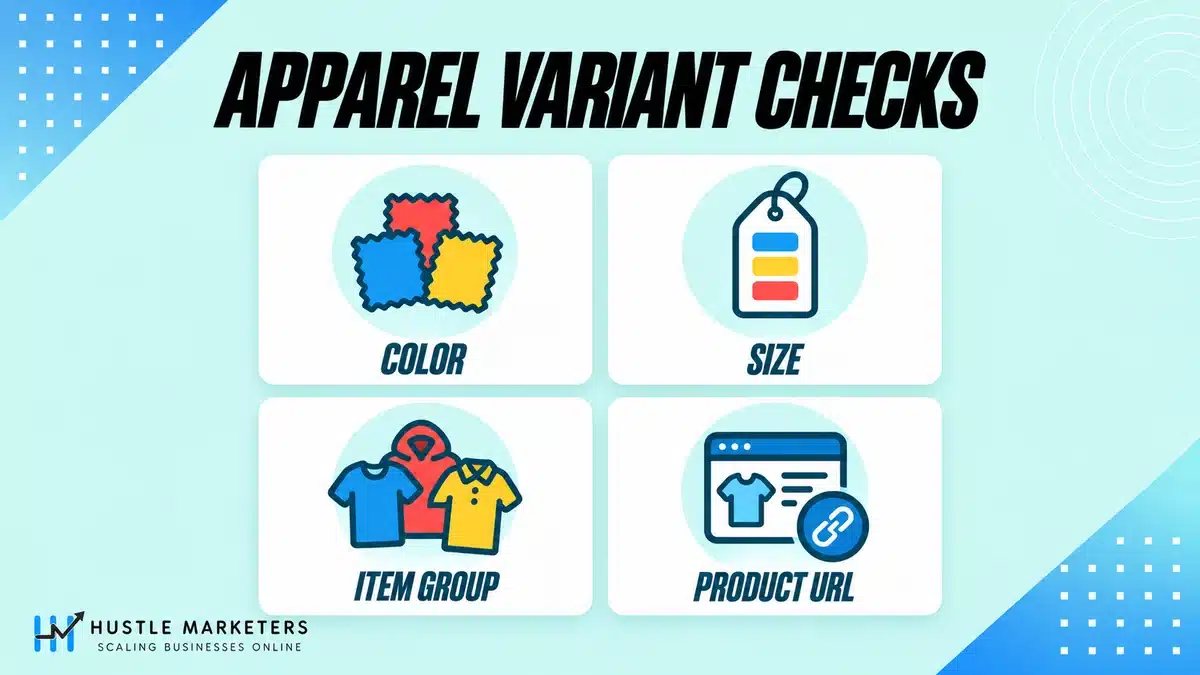
- Getting `[size]`, `[color]`, `[age_group]` and `[gender]` correct in the Merchant Center feed, at the right values, in the right countries
- Grouping variants under `[item_group_id]` so Google treats one garment as one product instead of forty competing ones
- Implementing `ProductGroup` structured data with `variesBy` and `hasVariant`, and giving every variant a distinct URL
- Deciding which faceted navigation URLs are indexable, which are canonicalised, and which are blocked
- Managing seasonal collection pages so equity is not thrown away twice a year
- Keeping ad copy and landing page claims inside the FTC textile, Made in USA and environmental marketing rules
- Keeping creative inside the Google and Meta policies that hit swimwear, lingerie and shapewear hardest
- Building the return rate into the paid media maths before spend is committed
Not one of the ten agency pages we read covers all eight. One covers three. Nine cover none.
Why is fashion SEO different from general ecommerce SEO?
Three structural reasons, and none of them is “fashion is visual”.
One garment, forty URLs
A single dress in eight sizes and five colours is forty purchasable combinations. Depending on the platform, that can be forty URLs, forty feed items, and forty near-identical pages competing with each other for the same query.
This is the defining technical problem of apparel SEO and it has three separate fixes that have to agree with each other: the feed uses `[item_group_id]`, the structured data uses `ProductGroup`, and the site uses canonicals plus distinct variant URLs. Get two right and the third wrong and you still have the problem.
One Shopify merchant described what this looks like when it goes wrong. They had one product page with three variants at different price points, and Google Merchant Center was only reading the lowest price from the page:
Google merchant center has dissaproved 2 of the 3 products and is telling us there is a price mismatch issue.
Because these other 2 products are disapproved we are unable to run google ads for them.
That is from a public Shopify Community thread on disapproved variants. The reply that solved it was one line: the structured data needed updating. A variant markup problem became an advertising outage. Nine of ten fashion SEO agency pages cannot explain that chain, because they never mention either end of it.
Collections turn over every season
An electronics retailer’s category pages are stable for years. A fashion brand replaces its collection pages twice a year, sometimes four times, and every one of those pages carries accumulated ranking equity that is usually thrown away when the collection ends.
The apparel-specific decision is whether a collection page is evergreen with rotating stock, or genuinely seasonal and redirected at end of life. Brands that never decide end up with a graveyard of thin, out-of-stock collection URLs, which is one of the most common findings in an apparel technical audit.
A small brand has the opposite problem
Almost everything written about fashion SEO assumes a large catalogue. One thread we read involved 5,000 products and 400 collections with only 76 pages indexed after three months.
An independent label with 40 products has the reverse issue: not enough indexable content to be competitive on anything but its own brand name. The fix is different in kind, not in degree. Large catalogues need pruning, consolidation and crawl control. Small catalogues need editorial surface area, which means guides, fit content, material content and lookbooks that can actually rank, not more product pages.
An agency that offers the same audit to both is not reading your business.
Which apparel feed attributes does Google actually require?
Four attributes, two different requirement tiers, and one attribute that is far narrower than almost everyone writes.
This matters for organic traffic and not only for ads. Free listings in Google Merchant Center run off the same feed, so a feed error suppresses unpaid visibility too. If that distinction is new, we cover it in free Shopping listings versus paid ads and in free listings in Google Merchant Center.
The four attributes, and the country rule almost everyone gets wrong
`[color]`, `[age_group]` and `[gender]` are required for apparel on two separate bases, and nearly every summary collapses them into one.
Free listings first. This requirement has no country limit at all. Google’s wording on the color attribute page:
Required for free listings for all `Apparel Accessories` (ID:`166`) products.
Shopping ads second. That one is country-limited. Same page:
Required for Shopping ads … when targeting these countries: Brazil, France, Germany, Japan, United Kingdom, United States
The age_group and gender attributes carry the identical two-tier structure. So the six-country list does not let an Australian or Canadian brand off. Target those markets and the free listings requirement still applies to every apparel item you sell.
Each of the three also has a second trigger that has nothing to do with apparel. Colour is required for all products available in different colours, age group for all products with an assigned age group, and gender for all gender-specific products.
And each has a carve-out worth knowing if you sell accessories. Google marks `[age_group]` and `[gender]` optional for a list of Apparel and Accessories sub-categories including keychains, lanyards, cufflinks, tie clips, watch bands, shoelaces, handkerchiefs and wristbands. Apparel and Accessories is a large tree and a lot of it is not apparel.
Size is narrower than almost everyone writes
You will read everywhere that `[size]` is required for apparel. It is not. Google’s size attribute page limits it:
Required for free listings for all `Apparel & Accessories > Clothing` (ID `1604`) and `Apparel & Accessories > Shoes` (ID `187`) products
Clothing and shoes. Not the whole Apparel and Accessories tree. Bags, hats, belts, sunglasses and jewellery sit inside Apparel and Accessories and outside 1604 and 187, so `[size]` is not required for them.
Google also constrains the value itself:
Submit only the size value. Don’t submit values such as ‘n/a’, ‘none’, or ‘multisize’.
Placeholder sizes are a common cause of disapproval on accessories feeds where a developer has auto-filled the field to make a validator happy.
item_group_id is required, not recommended
Google’s item_group_id documentation states it twice:
Required for free listings for product variants
Required for Shopping ads for product variants
The Shopping ads line carries the same six-country limit as the attributes above. The free listings line carries none, so item group id is required for variants in every market you sell into. Treating it as optional is what turns one dress into forty competing items.
Google also defines which attributes may differ within a group. Variants sharing an `[item_group_id]` can vary by colour, pattern, material, age group, gender and size. Those six are the listed variant attributes. Width shows up only inside Google’s `[variant_option]` examples for shoes, so treat it as something the feed can carry rather than as a seventh variant attribute.
size_type and size_system are optional
Both are listed on the product data specification as optional, apparel only. Neither is required anywhere. This is stated as a requirement in a great deal of feed advice and it is simply not what the specification says.
They are still worth submitting. `[size_type]` accepts regular, petite, maternity, big, tall and plus. `[size_system]` accepts US, UK, EU, DE, FR, JP, CN, IT, BR, MX and AU. If you sell one garment into multiple markets, `[size_system]` is what stops a UK 12 being matched against a US 12.
Google wants your apparel photographed on a person
This one reverses the advice most merchants have been given. Google’s image guidelines state:
Provide images of products worn by people for clothing (apparel) products. If you’re using a full-body image, avoid cropping the model’s head or feet.
For non-clothing items such as shoes and accessories, Google wants the product alone in the main image and on a model in the additional images. So the blanket “plain white background, product only” rule that most stores apply to everything is the wrong instruction for clothing and the right one for accessories.
On image size, Google’s best practices for advertising clothing and accessories recommends at least 512 by 512 pixels. Separately, Google has announced a minimum of 500 by 500 pixels for all products beginning 31 January 2027, so low-resolution legacy images now have a deadline. Overlaid logos, watermarks, promotional text, calls to action, prices and borders are all prohibited.
| Attribute | Required for apparel? | Where it applies | Common mistake |
|---|---|---|---|
| `[color]` | Yes | Free listings on all Apparel and Accessories worldwide; Shopping ads in BR, FR, DE, JP, UK, US; plus any product with colour variants | Marketing colour names with no primary colour word |
| `[age_group]` | Yes, with accessory exceptions | Same two-tier rule as colour; optional on some accessory categories | Left blank on adult ranges because it feels obvious |
| `[gender]` | Yes, with accessory exceptions | Same two-tier rule as colour; optional on some accessory categories | Unisex products split into two items instead of using unisex |
| `[size]` | Only for Clothing (1604) and Shoes (187) | Free listings and Shopping ads | Placeholder values such as n/a or multisize |
| `[item_group_id]` | Yes, for any variant | Free listings and Shopping ads | Treated as optional, so variants compete |
| `[size_type]` | No, optional | Apparel only | Assumed mandatory |
| `[size_system]` | No, optional | Apparel only | Omitted on multi-market feeds, so sizes mismatch |
If your feed is currently a mess, start with product feed optimisation and the Google product data specification walkthrough, then use a supplemental feed to fill the apparel attributes without waiting on a developer.
How do you mark up size and colour variants so Google can read them?
With `ProductGroup`, and with URLs that actually change when a shopper picks a colour.
ProductGroup, variesBy and hasVariant
Google’s product variant structured data documentation defines three properties that matter here:
The identifier of the product group (also known as the parent sku).
That is `productGroupID`. Then:
Aspects by which the variants in the ProductGroup vary, (for example, size or color)
That is `variesBy`. And:
A nested Product property that is one of the variants of the ProductGroup property
That is `hasVariant`. Together they tell Google that forty URLs are one garment.
`variesBy` supports exactly six values: colour, size, suggested age, suggested gender, material and pattern. There is no supported value for anything else.
The distinct URL requirement most product pages fail
This is the requirement that quietly disqualifies a large share of apparel sites. Google states it directly:
The site must have the ability to preselect each variant directly with a distinct URL (using URL query parameters)
If picking a colour on your product page changes the image and the price but not the URL, your variants are not eligible, no matter how good the markup is. Plenty of Shopify and headless builds fall on exactly this.
Google adds a second rule for sites that put all variants on one page:
For single-page websites only… Don’t use this property for multi-page websites.
Along with the requirement that each variant carries a unique `sku` or `gtin`, and each group a unique identifier.
What Google does not support here
Two mismatches worth knowing before an agency promises you something.
First, Merchant Center’s `[variant_option]` examples for shoes include width. The structured data `variesBy` list has no equivalent. If you sell shoes in multiple widths, that dimension can be carried in the feed and cannot be expressed in the variant markup.
Second, on the `Product` type itself, only `name`, `image` and `offers` are required, with `price` and `priceCurrency` required on the offer. Colour, size, material and pattern are all recommended, never required. Anyone telling you `size` is a required structured data property is quoting the feed spec at you, not the schema documentation.
| Layer | Property that groups variants | Distinct URL needed? | Width supported? |
|---|---|---|---|
| Merchant Center feed | `[item_group_id]` | No | Only inside `[variant_option]` examples |
| Structured data | `productGroupID` with `hasVariant` | Yes, required | No |
| Site architecture | Canonical strategy plus faceted navigation rules | Yes, to be crawlable | Not applicable |
All three have to agree. Most apparel sites we audit have one of the three configured and the other two absent.
What can you not say in a fashion ad?
Less than folklore claims in two places, and considerably more in a third.
Is lingerie or swimwear restricted on Google Ads?
The product is not a restricted category. The imagery very often is. Most advice gets one half of that and not the other, which is why swimwear brands keep getting surprised.
Google’s policy here is titled Sexual content, and it frames itself as follows:
Google Ads restricts certain kinds of sexual content in ads and destinations, which will only show in limited scenarios based on user search queries, user age and local laws where the ad is being served.
Across that policy the only lingerie reference is “sexual fetish lingerie”, listed under sexual merchandise as moderately restricted. Swimwear, underwear, intimates and bikini do not appear in it at all. So there is no Google rule saying you may not advertise swimwear.
Two subsections of that same page are where apparel actually gets caught, and they are about pictures rather than products. Partial nudity is a moderately restricted category covering people who “display partially exposed intimate body parts”, with examples including the lower or outer curve of the female breast exposed and the majority of buttocks exposed. That describes a large share of ordinary bikini photography. Sexually suggestive elements and themes is also moderately restricted, covering content that “can be interpreted as suggesting sexual intent or being sexually evocative”, including sexually suggestive poses or postures.
Moderately restricted does not mean banned. It means limited serving based on the query, the viewer’s age and local law, which shows up as reach that is lower than it should be rather than as a disapproval you can see.
On the Shopping side, the Shopping ads policies restrict three buckets of adult-oriented content: adult merchandise, sexually suggestive content, and images containing exposed skin and nudity. That third bucket is the one apparel merchants never account for. The same policy set names “sexually suggestive lingerie promotions”, which again attaches to the promotion and not to the product.
The `[adult]` attribute itself is:
Required if a product contains adult content such as nudity, sexually suggestive content, or is intended to enhance sexual activity.
It does not name lingerie, swimwear or underwear, so a standard swimwear listing does not automatically require it.
The practical reading: your catalogue is fine, and your art direction is the variable. A swimwear brand that shoots full-figure, non-suggestive product imagery advertises normally. One that shoots cropped, suggestive editorial will run restricted and will usually be told nothing about it.
Before and after images are prohibited, and the rule is in a subsection
Google’s Misrepresentation policy has ten subsections, and the one that matters for apparel is Clickbait ads, which prohibits:
Ads that use “before and after” images to promote significant alterations to the human body
Read the scope. It is about significant alterations to the body, so a colour swatch or a styling comparison is not caught. A shapewear or waist trainer before and after is, regardless of whether the result is real.
The sibling subsection, Unreliable claims, prohibits claims that entice with an improbable result, and specifically calls out claims of unrealistic weight loss in a set time frame or with little effort. Testimonials need visible disclaimers that results are not guaranteed and may vary.
Meta’s lingerie and swimwear carve-out is real, and it sits somewhere unexpected
Meta does publish an explicit exemption for these products, and it is not in the adult content policy where everyone looks for it. It is in the Health and Wellness advertising policy, where the age-targeting restrictions do not apply to ads that promote or sell:
Lingerie, swimwear or undergarments, as long as they do not violate the Adult Nudity and Sexual Activity policy.
So selling them is fine and exempt from blanket age gating. The constraint is on the creative. Meta’s Adult Nudity and Sexual Activity policy requires 18 plus targeting for creative:
Focused on individual body parts, such as groin, buttock or female breast(s)
and creative:
Depicting people in sexually suggestive poses, revealing clothing or stripping
That first line is what catches most swimwear creative, because cropping to the garment crops to a body part.
Shapewear, waist trainers and the wearable results ban
The single most important Meta clause for this category is almost never cited. In the same Health and Wellness policy, Meta prohibits:
Claims that results can be achieved solely by using wearable products.
That is the core shapewear and waist trainer claim, banned outright. The same policy prohibits:
statements of inferiority about physical appearance (i.e. terms, descriptions or questions that are negative and attack an individual’s appearance, specific body parts or hygiene)
and specifically prohibits creative showing a close up on a body area by pinching fat.
The size of what those rules govern is worth stating, because it usually gets discussed as an edge case. The plus size clothing keyword universe is 148,470 keywords and 8,788,030 US searches a month, at an average keyword difficulty of 37 and a median CPC of $1.42, with 96 of the top 100 keywords carrying a recorded CPC. The head term alone, “plus size clothing”, is 74,000 searches a month. Semrush US database, 23 September 2026.
That is the largest single demand pool in this article. It has real advertiser competition, unlike the agency keywords, and it sits inside the tightest creative rules on either platform. Size-inclusive apparel is not a niche with an asterisk. It is the category where getting the creative rules right has the most money attached to it, and where none of the pages currently ranking for fashion SEO will tell you what those rules are.
What Meta’s personal attributes policy actually covers
Worth correcting, because a lot of apparel advice gets this backwards. Meta’s personal attributes policy enumerates the protected attributes as race, ethnicity, religion, beliefs, age, sexual orientation or practices, gender identity, disability, physical or mental health, vulnerable financial status, voting status, trade union membership, criminal record and name.
Body type, clothing size and weight are not on that list. There is no shapewear clause and no plus-size clause in that policy, and Meta publishes no allowed-versus-not-allowed examples for body size anywhere. If you are shown such a table, it was invented.
What the policy does catch is the second-person construction. Ads may not imply the advertiser knows a personal attribute. The one apparel example Meta publishes is about names, not bodies: “We print customisable t-shirts and stickers with your name” is allowed, and “Billy Taylor, get this t-shirt with your name in print!” is not.
Apparel is also not a Special Ad Category. Those are employment, housing, financial products and services, and social issues, elections or politics. The credit category was replaced by financial products and services in January 2025, which is worth knowing if your brand runs buy now pay later messaging.
Body image copy costs you audiences on Google
Separately from ad approval, Google’s personalized advertising policy has a subsection on imposing negativity that treats it as a sensitive interest category, with body shaming and negativity related to physical attributes named as examples. Sensitive interest categories cannot be used for personalised targeting, which in practice means losing Customer Match, your data segments, audience expansion and lookalike segments on those campaigns. The ad may run and the targeting quietly will not.
Counterfeit is the one that ends the account
Every other policy on this page has a warning path. This one does not. Google’s counterfeit goods policy states:
If violations of this policy are found, your Google Ads accounts will be suspended upon detection and without prior warning, and you will not be allowed to advertise with Google Ads again.
Counterfeit is classed as an egregious violation. No warning, no three strikes, permanent. For anyone reselling branded apparel, this is the highest-consequence policy on the platform and it deserves a supplier audit rather than a paragraph in an onboarding document.
| Situation | Google Ads | Meta | Practical effect |
|---|---|---|---|
| Selling lingerie or swimwear | Not a restricted product category; only fetish lingerie is named | Explicitly exempt from age restrictions | You can advertise the product |
| Partially exposed or suggestive creative | Moderately restricted under Partial nudity and Sexually suggestive elements | Requires 18+ targeting | Reach cut, usually silently |
| Shapewear before and after | Prohibited under Clickbait ads | Wearable-results claim prohibited | Creative must be rebuilt |
| Body shaming language | Sensitive interest category, targeting restricted | Statements of inferiority prohibited | Audiences stop working |
| Counterfeit branded goods | Immediate permanent suspension, no warning | Prohibited under Commerce Policies | Business-ending |
If your ad account is already in trouble, this is where a Google Ads agency that has read the policies earns its fee, rather than one that only rebuilds campaigns.
Which claims put a clothing brand in front of the FTC?
Four areas, and the enforcement history in apparel is real rather than theoretical.
Fibre content has to appear in advertising, conditionally
The Textile Fiber Products Identification Act reaches your ads, not only your labels. The FTC’s guidance for textile and wool marketers states:
If a written ad for a textile product makes any statement about a fiber, or implies the presence of a fiber, the fiber content information that’s required on the label must appear in the ad, minus the percentages.
Two things people get wrong. The duty is conditional, triggered by stating or implying a fibre, so an ad that says nothing about fibre has no disclosure duty. And the advertising version drops the percentages the label requires.
The rule text at 16 CFR 303 goes further on implication. Section 303.40 deems terms that by custom and usage indicate a fibre to imply fibre content. Section 303.41(a) requires that using a fibre trademark or a generic fibre name triggers full disclosure of the fibre content information in at least one instance in the advertisement. So “silky” is a word your copywriter should think about, and “cashmere blend” in a headline carries a disclosure obligation.
The Care Labeling Rule, 16 CFR 423, is a labelling rule only and imposes no advertising duty. It applies to manufacturers and importers of textile wearing apparel. Shoes, gloves and hats are exempt, and handkerchiefs, belts, suspenders, neckties and non-woven single-use garments are excluded from the rule’s scope.
Bamboo is the $5.5 million example
On 8 April 2022 the FTC announced civil penalties against two retailers for bamboo textile claims: Kohl’s paid $2.5 million and Walmart $3 million. The FTC’s summary of the problem:
Kohl’s and Walmart’s supposed “bamboo” textiles are actually made of rayon derived from bamboo, which was not disclosed to consumers.
The rule itself is simple and widely broken. From the FTC’s own bamboo textiles resource page:
Textiles can only be called bamboo if they are made directly from actual bamboo fiber. Textiles made from rayon (or viscose, which is the same thing) that was created using bamboo as a plant source may be labeled and advertised as “rayon (or viscose) made from bamboo.”
The same case also challenged claims that the products were free of harmful chemicals and made with clean, non-toxic materials, when rayon production uses toxic chemicals. This was not the first round. In January 2013 the FTC settled with four retailers over bamboo claims for $1.26 million combined.
If you sell anything described as bamboo, this is a same-week fix, not a roadmap item.
Sustainable, eco-friendly and recycled
The governing document is the Green Guides, 16 CFR Part 260. Two facts about their status matter, because a lot of current writing gets them wrong.
The 2012 version is still the operative one. The FTC opened a review in December 2022 and held a workshop, and nothing has been finalised. The eCFR source note still reads 77 FR 62124, October 11, 2012, with no later amendment.
And two things in the Green Guides do not exist. There is no section on the word “sustainable”, and there is no section on “organic” for textiles. Both are policed indirectly.
What the Guides do say, in section 260.4:
Marketers should not make unqualified general environmental benefit claims.
That provision is what catches sustainable, eco-friendly and green. On recycled content, section 260.13(a):
It is deceptive to misrepresent, directly or by implication, that a product or package is made of recycled content
An unqualified recycled claim is only safe where the entire product or package, minor incidental components aside, is recycled. Anything less needs qualifying with the actual proportion.
On degradable claims, section 260.8 treats a claim as deceptive for items entering the solid waste stream if they do not completely decompose within one year after customary disposal. That one-year rule is the most frequently broken provision in apparel marketing.
Now the part that makes this commercially awkward rather than merely legal. The sustainable clothing keyword universe is 87,329 keywords and 1,979,440 US searches a month, at an average keyword difficulty of 22 and a median CPC of $1.09. Ninety-nine of the top hundred keywords in it are eco-claim terms.
| Eco-claim keyword | Monthly volume | KD | CPC |
|---|---|---|---|
| sustainable clothing | 9,900 | 51 | $1.47 |
| sustainable clothing brands | 9,900 | 63 | $0.94 |
| sustainable fashion brands list | 4,400 | 56 | $0.00 |
| eco friendly clothing | 2,900 | 71 | $1.19 |
| sustainable women’s clothing | 1,900 | 41 | $1.15 |
| sustainable apparel | 1,600 | 65 | $1.39 |
Semrush US database, 23 September 2026.
So there are roughly two million searches a month for precisely the words section 260.4 says you may not use unqualified. That is the tension, and it has a practical resolution rather than a dead end. You can rank for those queries. What you cannot do is answer them with an unqualified claim about your own product.
The workable pattern is to let the keyword live in the query and the qualification live in the copy. A collection page can target “sustainable women’s clothing” and describe what is actually true and substantiated: the fibre, the certification, the percentage, the facility. “Made with 60 percent recycled polyester, GRS certified” is both a compliant claim and a better one, because it is checkable. “Sustainable” on its own is a general environmental benefit claim and is what the FTC has been fining people over for fifteen years.
If your agency’s plan for this category is to put the word sustainable in your title tags and stop there, it has handed you a compliance problem dressed as a keyword strategy.
Made in USA
The Made in USA Labeling Rule, 16 CFR 323, carries civil penalties. The FTC’s compliance guidance defines the standard:
“All or virtually all” means that the final assembly or processing of the product occurs in the United States, all significant processing that goes into the product occurs in the United States, and all or virtually all ingredients or components of the product are made and sourced in the United States.
And on scope:
Marketers are now subject to civil penalties if they use an unqualified Made in USA label on a product that is not “all or virtually all” made in the U.S., including in catalogs or online.
The maximum civil penalty under section 5(m)(1)(A) of the FTC Act was set at $53,088 per violation in the January 2025 adjustment, recorded at 16 CFR 1.98. The FTC adjusts these annually, so check the current figure before quoting it anywhere client-facing.
For apparel cut and sewn domestically from imported fabric, the safe route is a qualified claim, for example “Made in USA from imported fabric”, rather than an unqualified one.
Fur is the strictest of all of them
The Fur Products Labeling Act requires a defined set of information in advertising, not only on the label: the animal name from the Fur Products Name Guide, country of origin of imported fur, any dyeing, bleaching or artificial colouring, used fur, damaged fur, and composed pieces such as paws, tails or bellies. The advertising rules that carry it are at 16 CFR 301.38, which governs how that required information has to appear.
That section also carries a carve-out that removes a shortcut online sellers might assume they have. The group-advertising allowance, which lets a seller disclose country of origin by reference to the label rather than in the ad, does not apply to catalogue, mail order or similar advertising where the buyer cannot see the label before delivery. Ecommerce is exactly that situation.
Influencers and reviews
Worth being precise here, because this is stated wrongly almost everywhere.
The Endorsement Guides, 16 CFR 255, carry no civil penalties of their own. The FTC says so plainly:
The Guides themselves don’t have the force of law. However, practices inconsistent with the Guides may result in law enforcement actions alleging Section 5 violations.
The Guides still bind you in substance, because the FTC states an advertiser is ultimately responsible for what others do on its behalf.
Penalty exposure runs through two other routes. One is a Notice of Penalty Offenses: once the FTC has put a company on notice that a practice is unlawful, it can seek civil penalties if the company does it anyway, and that is exactly the authority used in the bamboo case above. The other is the Consumer Reviews and Testimonials Rule, 16 CFR 465, took effect on 21 October 2024 and authorises courts to impose civil penalties for knowing violations. It prohibits fake reviews, paying for a particular sentiment, undisclosed insider reviews, presenting a company-controlled review site as independent, suppressing reviews by threat, and buying fake indicators of social media influence.
| Claim area | Governing rule | Applies to ads? | What to do this week |
|---|---|---|---|
| Fibre content | Textile Act, 16 CFR 303 | Yes, when a fibre is stated or implied | Audit product copy for fibre words and trademarks |
| Bamboo | Textile Act plus FTC Act | Yes | Change to “rayon made from bamboo” or stop using the word |
| Sustainable, eco-friendly | Green Guides, 16 CFR 260.4 | Yes | Replace unqualified claims with specific, substantiated ones |
| Recycled content | Green Guides, 16 CFR 260.13 | Yes | Qualify unless the whole product is recycled |
| Made in USA | 16 CFR 323 | Yes, catalogues and online included | Qualify if fabric is imported |
| Fur | 16 CFR 301.38 | Yes, disclosure in the ad itself | Add the full disclosure set to fur listings |
| Influencers | Endorsement Guides, 16 CFR 255 | Yes | Fix disclosures, assume you are responsible |
| Reviews | Reviews Rule, 16 CFR 465 | Yes, with civil penalties | Remove incentivised-for-sentiment reviews |
None of this is legal advice and we are not lawyers. It is the set of rules that decides whether your campaigns run, and any agency selling you fashion marketing should be able to discuss all of it.
How do returns change the maths on fashion marketing?
More than any other single variable, and almost nobody models it before committing budget.
The NRF and Happy Returns 2025 Retail Returns Landscape, published 15 October 2025, estimated that 19.3 percent of online sales would be returned in 2025, with total returns of $849.9 billion, or 15.8 percent of total retail sales.
One caution, because this number gets misused constantly. That 19.3 percent is across all online retail. NRF does not publish an apparel-specific return rate in that report. Apparel figures in the 25 to 40 percent range circulate widely and are attributed to NRF; they are not from NRF. If you see one presented that way, the citation is wrong.
The point for your media plan is not the exact figure. It is that a reported 4x return on ad spend at a 25 percent return rate is 3x, and at a 35 percent return rate is 2.6x, before you have paid for reverse logistics. If your agency reports gross ROAS and your finance team measures net, you will spend a year arguing about numbers that are both correct.
Three things follow, and they are SEO and CRO work as much as media work:
- Size guides, model measurements and “model is wearing size” data reduce returns and are indexable content in their own right
- Review content that mentions fit is the highest-value UGC in apparel, and it is also the content most likely to fall foul of the Reviews Rule if it is incentivised carelessly
- Custom labels in the feed let you bid differently on low-return and high-return product groups, which is covered in custom labels by margin tier
Ask any prospective agency what return rate they plan around. If the answer is that they report on revenue, keep looking.
What does fashion search actually cost?
Not one of the fourteen pages we read publishes a single real cost-per-click figure for apparel. Here are four, pulled from Semrush’s US database on 23 September 2026.
| Keyword universe | Size (keywords and monthly searches) | Average KD | Median CPC and range |
|---|---|---|---|
| womens dresses | 288,538 kw, 33,578,600 searches | 23% | $0.62 ($0.32 to $5.00) |
| plus size clothing | 148,470 kw, 8,788,030 searches | 37% | $1.42 ($0.64 to $2.29) |
| sustainable clothing | 87,329 kw, 1,979,440 searches | 22% | $1.09 ($0.67 to $4.05) |
| fashion marketing | 64,519 kw, 1,242,040 searches | 30% | see below |
These are Semrush estimates, not Google’s own figures, and they move. Pull your own for your market before you budget against them. But the shape tells you three things that matter more than the exact numbers.
Apparel clicks are cheap and apparel competition is expensive
A median CPC of $0.62 on the dresses universe is low for retail. The cost in apparel is not the click, it is the conversion rate after a 19.3 percent return rate takes its cut. A brand that budgets on CPC alone and never models returns will conclude that fashion paid search works, right up until finance recalculates it.
Note also that the cheap universe is the crowded one. Dresses average KD 23 across 288,538 keywords, which sounds easy, but the head terms sit at KD 47 to 55. The average is low because the tail is enormous. That tail is where a small brand actually competes, and it is why long-tail attribute and occasion pages beat another homepage rewrite.
The demand is concentrated in the two categories with the tightest ad rules
Look at what sits second and third in that table. Plus size clothing is 8.79 million searches a month. Sustainable clothing is 1.98 million. Those are the two apparel categories whose advertising is most constrained, by Meta’s body-image and wearable-results rules and by the FTC Green Guides respectively, and both sets of rules are covered further down this page.
That is the single most useful thing in this article. The biggest demand pools in apparel are the ones where what you may say is restricted, and no agency page in this category mentions either restriction. You are being sold campaigns into categories nobody has told you the rules for.
Nobody bids on fashion SEO hire keywords
Here is a finding that should change how you read every agency page you visit, including this one.
We pulled the top 100 keywords in the fashion SEO universe. Ninety-eight of them carry a cost per click of exactly zero. Only two have any CPC at all: “seo for clothing brands” at $6.89 with 50 searches a month, and one variant at $6.49 with 40.
Read a zero CPC precisely. It means Semrush has no reliable click price for that keyword, not that bidding is prohibited. Competitive density on the main hire terms sits around 0.33 out of 1, so there has been some advertiser activity. What it tells you is that advertiser demand is too thin to price.
Forty-eight of those hundred keywords are hire-intent terms, worth 3,330 searches a month between them, at keyword difficulty between 2 and 23.
| Hire keyword | Monthly volume | KD | CPC |
|---|---|---|---|
| seo services for fashion company | 590 | 15 | $0.00 |
| fashion seo services | 590 | 23 | $0.00 |
| seo services for fashion industry | 480 | 17 | $0.00 |
| fashion seo | 320 | 18 | $0.00 |
| seo for clothing company | 260 | 22 | $0.00 |
| seo strategy fashion company | 170 | 12 | $0.00 |
| seo specialists for apparel industry | 90 | 2 | $0.00 |
| seo professionals in luxury fashion | 90 | 3 | $0.00 |
| seo specialists in fashion ecommerce | 70 | 6 | $0.00 |
So this is a commercial cluster with real hire intent, keyword difficulty in the single digits to low twenties, and almost no measurable paid competition. The agencies competing for your business are not meaningfully buying these terms, which is why the SERP is made of service pages and self-ranking listicles rather than ads.
It also tells you this page was cheap for us to rank. That is the honest reason it exists, and you should weigh what it says accordingly.
Why the obvious head term is a trap
“Fashion marketing” looks like the keyword to own. It is 2,900 searches a month in the US at KD 25, and its universe runs to 64,519 keywords and 1,242,040 monthly searches.
Then you look at what those keywords are. We took the top 100 by relevance and classified them. Sixty-three of the hundred, carrying 68 percent of the volume, are career or study terms: fashion marketing major at 260, fashion marketing courses at 170, fashion marketing school at 90, degrees, universities, classes, job descriptions and salary questions. The single largest related keyword in the set is a supermarket at a shopping centre called Fashion Island.
Two thirds of that traffic is students and job seekers. If you are a clothing brand, ranking for it brings you almost nothing, and if you are an agency, it brings you applicants rather than clients.
This is worth doing yourself before you approve any keyword list. Take the head term your agency proposed, open the keyword variations, and read fifty of them. If the majority are jobs, salaries, courses or degrees, the head term is a vanity target and the plan built on it will underdeliver no matter how well it is executed.
How much does a fashion SEO agency cost?
Two of the ten agency pages we read publish a number. Here is what they say, and what that implies for the rest of the market.
The only published prices in this category
SeoProfy’s fashion SEO page states that the average price for small websites is nearly $3,000, and that large ecommerce stores start at $8,000. Netpeak’s fashion page states that monthly investments typically range from $1,500 to $10,000.
Those are self-declared numbers on public pages rather than survey data, and they are the best evidence available. You will also find blog posts quoting ranges from $2,500 to $25,000 a month presented as agency pricing data with no survey, no sample size and no methodology. Treat those as marketing, not as benchmarks.
What changes between the bands
| Monthly band | Realistic scope | Who it suits |
|---|---|---|
| Under $1,500 | One or two workstreams, usually content or a fixed technical backlog | Small catalogue brands with a clear single problem |
| $1,500 to $3,000 | Technical SEO plus feed health plus a modest content cadence | Independent labels and single-market DTC brands |
| $3,000 to $8,000 | Full technical, content, digital PR, feed and variant implementation across markets | Established brands with multi-thousand SKU catalogues |
| $8,000 and above | Multi-market, multi-language, migration work, enterprise stakeholder management | Retailers and brands with in-house teams to coordinate |
Implementation is the variable that moves these bands most. An agency that only recommends changes costs less and delivers slower than one that implements them, because the bottleneck in apparel SEO is almost always your development queue, not the strategy.
Why most fashion SEO agencies will not publish a price
Three honest reasons and one less honest one. Scope genuinely varies by catalogue size and platform. Implementation capacity varies. Multi-market work multiplies everything. And publishing a number invites comparison on price rather than on capability, which is uncomfortable if the capability is a template.
Our own position: we publish PPC management pricing and ecommerce SEO packages, and we would rather you compare them than guess.
Which fashion SEO agencies rank right now, and what do their pages say?
We checked the pages ranking for the fashion SEO agency and fashion SEO services keywords on 23 September 2026. The table below records only what each page publishes, which is something you can verify yourself in a few minutes.
Hustle Marketers is deliberately not in this table. Every “best fashion SEO agencies” list we found ranks its own publisher first, and adding ourselves to our own comparison would make this exactly as useful as those are.
First, what each page tells you about the commercial relationship.
| Agency page | Publishes a price | Names the delivery team | Fashion client results with figures |
|---|---|---|---|
| 1Digital | No | No | No |
| Coalition Technologies | No | No | Yes |
| Victorious | No | No | Yes |
| SeoProfy | Yes | No | Yes |
| Netpeak | Yes | No | Yes |
| Go Up | No | Yes | Yes |
| Bird Marketing | No | Yes | Not on this page |
| Status Bureau | No | No | No |
| Tinuiti | No | No | No |
| SEO Align | No | No | Yes, anonymised |
Second, whether the page shows any sign of apparel technical capability.
| Agency page | Mentions apparel feed attributes | Mentions variant structured data |
|---|---|---|
| 1Digital | Yes | Yes |
| Coalition Technologies | No | No |
| Victorious | No | No |
| SeoProfy | No | No |
| Netpeak | No | No |
| Go Up | No | No |
| Bird Marketing | No | No |
| Status Bureau | No | No |
| Tinuiti | No | No |
| SEO Align | No | No |
Read that table honestly. One agency in ten covers the apparel technical layer, and its own page carries no client figures. Five show real client figures and none of them covers the technical layer. Nobody does both, which is the entire opportunity in this category and the reason this page exists.
One more observation worth your time. Bird Marketing’s fashion page carries a heading for featured fashion SEO case studies, and the case studies listed under it include a server hardware company, a granite worktop business and a playground equipment supplier alongside other non-apparel accounts. Bird does publish apparel case studies elsewhere on its site, so this is a page-assembly issue rather than a missing track record. The general lesson holds: open the case studies before you accept a vertical claim from any agency, including ours.
How big are these agencies, and does it predict apparel capability?
Page content tells you what an agency says. Third-party data tells you how big it is. Both are worth having, so here is the second half, from Semrush’s US database on 23 September 2026.
| Agency | Authority Score | Monthly organic traffic | Referring domains |
|---|---|---|---|
| Coalition Technologies | 49 | 224,000 | 5,600 |
| SeoProfy | 43 | 29,900 | 5,100 |
| Tinuiti | 43 | 14,100 | 8,300 |
| Victorious | 38 | 13,100 | 6,800 |
| 1Digital | 37 | 19,200 | 2,500 |
| Go Up | 35 | 4,000 | 1,600 |
| Netpeak US | 33 | 3,200 | 1,800 |
| Hustle Marketers | 25 | 1,400 | 606 |
We are the smallest name in that table and we have published it anyway, because the point of the table is the opposite of a ranking.
Put the two tables side by side. Coalition Technologies is the largest agency here by organic traffic, by a factor of seven over the next one, and its fashion page covers none of the six apparel items. Tinuiti is a major agency with 8,300 referring domains and its apparel page carries no client metrics and no technical content at all. The one page in ten that explains apparel feed attributes and variant schema belongs to 1Digital, which sits fifth on Authority Score.
Domain size measures how well an agency markets itself. It does not measure whether anyone there has fixed an apparel feed. Those are different questions and the data shows they are not correlated in this category.
Use the first table to test capability and the second to sanity-check scale, and do not let a big number in one substitute for an empty column in the other.
How to read a “best fashion SEO agencies” list
Four rules, drawn from reading four of them.
- Check whether the publisher appears in its own list, and at what position. All four we read placed themselves first.
- Check whether a methodology is disclosed. One did. Its weighting included headquarters location at 10 percent of an agency quality score, which tells you something about the rest of it.
- Check the author. One of these lists ranks in the top ten as a LinkedIn article written by the founder of the agency it places first, with no disclosure on the article.
- Check whether any technical claim is made at all. If a list ranks agencies on years in business and client logos, it has not evaluated capability.
None of that makes these lists worthless. It makes them a directory rather than a recommendation, and you should shortlist from them and evaluate independently.
What should you ask a fashion SEO agency before you sign?
Nine questions. The first five have objectively right answers, so they work as a competence test rather than a preference conversation.
| Question | What a capable answer sounds like |
|---|---|
| Which attributes does Google require for apparel, and where? | Colour, age group and gender: free listings everywhere, Shopping ads in six named countries; size only for Clothing and Shoes |
| Is item_group_id required or recommended? | Required for variants, for both free listings and Shopping ads |
| How will you mark up our size and colour variants? | ProductGroup with variesBy and hasVariant, and distinct URLs per variant |
| Can we run before and after creative for our shapewear line? | No on Google under Clickbait ads, and no on Meta under the wearable-results clause |
| Are lingerie and swimwear ads restricted? | Not as products; the restriction attaches to creative and cropping |
| Who implements the changes, you or us? | A named answer either way, with a development capacity figure |
| What return rate will you plan the media around? | A specific figure from our data, with net rather than gross ROAS reporting |
| Which of our collection pages will you keep, consolidate or redirect? | A seasonal versus evergreen framework, decided before the season ends |
| Who specifically does the work, and can we meet them? | Named people, not account manager plus unnamed specialists |
If the first five get vague answers, the agency has not done apparel work, whatever the logo wall says. There is a longer version of this exercise in how to choose an ecommerce SEO agency and how to choose a Google Ads agency.
What if you are a small independent fashion brand?
Most fashion marketing advice is written for a marketing director at a company that has one. If you are the founder, the designer and the person packing orders, four things are different.
You are a maker, not a marketer, and that is normal. Speaking to Cultured in September 2026, designer Jacques Agbobly put it directly:
I love discussing business, but I do not come from that background.
Your marketing budget competes with your product budget, and product usually wins, correctly. That is an argument for organic channels rather than against marketing. Search is the channel that does not require the ad budget you do not have yet, and a clean feed gets you free Shopping listings without a campaign.
Your catalogue is too small to rank on product pages alone. Forty products will not out-index a retailer. Editorial content will: fit guides, fabric guides, care guides, styling content and collaboration stories are all indexable and all things a small brand can write more credibly than a large one.
And your margin makes the return rate lethal rather than annoying. A 30 percent return rate at a 60 percent gross margin is survivable. At a 25 percent margin it is not. Fit content and accurate size data are margin protection, not nice-to-haves.
Practical order of work for a brand under about 100 SKUs: fix the feed so free listings work, publish fit and material content that can rank, get reviews that mention fit, then add paid once the unit economics net of returns are known.
Which keywords should a fashion brand actually target?
Not the ones in this article. This page targets agency keywords because it is written for someone hiring an agency. Your store should target what your buyers search, and those are different words entirely.
Here is the structure, with real figures on the themes we pulled, so you can see the shape of the opportunity rather than a list of example phrases.
| Keyword theme | Worked example | Volume, KD and CPC | Where it belongs |
|---|---|---|---|
| Category head | dresses for women | 90,500, KD 55, $0.51 | Main category page. Too hard to start on |
| Category, second tier | women’s casual dresses | 2,900, KD 36, $0.58 | Collection page. Realistic first target |
| Attribute | women’s black dress | 3,600, KD 30, $0.46 | Indexable filtered collection |
| Fit and size head | plus size clothing | 74,000, KD 86, $1.54 | Fit hub, long game |
| Fit and size, workable | plus size clothing stores | 6,600, KD 51, $0.88 | Fit collection with stockist content |
| Material and claim | sustainable women’s clothing | 1,900, KD 41, $1.15 | Material collection, qualified copy |
| Material, brand-led | sustainable clothing brands | 9,900, KD 63, $0.94 | Editorial, not a product page |
Semrush US database, 23 September 2026. Volumes are estimates and they move, so pull your own before you commit.
Read the KD column, not the volume column. Every head term in that table is KD 51 to 86, which for a brand with 40 products means years. Every workable target is KD 30 to 51 and sits one level down: a colour, a fit, a use case, an occasion. That is where apparel SEO is actually won, and it is also where the feed attributes and variant markup earlier in this article start paying, because those second-tier pages are the ones that need clean colour and size data to exist at all.
The themes without pulled figures follow the same logic:
| Keyword theme | Example patterns | Intent | Page type and Ads match type |
|---|---|---|---|
| Occasion | wedding guest dress, interview outfit women | Commercial | Occasion collection or lookbook. Phrase |
| Brand | your brand name, your brand plus product | Branded | Home and product pages. Exact |
| Care and fit questions | how to wash merino wool, how should a blazer fit | Informational | Blog or guide linking to products. Not for ads |
| Sizing comparison | uk 12 in us size, eu 40 shoe in uk | Informational | Size guide page. Not for ads |
| Competitor | competitor brand alternative, competitor brand vs | Competitor | Comparison page. Exact, with care |
Care and sizing questions look like low-value informational traffic and are not. They are the content that reduces returns, and at a 19.3 percent online return rate that is margin, not just traffic.
Negatives matter as much in apparel as the positives. At minimum, exclude free, cheap, DIY, pattern, sewing, wholesale, supplier, manufacturer, job, salary, course, second hand, used, replica, fake, and the names of any brand you do not stock. Pull the rest from your own search terms report monthly, not from a template.
Pull your own volumes for your market before you commit. A UK brand and a US brand selling the same garment have different keyword universes, and the sizing terms above are market-specific by definition.
How Hustle Marketers helps fashion and apparel brands
We work on the layer the comparison table above shows is empty.
Feed and free listings. We build and repair Merchant Center feeds with the apparel attributes complete, variants grouped correctly, and supplemental feeds filling gaps that the platform export leaves behind. The same work carries free Shopping listings, so it earns unpaid visibility and not only ad eligibility. Our Merchant Center and Shopping work for Silicon Lightworks is a published example of the feed side of this.
Variant and technical SEO. ProductGroup markup, distinct variant URLs, faceted navigation rules, canonical strategy and collection lifecycle decisions, implemented rather than recommended.
Paid media inside the policies. Search, Shopping, Performance Max and Meta campaigns built with the apparel policy constraints designed in, so creative is not rebuilt after a disapproval. If Microsoft is part of your mix, our Bing Ads agency side runs the same discipline there.
AI search visibility. Apparel buying questions increasingly get answered in AI results before anyone reaches a product page. We treat that as its own channel, which is what our AI SEO work and our write-up on citations versus mentions in AI visibility cover.
Honest reporting. Net of returns where you can measure it, with the gross number shown alongside rather than instead.
Apparel experience worth naming plainly. Estelle Bridal, a Houston bridal boutique, recorded a video testimonial about working with Ishant Sharma on SEO and marketing guidance. That case study deliberately publishes no traffic or revenue figures, because the client did not state any. Our published ecommerce results with numbers sit in adjacent categories rather than apparel: a curly hair brand on Shopify and a building block toy brand. We would rather tell you that than imply apparel figures we do not have.
If you sell adjacent categories, we have separate guides for jewelry SEO, beauty marketing and pet marketing.
Why choose Hustle Marketers or Ishant Sharma for fashion marketing?
Three reasons, and a fourth that is really a warning.
Ishant Sharma has run Google Ads, Microsoft Ads and SEO since 2013, across ecommerce feeds, Merchant Center, Shopping, Performance Max and technical SEO. The feed and variant work described above is done in-house, not subcontracted.
We implement. The bottleneck in apparel SEO is nearly always development capacity, so an agency that hands over a recommendations document and waits is selling you a delay. Our SEO agency and PPC agency engagements include implementation.
We publish our sources. Every rule on this page is quoted from the page that states it, with a link. You can check all of it, which is the standard we would want from anyone pitching us.
And the warning: if what you need is brand campaign work, runway production or celebrity casting, we are not that agency and we will say so on the first call. What we do is the search, feed, ads and technical layer that turns demand into revenue, and the compliance layer that keeps it running.
White-label partners are welcome too. Agencies who need apparel feed and technical capability under their own brand can use our white-label SEO and white-label PPC services.
If you want a second opinion on your current setup, ask for a fashion feed and technical review. We will tell you what is broken whether or not you hire us.
Fashion SEO agency FAQs
What does a fashion SEO agency do?
It handles ecommerce SEO plus the apparel-specific layer: Merchant Center apparel attributes, variant grouping and markup, seasonal collection management, faceted navigation, and the FTC and ad platform rules that govern clothing claims and creative.
How much does fashion SEO cost per month?
The only agencies publishing prices in this market quote roughly $1,500 to $10,000 a month, with one stating that small sites average near $3,000 and large ecommerce stores start at $8,000. Independent labels usually sit in the $1,500 to $3,000 band and multi-market retailers above $3,000.
Is fashion SEO different from ecommerce SEO?
The core work is the same. Three things are genuinely different: size and colour variants multiply URLs and feed items, collection pages turn over seasonally, and apparel has its own required feed attributes and its own claim rules.
Which attributes does Google require for apparel feeds?
Colour, age group and gender, plus item group id for any variant. For free listings those apply to all Apparel and Accessories products with no country limit. For Shopping ads they apply when targeting Brazil, France, Germany, Japan, the UK and the US. Size is required only for the Clothing and Shoes categories. Size type and size system are optional.
Can I advertise lingerie and swimwear on Google and Meta?
Yes, the products themselves are fine. Google names only sexual fetish lingerie as a restricted product, and Meta explicitly exempts lingerie, swimwear and undergarments from its age restrictions. The constraints land on the creative. Google restricts partially exposed and sexually suggestive imagery, and Shopping separately restricts images containing exposed skin and nudity. Meta requires 18 plus targeting for creative focused on individual body parts or showing revealing clothing.
Can I run before and after photos for shapewear?
No. Google prohibits before and after images promoting significant alterations to the human body under its Clickbait ads policy, and Meta prohibits claims that results can be achieved solely by using wearable products.
Do I have to disclose fabric content in my ads?
Only if the ad states or implies a fibre. When it does, the fibre content information required on the label must appear in the ad, without the percentages.
Is it safe to call my products sustainable?
Not unqualified. The Green Guides direct marketers not to make unqualified general environmental benefit claims. Use specific, substantiated claims instead, and remember the FTC has already taken $5.5 million in penalties over bamboo textile claims.
How long does fashion SEO take to work?
Feed fixes can change free listing and Shopping visibility within days once the items are re-reviewed. Variant and technical fixes typically show in three to six months. Content and authority work runs six to twelve months. Any agency promising rankings in weeks is describing feed work and calling it SEO.
What does a fashion keyword cost per click?
Less than most retail categories. In Semrush’s US database in September 2026 the womens dresses universe has a median CPC of $0.62, plus size clothing $1.42 and sustainable clothing $1.09. The cost in apparel is not the click, it is what the return rate does to the conversion afterwards.
Is “fashion marketing” a good keyword for a clothing brand to target?
No. Sixty-three of the top hundred keywords in that universe, carrying 68 percent of the volume, are career and study terms such as fashion marketing major, courses, school and degrees. Ranking for it brings students, not buyers.
Which fashion keywords should a small brand start with?
Second-tier terms at KD 30 to 51, not head terms at KD 55 to 86. A colour, a fit, an occasion or a use case: “women’s black dress” at KD 30 is a realistic target where “dresses for women” at KD 55 is not, and those second-tier pages are exactly the ones that need clean colour and size data in the feed to exist at all.
Should I hire a fashion specialist or a general ecommerce agency?
Ask the five technical questions in the table above. A general ecommerce agency that answers them correctly is a better choice than a fashion specialist that cannot, and there are more of the latter than the category admits.
The platform changes the implementation, not the priorities. Our guide to ecommerce SEO sets out the order to work in, whichever cart you are on.
Summarise this article with: