Pet Marketing Agency: How to Hire One Without Wasting a Year

Ishant
Published on October 28, 2026
Ishant
Summarize this article with:
Key Observations
- An owner on Trustpilot in April 2026 wrote that their return on ad spend went from 450 percent running it themselves to 175 percent with an agency. Two other reviewers of a different agency reported the same direction, years earlier. That is the fear this page is written to answer.
- A pet seller running 17,000 products reported in 2022 that 90 percent of his automatically disapproved dog food, cat food and flea treatment listings were approved on manual review with no changes made. Thirteen other people marked that they had the same question.
- On Semrush, pet marketing agency is 210 searches a month in the US at keyword difficulty 17. Dog collars is 40,500. The keywords your business should target are about two hundred times bigger than the ones used to find an agency.
- Of the nineteen competitor pages we read across the two search results for this topic, none publishes a return on ad spend figure for a real pet client, and none publishes a before and after ranking position.
- Pet experience matters less than the internet claims. We looked hard for pet brand owners saying agencies fail because they do not know pet, and found one first-hand account. We are not going to inflate that into a trend.
- Nine contributors in the threads we read, mostly conversion consultants and vendors replying to owners, said the real problem was the store rather than the traffic.
- The word pet collides with three unrelated things. Inside the keyword variations for pet marketing, Semrush returns pete’s fresh market, a grocery chain, at 27.1K a month, and an st pete query, meaning St Petersburg Florida, at 14.8K. Autocomplete for pet ppc returns polyethylene terephthalate, the plastic. On broad match you are paying for all three.
- Seven of the nine buyer side pet seeds we checked volunteered country modifiers: uk, australia, nz, canada, india, malaysia, singapore, dubai. If you cannot ship there you are buying traffic that cannot convert.
- Ask about the contract before the price. Four reviewers in our set described a year long commitment, and one described an agency trying to conceal a twelve month lock in.
- The AI Overview for pet brand marketing agency cites all nine of the organic top nine, so ranking and being cited are closely coupled here. But it only names four agencies in its written answer, and three of those four are India based.
Table of Contents
- What does a pet marketing agency actually do?
- What is the average cost of a marketing agency for a pet brand?
- Does your agency need pet experience, or just ecommerce experience?
- What does a real pet marketing result look like?
- Why do pet brands say the agency underperformed what they were doing themselves?
- Which pet keywords quietly waste money?
- Which keywords should a pet brand actually target?
- What happens when Merchant Center disapproves your pet food, treats or flea products?
- What should you ask a pet marketing agency before you sign?
- What do the review sites actually tell you?
- Where else will a buyer look, and does it agree with Google?
- What do the nineteen pages we read leave out?
- Why choose Hustle Marketers or Ishant Sharma for pet marketing
- About the author
- Pet marketing agency FAQs
In April 2026 a business owner left a review saying their return on ad spend went from 450 percent running it themselves to 175 percent once an agency took over. We have left the agency’s name out. The point is the pattern, not one firm.
Two other reviewers reported the same thing in their own words, though both were reviewing one other agency and both wrote years earlier, in December 2022 and July 2023. One said their return on ad spend sat at 0.89 with the agency and that they had been achieving above 2 themselves at a higher level of spend. Another said it doubled after they brought the work back in house.
That is the honest starting point for this page. Plenty of ecommerce brands are worse off after hiring an agency. We did not find a pet brand saying so on the record, and we are not going to imply we did. Almost all the agency failure evidence below is ecommerce general, and we label it that way throughout.
This page is about how to avoid being one of them. It is written for the owner or marketing lead at a pet brand or pet ecommerce store who is about to spend real money.
It is built from two things. Nineteen competitor pages read in full, and thirty eight public threads and review profiles read in full. Where a Google policy decides the outcome we link Google’s own page for it.
If you want the operator’s guide to running pet marketing yourself, the ad rulebook, what pet keywords cost, competing with Chewy and Petco, subscription math and feeds, that is a separate piece: pet marketing. This page is the hiring decision.
What does a pet marketing agency actually do?
An AI Overview we captured for the query “pet brand marketing agency” on September 25, 2026 defined one as specialising in “growing pet food, D2C accessories, veterinary clinics, and pet care services by targeting the emotional psychology of pet parents.” D2C there means direct to consumer. AI Overviews are generated per session and are not reproducible, so treat that as a snapshot, not a standing definition.
That is a fair description of how the category sells itself and a poor description of what you are buying. In practice a pet marketing engagement is one or more of four separate jobs, and they have different timelines, different skills and different failure modes:
- Paid media. Google Ads, Meta, sometimes Microsoft. Fast feedback, and the only one where you can see whether it worked inside a month.
- Ecommerce SEO. Collection pages, product pages, technical fixes, internal links. Slow, compounding, and the one most often sold on rankings rather than revenue.
- Feed and Merchant Center. Merchant Center is the Google account that holds your product data and feeds Shopping. Product data, disapprovals, free listings. Invisible until it breaks, and then it takes your Shopping traffic with it.
- Conversion and store work. Trust, clarity, reviews, shipping and returns information. The one nine separate contributors in our research said was the actual problem when an owner complained about traffic that would not convert.
The reason that split matters is scope. One agency selling “pet marketing” may be doing only the first. If your problem is the fourth, more traffic makes your numbers worse, not better.
What is the average cost of a marketing agency for a pet brand?
“What is the average cost of a marketing agency” is a live People Also Ask question on the hiring query. Of the nineteen competitor pages we read, only four publish any figure at all. So here is what we can actually source.
On the management fee, the only published percentage we found in the threads we read came from a software vendor on the Shopify Community in December 2022, pitching his own tool as a cheaper alternative to agencies. He put it as a ceiling, not a norm: brands might expect to pay “up to 20% of that to a good agency”, where that is the ad budget. Read it knowing he had a reason to make agencies sound expensive.
On what goes wrong with pricing, the reviews are more useful than the rate cards. In our set:
- One owner reported being billed 4,500 dollars against a promised 400 dollars a month.
- One reported that unspent ad budget “won’t roll over”.
- One reported being double charged for hosting.
- One described a recurring pattern where the site needed more work again every month.
Three of those are self-reported accounts from named reviewers and one is a forum contributor, so four accounts, not a survey. What they tell you is which questions to ask, not what you should pay.
Three questions that would have caught all four:
- What is the monthly fee, what is ad spend, and can I have both in one document before I sign?
- Is the fee fixed, or a percentage of spend, and what happens when spend goes up?
- What happens to ad budget I do not spend this month?
Why we are not publishing a price band on this page
Because we would be making it up. We do not have enough pet engagements at enough sizes to publish an honest average, and a made up band is worse than none. If you want a number for your specific catalog size and market, ask us and we will scope it. That is a worse answer for this page’s rankings and a better answer for you.
Does your agency need pet experience, or just ecommerce experience?
The industry’s own answer is yes, obviously. The evidence we could find is thinner than that.
We went looking for pet brand owners saying an agency failed them because it did not understand pet. Across thirty eight sources read in full we found one first-hand account. Jane Harrell, answering the question is pet industry experience important when hiring a marketing agency, put it this way. She is herself the founder of a marketing agency, which is worth knowing when you read her answer:
I spent 11+ years being the ‘client’ to marketing partners and agencies who I ended up having to train on the pet space.
And on the upside of a specialist:
Having a partner who knows your industry gives them a leg-up and allows you to be a lot more hands-off.
That is one voice, and she frames it as a question of your own bandwidth rather than of competence. Her own screening question is the practical version:
How much time do you have to provide oversight to your PR/marketing partner?
We are reporting that honestly rather than building a trend out of it. Our reading is that the scarcity is partly a gap in what we could reach, because Reddit and private industry groups were unavailable to this research, and partly real: most agency failures in our set were not category failures. They were failures of communication, measurement, contract terms and store readiness, which are not pet specific at all.
Where pet experience does change the outcome is narrower and more concrete than “understands pet parents”:
- Claim language in feeds and ad copy for food and supplements, where a true statement can still get you disapproved.
- Who is on the hook when Merchant Center suspends the account, and how long recovery takes.
- Knowing that pet link building is a swamp. One site builder shopping for pet links said he was “struggling massively to find any that aren’t just spammy domain drops”.
- Knowing the homonym and geography traps further down this page, which cost money on day one.
How do you tell a pet specialist from a generalist with a pet page?
Read the page for the tells. Two examples from the results currently ranking for this term, both checkable today.
The page at position three for “pet brand marketing agency” belongs to a creative agency called Animal, working out of New Delhi, New York and Toronto. The clients on that page are Optimed Corp, Goldiam, Setu, Aguad, Airtel, Budweiser, Hyatt and CRED. Its about page adds PepsiCo, Adidas, Google, HBO, Microsoft and Tinder. Not one of them is a pet brand, and the page carries no pet content at all. Our reading is that it ranks because its name contains the word animal.
The page at position five has an uncorrected heading on its pet page that reads “Web Design & Development for Roofing Company”. Somebody duplicated a roofing template and missed a heading.
So: search the page for a pet sub-sector that matches yours. Search it for a number. Search it for a named author. Of the nineteen pages we read, ten name no human author and seventeen cite no external source for anything they assert.
What does a real pet marketing result look like?
This is where the category is weakest. Across nineteen pages we read, none publishes a return on ad spend for a pet client, and none publishes a before and after ranking position. Two publish any named pet client metric at all. One of those two publishes a sales figure, over 1.5 million pounds in a year for a named dog toy brand, and also publishes organic impression and visitor figures. Neither publishes a return on ad spend or a ranking movement.
Here is ours. We do not name clients in blog posts as a matter of policy, but every figure below is published in a case study you can open and read.
| What it was | Channel | Result as published | Case study |
|---|---|---|---|
| An Australian pet ecommerce brand selling premium dog collars, harnesses and leads on Shopify, shipping across Australia and New Zealand | Ecommerce SEO, a three month engagement | Organic clicks grew 56.3 percent. Impressions grew 37.6 percent. Average position improved from 10.3 to 9.4 across the site. Moved into the top 10 for dog collars, leather dog collar and best dog collars australia | Pet ecommerce SEO case study |
| A pet accessories brand in Australia on Shopify, under ten employees, selling collars, harnesses, grooming tools and apparel | Google Ads and Meta Ads | 346,593 dollars in revenue from Google Ads and Meta Ads | Pet accessories PPC case study |
| An online pet supply store on Shopify in the UAE | SEO plus AI search optimization | AED 6.5 million plus in revenue | Pet store SEO and AEO case study |
| A natural pet treat brand in the Philippines, selling treats, vegan paw balms and snack bites | Google Ads, Meta Ads, marketing automation and retargeting, in 45 days | Online sales grew 6 times. Online store sessions grew 29 percent. Marketing return on investment doubled | Philippines pet brand case study |
Three things to be straight about. The first two rows are the same account, the organic half and the paid half. We know that because we run both, not because the case studies say so. The fourth row is growth rates rather than absolute figures, because that case study publishes no revenue number at all, so you can check the shape of the result but not its size. And none of the nineteen competitor pages we read publishes a pet result from Australia, the Gulf, Southeast Asia or anywhere outside the US, UK and EU, so if your market is one of those, this is a thin field. If you sell in the Philippines, see our shortlist of top Philippine marketing agencies.
What those rankings are worth, in Semrush numbers
We pulled the terms that case study names, on Semrush. Because the client is Australian, the Australian numbers are the relevant ones: “leather dog collar” is 1,300 searches a month in Australia and “dog collars” is 9,900. For context, the same terms are 4,400 and 40,500 a month in the United States.
Semrush scores keyword difficulty on the US database, and there “leather dog collar” comes in at 8, which Semrush labels very easy and describes as a chance to rank new pages without any backlinks. “dog collars” is 37.
So the top ten placements in that case study are on terms with real demand and, for leather dog collar, low difficulty. That is the honest read. The win was real and the term was winnable, and both halves matter if you are judging an agency.
One more thing the Semrush data shows. Competitive density on dog collars, dog harness and leather dog collar is 1.00. That is a paid metric, scored 0 to 1.00, and 1.00 is the top of the scale, meaning more advertisers are bidding on those terms than the scale can distinguish. The organic difficulty is low to moderate while the auction is at its ceiling. That is an argument for earning the position rather than renting it.
The number in that table that matters most
Not the revenue. The average position moving from 10.3 to 9.4.
That looks unimpressive until you know what it means. It is an average across the whole site’s queries, not a rank, so 9.4 does not put anything on page one by itself. What it means is that the typical query moved from sitting just below the page one and page two boundary to sitting just above it, across the catalog rather than on one lucky term.
The brand’s organic performance before that engagement was carrying the business on its own brand name. The brand terms converted beautifully and the category terms were invisible. That is a pattern we have seen repeatedly in pet ecommerce, though we are not going to put a frequency on it.
None of the nineteen pages we read addresses that branded versus non-branded split at all. It is the first thing to ask any agency to show you, because an agency can report glowing organic growth that is entirely people typing your name.
Why do pet brands say the agency underperformed what they were doing themselves?
Because of the order of operations, mostly. Across the threads we read, the most common counter-argument to hiring came from people replying in owners’ threads, and it was consistent. Most of them are conversion consultants and vendors rather than owners, which is worth knowing, but the point they make is checkable against your own analytics.
The strongest version, from a Shopify Community reply in January 2026 to a pet store owner getting traffic but no sales:
Low add-to-cart usually means trust + clarity issues, not traffic.
Another, from March 2026, from a consultant replying in a candle brand’s thread rather than a pet one:
Clear product benefits, reviews, and very visible shipping/return info make a huge difference for conversions.
And the scope problem, as one Warrior Forum contributor put it in substance: an SEO agency can rank you number one and cannot control whether your site converts.
Nine separate contributors in our research made a version of that point. If you buy traffic before the store is ready, the agency’s numbers and your numbers diverge, and both of you will be able to prove you were right.
The question that prevents this specific argument
Ask, in writing, before you sign: if rankings and traffic rise and revenue does not, whose problem is that and what happens next?
That is the single most important scope question in everything we read, and almost nobody asks it.
Which pet keywords quietly waste money?
Four traps, all verifiable in Google autocomplete in a couple of minutes. We did not audit the nineteen competitor pages for these specifically, so we are not claiming nobody else covers them.
Why does the word pet collide with three unrelated things?
Because PET is also polyethylene terephthalate, the plastic that drink bottles are made from. Because Pete’s Market is a grocery chain. And because St Pete is what people call St Petersburg in Florida.
The autocomplete evidence first. When we pulled autocomplete for pet ppc in September 2026, the eight suggestions included pet preform price per kg in pakistan, pet price in pakistan, pet population control ppc and pet placement center ppc. Only two related to pet businesses at all, and only one to pet retail.
Then the Semrush evidence, which is bigger than we expected. On a keyword overview for “pet marketing”, Semrush returns 13,906 keyword variations totalling 257,000 searches a month. Four of the top five by volume are not about pets:
| Variation Semrush returned | Volume a month | KD |
|---|---|---|
| pete’s fresh market | 27,100 | 55 |
| mazzaro’s italian market st pete | 14,800 | 51 |
| pete’s market | 14,800 | 45 |
| pete’s fresh market near me | 8,100 | 40 |
| pet market | 3,600 | 65 |
Those volumes are as Semrush displays them, rounded, so 27,100 appears on screen as 27.1K.
The questions list on the same report tells a similar story, though that block is small, 394 questions worth 1.6K a month in total, with the biggest at 140. Its top four are who owns pete’s fresh market, is world market pet friendly, what time does pete’s market open and who owns pete’s market. Three of those four are about a grocery chain. Two of the top five, is world market pet friendly and is grain free pet food actually better or marketing hype, are genuine pet questions, so the set is not entirely noise. And on the keyword overview for “pet marketing agency”, two of the top five variations are marketing agency st pete at 170 a month and digital marketing agency st pete at 140.
The four biggest variations in that set are not about pets, and together they carry 64,800 of the 257,000 searches a month, about a quarter of it. We did not classify the other 13,901 variations, so we cannot tell you what share of the whole set is non pet. What we can tell you is that the top of it is.
If you or your agency runs broad or phrase match on short phrases containing pet, you are bidding against plastics traders and grocery shoppers. Our reading of the population control and placement center suggestions is that shelters and rehoming are in there too, though the data does not say so outright. The St Pete collision is a risk on the agency side of these terms rather than on your product terms, so it matters if you advertise a pet marketing service and much less if you sell collars. Negatives to add: preform, resin, granules, flakes, recycling, chips, sheet, per kg, bottle, population control, placement center.
Which countries are you paying for that you cannot ship to?
Seven of the nine buyer side pet terms we tested volunteered country modifiers. Dog collars did not. Leather dog collar returned uk, australia, nz, near me and canada. Pet food subscription returned uk, australia, canada, nz, malaysia, us, singapore and dubai. Dog grooming products returned australia, nz and uk.
If you hold stock in one country, most of that is unconvertible. This is a location targeting job, not a keyword job. Google’s location settings default to the looser of the two options, presence or interest, so check which one you are on before you blame the keywords.
Why leather dog collar manufacturer is not your customer
Because they are a competitor or an importer. Autocomplete for leather dog collar returns manufacturer in second place and hsn code in first. An HSN code is an Indian customs tariff code. Nobody looking one up is buying a collar.
The same pattern runs through the category. Pet supplements returns manufacturers and market. The seed dog grooming products returns wholesale, and also returns pet grooming products manufacturers and pet grooming products market. Trade, sourcing and market research intent sits directly on top of your buying keywords.
The retailer and forum modifiers
Dog training treats returns walmart and woolworths. Dog weight vest returns amazon and reddit. Those searchers have already chosen where they are buying, or they want peer opinion rather than your product page. Unless you actually sell on that retailer, they are negatives.
Which keywords should a pet brand actually target?
These are keywords for the pet business, not keywords for finding an agency. The pattern column is the part to use, because you substitute your own product, breed and market.
The examples are strings Google autocomplete returned to us in September 2026, with one exception marked below. Where we pulled a Semrush figure it is in the table. Semrush volumes are estimates and monthly averages, not Google’s own numbers, and they are US unless stated.
Two abbreviations in the table. KD is keyword difficulty, Semrush’s 0 to 100 score for how hard a term looks to rank for, where lower is easier. CPC is the average cost per click an advertiser pays.
Before the table, the number that makes the point. “pet marketing agency”, the term you would use to find an agency, is 210 searches a month in the US at a keyword difficulty of 17. “dog collars”, a term your customers use, is 40,500 a month. The keywords your business should target are roughly two hundred times bigger than the keywords used to find people like us.
| Keyword pattern | Example | Intent | Where it belongs | Match type for Ads |
|---|---|---|---|---|
| [product] | dog collars, 40,500 a month US, KD 37, CPC $1.04 USD, also 9,900 AU and 12,100 UK | Commercial, head | Collection page | Phrase |
| [material] [product] | leather dog collar, 4,400 a month US, KD 8 which Semrush calls very easy, CPC $0.60 USD, also 1,300 AU | Commercial, higher margin | Collection or sub-collection | Phrase and exact |
| [product] with name | dog collars with name | Personalization, high margin | Dedicated personalized page | Exact |
| [product] with name plate | leather dog collar with name plate | Personalization | Dedicated personalized page | Exact |
| [product] for [size] | dog harness for large dogs. The head term dog harness is 40,500 a month US, KD 40, CPC $0.82 USD, also 18,100 AU | Commercial, qualified | Filtered collection | Phrase |
| [product] for [breed] | dog harness for german shepherd | Commercial, very qualified | Breed guide plus product links | Phrase |
| [product] for [life stage] | dog training treats for puppies | Commercial, qualified | Filtered collection | Phrase |
| [product] and [product] set | dog harness and leash set | Bundle, higher order value | Bundle page | Phrase |
| [product] with [feature] | dog harness with handle | Feature led | Filtered collection | Phrase |
| [product] for [need] | dog training treats for sensitive stomachs | Problem led, converts well | Problem guide plus product | Phrase |
| best [product] [country] | best dog collars australia (not an autocomplete return, this is a term our Australian client moved into the top 10 for) | Comparison, page one is winnable | Buying guide | Phrase |
| [product] [country] | leather dog collar australia | Commercial, geo | Geo aware collection | Exact |
| [product] near me | leather dog collar near me | Local commercial | Store or stockist page | Phrase |
| [product] subscription | pet food subscription | Recurring revenue | Subscription landing page | Phrase |
| [product] bulk / [weight] | dog training treats 1kg | Bulk, higher order value | Size variant page | Exact |
| [product] wash / grooming | dog wash products | Adjacent category | Category page | Phrase |
And the negative keyword list this category needs. The themes come from what we observed in autocomplete and in public threads, and the Why column names the observed evidence. The individual terms inside each theme are our standard list for that theme, not a transcript of observed queries.
| Negative theme | Terms to add | Why | Risk |
|---|---|---|---|
| Plastics and PET resin | preform, resin, granules, flakes, recycling, chips, sheet, per kg, bottle, bottles, scrap | Observed: pet ppc autocomplete returns pet preform price per kg in pakistan and pet price in pakistan | Low. Check none of your products use the word bottle |
| Pete, Pete’s and St Pete | pete, petes, pete’s, st pete, st petersburg, fresh market, mazzaro | Observed: Semrush returns pete’s fresh market at 27,100 a month and mazzaro’s italian market st pete at 14,800 inside the variations for pet marketing | Low unless your brand name contains Pete |
| Jobs and careers | jobs, job, careers, hiring, salary, vacancy, internship, remote | Observed: pet brand marketing returns jobs, jobs remote and dog brand marketing jobs | Low |
| Trade, wholesale and sourcing | manufacturer, manufacturers, wholesale, wholesaler, supplier, suppliers, bulk order, oem, private label, distributor | Observed: leather dog collar returns manufacturer, pet supplements returns manufacturers, dog grooming products returns wholesale | High if you also sell wholesale. Split into a separate campaign instead of excluding |
| Customs and tariff codes | hsn, hsn code, hs code, tariff, customs, import duty | Observed: leather dog collar autocomplete returns hsn code in first place | Low |
| Market research | market, market size, market share, market report, industry report, statistics, trends | Observed: pet supplements and pet grooming products both return market | Low |
| Retailers you do not sell on | amazon, walmart, woolworths, chewy, petco, petsmart, ebay, temu, aliexpress | Observed: dog training treats returns walmart and woolworths, dog weight vest returns amazon | High if you do sell there. Audit first |
| Free, DIY and recipes | free, diy, homemade, recipe, how to make, pattern, template | Observed: dog training treats autocomplete returns recipe | Medium. Keep recipe terms if you publish content to capture them |
| Adoption, shelters and rehoming | adoption, adopt, rescue, shelter, rehome, foster, population control, placement center | Observed: pet ppc returns pet population control ppc and pet placement center ppc | Low, and it protects you from a badly matched audience |
| Unservable geographies | do NOT use negatives for this, use location exclusions in campaign settings | Observed: seven of the nine buyer side seeds we tested volunteered country modifiers | High if you do export. Negatives do not expand to variants, so a country negative misses its misspellings |
One warning on that last row. Negative keywords do not match close variants, so a country added as a negative will not catch its misspellings or abbreviations. Location exclusions in campaign settings are the reliable tool. Use negatives only for the country name appearing inside the query text.
What happens when Merchant Center disapproves your pet food, treats or flea products?
We found the pet version of this, and it is worse than the generic version. A pet ecommerce owner posted the whole problem on the Google Ads community in October 2022. Thirteen other people marked that they had the same question, and the thread has since been locked. From his post, in order:
A large portion of our products in the dog food/cat food/flea treatments are disapproved under the Healthcare and medicines (restricted pharmaceuticals) policy in Google Merchant.
If I request a manual review 90% of them will be approved without any changes made to the listings.
I have spoken support many times and explained that they are pet products but I just get the same template response that the automated systems have picked up on something but they can’t tell me what.
We are dealing with 17,000 products in total with hundreds of products being added each month – so to have to keep going into merchant center and manually requesting a review on hundreds of products one by one is a large disruption for our small team.
Read the second quote again. Ninety percent of his automatically disapproved products were approved on manual review with no changes to the listing at all. That is one seller’s self reported figure rather than Google data, so treat it as such, but it describes a false positive rate on a named policy, reported by somebody running 17,000 products.
Note also which categories he names. Dog food, cat food and flea treatments, not supplements alone. If you sell any of those, this is your problem too.
Separately, two non pet sellers in our research described the same absence of explanation, one on a single product disapproval and one on a whole account suspension:
No one from Google Support could help or problem solve.
Google will not give any specific reason to anyone why their accounts are suspended.
One of those non pet sellers took five months to get a Merchant Center and Shopping Ads suspension reversed.
The answer on that pet thread came from Emmanuel Flossie, who the page labels a Diamond Product Expert and founder of FeedArmy, a Google Ads and Merchant Center specialist. It was marked as the recommended answer and endorsed by a second Diamond Product Expert. His four points, reproduced as written including the typos:
1) Make you avoid making any claims and statements in the title and description both on the website and in the data feed. 2) Healthcare related products will not get approved for display ads, so make sure you checked if you are dispproved for shopping ads or only display ads. 3) Make sure to add accurate product identifiers. These are brand + barcodes 4) Make sure you don’t provide a blanket categorization of animal and pet supplies, make sure each product has its correct sub category.
Point four is worth checking even if you think you are already clean. The poster had written that his products were “correctly categorised in the appropriate animals & pet supplies taxonomy”, and he still got the disapprovals, so a correct top level category is not sufficient on its own. Dumping everything into animals and pet supplies rather than the correct sub category is a feed decision, not a policy decision, and it is fixable this week.
The day after, he named an actual trigger word:
Remove words such as formulated maybe use a different sentence where you say, from high quality ingredients. These types of sentences are regularly used for pharma related.
That is as concrete as this subject gets. The word formulated reads as pharmaceutical to an automated classifier. He also pointed at Google’s own list of unapproved pharmaceuticals and supplements, which is the document to check your ingredients against. His words for that step were to check that none of the ingredients violate that list.
The part nobody resolves
The expert’s advice is to test by removing suspect words. The pet seller’s answer to that is the honest objection:
Hmm, with no meaningful feedback during the review process it is going to be almost impossible to test which word or words Google is confusing for something else. I can’t believe it is beyond Google to improve their performance on this, especially as these are not even products for humans in the first place.
Both are right, and that is the real state of this problem. You are asked to debug a classifier that will not tell you what it objected to. What an agency can actually do is narrow the search. Check the ingredient list against Google’s policy page first. Fix the sub categories. Strip the claim language from both the site and the feed. Then change one variable at a time, so the test means something.
None of the nineteen pages we read mentions Merchant Center disapprovals for pet supplements or pet health claims. One mentions Merchant Center at all, as generic optimization. So this is worth two direct questions:
- Who owns the Merchant Center account, and if it is suspended, who fixes it and at whose cost?
- Show me how you write feed titles and descriptions for a supplement or a food product, before we start.
Two further points an agency should be able to explain without prompting. The disapproval detail for this category is covered in pet products on Google Shopping. And your feed is not only an ads asset. The same product data drives your free listings across the Shopping tab, Search, Images and Lens, and Google holds those free listings to the same policy standards as Shopping ads, so a title cleaned up for a paid campaign changes what you show organically as well, and one disapproval can cost you both at once. That overlap is set out in free Shopping listings versus paid ads.
What should you ask a pet marketing agency before you sign?
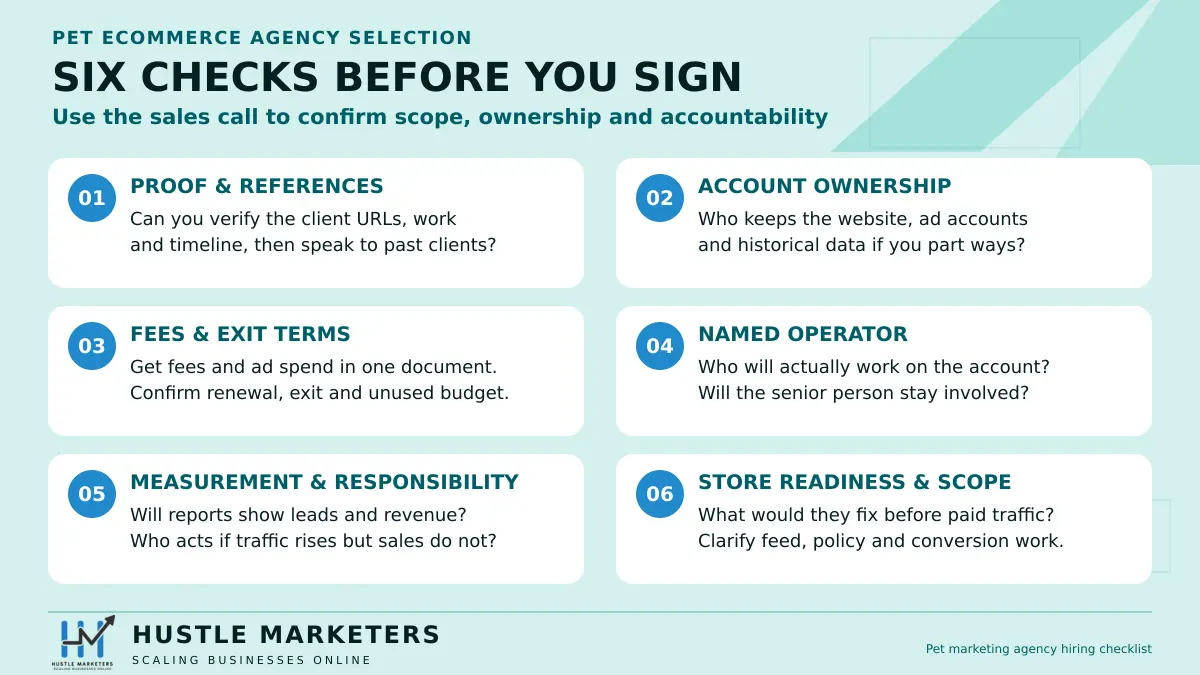
We collected forty five questions from owners and practitioners across thirty eight sources. These are the ones that map to an actual failure somebody in our set experienced. Where the count says contributors rather than owners, it is because the voices include practitioners and vendors giving advice, not only owners reporting harm.
| Ask this | Because | Source of the failure it prevents |
|---|---|---|
| Who are your clients, what are their URLs, and which keywords did you move for them? | Case studies without URLs cannot be checked | A Warrior Forum contributor’s standard screening question |
| How long did that take? | Nobody pins the timeline down in advance | Two reviewers described paying for six and seven months with nothing to show, and four practitioners said the timeline is what nobody agrees up front |
| Can I speak to past clients directly? | Two contributors advised exactly this rather than reading reviews | See the review section below |
| Is the senior person I am talking to going to work on my account? | One reviewer was assigned “a newbie to run my ads” | Six contributors raised junior staffing or churn |
| Does the contract auto renew, and for how long? | Four reviewers described a year long commitment | One described an agency trying to conceal a twelve month lock in |
| Is there a no penalty exit? | Recommended by a practitioner as a contract clause | Seven contributors raised lock in |
| Who owns the website, the ad account and the historical data if we part? | One reviewer’s website was held hostage when hosting stopped | Four contributors raised access and ownership |
| What level of access do you need, and why that level? | A Shopify contributor pointed out that payment gateway access can change where customer payments are sent | One owner found an unauthorized login and feared exposed bank details |
| Will reporting show leads and revenue, or rankings? | Ranking reports can rise while revenue does not | Eight contributors raised communication and reporting quality |
| Will reports include what went wrong? | Reporting that only covers wins is a warning sign | A Warrior Forum warning sign list |
| If rankings rise and revenue does not, whose problem is it? | This is where expectations diverge by default | The most important question in our research |
| What is the fee, what is ad spend, and can I see both in one document? | One reviewer was billed 4,500 against a promised 400 a month | Six contributors raised billing surprises |
| What happens to unspent ad budget? | One owner reported it does not roll over | Named reviewer |
| Show me the link sources before any link building starts | One practitioner on a network he was shown: “It is not a matter of if your friend’s website will tank. It is a matter of when will it tank.” | Eight practitioners raised risky tactics |
| Will you guarantee rankings? | A guarantee of number one is disqualifying. Page one does not guarantee revenue | A Warrior Forum warning sign list |
| Do you take clients at my size? | One reviewer updated their review to say the company was not suitable for smaller accounts | Two patterns in our set |
| Is my store ready for paid traffic, and what would you fix first? | Nine contributors said the store was the real problem | See the store readiness section above |
| How do you handle claim language for pet food and supplements? | A true claim can still be disapproved | Five sellers in our set hit a disapproval or suspension |
Print that. Take it to the call. An agency that answers all eighteen without flinching is a different proposition from one that answers twelve.
What do the review sites actually tell you?
Less than you would hope, and this is worth knowing before you use them as evidence.
Of the eight agency review profiles we read, five showed patterns consistent with non-independent reviews. Specifics, so you can judge for yourself:
- One profile is 96 percent five star with zero four star and zero three star reviews.
- One had eleven of thirteen reviews falling between July and October 2018 plus July 2019, two of them explicitly marked as incentivized.
- One had eight or more five star reviews appear within a few days of each other.
- One had a single review, marked as invited.
And one ex-client said it outright:
Don’t trust any of these reviews, as an ex-client, I can tell you they are more than likely incentivised.
There is a second problem, and a Warrior Forum contributor named it better than we could:
people that are receiving good experience are not going to call you
That caveat applies to everything on this page. Our pain counts come from people who went looking for somewhere to complain. Satisfied clients are underrepresented in every review corpus, including the ones we read. Treat the counts as a map of what can go wrong, not as a measure of how often it does.
Where else will a buyer look, and does it agree with Google?
Mostly yes, and that is the more useful finding.
We checked three surfaces on the query pet brand marketing agency: the organic results, the AI Overview on the same query, and the only video on point. The third is thin, and we say so because it changes how much weight its list deserves.
| Surface | Who it names |
|---|---|
| Organic top nine | Deskin Studio, Olbuz, We Are Animal, Socially Powerful, Pitch Pine, Instagram (a social profile, not an agency), Alpha Media, Digital PR World, SEO Sandwitch |
| The AI Overview on the same query, agencies named in its answer | BauBau Pet Services, Deskin Studio, Pet Engine Marketing, Olbuz |
| The only on point YouTube video, 14 views, two weeks old | Sweat Pants Agency, Top Growth Marketing, Brandon, redpepper, Petzbe Agency, inBeat, Pet Engine Marketing |
The important number is not in that table. The AI Overview on this query cites all nine of the organic top nine as sources. Ranking organically and being cited by the AI Overview are closely coupled here, so you do not need a separate AI strategy to be one of its sources on this term.
What differs is which agencies it actually names in its written answer. Only four, and three of those four are India based. So being cited as a source and being named in the answer are two different things, and the second one is the one a buyer reads.
Across the three lists, three names appear on two surfaces: Deskin Studio and Olbuz on organic and the AI Overview, and Pet Engine Marketing on the AI Overview and YouTube. No name appears on all three, and organic and YouTube share nothing at all.
The video’s own description calls it “an editorial shortlist based on publicly available information”, and its advice is sound and short:
Ask each finalist for experience that matches your business model, the metric it would prioritize first, and examples involving similar products or buying journeys.
That is roughly what the rest of this page says at much greater length. It is also worth knowing that the first agency on its list publishes its own best pet marketing agencies page, so treat the ordering as editorial rather than independent.
What do the nineteen pages we read leave out?
Every count below is out of the nineteen competitor pages we read across the results for pet brand marketing agency and seo for pet brands. That is not the same as the pages that rank, and any count phrased the other way would be wrong.
| Topic | Pages we read that cover it | What is missing |
|---|---|---|
| A return on ad spend figure for a real pet client | 0 of 19 | The proof point a buyer can least easily get anywhere else |
| A before and after ranking position for a pet client | 0 of 19 | The measure that shows whether SEO actually moved |
| A pet result from outside the US, UK and EU | 0 of 19 | No page we read publishes one |
| Merchant Center disapprovals for pet supplements or health claims | 0 of 19 | One page mentions Merchant Center at all, as generic optimization |
| Meta ad policy for animal products | 0 of 19 | Including the one page entirely about paid social for animal products |
| Branded versus non branded organic split | 0 of 19 | Where inflated organic reporting hides |
| Subscription and repeat purchase economics with real numbers | 0 of 19 | Two mention subscriptions only as a conversion to track |
| Any price figure at all | 4 of 19 | And none of the four publishes an agency retainer band, while average agency cost is a live People Also Ask question |
| Any external source cited | 2 of 19 | Seventeen assert without sourcing |
| A named human author | 9 of 19 | Ten are anonymous corporate copy |
| Any table | 4 of 19 | Fifteen have none |
| Petco or PetSmart named | 0 of 19 | One names Amazon and Chewy |
Two things we are not claiming as differentiators, because the audit says otherwise. AI search and large language model visibility is covered by six of the nineteen pages, so it is table stakes on this search result, not an edge. Pet influencer and user generated content creative is on seven of nineteen, and local pet service SEO with Google Business Profile is on eight of nineteen. Anyone selling you those three as their unique angle is selling you the category average.
Why choose Hustle Marketers or Ishant Sharma for pet marketing
Ishant Sharma has worked since 2013 in Google Ads, Meta Ads, SEO and ecommerce PPC. Hustle Marketers runs paid search, paid social and ecommerce SEO for pet brands, and the results are published rather than described.
What that means against the specific problems on this page:
- We publish numbers. A three month SEO engagement that moved organic clicks 56.3 percent and average position from 10.3 to 9.4, and a paid engagement that produced 346,593 dollars of revenue. None of the nineteen pages we read publishes a before and after ranking position for a pet client.
- We report the branded and non branded split separately, because the alternative is reporting your own customers back to you as growth.
- We will tell you if the store is the problem before we sell you traffic. Nine owners in our research said that was their actual issue, and conversion rate optimization is the honest service for it.
- We work in Merchant Center on pet catalogs, including supplements, where a factually true claim can still get you disapproved.
- We have delivered pet results outside the usual markets, in Australia, the UAE and the Philippines, including AI search optimization alongside SEO.
- We will not quote you a statistic we cannot attribute. Seventeen of the nineteen pages we read cite no source for anything they claim.
For the service pages, ecommerce SEO and ecommerce PPC management cover how the engagements are structured, and Shopify SEO covers the platform most pet brands in our work are on. If the immediate problem is the product feed rather than the ads, start with product feed optimization. Agencies who want this delivered under their own brand should read white label digital marketing.
About the author
This page was researched and written by Ishant Sharma, founder of Hustle Marketers. He has worked since 2013 in Google Ads, Meta Ads, SEO and ecommerce PPC, and he runs the pet accounts behind the case studies linked above. If something here is wrong, tell us and we will correct the page rather than leave it.
Pet marketing agency FAQs
What is the average cost of a marketing agency for a pet brand?
Only four of the nineteen competitor pages we read publish any figure, and none of the four publishes a retainer band, so there is no reliable published average. The one percentage we found in the threads we read came from a software vendor pitching a cheaper alternative to agencies, who put the ceiling at up to 20 percent of ad spend. That is a ceiling from an interested party, not a benchmark. Ask for the fee and the ad spend in one document, and ask what happens when spend rises.
Does a pet marketing agency need pet industry experience?
Less than the industry claims, on the evidence we could find. We found one first-hand pet-side account of having to train agencies on the pet space, from someone who runs a marketing agency herself. Most failures in our research were about communication, measurement, contracts and store readiness, which are not pet specific. Where pet experience does matter is narrow and concrete: claim language for food and supplements, Merchant Center suspensions, and knowing that pet link sellers are hard to vet.
How long before a pet SEO engagement shows anything?
Our published pet SEO engagement ran three months and moved organic clicks 56.3 percent and average position from 10.3 to 9.4. That is one account, not a promise. The useful thing to do is agree the timeline in writing before you start. Two reviewers in our research paid for six and seven months and got nothing, and four practitioners said the timeline is the thing nobody pins down in advance.
Why did my pet supplement ad get disapproved when the product is fine?
Because the claim is the problem, not its accuracy. The pet seller quoted above had 90 percent of his automatically disapproved listings approved on manual review with no changes at all. The first instruction he was given by a Diamond Product Expert was to strip claims and statements from both the website and the data feed. Five further sellers in our research hit a disapproval or a suspension, and one took five months to reverse.
Should I run Google Ads or Meta for a pet brand?
Practitioners in our research disagreed on this, and we are not going to pretend it is settled. What is not in dispute is the order: if add to cart is low, the issue is usually trust and clarity rather than traffic, and buying more of either channel makes the numbers worse.
Why do my pet ads show for plastic and bottle searches?
Because PET is also polyethylene terephthalate. Two of the eight autocomplete suggestions for pet ppc are plastics trade queries, including pet preform price per kg in pakistan. Add preform, resin, granules, bottle and per kg as negatives and prefer exact and phrase match on short pet phrases.
Can an agency guarantee rankings for pet keywords?
No, and a guarantee is a reason to walk. A Warrior Forum warning sign list makes the sharper point: ranking on page one does not guarantee quality traffic, revenue or leads. Ask instead what happens if rankings rise and revenue does not.
How do I check whether an agency’s pet page is real?
Search the page for a pet sub-sector that matches yours, for a number, and for a named author. Three of the nineteen pages we read, across two domains, have no pet content at all, and one page has an uncorrected heading about a roofing company on its pet page.
Should I trust agency reviews?
Cautiously. Five of the eight review profiles we read showed patterns consistent with non-independent reviews, including one at 96 percent five star with no four or three star reviews, and one ex-client stating the reviews were likely incentivized. Two contributors advised contacting past clients directly instead.
What is the one question most pet brands forget to ask?
If traffic and rankings go up and revenue does not, whose problem is that and what happens next. It was the clearest gap between agency and owner expectations in everything we read, and almost nobody asks it before signing.
Sources and how we researched this
Competitor pages. Nineteen pages read in full across the results for pet brand marketing agency and seo for pet brands, covering sixteen domains. Sixteen of the nineteen are the ranking URLs themselves and three are second pages from domains already counted. One page could not be read, blocked by robots with a connection timeout on the robots file, and no coverage was recorded or inferred for that domain. One social profile in the results was not attempted. Every count on this page is scoped to the nineteen pages we read.
Public discussions and reviews. Thirty eight sources read in full, plus one search listing we did not fetch. That is seventeen Shopify Community threads, of which eight are pet specific, six Warrior Forum threads, three BlackHatWorld threads, eight agency review profiles across Trustpilot, Sitejabber and G2, and four pet industry publications or pet specialist blogs. Eighty distinct question phrasings were collected, forty nine of them from threads read in full.
What we could not reach, stated plainly because it changes what this page can claim. Reddit could not be accessed for this research. It is where pet brand owners most often discuss agencies, so that gap stands. The Meta Business Help Community is robots blocked and login gated. WebmasterWorld returned a 403. We could not obtain a YouTube transcript, only a description.
Selection bias, which applies to every count here. Review corpora and complaint threads are written by people motivated to complain. A Warrior Forum contributor put it directly: people receiving a good experience are not going to call you. Our counts describe what can go wrong, not how often it does.
Live search results, read in September 2026 rather than through a search tool, because the two return different sets. People Also Ask blocks and one AI Overview were read from the rendered page in a browser. Autocomplete came from Google’s own suggestion endpoint.
Semrush. Volume, keyword difficulty, cost per click and competitive density were read from Semrush Keyword Overview in September 2026, US database unless a row says otherwise. Semrush volumes are estimates and monthly averages, not Google’s own figures.
The Google Ads community. The pet disapproval thread and its replies were read in a browser. An earlier attempt with a tool that does not run JavaScript returned thread titles only, which is why our first pass on this subject leaned on non pet threads.
YouTube. One on point video was read for its description and its list of named agencies. We could not obtain a transcript.
One finding worth stating because it shaped this page. We looked up “seo for pet brands” in Semrush, which is one of the two search results this research was built against, and it returns no volume, no difficulty and no global volume at all. Its entire variation set is five keywords worth thirty searches a month between them. Google autocomplete returns nothing for it either. That is why this page targets pet marketing agency instead.
What we did not do. We did not publish a price band, because we do not have enough pet engagements at enough sizes to publish an honest one. We did not pull Semrush figures for every keyword in the table, only the ones marked, and the unmarked rows are autocomplete strings with no volume attached.