Ecommerce SEO: The Rules Google Actually Publishes

Ishant
Published : October 7, 2026 at 10:30 am
Updated : October 7, 2026 at 5:48 am
Ishant

Google publishes nine hard rules for ecommerce SEO, and each one names a status code, a directive or a URL pattern. Return a 404 when a filter combination returns nothing, and consider one when a category empties out. Give every product variant its own URL, with the parameter-free URL as the canonical. Give every paginated category page its own canonical, never use # fragments for page numbers, and link between pages with plain <a href> tags. Keep duplicate list variations out of the index with noindex or robots.txt, and use a distinct URL for each currency.
Just as useful is what Google does not publish. There is no Google rule for out-of-stock or discontinued products, none for indexing internal site search, and none for which filter combinations deserve to rank. Below, each rule is quoted with the date Google prints on its page. Where Google is silent, we show how we handle it and label it as our method, not Google’s.
What does Google actually publish about ecommerce SEO?
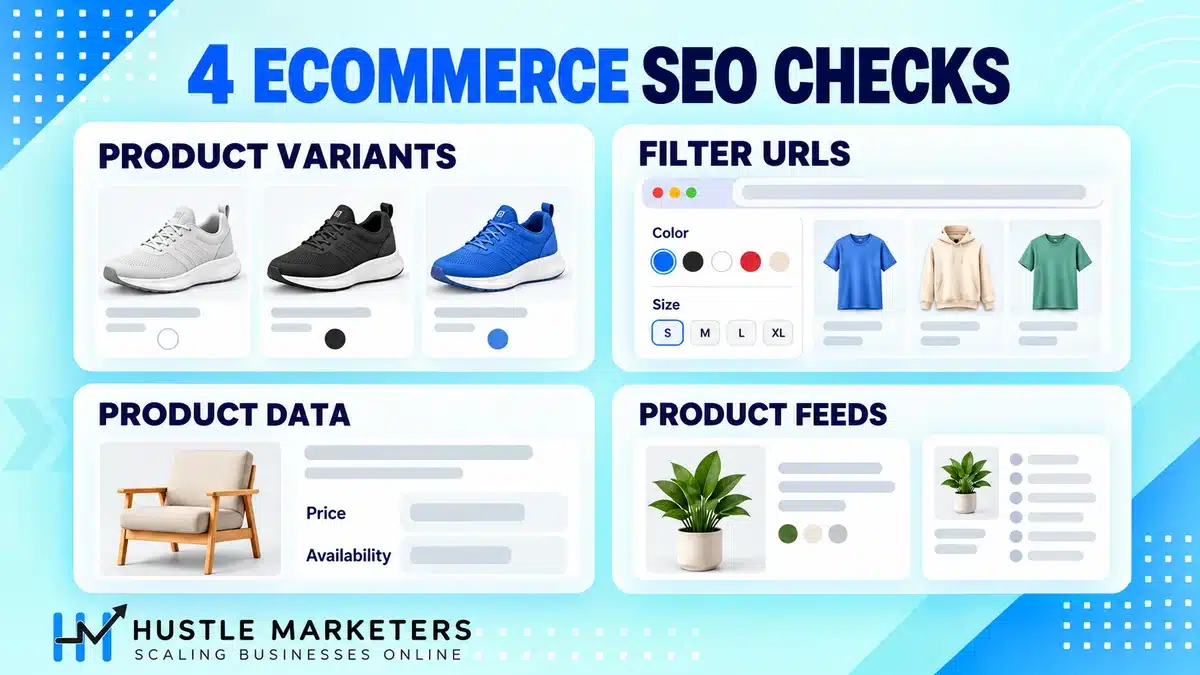
Less than you would guess. Google runs a dedicated ecommerce section in Search Central, and we read all of it, along with the crawling and structured data pages it relies on. Here is every hard rule we found, with the date Google prints on each page.
The rules that name a status code or a directive
| Rule, as Google words it | Where it comes from | Date on the page |
|---|---|---|
| “Return an HTTP 404 status code when a filter combination doesn’t return results” | Managing crawling of faceted navigation URLs | December 18, 2025 |
| “If your site detects that a category has become empty and automatically removes the category from on-site search and browse, consider returning a 404 (not found) HTTP status code” | Designing a URL structure for ecommerce sites | December 10, 2025 |
| “Don’t use the first page of a paginated sequence as the canonical page. Instead, give each page its own canonical URL.” | Pagination and incremental page loading | December 10, 2025 |
| “To avoid indexing variations of the same list of results, block unwanted URLs from being indexed with the noindex robots meta tag or discourage crawling of particular URL patterns with a robots.txt file.” | Pagination and incremental page loading | December 10, 2025 |
| “If you use optional query parameters to identify variants, use the URL with the query parameter omitted as the canonical URL.” | Designing a URL structure for ecommerce sites | December 10, 2025 |
| “To help Google understand your product variants, make sure that each variant can be identified by a separate URL.” | Designing a URL structure for ecommerce sites | December 10, 2025 |
| “Don’t use URL fragment identifiers (the text after a # in a URL) for page numbers in a collection.” | Pagination and incremental page loading | December 10, 2025 |
| “Include links directly on the pages using <a href> tags; don’t use JavaScript to navigate between pages.” | Designing a URL structure for ecommerce sites | December 10, 2025 |
| “When offering products for sale in multiple currencies, have a distinct URL per currency.” | Merchant listing structured data | No date retrieved |
Those are the nine hard ecommerce rules we found that name a status code, a directive or a URL pattern. Every ecommerce SEO recommendation beyond rules like these is either an inference, a platform constraint, or someone’s opinion, and it should be labeled as such when it reaches you.
What Google publishes no rule for at all
This matters more than the list above, because it is where confident advice tends to be invented. We checked each of these against the whole ecommerce section and the structured data references.
| Topic | What Google actually publishes | What to do instead |
|---|---|---|
| Out-of-stock products | No rule. No 404, no 410, no 301, no noindex, no keep-the-page instruction anywhere | Decide by link equity and demand, and mark availability honestly in structured data |
| Discontinued products | No rule. The Discontinued availability value exists in schema, but no handling instruction | Same. Treat it as a commercial decision, not a compliance one |
| Internal site search pages | No instruction to noindex them anywhere in the ecommerce docs | Judge by crawl waste in your own logs, not by a rule that does not exist |
| Which facet combinations deserve indexing | No documented view | Decide from search demand, then keep the rest out of the crawl with the methods Google documents |
| View-all pages | Absent from the documentation entirely | Stop citing it. The guidance it came from is gone |
| Breadcrumbs for ecommerce | No recommendation beyond BreadcrumbList appearing in a list of relevant types | Use them for users and rich results, not because a rule requires it |
| Ecommerce migration timing | No guidance and no timing numbers in the ecommerce section | Plan against your release calendar, not an invented Google window |
When an audit hands you a discontinued-product policy and attributes it to Google, that attribution is wrong. The decision may still be right, but it is a judgement call and you deserve to be told which of the two you are buying.
What does ecommerce SEO cover beyond those rules?
Mostly structure. On a store, the reasons a catalog underperforms in search usually sit in how URLs are generated, how variants are exposed, how filters multiply pages, and how product data reaches Google. Copy and links matter too, but they sit on top of that structure.
A store also has two pipes into Google, not one: the pages a crawler fetches, and the product feed. The feed is easy to miss because it usually belongs to the paid media team. The table maps each area to the Google rule behind it and the section of this post that covers it.
| Area | What that means on a store | Google’s rule, and where it is covered |
|---|---|---|
| Crawl and index control | Which of your generated URLs Google is allowed to reach, and which are wasting crawl | A 404 on empty filter combinations, and robots.txt or URL fragments for filter URLs. See faceted navigation |
| Product and variant structure | Whether variants get their own URLs, and what the canonical points at | A separate URL per variant, with the parameter-free URL as canonical. See product variants |
| Category and collection pages | Pagination, thin collections, and which page targets the commercial term | Its own canonical for each paginated page, and no # fragments for page numbers. See pagination |
| Product data and feed | Structured data, merchant listing eligibility, and feed to page parity | Merchant Center is mandatory for the Shopping tab, not for ordinary Search results. See the product feed |
| International and currency | Separate URLs per currency, locale duplication, hreflang | A distinct URL per currency. See international stores |
| Speed on product templates | The template that carries revenue, not the homepage | Not one of the nine rules. See our ecommerce Core Web Vitals guide |
| Measurement | Separating organic product clicks from ads, and stating the date range | Not one of the nine rules. See the worked example |
How should product variants be handled?
Give each variant its own URL, then point the canonical at the parameter-free parent. Both halves matter, and quoting either one alone inverts the advice.
Google’s URL structure guidance, updated December 10, 2025, says: “To help Google understand your product variants, make sure that each variant can be identified by a separate URL.” The same page adds the other half: “If you use optional query parameters to identify variants, use the URL with the query parameter omitted as the canonical URL.”
So variants are crawlable and addressable, and consolidation happens through the canonical rather than by hiding them. The product variant structured data reference, updated September 8, 2026, adds the markup requirements.
| Requirement | Exactly what Google specifies |
|---|---|
| Variant addressability | “The site must have the ability to preselect each variant directly with a distinct URL (using URL query parameters).” |
| Unique identity per variant | “Each variant must have a unique ID in its corresponding structured data markup (for example, using the sku or gtin properties).” |
| Group identity | productGroupID on the ProductGroup, or inProductGroupWithID on each variant. One of the two must be provided |
| Parent and child linkage | hasVariant on the parent, or isVariantOf on the child pointing back to the parent |
| ProductGroup required property | name, and nothing else |
| variesBy supported values | Exactly six: color, size, suggestedAge, suggestedGender, material, pattern |
That six-value limit is the detail that catches people. There is no custom variant axis. If your catalog varies by voltage, fabric weight, thread count or lens width, none of those can be declared through variesBy, and a plugin that claims otherwise is emitting markup Google does not recognize.
How should faceted navigation and filter URLs be handled?
Use Google’s documented methods for keeping filter URLs out of the crawl, strongest first, and return a hard 404 on empty combinations.
Google’s faceted navigation documentation, updated December 18, 2025, ranks the handling methods rather than leaving it open. For URLs you do not need crawled it gives robots.txt disallow on the filter patterns and URL fragments, then rel=canonical and rel=nofollow as weaker alternatives. It calls the last two “generally less effective in the long term”.
Deciding which facets to index is not a Google question, because Google publishes no view on it. It is a demand question. We pull the filter combinations that have real search volume, index those as dedicated listing pages, and shut the rest out with the strongest method your platform allows.
How should category page pagination be handled?
Self-canonical every page in the sequence, and stop using markup Google retired.
Google’s pagination guidance, updated December 10, 2025, is unusually direct: “Don’t use the first page of a paginated sequence as the canonical page. Instead, give each page its own canonical URL.” If your theme canonicalizes page 2 onward back to page 1, it is working against that.
| Common practice | What Google’s documentation says | Verdict |
|---|---|---|
| Canonical every paginated page to page one | “Don’t use the first page of a paginated sequence as the canonical page” | Stop |
| Add rel=next and rel=prev | “In the past, Google used <link rel=”next” href=”…”> and <link rel=”prev” href=”…”> to identify next page and previous page relationships.” Past tense | Harmless, but it is not a fix |
| Write unique titles and descriptions for page 2 onward | “You can use the same titles and descriptions for all pages in the sequence.” | Not a problem. Ignore the audit flag |
| Canonical the set to a view-all page | View-all is absent from the current documentation entirely | Stop citing guidance that no longer exists |
| Use #page=2 style fragments | “Don’t use URL fragment identifiers (the text after a # in a URL) for page numbers in a collection.” | Stop |
| Block sort-order variations | “block unwanted URLs from being indexed with the noindex robots meta tag or discourage crawling of particular URL patterns with a robots.txt file” | Correct, and documented |
Row three saves real money. Duplicate-title warnings on paginated sets are one of the most common findings in an automated audit, and by Google’s own documentation they are not a defect. Paying somebody to write 400 unique category page titles for page 2 onward is paying to fix a tool’s opinion.
What should happen to out-of-stock and discontinued products?
There is no Google rule, so anyone who gives you one is giving you their opinion wearing Google’s name. We checked the whole ecommerce section and the structured data references. No 404, no 410, no 301, no noindex, no keep-the-page instruction exists.
What does exist is the availability vocabulary. Structured data supports ten values, including InStock, OutOfStock, BackOrder, PreOrder, SoldOut, LimitedAvailability and Discontinued. Google wants that value to be accurate, and warns that dynamically generated markup “can make Shopping crawls less frequent and less reliable, which can be an issue for fast-changing content like product availability and price.”
So the real decision is commercial. Here is how we make it, labeled clearly as our method rather than Google’s.
| Situation | What we do | Why |
|---|---|---|
| Temporarily out of stock, returning | Keep the URL, keep it indexed, mark availability OutOfStock or BackOrder, show alternatives | The page has history and links. Removing it throws both away |
| Discontinued, with inbound links or steady traffic | Keep the URL, mark it Discontinued, link prominently to the successor product | A 404 here loses the link equity and the visitor |
| Discontinued, no links, no traffic, no successor | 410, or 404 if the platform cannot send 410 | Nothing is lost and the index stays clean |
| Discontinued with a direct replacement | 301 to the replacement product, not to the category | A redirect to a category reads as a soft 404 to users and often to Google |
| Seasonal item returning next year | Keep the URL indexed year-round | Rebuilding the page every season restarts its history every season |
Notice that three of the five keep the page. The instinct to purge discontinued SKUs is usually the most expensive instinct in an ecommerce audit, and it is never required by anything Google publishes.
Should internal site search pages be indexed?
Probably not, but not because Google says so. Google publishes no instruction to noindex internal search result pages anywhere in its ecommerce documentation.
The argument for excluding them is crawl waste, and that is measurable in your own logs rather than assumed. If your search pages generate tens of thousands of crawlable URLs from query strings, they are consuming fetches that product pages need. If your store has 300 SKUs and search pages are not linked, they are not costing you anything worth an invoice.
Where an internal search URL has genuine demand behind it, the answer is usually to promote it into a real category page rather than to block it. That is the same decision as the facet question, and it comes from search volume, not from a checklist.
What do you do about duplicate manufacturer product descriptions?
Rewrite by revenue, not alphabetically, and accept that you will never rewrite most of the catalog.
In our audits, a store with twelve thousand SKUs on supplier copy never rewrites twelve thousand descriptions, and no agency that quotes for it intends to. So the honest version is a prioritized subset and a rule for everything else.
| Tier | Which products | Treatment |
|---|---|---|
| Tier 1 | Products that already earn impressions or revenue, plus anything in a considered-purchase category | Fully original copy, real specifications, genuine use guidance |
| Tier 2 | Products with demand but no current visibility | A structured template with per-product variables that produce real differences, not spun sentences |
| Tier 3 | Long tail, low demand, near-identical variants | Leave the supplier text. Make sure the category page above it is strong |
Tier 3 is the part clients argue about. Leaving supplier copy on a low-demand SKU is not a penalty risk. It is a decision to spend the budget where it returns something, so state it in the scope rather than skipping it quietly.
Why does your product feed decide part of your organic visibility?
Because a large share of ecommerce visibility now runs through surfaces the feed populates, and the feed usually belongs to the paid media team rather than to SEO.
Search Engine Land reports that the Shopping Graph “now contains more than 50 billion product listings”, and identifies the ownership problem exactly: “Ask most ecommerce brands who owns their product feed, and the answer is almost always the same: the paid media team.” The feed therefore sits outside the SEO scope and outside the paid team’s SEO thinking.
That seam produces a specific class of fault: errors the website causes but that surface only inside Merchant Center. A price that disagrees between the feed and the landing page, an availability value that lags the site, a product page a crawler cannot reach. An SEO who never opens Merchant Center cannot see them. A feed manager who never crawls the site cannot fix them.
Merchant listing or product snippet, and why the difference matters
They are different rich result types with different required properties, and mixing them up is why so much Product markup earns nothing. We have written up the Merchant Center errors and what each one means separately.
| Merchant listing | Product snippet | |
|---|---|---|
| What it is | A result on a surface where a shopper can buy | An enhanced organic result with rating or price |
| Product required properties | name, image, offers | name, plus one of review, aggregateRating or offers |
| Offer required properties | price or priceSpecification.price, and priceCurrency or priceSpecification.priceCurrency | Not required |
| Page eligibility | “Only pages where a shopper can purchase a product are eligible for merchant listing experiences, not pages with links to other sites that sell the product” | Editorial and review pages included |
| Multiple currencies | “When offering products for sale in multiple currencies, have a distinct URL per currency” | Not addressed |
The eligibility line rules out a common mistake: putting merchant listing markup on category pages, or on affiliate pages that link out to other sellers. Neither is eligible, and marking them up does not make them eligible.
Do you need Google Merchant Center to rank?
Not for ordinary Google Search results. You do need it for the Shopping tab. Google states both halves plainly and the industry routinely gets one or the other wrong.
From Google’s guidance on sharing product data, updated December 10, 2025: “While structured data isn’t required to appear in Google Search results, it can help Google understand your page better and display it as a rich result.” And on the other side: “Participation in Google Merchant Center is mandatory for some Google surfaces, such as listings in the Google Shopping tab.”
| Claim you may have been told | What Google’s documentation supports |
|---|---|
| You must have structured data to rank | False. “structured data isn’t required to appear in Google Search results” |
| Merchant Center is only for paid Shopping ads | False. It is mandatory for some organic surfaces including the Shopping tab |
| Merchant Center improves your ordinary organic rankings | Not stated anywhere. Do not buy it on that basis |
| Product markup alone gets you into the Shopping tab | Not supported. Google names Merchant Center participation as mandatory for that surface |
| JavaScript-rendered Product markup is fine | Google warns it “can make Shopping crawls less frequent and less reliable” |
If your products show as Active in Merchant Center but earn no free listing impressions, that is a specific and common failure with its own causes. We have written it up separately in active in Merchant Center but no free listings.
That last row is a real build decision. If your Product structured data is injected client side, Google’s own merchant listing documentation treats it as a reliability problem for exactly the fields that change most, price and availability. Server-rendered markup is the safer default on a store.
How is international and multi-currency ecommerce SEO handled?
Separate URLs per currency, and a deliberate decision about locale duplication before you launch the second market.
The one hard rule Google publishes is on the merchant listing reference: “When offering products for sale in multiple currencies, have a distinct URL per currency.” A store that switches currency with a cookie or a session variable on the same URL cannot satisfy that, and its merchant listings will reflect one currency regardless of who is looking.
| Decision | What usually goes wrong | What we do |
|---|---|---|
| Currency switching | One URL serves several currencies via session state | A distinct URL per currency, as Google requires for merchant listings |
| Locale structure | Subfolder, subdomain and ccTLD chosen by whoever built the site | Chosen against the catalog and the team who will maintain it, then kept consistent |
| Duplicate catalog across locales | The same product text on five locale URLs with nothing distinguishing them | hreflang clusters with self-referencing canonicals inside each locale |
| Geo-redirects | Automatic IP redirects that trap crawlers in one locale | Suggest, do not force. Let the crawler and the shopper reach every locale |
| Pricing and tax display | Feed price disagrees with what the landing page shows in that market | Parity checked per locale, because the mismatch surfaces only in Merchant Center |
If you sell in one country and one currency, you can skip this section. If a second market is planned, settle the URL for each currency before that market launches.
Does an ecommerce store need anything extra for AI search?
Technically, no. Google’s AI features documentation, updated December 10, 2025, says a page must be indexed and eligible to show with a snippet, then adds: “There are no additional technical requirements.” What does change for a store is which surface assembles the answer, and for products that increasingly means the feed.
So you do not need a separate AI technical audit, because Google documents no separate technical requirement. What is worth checking is whether your product data reads clearly enough for an engine to quote it accurately: plain product names, specifications written as text rather than baked into images, and feed values that match the page. Our guide to AI SEO for ecommerce and our AI Overviews optimization page go into the mechanics.
What does it cost to hire help with ecommerce SEO?
Published market figures put ecommerce SEO between roughly $2,000 and $10,000 a month, per Shopify’s own pricing guide.
| Source | Figure, exactly as published | Date on the source |
|---|---|---|
| Shopify, How Much Does SEO Cost | Ecommerce SEO: “$150–$500” hourly, “$2,000–10,000” monthly, “$5,000–$30,000” one-time | December 11, 2025 |
| Shopify, same guide | Technical SEO audit: “$150–$300” hourly, “$1,000–$2,000” monthly, “$2,500–$15,000” one-time | December 11, 2025 |
| Shopify, same guide | Overall SEO “ranging from around $1,500 a month to more than $20,000 a month” | December 11, 2025 |
| Shopify, same guide | In-house alternative: “more than $40,000 per person annually” | December 11, 2025 |
| Ahrefs, 439 providers polled | “SEO costs $2,917 per month on average.” “Agencies charge $3,209/month, on average.” | Updated August 15, 2024 |
| Ahrefs, same poll | “The average hourly rate for SEO is $111.” “68.8% charge $2,000/month or less” | Updated August 15, 2024 |
Those ranges are wide because scope varies so much from store to store. These are the drivers that move an ecommerce quote most in our experience, and each one is worth asking about on a sales call.
| Cost driver | Why it moves the price |
|---|---|
| Number of templates, not number of SKUs | In our experience a forty thousand SKU store with six templates is less work than a nine hundred SKU store with twenty |
| Whether the feed is in scope | Merchant Center and feed parity work adds time and usually a specialist |
| Diagnosis only, or implementation too | Writing and shipping the fixes is separate work from finding them, so expect it to be quoted separately |
| Platform | A headless build and a stock Shopify theme are not the same job |
| Number of locales and currencies | Each market multiplies the checks, not just the pages |
| Whether a replatform is coming | Migration work is time-boxed to your release date, so it prices differently |
One anchor from Google itself: its technical requirements page says “It costs nothing to get your page in search results, no matter what anyone tries to tell you.” What you pay for is the diagnosis and the engineering time, not access to Google.
What should an ecommerce SEO audit include?
A fix queue your developers can act on, not a score. Whether the audit is done in-house or by an agency, these are the parts worth asking for by name.
| Part of the audit | What is in it |
|---|---|
| Crawl and index baseline | Full crawl, Search Console Page Indexing reconciliation, a count of your real crawlable URLs against your real SKU count |
| Template diagnosis | Rendered output checked on homepage, category, product, variant and search templates |
| Feed and Merchant Center review | Feed to landing page parity on price and availability, disapproval review, merchant listing eligibility |
| Prioritized fix queue | Every finding as a ticket: affected URL pattern, the change, dependencies, how to validate it, expected effect |
| Walkthrough | A live session with whoever will implement, not a PDF handover |
| Implementation or handoff | Agreed before the work starts, and priced separately from the diagnosis |
A quick test for any proposal: take one finding from a sample report and ask whether a developer could ship it without a follow-up call. If the ticket names the URL pattern, the change and how to check that it worked, the answer is yes.
Who should implement the fixes?
Whoever can ship template changes on your platform, agreed before the audit starts. That can be the agency, your own developers, or a mix of both.
On a hosted platform such as Shopify or BigCommerce, much of the work happens in the theme and the admin, so an outside specialist with staff or collaborator access can often ship it directly. On headless and custom builds, the work usually arrives as tickets sized for your sprint, because only your team can deploy. Most engagements end up mixed.
How does your platform change what you can fix?
Google’s rules are platform-neutral, but each platform limits which of them you can act on. Here is the constraint that bites first on each one.
| Platform | The constraint that decides what is even possible | Where to read more |
|---|---|---|
| Shopify | Forced /collections/ and /products/ paths, the duplicate collection and product URL pattern, limited robots.txt control, theme-level app bloat | Shopify SEO and Shopify SEO issues |
| WooCommerce | Plugin-driven markup conflicts, attribute and filter URL explosion, feeds that stop updating silently, hosting-dependent speed | WooCommerce technical SEO and platform-specific ecommerce SEO |
| Magento and Adobe Commerce | Layered navigation URL volume, index management, heavy template rendering | Magento SEO and the Magento 2 checklist |
| BigCommerce | Faceted URL handling and template control limits | BigCommerce SEO |
| Webflow | Static generation limits and collection URL structure | Webflow SEO |
| Headless and custom | Whether links and Product markup exist in the initial HTML, before JavaScript runs | Compare view-source with the rendered HTML in Search Console’s URL Inspection tool |
Google itself is unusually relaxed about this. Its URL structure page tells platform users: “If you’re using an ecommerce platform, you can most likely skip this section, as the platform has most likely already considered these issues for you.” That is worth holding onto when somebody quotes you for URL restructuring on a hosted platform that will not let them change the URLs anyway.
What does fixing the feed seam look like in practice?
Here is one example from our own work, with the date range stated, because a percentage without a baseline is not evidence.
Our Judaica ecommerce SEO case study covers a Brooklyn retailer. The store name stays off the page at the client’s preference. The figures, each with the tool and window the case study states:
| Metric | Result | Measurement window |
|---|---|---|
| Organic clicks | We measured clicks rising from 9.96K to 13.1K, about 31 percent | Search Console, 28 days vs previous 28 days |
| Free listing clicks | We measured organic online store clicks from free listings at 10.59K, up 36.6 percent | Merchant Center, August 28 to September 24, 2026 vs previous period |
| Product clicks, ads and organic | We measured product clicks across ads and organic at 11.41K, up 46.8 percent | Merchant Center, same window |
| AI search visibility | “51 mentions and 324 citations” | Semrush AI Visibility, US, six-month view, September 23, 2026 |
Notice the free listings line. Those are organic product results that cost nothing per click, and they came through Merchant Center rather than through the pages. That is the seam described earlier, working in the right direction.
Use the same test on any SEO result you are shown. If a number has no date range and no source, you cannot tell whether it describes a year of work or a good fortnight.
What are the red flags in an ecommerce SEO proposal?
Eight things that should make you slow down before you sign, whoever the proposal comes from. Our guide to choosing an ecommerce SEO agency has the full set of vetting questions.
- A health score sold as the outcome. A crawler number moving from 58 to 91 is not revenue.
- A crawl export with a logo on it. If a deliverable could be produced by pressing Export, it is not an audit.
- Google quoted for rules Google has not published. Out-of-stock handling and internal search indexation are judgement calls, and a good proposal labels them that way.
- A separate AI or GEO technical audit. Google documents no additional technical requirement for its AI features, so there is nothing separate to fix at the technical level.
- A quote to rewrite the entire catalog. Rewrites should be tiered by demand, with the low-demand tier left alone.
- Guaranteed rankings or revenue. Google’s own guidance on hiring an SEO says “No one can guarantee a #1 ranking on Google.”
- A dollar value attached to a free audit to make it feel like a gift.
- International work scoped for a single-market store.
When you should not hire an ecommerce SEO agency
Five situations where an audit is the wrong purchase, however good the agency is.
| Situation | Why an audit will not help | What to do instead |
|---|---|---|
| Nobody on your side can deploy a template change | The fix queue becomes a PDF. This is the most common way these engagements fail | Fix the deployment path, or buy implementation rather than diagnosis |
| Your margins do not survive the acquisition cost | Organic still costs money to earn, just not per click | Fix unit economics first. Traffic will not rescue a broken margin |
| Nobody searches for what you sell | Technical work cannot create demand that does not exist | Demand research, then category and content strategy |
| You are indexed, fast, structured and your feed is clean | You are at the technical ceiling. More technical work returns close to nothing | Merchandising, content and brand |
| You are replatforming next quarter | Findings will be obsolete after the migration | Buy migration support instead, before the build is finished, not after launch |
Google publishes its own guidance on whether you need an SEO, updated June 5, 2026. It is worth reading before you talk to anyone, us included.
About Hustle Marketers
This post comes from Hustle Marketers. If you want the service side rather than the rules, our ecommerce SEO agency page covers scope and process.
| Detail | |
|---|---|
| Who does the work | Ishant Sharma, working in search since 2013 |
| Certifications | Google Partner, Meta Business Partner and Microsoft Advertising Partner |
| Reviews | 4.9 out of 5 from 591 reviews, and Clutch 5.0 from more than 50 reviews, verifiable on our Clutch profile |
| Recognition | 6 Clutch awards in 2026 |
| Scale | Our team has worked with more than 2,500 brands |
| Ecommerce specifics | Feed, Merchant Center and organic handled by the same team |
| Measurement standard | Published as our reporting integrity standard, including what we will not claim in a bad month |
| Sectors | Ecommerce, local service, SaaS, and white-label delivery through our white label SEO services |
Free tools you can use before hiring anybody: our Google Shopping feed validator and our GTIN and UPC check digit calculator. Both are free and neither asks for an email.
Frequently asked questions
How much does ecommerce SEO cost?
Published market figures put it at “$2,000–10,000” a month, per Shopify’s pricing guide of December 11, 2025, with Ahrefs reporting “Agencies charge $3,209/month, on average” from a poll of 439 providers. Template count, whether the feed is in scope and whether the agency implements move a quote more than SKU count does.
How long does ecommerce SEO take to work?
Indexation and crawl changes can show within days to a few weeks once fixes ship, because you are changing what Google can reach. Revenue effects take longer and depend on your category. Anyone giving you a fixed date is guessing, and Google publishes no timing guidance for ecommerce at all.
Do I need Google Merchant Center for SEO?
Not for ordinary search results. Google’s documentation says structured data “isn’t required to appear in Google Search results”, but also that “Participation in Google Merchant Center is mandatory for some Google surfaces, such as listings in the Google Shopping tab”. If free product listings matter to you, Merchant Center is not optional.
Should every product variant have its own URL?
Yes, with the canonical pointing at the parameter-free parent. Google says “make sure that each variant can be identified by a separate URL” and, in the same guidance, to use the URL with the query parameter omitted as the canonical. Both halves together. Either one alone gives you the wrong answer.
Should I delete discontinued products?
Usually not, and Google publishes no rule either way. If the page has links or traffic, keep it, mark it Discontinued and point to the successor. If it has a direct replacement, redirect to that product rather than to the category. Only remove pages that have nothing attached to them.
Should an ecommerce SEO agency fix the issues or just report them?
Either can work, as long as it is agreed before the audit starts. If the agency implements, check that it has shipped changes on your platform before. If it hands off, ask for tickets written for your stack and sized for a sprint. Either way, you need one named person who can deploy.
Is ecommerce SEO different for B2B and wholesale stores?
Yes. Trade pricing, login-gated catalogs and account-only products change what can be indexed and what can go in a feed, so the scope differs from a consumer store. Details on our B2B ecommerce SEO services page.
Sources and how we verified them
Every source below was opened and read on September 28, 2026, and the Google pages on faceted navigation, AI features, technical requirements and hiring an SEO were opened again on October 7, 2026. Nothing here comes from another page’s summary of a study or a doc. Where a source could not be reached, or a date was not printed, it is listed as such.
| Source | Date on the source | What we verified |
|---|---|---|
| Google, Designing a URL structure for ecommerce sites | Last updated 2025-12-10 | The variant URL rule, the variant canonical rule, the empty category 404, the a href navigation rule, the descriptive words line and the skip-this-section line for platform users |
| Google, Pagination and incremental page loading | Last updated 2025-12-10 | The per-page canonical rule, the past-tense rel next and rel prev sentence, the same titles and descriptions line, the fragment rule, the noindex and robots.txt line, and that view-all is absent |
| Google, Share your product data with Google | Last updated 2025-12-10 | That structured data is not required to appear in Search, and that Merchant Center participation is mandatory for some surfaces including the Shopping tab |
| Google, Product variant structured data | Last updated 2026-09-08 | The six variesBy values, the single required ProductGroup property, the unique variant ID requirement, the productGroupID and inProductGroupWithID rule and the distinct URL requirement |
| Google, Merchant listing structured data | No date retrieved, see note below | The purchase-page eligibility sentence, the required Product and Offer properties, the dynamically generated markup warning and the distinct URL per currency rule |
| Google, Managing crawling of faceted navigation URLs | Last updated 2025-12-18 | The 404 on empty filter combinations, the stated preference order and the less effective in the long term rating for canonical and nofollow |
| Google, Do you need an SEO? | Last updated June 5, 2026 | That Google publishes its own hiring guidance, and its line that no one can guarantee a #1 ranking |
| Google, AI features and your website | Last updated 2025-12-10 | That a page must be indexed and eligible for a snippet, and that there are no additional technical requirements |
| Google, Search Essentials technical requirements | Last updated 2025-12-18 | The line that it costs nothing to get a page in search results |
| Shopify, How much does SEO cost | December 11, 2025, by Shelby Blackley | Every ecommerce and audit price band quoted, the overall range and the in-house figure |
| Ahrefs, SEO Pricing, 439 people polled | Updated August 15, 2024, by Joshua Hardwick | The 439 sample, the $2,917 monthly average, the $111 hourly average, the $3,209 agency average and the 68.8 percent figure |
| Search Engine Land, product feeds and organic strategy | No date shown on the page, by Jen Cornwell | The Shopping Graph figure and the feed ownership sentence |
| Hustle Marketers, Judaica ecommerce SEO case study | Published September 25, 2026 | Every figure in the results table, including the tool and the measurement window for each |
What we could not confirm
We could not retrieve a last-updated date for Google’s merchant listing reference, so none is published for it here. The quotes from it are exact.
Why this page has no FAQPage schema
Google stopped showing FAQ rich results entirely on May 7, 2026 and removed the documentation on June 15, 2026, so the markup no longer earns the feature it was built for. Adding it to look thorough would contradict the argument of this page. The page carries BlogPosting, Organization and Person markup, which describe things that are true about it.
Written by Ishant Sharma, founder of Hustle Marketers, working in search since 2013. If you want to know whether your store has a structural problem, a feed problem or a demand problem before anyone quotes you for fixing one, that is the first call, and you can book it through contact us. Our broader SEO services, technical SEO and AI SEO work sit alongside this.
Summarise this article with: