Water Damage PPC: Google Ads Guide for Restoration Companies

Ishant
Published : October 26, 2026 at 5:30 pm
Updated : October 27, 2026 at 5:40 pm
Ishant
Water damage PPC is paid search advertising, mainly Google Ads and Local Services Ads, that puts a restoration company in front of a homeowner the moment a pipe bursts or a basement floods. It pays off when emergency searches get their own campaign, every call is tracked to a booked job, and junk searches are blocked.
Summarize this article with:
Key Observations
- Water damage clicks cost far more than the home services average. 99 Calls reports an $80.44 average CPC and a $610 cost per lead for “water damage restoration” searches across 107 advertisers it manages (99 Calls, 2024 to mid-2026 data), against a $7.85 CPC median for all home services (LocaliQ).
- “Water damage services” is a Local Services Ads category in the US, and Google lists IICRC certification among its license checks (Google screening requirements).
- Local Services Ads are moving into Google Ads as Performance Max campaigns with pay-per-lead goals, starting with select US home service advertisers in August 2026 (Google Ads Help).
- Split the account by urgency first (emergency vs planned), then by loss type (water, sewage, mold, fire), so each one gets its own budget, schedule and landing page.
- Google stopped new call-only ads in January 2026 and will stop serving them in February 2027, so restoration accounts need responsive search ads with call assets (Google Ads Developer Blog).
What is water damage PPC and how does it work?
Water damage PPC is pay-per-click advertising for restoration companies. You bid on searches like “water damage restoration near me”, your ad shows above the organic results, and you pay when someone clicks or calls. Local Services Ads work differently: you pay per valid lead, not per click, and the ads have no keywords.
The job is unusual because most of the demand is an emergency. A homeowner standing in an inch of water does not compare five websites. They call the first company that looks credible and answers. That is why water damage PPC lives or dies on three things: showing up on emergency searches in your real service area, answering every call, and knowing which calls became jobs.
Most restoration accounts run on three Google surfaces:
- Search campaigns: keyword-based text ads with call assets. You control keywords, negatives, bids, schedules and landing pages.
- Local Services Ads: pay-per-lead ads at the top of Search and on Maps, with a Google Verified badge after screening.
- Performance Max: Google’s automated campaign type. It is now also the home of Local Services Ads as they migrate into Google Ads.
Microsoft Advertising can mirror your best Search campaigns at a smaller scale once Google is profitable. Start with Google, where the volume is.
How much does water damage PPC cost?
Water damage PPC is one of the most expensive local service categories. Agency data from 99 Calls shows an average cost per click of $80.44 and an average cost per lead of $610 for “water damage restoration” searches. Your real cost depends on your market, your close rate and how tightly you control wasted clicks.
Cost per click and cost per lead by job type
The table below uses 99 Calls’ figures, aggregated from Google Ads campaigns it manages for 107 damage restoration advertisers, January 2024 to mid-June 2026, with $1.9M+ in spend (99 Calls lead cost study). Treat it as one agency’s portfolio, not a national census.
| Search theme | Avg cost per click | Click-to-lead or conversion rate | Avg cost per lead |
|---|---|---|---|
| Water damage restoration | $80.44 | 13.2% | $610 (99 Calls) |
| Emergency / 24 hour | $80.41 | 16.0% | $500 (99 Calls) |
| Flood / flooded basement | $70.66 | 12.0% | $585 (99 Calls) |
| Sewage cleanup | $61.23 | 11.7% | $525 (99 Calls) |
| Leak detection | $47.96 | 14.5% | $330 (99 Calls) |
| All home services (median) | $7.85 | 7.33% | $90.92 (LocaliQ) |
| Plumbing (median) | $10.49 | 7.63% | $129.02 (LocaliQ) |
LocaliQ’s home services benchmark covers 3,211 US campaigns from April 1, 2024 to March 21, 2025, reports medians, and does not break out restoration as its own category (LocaliQ home services benchmarks). That is why general “home services” averages badly understate what water damage clicks cost.
Why restoration clicks cost so much
Restoration jobs are large and often insurance-funded. The average homeowners insurance claim for water damage and freezing was $15,400 over 2019 to 2023, according to ISO data published by the Insurance Information Institute. That figure is what insurers paid on claims, not your invoice, but it explains why national franchises and local operators all bid hard on the same few emergency terms.
How to work out what you can afford per lead
Your break-even cost per lead is your gross profit per job multiplied by the share of leads that become jobs. Here is an illustrative example. The inputs are assumptions for the math, not benchmarks.
| Input (illustrative assumption) | Value |
|---|---|
| Average mitigation invoice | $4,000 (assumed) |
| Gross margin after labor, equipment and materials | 45% (assumed) |
| Gross profit per job | $1,800 (calculated: $4,000 x 45%) |
| Leads that become booked jobs | 30% (assumed) |
| Break-even cost per lead | $540 (calculated: $1,800 x 30%) |
At those assumptions, a $610 lead loses money and a $500 emergency lead barely clears. Run the same math with your own job values and close rate before you set bids. Reconstruction work after mitigation raises the job value, so include it if you track it.
What a realistic monthly budget looks like
Small budgets get very little data at these prices. As an illustration, $3,000 a month at the 99 Calls average of $80.44 per click buys about 37 clicks, and at a 13.2% click-to-lead rate that is about five leads (calculated from 99 Calls averages). With a small budget, put it all on emergency water terms in your tightest radius and let Local Services Ads cover the rest. Our Google Ads cost guide covers budgeting in more depth.
What does PPC management cost?
Management is a separate fee from ad spend. Hustle Marketers charges $600 to $800 per platform per month, month to month, and the restoration company owns its ad accounts. Ask any agency whether you keep the account, the call recordings and the conversion history if you leave.
How should you structure a Google Ads account for water damage restoration?
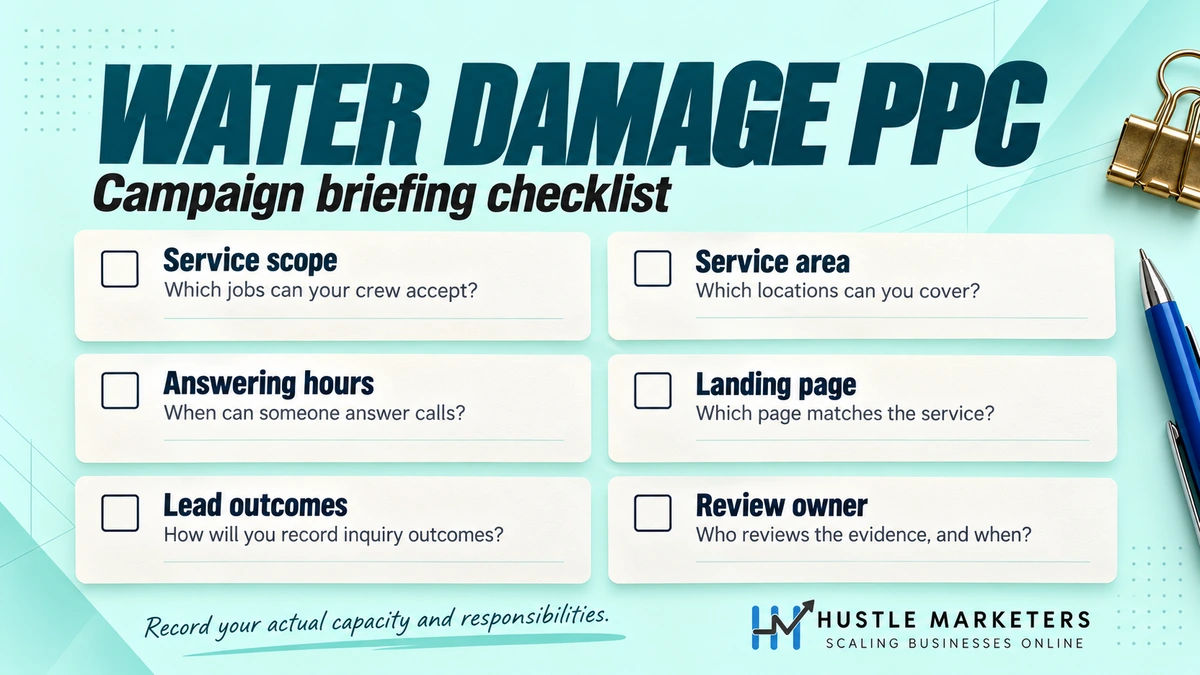
A water damage Google Ads account works best when it is split by urgency first and loss type second. Emergency water searches need 24/7 ads, phone-first copy and the highest bids. Planned work such as mold, fire rebuilds and repairs needs business-hour schedules, forms and different landing pages. Mixing them hides which one makes money.
Emergency vs planned campaigns
Emergency searchers want someone at the door within hours. Planned searchers, such as someone with a stained ceiling or a mold smell, compare companies over days. These two groups convert differently, so they should never share a budget. If they do, the cheaper planned clicks soak up spend at 2 a.m. when only emergency calls matter.
Water, sewage, mold and fire campaigns
| Campaign | Example ad groups | Schedule | Main conversion | Landing page |
|---|---|---|---|---|
| Emergency water damage | Water damage restoration, water removal and extraction, flooded basement, burst pipe | 24/7 if you answer 24/7 | Calls | Emergency water page |
| Sewage and Category 3 | Sewage backup cleanup, toilet overflow cleanup | 24/7 | Calls | Sewage cleanup page |
| Mold remediation | Mold removal, mold remediation company, mold inspection | Business hours | Calls and forms | Mold page |
| Fire and smoke damage | Fire damage restoration, smoke damage cleanup, soot removal | 24/7 or extended hours | Calls | Fire page |
| Repairs and commercial | Water damage repair, ceiling and drywall repair, commercial water damage | Business hours | Calls and forms | Repair or commercial page |
| Brand | Your company name and misspellings | 24/7 | Calls | Homepage or emergency page |
The IICRC S500 standard grades water by contamination. R&R magazine summarizes Category 3 as “grossly contaminated”, with sewage as an example (R&R magazine on IICRC categories). That is a practical reason to give sewage its own campaign and page: the crew, pricing and message differ from a clean supply-line leak.
Location targeting, schedules and match types
- Location: Google’s default option is “Presence or interest”, which can show ads to people outside your area (Google advanced location options). Switch emergency campaigns to “Presence” and draw the radius around real drive times. Our location targeting guide walks through the settings.
- Schedules: run emergency campaigns 24/7 only if a person answers 24/7. Otherwise schedule them for the hours you cover.
- Match types: in our experience, broad match works only once an account already has conversion data. New restoration campaigns start on exact match and open up later. Exact terms cost more per click, but the traffic matches the job.
Is water damage restoration a Local Services Ads category?
Yes. “Water damage services” is a Local Services Ads category in the United States. Google describes it as professionals who clean and inspect water damage issues such as mold, sewage and paint damage. There is no separate “restoration” or “fire damage” category in Google’s home services list, so fire work stays in Search campaigns.
What Google checks before your ads go live
Google’s US requirements for the water damage services category include general and professional liability insurance, state-level business and owner licenses, IICRC certification, and background and registration checks for select users (Google screening and verification requirements). Google also notes that some states need additional licenses for mold remediation or assessment. The same page says screening takes 3 to 4 weeks on average after documents are submitted, so start early.
Google Verified replaced Google Guaranteed
Google now uses one badge for all Local Services advertisers, called Google Verified. It is also discontinuing the Money Back Guarantee that came with the old Google Guaranteed badge. Consumers can claim only for services booked before December 7, 2025 (About Google Verified badge). Update any ad copy, website badge or sales script that still says “Google Guaranteed”.
What counts as a charged lead?
Local Services Ads charge per valid lead. Google’s rules (How leads work) include:
- You are charged for answered calls, texts, emails, voicemails, booking requests (US and Canada), and missed calls during business hours where the caller stays on the line for more than 20 seconds.
- Repeat contacts from the same phone number or email within 15 days of a charged lead are not charged again.
- Charged leads are reassessed over 30 days, and low-quality, duplicate or invalid leads may be credited automatically.
One rule matters a lot for restorers: Google no longer credits “job type not serviced” or “geo not serviced” leads (Automated lead credits). Set your service types and service area precisely, or you will pay for calls you cannot take.
How does the 2026 move of LSA into Google Ads change things?
Google is moving Local Services Ads into Google Ads as Performance Max campaigns with pay-per-lead goals (Google Ads Help, Local Services Ads migration). You still pay only for valid leads, the ads still show on Search and Maps, and targeting stays keywordless. Here is what changes:
| Item | What Google says | What restorers should do |
|---|---|---|
| Timeline | Select US home and storefront service advertisers from August 2026; service-area businesses without storefronts in late 2026; non-US accounts and remaining categories in 2027 (Google) | Restorers without a storefront may fall in the later wave, so watch for the migration email |
| Notice | Admins get an email 14 days before migration and a reminder 7 days before (Google) | Make sure an owner, not a former employee, is an account admin |
| Reports | LSA performance reports do not transfer to Google Ads (Google) | Download or screenshot lead and cost history now |
| Bidding | Manual bidding is no longer supported and vertical-level Target CPA is not supported; separate campaigns per vertical are suggested (Google) | If you also run another category, give water damage its own campaign |
| Budget | Weekly budgets are divided by 7; monthly spend is capped at the daily average x 30.4 (Google) | Plan storm-season budget changes as daily amounts |
| Leads | Lead history, call recordings and messages move to Google Ads under Goals, Conversions, Leads (Google) | Keep scoring leads by outcome in the new view |
| Badge | Completed verification and the Google Verified badge carry over (Google) | No new screening needed unless Google asks |
Google says to allow up to two weeks for performance to settle after migration, and new pay-per-lead campaigns still start at g.co/localservices until Google Ads supports creating them. For the full LSA setup, see our Local Services Ads management page.
How Local Services Ads rank
Google ranks Local Services Ads on your bid, your profile quality (rating, number of reviews, response time and photos) and your responsiveness. Google states plainly that “Missed calls may negatively affect your responsiveness” (About ad rankings). For a 24/7 emergency trade, an answering plan is part of your ad strategy, not an admin task.
Which keywords should water damage companies bid on?
Water damage companies should bid first on emergency, service-plus-location keywords such as “water damage restoration near me”, “emergency water removal” and “flooded basement cleanup”. These show a homeowner with a live problem. Research-style searches, such as how to dry a carpet, belong in SEO content, not in a paid budget.
Use this table as a starting map for ad groups. Check every term’s volume and bid range for your own ZIP codes in Google Keyword Planner before you add it, because local demand varies widely.
| Ad group | Example keywords | Intent |
|---|---|---|
| Core water damage | water damage restoration near me, water damage company, water damage restoration plus your city name | Emergency |
| Water removal | emergency water removal, water extraction service, standing water removal | Emergency |
| Flooding | flooded basement cleanup, basement water removal, flood cleanup company | Emergency |
| Pipes and leaks | burst pipe water damage, leak detection service, slab leak water damage | Emergency to planned |
| Sewage | sewage backup cleanup, sewage cleanup company, toilet overflow cleanup | Emergency |
| Mold | mold remediation company, mold removal near me, mold inspection | Planned |
| Fire and smoke | fire damage restoration, smoke damage cleanup, soot removal | Emergency to planned |
| Repairs | water damaged ceiling repair, drywall water damage repair | Planned |
Keep insurance searches such as “water damage insurance claim help” in their own monitored ad group. People with an open claim do hire restorers, but the same searches pull in people looking for lawyers, which is where negative keywords come in.
Which negative keywords should restoration companies add?
Restoration companies should exclude job seekers, DIY searches, phone and device repairs, training courses, equipment rentals, lawyers and claim disputes, and unrelated “restoration” searches like car or furniture restoration. These searches can cost as much per click as a real emergency, so one bad week of them can burn a small budget.
| Group | Example negatives | Suggested match |
|---|---|---|
| Jobs and careers | jobs, job, hiring, salary, careers, technician | Broad (single words) |
| DIY and how-to | diy, how to dry, yourself, home remedy | Phrase |
| Devices and vehicles | iphone, phone, laptop, watch, car | Broad (single words) |
| Training | certification course, iicrc training, class, school | Phrase |
| Lawyers and disputes | lawyer, attorney, lawsuit, sue, settlement, claim denied | Broad or phrase |
| Equipment | rental, rent, for sale, machine | Broad or phrase |
| Wrong “restoration” | car restoration, furniture restoration, photo restoration, hair, skin | Phrase |
| Wrong “smoke damage” | lungs, weed, vape, cigarette | Broad (single words) |
Industry writers have flagged the same traps for years. R&R magazine’s example list includes “iPhone” for phone water damage searches and “weed” and “lungs” for smoke damage searches (R&R magazine on negative keywords). Watch “IICRC”: block “iicrc training” and “certification course”, but not “iicrc certified”, because homeowners use that phrase to find a qualified company.
Account level or campaign level?
Put universal junk (jobs, DIY, devices, lawyers) in an account-level list, so a miss at campaign level does not matter. Google applies account-level negatives to Search, Performance Max and other campaign types, with a limit of 1,000 per account (About account-level negative keywords). Use campaign-level negatives to route traffic, for example adding “mold” as a negative in the water campaign so mold searches land on the mold campaign and page.
Negative keywords do not cover close variants, so add plurals and misspellings yourself (Google). When you run broad match, build the phrase and exact negative list before launch rather than waiting for waste to show up. Our Google Ads negative keywords guide covers match type behavior in detail.
How do you track calls from water damage ads?
Call tracking for water damage ads means counting calls from the ad itself and from the landing page, then marking which calls became booked jobs. Google Ads can track ad calls through Google forwarding numbers, and you choose the minimum call length that counts as a conversion. Without this, bidding optimizes for clicks, not jobs.
- Turn on call reporting so Google forwarding numbers show on your call assets. New calls count under the default “Calls from ads” conversion action (Track calls from ads). Google also recommends turning on call recording.
- Set a minimum call length. Google counts every call that lasts at least the length you choose (About phone call conversion tracking). Listen to a sample of recorded calls and set it where real job inquiries start.
- Track calls from the landing page too, with a website call conversion or a third-party call tracking number swapped onto the page.
- Score each call by outcome: booked, quoted, out of area, wrong service, or spam.
- Send booked jobs back into Google Ads as offline conversions, so Smart Bidding learns from real jobs. Our conversion tracking guide explains the setup.
Plan the move away from call-only ads now. Google blocked new call-only ads from January 2026, and all call-only ads stop serving in February 2027. Google’s recommendation is responsive search ads with call assets (Google Ads Developer Blog). If spam calls or fake form fills are inflating your numbers, read our guide to Google Ads spam leads.
Should you buy water damage leads or run your own ads?
Buying water damage leads gives you calls without managing an ad account, but you pay a markup, the lead may be shared, and you build no asset. Running your own ads costs time or a management fee, yet you keep the account, the data and the exclusive caller. Most growing restorers use both and judge them on cost per booked job.
| Option | You pay for | Exclusive? | Who controls the data | Main risk |
|---|---|---|---|---|
| Shared leads | Each lead | No, sold to several companies | Lead seller | A race to call back first |
| Exclusive leads | Each lead | Yes | Lead seller | Quality varies by vendor |
| Pay per call | Calls over a set talk time | Check the contract | Lead seller | Vendor sets the billable call length |
| Local Services Ads | Each valid lead | The caller contacts you, but other providers show beside you | You, inside Google | Keywordless, limited control |
| Your own Google Ads | Each click | Yes | You | Needs tracking, negatives and management |
Pay-per-call vendors bill once a call passes a talk-time threshold, and Elevarus advises setting that threshold deliberately instead of accepting the vendor’s default (Elevarus on water damage leads). Ask any lead seller three questions: is the lead exclusive, can I hear the call recording, and what qualifies for a refund?
Our view: buy leads to test a new territory or fill a slow month, and run your own ads to build the long-term channel. When you compare them, use the same yardstick, cost per booked job, not cost per lead.
What makes a water damage PPC landing page convert?
A water damage PPC landing page converts when an upset homeowner on a phone can call within seconds. That means a tap-to-call number at the top, the service and city in the headline, a clear response time you can keep, and proof that you are licensed and certified. Send each loss type to its own page.
- A tap-to-call phone number in the header and above the fold, tracked with a forwarding number.
- A headline that repeats the search, such as “Emergency Water Damage Restoration in Tampa” for a Tampa company.
- Your real hours and response promise. Only say 24/7 or “on site in 60 minutes” if it is operationally true.
- Trust signals you can prove: IICRC certification, licenses, insurance, reviews and real crew photos.
- A plain note on insurance, for example that you work with the homeowner’s insurer, if you do.
- A short form (name, phone, ZIP, what happened) for people who cannot talk.
- Fast mobile load and no menu links that pull people away from calling.
For the full checklist, see our PPC landing page guide.
Why are my water damage ads not getting calls?
Water damage ads usually fail to get calls for one of five reasons: they show outside your area, they share a budget with planned work, they send people to the homepage, nobody answers after hours, or tracking counts junk calls as wins. Each one is fixable in the account settings or on the phone, not with a bigger budget.
- Default location setting. “Presence or interest” lets people outside your service area see your ads. Switch to “Presence”.
- One campaign for everything. Mold and repair clicks spend the budget meant for emergencies.
- Homepage landing pages. The visitor has to hunt for the number while water spreads.
- Missed calls. In Local Services Ads, missed calls can lower your responsiveness, and in Search they are paid clicks with no job.
- Bad conversion data. Counting every call, including spam and two-second hang-ups, teaches Smart Bidding the wrong lesson.
- Loose LSA settings. Wrong service types or a wide service area mean paying for leads Google will not credit.
- Broad match with no negative list on a new account.
Other trades that rely on urgent calls hit the same issues. Our guides to Google Ads for plumbers and Google Ads for electricians show how we handle them in those accounts.
When should a restoration company hire a PPC agency?
A restoration company should hire a PPC agency when ad spend is large enough that wasted clicks cost more than the management fee, or when nobody in-house has time to review search terms and call recordings every week. At roughly $80 per click for core water damage terms (99 Calls), even a small leak adds up fast.
Hustle Marketers was founded in 2020. Our founder, Ishant Sharma, has worked in Google Ads, Microsoft Ads and SEO since 2013. We are a Google Partner, Meta Business Partner and Microsoft Advertising Partner, based in Zirakpur, India, and we deliver to clients worldwide. PPC management is $600 to $800 per platform per month, month to month, and you own your ad accounts.
Our client work is covered by signed NDAs, so this guide shares the process we follow rather than client names or results. For how we run accounts, see our PPC agency services.
Water damage PPC FAQs
How long does water damage PPC take to generate calls?
Search ads can start showing soon after they pass review, so calls can come in the first week. Local Services Ads take longer, because Google says screening takes 3 to 4 weeks on average after documents are submitted (Google). Plan on a few weeks of data before judging cost per job.
Should I run Local Services Ads and Google Search ads at the same time?
Yes, for most restorers. Local Services Ads cover the top of the page on a pay-per-lead basis, while Search campaigns let you control keywords, landing pages and planned services such as fire and repairs. Compare the two on cost per booked job each month and move budget toward the cheaper one.
Can I advertise mold remediation in Local Services Ads?
Google’s water damage services category description includes mold. Google also notes that professionals in some states may need additional licenses for mold remediation or assessment (Google). Check your state’s rules first, and run a separate Search campaign for mold.
Should I use Performance Max for water damage?
Not as your first campaign. Performance Max needs conversion data and gives less control over search terms than a Search campaign. It is now the format Local Services Ads migrate into, so you will likely run pay-per-lead Performance Max anyway. Add standard Performance Max only after Search has steady, tracked booked jobs.
Should I block searches about water damage insurance claims?
No, not all of them. Homeowners with an open claim still need a restorer. Block the legal modifiers (lawyer, attorney, lawsuit, settlement) and keep the remaining insurance searches in their own ad group so you can watch what they cost and convert.
How do I stop paying for spam leads?
In Local Services Ads, Google filters some spam and reassesses charged leads over 30 days for automatic credits (Google). In Search, use call recordings, a sensible minimum call length and form spam filters, and exclude junk sources. Our spam leads guide has the full steps.
Sources
- Google Ads Help: Local Services Ads migration to Google Ads
- Local Services Help: How leads work
- Local Services Help: Business screening and verification requirements (US)
- Local Services Help: About Google Verified badge
- Local Services Help: Automated lead credits
- Local Services Help: About ad rankings
- Google Ads Help: Account-level negative keywords
- Google Ads Help: Advanced location options
- Google Ads Help: Track calls from ads
- Google Ads Help: About phone call conversion tracking
- Google Ads Developer Blog: Upgrade your call-only ads
- 99 Calls: Google Ads lead costs for water damage restoration
- LocaliQ: Home services search advertising benchmarks
- Insurance Information Institute: Homeowners and renters insurance facts
Want a second pair of eyes on your restoration account? We review search terms, negatives, call tracking and LSA settings, and we tell you where we see wasted spend.