SaaS SEO Agency: A Buyer’s Guide to Services, Costs and Vetting

Ishant
Published on November 18, 2026
Ishant

A SaaS SEO agency helps software companies win trials, demos and signups from organic search. The work covers product-led content, comparison and integration pages, technical SEO for JavaScript apps and docs, and reporting that ties organic visits to pipeline. A good agency shows its process, prices its scope clearly and reports revenue, not rankings.
Summarize this article with:
Key Observations
- Google defines scaled content abuse as many pages “generated for the primary purpose of manipulating search rankings.” Programmatic SaaS pages need real value on every page.
- Prices vary widely. The Ahrefs pricing survey of 439 SEO providers found agencies averaged $3,209 a month, while one SaaS specialist publishes retainers from $6,000 a month.
- Google’s own hiring advice says “No one can guarantee a #1 ranking on Google.” Treat a ranking guarantee as a reason to find someone else.
- Google Ads can import qualified leads and closed deals for up to 90 days after a click, per Google Ads Help, so SEO and paid search can report on one pipeline.
- Google says there are no additional requirements to appear in AI Overviews or AI Mode. Pages still need to be indexed and eligible for a snippet.
This guide is for SaaS founders, heads of marketing and growth leads in the US who are deciding whether to hire a B2B SaaS SEO agency, and how to pick one. Our client work is covered by signed NDAs, so this guide shares the process we follow rather than client names or results.
What does a SaaS SEO agency do?
A SaaS SEO agency plans, builds and measures the organic search pages that bring software buyers to a trial, demo or signup. Compared with a general SEO company, it spends more time on product-led content, comparison and integration pages, JavaScript rendering, documentation and attribution to pipeline. The output is pages and fixes, measured in trials and revenue.
A general agency can still do this work. The difference is focus. If you want the wider picture of SEO services first, see what an SEO company does. The SaaS-specific jobs are below.
Product-led content
Product-led content teaches a task and shows your product doing it, with real screens and steps. A post on “how to automate invoice reminders” should walk through the workflow inside your tool, not stop at generic tips. This content ranks for problem searches and moves readers toward a trial in the same visit.
Comparison and alternatives pages
Comparison pages target buyers who already know the category, such as “[competitor] alternatives” or “[your product] vs [competitor].” These searchers are close to a decision, so the pages often convert well. They must stay accurate. The FTC says comparative advertising, “when truthful and non-deceptive,” is useful to buyers, per its policy statement on comparative advertising.
In practice, that means dated pricing, fair feature tables and a review date on every comparison page. Have product or legal staff check claims about competitors before publishing.
Integration and use-case pages
Integration pages answer searches like “[tool] integration” and show what your product does with Slack, Salesforce, HubSpot or whatever your buyers already use. Use-case pages target “[category] software for [industry or role].” Both work only when each page explains a real workflow, real setup steps and real limits.
Technical SEO for the marketing site, app and docs
SaaS sites often run on JavaScript frameworks, split content across a marketing site, an app and a help center, and ship changes weekly. A SaaS SEO agency checks rendering, indexing, internal links and site migrations so releases do not remove pages from Google. See the technical section below, or our technical SEO agency service.
Pipeline reporting
Pipeline reporting connects organic landing pages to trials, demos, qualified opportunities and revenue in your CRM. Rankings and traffic still matter, but they are leading signals. The monthly report should show which pages started trials or demos and what those leads became.
Which keywords should a SaaS company target?
A SaaS company should target keywords by buying stage: alternatives and comparison terms for buyers near a decision, category and use-case terms for buyers comparing tools, integration terms for buyers checking fit, and problem or template terms for people learning the task. Start with decision-stage terms, because they are closest to a trial or demo.
The table shows the keyword types a SaaS company targets, with example patterns. Check real search volume for your own patterns in a keyword tool before you build pages, and drop patterns with no demand.
| Keyword type | Example pattern | Buying stage | Page to build | Watch out for |
|---|---|---|---|---|
| Alternatives | “[competitor] alternatives” | Decide | Alternatives page | Keep competitor facts dated and fair |
| Head-to-head | “[your product] vs [competitor]” | Decide | Comparison page | Update when either product changes |
| Category | “[category] software”, “best [category] software” | Compare | Category or solution page | Review sites and listicles often compete here; check the live results |
| Use case | “[category] software for [industry]” | Compare | Use-case page | Needs real use-case proof, not swapped nouns |
| Integration | “[tool] integration”, “[tool A] [tool B] integration” | Decide | Integration page or directory | Only list integrations that exist and work |
| Pricing | “[competitor] pricing”, “[category] pricing” | Decide | Pricing or comparison page | Prices change; add a “checked on” date |
| Problem or task | “how to [task]” | Learn | Product-led blog post | Show the product doing the task |
| Template or tool | “[document] template”, “[metric] calculator” | Learn | Template or free tool page | The tool must work and be useful |
| Branded and docs | “[your product] API”, “[your product] setup” | Retain | Docs and help center | Keep login and app screens out of the index |
Note: patterns only, no volumes. Volumes depend on your category, so pull them for your own product.
How do you do programmatic SEO without breaking Google’s rules?
Programmatic SEO is safe when each generated page gives a searcher something unique, such as real integration steps, real data or a real comparison. Google’s spam policies call out pages “generated for the primary purpose of manipulating search rankings,” and say this applies no matter how the content is created. Build fewer, better pages, and test before you scale.
Programmatic SEO means building many pages from one template and a data source, such as one page per integration. Google’s spam policies list “Using generative AI tools or other similar tools to generate many pages without adding value” as an example of scaled content abuse. The same page defines doorway abuse as pages “created to rank for specific, similar search queries.”
Founders discussing this on Indie Hackers suggest a practical safeguard: build a small batch, then check indexing in Search Console before you add more. One commenter reported that most of a 200-page batch in a narrow niche was filtered out.
A safe programmatic process looks like this:
- Validate demand. Confirm each pattern has search volume before building templates.
- Hand-build the first pages. Write 10 to 20 pages by hand to learn what a useful page in this pattern needs.
- Add a unique block per page. Real setup steps, field mappings, screenshots, limits or data that differ page to page.
- Publish a small batch. Watch indexing and impressions in Search Console for several weeks.
- Prune or noindex thin variants. Merge pages that say the same thing, and keep only pages that earn impressions or help users.
- Scale only what works. Expand a pattern after the first batch is indexed and earns trials or demos.
What technical SEO does a SaaS site with a JavaScript app need?
A SaaS site with a JavaScript front end needs pages that Google can render and index, clean routing, correct status codes and a clear line between public pages and the logged-in app. Google processes JavaScript sites in three phases, crawling, rendering and indexing, so content that appears only after scripts run can be delayed or missed.
Google’s JavaScript SEO basics page covers the core rules. The checklist below applies them to a typical SaaS setup.
- Render key pages on the server. Google says server-side or pre-rendering “is still a great idea” because it makes sites faster for users and crawlers.
- Use real URLs for routes. Google recommends the History API for routing between views, instead of URL fragments.
- Avoid soft 404s. For missing pages in a single-page app, Google suggests a JavaScript redirect to a URL that returns a 404 status, or a noindex tag on the error page.
- Do not rely on JavaScript to remove noindex. Google warns that changing a robots meta tag from noindex with JavaScript “may not work as expected.”
- Keep the app out of the index the right way. Google’s robots.txt guide says robots.txt “is not a mechanism for keeping a web page out of Google.” Use noindex or password protection for login and app screens.
- Treat docs as an SEO asset. Help centers and API docs answer branded and integration searches. Give each version a canonical URL and link docs to matching feature pages.
- Protect releases and migrations. Check redirects, canonicals and internal links before each major site release or framework change.
Our free schema checker helps you confirm structured data on key templates after a release.
How much does a SaaS SEO agency cost?
A SaaS SEO agency usually charges a monthly retainer, and published prices run from under $1,000 to $20,000 a month. The Ahrefs survey put the average agency retainer at $3,209 a month. SaaS specialists that publish prices list plans from $599 to $20,000 a month. Scope, content volume and team seniority drive the gap.
Most of the difference comes from how many pages the agency writes, who writes them, and whether technical work and link building are included. Ask every agency to show the monthly deliverables behind the fee.
Which pricing models do SaaS SEO agencies use?
| Model | How it is billed | Fits when | Watch for |
|---|---|---|---|
| Monthly retainer | Fixed fee for a defined monthly scope | You need ongoing content, technical work and reporting | Vague scope; no exit terms |
| Project | One fee for an audit, migration or site launch | You have a single job, such as a framework change | No handover plan |
| Content package | Price per page or per batch of pages | Strategy is in-house; you need writers who know SaaS | Pages written without keyword or product input |
| Sprint | Fee per fixed sprint, often 90 days | You want a test before a longer commitment | Sprint goals that are not measurable |
| Hourly advisory | Hourly or day rate for a senior consultant | Your team executes; you need direction and review | Hours with no written output |
| Performance-based | Fee tied to rankings or traffic | Rarely a good fit for SaaS | Pays for rankings, not pipeline |
What do SEO agencies charge in the market?
The figures below come from published surveys and agency pricing pages. They are market figures, not Hustle Marketers prices, and older surveys may understate current rates.
| Source | What it measured | Figure | Date |
|---|---|---|---|
| Ahrefs survey (439 SEO providers) | Average monthly retainer charged by agencies | $3,209 a month | Published Dec 2023, updated Aug 2024 |
| Ahrefs survey | Share of providers that charge a monthly retainer | 78.2% | Published Dec 2023, updated Aug 2024 |
| SE Ranking survey (260 agencies, mostly small) | Agencies charging under $1,000 a month | 64% | Published Dec 2024 |
| SE Ranking survey | US and Canada agencies charging over $2,000 a month | 22% | Published Dec 2024 |
| Clickstrike (SaaS SEO agency, own page) | Published SaaS retainers | From $6,000 a month early stage; $8,000 to $20,000 a month growth stage | Checked Oct 2026 |
| Embarque (SaaS SEO agency, own article) | Published monthly plans | $599 to $3,499 a month | Checked Oct 2026 |
The two agencies are examples of published pricing, not recommendations. The SE Ranking authors note their sample skews toward smaller agencies and may not be statistically significant. To test whether a fee can pay back, run your own numbers in our SEO ROI calculator.
How long does SaaS SEO take to work?
SaaS SEO has no fixed timeline, and no one can promise a date. Google does not publish one. Its hiring guide tells you to ask each SEO “What kind of results do you expect to see, and in what timeframe?” Published agency estimates for early traffic gains range from about two to six months.
Timing depends on your domain’s history, how competitive the category is, how fast your team ships pages, and whether technical blockers exist. Agencies publish their own estimates.
Clickstrike states on its service page that it expects measurable traffic improvements within 60 to 90 days and pipeline impact by months 4 to 6. InBound Blogging’s FAQ says four to six months for meaningful traffic gains and six to twelve months for competitive terms. Treat any estimate as a target, not a promise.
Instead of a forecast, ask for a plan with dated deliverables. A typical sequence looks like this:
| Phase | What should be delivered | What to check |
|---|---|---|
| Weeks 1 to 4 | Access set up, tracking audit, technical audit, keyword map by buying stage | Trial and demo events fire correctly |
| Months 2 to 3 | Technical blockers fixed; first comparison, alternatives and integration pages live | New pages indexed in Search Console |
| Months 4 to 6 | Content clusters expanded, internal links added, early pages refreshed | Impressions and clicks on decision-stage queries |
| Months 6 to 12 | Scale the page types that convert; test a programmatic batch if data supports it | Organic trials, demos and pipeline in the CRM |
This is a planning sequence, not a forecast. Hold the agency to the deliverables, and judge results against your own baseline.
How do you measure SEO in trials, demos and pipeline?
SaaS teams measure SEO by tracking each trial, signup and demo as a key event in analytics, passing the organic landing page into the CRM, and reporting pipeline and closed revenue by page type. Traffic and rankings show progress; pipeline from organic shows whether the agency is worth the fee.
Set this up before content work starts, or the first months of results will be hard to read.
- Define conversions. Mark trial start, signup, demo request and contact as key events in GA4.
- Capture the source. Store the first landing page, source and medium in hidden form fields so the CRM keeps them.
- Add a self-reported field. A “How did you hear about us?” field catches AI assistant and word-of-mouth referrals that analytics misses.
- Report by page type. Group results by comparison, integration, use case and blog so you know which page types to scale.
- Follow leads to revenue. Report organic-sourced qualified opportunities, pipeline value and closed revenue each month.
If paid search runs too, use one conversion setup for both channels. Our guide to Google Ads conversion tracking covers the paid side.
How do you choose a SaaS SEO agency?
To choose a SaaS SEO agency, define your goal and stage, ask for SaaS page samples, request a written 90-day plan, meet the people who will do the work, check reviews and references, and confirm that you own every account and asset. Pick the agency whose plan and reporting tie to pipeline, not the one with the biggest traffic claims.
- Write down your goal. For example, more demo requests from mid-market buyers, or lower cost per trial than paid search.
- Ask for page samples. Request live comparison, integration or product-led pages the agency wrote, with permission to view them.
- Request a 90-day plan. It should list the pages, fixes and tracking work for each month.
- Meet the team. Talk to the strategist and writer on your account, not only the sales lead.
- Check reviews and references. Read reviews on platforms such as Clutch or G2, and speak to a current client.
- Confirm ownership and exit terms. You should own content, Search Console, analytics and ad accounts, with a notice period you can live with.
What questions should you ask a SaaS SEO agency before you sign?
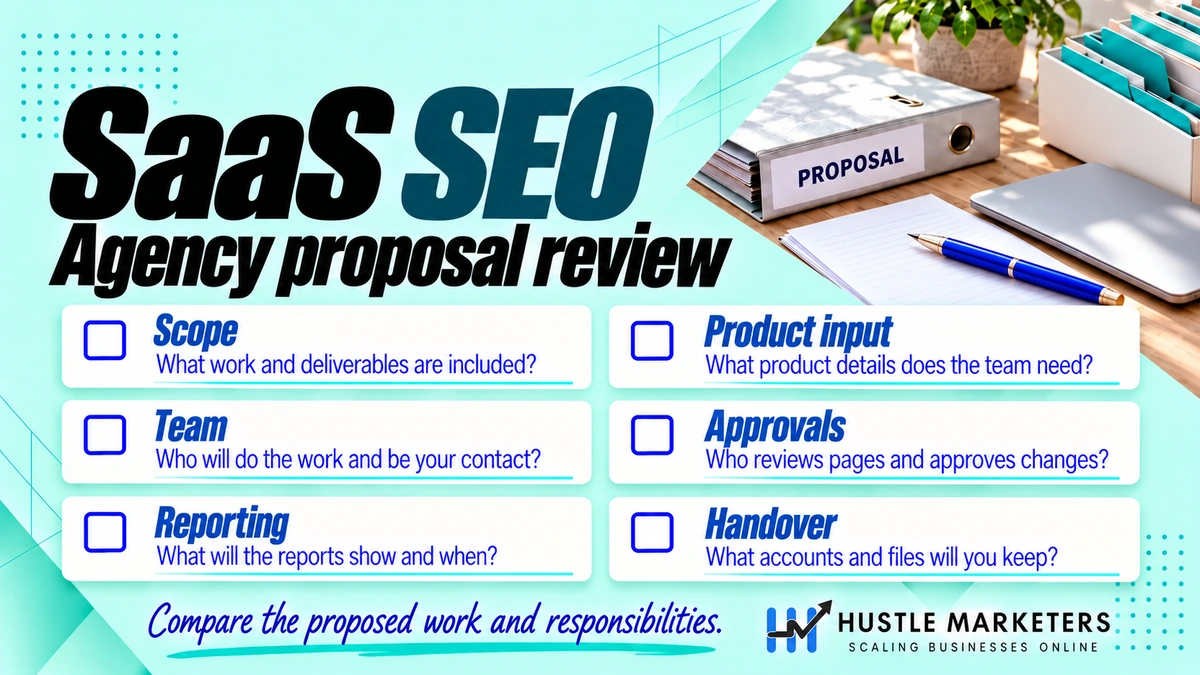
Google’s “Do you need an SEO?” guide suggests asking “Can you show me examples of your previous work and share some success stories?” It also suggests asking whether they follow the Google Search Essentials. Add these SaaS-specific questions:
- How will you decide which comparison and integration pages to build first?
- Who reviews competitor claims on comparison pages before they go live?
- How do you check that our JavaScript pages render and get indexed?
- How will you report trials, demos and pipeline from organic search?
- What is your approach to programmatic pages, and how do you test them?
- Who on our side needs to approve content, and how fast?
How do you score SaaS SEO agencies side by side?
| Criterion | Good sign | Warning sign |
|---|---|---|
| SaaS experience | Live comparison, integration and product-led pages to show | Only local or ecommerce samples |
| Plan | Written 90-day plan with named pages and fixes | “We’ll start with a big audit” and nothing dated |
| Reporting | Trials, demos and pipeline by page type | Rankings, traffic and domain authority only |
| Technical depth | Can explain rendering, noindex and migration risk on your stack | Plugin-level checks only |
| Ownership | You own content and every account | Agency-owned accounts or content licenses |
| Contract | Clear scope and notice period | Long lock-in with vague deliverables |
What are the red flags when hiring a SaaS SEO agency?
The main red flags are ranking guarantees, secret methods, link packages, mass AI-written pages, reports built only on traffic and rankings, and contracts that leave the agency owning your accounts or content. Google’s own hiring guide warns against several of these, which makes them easy to raise in a sales call.
- Ranking guarantees. Google says “No one can guarantee a #1 ranking on Google.”
- Secrecy. Google warns to be careful if a company “won’t clearly explain what they intend to do.”
- Required links back to the agency. Google says “You should never have to link to an SEO.”
- Bought links. Google’s spam policies list “Buying or selling links for ranking purposes” as link spam.
- Hundreds of thin pages in month one. Mass pages with no unique value fit Google’s description of scaled content abuse.
- Vanity reporting. Reports with no trials, demos or pipeline hide whether the work pays back.
- Agency-owned assets. If the agency owns your content or accounts, leaving costs you your history.
Founders on Indie Hackers report that generic guest posts and directory links wasted time, while problem-focused posts and internal links to feature pages helped. Ask any agency how much of its budget goes to each.
Should you hire an agency, a consultant or an in-house SEO?
A SaaS SEO agency fits when you need strategy, writers and technical help at once without building a team. A consultant fits when your team can execute and needs senior direction. An in-house SEO makes sense when organic search is a core channel and you can fund a full-time lead plus writers. Many teams combine an in-house owner with an agency.
| Option | Best for | Strengths | Trade-offs |
|---|---|---|---|
| SaaS SEO agency | Seed to growth stage teams without SEO staff | Strategy, content and technical skills in one contract | Needs product access and fast approvals to write well |
| Consultant | Teams with writers and developers already | Senior advice at lower total cost | Your team does the execution |
| In-house SEO | Companies where organic is a main channel | Deep product knowledge, close to engineering | Hiring time and cost; one person rarely covers every skill |
| Hybrid | Growth stage companies | In-house owner sets priorities; agency adds capacity | Needs clear ownership of each task |
For a broader B2B view, including longer buying committees outside SaaS, see our B2B SEO agency page.
How do SEO and Google Ads work together for SaaS?
SEO and Google Ads work together when they share keyword data, one conversion setup and one pipeline report. Paid search tests which terms produce trials and demos quickly, and SEO builds lasting pages for the terms that convert. Google Ads also offers a paid and organic report that shows both channels for the same queries.
The paid and organic report needs a linked Search Console account. Google suggests using it to find queries where you appear organically but have no ads, and to see how changes affect paid, organic and combined traffic. Google also states that paid spend does not affect organic rankings.
Here is how we connect the two channels:
- Test before you write. Run a small exact match campaign on a new keyword theme to see if it produces demos before you commit to a content cluster.
- Start exact, then open up. In our experience, broad match works best once an account already has conversion data, so new SaaS campaigns start on exact match.
- Build negatives upfront. When broad match runs, add a negative keyword list in phrase and exact match at account level from day one, covering terms like “jobs,” “careers” and “login.”
- Share search terms. Search terms reports reveal buyer wording that becomes headings and FAQ answers on SEO pages.
- Import pipeline outcomes. Google Ads accepts qualified leads and closed deals through offline conversion imports for up to 90 days after the click, or 63 days for enhanced conversions data.
For the paid side, read our guides to choosing a SaaS PPC agency, Google Ads agencies for SaaS and B2B PPC for pipeline.
How does AI search change SaaS SEO?
AI search changes where buyers first see your product, but not the foundations. Google says there are no extra requirements to appear in AI Overviews or AI Mode, beyond pages being indexed and eligible for a snippet. Clear comparison, integration and use-case pages also give AI answers specific facts to cite.
Google’s AI features guide says these features may use “query fan-out,” running several related searches across subtopics. For SaaS, those subtopics often include pricing, integrations, alternatives and fit for a team size. Pages that answer each one directly have more chances to be cited.
Google also says traffic from AI features is included in Search Console’s overall Web search data, so you cannot isolate it there. Use your self-reported attribution field and referral data from AI assistants to fill the gap. Our answer engine optimization services cover this work, and our free AI visibility checker gives you a starting view.
Why choose Hustle Marketers for SaaS SEO?
Hustle Marketers combines SEO with paid search experience, which suits SaaS teams that want both channels judged on pipeline. Founder Ishant Sharma has worked in Google Ads, Microsoft Ads and SEO since 2013. We plan SaaS SEO around trials, demos and revenue, and we report on the same pipeline for organic and paid search.
- Founded in 2020 by Ishant Sharma, with a delivery team in Zirakpur, India, serving clients worldwide.
- Partner status: Google Partner, Meta Business Partner and Microsoft Advertising Partner.
- Clear pricing: SEO from $500+ a month as a starting range that varies by business, with fuller programs scoped separately. PPC management is $600 to $800 per platform per month, month to month.
- You own everything: Search Console, GA4, content and ad accounts stay in your name.
- Reviews and awards: 591+ reviews across Google, Trustpilot, Clutch, G2, DesignRush, Upwork and other platforms, and Clutch Award wins in 2023, 2024 and 2026.
- Open tools: free marketing tools and open-source SEO and Google Ads code on GitHub.
Our client work is covered by signed NDAs, so we walk through our process on a call rather than share client names or results. See our SEO packages for scope options.
How we created this guide: we read the pages that rank for this topic, reviewed founder discussions on Indie Hackers, and checked every policy, price and limit against its source in October 2026. A person fact-checked the guide before publishing.
SaaS SEO agency FAQs
What is the best SaaS SEO agency?
There is no single best SaaS SEO agency. The right one depends on your stage, budget, category and whether you need content, technical work or both. Most “best agency” lists online are written by agencies that rank themselves first, so compare page samples, written plans, reporting and references instead of list positions.
Can AI replace a SaaS SEO agency?
AI tools can speed up research, outlines and drafts, but they do not replace strategy, product knowledge or fact-checking. Google’s spam policies name generating many pages with AI “without adding value” as scaled content abuse. A small team using AI with careful review can work well; unreviewed mass pages are a risk.
Is SEO worth it for an early-stage SaaS startup?
SEO is often worth starting early with a small scope: decision-stage comparison pages, a few product-led posts and clean technical setup. Results build over months, so it rarely fixes a short-term pipeline gap. Paid search can cover that gap while organic pages grow.
Should SaaS docs live on a subdomain or a subfolder?
Both setups can rank. What matters more is that docs are crawlable, linked from the main site, free of duplicate versions without canonicals, and connected to matching feature and integration pages. Pick the setup your engineering team can maintain and keep stable.
Who should own the content, Search Console and analytics?
Your company should own them. Content, Search Console, GA4, Google Ads accounts and the domain should sit in your company’s name, with the agency added as a user. That keeps your history and data if you change agencies.
Do SaaS SEO agencies still build backlinks?
Many do, through digital PR, original data, partner pages and integration listings. Buying links that pass ranking credit breaks Google’s link spam policy. Ask any agency where its links come from and whether any are paid.