Dental PPC: How to Run Google Ads for Dentists That Book Patients

Ishant
Published : October 26, 2026 at 12:30 pm
Updated : October 27, 2026 at 5:40 pm
Ishant
PPC for dentists is easy to switch on and easy to waste. Left alone, Google will spend your budget on job seekers, dental students and free care searches. This guide shows how we set up Google Ads for dentists so spend turns into booked appointments.
Summarize this article with:
Quick Answer: How do you run PPC for dentists that books patients?
Start with treatments people search for with urgency or high value: emergency care, new patient exams, implants and clear aligners. Give each its own Search campaign and landing page, target a realistic drive radius with the Presence setting, block job, school, free and DIY searches, and count booked appointments as conversions, not clicks.
Key Observations
- Dental clicks cost more than average. LocaliQ’s 2026 benchmarks put dental search at $8.00 per click and $72.97 per lead, against $5.42 and $66.69 across all industries.
- Dentists can run Local Services Ads. Google lists Dentist under Health Care in the US, but offers no lead credits for health care.
- Remarketing is limited. Google treats health, including surgical procedures, as sensitive, and does not support Customer Match or your data segments there.
- Booking forms carry HIPAA risk. HHS says a tracker that collects an email or reason for visit from a booking page can disclose protected health information.
What is dental PPC and where does it fit in marketing a dental office?
Dental PPC (pay per click) is advertising where a practice pays each time someone clicks its ad on Google, Bing or another platform. It reaches people who need a dentist this week, while SEO and your Google Business Profile build free visibility over months.
Related guides: local SEO for dentists, digital marketing for dentists, orthodontist Google Ads management and Google Ads for doctors.
Which dental treatments should you advertise first?
Start where searches are urgent or the case value is high, and where your practice can see the patient soon: emergency dentistry, new patient exams, implants and clear aligners. Cleanings, whitening and broad cosmetic terms can wait until tracking proves the first campaigns book patients.
| Treatment | What patients type | What the landing page needs |
|---|---|---|
| Emergency | emergency dentist near me, broken tooth same day | Same-day slots, hours, tap-to-call |
| New patients | dentist near me, dentist accepting new patients | Insurance accepted, first visit, online booking |
| Implants | dental implants near me, all on 4 dentist, implant cost | Consult booking, financing, implant training |
| Clear aligners | clear aligners near me, teeth straightening for adults | Price range, financing, number of visits |
In our view, start with the campaign your schedule can absorb. PPC for oral surgeons follows the same method around wisdom teeth, extractions and implants, with more weight on brand searches, since many patients arrive by referral.
How should you structure Google Ads for a dental practice?
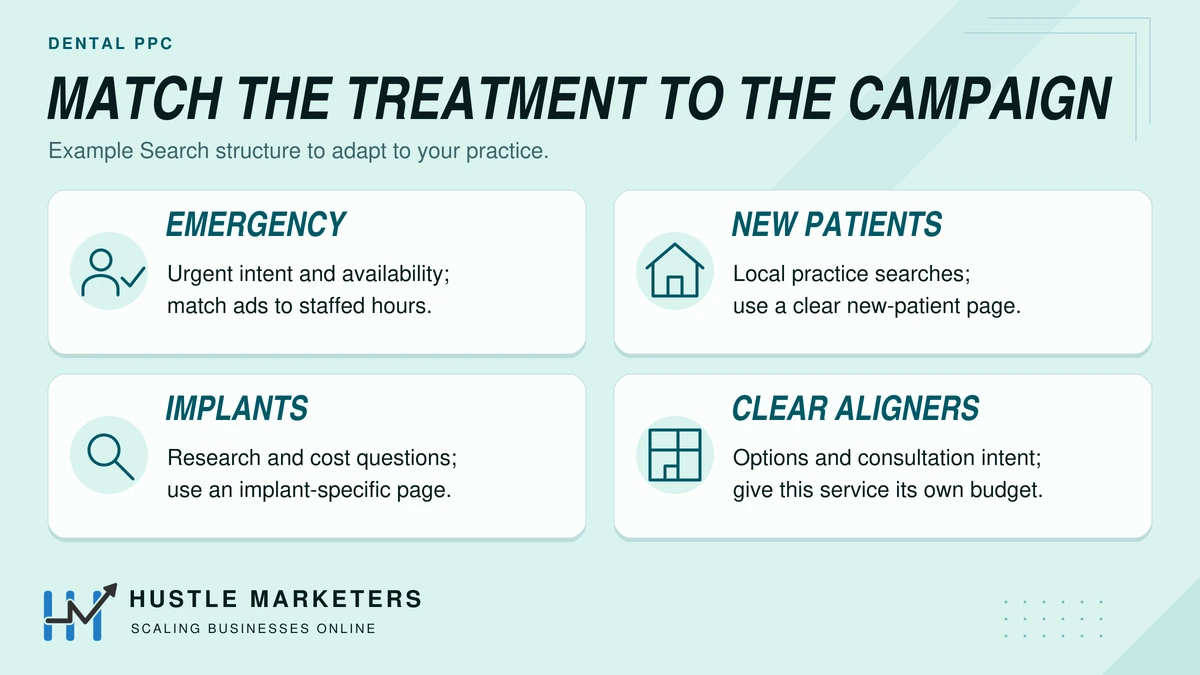
Give each treatment its own Search campaign with its own budget, keywords, ads and landing page, plus a small brand campaign for your practice name. Keep ad groups tight around how people phrase the need, and add Performance Max only after Search is tracking real bookings.
How do you split campaigns by treatment?
| Campaign | Example ad groups | Setting to watch |
|---|---|---|
| Brand | Practice name, dentist names | Low cost; protects your name |
| Emergency | Emergency dentist, tooth pain, open weekends | Ad schedule matched to staffed phone hours |
| New patients | Dentist near me, family dentist | Presence setting, tight radius |
| Implants | Dental implants, full arch, implant cost | Wider radius, longer wait before judging |
| Clear aligners | Clear aligners, aligner cost | Budget cap so it does not starve emergency |
If you turn on AI Max for Search, final URL expansion can send people to other pages, so add URL exclusions for careers and blog pages. In our experience, Performance Max should wait for a month of clean booking data, or it chases cheap form fills.
What location radius should a dental practice target?
Target the distance patients will drive for each treatment and set the location option to Presence, because the default, Presence or interest, can reach people who only showed interest in your area. Google’s minimum radius is 1 km.
| Treatment | Our starting radius |
|---|---|
| Emergency | 3 to 8 miles |
| General and new patient | 5 to 10 miles |
| Clear aligners | 10 to 15 miles |
| Implants and full arch | 15 to 30 miles |
Source: Google Ads Help on radius targeting and location options (accessed October 2026). Radius values are our suburban starting points, not Google rules. See our location targeting guide.
Which negative keywords should every dental account have?
Block the leaks in almost every dental search terms report: jobs, dental schools, free clinics, DIY fixes and insurance programs you do not accept. Put terms that are wrong everywhere in an account-level list, which Google applies across Search, Performance Max and other campaign types.
| Leak | Example negatives | Watch out for |
|---|---|---|
| Jobs | job, jobs, hiring, salary, dental assistant | Add singular and plural |
| Schools | dental school, university, course, residency | School clinics draw low-cost seekers |
| Free care | free dental clinic, free dentures, sliding scale | Skip bare “free” if you offer free consults |
| DIY | at home, diy, home remedy, kit | Review “how to” searches first |
| Insurance you do not take | medicaid, dental insurance plans | If you accept Medicaid, give it an ad group |
Google allows 1,000 account-level negatives, and negatives do not match close variants, so add “job” and “jobs” both. Our negative keywords guide covers match behavior.
Source: Google Ads Help, account-level negative keywords (accessed October 2026).
Which match types should a new dental account start with?
Start on exact match. Exact terms cost more per click, but the traffic matches the treatment you paid for. Broad match works once the account has conversion data, and when we open it up, the negative lists above go in first, in phrase and exact.
How do you write dental ads that pass Google’s healthcare policy?
Ordinary dental ads are not a restricted category under Google’s healthcare and medicines policy, which focuses on prescription drugs, pharmacies, unapproved substances, speculative treatments and health insurance. Dental accounts get into trouble in three places:
- Prescription drug terms: in the US you may use them in ads and landing pages, but you need certification to target them as keywords.
- Audiences: health is a sensitive category that includes surgical procedures, so Customer Match, your data segments and lookalike segments are not supported. Our reading: implant and oral surgery ads fall here. In-market segments remain available.
- Claims: ADA Code section 5.F bars advertising that is false or misleading in any material respect, and 5.H governs announcing a specialty. Avoid “best”, “painless” or guaranteed outcomes.
Good headlines are plain and true: “Same-Day Emergency Visits” if you hold slots open, “Most PPO Plans Accepted” if the front desk can confirm plans.
Source: Google Healthcare and medicines, Restricted drug terms and Health in personalized advertising (accessed October 2026); ADA Code of Ethics (revised October 2025).
Is your dental account paying for job seekers and free clinic searches? We review your search terms, negatives, location settings and match types, and show you where spend is leaking. Get Free Audit Worth $500
Should dentists run Local Services Ads, Search ads, or both?
Most practices that qualify should run both. Local Services Ads charge per lead and need no keywords, which suits broad new patient searches. Search ads give you control over treatments, wording and landing pages. Dentists have been eligible since early 2023, as Dental Economics reported.
| Question | Local Services Ads | Search ads |
|---|---|---|
| You pay for | Valid calls, messages and booking requests | Clicks |
| Targeting | Services and area, no keywords | Keywords, negatives, radius, schedule |
| Approval | Provider and practice checks, state licenses where applicable | Standard ad policies |
| Ranking | Bid, relevance, rating, reviews, response time | Bid, ad quality, landing page |
| Poor leads | No lead credits for health care | You block them with negatives |
Source: Google Local Services Help on US verification, how leads work and ranking; Google Ads Help on Ad Rank (accessed October 2026).
Google filters some invalid leads before charging, but with no lead credits or call recordings for US health care, a charged poor lead stays charged. Google says missed calls can hurt responsiveness, so answer every call. Our Local Services Ads guide covers setup.
Google is also moving Local Services Ads into a Performance Max campaign type with pay-per-lead goals, starting with US home services in August 2026 and remaining categories by 2027. Google’s page does not name dentists yet.
How do you track dental calls and bookings as conversions?
Track three things as primary conversions: calls from ads over a minimum length, website calls through a Google forwarding number, and completed online bookings. Then import which leads became booked or attended appointments, so Google bids toward patients rather than any phone call.
| Action | How it is tracked | Use as |
|---|---|---|
| Call from the ad | Call assets with a minimum call length | Primary |
| Website call after an ad click | Google forwarding number | Primary |
| Online booking completed | Google tag on the confirmation step, counted One | Primary |
| Booked or attended appointment | Offline conversion import | Primary once volume is steady |
| Tap on the phone number | Click only; the call itself is unseen | Secondary |
Primary actions feed bidding; secondary actions are for observation only. You set the minimum call length; we start at 60 seconds, because the shortest calls are often wrong numbers. Google’s AI-qualified call leads judge calls from recordings, but recording stays off by default for healthcare. Our conversion tracking guide and CRM tracking guide cover setup.
Source: Google Ads Help on call conversions, website calls, AI-qualified call leads, primary and secondary actions, counting and offline import (accessed October 2026).
What does HIPAA change about tracking dental bookings?
HHS guidance on online tracking says a tracker that collects an email or reason for visit from a booking page may disclose protected health information, and vendors receiving it generally need a business associate agreement. A court vacated the IP address part on June 20, 2024; our reading is that the booking form example stands.
Our rule: send Google only a “booking completed” event, never names or reasons for visit. Ask your compliance adviser before enabling call recording or enhanced conversions for leads, which sends hashed emails or phone numbers. This is not legal advice.
How much should a dental practice spend on Google Ads?
Plan two lines: ad spend paid to Google and a management fee. At LocaliQ’s 2026 dental average of $8.00 per click, one treatment campaign usually needs a few thousand dollars a month to judge. Hustle Marketers charges $600 to $800 per platform per month for management.
| 2026 search benchmark | Dentists and Dental Services | All industries |
|---|---|---|
| Average cost per click | $8.00 | $5.42 |
| Average click-through rate | 5.66% | 6.64% |
| Average conversion rate | 10.67% | 8.18% |
| Average cost per lead | $72.97 | $66.69 |
Source: LocaliQ, 2026 Search Advertising Benchmarks (last updated June 1, 2026). Averages from LocaliQ customer campaigns on Google Ads and Microsoft Ads. Your city and treatment mix will differ.
What does that mean for cost per booked patient?
Take $3,000 a month in ad spend. At $8.00 a click that buys 375 clicks and, at 10.67%, about 40 leads. If the front desk books half, that is 20 new patients at $150 each, or $180 to $190 with a $600 to $800 fee. This is an illustration, not a forecast: pull real click costs and monthly trends for your ZIP codes from Keyword Planner, and raise budgets in your busiest search months.
Our working rule: each campaign should afford at least 10 clicks a day, roughly $2,400 a month at $8.00, so $3,000 runs one or two campaigns well, not five. Try our Google Ads budget calculator and CPA calculator, or read how much Google Ads costs.
Our PPC management pricing guide explains fee models. We found no current ADA figure for overall dental marketing spend, so work back from what a new patient is worth.
Why are your dental ads not booking patients?
When dentist PPC brings clicks but not patients, the cause is usually tracking, call handling, traffic quality, landing pages, budget or match type. Check them in this order, because a tracking error hides every other problem:
- Wrong conversions. If page views or phone taps are primary, bidding chases the cheapest of them.
- Unanswered calls. Schedule call assets to staffed hours.
- Wrong traffic. Read search terms for jobs, schools, free care and other cities.
- Weak landing pages. Implant patients want prices and financing; emergency patients want a same-day answer.
- Thin budgets. Five campaigns on $2,000 a month means none gets enough clicks to learn.
- Broad match too early. Without conversion data it wanders; go back to exact match.
Getting calls but not booked patients? We check your conversion actions, call tracking, booking events and landing pages, and tell you what Google is really optimizing toward. Get Free Audit Worth $500
How do you choose a dental Google Ads agency?
Choose a dental Google Ads agency that gives you admin access to your own account, reports booked patients rather than clicks, and states its fee separately from ad spend. Ask on the first call:
- Who owns the account? It should be your practice’s.
- Is ad spend billed separately? Ask about any markup.
- What counts as a conversion? Calls over a set length and bookings, not clicks.
- How do you handle healthcare policy and HIPAA in tracking? Expect specifics.
- Who does the work, and where are they based?
Walk away from guaranteed patient numbers, click-only reports and lock-in contracts. See how we work on our Google Ads agency page.
Why choose Hustle Marketers and Ishant Sharma for dental PPC?
Hustle Marketers is run by Ishant Sharma, a Google Ads, Microsoft Ads and SEO specialist working in digital marketing since 2013. We charge $600 to $800 per platform per month, month to month with no lock-in, and ad spend is paid to Google directly. Our delivery team is in Zirakpur, India, and works with US clients remotely.
- Method: our dental PPC management uses treatment campaigns, exact match first, account-level negatives and booked-patient tracking.
- Partners: Google Partner, Meta Business Partner and Microsoft Advertising Partner.
- Reviews: 4.9 out of 5 from 591+ reviews across platforms, 5.0 on Clutch from 52 reviews, and Clutch Award wins in 2023, 2024 and 2026.
Client work is under NDA, so this guide shows method rather than naming practices. For a local account we can show, see our Google Ads rebuild for a Pennsylvania signage company or our case studies.
FAQs about PPC for dentists
How much does PPC for dentists cost per month?
Plan two lines. Ad spend depends on your city and treatments; at LocaliQ’s 2026 dental average of $8.00 per click, our 10-clicks-a-day rule puts one campaign at about $2,400 a month. Management is separate: Hustle Marketers charges $600 to $800 per platform per month, month to month.
What is a good cost per lead for dental Google Ads?
LocaliQ’s 2026 benchmarks show an average of $72.97 per lead for dentists and dental services. Treat that as a reference, not a target. A good cost per lead still gives you an affordable cost per booked patient after your front desk converts leads, so track bookings too.
How long does it take for dental Google Ads to book patients?
Calls can start in the first week once ads are approved, but judging a campaign takes longer. We look at one to two months of booked appointment data before big changes, and longer for implants, where patients often research for weeks before booking a consult.
Can dentists use remarketing in Google Ads?
Often not for treatment ads. Google treats health, including surgical procedures, as a sensitive category and does not support Customer Match, your data segments or lookalike segments for it. Our reading is that implant and oral surgery ads fall in this group. In-market segments are still supported.
Do dental Google Ads need to be HIPAA compliant?
The ads follow Google’s policies, but your tracking can raise HIPAA questions. HHS guidance says trackers that collect a patient’s email or reason for visit from a booking page may disclose protected health information. Send Google only a booking completed event and check call recording with your compliance adviser.
Who should own the Google Ads account when I hire an agency?
You should. Keep the account under your practice’s own Google Ads login, or get admin access if the agency sets it up, so history and conversion data stay with you if you switch. At Hustle Marketers the client owns the ad account and the contract is month to month.
How we created this guide
Ishant Sharma wrote this guide in October 2026 after reading the top US results for “ppc for dentists”, “dental ppc” and “google ads for dentists”. Policy points were checked against Google’s help pages, HHS tracking guidance and the ADA Code of Ethics; cost figures come from LocaliQ’s 2026 benchmarks.
Advice marked as our view, such as radius starting points and the 60-second call threshold, comes from Ishant’s Google Ads work, not from Google. Sources were last checked on October 22, 2026.
Want a second opinion on your dental Google Ads?
Give us read access to your Google Ads account and we will check your search terms, negatives, location settings, call and booking tracking, and budget split. You get a prioritized list of fixes. Get Free Audit Worth $500