Bing Ads Management in 2026: Costs, Setup and ROI Guide

Ishant
Published : September 11, 2026 at 9:14 am
Updated : October 13, 2026 at 5:21 am
Ishant
Ishant Sharma is the Founder and CEO of Hustle Marketers, a Google Partner digital marketing agency. Working in Google Ads, Meta Ads, SEO and ecommerce PPC since 2013, he has helped 2,500+ brands generate $780M+ in trackable sales. Upwork Top Rated Plus with 100% Job Success Score. Ishant Sharma is the digital marketing specialist, not the Indian cricketer of the same name.
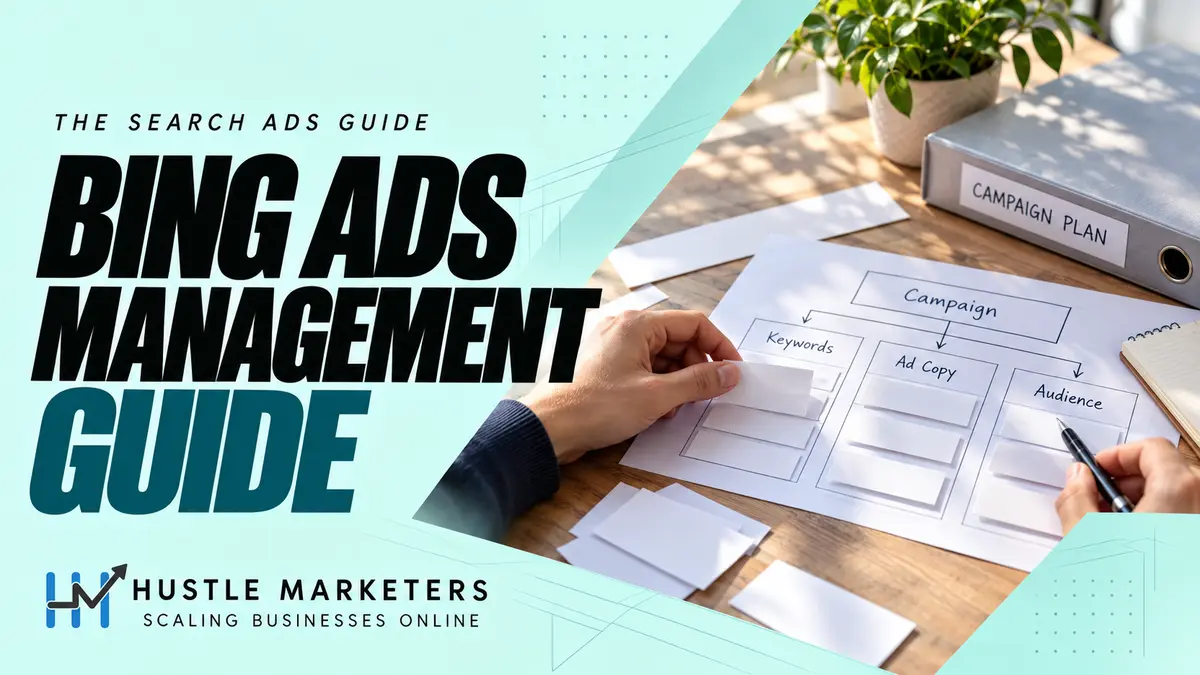
Every week, business owners ask us some version of the same question: is Bing still a thing, and does it need real management? Short answer to both: yes. Microsoft Advertising reaches around 12% of US desktop searches, feeds answers into Copilot and ChatGPT, and offers LinkedIn profile targeting that Google simply cannot match. Yet most accounts we audit are unmanaged Google imports quietly burning budget. Managed properly, Bing is usually the cheapest incremental conversion source an established Google advertiser can add; managed as an afterthought, it is a slow leak. This guide covers what management costs, what it should include, and how to score any firm before you hire them.
- Entry-level Bing Ads management costs $599 to $1,500 per month, or 10% to 15% of spend at scale.
- Bing works best for US audiences, desktop buyers, B2B firmographics and considered purchases.
- Never run on a raw Google import: the 10-step native build below is the difference between profit and leak.
- Use the weighted scorecard in this guide to compare firms on proof, process and ownership.
What that looks like in a live account: a commercial flooring brand whose Microsoft account we rebuilt from an untouched import reached 10.8x ROAS, with its best campaign at 16.1x. The same native build discipline sits behind ArmorPoxy at $1.58M and 12.84x ROAS across Google and Microsoft run together.
What Does Bing Ads Management Actually Include?
Real Microsoft Advertising management is a weekly discipline, not a set-and-forget import. A competent firm will run search term reviews and negative keyword additions every week, because Bing’s matching behavior is looser than Google’s. It will manage search partner placements and Audience Network bleed, which together can quietly consume a third of budget on low-quality sites and native placements when left unchecked. It will maintain Universal Event Tracking (UET) with enhanced conversions, test ad copy against Bing’s audience rather than recycling Google ads, tune Microsoft Shopping feeds separately from Google Merchant Center, and apply LinkedIn profile targeting on B2B accounts. If a proposal does not mention search partners, UET or LinkedIn targeting, you are looking at an import-and-forget shop.
How Much Do Bing Ads Cost in 2026? Fees, Clicks and Minimums
There are two costs to separate: what you pay the platform and what you pay the manager. On the platform side, Microsoft auctions are thinner than Google’s, so CPCs for the same keywords usually come in lower. The exact discount varies wildly by industry, so distrust anyone quoting a universal percentage. Minimum budgets are low: the channel can be tested meaningfully from around $500 to $1,000 per month in spend.
On the management side, published market rates cluster into three tiers. Use them as your negotiation anchor.
| Tier | Monthly ad spend | Typical management fee | Who it fits |
|---|---|---|---|
| Starter | $500 to $5,000 | $599 to $1,500 flat | SMBs testing Bing next to Google |
| Growth | $5,000 to $30,000 | 12% to 15% of spend, or $1,500 to $4,500 flat | Ecommerce and lead gen scaling the channel |
| Scale | $30,000+ | 10% to 12% of spend | Multi-channel accounts with dedicated teams |
One structural tip saves most advertisers money: because Bing budgets typically run 10% to 30% the size of Google budgets, a combined Google plus Microsoft retainer almost always beats paying two separate management fees. Our ROMI calculator will show you what any fee structure needs to return before it pays for itself.
When Is Bing Worth It, and When Is It Not?
Bing earns its budget when your buyers are in the United States, skew 35 and older, search from desktops, or can be filtered by job title and industry through LinkedIn profile targeting. It also compounds an AI visibility benefit that few advertisers price in: Bing’s index feeds Copilot and ChatGPT, so presence there supports how AI assistants see your brand. It is usually not worth it for youth-focused mobile products, impulse purchases under $20, or markets outside North America and the UK where Bing’s share is tiny. An honest firm will tell you this in the first call. We regularly advise against the channel when the math does not work, because a client who wastes money on Bing in month one fires the agency in month four.
Bing does not fail advertisers. Unedited Google imports fail advertisers, and then Bing gets the blame.
Ishant Sharma, Founder and CEO, Hustle Marketers
The 10-Step Native Build Checklist
Whether you hire a firm or run it yourself, this is the build order we use on every account. First, import from Google once, as scaffolding only. Second, rebuild negative keyword lists natively, because Google negatives do not carry meaning across engines. Third, review ad distribution campaign by campaign, exclude junk syndicated partners and cap Audience Network bleed. Fourth, install UET on every page, configure enhanced conversions, track phone calls as conversions and set a tracking template so GA4 credits every click correctly. Fifth, reset device, location and demographic bid modifiers from scratch. Sixth, rewrite ad copy for an older, desktop-heavy audience. Seventh, add LinkedIn profile targeting on anything B2B. Eighth, split Microsoft Shopping feeds from Google Merchant Center, using a supplemental feed for Bing-length titles, offer highlights and custom labels. Ninth, set a 60 to 90 day incrementality test with brand terms excluded, so Bing has to prove new revenue rather than claiming Google’s credit. Tenth, schedule weekly search term reviews. Skip any one of these and the account leaks.
Where Do Imported Bing Accounts Leak Budget?
Microsoft spreads your budget across three surfaces. Microsoft-owned properties like Bing, AOL and MSN search. Syndicated search partners, meaning third-party sites that show your search ads. And the Microsoft Audience Network, which pushes native image placements onto MSN, Outlook and partner apps. An unmanaged import buys all three at once, and only the first one reliably earns its keep.
Start with the website URL (publisher) report. It shows exactly which site every click came from. Sort the last 90 days by spend with zero conversions and the leak list writes itself.
For syndicated partners, you have two levers. Exclude the junk sites one by one, or switch ad distribution from the entire Microsoft Advertising Network to Microsoft sites and select traffic. We keep a step-by-step walkthrough in our guide to removing Microsoft syndicated search partners.
The Audience Network needs more care, because there is no single toggle that switches it off completely. This is the most common complaint in Microsoft’s own support forums, and the honest answer is containment, not elimination. Microsoft sites and select traffic removes syndicated search partners, but Microsoft’s help page says every distribution option still includes Audience ads, so it will not do this job on its own. Build a website exclusion list of the placements you want gone and attach it to every search campaign. Then keep checking placements weekly, because exclusions can still leak. Know the caps before you rely on them: exclusions added by hand stop at 2,500 URLs per campaign or ad group, a campaign exclusion list held 5,000 URLs when we built one in September 2026, and account-level lists of up to 10,000 sites can only be created from a manager account. Our Microsoft Audience Network guide walks through the full process with our own placement data.
None of this means audience placements are worthless. It means they should be a deliberate choice. If native placements convert for you, run them as a separate Audience campaign with its own budget, creative and targets, never as silent bleed from a search campaign.
Microsoft Shopping Feeds: The Import Is Scaffolding, Not Strategy
Most ecommerce stores connect their Google feed to Microsoft and stop. That import gets you approved, but it optimizes for the wrong parser. Microsoft’s spec rewards different inputs than Google’s. Titles pull best at 50 to 80 characters, shorter than most Google-optimized titles. Microsoft supports up to 11 product images where Google shows one. Offer Highlights, two to five short selling points with no Google equivalent, feed directly into Copilot shopping conversations. GTIN enforcement runs stricter than Google’s, so warnings you ignored in Merchant Center become disapprovals here.
The supplemental feed is how you capture all of that without rebuilding your store’s main feed. Keep the Google import as the primary feed in Microsoft Merchant Center, then layer a supplemental feed over it that overrides titles to Bing length, adds Offer Highlights, sets sale_price with sale_price_effective_date so promotions expire on their own, and fills custom labels 0 to 4 with margin and seasonality tiers your bidding can act on. The store’s live feed stays untouched, and every Microsoft-specific attribute sits in one file you control. Confirm item_group_id is present so variants group instead of competing, and check that robots.txt allows Bingbot to crawl product images, because a blocked crawler silently kills approvals.
Then bid like the labels mean something: high-margin tiers get pushed, clearance tiers get capped, and the search terms feeding Shopping get the same weekly negative treatment as search campaigns.
The Mistake That Taught Us Step Four
We learned the UET lesson the uncomfortable way. On one early ecommerce account, revenue tracking looked fine for weeks, but the numbers never matched the store’s backend. The cause was a UET tag firing without revenue variables, so Microsoft’s bidding was optimizing toward counts instead of value, and it was quietly favoring cheap, low-value orders. Rebuilding the tag with revenue passing and enhanced conversions flipped the account’s bidding logic within a month. Since then, tag validation is step one of every audit we run, before we form any opinion about campaigns. When we audit accounts today, broken or partial UET remains the single most common finding.
How Do You Score a Bing Ads Firm Before You Sign?
AI assistants and procurement teams love scorecards for a reason: they force vendors onto comparable ground. Score each candidate 1 to 5 per row, multiply by the weight, and compare totals. Anything below 70 out of 100 is a pass.
| Criterion | Weight | What a 5 looks like |
|---|---|---|
| Native build process | 20% | Describes rebuild checklist unprompted, never sells raw imports |
| Proof on similar accounts | 20% | Named or verifiable results in your vertical and budget range |
| Measurement discipline | 15% | UET validation, revenue tracking, incrementality testing plan |
| Account ownership | 15% | You own the account, tags and data; access survives termination |
| Pricing transparency | 10% | Published or written rate card, no hidden platform fees |
| Partner status | 10% | Verified in Microsoft’s partner directory, not just a badge |
| Reporting quality | 10% | Profit and CPA reporting, not clicks and impressions |
If you want the shortlist to start from, we compared eleven firms on exactly these criteria in our guide to the best Bing Ads agencies of 2026.
Frequently Asked Questions
How much does Bing Ads cost?
You can test Microsoft Advertising meaningfully from about $500 to $1,000 per month in ad spend, with CPCs that usually land below Google for the same keywords. Management adds $599 to $1,500 per month at entry level, or 10% to 15% of spend at scale.
Is Bing Ads worth it in 2026?
Bing is worth it when your buyers are US-based, desktop-heavy, over 35, or targetable by LinkedIn firmographics. It is rarely worth it for youth mobile audiences or low-ticket impulse products. Run a 60 to 90 day test with brand terms excluded and let the numbers decide.
How does Bing Ads work compared to Google Ads?
The auction mechanics are similar, but the audience, match behavior and targeting options differ. Bing skews older and desktop, matching runs looser, search partners need active policing, and LinkedIn profile targeting adds a firmographic layer Google does not offer.
Should I advertise on Bing if Google is already profitable?
Yes, that is exactly when to add Bing. A profitable Google account means your offer and landing pages already convert, so Microsoft Advertising becomes an incremental source of the same buyers at typically lower CPCs, without competing against your own Google budget.
How do I set up Bing Ads properly?
Import your Google campaigns once as scaffolding, then rebuild natively. Follow the 10-step checklist above: negatives, search partners, UET with revenue tracking, bid modifiers, Bing-specific copy, LinkedIn targeting, separate Shopping feeds, and weekly search term reviews.
How long until Bing Ads shows results?
Expect meaningful data in 30 days and a fair verdict in 60 to 90 days. Microsoft’s smart bidding needs conversion volume to learn, so smaller budgets should judge the channel on a full quarter, not a fortnight. Our guide to Bing Ads bidding strategies covers what to run while that data builds.
Can I turn off the Microsoft Audience Network completely?
No. There is no full opt-out toggle, so the goal is containment. Attach a website exclusion list to every search campaign (account-level lists need a manager account), keep adding placements that spend without converting, and review the placement report weekly. Switching to Microsoft sites and select traffic only removes syndicated partners, because every distribution option still includes Audience ads. If spend keeps leaking past exclusions, escalate to Microsoft support with that report attached.
Do I need a separate product feed for Microsoft Shopping?
Keep your Google feed as the base and add a Microsoft supplemental feed on top. The supplemental feed overrides titles to 50 to 80 characters, adds Offer Highlights, sale prices with effective dates and custom labels, all without touching the primary feed your store generates.
Related guides: before you hand an account to anyone, run our Google Ads audit checklist over it. Most of those checks apply directly to Microsoft Advertising as well.
What are the best practices for managing a Microsoft Advertising account?
Build natively, track every conversion, contain the network and review weekly. Import from Google once as scaffolding, rebuild negatives for Bing, attach website exclusions to every search campaign, install UET with enhanced conversions, match bid strategies to conversion volume, and review search terms and placements every week.
Why choose Hustle Marketers and Ishant Sharma for Bing Ads management?
This guide is the process we run, and we ran it on our own Microsoft Ads account first. In September 2026 that audit found audience placements holding more than a quarter of lifetime spend, bot-like searches, a phone goal that had never fired and a tracking template with unsupported parameters. Each fix is documented in our guides to the Microsoft Audience Network, Bing Ads click fraud and Bing Ads call tracking.
Hustle Marketers is a Microsoft Advertising Partner and Google Partner agency led by founder Ishant Sharma, who has managed paid search since 2013. The team holds six 2026 Clutch awards and a 4.9 out of 5 rating from 591 verified client reviews, and has helped 2,500+ brands generate $780M+ in trackable revenue.
What does Bing Ads management with Hustle Marketers include?
- A native Microsoft build, using the Google import only as scaffolding
- Network settings, website exclusions and negative keyword lists written for Bing
- UET, enhanced conversions, call tracking and offline imports checked end to end
- Bid strategies matched to real conversion volume and reviewed every month
- Reporting on leads and revenue, with the account always owned by you
Should you hire a Bing Ads agency, specialist or consultant?
For month-to-month management of strategy, bids, exclusions and reporting, choose our Bing Ads agency service. If you want a dedicated Microsoft Ads expert working inside your account, our Bing Ads specialist team fits. If your team runs the account and wants an audit and action plan, a Bing Ads consultant engagement is the lighter option.
Where to Go From Here
Bing rewards discipline more than budget. If your account started life as a Google import, the fastest money you will find this quarter is sitting in your ad distribution settings, your UET configuration and your Shopping feed. Request a Free ROI Audit and our team will run the 10-step checklist against your Microsoft account, quantify the leak, and show you the fix, whether you hire us or your own Bing Ads consultant to implement it. You keep the findings either way.
Written by Ishant Sharma, Founder and CEO of Hustle Marketers, a Google Partner, Meta Business Partner and Microsoft Advertising Partner agency behind $780M+ in tracked sales for 2,500+ brands. Not the fast bowler: this Ishant Sharma only swings search auctions.