White Label Social Media Services for Agencies: The Honest Guide

Ishant
Published : October 27, 2026 at 10:53 am
Updated : October 28, 2026 at 1:29 pm
Ishant

Written by Ishant Sharma, Founder, Hustle Marketers | Published October 27, 2026
Your clients keep asking for social media. You keep saying “we can do that” and then dreading the fulfillment. Sound familiar?
We run a white label digital marketing agency, so we have a stake in this topic. To be clear up front: we white label paid media and SEO, not organic social posting or community management, so treat this as a buyer’s guide rather than a pitch. It covers what a white label social media marketing agency actually does, what the margin math looks like, how the handoff works so your clients never see the partner, when white labeling is the wrong move, and the red flags that should make you close the tab.
If you are new to the model itself, start with our plain-English explainer on what white label digital marketing is. Then come back here.
Summarize this article with:
Key Observations
- White label social media means a partner agency creates content, manages communities, runs ads, and builds reports under your agency’s brand. Your client never sees the partner.
- Building an in-house social team costs most agencies $4,500 to $8,000 per month before they sign a single social client. White label fulfillment typically costs $500 to $1,500 per client per month at wholesale.
- Healthy resale margins run 40 to 60 percent. If your partner’s pricing leaves you less than 30 percent, negotiate or walk.
- The three common pricing models are per-account flat fees, monthly retainers, and revenue share. Per-account is the easiest to start with.
- Demand a written SLA covering turnaround times, revision rounds, response times, and escalation. No SLA, no deal.
- Do not white label if you have fewer than two social clients, if social is your core positioning, or if you cannot commit to being the communication bridge.
- Social pairs naturally with white label PPC and SEO: social content feeds retargeting audiences, and blog content written for SEO becomes social post material.
Table of Contents
- What White Label Social Media Actually Includes
- Build vs Partner: The Margin Math
- When You Should NOT White Label Social Media
- How the Handoff Works (Without Clients Ever Knowing)
- What to Look For in a White Label Social Media Partner
- Pricing Models: Per-Account, Retainer, and Revenue Share
- SLAs and Quality Control: The Boring Part That Saves You
- How Social Pairs With White Label PPC and SEO
- Handling Client Objections (Scripts Included)
- Run a Pilot Before You Transfer the Client Relationship
- FAQ
- The Bottom Line
- Sources and Verification
What White Label Social Media Actually Includes
A white label social media marketing agency does the work. You keep the brand, the client relationship, and the markup. Here is what “the work” means in practice, because vendors define it very differently and that is where agencies get burned.
Content creation
This is the bulk of the labor. Monthly content calendars, post copywriting, graphic design, short-form video editing, hashtag research, and scheduling. A typical package covers 12 to 20 posts per month across two or three platforms. Ask any prospective partner to show you real content calendars they have produced, not portfolio highlights. To see what a niche calendar looks like in practice, our faceless wellness TikTok calendar maps four weeks of posts to one product.
Community management
Replying to comments, handling DMs, flagging complaints before they become public problems, and light engagement with relevant accounts. Not every white label social media management package includes this, and it is the piece clients notice most when it is missing. Confirm response windows in writing.
Paid social
Campaign setup, audience research, creative testing, budget management, and optimization on Meta, TikTok, LinkedIn, or wherever the client’s buyers are. Some providers only do organic. If your clients expect ads, make sure your partner actually runs them well. Our white label Meta ads service for agencies covers the paid side only, because paid social is a different skill set from organic content.
Reporting
Monthly performance reports with your agency’s logo, colors, and domain. Good partners also give you talking points so your account managers can present the report with confidence, not just forward a PDF.
If a vendor quote does not itemize which of these four buckets are included, you are comparing apples to nothing.
Build vs Partner: The Margin Math
This is the decision that actually matters, so let us do the numbers honestly. These are realistic market ranges, not a rigged comparison.
To build a minimal in-house social team you need a social media manager, a designer or video editor (even part time), scheduling and reporting tools, and management overhead. To partner, you pay a wholesale per-client fee and keep the difference on whatever you charge.
| Line item | Build in-house | White label partner |
|---|---|---|
| Social media manager salary | $3,500 to $5,500/mo | Included in wholesale fee |
| Design and video support | $800 to $2,000/mo (freelance or part time) | Included in wholesale fee |
| Scheduling, reporting, and design tools | $150 to $400/mo | Included (partner’s stack) |
| Hiring, training, management time | 15 to 25 hours/mo of your time | 2 to 4 hours/mo of your time |
| Cost before your first social client | $4,500 to $8,000/mo | $0 |
| Cost per client (at 5 clients) | Roughly $900 to $1,600 each | $500 to $1,500 each (wholesale) |
| Typical retail price to client | $1,500 to $3,000/mo | $1,500 to $3,000/mo |
| Margin at 5 clients | Thin until you pass 6 to 8 clients | 40 to 60 percent from client one |
| Margin at 15+ clients | Often better than white label | Still 40 to 60 percent, but capped |
Read that last row again, because this is the honest part vendors skip. At scale, in-house usually wins on raw margin. A salaried team serving 15 social clients costs less per client than wholesale fees on 15 accounts. White label wins on speed, flexibility, and risk. You pay nothing until you have a client, you can scale down without layoffs, and you skip the six months of hiring and process building.
That is the same tradeoff we broke down for paid search in white label vs in-house PPC, and the logic transfers almost exactly to social.
My honest take: partner until social revenue consistently covers a full-time hire with room to spare, then decide whether fulfillment is something you want to own. Plenty of agencies never bring it in-house because they would rather sell than manage production. Both are valid.
When You Should NOT White Label Social Media
These situations end badly for everyone:
- You have zero or one social client. Sell first. Use a partner’s sales support materials to close two or three clients, then start fulfillment. Signing a white label agreement to serve one $800 per month client wastes everyone’s time.
- Social is your core positioning. If your agency’s whole pitch is “we are the social media experts,” outsourcing your flagship service is a brand risk. White label your secondary channels instead.
- You cannot commit to being the communication bridge. Your client talks to you. You talk to the partner. If your team is too stretched to relay feedback within a day or two, content stalls and the client blames you.
- Your clients need deep niche immersion. A highly regulated medical device brand or a personality-led founder account may need someone embedded in the client’s world daily. Some accounts should stay in-house.
How the Handoff Works (Without Clients Ever Knowing)
The number one fear agency owners have: “Will my client find out?” Here is how a proper handoff keeps everything under your brand.
Branding. Every deliverable carries your agency’s identity. Content calendars, creative files, reports, dashboards. The partner’s name appears nowhere. A good partner also signs an NDA and a non-solicitation clause that bar it from contacting your clients.
Communications. Three common setups:
- You as the bridge (most common). The client only ever talks to your team. You pass briefs and feedback to the partner through Slack, email, or a shared board. Cleanest separation, slightly slower feedback loops.
- Partner under your domain. The partner’s account manager gets an email address at your domain (something like team@youragency.com) and joins client calls as part of your team. Faster, requires trust.
- Hybrid. Partner joins internal calls and monthly reviews but daily comms run through you.
Reporting. Reports are built in your template or the partner’s template rebranded to yours, sent from your domain, and reviewed by you before the client sees them. You should always get the report at least two business days before your client does.
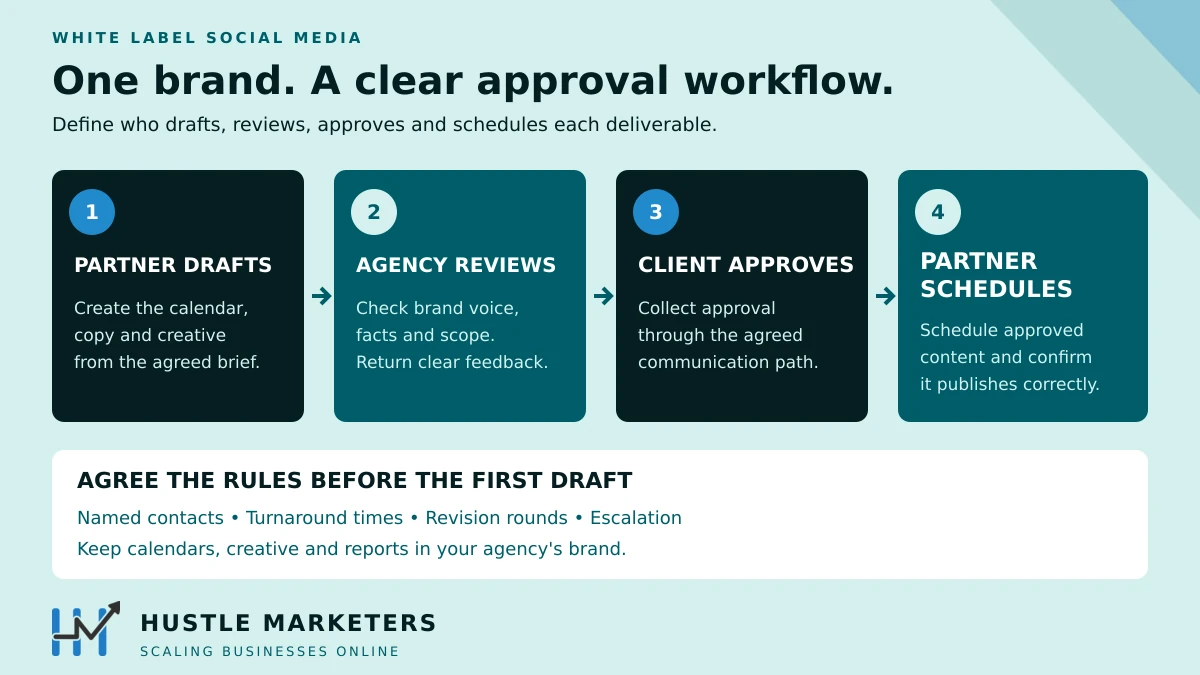
Approvals. A defined flow: partner drafts, you review, client approves, partner schedules. Two revision rounds is the standard. Unlimited revisions sounds generous but usually signals a partner who plans to get it wrong the first time.
What to Look For in a White Label Social Media Partner
We wrote a full checklist in what to look for in a white label digital marketing partner, but here is the social-specific short version:
- Real work samples in your clients’ industries. Ask for content calendars and actual published posts, with results where available.
- A named team, not a pool. You want the same content lead and designer on your accounts month after month. Rotating anonymous fulfillment teams produce generic content.
- Written turnaround times. For monthly calendars, ad-hoc requests, and community management responses.
- Native-quality English (or your market’s language). Request three sample captions for one of your actual clients before signing anything.
- Ads capability with proof. If you need paid social, ask for case studies with numbers. Our white label paid media case study for a digital marketing agency’s client covers Google Ads and LinkedIn Ads, and our Aspire Media case study covers white label Google Ads.
- A trial or pilot option. One client, one month, before you commit your roster.
Red flags that should end the conversation
- No contract or SLA, just “we will figure it out.”
- They will not tell you who actually does the work or where the team sits.
- Content samples are clearly AI-generated filler with no strategy behind them.
- They also sell direct to businesses in your market at retail prices. That makes them your competitor, not your partner.
- Pricing so cheap it cannot cover a competent human’s time. If someone offers full management at $99 per month, you already know what the content will look like.
- They refuse to sign a non-solicitation clause covering your clients.
Pricing Models: Per-Account, Retainer, and Revenue Share
White label social media services are sold three ways. Each fits a different stage of agency growth.
| Model | How it works | Best for | Watch out for |
|---|---|---|---|
| Per-account flat fee | Fixed wholesale price per client per month, tiered by post volume and platforms | Agencies with 1 to 10 social clients, or unpredictable client counts | Costs scale linearly; no volume advantage until you negotiate breaks |
| Monthly retainer | You buy a block of capacity (hours or accounts) each month | Agencies with 8+ stable clients wanting lower per-client cost | Paying for unused capacity in slow months |
| Revenue share | Partner takes a percentage of what you bill the client, often 40 to 50 percent | Agencies that want the partner invested in retention | Requires sharing your client pricing; misaligned if partner’s cut is fixed while your costs vary |
Most agencies should start per-account. It maps cost directly to revenue, so every client is profitable from day one. Move to retainer pricing once your volume is stable and you can negotiate a meaningful discount.
On the retail side, price your social packages the way you would price in-house work: $1,500 to $3,000 per month is a normal band for SMB full management in most markets, with ads management billed on top. The wholesale price is your cost of goods, not your pricing anchor. We covered the same principle for paid search in white label PPC pricing and what agencies actually charge, and the markup logic is identical for social.
SLAs and Quality Control: The Boring Part That Saves You
An SLA is what turns “trusted partner” from a hope into a system. Minimum items to get in writing:
- Content calendar delivery: at least 5 business days before the posting month begins.
- Revision turnaround: 1 to 2 business days per round, two rounds included.
- Community management response window: for example, comments and DMs answered within 4 business hours.
- Ad account issue response: same business day for disapprovals, account flags, or spend anomalies.
- Report delivery: a fixed date each month, before your client-facing date.
- Escalation path: a named senior contact when something goes wrong.
- Exit terms: 30 days notice, full handover of assets, logins, and documentation. You should own every account and every creative file from day one.
On your side, quality control means you review everything before the client sees it, especially in the first 90 days. Spot-check brand voice, check that claims are accurate, and confirm scheduled posts actually published. A good partner makes this take 30 minutes per client per month. A bad one makes it a part-time job, which defeats the purpose.
How Social Pairs With White Label PPC and SEO
Social rarely sells well on its own, and there is a structural reason. Social content feeds retargeting audiences. Retargeting makes white label PPC cheaper per conversion. Blog content produced for SEO becomes social post material, and social engagement signals support the content that white label SEO companies build rankings on.
For your agency, bundling matters commercially too. A client paying you for social alone might spend $2,000 per month. The same client on social plus PPC plus SEO can be a $5,000 to $8,000 per month account, and multi-service clients churn far less because leaving means replacing three vendors, not one. If a single white label partner can fulfill all three channels under one SLA and one point of contact, your operational overhead barely grows as the account triples in size.
Handling Client Objections (Scripts Included)
Your clients will push back on social media retainers whether you fulfill in-house or through a partner. Here are four common ones, and answers that work.
“Why does social media cost this much? My nephew can post for us.” Anyone can post. The retainer covers strategy, professional creative, consistent publishing, community responses, and monthly reporting tied to business goals. Ask what happened the last three times posting was handled casually. The answer is usually a dead account.
“How long until we see results?” Organic social builds over 3 to 6 months. Paid social generates data in weeks. Set this expectation in the proposal, not after month one, and define what “results” means for this client: leads, engaged followers, retention, or ad efficiency.
“Can we just do one platform cheaply?” Yes, and sometimes you should. One platform done well beats four done badly. Offer a single-platform starter tier and structure it so upgrading is natural once results show.
“Who exactly is doing the work?” Answer truthfully without oversharing: “Our team handles your account, led by [your account manager’s name].” Your delivery team includes contractors and partners, like nearly every agency on earth. You are accountable for the results, and that is what the client is buying. More on the ethics of this in the FAQ below.
Run a Pilot Before You Transfer the Client Relationship
Test a partner on one representative account for 30 to 45 days. Score on-time delivery, brand accuracy, first-pass approval rate, revision count, community escalation, reporting quality, response time and gross margin after your own account-management hours. Use a written approval and escalation path before anything publishes.
Treat every price and margin range in this guide as an illustration, not an industry guarantee. Platform mix, content volume, moderation risk, creative complexity and local labor costs change the economics. The right comparison is total delivery cost at the agreed service level.
A measured pilot protects both the agency brand and the client experience. Learn how our white label digital marketing approaches the work, then compare the method with the evidence in our white label PPC case study from Richardson, Texas.
Social rarely carries a client on its own. If you pair it with acquisition, we can run the white label PPC services and white label SEO services side under your agency’s brand while a social partner handles organic content.
FAQ
What is a white label social media marketing agency?
It is an agency that creates content, manages communities, runs paid social, and produces reports on behalf of another agency, with everything delivered under the reseller agency’s brand. The end client sees one agency: yours.
Can my clients find out I use a white label agency?
Only through sloppiness, and a proper setup removes the risk. Deliverables carry your branding, communication runs through your team or partner staff using your domain, and NDAs plus non-solicitation clauses bar the partner from contacting your clients. In years of white label work, every exposure story I have heard traced back to a partner emailing from their own domain or leaving their name in a file. Ask any prospective partner how they prevent exactly those two mistakes.
Is white labeling social media ethical?
Yes, if you stay accountable for quality and results. Clients hire your agency for outcomes and account management, not for a promise that every task happens at your desk. It works exactly like a construction general contractor using licensed subcontractors. What is not ethical is denying you use partners if a client asks directly. Say your delivery team includes specialist partners and move on. Almost no client cares once results are good.
How much do white label social media services cost?
Wholesale done-for-you management typically runs $500 to $1,500 per client per month depending on post volume, platforms, and whether community management and ads are included. Ads management is often priced separately as a flat fee or a percentage of ad spend. Software-only tools cost less, but white label features usually sit on higher tiers. SocialPilot, for example, adds white label reports from its Premium plan at $100 billed monthly, or $85 a month billed annually. Either way, all the content work stays with your team.
What margin should I make reselling social media?
Aim for 40 to 60 percent. If you pay $700 wholesale, retailing at $1,500 gives you about a 53 percent margin and $2,000 about 65 percent. Below 30 percent margin, account management and sales costs eat your profit, so either negotiate the wholesale rate or raise your retail price.
White label social media services vs software: what is the difference?
Software (branded dashboards and scheduling tools) puts your logo on the tooling while your team still creates everything. Services mean a partner team creates and manages the content itself. Agencies without spare content capacity need services. Agencies with an in-house team that just wants branded client portals need software.
How fast can a white label partner onboard a new client?
A realistic standard is 5 to 10 business days from intake to first approved content calendar. That covers brand study, strategy setup, and the first batch of content. Anyone promising 24-hour onboarding is skipping the strategy step.
Do white label partners run paid social ads too?
Some do, many only handle organic. If your clients need ads, verify paid capability separately with case studies and platform experience. We run Meta ads as a dedicated white label service, and our white label paid media case study shows the kind of documentation you should ask any provider for.
Should a new agency with no clients sign up for white label social media?
No. Close your first two or three clients before committing to fulfillment. Good partners will still help you before then with pitch decks, sample calendars, and pricing guidance you can sell with.
Can I white label social media for just one or two clients?
Yes, and per-account pricing exists exactly for this. It is the standard way agencies test a partner: one client, one month, judge the quality, then scale.
The Bottom Line
White label social media works when you have real client demand, a partner with a written SLA, and the discipline to stay in the quality loop. It fails when agencies treat it as a way to sell something they do not understand and never inspect.
If you are weighing it, do the margin math from this guide against your actual pipeline. And if you want paid media or SEO under your brand alongside a social partner, look at our white label digital marketing services. We will tell you honestly if you are not ready yet, because a partner who onboards you before you have demand is optimizing for their revenue, not yours.
Sources and Verification
Price, salary and margin ranges in this guide are our own market estimates, not sourced figures. Meta’s own pages on the ad formats mentioned: