Healthcare PPC: How to Run Google and Microsoft Ads for Healthcare Within the Rules

Ishant
Published : October 27, 2026 at 12:30 pm
Updated : October 27, 2026 at 5:40 pm
Ishant

Summarize this article with:
Quick Answer: How do you run healthcare PPC within the rules?
Healthcare PPC means paying for Google and Microsoft search ads that reach people looking for care. To stay within the rules, confirm whether your service needs certification first (telehealth prescribing, online pharmacy, addiction treatment, health insurance), drop remarketing and Customer Match for health condition promotions, keep patient details out of every tag, and judge results by cost per booked patient.
Key Observations
- Certification comes first. In the US, Google requires LegitScript certification for telemedicine prescribing and addiction services, LegitScript or NABP accreditation for online pharmacies, and G2RS for health insurance.
- Remarketing is mostly off the table. Health is a sensitive category, so remarketing lists and Customer Match cannot promote health condition services.
- The 2024 court ruling was narrow. It vacated only the HHS position on IP addresses and unauthenticated pages about health conditions or providers. Portal, booking page and BAA guidance remains.
- A cookie banner is not HIPAA authorization. HHS says so. Consent Mode manages ad consent, not HIPAA.
- Cost per booked patient is the metric. Clicks and form fills hide missed calls and no shows.
What is healthcare PPC?
Healthcare PPC advertising is pay per click advertising for healthcare organizations: you pay when someone clicks. For most US providers it means Google Ads and Microsoft Advertising search campaigns that appear for searches such as “urgent care open now” or “in home care for elderly parent” and lead to a page to call or book.
Three things set PPC for healthcare apart: platforms restrict what you promote and who you target, privacy law limits what tracking may send, and the real conversion, an attended appointment, happens off the landing page.
Should healthcare businesses use PPC?
Yes, when you have capacity for new patients, your service is allowed (or you can get certified), someone answers inquiries quickly, and a new patient is worth more than it costs to win one. If any of those is missing, fix it first. Ads only multiply what already happens after the click.
| PPC usually fits when | PPC usually struggles when |
|---|---|
| You have open appointment slots or care hours | You are fully booked or have a waitlist |
| Your service is allowed, or you hold the certification it needs | Your service is prohibited, such as experimental treatments |
| Calls are answered live and forms get a same day reply | Calls go to voicemail after hours |
| You can tie a booking back to the ad click | Nobody records where new patients came from |
PPC buys visibility now; organic rankings take months. Pair this with our medical SEO guide.
What rules apply to healthcare PPC on Google and Microsoft Ads?
Google’s Healthcare and medicines policy sorts health content into three groups: not allowed, allowed only in some locations, and allowed only after certification. Sub-policies such as addiction services give a warning at least 7 days before suspension; unauthorized pharmacy violations bring suspension without warning.
Which healthcare advertisers need certification before ads run?
| Business type (US) | Third party requirement | Google step |
|---|---|---|
| Online pharmacy | LegitScript Healthcare Merchant Certification or NABP accreditation | Google healthcare certification |
| Telemedicine provider promoting prescription drug services | LegitScript Healthcare Merchant Certification | Google healthcare certification |
| Drug and alcohol addiction services, including sober living, referral services and crisis hotlines | LegitScript Addiction Treatment Certification | Apply and be approved by Google |
| Health and medical insurance | G2RS certification (government advertisers pre-approved; dental, vision and travel insurance not restricted) | Google certification, plus an extra certificate for ACA keywords |
Source: Google Ads Healthcare and medicines policy and Addiction services policy, checked October 22, 2026. Pharmaceutical manufacturers and abortion related advertisers also need certification.
LegitScript lists Addiction Treatment Certification at $1,395 to $1,595 to apply plus $2,550 to $3,095 a year per facility, and Healthcare Merchant Certification at $975 per website plus $2,150 a year. Its FAQ says certification does not guarantee ad approval.
Source: LegitScript Addiction Treatment Certification, Healthcare Certification and FAQ, fees as listed in October 2026.
Microsoft Advertising reviews ads separately, so a Google approval does not carry over, and advertiser threads on Microsoft Q&A show support declining to explain suspensions. LegitScript lists Microsoft Ads among the platforms requiring its certification for addiction treatment ads, and Microsoft banned clinical trial and experimental treatment ads globally from August 1, 2023. Its Doctor and Clinic Ads format launched as an open beta in March 2023; ask Microsoft whether your account can use it.
Which healthcare promotions are restricted or banned?
- Prescription drug terms: drug names in ads, landing pages and keywords are restricted, which catches med spas and telehealth brands naming medications.
- Unapproved substances: examples include ephedra, hCG for weight loss and products implying they work like prescription drugs.
- Experimental treatments, trial recruitment and opioids: speculative treatments are not allowed, trial recruitment is barred in most locations, and opioid painkiller ads are banned with narrow exceptions.
Why can’t most healthcare advertisers use remarketing or Customer Match?
Google’s Health in personalized advertising policy covers physical and mental health conditions, treatments for chronic conditions (including OTC medicines and medical devices), intimate health, invasive procedures such as cosmetic surgery and injections, and disabilities, even when the ad is aimed at a caretaker. If yours do, here is what still works.
| Targeting option | For health condition promotions |
|---|---|
| Remarketing lists (your data segments), Customer Match, audience expansion, lookalike segments | Not allowed |
| Custom segments using sensitive ads or landing pages | Display only, contextually or to non-sensitive audiences |
| Google’s predefined in-market, affinity, life event and demographic audiences | Allowed |
| Keywords and location targeting | Allowed |
Source: Restricted targeting in personalized advertising and the May 2025 update, which excludes content directed at healthcare professionals in their professional capacity from the health category.
Our view: copy that promises outcomes (“guaranteed results”) or names a prescription drug gets flagged; plain service and location copy rarely does.
How do you track healthcare PPC conversions without sharing patient data?
The HHS Office for Civil Rights publishes guidance on online tracking technologies explaining when pixels can disclose protected health information (PHI) to vendors such as ad platforms. This is not legal advice; check your setup with your compliance counsel.
What did the June 2024 court ruling change about tracking pixels?
On June 20, 2024, a federal court in Texas (American Hospital Association v. Becerra) vacated the guidance only where it said HIPAA applies when a technology connects an IP address with a visit to an unauthenticated public page about specific health conditions or providers. HHS’s page still says it is “evaluating its next steps” (checked October 22, 2026).
The rest is still on the page. Tracking on logged in pages such as patient portals generally has access to PHI. Booking pages and symptom checkers can expose PHI. Vendors that receive PHI must sign a business associate agreement (BAA), and cookie banners are not valid HIPAA authorizations.
Apps outside HIPAA may still fall under the FTC Act and the FTC’s Health Breach Notification Rule. In 2024 the FTC settled with addiction treatment firm Monument, which it said sent custom events such as “Paid: Weekly Therapy” to Meta and Google with users’ email addresses.
What does a privacy safe healthcare tracking setup look like?
- Keep tags off logged in pages. Google’s Analytics HIPAA page says authenticated pages are likely HIPAA covered and Google offers no BAA for Analytics.
- Keep conditions out of URLs and forms. No symptom, condition or name in page paths, query strings or fields that tags can read.
- Name conversions neutrally. “Booking request” is enough to bid on; “Diabetes consult” says too much.
- Import bookings, not records. Offline conversion import needs a click ID, conversion name, time and value. See our CRM tracking guide and conversion tracking guide.
- Use Consent Mode for consent, not HIPAA. Consent mode adjusts Google tags to cookie choices; our Consent Mode guide covers setup.
- Ask before hashing. Before uploading hashed emails or phone numbers, or adding call recording, ask your compliance counsel whether that vendor needs a BAA.
Not sure what your tags send to Google or Microsoft? We review your tags, landing pages, policy status and search terms, then send prioritized fixes in writing. Get Free Audit Worth $500
How does healthcare PPC change by type of healthcare business?
How should clinics and medical practices run PPC?
Build campaigns by service line and location. Urgent searches (“walk in clinic near me”) lean mobile and call heavy, so run call assets during staffed hours; planned care (“knee replacement surgeon”) needs a strong service page. If Local Services Ads cover your category, test them; see our Local Services Ads guide.
Our view from running accounts: start new campaigns on exact match, open up only once conversion data exists, and keep account level negatives for jobs, courses and free care. Specialty detail is in our guides on Google Ads for doctors and dental PPC.
How do home care agencies run PPC campaigns?
The searcher is often an adult child arranging care for a parent. Non-medical home care is not a certification category on Google’s healthcare policy page, but dementia care pages fall inside the health category, and so does disability content, even when aimed at a caretaker. Plan on keyword and location targeting, not remarketing lists.
Expect job seeker searches such as “caregiver jobs” and “CNA pay”. Block them at account level and run recruitment as its own campaign so hiring clicks stay out of client reporting.
How do medical device and B2B healthcare companies use PPC?
It depends on who buys. A chronic condition device sold to consumers sits in Google’s health category, so personalized audiences are out. Content directed at healthcare professionals in their professional capacity has been excluded since May 2025, which helps suppliers selling to clinics. Product claims still need your regulatory team’s sign off.
Sales cycles run long, so import qualified opportunities from your CRM and bid on those; our B2B PPC guide covers the method.
How should digital health and telehealth companies approach PPC?
If you promote online prescribing, you need LegitScript Healthcare Merchant Certification and Google certification before ads run, and medication names fall under restricted drug terms. Apps outside HIPAA still answer to the FTC, as the Monument case shows. Software sold to clinics (scheduling, billing, EHR tools) is B2B SaaS; see Google Ads for SaaS.
Can addiction treatment centers run PPC?
Yes, once certified. Google lets LegitScript certified addiction service providers advertise in the US and Canada; in Australia, France, Ireland and New Zealand only government entities may. Search Engine Land reported in 2019 that Bing would require LegitScript certification and stop allowing lead generators for US addiction recovery ads.
How do you measure healthcare PPC return with cost per booked patient?
Cost per booked patient is total PPC cost (ad spend plus management fee) divided by new patients booked from ads. It beats cost per lead because it accounts for leads that never answer, are existing patients or never show. The example is illustrative, not a benchmark.
| Step (example month) | Count | Cost per step |
|---|---|---|
| Total cost: $5,000 ad spend plus $700 management | $5,700 | Not applicable |
| Calls and forms (leads) | 100 | $57 per lead |
| New patients booked | 40 | $142.50 per booked patient |
| Attended first visit | 32 | $178 per attended patient |
Compare the last figure with a new patient’s margin over the first year. That comparison, not an industry average, sets your target. Our CPA calculator does the math.
- Capture the click ID in a hidden form field and in call tracking, and store it with the inquiry.
- Mark the stage when staff book or the patient attends, flagging new patients.
- Import weekly to Google Ads and Microsoft Advertising with neutral names, then bid toward booked patients once volume allows.
Do you know your real cost per booked patient? We trace ad clicks to bookings, flag spend that never reaches your front desk, and show where policy limits hold campaigns back. Get Free Audit Worth $500
What should a healthcare PPC agency prove before you hire it?
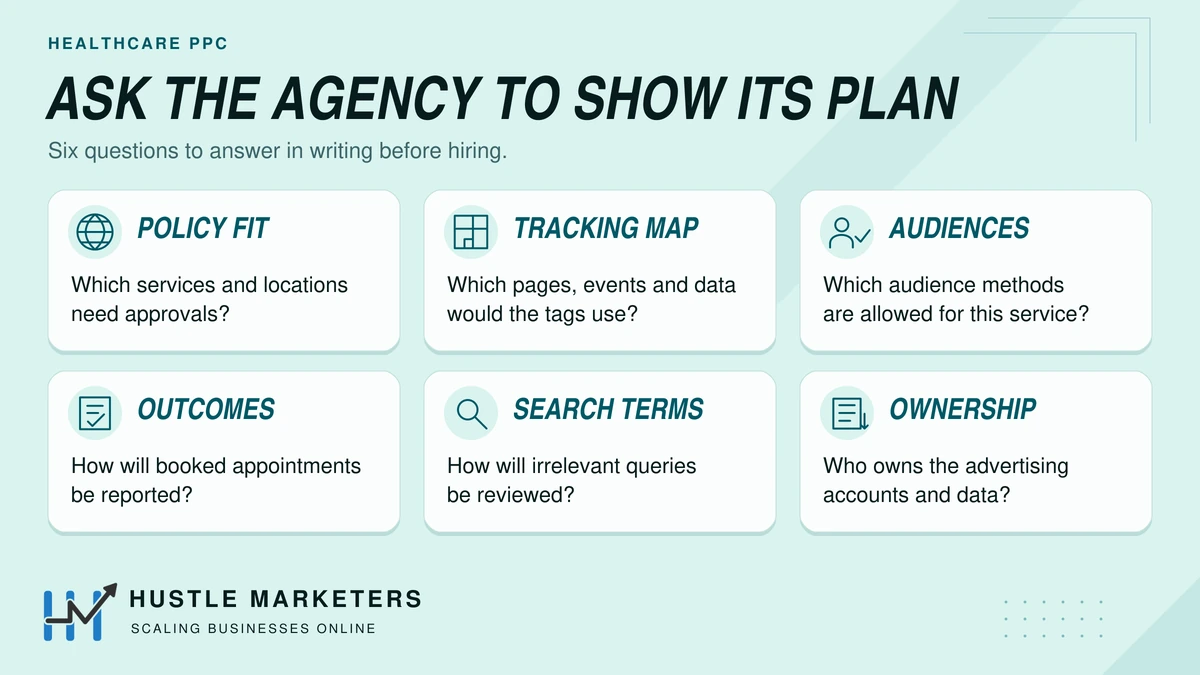
Whether you call it a healthcare PPC company, a PPC agency for healthcare or a medical PPC services provider, ask it to show these in writing before you sign.
- Policy fit: which certifications your services need, and who files them.
- A tracking plan: which pages carry tags, what each conversion is called, and how PHI stays out.
- Audience discipline: no remarketing or Customer Match where the health policy blocks it.
- Booked patient reporting: cost per booked patient, not just clicks.
- A search terms review: the job, research and free care queries they would block, as in our negative keywords guide.
- Ownership and terms: you own the accounts and data, and you can leave without penalty.
- Microsoft coverage: a plan for Microsoft Advertising, not a copied Google account.
Why choose Hustle Marketers and Ishant Sharma for healthcare PPC?
Hustle Marketers is a PPC agency founded in 2020 by Ishant Sharma, a Google Ads, Microsoft Ads and SEO specialist since 2013. Our healthcare PPC services cover Google Ads and Microsoft Advertising within the policies above.
- Clear pricing: $600 to $800 per platform per month, month to month, no lock-in. You own your ad accounts and ad spend is separate. See PPC management pricing.
- Relevant work: our child development case study covers Google Ads for a speech, occupational and physical therapy brand, reporting 286.94 conversions on $47K of ad spend over three months. Our eczema skincare case study covers Google and Meta Ads. Most other work is under NDA.
- Proof you can check: 4.9 out of 5 from 591+ reviews across Google, Trustpilot, Clutch, G2 and other platforms, and Clutch Award wins in 2023, 2024 and 2026.
- Where we work from: our delivery team is in Zirakpur, Punjab, India, and works with US clients.
We are not lawyers; we build to platform rules and work with your compliance counsel on HIPAA questions.
Healthcare PPC FAQs
Is Google Ads HIPAA compliant?
Do not treat it as a place PHI can go. For Google Analytics, Google offers no business associate agreement and says HIPAA regulated customers must not send it PHI. Plan Google Ads tracking the same way: tags off logged in pages, no conditions in URLs or event names, neutral booking conversions. Confirm with your compliance counsel.
Can healthcare providers use remarketing on Google Ads?
Usually not for health condition services. Google’s Health in personalized advertising policy blocks remarketing lists, Customer Match, audience expansion and lookalike segments when ads or landing pages promote sensitive health content. Keyword targeting, location targeting and Google’s predefined audiences remain available.
Do I need LegitScript certification to run Google Ads?
Only for certain services. In the US, Google requires LegitScript certification for telemedicine providers promoting prescription drug services and for addiction services, and accepts LegitScript or NABP accreditation for online pharmacies. A typical clinic, dental practice or home care agency that does not prescribe or sell medication online does not need it.
How much do healthcare PPC services cost?
There are two costs: ad spend paid to Google or Microsoft, and the management fee. Hustle Marketers charges $600 to $800 per platform per month, month to month, with no lock-in, and you own the accounts. Ad spend depends on your specialty, city and patient goals, so set it from your target cost per booked patient.
Is Microsoft Advertising worth it for healthcare?
Often, as a second platform once Google tracks bookings properly. Microsoft reviews ads under its own policies, so an imported campaign can pass on Google and fail on Microsoft. It also has its own rules, such as a global ban on clinical trial ads since August 2023. Judge it on cost per booked patient.
Did the 2024 court ruling end HIPAA rules for tracking pixels?
No. The June 2024 ruling vacated only the part of the HHS guidance about linking an IP address to a visit to an unauthenticated public page about health conditions or providers. The guidance on patient portals, booking pages and business associate agreements is still on the HHS page, and HIPAA itself did not change.
Can a home care agency advertise on Google Ads?
Yes. Non-medical home care is not a certification category under Google’s healthcare policy, so most agencies can run search campaigns by service and area. Pages about dementia or disability care fall inside Google’s health category, which blocks remarketing lists. Block caregiver job searches at account level and run hiring as a separate campaign.
How we created this guide
On October 22, 2026 we read the ten leading US results for “healthcare ppc”, “healthcare ppc services” and “ppc for healthcare”. We then opened every primary source cited: Google’s healthcare and personalized advertising policies and their 2025 to 2026 updates, Google’s Analytics HIPAA and consent mode pages, Microsoft Advertising’s 2023 announcements, LegitScript’s certification pages, the HHS OCR tracking guidance and the FTC’s Monument release. We also read advertiser threads on Microsoft Q&A and a LegitScript panel recap from treatment marketers.
Practice advice marked as our view comes from Ishant Sharma’s account work. Policies change often, so open the linked page before launch. Nothing here is legal advice.
Want a second opinion on your healthcare PPC account?
Send us your Google Ads or Microsoft Advertising account. We check policy status, audience settings, what your tags send and how many clicks become booked patients, then give you a written plan you can use with or without us. Get Free Audit Worth $500