Automotive PPC in 2026: How Car Dealerships Run Google Ads, Vehicle Ads and Meta Inventory Ads That Sell Cars and Book Service

Ishant
Published : October 27, 2026 at 3:30 pm
Updated : October 27, 2026 at 5:39 pm
Ishant
Summarize this article with:
Automotive PPC is paid advertising that dealerships buy by the click to sell specific vehicles and fill service bays. In 2026 a working setup has four parts. Google Search is built around buyer intent. Google vehicle ads run from a clean VIN-level feed. Meta and Microsoft inventory ads add reach, and tracking follows each call and form to a sold unit in the DMS.
The rules moved a lot between January 2025 and October 2026. Google’s free vehicle listings are gone, and vehicle ads now run in Standard Shopping as well as Performance Max. The FTC CARS Rule was formally withdrawn in February 2026, while California’s own CARS Act took effect on October 1, 2026.
This page covers paid media in depth, with a dated source for each change. For the full store plan (SEO, Business Profile, VDPs, BDC and digital retailing), read our automotive digital marketing guide for dealerships.
Key Observations
- Split Google Ads by intent for each rooftop: brand, new, used, conquest, service, parts, collision, finance and trade-in.
- Vehicle ads need a VIN-level feed whose price, mileage, condition and availability match the VDP. Since mid-April 2026, Merchant Center flags each mismatch.
- In the US, the feed price must be what any consumer can pay, excluding only required government charges and fees. Keep conditional rebates out.
- Since May 2026, vehicle ads can run in Standard Shopping, which gives manual bid control when data is thin.
- The FTC CARS Rule is gone, but deception law, California’s CARS Act and federal credit and lease ad disclosures still apply.
- Judge every channel on cost per sold unit from CRM and DMS match-back, not cost per lead.
What does automotive PPC and digital marketing involve for dealerships?
For a dealership, automotive PPC and digital marketing involve paying for visibility where car shoppers search, scroll and watch. Then you prove which of those clicks became sold vehicles and repair orders. Each paid channel has a different job, as of September 2026:
| Channel | Job for the rooftop | Needs first | Judge it on |
|---|---|---|---|
| Google Search | Captures searches for your store, models, used stock and service jobs | Call and form tracking, negative lists | Cost per appointment and per sold unit |
| Google vehicle ads | Shows a specific VIN with photo, price, mileage and store name | Merchant Center vehicle feed, linked Business Profile | VDP views, leads, store visits |
| Meta automotive inventory ads | Shows units to people who viewed or searched similar vehicles | Vehicle catalog plus matching Pixel events | Lead-to-show rate |
| Microsoft Automotive Ads | Shows inventory on Bing results and Audience ads placements | Auto inventory feed in the ad account | Cost per lead vs Google |
| YouTube | Builds demand for new and redesigned models | Walkaround and comparison videos | Lift in model searches |
| Local Services Ads | Pay-per-lead listings for repair, tire and towing trades | Eligible category, Google screening | Cost per booked job |
The rest of the stack (SEO, reviews, VDP quality and lead handling) decides how much of that paid traffic turns into deals. Those pieces live in the dealer guide linked above. This page is about buying media well.
What changed in automotive PPC in 2025 and 2026?
Eight changes since January 2025 affect how dealers buy and word their ads. Each links to its primary source.
| Date | Change | What to do |
|---|---|---|
| Early 2025 | Meta’s new Financial products and services special ad category became required for US financial services campaigns | Plan financing ads around its targeting limits |
| Jan 27, 2025 | The Fifth Circuit vacated the FTC CARS Rule | Stop citing it in checklists |
| Jun 12, 2025 | Google announced Vehicle Listing rich results would be phased out of Search; free listing feed processing has since stopped | Use paid vehicle ads for inventory tiles |
| Feb 12, 2026 | The FTC withdrew the CARS Rule, effective the same day | Keep pricing honest: deception law still applies |
| Mid-April 2026 | Merchant Center began listing vehicle data mismatches as account issues | Check account issues weekly |
| May 2026 | Vehicle ads became available in Standard Shopping campaigns | Test it where Performance Max lacks data |
| May 2026 | US vehicle ads added ATVs, UTVs, RVs, travel trailers and campers | Powersports and RV dealers can apply |
| Oct 1, 2026 | California’s CARS Act (SB 766) became operative | California stores show total price in qualifying ads |
How should a car dealership structure its Google Ads account?
Build one set of campaigns per rooftop, split by intent, so each type of searcher gets its own budget, bids, ads and landing page. When brand, new, used and service share a campaign, your own name soaks up the budget because it is the cheapest click. It also hides what everything else costs.
At Hustle Marketers, the first thing we check in any lead generation account is whether branded and non-branded traffic are reported apart. For a dealer, that split separates a flattering report from real new demand.
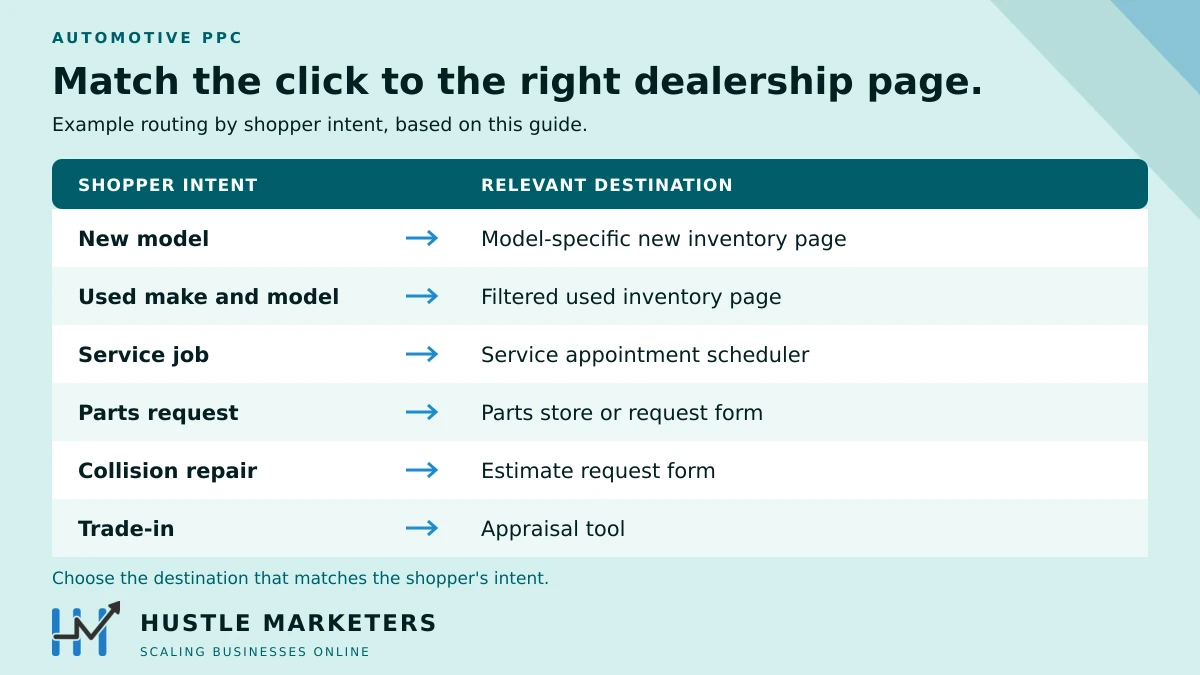
| Campaign | Example keyword themes | Landing page | Notes |
|---|---|---|---|
| Brand | [dealer name], [dealer name] service | Homepage or department page | Own budget; report apart |
| New model | 2026 [model] for sale, [make] dealer near me | New SRP for that model | Check OEM rules on offer wording |
| Used make and model | used [make] [model], used trucks near me | Filtered used SRP | Pause themes when stock runs out |
| Conquest | [rival model] vs [your model], rival dealer names | Comparison page or SRP | Hard budget cap |
| Service | oil change near me, brake repair [city] | Service scheduler | Schedule to service hours |
| Parts | [make] OEM parts, [part] for [model] | Parts store or request form | Block “parts” in sales campaigns |
| Collision | collision repair near me, auto body shop [city] | Estimate form | Often its own hours and profile |
| Finance | car loan bad credit [city] | Credit application | Consumer finance targeting limits apply |
| Trade-in | sell my car [city], trade-in value [model] | Appraisal tool | Track as inventory acquisition |
| Vehicle ads | No keywords; the feed decides | The VIN’s VDP | Performance Max or Standard Shopping |
Keep targeting tight to your primary market area and use the “presence” option, so ads reach people in or regularly in your area. Our guide to Google Ads location targeting settings covers radius and presence options.
Should a dealership bid on its own name?
Usually yes, but report it apart, because brand clicks are cheap, convert well and would often reach you anyway. Bid on your name when competitors or marketplaces show ads above your organic listing.
Dealers argue about this on forums. In a June 2026 DealerRefresh thread on PPC oversight, the author said weak vendors let brand terms carry most reported conversions. He suggested around 5% of budget on brand when competitors bid on the name. He also admits the 92% in the thread title is made up, so treat it as opinion. Our post on branded vs non-branded search shows how to split the reporting.
Can dealers bid on competitor dealership names?
Yes, Google allows competitor names as keywords, but its trademark policy can restrict a trademark in ad text after the owner complains. Bid on the name, but write ads about your own store and stock.
Franchise dealers have a second layer. Bidding on a same-brand dealer’s name can clash with OEM program rules. In the same thread, a moderator noted that dealers can report it to their OEM reps.
Which negative keywords stop wasted clicks for car dealers?
Start with seven themes: recalls, DIY, parts-only, jobs, salvage, toys and games, and private-party marketplaces. Then adjust per campaign, because a term that wastes money in sales can be a lead in service. Here is the Hustle Marketers starting matrix for dealership negatives.
| Theme | Example negatives | Add to | Exception |
|---|---|---|---|
| Recalls | recall, recall lookup, class action | Sales campaigns | Keep in service if your shop does recall work |
| DIY | how to, diy, manual, wiring diagram | All campaigns | Keep “cost” and “near me” service searches |
| Parts-only | parts, part number, junkyard | Sales campaigns | Positive in the parts campaign |
| Jobs | jobs, careers, hiring, salary | Account-level list | Remove if you recruit with ads |
| Salvage | salvage, junk, scrap, rebuilt title | Sales and trade-in | Keep only if you buy salvage |
| Toys and games | toy, diecast, model kit, wallpaper | Account-level list | None |
| Private-party | craigslist, marketplace, by owner | Used sales | Test first; some still buy from dealers |
Build these as shared lists and read search terms weekly for the first month. Our guide to Google Ads negative keywords covers match types and list setup.
How do Google vehicle ads work for dealerships?
Google vehicle ads are feed-based ads that show a specific vehicle’s photo, price, mileage and your dealership name, and send the click to its VDP. Many dealers still call them vehicle listing ads (VLAs). There are no keywords. You upload inventory to Merchant Center, link Google Ads and your Business Profile, and Google matches each VIN to searches, per its vehicle ads overview.
Who is eligible for vehicle ads in the US?
US dealers, retailers, aggregators and OEMs with a physical location can run vehicle ads, while private sellers and brokers cannot. As of September 2026:
- Vehicle ads are fully released in the US, Canada, Australia and Japan, and in open beta in the UK, Germany, France, Italy, Spain and the Netherlands.
- Cars and pickups qualify. Since May 2026, US listings can also include ATVs, UTVs, RVs, travel trailers and campers.
- Motorcycles, boats, buses, farm and commercial vehicles do not qualify.
- You need a lot customers can visit, plus a dealer license where your state requires one.
- One Merchant Center account can list vehicles in one state only, so a three-state group needs three accounts.
The one-state rule sits in Google’s vehicle ads policies. It is easy to miss for groups that cross state lines.
What does a Google vehicle feed need?
A US vehicle feed needs one row per VIN with price, condition, mileage, brand, model, year, image and a link or store code. Every value must match the VDP. These rules come from Google’s vehicle attributes specification and image guidelines, checked in September 2026.
| Attribute | US rule | What usually breaks |
|---|---|---|
| vin | Required, 17 characters, unique in the feed | Same VIN twice when rooftops share stock |
| price | What any consumer can pay, excluding only required government charges and fees; matches the most prominent VDP price | Conditional rebates baked in |
| vehicle_msrp | Required for new units; if different from price, shown on the VDP labeled MSRP | MSRP missing on the VDP |
| condition | New or Used | Demo units labeled differently on the VDP |
| mileage | Required for every vehicle, with a unit | DMS updated, VDP not |
| image_link | At least 500 x 500 px, 1500 x 1500 recommended; no watermarks, logos or text; stock photos only for new cars that match | Dealer frames and price banners |
| store_code | Required for in-store offers, with a link template | Code does not match the Business Profile |
| availability | Must be correct; VDPs must not show sold, reserved or incoming units | Sold units live on a once-a-day feed |
The US price rule matters most. If a loyalty or military rebate only applies to some buyers, keep it out of the feed price and show it lower on the VDP as a conditional offer.
Google’s activation checklist also wants the dealer name, location, price, VIN, mileage (for used units) and availability visible as the VDP loads. Since mid-April 2026, Merchant Center flags six issue types: availability, condition, price and mileage mismatches, mismatched vehicle details, and landing page errors. Our rule of thumb: check five random VINs each week across feed, VDP and DMS.
Should vehicle ads run in Performance Max or Standard Shopping?
Use Performance Max when the rooftop has solid conversion tracking and steady lead volume. Use Standard Shopping when you need manual control or your data is thin. Performance Max used to be the only option, so older guides still say so.
| Factor | Performance Max | Standard Shopping |
|---|---|---|
| Bidding | Automated; Google recommends Maximize conversion value | Manual CPC at ad group level, or automated |
| Reach | Feed-only asset groups serve on Search; Display rolling out in the US, Canada and Australia | Feed-based vehicle ads only |
| Control | Listing groups and audience signals | Ad groups, product groups, campaign priority |
| Best when | Leads, calls or store visits flow back reliably | New account, thin data, or pushing aged units |
| Timing | Up to 48 hours to serve; 2 weeks to ramp; compare after 4 to 6 weeks | No ramp period stated; test over the same window |
Timing comes from Google’s page on vehicle ads in Performance Max. Note that the linked Merchant Center cannot be changed after a Standard Shopping campaign launches. Keep a Search campaign either way; our Performance Max vs Search comparison explains why.
What happened to free vehicle listings on Google?
Google stopped showing free organic vehicle listings in 2025, so paid vehicle ads are now the main way to show inventory tiles in Search. On June 12, 2025, Google said Vehicle Listing rich results would be phased out. Its vehicle listings developer page now says the organic auto listings feature is ending and feed processing has stopped.
A June 30, 2025 DealerRefresh thread shows dealers seeing listings vanish from Business Profiles and getting mixed answers from Google. If free listings drove VDP traffic, plan a paid replacement.
How do Meta automotive inventory ads work?
Meta automotive inventory ads show vehicles from your catalog to people who viewed or searched similar units. They only work when Pixel events carry IDs that match the catalog. Meta groups them under automotive ads, next to model ads for new-model offers.
- Have a Facebook Page and an ad account.
- Build a vehicle catalog. Required fields include vehicle_id, make, model, year, mileage, 1 to 20 images, body_style, price, exterior_color, state_of_vehicle and dealer address with coordinates.
- Send the automotive events Meta documents: Search, ViewContent and AddToWishlist, with content_type “vehicle” and content_ids that match the catalog.
- Create a product set and a campaign that uses it.
The common break is simple. If your site sends stock numbers while the catalog uses VINs, Meta cannot match viewers to vehicles.
Financing ads likely fall under Meta’s Financial products and services category. For credit ads, Meta’s documentation fixes age at 18 to 65+, removes ZIP and lookalike targeting, and requires a minimum radius around any location. For catalog setup and creative, see our guide to Meta Advantage+ catalog ads.
Does Microsoft Advertising have automotive ads?
Yes, Microsoft Advertising runs Automotive Ads, feed-based inventory ads that show on Bing results, Bing image results and native Audience ads placements. Its auto inventory feeds documentation sets out how they work:
- The feed lives in the Microsoft Advertising account, not a merchant center.
- Automotive Ads need a dedicated campaign and ad group.
- Microsoft suggests an ad group keyword nobody would search, so ads only serve as automotive ads.
- Limits are 100 feeds and 5 million feed items per account.
Availability can differ by market, so confirm it with Microsoft before you build. Microsoft usually brings less volume than Google, so treat it as a test once your Google feed is clean.
Which vehicle feed fields do Google, Meta and Microsoft need?
All three platforms want the same core facts under different field names, so build one master inventory export and map it three ways. This map reflects each platform’s docs as of September 2026.
| Data | Google vehicle ads | Meta vehicle catalog | Microsoft feed example |
|---|---|---|---|
| Unique ID | vin (required in US) | vehicle_id (required); vin optional | Vehicle ID and VIN |
| Price | price, US rule above | price with currency | Price |
| New or used | condition: New or Used | state_of_vehicle: New, Used or CPO | State of vehicle |
| Mileage | mileage with unit | mileage value and unit | Mileage value and unit |
| Location | store_code tied to the Business Profile | address, latitude, longitude | City, latitude, longitude |
| Images | image_link plus up to 10 more | 1 to 20 images | Image URL |
| Landing page | link or link_template | url | Final URL |
Use the VIN as the ID everywhere you can. One ID across all three platforms and your website events makes debugging far easier.
How should dealers use PPC for service, parts and collision?
Give fixed ops its own budget, hours and conversion goal, because service searches convert far better than sales searches. LocaliQ’s 2026 benchmarks put automotive repair, service and parts at a 15.51% conversion rate, against 6.01% for automotive for sale.
- Split service by job: oil change, brakes, tires, batteries, inspection and “[make] service near me”.
- Make the online scheduler the main conversion, with calls in open hours second.
- Run parts and collision as separate campaigns with their own forms.
- Judge fixed ops on cost per repair order, not cost per lead.
Can car dealers use Google Local Services Ads?
Not for car sales: as of September 2026, Google’s US Local Services Ads category list has no car dealer category. It does include service trades such as Auto Repair Shop, Auto Body Shop, Brake Shop, Oil Change Service, Tire Shop and Towing.
Whether a dealer service department qualifies depends on Google’s screening, so run the eligibility check first. Our Local Services Ads guide covers verification and ranking.
Where does YouTube fit for new model launches?
YouTube earns budget when a new or redesigned model arrives and you need local shoppers to search for it by name. Use walkaround and comparison videos aimed at in-market auto audiences and custom segments built from the model’s search terms. Judge it on model search volume and VDP views in your area, not last-click leads.
What are the advertised price rules for dealership PPC in 2026?
Your ad price has to be true in three places: the ad or feed, the VDP, and federal, state and OEM rules. This is a practitioner summary, not legal advice, so have counsel review offer templates.
Is the FTC CARS Rule still in effect?
No. The Fifth Circuit vacated the CARS Rule on January 27, 2025, finding the FTC skipped a required advance notice of proposed rulemaking. The FTC then formally withdrew it, effective February 12, 2026. That does not make bait pricing legal: the FTC Act’s ban on deceptive practices and state laws still apply.
What does California’s CARS Act change for dealer ads?
California’s SB 766 requires dealers to show the total price in any ad that references a specific vehicle for sale, or states a monetary amount or financing term for a specific vehicle. It was approved on October 6, 2025 and became operative on October 1, 2026. It also bars misrepresenting whether vehicles are available at an advertised total price.
Under the chaptered text, total price excludes the taxes and government fees in Vehicle Code section 11713.1. For PPC, that touches vehicle ads, Meta catalog prices and any search ad that names a price for a specific vehicle. Other states have their own rules.
Why can a payment in a headline create a compliance problem?
Because federal rules say a monthly payment or down payment in an ad triggers extra disclosures, and a 30-character headline cannot hold them.
- Credit ads: under Regulation Z, 12 CFR 1026.24(d), a down payment, number of payments, payment amount or finance charge triggers the down payment, repayment terms and APR.
- Lease ads: under Regulation M, 12 CFR 1013.7(d), a payment amount or amount due at signing triggers five disclosures. These include that it is a lease, the total due at signing, the payment schedule, any security deposit and end-of-lease charges.
Our rule of thumb at Hustle Marketers: keep payment and down payment numbers out of search ad text unless compliance approved the exact wording. Lead with the model and stock, then show the full offer with disclosures on the landing page. Since an April 2024 policy update, vehicle ad VDPs may show lease and purchase options side by side.
Finance campaigns face a targeting limit too. Google’s personalized advertising policy bars US and Canadian consumer finance ads from targeting by gender, age, parental status, marital status or ZIP code.
How do OEM co-op and Tier 1, 2 and 3 rules affect your ads?
Co-op money usually comes with conditions, so read your OEM’s current program guide before you build campaigns you want reimbursed. Tier 1 is the manufacturer’s national advertising, Tier 2 is regional dealer associations, and Tier 3 is the individual dealer, which is where rooftop PPC sits. Confirm in writing which channels qualify and whether a certified vendor is required. Also confirm the approved offer wording, rules on bidding for same-brand dealer names, and what proof a claim needs.
How do you track calls, forms and chats back to sold cars?
Capture each lead with its click ID and source, and push it into the CRM. Then match sold units back to those leads and send the results to Google and Meta as offline conversions. Without that loop, bidding optimizes to form fills, not deals. For the Meta side, our guide to Meta conversion campaigns covers event choice, Conversions API deduplication and lead quality.
- Calls: use call assets plus dynamic number insertion on the site, and count calls only above a set duration.
- Forms and chat: pass the GCLID and UTM source into hidden fields, and make the chat vendor send source data to the CRM.
- CRM: one lead source list, duplicates merged, paid media kept apart from marketplace leads.
- Offline conversions: import appointment, show and sold stages to Google Ads and to Meta through the Conversions API.
- DMS match-back: monthly, match sold deals to leads by name, phone and email.
- Values: if one in ten appointments buys, an appointment is worth one tenth of your average gross per unit.
Our Google Ads conversion tracking guide covers offline imports and enhanced conversions. Filter junk before bidding learns from form fills; our post on stopping Google Ads spam leads shows how.
Dealers judge lead sources the same way. In a July 2026 DealerRefresh thread on lead sources, they focused on appointments, shows, sold units and cost per sold. They also warned that duplicate leads inflate attribution.
How much does automotive PPC cost per lead and per rooftop?
As of June 2026, LocaliQ puts the average automotive for-sale search ad at $2.27 per click and $44.26 per lead. Automotive repair, service and parts averages $4.35 per click and $29.96 per lead. Your costs depend on market, brand mix and how well the store closes leads.
What are the 2026 automotive Google Ads benchmarks?
Two widely used sources, LocaliQ’s 2026 report and WordStream’s 2025 report, land close together. Both are blended figures across their advertisers (WordStream reports medians), not dealer-only data. For how search compares with Meta, TV, radio and billboards, see how much advertising costs in 2026.
| Category and source | CPC | CTR | Conv. rate | Cost per lead |
|---|---|---|---|---|
| For sale, LocaliQ 2026 | $2.27 | 8.28% | 6.01% | $44.26 |
| For sale, WordStream 2025 | $2.41 | 8.29% | 7.76% | $38.86 |
| Repair, service and parts, LocaliQ 2026 | $4.35 | 5.56% | 15.51% | $29.96 |
| Repair, service and parts, WordStream 2025 | $3.90 | 5.56% | 14.67% | $28.50 |
Sources: LocaliQ search advertising benchmarks (updated June 1, 2026) and WordStream Google Ads benchmarks (16,446 US campaigns, April 2024 to March 2025). Brand terms pull averages down, so do not compare non-brand CPCs with them.
How do you set a PPC budget for one rooftop?
Work backward from the sales you want from paid media, your lead-to-sale rate and a realistic cost per lead. In this worked example, the goal and close rates are assumptions and the cost per lead is LocaliQ’s 2026 for-sale average.
| Step | Store A (8% close rate) | Store B (12% close rate) |
|---|---|---|
| Monthly sales goal from paid search | 25 units | 25 units |
| Leads needed | 313 | 209 |
| Cost per lead | $44.26 | $44.26 |
| Monthly media budget | $13,853 | $9,250 |
| Cost per sold unit | $554 | $370 |
Store B needs about $4,600 less per month for the same 25 sales, only because it closes more leads. Fixing lead handling often saves more than chasing a lower CPC. Try your own numbers in our free Google Ads budget calculator, and see the channel split per rooftop in our dealer marketing guide.
Which KPIs matter more than cost per lead?
Cost per sold unit matters most, followed by lead-to-appointment rate, show rate and cost per repair order, because they connect spend to gross profit. Ishant Sharma, founder of Hustle Marketers, who has run Google Ads and Microsoft Ads accounts since 2013, ranks lead generation KPIs this way. The outcome comes first, then the steps that lead to it.
| KPI | How to calculate it | Data source |
|---|---|---|
| Cost per sold unit | Paid spend divided by sold units matched to paid leads | Ad platforms plus DMS |
| Lead-to-appointment rate | Appointments divided by leads | CRM |
| Show rate | Shows divided by appointments | CRM |
| Cost per repair order | Service spend divided by paid repair orders | Scheduler and DMS |
| Brand share of spend | Brand spend divided by total spend | Google Ads |
| Feed approval rate | Approved VINs divided by submitted VINs | Merchant Center |
What does a 90-day automotive PPC plan look like?
Spend month one on tracking and the feed, month two on rebuilding campaigns, and month three on feeding sold-unit data back into bidding. This plan covers paid media only.
- Days 1 to 15, audit: confirm the dealer owns every account, test call tracking, split brand from non-brand, and read Merchant Center issues.
- Days 16 to 30, tracking and feed: remove junk conversions, capture GCLIDs, and align feed prices with VDPs.
- Days 31 to 45, Search rebuild: split campaigns by intent, load negative lists, and rewrite ads without triggering terms.
- Days 46 to 60, inventory ads: launch vehicle ads, connect the Meta catalog and events, and test Microsoft.
- Days 61 to 75, offline data: import appointments and sales, then bid toward them when volume allows.
- Days 76 to 90, reallocate: run the first DMS match-back and move budget to the lowest cost per sold unit.
What are the most common automotive PPC mistakes, and how do you fix them?
Most dealer PPC problems trace back to tracking, the feed or account structure, not bids. At Hustle Marketers we troubleshoot in that order, and this matrix maps common symptoms to their usual causes.
| Symptom | Likely cause | Fix |
|---|---|---|
| Vehicle ads approved, no impressions | Vehicle data source not selected, or under 48 hours live | Check campaign data source; wait 48 hours |
| Price mismatch issue | Conditional rebates in feed price, or a different VDP headline price | Feed the price any buyer can pay |
| Sold units still showing | Daily feed, sold VDPs still live | Refresh more often; pull sold VDPs |
| Leads up, sales flat | Brand terms or spam forms inflate conversions | Split brand; filter spam; bid to appointments |
| Spend on recall and DIY searches | Broad match without negatives | Apply the negative matrix |
| Meta shows random units | content_ids do not match vehicle_id | Use the VIN in both |
| Clicks from outside the market | “Presence or interest” location setting | Switch to presence |
Client example: Google Shopping and Facebook Ads for a Corvette parts retailer
- Client: C7 Carbon, a US retailer of Corvette parts and accessories, named in our published case study.
- Starting problem: products were not ranking in Google Shopping, ads were matching searches like “cool cars” and “sports cars”, only Brand and Performance Max campaigns were running, and Facebook ads had no pixel tracking.
- What we changed: added Google product categories, product specifications and promotions to the feed; rebuilt the account into six campaigns; added those irrelevant terms as account-level negatives; installed the Facebook Pixel for purchase and add-to-cart tracking.
- Result: 202 purchases tracked in Google Ads at a conversion value to cost ratio of 4.42, and Facebook campaigns averaging a ROAS above 10 once purchases could be tracked.
One account over a six-month engagement, measured in Google Ads and Facebook Ads Manager. Full breakdown: C7 Carbon case study.
Frequently asked questions
Is automotive PPC worth it for independent used car dealers?
Yes, if your inventory is priced to market and someone answers leads quickly. Independents can run vehicle ads with a physical lot and a dealer license where required. Start with used make and model search plus vehicle ads before any video.
Are Google vehicle ads free?
No. Vehicle ads are paid, like other Google ads. The free organic vehicle listings ended after Google’s June 2025 announcement, so there is no longer a free way to show inventory tiles in Search.
Can motorcycle or boat dealers run Google vehicle ads?
Not as of September 2026. Motorcycles and boats remain excluded, though US vehicle ads added ATVs, UTVs, RVs, travel trailers and campers in May 2026. Motorcycle and boat dealers should rely on Search and Meta for now.
How long does automotive PPC take to show results?
Search ads can drive leads within days of approval. Vehicle ads in Performance Max take up to 48 hours to serve, and Google suggests four to six weeks before comparing results. We suggest judging cost per sold unit after 60 to 90 days, once a full DMS match-back has run.
Should a dealer group use one Google Ads account or one per rooftop?
In most cases, use a manager account with one ad account per rooftop. Budgets, co-op claims and reporting are usually per store, and Merchant Center already limits vehicle listings to one state per account.
Who should own a dealership’s Google Ads account?
The dealership should. Ask for admin access to Google Ads, Merchant Center, Meta and Microsoft, with ad spend billed to you directly. Our clients always own their ad accounts and we are linked as a manager, so nothing is lost if you switch vendors.
Want a second opinion on your dealership’s Google Ads?
Hustle Marketers offers a free Google Ads audit that looks for wasted spend. Request your free Google Ads audit.
Prefer to hand it off? Our PPC agency service runs Google Ads, Microsoft Ads and Meta Ads for a flat $600 to $800 per platform per month, not a percentage of spend. It is month to month, ad spend goes straight to the platforms with no markup, and you own every account.
About the author
Ishant Sharma is a Google Ads, Microsoft Ads and SEO specialist who has worked in digital marketing since 2013, and the founder of Hustle Marketers, a Google Partner, Meta Business Partner and Microsoft Advertising Partner agency. His work covers Google Ads Search, Performance Max and product feeds for lead generation and ecommerce brands, and his named work includes CMSC and ArmorPoxy. His agency has worked with more than 2,500 brands and holds a 5.0 rating on Clutch from 50+ reviews.