Meta Conversion Campaigns: 2026 Best Practices for Sales and Lead Campaigns That Actually Optimize

Ishant
Published : October 22, 2026 at 3:30 pm
Updated : October 11, 2026 at 8:46 am
Ishant
Effective Meta conversion campaigns in 2026 come down to five habits. Optimize a Sales or Leads campaign for the deepest event each ad set can reach about 50 times a week. Send that event through both the Pixel and the Conversions API with deduplication. Keep the structure consolidated, let Advantage+ handle audience and placements, and feed it clearly different creative concepts.
This guide is the optimization layer, not a setup tutorial. If you are building your first campaign, start with our complete guide to advertising on Facebook. Here we cover the choices that decide whether Meta’s delivery system learns: event choice, signal quality, attribution, structure, bidding, creative and diagnostics, checked against Meta’s documentation and dated trade press as of September 2026.
It also covers what changed. In 2026 Meta rewrote click attribution, dropped two view-through windows from its reporting API and completed the retirement of legacy Advantage+ shopping APIs. Many ranking guides still describe the old setup.
Key Observations
- A “conversion campaign” is now a Sales or Leads campaign optimized for a website, app or CRM event. The old Conversions objective was split into those two in 2022.
- Pick the deepest event an ad set can reach about 50 times in 7 days. If you cannot, consolidate ad sets before you move up the funnel.
- Run the Pixel and Conversions API together with the same event_id and event name. Meta says only matched events can be used for delivery optimization.
- Since March 2026, click-through attribution counts link clicks only. Other interactions moved to a 1-day engage-through window, so reported results can shift while sales stay flat.
- Fewer ad sets, Advantage+ campaign budget and Advantage+ audience usually beat many small, tightly targeted ad sets.
- Andromeda rewards creative variety. Ten near-copies of one ad are not a creative test.
- For lead gen, send CRM outcomes back to Meta and optimize for conversion leads once you meet Meta’s volume rules.
What is a Meta conversion campaign in 2026?
A Meta conversion campaign is a Sales or Leads campaign optimized for a specific action, such as a purchase, lead or sign-up. Meta shows your ads to the people it predicts will take that action on your website, app, messaging thread, call or lead form.
Meta’s Outcome-Driven Ad Experiences (ODAX) update cut the objective list from 11 to 6: Awareness, Traffic, Engagement, App promotion, Leads and Sales. Purchase-type conversions moved to Sales and lead-type conversions moved to Leads, as Jon Loomer’s ODAX breakdown explains.
Inside the campaign, three settings define what “conversion” means. The conversion location says where it happens. The performance goal says what to maximize, such as the number or the value of conversions. The conversion event names the exact action, such as Purchase, Lead or a custom conversion.
Is there still a “Conversions” objective in Meta Ads Manager?
No, there is no standalone Conversions objective among the six ODAX objectives. You get the same optimization by choosing Sales or Leads, selecting Website (or another conversion location) and picking your event. Guides that tell you to “choose the Conversions objective” were written before the change.
Should you use a Sales campaign or a Leads campaign?
Use Sales when the action you want carries revenue, such as a Purchase or a paid subscription. Use Leads when the real business outcome happens later, in a CRM, on the phone or offline. The table below maps common outcomes to a setup.
| Your main outcome | Objective | Conversion location | What to optimize for | Watch out for |
|---|---|---|---|---|
| Online purchase | Sales | Website (or website and app) | Number of conversions, or value of conversions | Purchase must send value and currency |
| Large product catalog | Sales | Website with a catalog | Number or value of purchases | Feed quality; see our Advantage+ catalog ads guide |
| Quote or booking form on your site | Leads | Website | Lead, or a qualified-lead custom event | Cheap form fills that never answer |
| Form inside Facebook or Instagram | Leads | Instant forms | Leads, then conversion leads | Conversion leads needs CRM data sent back |
| Chat or phone sales | Sales or Leads | Messaging apps or calls | Conversations or calls | The outcome happens off-site, so log it in your CRM |
What are the best practices for creating effective Meta conversion campaigns?
The best practices are to feed Meta a clean, frequent conversion signal, give it a simple structure with enough budget per ad set, and supply varied creative. Then judge results on business outcomes, not platform-reported numbers alone. Here is the full list, with detail in the sections that follow.
- Choose the objective by outcome: Sales for revenue, Leads for pipeline.
- Optimize for the deepest event each ad set can reach about 50 times per week.
- Send that event through the Pixel and the Conversions API with a matching event_id and event name.
- Raise Event Match Quality with email, phone, IP address, user agent and fresh fbp and fbc values.
- Set attribution on purpose. It changes how Meta delivers ads, not only what it reports.
- Consolidate: one campaign per goal, few ad sets, and Advantage+ campaign budget where ad sets share a goal.
- Start on Highest volume or Highest value. Add a cost per result goal or ROAS goal only when you know your numbers.
- Keep Advantage+ audience and placements on unless a legal, brand or data reason says otherwise. Use custom audience exclusions where they matter.
- Diversify creative by concept, format and angle, and add new concepts on a steady cadence.
- Close the loop: CRM events for lead gen, landing pages that match the ad, and a holdout test before you trust ROAS.
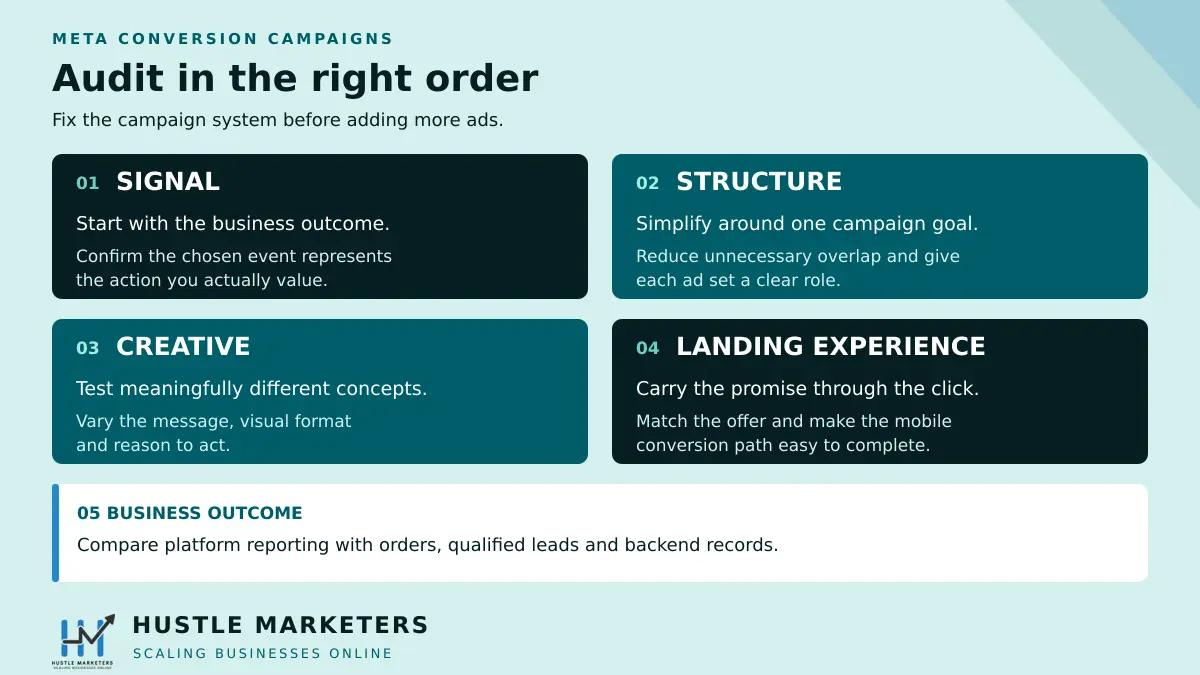
At Hustle Marketers we audit conversion campaigns in that same order: signal first, then structure, then creative, then landing page. A campaign that “stopped working” often has a signal or structure problem that new creative alone will not fix.
What changed for Meta conversion campaigns in 2025 and 2026?
Five changes matter most. Andromeda changed ad retrieval, Advantage+ became one unified setup, legacy shopping campaign APIs were retired, long view-through windows left reporting, and click attribution was rewritten in March 2026. This change log lists each one with its date and source.
| Date | Change | What it means for conversion campaigns | Source |
|---|---|---|---|
| Dec 2, 2024 | Meta introduced Andromeda, a new ads retrieval engine | Creative variety matters more, because retrieval decides which ads are even considered | Engineering at Meta |
| Jan 2025 | Detailed targeting exclusions removed | Exclude with custom audiences instead of interests | PPC Land Advantage+ explainer |
| Feb to Mar 2025 | One Advantage+ setup for sales, app and leads; Advantage+ sales replaced Advantage+ shopping; opportunity score (0 to 100) added | Ad sets, audience suggestions and custom audience exclusions return; 50 ads per ad set; existing customer budget cap removed | Search Engine Land, Jon Loomer |
| May 29, 2025 | Advantage+ status derived from three levers: campaign budget, audience and placements | Turning one lever off removes Advantage+ status | PPC Land |
| 2025 | Incremental attribution model added | Delivery can aim at conversions Meta predicts were caused by ads | Jon Loomer |
| Oct 2025 | Marketing API v24.0 blocked new legacy ASC and AAC campaigns; v25.0 in Q1 2026 extended the block to all versions | Tools and scripts that build old ASC campaigns must move to the Advantage+ structure | PPC Land |
| Oct 2025 | Default allows up to 5% of budget to reach excluded placements | Placement exclusions now behave more like preferences | PPC Land |
| Jan 12, 2026 | 7-day view and 28-day view windows stopped returning data in the Ads Insights API | Dashboards built on those windows go blank | PPC Land |
| Mar 2026 | Click-through counts link clicks only; engage-through replaced engaged-view; video engaged-view threshold cut from 10 to 5 seconds | Reported conversions can move between columns without any change in sales | PPC Land |
| Jul 29, 2026 | Graph API v26.0 removed Instagram Explore Feed and Messenger Stories as selectable placements | Update saved manual placement templates | PPC Land |
If a guide still tells you to pick 28-day click, rank eight events for Aggregated Event Measurement or choose the Conversions objective, it is out of date.
Which conversion event should you optimize for?
Optimize for the event closest to revenue that each ad set can reach about 50 times in 7 days. That is roughly what Meta needs to leave the learning phase. For a store that is usually Purchase. For lead gen it is Lead, or better, a qualified lead event.
How many conversions does Meta need to exit the learning phase?
An ad set generally needs about 50 optimization events within 7 days of its last significant edit. That figure comes from Meta’s Business Help Center, as quoted in PPC Land’s learning phase explainer. Below that pace, the Delivery column shows “Learning limited”.
Significant edits restart the count. Meta’s list includes changes to targeting, placements, the optimization event or bid strategy, adding new ads, pausing for 7 days or more, and large budget or bid changes.
Some vendor posts say Meta cut the threshold to 10 events for purchase campaigns in 2024. PPC Land notes that no official Meta documentation came with those reports, so we still plan around 50.
Learning limited is a volume warning, not a verdict. As Pigeon Digital points out, spending more just to clear the label rarely pays. If CPA is on target, an ad set can keep running in that state.
The Hustle Marketers event ladder below is how we pick the event and structure from weekly volume. The bands are our working rules from managing accounts, not Meta rules. Meta only publishes the “about 50” guideline.
| Optimization events per ad set per week (after consolidation) | What we optimize for | Structure | What to watch |
|---|---|---|---|
| 50 or more | Purchase (volume or value), or your qualified lead event | Keep it stable; consider Highest value or a ROAS goal once purchase values are clean | Edits that reset learning |
| About 15 to 49 | Keep the deepest event | One ad set or one Advantage+ campaign, Advantage+ campaign budget, no second campaign chasing the same event | Learning limited is expected; judge CPA over 14 days |
| Under 15 | Test the next event up (InitiateCheckout or AddPaymentInfo for stores, a qualified custom event for lead gen), or raise budget | A separate test campaign for the proxy event | Judge the test on purchases or qualified leads, never on the proxy event’s cost |
Should a store spending $150 a day optimize for Purchase?
Usually yes, as long as it consolidates first. Our assumptions: $150 a day ($1,050 a week) and an average cost per purchase of $55. The budget sits in three ad sets at $50 a day, and InitiateCheckout costs $14.
- Total purchases per week: $1,050 divided by $55 is about 19.
- Split across three ad sets, each gets about 6 a week. All three sit in Learning limited and learn separately.
- Merged into one ad set, it gets about 19 a week. That lands in the middle band of the ladder.
- Reaching 50 purchases a week at $55 would need $2,750 a week, or about $393 a day.
- InitiateCheckout at $14 would give about 75 events a week, enough to exit learning.
Our call: merge into one ad set and keep Purchase. Run InitiateCheckout only as a separate test with its own budget, and compare purchases per dollar after 14 days. Our free CPA calculator helps you run the same numbers for your account.
Should you optimize for Add to Cart when purchases are too low?
Usually not as a first move. Consolidate ad sets first, then test InitiateCheckout or AddPaymentInfo before AddToCart. The further an event sits from the purchase, the more Meta finds people who stop at that step.
If you do test a proxy event, judge it on purchases and revenue in your store backend. For custom conversions, note that Meta allows up to 100 custom conversions per ad account, so archive ones you no longer use.
How do the Pixel and Conversions API work together in a conversion campaign?
They send the same events from two places, the browser and your server, and Meta merges them. The campaign then sees more of your conversions without counting any twice.
Meta’s Conversions API best practices recommend this redundant setup: use the Conversions API in addition to the Pixel and share the same events through both. The same page states that only matched events can be used for ads attribution and ad delivery optimization. A purchase Meta cannot match to a person teaches the campaign nothing.
We will not repeat setup steps here. Our Meta CAPI and Google Enhanced Conversions setup guide covers tokens, server-side tagging and hashing. Shopify stores can follow our Shopify server-side tracking guide.
How does Meta deduplicate Pixel and Conversions API events?
Meta treats a browser event and a server event as one conversion when both carry the same event_id and event name. It generally keeps the one it received first. These are the rules from Meta’s deduplication documentation and its server event parameters page:
- The Pixel eventID must match the server event_id exactly. An order number or transaction ID works well for Purchase.
- The event name must match too: Purchase with Purchase, not Purchase with purchase_complete.
- Events only deduplicate within 48 hours of the first event with that event_id.
- The fallback method, using fbp or external_id, only works when the browser event arrives first. If the server event lands first, the later browser event is not deduplicated.
- A server event’s event_time can be up to 7 days in the past. Older events fail.
A common cause of double counting is a theme, app or plugin that fires its own Purchase event next to a server integration with a different event_id. Compare browser and server counts for the event in Events Manager against your real orders.
What is Event Match Quality and which parameters raise it?
Event Match Quality (EMQ) is Meta’s score out of 10 for how well the customer information on a server event can be matched to a Meta account. It is shown for web events. Meta’s best practices name email, client IP address, first and last name, and phone among the parameters that help.
The gaps we check first at Hustle Marketers, on the event the campaign optimizes for:
- Email and phone missing from Purchase or Lead server events, or badly formatted before hashing.
- client_ip_address and client_user_agent missing because the server call does not pass them through.
- fbp and fbc cookie values not captured, or cached and stale. Meta says these values change and should be refreshed.
- external_id missing for logged-in customers.
- Events that carry only weak fields. Meta rejects events whose only identifiers are combinations such as city, state, zip, country, gender and user agent.
Check EMQ per event in Events Manager. The score on your Purchase or Lead event matters far more than the score on PageView. Only send personal data you have consent to share.
Do you still need to prioritize 8 events for Aggregated Event Measurement?
No. Meta dropped the requirement to configure and prioritize eight web events in 2023, as Jon Loomer reported. Mandatory domain verification for event setup and the conversion domain choice in ads went at the same time. Domain verification is still recommended for link ownership. A checklist that asks you to rank eight events is out of date.
Which attribution setting should a Meta conversion campaign use in 2026?
Start with the default of 7-day click, 1-day engage-through and 1-day view for prospecting. Remove view-through for retargeting and for non-purchase events. This matters because the attribution setting shapes which conversions Meta optimizes delivery toward, not just what Ads Manager reports.
As of September 2026, based on Jon Loomer’s 2026 attribution guide and PPC Land’s report on the March 2026 change, the options are:
- Click-through: 7-day (default) or 1-day. Since March 2026 only link clicks count, plus call, message and lead form clicks. You can no longer set 28-day click; it only appears in Compare attribution settings.
- Engage-through: 1 day. It covers likes, comments, shares, saves and other non-link clicks, plus video views of 5 seconds or more. It replaced engaged-view.
- View-through: 1 day, on by default, and can be set to none.
- Incremental attribution: a model that aims delivery at conversions Meta predicts were caused by the ad. When you pick it, you can no longer edit the attribution windows.
On the reporting side, PPC Land reports that the 7-day view and 28-day view windows stopped returning data in the Ads Insights API on January 12, 2026. Third-party dashboards that relied on them need new settings.
| Situation | Setting we start with | Why |
|---|---|---|
| Prospecting for online purchases | 7-day click, 1-day engage-through, 1-day view | Gives Meta the most signal on new buyers |
| Retargeting site visitors or customers | 7-day click, view-through set to none | View-through tends to credit people who would buy anyway; Jon Loomer also advises removing it for remarketing |
| Website lead gen optimizing for Lead | 7-day click, view-through set to none | Reduces credit for leads the ad did not drive |
| High-consideration purchase | 7-day click with default engage-through and view | The longest click window still available |
| You want delivery aimed at incremental sales | Incremental attribution, run as a test | Locks the windows; compare against the standard model before switching everything |
If your reported results fell in March 2026 while store orders held steady, compare columns before changing anything. Conversions that used to count as click-through after a like or save now sit under engage-through, with a 1-day window instead of 7. Jon Loomer also reports seeing little difference with incremental attribution so far, so treat it as a test, not a default.
How should you structure a Meta conversion campaign?
Use as few campaigns and ad sets as your goals allow. Each ad set learns on its own, so splitting a small budget also splits the signal Meta needs to optimize.
How many ad sets should a conversion campaign have?
Create one ad set per real difference in goal, country or budget rule, not one per interest or creative theme. Our working rule: every ad set should be able to reach the middle band of the event ladder, about 15 or more events a week. If it cannot, merge it.
Avoid running two campaigns that optimize for the same event toward the same people. They chase the same buyers and split the learning between them.
Should you use Advantage+ campaign budget or ad set budgets?
Use Advantage+ campaign budget, the feature formerly called campaign budget optimization, when ad sets share the same event and a similar target CPA. Use ad set budgets when you must guarantee spend for a specific country, segment or test cell. Campaign budget also works with every main bid strategy: lowest cost, cost cap, bid cap and minimum ROAS.
When should you turn on Advantage+ audience and placements?
Leave them on by default for prospecting. Switch them off only for a clear reason, such as a legal age limit, strict geography or brand safety on certain surfaces. Since May 2025, a campaign counts as Advantage+ only when budget, audience and placements are all on Advantage+, per PPC Land’s report on the unified structure. Turning one off removes the status.
Advantage+ audience needs default or suggested age and gender and no hard custom audience inclusion. Meta also caps how high the minimum age can go, so check the limit Ads Manager shows before you narrow it. You can still add audience suggestions. Advantage+ placements make Facebook, Instagram, Messenger, Threads and Audience Network surfaces eligible.
Automation does not rescue a weak offer. One media buyer quoted in Bïrch’s Advantage+ sales guide makes the point that it will not fix a broken funnel. It scales conversion performance you already have.
Which exclusions still work in Meta conversion campaigns?
Custom audience exclusions still work, including in Advantage+ sales campaigns, but detailed targeting exclusions based on interests and behaviors were removed in January 2025. Exclude recent purchasers when you sell a one-time product. Exclude open leads and current customers with a CRM list when a retention campaign covers them.
The existing customer budget cap from Advantage+ shopping is gone, and the API field behind it was deprecated. If you need a hard split between new and existing customers, use a custom audience exclusion in a separate campaign.
Which bid strategy should you use for Meta sales and lead campaigns?
Start with Highest volume, or Highest value for ROAS-focused stores, until the campaign has a stable CPA or ROAS history. Then add a cost per result goal or ROAS goal set near what you already achieve, not near what you wish for. Names below follow Jon Loomer’s bid strategy glossary.
| Bid strategy | What it does | Use it when | Watch out for |
|---|---|---|---|
| Highest volume (default) | Spends the full budget for the most optimized events | New campaigns, learning, low volume | CPA can drift when auctions get more expensive |
| Cost per result goal | Aims to keep the average cost per result near your goal | You have 2 to 4 weeks of stable CPA | A goal set too low stalls spend |
| Bid cap | Caps your bid in each auction | You know your margins and accept lower volume | A low bid does not guarantee a low cost per result |
| Highest value | Chases purchase value instead of purchase count | Wide price range and clean value data | Purchase must send value and currency |
| ROAS goal | Aims for a minimum return on ad spend | Clean value data and a known break-even ROAS | A goal far above your history chokes delivery |
In the Marketing API, these map to LOWEST_COST_WITHOUT_CAP, COST_CAP, LOWEST_COST_WITH_BID_CAP and LOWEST_COST_WITH_MIN_ROAS. Before you set a ROAS goal, work out your number with our break-even ROAS formula and calculator. A goal below break-even buys unprofitable revenue. To compare Meta with Google, TikTok and offline channels on cost, see how much advertising costs in 2026.
Value bidding also depends on the data. Per Meta’s Pixel reference, Purchase requires value and currency. Send the value you want to optimize on, such as the order total after discounts, and keep it consistent between browser and server.
How does Andromeda change creative strategy for conversion campaigns?
Andromeda makes creative variety your main targeting lever. Meta’s retrieval stage now decides which of your ads are even considered for each person, before the auction ranks them.
Meta’s engineering team introduced Andromeda on December 2, 2024. Retrieval narrows tens of millions of candidate ads to thousands. Meta reported a 6% recall improvement for the retrieval system and an 8% ads quality improvement on selected segments. It also said the system was built to handle fast growth in ad volume from generative AI tools.
Many media buyers believe near-identical ads get treated as one, so twenty color swaps act like a single ad. Meta has not documented that mechanism. The safe response is the same either way: vary the concept, not the button color.
- Angle: problem, outcome, proof, offer, objection handling.
- Format: static image, short video, carousel, creator-style video.
- Persona: different buyer types, ages or use cases.
- Setting: home, work, outdoors, in store.
For offer and message structure, our direct response advertising guide goes deeper. Check dimensions and safe zones in our Meta ad sizes and specs guide before you build variants.
How many ads should you run per ad set?
Run enough distinct concepts for Meta to choose between, well under the 50-ad limit per ad set in Advantage+ sales campaigns. Our working range is 3 to 6 live concepts per ad set, each with a couple of format versions. Adding ads counts as a significant edit, so add them in weekly batches rather than one a day.
How often should you refresh or test creative?
Add new concepts on a fixed cadence, such as weekly or every other week, in batches. Retire an ad when both its spend share and its CPA get worse, not the moment frequency rises.
Inside one ad set, Meta shifts spend toward the ads it predicts will win, so uneven spend is not a fair test. For big questions, such as one concept against another, use a proper A/B test in Ads Manager with its own budget.
How do you optimize Meta lead campaigns for lead quality, not just volume?
Send your CRM outcomes back to Meta through the Conversions API. Once you meet Meta’s requirements, switch the performance goal to conversion leads. The campaign then optimizes for leads that became qualified or closed, not just form fills.
These are the requirements in Meta’s Conversions API for CRM integration documentation, as of September 2026:
| Requirement | Meta’s guidance |
|---|---|
| Lead volume | At least 200 leads per month |
| Upload frequency | At least once per day |
| Lead ID | Store the 15 to 17 digit Meta lead ID in your CRM; click ID, phone or email are accepted alternatives |
| Conversion window | The lead reaches your chosen stage within 28 days of being generated |
| Conversion rate | Between 1% and 40% of leads reach that stage |
| Ad format | Facebook and Instagram lead ads (Instant Forms) |
| Time to value | About 3 to 4 weeks on Meta’s project timeline, or about 1 month based on Meta’s historical data |
Pick a CRM stage that meets both the volume and the 1% to 40% rule. If closed deals are rare, “qualified” or “appointment booked” usually works better than “won”. Add one or two qualifying questions to the form so the stage means something.
For website leads, send a qualified-lead event through the Conversions API when your team marks the lead, within the 7-day event_time limit. For in-store sales, Meta’s offline events documentation says to upload physical store transactions within 62 days and recommends daily or real-time uploads. Pair either route with a landing page built for the ad, using our PPC landing page guide.
How do you know if your Meta conversion campaign is incremental?
You only know from a controlled test, such as a Meta Conversion Lift study, a geo holdout or an audience holdout. Attributed conversions include people who would have bought anyway, especially in retargeting.
Meta’s lift study documentation describes randomly splitting people into a treatment group that can see ads and a control group that cannot. It notes that Conversion Lift access is currently limited and goes through a Meta representative.
Without lift access, run a simple geo holdout. Pause Meta in a few comparable regions for two to four weeks and compare backend sales against regions where ads kept running. Track MER, total revenue divided by total ad spend, alongside platform ROAS. Incremental attribution helps delivery, but it is a model, not a test.
Why is my Meta conversion campaign not spending or not converting?
Most cases trace back to one of four causes: a bid or cost goal set too tight, a broken or duplicated conversion event, a structure too fragmented to exit learning, or a landing page that does not match the ad. Use this matrix to find the cause before you change anything.
| Symptom | Likely cause | Where to check | Fix |
|---|---|---|---|
| Spends little or nothing | Cost per result goal, ROAS goal or bid cap below what the auction needs; audience too narrow; ad restricted | Ads Manager bid strategy and Delivery column; Account Quality | Switch to Highest volume for a week to find the market cost, then reset any goal near that level |
| Spends, but zero conversions | Wrong event or dataset selected; event not firing on the confirmation page; wrong domain in event_source_url | Events Manager Test Events and Overview | Place a real test order or lead and confirm browser and server events both arrive |
| More conversions than real orders | Deduplication failing: event_id or event name differs, or a plugin fires a second Purchase | Events Manager event details; browser vs server counts | Send the same event_id, such as the order ID, from both sources; remove duplicate events |
| Stuck in Learning limited | Under about 50 events per ad set per week; too many ad sets; rare event | Delivery column | Consolidate, then apply the event ladder |
| CPA jumped after changes | A significant edit reset learning | Ad set activity history | Batch edits weekly and wait 7 days before judging |
| Reported conversions fell in March 2026, sales steady | Click-through now counts link clicks only; some results moved to engage-through | Attribution setting columns | Check backend revenue before cutting budget |
| Cheap leads that never answer | Optimizing for any form fill on an easy form | CRM lead-to-qualified rate | Add qualifying questions; send CRM stages; move to conversion leads when eligible |
| Good CTR, weak conversion rate | Landing page does not match the ad, or loads slowly on mobile | Landing page views vs conversions | Match headline and offer to the ad; fix mobile speed |
| High Meta ROAS, flat business revenue | Retargeting and view-through credit buyers who would convert anyway | Backend new vs returning revenue; MER | Set view-through to none on retargeting; run a holdout |
| CPA creeping, frequency rising | Creative fatigue or too few distinct concepts | Ad-level frequency and CPA trend | Add a batch of new concepts |
| Low EMQ on Purchase or Lead | Missing email, phone, IP or user agent; stale fbp or fbc | Events Manager, EMQ per event | Add the missing fields server-side |
Where do you check Meta conversion campaign problems first?
Check Events Manager before Ads Manager, because a delivery problem is often a signal problem in disguise. This is the order Hustle Marketers follows:
- Events Manager overview for the optimized event: volume by browser and server, and any drop in the last 7 days.
- Diagnostics in Events Manager for warnings on deduplication, missing parameters or domain issues.
- EMQ for the optimized event.
- A live test with the Test Events tool.
- Ads Manager Delivery column: Active, Learning or Learning limited.
- Account Quality for rejected or restricted ads.
- Breakdowns by placement, age and device to spot where spend goes without results.
Meta conversion campaign pre-launch checklist
This is the checklist we run before any Sales or Leads campaign goes live. Work through it top to bottom.
- The objective matches the outcome: Sales for revenue, Leads for pipeline.
- The optimized event fires once per conversion and shows in Test Events from both browser and server.
- Browser and server events share event_id and event name, and counts are close to your backend.
- Purchase sends value and currency, using the value you want to optimize on.
- EMQ is checked on the optimized event, with email, phone, IP, user agent, fbp and fbc sent where you have consent.
- Weekly event volume per ad set is estimated, and the structure follows the event ladder.
- The attribution setting is chosen on purpose, with view-through off for retargeting and non-purchase events.
- There is one campaign per goal, with no second campaign optimizing the same event for the same people.
- The bid strategy starts on Highest volume or Highest value unless you have stable history.
- Advantage+ audience and placements are on unless a written reason says otherwise, and exclusions use custom audiences.
- At least 3 distinct creative concepts are live, with specs checked for each placement.
- The landing page matches the ad’s offer, loads fast on mobile and carries UTM parameters.
- For lead gen, the Meta lead ID is stored in the CRM and a daily upload is planned.
- A backend CPA or ROAS target, your break-even ROAS and a date for a holdout test are written down.
- Edits are batched, with a 7-day no-touch window after launch.
Frequently asked questions
How long does the Meta learning phase last?
There is no fixed duration. An ad set leaves learning once it records about 50 optimization events within 7 days of its last significant edit. A high-volume ad set can exit in days, while a low-volume one may stay Learning limited for good. Judge results over 7 to 14 days, not day by day.
Does changing the budget reset the learning phase?
A large budget change counts as a significant edit and can send an ad set back into learning. Small changes usually do not. Meta’s documentation that we could access gives no single percentage threshold. So change budgets in modest steps and avoid stacking several edits on one day.
Can you run a Meta conversion campaign without the Conversions API?
Yes, the Pixel alone still works, but Meta recommends using both. Browser-only tracking misses conversions lost to browser limits, ad blockers or pages that fail to load. Events Meta never receives, or cannot match, cannot help optimization.
Should you exclude past purchasers from a Meta sales campaign?
Exclude them when the product is a one-time purchase or when a separate retention campaign covers them. For repeat-purchase brands, keep them in and watch new versus returning revenue in your backend. With the existing customer budget cap gone, a custom audience exclusion is the reliable way to separate them.
How much budget does a Meta conversion campaign need?
Enough for each ad set to reach its event often enough to learn. A quick check: target CPA times 50, divided by 7, is the daily budget one ad set needs to meet the 50-event guideline. At a $30 CPA that is about $214 a day. Below that, consolidate or accept Learning limited while CPA stays on target.
Why does Meta report more conversions than Shopify or GA4?
Meta counts view-through and engage-through conversions and uses its own windows, while GA4 uses different models and Shopify simply counts orders. Failed deduplication inflates Meta further. Our guide to why Google Ads, Meta and GA4 report different ROAS shows how to reconcile the numbers.
What is the difference between a standard event and a custom conversion?
A standard event is a predefined action, such as Purchase or Lead, that you send with the Pixel or the Conversions API. A custom conversion is a rule built on URLs or event parameters, with a limit of 100 per ad account. Optimize for standard events where you can, and use custom conversions to narrow them, such as leads from one form.
Is an Advantage+ sales campaign better than a manual sales campaign?
It depends more on signal and creative than on the label. Since 2025, a sales campaign counts as Advantage+ when campaign budget, audience and placements are all set to Advantage+. So the real question is which levers you keep. Weak tracking or weak creative will hold back either setup.
Want a second opinion on your Meta conversion campaigns?
Hustle Marketers is a Meta Business Partner. Our PPC management service covers Meta Ads alongside Google Ads and Microsoft Ads for a flat $600 to $800 a month per platform, not a percentage of ad spend. You own the ad account, pay Meta directly with no markup, and can stop month to month.
If your campaigns are stuck in Learning limited, over-reporting, or spending without sales, get in touch with our team. We will review signal, structure and creative in the order described above and tell you what we would fix first.
About the author
Ishant Sharma is a Google Ads, Microsoft Ads and SEO specialist who has worked in digital marketing since 2013, and the founder of Hustle Marketers, a Google Partner, Meta Business Partner and Microsoft Advertising Partner agency. His team runs Meta Sales and Leads campaigns alongside Google Ads for ecommerce brands, local service businesses and B2B lead generation accounts. His agency has worked with more than 2,500 brands and holds a 5.0 rating on Clutch from 50+ reviews.