Google Ads for SaaS: How to Turn Clicks Into Trials, Demos and Paying Customers (2026 Playbook)

Ishant
Published : October 19, 2026 at 3:30 pm
Updated : October 16, 2026 at 12:13 pm
Ishant
Google Ads works for SaaS when you bid for paying customers, not sign-ups. Match the conversion goal to your funnel: free trial, demo or hybrid. Send Google the expected value of each trial or lead. Cap your cost per trial from your CAC payback target, and start with high-intent Search. Add Performance Max, Demand Gen and remarketing only once that data flows.
The usual failure is simple. Google is told that a student’s trial and a 40-person team’s trial are worth the same. So it buys the cheaper one. This playbook fixes that: which events to track, what values to send, which keywords to buy first, and how the 2026 changes to bidding and offline imports affect SaaS accounts.
This guide is SaaS-specific. For generic B2B mechanics such as CRM connections, Customer Match uploads and negative keyword lists, use our B2B PPC strategy guide for Google Ads and Microsoft Ads.
Key Observations
- Bid on one primary conversion that fits your funnel: activation or paid for self-serve, qualified demo or opportunity for sales-led, product-qualified lead (PQL) for hybrid.
- Send values, not flat counts, so Google can tell a hobbyist from a team account.
- The Hustle Marketers payback rule: when the value is expected first-year gross profit, a Target ROAS of 100% equals a 12-month CAC payback.
- Work out your maximum cost per trial or demo before you set a budget.
- Start with Search on category, alternative, pricing and integration keywords. Competitor names are fine as keywords, but Google may restrict them in ad text after a trademark complaint.
- Since June 15, 2026, new API-based offline imports must use the Data Manager API. Since September 1, 2026, campaign-level broad match has been moving to AI Max.
- Add Performance Max, Demand Gen and Microsoft Ads only after your conversion data is clean.
How should a SaaS company use Google Ads?
A SaaS company should use Google Ads to capture buyers who are already searching for a tool like theirs, then teach Google which of those clicks become paying accounts. In practice that means five moves, in this order.
- Define the funnel: self-serve trial, freemium, sales-led demo or hybrid. This decides every setting below.
- Track the full journey: sign-up, activation, PQL or sales-qualified lead (SQL), and paid subscription, each with a value.
- Set a ceiling: work out the most you can pay per trial or demo from your CAC payback target.
- Launch high-intent Search: brand, category, alternative, pricing and integration keywords, each with its own landing page.
- Scale with automation only when the data is ready: value-based bidding first, then Performance Max, Demand Gen, remarketing and Microsoft Ads.
Skip step 2 and the rest fails. Smart Bidding optimizes toward whatever you mark as a conversion. If that is a sign-up form, you get more sign-ups, and many come from students, job seekers and people who never log in twice.
Is Google Ads worth it for SaaS in 2026?
Yes, if your unit economics can carry the click cost. Search catches buyers while they compare tools, which social platforms cannot do. But it is not cheap. WordStream’s 2026 Google Ads benchmarks have no software category. The closest one, Business Services, averaged $5.87 per click and $93.69 per lead across US campaigns from April 2025 to March 2026.
Dreamdata’s B2B Google Ads benchmarks (updated October 2025) show the gap between brand and non-brand search. Non-branded search averaged a €21.1 CPC and a reported 78% ROAS. Branded search averaged €5.5 and 1,299%. Non-brand search rarely pays back on first revenue. It has to pay back over the subscription, which is why this guide is about values and payback.
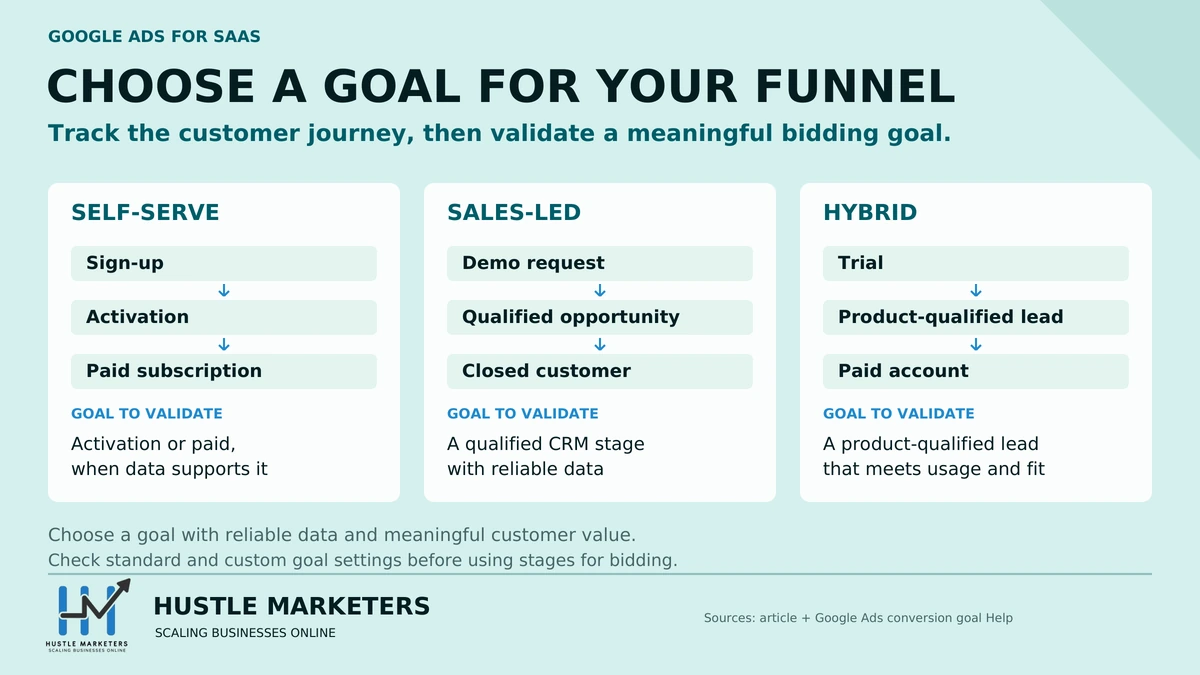
Which SaaS funnel are you running, and what should Google optimize for?
Your funnel decides what Google should bid for. At Hustle Marketers we fill in this table before we touch keywords, because a wrong answer here wastes every dollar spent after it.
| Question | Self-serve trial or freemium (PLG) | Sales-led demo | Hybrid (product-led sales) |
|---|---|---|---|
| Bid goal at launch | Sign-up, valued by segment | Demo request from a qualifying form | Sign-up, valued by segment |
| Bid goal once volume allows | Activation, then paid subscription | SQL or opportunity from the CRM | Product-qualified lead (PQL) |
| Value to send | First-year gross profit × sign-up-to-paid rate | Contract value × stage-to-close rate × margin | First-year gross profit × PQL-to-paid rate |
| Main landing page CTA | Start free trial or Get started free | Book a demo, with pricing guidance nearby | Start free trial, plus Talk to sales for larger teams |
| Biggest risk | Paying for sign-ups that never come back | Paying for form fills that never book or show up | Product and sales teams counting the same customer twice |
What should a self-serve free trial or freemium account optimize for?
A self-serve account should optimize for activation, then paid subscriptions, not raw sign-ups. Sign-ups help at launch because they arrive fast. Once you see enough activations each month, make activation the primary goal and keep sign-ups as a secondary signal.
Freemium needs lower values than a free trial. Kyle Poyar and Lenny Rachitsky’s 2023 survey of more than 1,000 products put good free-to-paid conversion at 3% to 5% for self-serve freemium. For free trials it was 8% to 12%, measured as paid within six months. At the midpoints, a freemium sign-up is worth about 40% of a trial sign-up. Your values should say so.
What should a sales-led demo funnel optimize for?
A sales-led funnel should optimize for sales-qualified leads or opportunities imported from your CRM. A demo request is a promise, not pipeline. Qualify it on the form with work email, company size and role, then send the later stages back to Google.
Watch the conversion window. Google’s conversion window defaults to 30 days and goes up to 90 days for Search, depending on the source. Conversions after the window are not recorded. If your deals close in five months, bid on a stage that usually happens inside 90 days, such as SQL.
How do you run Google Ads for a hybrid, product-led sales motion?
Run a hybrid funnel on product-qualified leads. A PQL is a trial account that passes a usage test and a fit test, for example three teammates invited and a company above your minimum size. Make the PQL the primary goal, valued by segment. Keep sign-ups and demo requests secondary so sales and product do not double count.
Google is testing a better fit for this. In its Google Marketing Live 2026 bidding update (May 7, 2026), it announced journey-aware bidding in beta for Search campaigns on Target CPA. It learns from biddable and non-biddable goals across the lead to sale journey, so teams that track every stage are ready for it.
Which conversion actions should a SaaS account track in Google Ads?
A SaaS account should track every stage from sign-up to paid, but make only one of them the primary bid goal. Primary goals drive bidding. Secondary goals are for reporting. Setting two stages as primary counts the same customer twice.
| Event | Fires when | Primary or secondary | Value to send | How it reaches Google |
|---|---|---|---|---|
| Sign-up | Account created and email verified | Primary at launch, then secondary | First-year gross profit × sign-up-to-paid rate | Google tag or tag manager event |
| Activation | First real use, such as a data source connected | Primary for self-serve once volume allows | First-year gross profit × activated-to-paid rate | Server-side event or offline import |
| PQL | Activation plus company fit | Primary for hybrid | First-year gross profit × PQL-to-paid rate | Offline import via the Data Manager API or a connector |
| Qualified demo request | Form with work email, company size and role | Primary at launch for sales-led | Contract value × demo-to-close rate × margin | Google tag plus enhanced conversions for leads |
| SQL or opportunity | Sales accepts the lead or opens a deal | Primary for sales-led once volume allows | Contract value × stage win rate × margin | CRM offline import |
| Paid subscription | First successful charge | Primary for self-serve at scale | First-year gross profit for the plan bought | Billing event sent server-side or imported |
| Refund or early cancel | Cancel inside the refund window | Not a conversion | Retract or restate the earlier value | Conversion adjustments |
What is an activation event, and why does it beat the sign-up?
An activation event is the first action that shows a user got real value, and it beats the sign-up because it predicts payment far better. To find yours, compare accounts that paid with those that did not, and pick the early action the payers took. Keep it early: Google’s value-based bidding guidance recommends conversion delays of under 7 days.
How do you send PQLs and paid subscriptions back to Google?
You send them back as offline conversions, matched to the original click or to hashed customer data. Store the click ID and email with the account at sign-up. When the account qualifies or pays, send that event with its value. Billing is the usual snag, since passing a Stripe trial-to-paid event into Google takes planning.
Two facts shape the setup in 2026. Google recommends enhanced conversions for leads for anyone starting offline imports now. And from June 15, 2026, the Google Ads API stopped accepting new adopters of offline imports, making the Data Manager API the primary route. Upload daily. Our Google Ads conversion tracking guide covers the import options, and the B2B PPC guide covers CRM connections.
How does value-based bidding work for SaaS?
Value-based bidding lets Google bid more for clicks likely to bring more revenue, using the values you send. You run it with Maximize conversion value, with or without a Target ROAS. Google says values can be real revenue or proxies such as a lead score. Google also asks for two or more unique values, so one flat value per trial will not work.
What value should you send for a trial, a PQL or a paid plan?
Send expected first-year gross profit: monthly price × 12 × gross margin × the chance this stage becomes a paying customer. Use gross profit, not revenue, so the value reflects what the customer is worth to you.
- Paid Team plan at $99 a month with 80% margin: $99 × 12 × 0.8 = $950.40.
- Trial on that plan with a 10% trial-to-paid rate: $950.40 × 0.10 = $95.04.
- Activated trial where 25% go on to pay: $950.40 × 0.25 = $237.60.
- Segment rates by what you know at sign-up: work or personal email, company size, country and plan.
- If you use a predicted lifetime value model, cap the value so one outlier cannot swing bids.
What is the Hustle Marketers payback rule for Target ROAS?
When your conversion value is expected first-year gross profit, CAC payback in months equals 12 divided by your Target ROAS. That turns a vague ROAS target into a number your finance team already uses.
- Target ROAS 200% means a 6-month payback on ad spend.
- Target ROAS 150% means an 8-month payback.
- Target ROAS 100% means a 12-month payback.
- Target ROAS 67% means roughly an 18-month payback.
The rule only holds if your conversion rates by segment are right, and it covers ad spend only. Ishant Sharma, founder of Hustle Marketers, has run Google Ads and Microsoft Ads accounts since 2013. He recommends checking those rates against your last two or three cohorts before you trust any target.
When is a SaaS account ready for Target ROAS?
A SaaS account is ready for Target ROAS when it meets Google’s value-based bidding thresholds, checked in September 2026:
- At least 15 conversions in the last 30 days at the conversion tracking level.
- Values uploaded for 3 weeks or 1 to 2 conversion cycles, whichever is longer.
- Daily offline uploads, with conversion delays ideally under 7 days.
- Two or more unique values across conversions.
Switch as a test, not a leap. Run the new strategy against the old one with Google Ads experiments, and see our guide to Google Ads bidding strategies for when Target CPA is the safer choice.
How much can a SaaS company afford to pay per trial or demo?
You can afford a cost per trial equal to your allowable CAC multiplied by your trial-to-paid rate. Allowable CAC comes from price, margin and your payback target. The inputs below are assumptions for illustration, not benchmarks.
| Input or output | Self-serve trial | Sales-led demo |
|---|---|---|
| Monthly revenue per account | $99 | $1,000 |
| Gross margin | 80% | 80% |
| CAC payback target | 12 months | 18 months |
| Allowable CAC (revenue × margin × months) | $950.40 | $14,400 |
| Share of CAC available for ads | 100% (no sales touch) | 50% (sales costs take the rest) |
| Allowable ad cost per customer | $950.40 | $7,200 |
| Trial-to-paid or demo-to-close rate | 10% | 15% |
| Max cost per trial or demo | $95.04 | $1,080 |
| Click-to-trial or click-to-demo rate | 5% | 3% |
| Max average CPC | $4.75 | $32.40 |
Compare the self-serve column with WordStream’s Business Services average of $5.87 per click. At a 5% click-to-trial rate, that is $117.40 per trial, above the $95.04 ceiling. To close the gap you need a better landing page, a higher price, a longer payback target, or keywords that convert above your average.
Run your own numbers with our free CAC calculator, and read our customer acquisition cost guide before you set targets. Count management fees and tools in the full CAC.
What is a realistic SaaS cost per trial or cost per lead on Google Ads?
No credible public study isolates Google Ads cost per trial for software as of September 2026, so your own ceiling is the number to manage to. Many ranges on vendor blogs have no stated source. These are the dated references we trust.
| Metric | Figure | Source and date | How to use it |
|---|---|---|---|
| Business Services (closest to software) | $5.87 CPC, 4.85% conversion rate, $93.69 cost per lead | WordStream, May 19, 2026 (13,474 US search campaigns) | Sanity check for your CPC ceiling, not a software benchmark |
| B2B search, non-branded vs branded | €21.1 CPC and 78% ROAS vs €5.5 CPC and 1,299% ROAS | Dreamdata, updated October 2025 | Report brand and non-brand apart; the page does not define its ROAS method |
| Free-to-paid conversion | Free trial: good 8% to 12%. Freemium self-serve: good 3% to 5% | Lenny’s Newsletter, August 1, 2023 | Starting assumption for trial values until you have your own cohorts |
| New CAC ratio | Median $2.00 of sales and marketing spend per $1.00 of new customer ARR (2024 data) | Benchmarkit 2025 SaaS Performance Metrics | Company-wide efficiency check, not a Google Ads target |
How much budget does a SaaS company need to start Google Ads?
Start with enough budget to reach Google’s learning threshold on the goal you care about: the conversions you need multiplied by your allowable cost per conversion. In the self-serve example, 15 activations a month at $237.60 each needs about $3,564 a month. If that is too much, run only brand, alternative and pricing keywords, bid on sign-ups valued by segment, and move the goal deeper as volume grows.
Which keywords should SaaS companies bid on?
SaaS companies should bid first on keywords that show a buyer is choosing a tool: category, alternative, pricing, integration and brand terms. Problem and template searches can work too, but only when the page and funnel fit. Give every theme its own ad group and landing page. For why the biggest keywords are rarely the best buys, see our breakdown of the most searched and most expensive Google Ads keywords.
| Theme | Example search | Send them to | Best fit |
|---|---|---|---|
| Category | project management software | Category page with pricing, proof and one CTA | All funnels; usually the most competitive |
| Problem | how to track team workload | Page that shows the fix inside your product | Self-serve trial; test with values |
| Alternative | [competitor] alternative | Dedicated alternative page with migration help | All funnels |
| Versus | [competitor A] vs [competitor B] | Fair comparison page that adds you as a third option | Test on a small budget |
| Pricing | [category] pricing, [competitor] pricing | Pricing page or pricing comparison | All funnels; close to a decision |
| Integration | [category] with Salesforce integration | Integration page with setup steps | All funnels |
| Templates | project plan template | A template that opens inside your product after sign-up | Self-serve only; add “template”, “free” and “example” as negatives for sales-led |
| Your brand | [your brand], [your brand] pricing | Brand landing page; block login and support searches | All funnels |
Should you bid on “alternative to X” and “X vs Y” keywords?
Yes, bid on “alternative” keywords early, and treat “X vs Y” keywords as a test. Someone searching for an alternative knows the category and wants to switch, so a page that answers “why switch” and “how hard is the move” beats the homepage. “X vs Y” searchers are comparing two other tools, so fewer will pick a third. Judge both on activations or pipeline, not clicks, and keep every claim accurate.
Is it legal to bid on competitor brand names in Google Ads?
Google allows competitor brand names as keywords, but it may restrict them in your ad text. Under Google’s trademark policy, as of September 2026, using trademarks as keywords is not restricted. If a trademark owner complains, Google reviews it and may restrict the trademark in ads, including ads from direct competitors. Trademark law differs by country, so this is policy guidance, not legal advice.
- Use the competitor’s name as a keyword, not in headlines or descriptions.
- Write ads about the switch, such as “Moving tools? Import your projects free”.
- Never imply you are the competitor or a partner of theirs.
- Expect lower CTR and Quality Score than on your own terms, and bid from your ceiling.
What should a SaaS landing page from Google Ads include?
A SaaS landing page should repeat the search in the headline, offer one clear next step, and answer price and fit questions before the buyer asks. This is the checklist we use when we review one.
- A headline that matches the keyword theme, such as “The [competitor] alternative for agencies”.
- One primary CTA that matches the funnel. A secondary link is fine; two equal buttons are not.
- Trial terms in plain words: length, card or no card, and what happens at the end.
- Pricing, or at least a starting price. Hidden pricing pulls in demos from buyers who cannot afford you.
- Proof from customers in the searcher’s segment.
- For alternative pages, a feature and price table plus help with the move. For integration pages, what syncs and how long setup takes.
- A form that asks only what sales needs, with work email for demos.
Should the CTA be “Start free trial” or “Book a demo”?
Use “Start free trial” when a buyer can get value alone in one session, and “Book a demo” when setup needs data migration, security review or several approvers. For hybrid products, lead with the trial and add “Talk to sales” above your seat threshold. Judge the choice on paid customers, not form fills.
Which Google Ads campaign types work best for SaaS?
Search works best for SaaS, with brand and non-brand in separate campaigns. Performance Max, Demand Gen and remarketing earn a place once Search is profitable and your conversions carry values.
Should SaaS companies use Performance Max?
SaaS companies should use Performance Max only after they import qualified leads or paid customers with values. Without that, PMax finds the cheapest form fills it can. Google’s Performance Max lead generation guidance points the same way. For value-based bidding, it suggests the goal closest to a sale with at least 15 conversions in 30 days, plus brand exclusions if you want PMax off your brand terms.
The upside is reach across YouTube, Gmail, Discover and Display from one campaign. The downside is less control. Our guide to Performance Max vs Search campaigns covers how the two compete and how to test PMax without losing Search volume.
How do you use Demand Gen and YouTube for SaaS?
Use Demand Gen to show short product videos to people like your best customers, then catch them later on Search. Demand Gen campaigns run on YouTube (including Shorts), Discover, Gmail, Maps and the Google Display Network, and support lookalike segments. Seed lookalikes from paying customers, not every sign-up. Judge Demand Gen on brand search growth and assisted trials over several weeks, not last-click trials.
How should you remarket to free trial users?
Remarket to trial users by stage, with a different message for each, and exclude anyone who already pays. Google lists a minimum of 100 active users in the last 30 days for a Search or YouTube audience segment, so small trial volumes may need longer membership windows.
- Signed up, not activated: a short setup video or a guided onboarding offer.
- Activated, not paid: plan comparison, or a customer story from the same segment.
- Trial expired: what they lose, and how to restart.
- Pricing page visitors without a trial: the trial offer and an answer to the top pricing objection.
- Paying customers: excluded. Google’s customer acquisition goal can also bid only for new customers once you define existing ones with a customer list and the site tag.
How do you keep SaaS ads away from job seekers, students and the wrong countries?
Keep SaaS ads clean with three filters: location settings, values that reward business sign-ups, and a short list of SaaS-specific negatives. Blocking every personal email at sign-up is rarely needed. Valuing those sign-ups lower lets Google learn the difference.
- Target only countries where you can bill, support and sell. Use the “presence” location option so people merely interested in a country do not qualify.
- Value work-email sign-ups from target company sizes higher than personal-email sign-ups.
- Add SaaS negatives such as login, sign in, support, cancel, open source, crack, jobs, salary and course.
- Ask for work email on demo forms, and keep trial forms short.
The full negative keyword process for B2B accounts is in our B2B PPC guide, so we will not repeat it here.
Should SaaS companies run Microsoft Ads too?
Yes, once Google Search is profitable, Microsoft Ads is the natural second engine for SaaS because of LinkedIn data. Microsoft Advertising lets you target people by LinkedIn profile information, including company, industry or job function. That LinkedIn data is not available in Google Ads.
Import your winning Google Search campaigns, then add LinkedIn profile targeting on terms that attract mixed audiences. Our guide to LinkedIn profile targeting in Microsoft Ads walks through the setup.
What changed in Google Ads for SaaS advertisers in 2026?
Five dated changes in 2026 and early 2027 affect how SaaS accounts track and bid. Each row cites Google’s own announcement.
| Date | Change | What SaaS advertisers should do | Source |
|---|---|---|---|
| May 7, 2026 | Journey-aware bidding enters beta for Search on Target CPA, learning from biddable and non-biddable goals. | Track sign-up, activation, PQL and paid even if only one stage is biddable. | Google Marketing Live 2026 bidding news |
| June 15, 2026 | The Google Ads API stops accepting new adopters of offline conversion imports, including enhanced conversions for leads. | Build new CRM or billing imports on the Data Manager API or a connector that uses it. | Google Ads Developer Blog, May 15, 2026 |
| August 17, 2026 | Budget-limited campaigns on target-based bidding now deliver closer to the target set, even if they were beating it. | Reset Target CPA or ROAS to the level you want, and flag the date in before and after reports. | Google Ads Help on the bidding update |
| September 1, 2026 | Search campaigns using campaign-level broad match start moving to AI Max, with search term matching on. New campaign-level broad match settings were blocked from August 3. | Review search terms weekly and add exact match versions of your best queries. | Google Ads Developer Blog, August 12, 2026 |
| February 1 to 28, 2027 | Dynamic Search Ads automigrate, and new DSA ad groups can no longer be created. | Decide how AI Max replaces your DSA coverage before the migration. | Google Ads Developer Blog, August 12, 2026 |
What does a 90-day Google Ads launch plan for SaaS look like?
A 90-day SaaS launch plan moves from measurement to Search to value-based bidding to expansion, and each phase has a gate. Move on when the gate is met, not when the calendar says so. Hustle Marketers uses this as a starting point.
| Phase | What to do | Gate to move on |
|---|---|---|
| Days 1 to 14: measure | Pick the funnel and primary goal. Set up sign-up, activation, PQL or SQL, and paid events with values. Store click IDs and emails at sign-up. Build alternative, pricing and integration pages. | Test conversions show in Google Ads with values that vary by segment |
| Days 15 to 45: launch Search | Launch brand, category, alternative, pricing and integration ad groups on exact and phrase match. Cap CPCs at your ceiling. Review search terms daily for two weeks. | Cost per trial or demo near your ceiling, and offline events arriving daily |
| Days 46 to 75: add value | Keep uploading values daily. After 3 weeks or 1 to 2 conversion cycles, test Maximize conversion value or Target ROAS as an experiment. | At least 15 conversions in 30 days on the goal you bid on |
| Days 76 to 90: expand | Launch stage-based remarketing. Test Demand Gen video. Import winning Search campaigns into Microsoft Ads. Test PMax only if qualified or paid values flow. | First paid cohort on track for your payback target |
What are the most common Google Ads mistakes SaaS companies make?
The most common SaaS mistake is bidding on sign-ups with one flat value, and most other problems grow from it. When an account underperforms, Hustle Marketers checks these symptoms in this order, because fixes near the top change what Google learns from every later click.
| Symptom | Likely cause | Check first | Fix |
|---|---|---|---|
| Trials rise, paid customers stay flat | Bidding on sign-ups with one flat value | Which action is primary in the campaign goal | Make activation, PQL or paid the primary goal, with values by segment |
| Brand CPA looks great, new revenue does not move | Existing users searching to log in or get support | Search terms with login, sign in, support or cancel | Add them as negatives and exclude customer lists |
| PMax reports cheap conversions, pipeline is flat | PMax bidding on form fills and brand queries | The goal PMax uses, and brand exclusions | Move PMax to a qualified or paid goal with values, and add brand exclusions |
| Value-based bidding spends little or swings | Too few conversions, or late value uploads | Conversions in the last 30 days and upload lag | Upload daily, and wait for 15+ conversions and 1 to 2 conversion cycles |
| Competitor ad disapproved for trademarks | Competitor name in ad text after a complaint | The policy detail on the ad | Remove the name from ad text and keep it as a keyword |
| New offline import fails with CUSTOMER_NOT_ALLOWLISTED_FOR_THIS_FEATURE | New Google Ads API adopter after June 15, 2026 | Which API your connector uses | Move the import to the Data Manager API or a connector that supports it |
| Ads or site flagged as a compromised site | Possible causes raised in this Hacker News thread from a SaaS founder: domain history or third-party scripts | Google Safe Browsing and every external script on the page | Remove non-essential scripts, then request a review |
Frequently asked questions
How long does Google Ads take to work for a SaaS company?
Expect early signals in the first few weeks, but plan on about 90 days before you judge Google Ads on paying customers. Value-based bidding alone needs 3 weeks or 1 to 2 conversion cycles of values before you switch. Then the first paid cohort needs time to show its real payback.
Is Google Ads or LinkedIn Ads better for B2B SaaS?
They do different jobs, so most B2B SaaS companies need Google first and LinkedIn second. Google captures buyers already searching for a tool. LinkedIn reaches people by job title before they search. Microsoft Ads sits between the two, with search intent plus LinkedIn profile targeting.
Should a SaaS company bid on its own brand name?
Yes, if competitors or resellers bid on your name, because those clicks are cheap and close to purchase. Dreamdata’s B2B data shows branded search with a far lower CPC and far higher ROAS than non-branded. Report brand separately and remove login and support searches, or brand will flatter the whole account.
What is a good ROAS for SaaS Google Ads?
A good ROAS for SaaS is the one that matches your payback target, not a universal number. If you send expected first-year gross profit as the value, 100% ROAS means a 12-month payback and 200% means six months. A reported ROAS below 100% on non-brand search is common in B2B: Dreamdata’s benchmark put it at 78%.
Should SaaS companies use broad match in 2026?
Use broad match only with value-based bidding, a deep conversion goal and strong negatives. Since September 1, 2026, Google has been moving campaign-level broad match campaigns to AI Max. Test broad match in an experiment against your exact and phrase setup before rolling it out.
How do you track Google Ads conversions when the sales cycle is longer than 90 days?
Bid on an earlier stage that usually happens within 90 days, such as SQL, and keep later stages for reporting. Google’s click-through conversion window goes up to 90 days for Search. Conversions after the window are not recorded, so a deal closed in month six will not train bidding.
Want a second opinion on your SaaS Google Ads account?
If trials are climbing but paid accounts are not, the fix usually sits in the conversion setup, not the keywords. Hustle Marketers offers a free Google Ads audit. We look for wasted spend, check which conversion Google is actually bidding for, and map your values to payback. Request your free Google Ads audit.
We manage accounts on a flat monthly fee of $600 to $800 per platform, not a percentage of ad spend, and you always own your ad accounts. Terms are month to month with no lock-in, and our PPC management pricing guide shows how that compares with percentage deals. See our Google Ads agency services. If you are comparing partners, read our list of the best Google Ads agencies for SaaS and our guide on what to look for in a SaaS PPC agency.
About the author
Ishant Sharma is a Google Ads, Microsoft Ads and SEO specialist who has worked in digital marketing since 2013, and the founder of Hustle Marketers, a Google Partner, Meta Business Partner and Microsoft Advertising Partner agency. His B2B lead generation work across Google Ads and Microsoft Ads centers on getting bidding to chase qualified pipeline and paying customers rather than raw form fills. His agency has worked with more than 2,500 brands and holds a 5.0 rating on Clutch from 50+ reviews.