How to Improve Brand Visibility in AI Search Engines (2026)

Ishant
Published : October 3, 2026 at 2:30 pm
Updated : October 3, 2026 at 9:05 am
Ishant
Key Observations
- Every major AI platform has not published how it picks sources. Google, OpenAI, Perplexity, Anthropic and Microsoft all say some version of this in their own documentation. Any agency selling you “the algorithm” is selling you a guess.
- Two controlled tests, one on 1,885 pages and one across seven platforms, found schema markup made no measurable difference to AI citation. Microsoft is the only platform that has publicly said schema helps its own model, and neither test isolated Copilot.
- Microsoft Copilot is the only AI surface with first-party citation reporting, free, inside Bing Webmaster Tools. It is also the surface almost nobody writes about. One site earned 2,718 Copilot citations while Google had deindexed it entirely and ChatGPT cited it zero times.
- Earned mentions beat owned content by a wide margin in the one 30-day cold-start test with published numbers: 85.8% of citations came from third-party sources, 14% from the brand’s own pages, and the brand’s own listicle took 18 days to get its first citation.
- AI answers are not stable enough to “rank” in. Across 2,961 runs, the odds of ChatGPT or Google AI returning the same brand list twice were under 1 in 100. Measure visibility as a percentage across many prompts, not as a position.
- Blocking AI crawlers by accident is the most common own goal and the only problem on this page with a one-line fix.
Table of Contents
- What strategies improve brand visibility in AI search engines?
- How do AI search engines decide which brands to mention?
- Which AI visibility tactics have real evidence behind them?
- Which popular tactics failed when someone actually tested them?
- How to improve brand visibility in AI search results, platform by platform
- Why does ChatGPT recommend your competitor instead of your brand?
- How to improve brand visibility in AI generated answers when you already rank on Google
- What do you do when an AI tool says something wrong about your brand?
- How long does each tactic take to show up in AI responses?
- What does this cost to run in-house?
- How do you prove AI visibility work made money?
- Who should own AI visibility work inside a company?
- How to improve AI search visibility for enterprise software
- Which of these tactics could actually get your brand in trouble?
- How to ensure company visibility in AI: the first 30 days
- Improve brand visibility in AI search FAQs
What strategies improve brand visibility in AI search engines?
Six things move the needle, and they are not the six things most articles list. Sorted by how strong the evidence actually is:
| Strategy | Evidence level | What the evidence is | Effort |
|---|---|---|---|
| Let the AI crawlers in, and confirm it in your server logs | Documented by platform | OpenAI, Perplexity, Anthropic and Microsoft each publish the exact user agents. Blocking OAI-SearchBot removes you from ChatGPT search entirely | One afternoon |
| Stay indexed and snippet eligible in Google | Documented by platform | Google states a page must be indexed and eligible for snippets to appear in AI Overviews or AI Mode | Ongoing |
| Earn third-party mentions on sites the models already retrieve from | Measured | In a 30-day cold-start test, earned placements produced 85.8% of citations against 14% for owned content | Months |
| Put citations, statistics and direct quotations into your content | Measured | The original generative engine optimization paper measured +27.7%, +32.8% and +42.6% visibility against baseline for these three edits | Per page |
| Answer the question in the first 40 to 60 words, then support it | Measured, partly | Same paper. Also the single most common recommendation across the 33 competitor pages we read, at 30 of 33 | Per page |
| Claim Bing Webmaster Tools and read the AI Performance report | Documented by platform | The only free first-party AI citation data any platform currently gives site owners | One hour |
And the honest counterpart, because no other page on this topic publishes one. These are the tactics recommended most often that have the least evidence:
| Commonly recommended | What testing actually found |
|---|---|
| Add schema markup to get cited | Two controlled tests found no effect. One found a small decline on Google AI Overviews |
| Publish an llms.txt file | 84 hits out of 62,100 AI bot visits in a 90-day server log study. Google has stated it does not use the file |
| Post in communities so AI picks you up | The research everyone cites shows AI often cites Reddit and Quora. No published test shows your own posting there gets your brand mentioned |
| Refresh content constantly for freshness | Only 12.32% of AI Overview citations came from content published in the prior 30 days |
| Add author bios and credentials for E-E-A-T | Carried over from Google’s traditional search guidance. No published test measures its effect on AI citation |
We have set out the reasoning and the sources for every row further down. If you only take one thing from this page, take this: the gap between what is recommended and what is tested is the widest we have seen in any marketing discipline, and a lot of budget is being spent inside that gap.
How do AI search engines decide which brands to mention?
They do not all work the same way, and the differences matter more than the similarities.
Three of the five major surfaces retrieve live from a search index at the moment you ask. Google AI Overviews and AI Mode retrieve from Google’s index. Microsoft Copilot retrieves from the Bing index. Perplexity runs its own crawler and index. ChatGPT combines a live search layer with what the model already absorbed in training. Claude searches the live web when the conversation calls for it and cites what it finds.
That split explains a lot of confusing advice. A tactic that changes what a live retriever finds can work within days. A tactic aimed at what the model “knows” is aimed at a training run you cannot schedule.
What each platform states on the record
We read the primary documentation rather than other people’s summaries of it. Here is what each company actually commits to in writing.
| Platform | What it documents | What it will not say |
|---|---|---|
| A page must be indexed and snippet eligible. No special file, markup or AI text file is needed. Normal SEO is the lever. Content made mainly to manipulate AI responses breaks its scaled content abuse policy | Its AI Overviews and AI Mode source selection criteria | |
| OpenAI | OAI-SearchBot must be allowed to crawl for ChatGPT search inclusion. Blocking GPTBot removes you from training data but not from search | Its ranking factors. It says results are ranked using multiple factors and declines to name them |
| Perplexity | PerplexityBot is used for search surfacing and not for model training | Its source selection or ranking criteria. The crawler page is silent on this |
| Anthropic | ClaudeBot, Claude-User and Claude-SearchBot each control a separate behavior. Web search cites sources with a 150 character cited text cap | Its source ranking algorithm |
| Microsoft | Depth, structure, clarity, evidence-backed claims and freshness help Copilot citation. Citation Share is a share of citations for a query, not a ranking score | The exact citation algorithm, explicitly |
Read the second column again. Every one of the five says, in its own documentation, that it does not publish the mechanism. That is a documented absence, not an oversight, and it is the single most important fact on this page.
Worth knowing. When a vendor tells you they know how AI picks sources, ask them which platform document says so. All five platforms have published documentation. None of it contains the answer. What vendors have instead is inference from correlation, which can still be useful, but it is a different thing and should be priced differently.
What no platform will tell you
Because the mechanism is undisclosed, the industry fills the gap with correlation studies, and the correlation studies disagree with each other in ways that are rarely acknowledged.
On whether ranking on Google predicts being cited by AI, there are credible numbers on both sides. One agency measuring 400 plus keywords across 16 clients found that when a client ranked on Google page one, they appeared in ChatGPT and Perplexity answers for the same keyword 77% of the time, rising to 82% in the top three. Ahrefs, looking at the question from the URL side, found only about 12% of AI cited URLs ranked in Google’s top 10. Seer Interactive found 87% of SearchGPT citations matched Bing’s top results. One practitioner reports a page earning roughly 1,200 Microsoft Copilot citations while sitting at Google average position 22.4.
Those findings are not actually incompatible, and understanding why is useful. The high numbers measure whether a brand appears when it already ranks, which is a brand-level question. The low numbers measure which specific URLs get cited, which is a page-level question. And the Copilot outlier is a different retriever reading a different index. A brand can be highly visible in AI answers while almost none of its individual pages are the cited URL.
Which AI visibility tactics have real evidence behind them?
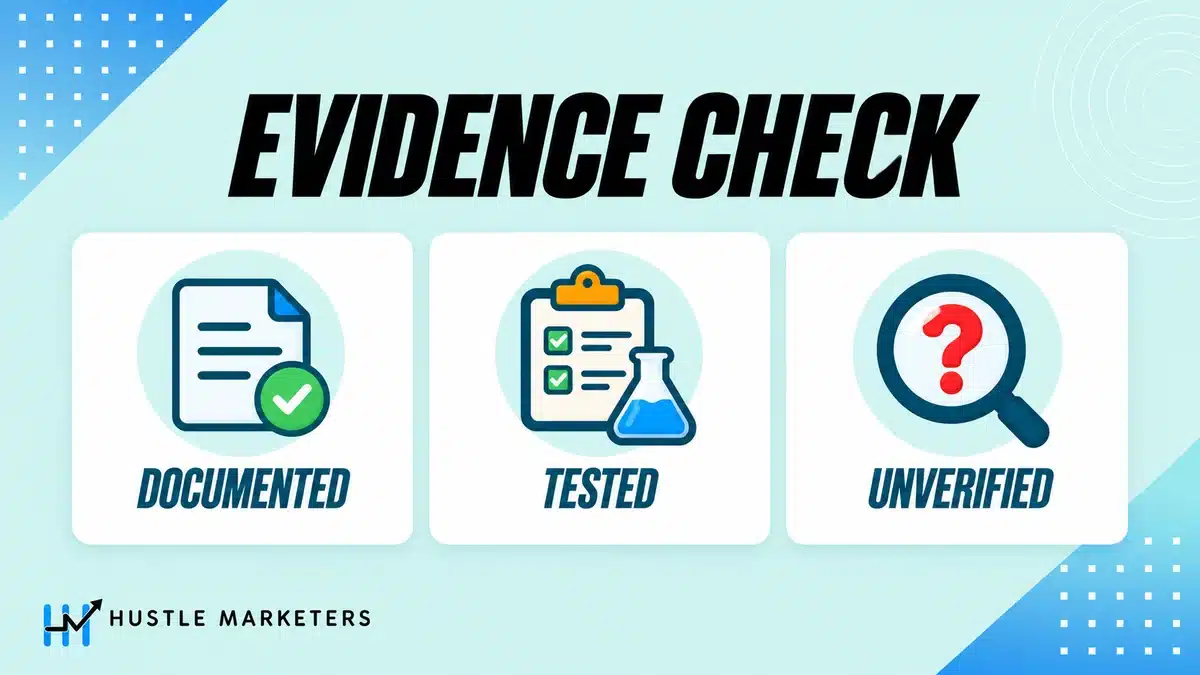
We sorted every tactic we encountered into three tiers. The tier is about evidence quality, not about how useful the tactic feels.
Tier 1: documented by the platform itself
These are things a platform has put in writing. They are the safest place to spend first.
- Allow the AI crawlers you want, and verify in your server logs that they are actually getting through. This is the only item on this page with a one line fix and an invisible failure mode. One practitioner found his own bot protection had been silently blocking AI crawlers by default, and estimates roughly half of major sites block at least one AI crawler without ever deciding to.
- Stay indexed and snippet eligible in Google. Google states this plainly as the precondition for AI Overviews and AI Mode.
- Claim Bing Webmaster Tools and turn on the AI Performance report. Microsoft ships four metrics: Total Citations, Average Cited Pages, Grounding Queries and page-level citation counts. Microsoft also states its own limits, which we respect here: grounding queries are a sample, the citation count reflects how often pages are cited rather than importance or ranking, and the data is aggregated across Copilot and Bing AI summaries so you cannot separate them.
- Set the Preferred Sources flag in Search Console if you are eligible. Google documents that Preferred Sources can appear in AI Mode and AI Overviews.
- Do not produce content mainly to manipulate AI responses. Google documents this as scaled content abuse. This is not a caution, it is a published policy.
Tier 2: measured in a published test
These have a named study with a method and an effect size behind them. Treat the numbers as directional, since most were measured in a benchmark rather than in live production.
| Content edit | Measured effect | Where it was measured |
|---|---|---|
| Add quotations from credible sources | +42.6% visibility against baseline | Generative engine optimization paper, simulated benchmark |
| Add statistics | +32.8% | Same |
| Cite your sources | +27.7% | Same |
| Improve fluency of the writing | +28.7% | Same |
| Use technical terms correctly | +18.5% | Same |
| Rewrite in plain language | +13.8% | Same |
| Adopt an authoritative tone | +11.8% | Same |
| Keyword stuffing | -8.7%, the only negative result in the test | Same |
Two caveats that the pages quoting this study usually leave out. The main benchmark ran on GPT-3.5 answering from Google’s top five results, with Perplexity used only as a secondary real-world check, so it may not transfer cleanly to today’s engines. And the same body of work found the gain is not uniform: lower-ranked pages saw large gains from adding sources and statistics while already top-ranked pages saw a decline from the same edit. If you are already the top result, adding citation density may cost you.
The other Tier 2 finding worth its own paragraph is about earned versus owned. In a 30-day cold-start test on a link building SaaS with no baseline visibility, across 15 keywords and six AI platforms, the brand went from zero to 298 appearances. Earned placements produced 85.8% of those citations. Owned content produced 14%. The brand’s own listicle took 18 days to earn its first citation, the slowest of any source in the test. The author’s own conclusion, revising her earlier position, was that owned listicles are a foundation and not a growth lever.
Tier 3: repeated everywhere, tested by no one
We read 33 competitor pages on this exact topic in full. Schema markup appears as a recommendation on 14 of them, usually in the top three. Content freshness appears on 14. Author credentials appear on 7. Community posting appears on 15. Across all 33 pages, not one presented an independent, checkable test tying any of those four to AI citation specifically.
That does not make them worthless. It makes them unpriced. We applied the same evidence test to the wider discipline in answer engine optimization. If someone is charging you for them as a distinct AI visibility service, you are paying a premium for an untested hypothesis.
If you want to know which of these three tiers your current AI visibility spend sits in, we will look at what you are being charged for and tell you plainly, including where we think our own recommendations are the weakest.
Get an honest read on your AI visibilityWhich popular tactics failed when someone actually tested them?
This is the section no competitor page has, so it is worth reading even if you skip the rest.
Schema markup
Two independent tests, different methods, same answer.
A seven-platform experiment run between December 2025 and March 2026 did three things. It asked seven AI platforms to fetch the raw schema from a page: only Gemini retrieved the correct JSON-LD, six of seven failed, and Google AI Mode hallucinated a Service schema that did not exist on the page. It then measured brand coverage across 319 US market prompts before and after implementing schema, and the platforms moved in opposite directions: Google AI Overviews up 611%, Google AI Mode up 42%, ChatGPT down 71%, Gemini down 35%. Finally it added FAQ schema containing information available nowhere else online, and no platform answered using it. The stated conclusion was that schema did not appear to directly influence AI search citation behavior in a measurable way for most platforms.
Separately, a matched difference in differences test across 1,885 pages reported Google AI Overviews down 4.6%, Google AI Mode up 2.4%, ChatGPT up 2.2%, and concluded that adding schema did not increase AI citations on any platform. A correlation does exist in larger datasets, where cited pages are roughly three times more likely to carry JSON-LD, but that is attributed to the kind of sites that bother with structured data rather than to the markup itself.
The complication, and we think it is a real one: Microsoft’s Fabrice Canel has publicly confirmed that schema helps Microsoft’s models understand content for Copilot. Neither controlled test isolated Copilot. So the strongest published tests and the strongest published platform statement are talking about different engines. Our read is that schema is cheap, it has other justifications, and it should not be sold to you as an AI visibility lever with a number attached.
llms.txt
A 90-day server log study on a site with llms.txt implemented recorded 62,100 plus AI bot visits in total. Eighty-four of them touched the llms.txt file, roughly 0.1%. The average page on the site received around 265 AI bot visits, so the file performed about three times worse than an average page. Ahrefs, looking across 100,000 domains, reported 97% of llms.txt files got no requests at all. Google has stated on the record that it does not support the file and is not planning to.
There is one published counterexample and it deserves to be stated fairly, because almost nobody cites it. A developer submitted his llms.txt through the Search Console URL Inspection tool on 2 February 2026, and documented with screenshots and Cloudflare access logs that the file was crawled the same day, appeared as the number one source in Google AI Mode for a German language query about his company the following day, persisted on 5 February, was hit by six named bots between 14 and 18 February, and was cited across three of four topic queries on 20 February. He is also explicit that his tracked keyword positions did not move at all during the 18-day window. It is one site, one language, and heavily branded queries, and he does not control for that.
There is also a counter-argument about the test itself. One developer argues that measuring crawler logs answers the wrong question, because llms.txt is aimed at agentic tools that a user points at a specific URL, not at discovery crawlers. Nobody has yet published a test designed around that claim.
The cats.txt test, and why you should apply it to every claim on this topic
In August 2026 a technical SEO invented cats.txt, a joke standard listing office cats with job titles, breeds and a “PurrLevel” score, published a spec, and wrote it up as the missing standard for SEO and GEO. Other practitioners adopted the joke. Someone built a site for it. PerplexityBot, GPTBot, ClaudeBot and Googlebot all crawled it. Google indexed it. Google’s AI Overview then reported that a fictional cat named Odd was a “Render Cat” with a PurrLevel of 5 out of 7 who chases the cursor and pounces on stray pixels.
The point is methodological and it is the most useful idea in this entire topic. Cats.txt satisfied all four proofs that people routinely offer for llms.txt working: bots crawled it, Google indexed it, LLMs repeated invented content from it, and ChatGPT endorsed it as a ranking tactic. Cats.txt is obviously worthless. Therefore those four proofs prove nothing.
Use it as a filter. When someone shows you evidence that an AI tactic works, ask whether cats.txt would have passed the same test. If it would, the evidence is not evidence.
Listicles and comparison pages
This one is a live example of a tactic decaying under you. In August 2026 listicles fell from 15.77% to 7.80% of ChatGPT citations, a 50.5% relative decline, and comparison pages fell from 9.08% to 6.17%. Product pages rose to 16.39% of retrieved pages over the same period. The reported timeline points at a ChatGPT model update on 6 August and a Google spam update rolling out 18 to 21 August.
What makes this instructive is the sequencing. A well-run 14-day study published weeks earlier had recommended comparison and alternatives pages on the strength of real data. The data was real. The tactic still collapsed. As one write-up put it, a page that exists only to catch a comparison query has no audience underneath it, so when retrieval behavior shifts nothing holds it up.
Scaled AI content
Two fresh domains were launched in April 2026 with roughly 1,000 AI-generated posts each. One collapsed in Google from 1,629 to 15 daily impressions on 9 April; the other from 859 to 85 on 26 June. Search Console showed “No issues detected” under Manual actions the whole time, which is the detail worth keeping: algorithmic suppression does not produce a manual action, so the report you would naturally check tells you nothing.
The same experiment produced the most interesting AI visibility data point we found anywhere, which we come back to under Copilot below.
How to improve brand visibility in AI search results, platform by platform
Most articles name five platforms and then give one undifferentiated list. Of the 33 competitor pages we read in full, at most five added even a sentence describing how platforms differ, and not one translated that into different recommended actions per platform. Here is that translation.
| Platform | Where it retrieves from | What actually moves it | What to ignore |
|---|---|---|---|
| Google AI Overviews and AI Mode | Google’s own index | Being indexed and snippet eligible, ordinary SEO strength, Preferred Sources flag | llms.txt. Google has said it does not use it |
| ChatGPT | A live search layer plus training data | OAI-SearchBot access, third-party mentions on sites it retrieves from | Crawl volume. One test logged 4,808 ChatGPT-User visits and zero citations |
| Microsoft Copilot | The Bing index | Bing indexation, Bing Webmaster Tools, extractable page structure, schema | Assuming Google rankings carry over. They often do not |
| Perplexity | Its own crawler and index | PerplexityBot access, citation-dense and statistic-dense content | Expecting volume. It produced 4 of 298 appearances in one six-platform test |
| Claude | Live web search when the conversation needs it | Claude-SearchBot access, clear extractable passages | Anything aimed at training data. Claude-User and ClaudeBot are separate controls |
| Gemini | Google infrastructure | The same work as Google AI Overviews | Treating it as a separate program |
Google AI Overviews and AI Mode
Google’s own documentation is unusually direct here and it is worth taking at face value: no special file, no special markup, no AI text file. A page must be indexed and eligible to be shown as a snippet. Normal SEO practice is the lever. Google adds one genuine steer, which is that a unique point of view helps because its systems look across a variety of sources, though it does not quantify that. Our separate guide covers how to optimize content for Google AI Overviews in more depth.
The practical implication is uncomfortable for the AI SEO industry: for the largest AI surface by reach, the recommended work is the work you were already supposed to be doing. Our technical SEO checklist covers the indexation and crawl side of that, and AI search optimization covers what Google actually documents in more depth.
ChatGPT
Two separate controls, and mixing them up is a common and expensive mistake. Blocking GPTBot removes your content from OpenAI’s training data. It does not remove you from ChatGPT search. OAI-SearchBot is the one that governs search inclusion, and blocking it removes you from ChatGPT search entirely. Plenty of sites have blocked the wrong one, in both directions.
OpenAI states that results are ranked using multiple factors and declines to name them. So the honest ChatGPT playbook is: allow OAI-SearchBot, verify in logs that it is getting 200 responses, and then work on being mentioned by the sources ChatGPT retrieves from, because you cannot work on the ranking layer you cannot see.
One caution on measurement. Crawl volume is not a proxy for citation value. In the two-site experiment above, ChatGPT-User crawled 4,808 times and cited zero times. If a vendor reports rising AI crawler traffic as a result, that is activity, not outcome. We go deeper on this distinction in citations versus mentions and on measurement specifically in how to track brand mentions in AI search.
Microsoft Copilot
This is the biggest open opportunity in AI visibility right now, and we say that having looked for someone else making the case and not finding one. Across 33 competitor pages, Copilot appears only in generic five-platform lists, features in exactly one comparison table, and never receives its own paragraph, tactic or case. A dedicated video search returned nothing about Copilot brand visibility at all, only videos about using Copilot as a tool.
Three things make it worth your attention.
First, it is the only AI surface that gives site owners first-party citation data, free, in Bing Webmaster Tools. Google Search Console does not report AI Overview or AI Mode citations this way. OpenAI reports nothing.
Second, the published first-party numbers suggest Copilot cites far more readily than the surfaces everyone optimizes for. One operator on a DR-25 domain found 671 Copilot citations across 90 days that he had no idea existed, climbing to roughly 1,200 by late May 2026, while his measured citation rate on ChatGPT, Perplexity and Claude was around 30%. An agency reported 6,700 Copilot citations in 90 days from 111 unique grounding queries, with a page at Google average position 22.4 earning about 1,200 of them.
Third, and this is the data point we could not find connected anywhere else: in the two-site scaled content experiment, the site that Google had deindexed entirely went on to earn 2,718 Microsoft Copilot citations, 69% of its 3,934 total, while earning exactly zero from ChatGPT and zero from Google AI and Gemini, over the same period, on the same content. Its Bing impressions grew to 91,104 in July against zero Google impressions.
We are not presenting that as a strategy. It is an observation that Copilot’s bar for citation is materially different from ChatGPT’s and Google’s, measured on identical content at the same time. If your category has any Microsoft-heavy audience at all, Copilot is where your effort is currently least contested.
Two practical notes. Citation concentration on Copilot is extreme in every dataset we found: five pages accounted for 74.6% of citations in one, with the homepage alone at 32.3%; three pages accounted for 87.25% in another. So a Copilot strategy is a small-number-of-pages strategy, not a publish-more strategy. And Microsoft is the one platform that has said schema helps its models, which is why we did not write schema off entirely earlier.
Perplexity
Perplexity runs its own crawler and index, so PerplexityBot access is the gate. The generative engine optimization benchmark that produced the citation, statistic and quotation numbers was tested primarily against Perplexity, so those content edits were also tested here, with smaller and mixed gains.
Set expectations on scale. In one six-platform 30-day test, Perplexity produced 4 appearances out of 298. Perplexity is worth tracking, and we have written a full guide to Perplexity rank tracking, but for most B2B and ecommerce categories it is not where the volume is.
Claude
Anthropic documents three separate crawlers, each controlling a different behavior: ClaudeBot for training, Claude-User for fetches triggered by a user’s question, and Claude-SearchBot for search indexing. If you want to appear in Claude’s cited answers while staying out of training data, that is a supported configuration and you should set it deliberately rather than block everything with one rule.
Anthropic also documents that its web search cites sources with a 150 character cited text cap. That is a small but real structural hint: a self-contained claim that survives being quoted in 150 characters is easier to cite than the same claim spread across a paragraph.
Why does ChatGPT recommend your competitor instead of your brand?
This is the most common phrasing of the question on Quora, and it appears there in at least six near-identical variants. Almost no published article answers it with a diagnostic procedure, so here is one. Work through it in order, because each step rules out the ones below it.
| Step | What to check | How to check it | If this is the problem |
|---|---|---|---|
| 1 | Are AI crawlers reaching you at all | Server or CDN logs for OAI-SearchBot, PerplexityBot, ClaudeBot, Claude-SearchBot, Bingbot. Look for 200s, not just hits | One allowlist rule. Fastest fix on this list |
| 2 | Are you indexed where that platform retrieves from | Google for AI Overviews and Gemini. Bing for Copilot, and to a large degree for ChatGPT | Fix indexation on the right index. Bing is often the one being ignored |
| 3 | Do third parties mention you in the same breath as the query | Search the query yourself and read which sources the answer cites. Are you named on any of them | This is the real work. Earned mentions, not more pages |
| 4 | Is your own content extractable | Can a single passage answer the question without the surrounding page | Restructure. Answer first, then support |
| 5 | Is the answer just unstable | Run the same prompt 10 times in a fresh session | Nothing is broken. See the consistency section below |
Step 5 is not a joke. In a study of 2,961 runs by 600 volunteers across ChatGPT, Claude and Google AI, the probability of getting an identical brand list across 100 runs was under 1 in 100, and under 1 in 1,000 for the same list in the same order. A competitor appearing once and you appearing the next time is the normal behavior of the system, not a diagnosis.
Worth knowing. Before you spend anything on AI visibility, run step 1. One practitioner discovered his bot protection had been blocking AI crawlers by default for months. Roughly half of major sites block at least one AI crawler, usually because a security product decided it rather than a person. It is the only failure on this page that is invisible from the outside and free to fix.
How to improve brand visibility in AI generated answers when you already rank on Google
This is the frustrating case, and the Quora wording for it is blunt: why do some products never show up in ChatGPT or AI search results, even if they rank on Google.
There are two different invisibility problems and they need different work.
Retrieval invisibility means the model can find you but does not choose you. You rank, you are indexed, the crawlers get through, and you still are not cited. The lever here is association: which sources mention you, who you appear alongside, and how recently. The cold-start experiment above found exactly this, and the author’s summary is worth quoting as a principle rather than a statistic: LLM visibility depends more on associations than on page ranking.
Training invisibility means the model does not know you exist as an entity. It will not volunteer you in an answer that does not trigger a live search. You cannot fix this on a schedule, because you do not control training runs. What you can do is make the entity unambiguous everywhere it appears, so that when a training run does happen, or when a live retrieval happens, there is one consistent story about who you are and what you do.
A useful diagnostic someone posed and nobody answers in published content: if you Googled your brand today and then asked ChatGPT about it, would the two answers tell the same story? Where they diverge is where your entity is unclear.
What do you do when an AI tool says something wrong about your brand?
We went looking for a documented case of a brand getting an AI platform to correct a false claim through an official channel. We did not find one. Not a single verified first-person account. That absence is itself the finding, and every page that tells you to “address it at the source” without saying how is glossing over it.
Here is what is actually available, in order of how much control you have.
| Option | What it does | Realistic outcome |
|---|---|---|
| Fix the underlying source | Correct the third-party page the model is drawing from | The only option with a real mechanism. Slow, and depends on the publisher agreeing |
| Publish an unambiguous correction on your own site | Gives live retrieval something accurate to find | Helps on retrieval surfaces. Does nothing for training data already absorbed |
| Use the platform’s feedback control | Thumbs down and report in the interface | No published evidence of a brand-level correction resulting. Do it, expect nothing |
| Bing Webmaster Tools grounding queries | Shows you which phrasings pull your pages into Copilot answers | Diagnostic only, and Copilot only |
| Legal action | Defamation claims over AI output exist | One filed case we are aware of, involving an individual rather than a brand. Not a marketing remedy |
One anomaly worth knowing about because it breaks the usual advice: a researcher documented ChatGPT citing a Wikipedia page that had been deleted months earlier and was never indexed by Google. If a model is drawing on something that no longer exists on the live web, fixing the live web does not reach it.
Our honest position: treat wrong AI claims as a reputation problem with a slow fix, not a technical problem with a fast one. Fix the sources, publish the correction, and monitor. Anyone promising to get an AI platform to retract something is promising a mechanism nobody has publicly demonstrated.
How long does each tactic take to show up in AI responses?
Published articles give one anecdotal number for the whole discipline, usually somewhere between six weeks and twelve months. That is not useful, because the timelines differ by mechanism, not by effort. Here is the breakdown by what the tactic actually changes.
| Tactic | What it changes | Realistic window | How you know it worked |
|---|---|---|---|
| Unblock AI crawlers | Access | Days | 200 responses from the named user agents in your logs |
| Fix indexation on Bing | Which index you exist in | 1 to 4 weeks | Bing Webmaster Tools coverage, then AI Performance citations |
| Restructure a page to answer first | Extractability | 2 to 8 weeks after recrawl | Grounding queries in Bing, prompt testing elsewhere |
| Add citations, statistics, quotations | Content signals | 2 to 8 weeks after recrawl | Prompt testing across 20 plus prompts, repeated |
| Earn a third-party mention | Association | 2 to 12 weeks from publication | The citing source appearing in AI answers |
| Build an owned listicle or comparison page | Owned content | Slowest of all. 18 days to first citation in the one measured test, then modest | Citation count, with low expectations |
| Change how the model “knows” you | Training data | Not schedulable. Do not plan around it | You cannot verify it |
The pattern is consistent: access changes fast, structure changes at crawl speed, association changes at publication speed, and training does not change on your timetable. Any plan that promises a single timeline across all four is not distinguishing between them.
What does this cost to run in-house?
Of the 33 competitor pages we read, exactly one raised the cost question, and it answered by linking to its own pricing page. So here are hours instead of prices, because hours transfer across markets and rates do not.
| Work | First pass | Ongoing | Who does it |
|---|---|---|---|
| Crawler access audit and fix | 2 to 4 hours | Quarterly recheck, 1 hour | Developer or technical SEO |
| Bing Webmaster Tools setup and AI Performance baseline | 1 to 2 hours | 1 hour monthly | Whoever owns SEO |
| Prompt set design, 20 to 40 prompts across 3 buckets | 4 to 6 hours | 1 hour monthly to revise | Marketing, with sales input |
| Manual visibility testing, run each prompt 3 times | 3 to 5 hours per round | Monthly | Anyone, it is mechanical |
| Restructuring a priority page to answer first | 2 to 4 hours per page | As pages change | Writer |
| Adding citations and statistics to a page | 1 to 3 hours per page | As pages change | Writer with research time |
| Earned mention outreach | 6 to 10 hours per placement attempted | Continuous | PR or founder |
A realistic first 90 days for a small team is roughly 40 to 60 hours of setup plus 10 to 15 hours a month of maintenance, with the earned mention work sitting on top of that and scaling with ambition. Tool spend is optional at the start: manual prompt testing costs nothing but time, and the one free first-party data source is Bing’s. If you want a comparison of the paid options and what they actually measure, we published AI visibility tools for exactly that.
The uncomfortable arithmetic: the earned mention line is both the most expensive and the best evidenced. Everything cheaper on this table has weaker support.
How do you prove AI visibility work made money?
Nobody publishes a method for this, so we will be explicit about what is possible and what is not.
You cannot do last-click attribution on AI answers. Most AI recommendations produce no click at all, and when they do, referral data is thin. One practitioner puts AI referral traffic under 1% and argues AI search is best understood as a branding channel rather than a traffic channel. Treat it that way and the measurement problem becomes tractable.
Four things you can actually measure:
- Visibility percentage across a fixed prompt set, run repeatedly. Not a position, a percentage. The consistency research is clear that any tool reporting a “ranking position in AI” is overstating what the data supports, and equally clear that visibility percentage across dozens to hundreds of prompts run multiple times is a reasonable metric. Fix your prompt set, run it monthly, watch the percentage.
- A “how did you hear about us” field on your lead form, with an AI assistant option. Crude, self-reported, and the only direct signal most companies will get. One team measured 3.25% of new users arriving via an AI assistant channel this way.
- Branded search volume and direct traffic. If AI is recommending you without linking, the downstream effect shows up as people searching your name.
- Copilot citations from Bing Webmaster Tools, as the one hard number. It is one surface only and Microsoft says it is a count of citations rather than a measure of importance. It is still the only first-party figure in the whole discipline.
What to refuse: a report that shows an AI ranking position, a report that shows AI crawler hits as a result, and any ROAS figure attached to AI visibility. The first two are measuring the wrong thing and the third cannot be calculated from available data. Our view on what a defensible report looks like is in automated SEO reporting.
Who should own AI visibility work inside a company?
One of 33 pages raised this, in a single paragraph. It matters because the work splits across teams that do not normally share a plan, and that is why it stalls.
| Workstream | Natural owner | Why it lands there |
|---|---|---|
| Crawler access, indexation, page structure | Technical SEO or web development | It is server configuration and templates |
| Prompt set and monthly measurement | Whoever owns organic reporting | It is a recurring measurement task, not a project |
| Earned mentions and third-party placement | PR, or the founder in a small company | It is relationship work, and it produces most of the results |
| Entity consistency across properties | Brand or marketing operations | Someone has to own the single description of what the company is |
| Deciding what not to spend on | The budget holder | Because most of the spend on offer is Tier 3 |
The last row is the one we would actually insist on. The failure mode we see is not underinvestment, it is paying for measurement and calling it improvement. If you are evaluating outside help, our guide to choosing a generative engine optimization agency sets out what to ask. Measurement is a diagnostic. It is being sold as a growth lever, frequently by the company that makes the measurement tool.
How to improve AI search visibility for enterprise software
Enterprise software buyers ask AI for shortlists, and the shortlist behavior is different from consumer categories in three measurable ways.
Category width changes everything. The consistency research found brand visibility varied from 90 to 100% in narrow categories down to 30 to 40% in wide ones, and in one narrow case a single organization hit 97% visibility, appearing in 69 of 71 responses. Enterprise software categories are usually wide. That means your realistic ceiling on any single prompt is lower, and your prompt set needs to be wider to detect movement.
Buyer prompts are needs-based, not brand-based. Academic work on LLM recommendation found that needs-based and contextual queries change which brands get retrieved. So a prompt set built from your category name will mislead you. Build it from the problem statements your sales team actually hears.
Product specifics outweigh brand name. In one controlled academic setup, product quality and specification accounted for 82.4% of ranking variance against 1.2% for brand name. For enterprise software that argues for publishing real specifics, integration lists, limits, pricing structure and supported configurations, in extractable form, rather than positioning language. It also argues against thin comparison pages, which is consistent with the listicle collapse above.
One warning from the same body of research. Persuasive, authority-sounding language was measured to shift LLM recommendations in the absence of any real quality difference, roughly equivalent to 0.17 rating points of bias. The same work found that once every competitor adopts the trick, the individual advantage collapses to near zero. It is documented as a manipulation dynamic in a controlled test, not as a durable tactic, and we are naming it here so you recognize it when someone sells it to you.
Which of these tactics could actually get your brand in trouble?
No page we read discusses this, including the pages recommending the riskiest tactics. One openly advises getting mentioned on Reddit by any means necessary, whether as the brand or anonymously, on the same page where it warns against fake mentions.
| Tactic | The risk | Our position |
|---|---|---|
| Manufactured or anonymous community mentions | Platform bans, and in many markets disclosure law applies to undisclosed paid or affiliated endorsement | Do not. There is also no evidence manufactured mentions carry the same weight as organic ones |
| Content produced mainly to manipulate AI responses | Google documents this as scaled content abuse | Do not. This is a published policy, not a theory |
| Large volumes of AI-generated content | Two test sites lost 90 plus percent of Google impressions with no manual action shown | Do not. And note the failure is invisible in Search Console |
| Fabricated authority language and credentials | Measured to work in a controlled test, which is exactly why it is a problem | Do not. It is documented as a manipulation vulnerability, not a tactic |
| Paid advertorials framed as a way to influence AI training data | Disclosure obligations apply to the placement regardless of the AI rationale | Allowed if disclosed properly. Judge it as PR spend, not AI spend |
The general rule we apply: if the tactic only works while the platform does not notice it, it is not a strategy, it is a timing bet.
How to ensure company visibility in AI: the first 30 days
Ordered so each step gives you information the next one needs.
- Days 1 to 3. Pull server or CDN logs and confirm OAI-SearchBot, PerplexityBot, ClaudeBot, Claude-SearchBot and Bingbot are receiving 200 responses. Fix any blocks. This is the highest ratio of outcome to effort on the whole list.
- Days 3 to 5. Claim Bing Webmaster Tools, submit your sitemap, and open the AI Performance report. You now have the only free first-party AI citation data that exists. Note the baseline.
- Days 5 to 10. Build a prompt set of 20 to 40 prompts in three buckets: core prompts where you should already appear, competitive prompts where a rival dominates, and experimental prompts testing a new angle. Write them from real buyer language, not category names.
- Days 10 to 12. Run every prompt three times in fresh sessions across ChatGPT, Google AI Mode, Copilot, Perplexity and Claude. Record appearance as a percentage, not a position. This is your baseline and it will be noisier than you expect.
- Days 12 to 15. Read which sources the answers cite. This list is your actual target list. Note which ones already mention you and which do not.
- Days 15 to 25. Restructure your three most important pages to answer the core question in the first 40 to 60 words, then support it with citations and statistics. Three pages, not thirty. The Copilot data shows citations concentrate on a handful of pages regardless.
- Days 25 to 30. Start outreach on the two or three citing sources from step 5 that do not mention you. Expect this to take months, and expect it to produce most of your eventual results.
What is deliberately not on this list: publishing llms.txt, adding schema as an AI tactic, a content refresh sprint, and buying a tracking tool. None of them is forbidden. They are all Tier 3, and they should not come before the seven steps above.
We will run steps 1 through 5 on your site and send you the findings, including your crawler access status, your Copilot baseline and the list of sources AI is actually citing in your category. No obligation to work with us afterwards.
Ask us to run the first five stepsImprove brand visibility in AI search FAQs
How long does it take to improve brand visibility in AI search engines?
It depends entirely on which lever you pull. Unblocking AI crawlers shows up in days. Bing indexation takes one to four weeks. Restructuring a page shows up two to eight weeks after it is recrawled. Earned third-party mentions take two to twelve weeks from publication. Changing what a model knows about you in training data is not schedulable at all. Anyone quoting one number for the whole discipline is not distinguishing between these.
Can you pay to get your brand mentioned in ChatGPT or AI answers?
Not directly. No platform sells placement inside its cited answers today. You can pay for advertising on some AI surfaces, and you can pay for PR that earns a mention on a source the model retrieves from, which is an indirect and legitimate route. Anyone offering to place your brand inside AI answers for a fee is either describing PR in misleading language or describing something you should not buy.
Does schema markup improve AI visibility?
The two controlled tests we found say no. A 1,885 page difference in differences test found no increase on any platform and a small decline on Google AI Overviews. A seven-platform experiment found no measurable influence for most platforms. The one counterweight is Microsoft, whose team has publicly said schema helps its models understand content for Copilot, and neither test isolated Copilot. Add schema for its other benefits, but do not buy it as an AI visibility service with a percentage attached.
Is llms.txt worth publishing?
On current evidence, it is close to free and close to useless for Google. Google has stated it does not use it. A 90-day server log study recorded 84 hits out of 62,100 AI bot visits. Ahrefs found 97% of llms.txt files across 100,000 domains got no requests at all. There is one documented counterexample involving Google AI Mode citing the file after a manual Search Console submission, on a single site with branded German queries. Publish it if it costs you an hour. Do not build a strategy on it and do not pay for it.
Why does my competitor appear in AI answers when I rank higher on Google?
Because ranking and citation are related but not the same. Ahrefs found only about 12% of AI cited URLs ranked in Google’s top 10. One documented page earned roughly 1,200 Microsoft Copilot citations while sitting at Google position 22.4. Copilot reads the Bing index, not Google’s, and ChatGPT leans heavily on third-party mentions and a live search layer. Check your Bing indexation first, then check which sources the AI answer cites and whether you are named on any of them.
How do I check if AI is mentioning my brand without paying for a tool?
Two free methods. Run a fixed set of 20 to 40 buyer-language prompts three times each in fresh sessions across ChatGPT, Google AI Mode, Copilot, Perplexity and Claude, and record the percentage of runs in which you appear. Then claim Bing Webmaster Tools and read the AI Performance report, which gives you an actual count of Copilot citations and the grounding queries that produced them. Between them those two cover diagnosis adequately. We walk through the manual method in detail in our guide to tracking brand mentions in AI search, and the ChatGPT-specific version in ChatGPT rank tracking.
Should I block AI crawlers to protect my content?
Understand what each one does before you decide, because the controls are not interchangeable. Blocking GPTBot keeps you out of OpenAI’s training data but does not remove you from ChatGPT search. Blocking OAI-SearchBot removes you from ChatGPT search entirely. Anthropic splits training, user-triggered fetches and search indexing across three separate crawlers. You can opt out of training and stay in search, and most brands should want exactly that configuration. Check what your security product is doing by default, because many block AI crawlers without anyone deciding to.
Does posting on Reddit or Quora get my brand mentioned by AI?
The evidence for this is weaker than the advice suggests. Research shows AI answers frequently cite Reddit and Quora as domains, which is a descriptive finding. No published test shows that your own posting there increases the odds of your brand being mentioned, which is the prescriptive claim people make from it. Reddit’s share of ChatGPT citations has also collapsed twice, once in late 2025 and again in August 2026, the second time by 86.4% in four days with no published explanation. Treat any platform-dependent tactic as a tenancy, not an asset.
How many prompts do I need to measure AI visibility reliably?
More than most people use. In a study of 2,961 runs across ChatGPT, Claude and Google AI, the chance of getting an identical brand list twice was under 1 in 100. A single prompt run once tells you nothing. Twenty to forty prompts, each run at least three times, gives you a percentage stable enough to compare month over month. Measure percentage of appearances, never position.
Is AI visibility work different for ecommerce?
Yes, in emphasis. Product specifics carry more weight than brand language, product pages have been rising as a share of retrieved pages while listicles and comparison pages fell sharply in August 2026, and feed and catalog data enters the picture in a way it does not for services. We cover the specifics in AI SEO for ecommerce.
Do I need an agency for this?
For the first five steps above, no. Crawler access, Bing Webmaster Tools, prompt set design and manual measurement are all in-house work and we have laid out the hours. Where outside help earns its fee is earned mentions, which is the best evidenced and most expensive part, and in telling you which of the things you are being sold are Tier 3. If you want that read on your current setup, talk to us or see how we approach it as an AI SEO company.
Sources and how we verified them
We read 33 competitor pages on this topic in full, along with the primary documentation from Google, OpenAI, Perplexity, Anthropic and Microsoft, nine published studies, and practitioner threads on Hacker News, Product Hunt and Indie Hackers. Every number on this page comes from one of those. Where a claim is one person’s single-site account rather than a study, we have said so in the text.
Three things we could not verify and are flagging rather than hiding. Reddit is unreachable from our research environment, so no Reddit thread is quoted anywhere on this page, and two secondhand relays of Reddit comments are labeled as relays in our notes. YouTube returned rate limit errors on every attempt across 16 tries, so no video is cited here; we can tell you that a dedicated search for Copilot brand visibility videos returned nothing on topic, which supports the gap we describe, but we have no transcripts. And we found no verified first-person account of any brand getting an AI platform to correct a false claim, which is why that section says so plainly instead of offering a method.
Platform documentation: Google AI features and your website, Google guide to optimizing for generative AI features, Google Preferred Sources, OpenAI crawler documentation, OpenAI ChatGPT search help, Perplexity crawlers, Anthropic crawler documentation, Anthropic web search tool, Microsoft AI Performance in Bing Webmaster Tools.
Studies and tests: the generative engine optimization paper, Ahrefs schema markup causal test, Ahrefs AI citation and ranking overlap, Semrush technical SEO and AI search study, Semrush reasoning mode citation instability, Seer Interactive on SearchGPT and Bing overlap, BrightEdge AI Overview and organic overlap, SparkToro research on AI recommendation consistency, brand retrieval and ranking in LLM recommendations, incumbent advantage and brand bias in LLM recommendation.
Experiments and practitioner reports: the llms.txt server log experiment, the schema markup multi-platform experiment, the 2,000 AI blogs deindexation experiment, the cats.txt falsifiability test, the llms.txt counterexample with access logs, GEO experiments challenging conventional advice, the listicle and comparison page citation collapse, the Reddit citation collapse mechanism, the second Reddit collapse, ranking and AI citation correlation across 400 keywords, Bing AI Performance first-party analysis, a single operator’s Copilot citation account, an agency’s 90-day Copilot citation data, schema markup in AI search without the hype, Google on normal SEO and llms.txt, practitioners on whether GEO is a new discipline, on generative information retrieval misinformation, why AI cannot be tracked like traditional search.
Hustle Marketers is a Google Partner, Meta Business Partner and Microsoft Advertising Partner, rated 4.9 out of 5 from 591 reviews, with a Clutch rating of 5.0 from more than 50 reviews and 6 Clutch Awards in 2026. Ishant Sharma, who founded the agency, has worked in search since 2013. We have run SEO and paid media for more than 2,500 brands.
Summarise this article with: