The Future of SEO: Scoring the Last Round of Predictions

Ishant
Published on October 30, 2026
Ishant

Most writing about the future of SEO cannot be wrong, because it never says anything specific enough to check. We read the ten pages ranking for this term and counted.
Three of them make a dated prediction they actually own. None states what would prove their thesis wrong. And none goes back to score the last round, which is the only way to know what any of this is worth.
Summarize this article with:
Key Observations
The short answer: SEO is not ending, the fundamentals have been unusually stable through every previous panic, and the confident numbers in this category have a poor track record you can actually verify.
- The most repeated SEO prediction of the last decade was wrong three ways. The claim that half of all searches would be voice by 2020 was not published by the firm it is credited to, was not about voice alone, and was not about the Western market. We traced it to the original 2014 article below.
- Only three of the ten pages we read make a dated prediction of their own. Five make no dated claim at all. The genre supplies confidence through precise-looking percentages it neither collected nor traced.
- Not one of the ten states a falsification condition. No page says what it would expect to see if it were wrong, or by when.
- None of them quotes the Google guidance that governs the tactics they recommend, and some contradict it. Google states that structured data is not required for generative AI search, while pages in this set tell you schema is becoming more important for AI Overviews.
- Three different numbers get blurred into one scary figure: how much traffic AI tools refer, how often an AI summary appears, and how much click-through falls on a given query. They measure different things.
- Eight of the ten are published by agencies or vendors selling the remedy. None discloses it. We sell SEO too, and that disclosure is at the end.
Our five dated predictions, and the conditions that would prove each one wrong, are in the section near the end. We will come back and score them.
On this page
Fourteen sections. The first three are about the quality of prediction in this category, because that is what decides how much weight to give anything you read on the subject, including this page. The middle sections are the practical work you can do on your own data this week.
The last two commit to five dated predictions and then say what we are most likely getting wrong. Jump to whichever section you came for.
What is the future of SEO?
Search is fragmenting across AI answers, classic results, social platforms and assistants, and the work is shifting from earning a click to earning a citation. What is not happening is SEO ending. Google states plainly that optimizing for its generative AI features is still SEO, because those features run on the same core ranking systems. The practice of optimizing for those answers is covered in our guide to generative engine optimization.
That is the honest version, and it is less dramatic than the headlines. The fundamentals that decided whether you were a candidate for a result five years ago still decide it: can the page be crawled, does it answer the question, is there a reason to trust it, and do other people reference it.
What has genuinely changed is the surface. A well-optimized page now competes for a slot inside an answer as well as a position in a list, and some of those answers do not send a click at all. That is a real commercial problem and it deserves real measurement rather than a percentage from an unnamed report.
Is SEO dying?
No, and the claim has a long history of being made confidently and then quietly dropped. Mobile-first was going to end it, then featured snippets, then voice, then Core Web Vitals. Each time the surface changed and the underlying work did not change much. The current round is bigger than most, because an answer can now satisfy the searcher without a visit, but “the click is harder to win” is a different statement from “SEO is over”.
Scoring the last round of predictions
The most repeated SEO prediction of the last decade was that half of all searches would be voice by 2020. It was wrong, and more usefully, it was wrong in three specific ways that are all still visible in how this category handles numbers today. We traced it back to the original article.
The source is a Fast Company piece by Luke Dormehl, published September 17, 2014, about Baidu’s deep learning work. The line everyone has been quoting since is Andrew Ng, then Chief Scientist at Baidu, saying “in five years time at least 50% of all searches are going to be either through images or speech.”
Now read the sentence immediately before it in the same article, which almost nobody quotes: “At the moment, around 10% of Baidu search queries are done by voice, with a much smaller percentage carried out using images.” That single sentence tells you what Ng was actually forecasting.
| What the industry said | What the source actually says | Why it matters |
|---|---|---|
| comScore predicted it | comScore never published it. Brodie Clark states flatly that “The ‘50% by 2020’ prediction was NOT published by Comscore in the first place.” | A research firm’s name was attached to a claim it never made, which is what gave it authority. |
| 50 percent of searches would be voice | The quote says “either through images or speech”. Two modes combined, not voice alone. | The number was roughly halved in meaning the moment voice was reported on its own. |
| It described search generally | The preceding sentence anchors it to Baidu, where voice was already around 10 percent of queries at the time. | A forecast about one company in one market became a global certainty. |
| It was current | It was made in 2014 about 2019, and kept circulating through 2020 and beyond. | Econsultancy noted in 2018 that “Only the marketing industry is still stuck on this statistic, and it’s starting to look increasingly ridiculous.” |
None of this makes Andrew Ng wrong. He said something specific and bounded about the company he worked for. The failure happened downstream, in the marketing industry, over six years.
It was not only a search problem
Econsultancy scored a batch of 2020 marketing technology predictions and found the same pattern across the board, with named originators. Gartner’s claim that customers would manage 85 percent of their enterprise relationship without a human, its claim that the average person would have more conversations with bots than with their spouse, and its claim that 30 percent of browsing would happen without a screen were all assessed as having missed by wide margins, along with a projection that AR and VR would generate $150bn by 2020.
The lesson we take from this is not that forecasting is pointless. It is that a forecast without a named originator, a date and a scope is not information. It is atmosphere.
How many of today’s predictions can even be checked?
Three out of ten. We read the ten pages ranking for this topic and looked for predictions that were the author’s own, carried a year, and could be scored later. Five of the ten make no dated claim at all. The rest hedge, or borrow their dates from someone else.
Credit where it is due. Two pages in that set do commit properly.
- McKinsey puts named years on named figures, including AI summaries appearing on more than 75 percent of Google searches by 2028, and it publishes the survey behind them. You can disagree with the forecast and still check it.
- Kelsey Libert at Search Engine Land commits to a human-to-AI workflow split by 2027 and to hallucinations becoming much rarer within a stated window, off the back of an original consumer and marketer study.
The other eight either date nothing, or attribute their dates to unnamed experts. One page builds a timeline for artificial general intelligence and attributes it to “most experts” without naming one. Another borrows a 2030 figure from a retailer’s blog post.
The practical consequence for you: when a proposal quotes you a percentage about AI search, ask three questions. Who produced the number, what exactly did they measure, and what year does it apply to. Most of the time one of those three has no answer, and that tells you how much weight to give it.
What Google actually documents about AI search
Google publishes a guide for exactly this, and it is more deflating than most of the commentary about it. It states that optimizing for generative AI search is still SEO, and it lists what you do not need to do. Not one of the ten pages we read quotes it, and some of them recommend the opposite.
The four lines worth knowing, quoted exactly from Google Search Central’s AI features guide:
- “You don’t need to create new machine readable files, AI text files, markup, or Markdown to appear in Google Search.”
- “There’s no requirement to break your content into tiny pieces for AI to better understand it.”
- “You don’t need to write in a specific way just for generative AI search.”
- “Structured data isn’t required for generative AI search, and there’s no special schema.org markup.”
Set that against what is currently ranking. Pages in this set tell readers that structured data is becoming more important for AI Overviews, and build whole optimization paradigms on it.
Google says it is not required. Both statements are in public. Only one of them is from the platform.
To be fair to the schema advice, Microsoft Bing does recommend structured data and short question and answer pairs for its own AI answers, so the advice is not baseless. It is just attributed to the wrong platform. We set the two sets of guidance side by side in AI content optimization.
On AI-written content, Google’s position has not moved since February 2023: “Appropriate use of AI or automation is not against our guidelines.” and “Using AI doesn’t give content any special gains. It’s just content.”
What has measurably changed, and what has not
The surface changed a great deal and the underlying work changed very little. That is the pattern from every previous shift, and it is worth writing down because it is the part the trend pieces skip.
| Changed, and you should act on it | Not changed, despite the noise |
|---|---|
| An answer can now satisfy the searcher without a click, so some queries are worth less traffic than they used to be. | Crawlability, internal links and page quality still decide whether you are a candidate at all. Google states its AI features run on the core ranking systems. |
| You now compete for a citation slot as well as a position, and the two do not always go to the same page. | The keyword-to-intent work is the same work. Understanding what someone actually wants was always the job. |
| Off-site reputation matters more, because models synthesize what the web says about you rather than only what you say. | There is still no shortcut. Google states there are no secrets that automatically rank a site first. |
| Measurement got harder and less complete, which is a real problem rather than a talking point. | Content length still is not a ranking factor, and word count targets in briefs are still a habit rather than a requirement. |
| New answer surfaces appeared on other platforms, so a single-engine plan is narrower than it was. | The technical basics are unchanged. Nothing about AI search removed the need for a crawlable, fast, well-structured site. |
If you want the one-line version to give a client: the work did not change, the payoff per ranking did, and the measurement got worse. That is a less exciting story than most of what is published and it is closer to what we see in accounts.
The three numbers people keep blurring together
Most alarming statistics in this category are one of three different measurements presented as if they were the same thing. They are not, they move independently, and conflating them is how a modest change becomes a crisis in a slide deck.
| The measurement | What it actually tells you | What it does not tell you |
|---|---|---|
| AI referral share. The percentage of your sessions arriving from an AI tool. | How much traffic assistants currently send you. First-party, checkable in your own analytics. | Nothing about whether you are losing traffic elsewhere. A small referral share is normal and is not evidence of decline. |
| AI answer presence rate. How often an AI summary appears for a set of queries. | How much of your keyword set now has an answer above the results. Useful for prioritizing. | Nothing about clicks. An answer appearing does not mean nobody clicked, and presence varies enormously by query type. |
| Query-level click-through change. How click-through on a specific query moved after an answer appeared. | The closest thing to a real commercial impact number, when measured on your own queries in Search Console. | It does not generalize. A vendor’s aggregate figure from someone else’s query set tells you very little about yours. |
We have seen a single article run an 8 percent figure, a 15 percent figure and an 18 to 64 percent range without reconciling what each one measured. Anyone reading that comes away with an impression rather than a number.
What to do instead, and it is free. Pull your own queries in Search Console, split them by whether an answer is appearing, and compare click-through on your own data. You will get a smaller, duller, correct number instead of a large borrowed one. Our reporting integrity standard sets out which numbers we will and will not put in a client report.
How do you identify AI search trends for your own business?
Start from your own data rather than from trend articles. Pull the queries you already rank for, check which of them now return an AI answer, and look at what those answers cite. That gives you a specific list for your market, which is worth more than any general prediction about the industry.
Here is the sequence we use on client accounts, in order, using tools you already have.
- Export your Search Console queries for the last twelve months. This is your actual market, not the one in the trend pieces.
- Search your top twenty queries yourself, signed out. Note which return an AI answer, which return a classic list, and which return neither consistently.
- Read what the answers cite. If the same three domains keep appearing across your category, that is your real competitive set for AI visibility, and it is often not the same as your ranking competitors.
- Split your queries into three buckets. Answer-dominated, classic, and mixed. The first bucket is where traffic will erode and where a citation is the win. The second is where ordinary SEO still pays normally.
- Check your analytics for assistant referrals. Small numbers are normal. You are establishing a baseline, not proving a thesis.
- Re-run it quarterly, not weekly. These surfaces are volatile enough that weekly readings will mostly show noise and will make you change strategy for no reason.
Two things deliberately absent from that list: buying a monitoring tool before you have a baseline, and restructuring working pages into fragments. Google states chunking is not required, and we have no evidence it helps.
How do you measure whether your AI SEO is working?
Use Search Console for Google surfaces and your analytics referral data for assistants, then judge the work on inquiries rather than on visibility. Neither source is complete, and both are first-party and free, which puts them ahead of most paid alternatives.
The uncomfortable part is that nobody can give you a complete number. ChatGPT, Claude and Perplexity do not publish how often you appear in their answers. Paid tools estimate it by running prompts repeatedly and recording what comes back, which is sampling. That is a legitimate method and it is not measurement, and a report that calls it your AI visibility score without stating the sample size is overselling.
Google also pairs its own measurement guidance with a warning worth repeating: “Be wary of third-party tools that promise ranking success or claim to use ‘internal’ Google metrics.” Almost every product in this category is exactly such a tool.
We wrote up a free method alongside the paid options in how to track your brand visibility in AI search, including what each approach can and cannot see.
Who should you actually follow on this?
Follow the people still doing the work and the platforms themselves, in that order. The lists of SEO influencers are largely popularity rankings, and several of the most-recommended names have moved into software or media and are no longer practicing. We checked that rather than assuming it.
Start with the primary sources, because they are free and they outrank every commentator on accuracy.
- The Google Search Central blog and its AI features guide. If a tactic contradicts this, the tactic is wrong or it is about a different platform.
- Microsoft Bing’s advertising and webmaster blogs, which publish their own AI answer guidance and frequently differ from Google’s.
Then a small number of practitioners who still take client work. Two examples we verified on their own sites rather than from a list: Aleyda Solis at Orainti runs SEO consulting as her primary business with six published service lines, and Marie Haynes states she strategizes with a small number of clients alongside her research and newsletter. Barry Schwartz at Search Engine Roundtable remains the fastest place to find out that something changed at all.
We looked at this properly because the lists are misleading in a specific way. Of the six names that appear most often across published rankings of SEO experts, only one runs SEO consulting as her main business. Two run software companies. We set out the full check, with the date and the source for each person, in best SEO professionals.
One thing we would not do is ask a language model who to follow. The models keep recommending people who stopped practicing years ago, which is the same staleness problem the human lists have with the sourcing removed.
Five predictions we will put a date on
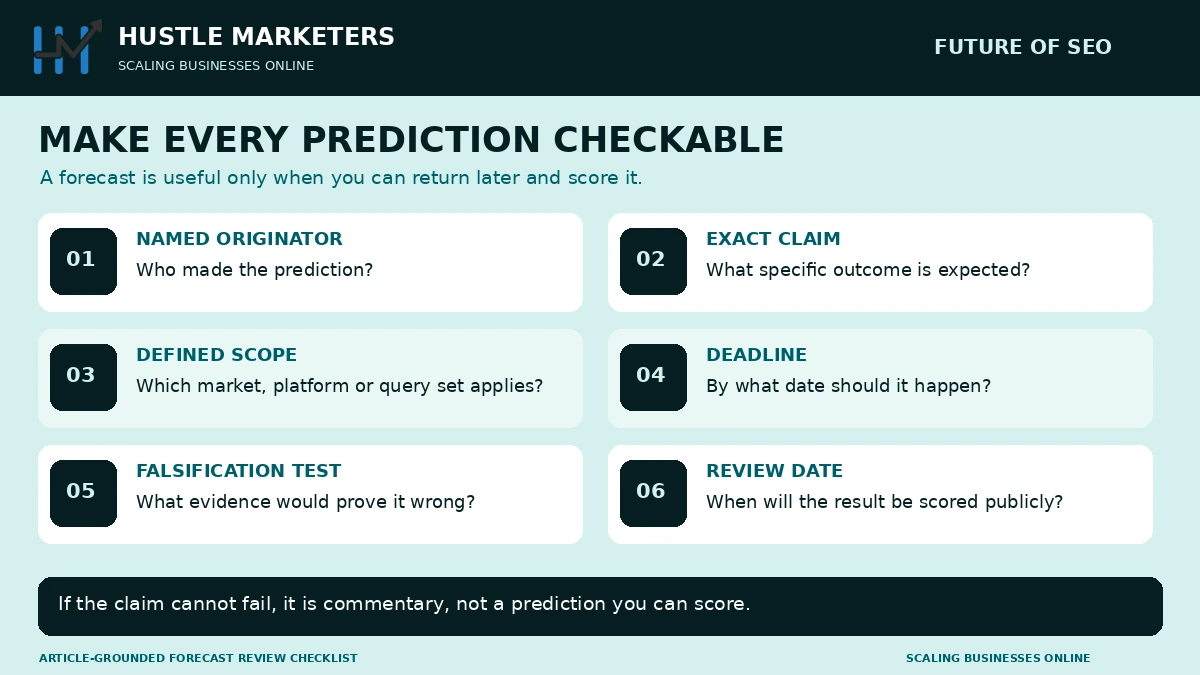
Nobody in this category states what would prove them wrong, so here are five predictions with dates and falsification conditions. We will come back to this section and mark each one. If we get them wrong we would rather that be visible than quietly edited out.
These are our own view from running client accounts, not a survey. Treat them accordingly.
| Prediction | By when | What would prove us wrong |
|---|---|---|
| Classic organic results remain the largest single source of search-driven inquiries for the local service and B2B accounts we run. AI referrals grow but stay a minority channel. | End of 2027 | AI referrals exceeding classic organic as a share of inquiries on a majority of the accounts we manage, measured in their own analytics. |
| Google does not introduce a required file, markup type or schema specifically for generative AI search. Its current position holds. | End of 2027 | Google publishing documentation that names any new required file or markup for appearing in its AI features. |
| Content scores from optimization tools remain weakly correlated with rankings, and no vendor publishes a replicable study showing otherwise. | End of 2027 | Any vendor publishing a study with a stated methodology and sample that shows a strong correlation, and it surviving independent replication. |
| The measurement gap does not close. No platform other than Google publishes per-site AI answer appearance data, so third-party estimates remain sampling. | End of 2027 | OpenAI, Anthropic or Perplexity publishing per-site appearance or citation data in a first-party tool. |
| At least one widely repeated AI search statistic currently in circulation is publicly retracted or traced to a source that never published it. | End of 2027 | No such correction appearing, with the current crop of figures holding up to scrutiny. |
The fifth one is the safest bet on the list, for the reason the voice search section covers. The pattern that produced that error has not gone away, and several figures in circulation right now are sourced to unnamed industry reports.
One prediction we are deliberately not making: a number for how much click-through will fall. We do not have data good enough to justify one, and the published figures disagree with each other by a wide margin. Guessing precisely would make this page look more authoritative and would be the exact behavior we just spent three sections criticizing.
What we are probably wrong about
Three things, stated now rather than after the fact. None of the ten pages we read has a section like this, and it is the one that would have saved the industry six years of repeating a bad statistic.
- We may be underrating how fast commercial queries move. Our predictions above lean on stability, and stability has been the right bet through every previous shift. If AI shopping and comparison surfaces mature faster than we expect, transactional queries could erode much faster than informational ones, and our first prediction would fail on ecommerce accounts before it failed anywhere else.
- We may be too dismissive of structured data for AI. Our position follows Google’s documentation, which says it is not required. Microsoft says it helps on its surfaces. If Google quietly starts using it more heavily without changing the documentation, we would be following the letter of a guide that no longer describes the behavior.
- We are reasoning from a specific client base. We run local service, ecommerce and B2B accounts, mostly small and mid-sized. Someone running enterprise publishers or very large marketplaces is seeing a different picture, and their read may be better than ours for those cases.
There is also a limit worth naming on the research behind this page. No Reddit discussion informed it, so several threads that rank for these terms went unread. That is a gap in what informed this, not a gap we have papered over.
Frequently asked questions
Twelve questions, answered from platform documentation where one exists and from our own client work where it does not.
What will SEO look like in five years?
Recognizably similar in the work and different in the surface, on the evidence of every previous shift. Crawlability, intent and trust decided candidacy before and still do. What changes is how often a ranking converts into a visit, and that is the number worth watching rather than the tactics.
Has this happened before?
Yes, repeatedly. Mobile-first, featured snippets, voice search and Core Web Vitals were each described as the end of SEO. Each time the surface changed and the underlying work did not change much. That base rate is the reason to discount the current round somewhat, though not to zero.
How is AI changing SEO?
It adds a second thing to compete for. You are now trying to be a candidate for an answer as well as a position in a list, and the two do not always go to the same page. Off-site reputation matters more because models synthesize what the web says about you.
Will AI replace SEO jobs?
It has changed the mix rather than removed the work. Research and briefing compress a lot with AI tools. The parts that decide performance, which are judgment about what to build and the specific detail only your business has, are the parts models are weakest at.
Did voice search really become half of all searches?
No, and the prediction was misreported three ways. It came from Andrew Ng at Baidu in 2014, it covered images and speech together rather than voice alone, and it was about Baidu where voice was already around 10 percent of queries. It was widely credited to comScore, which never published it.
Do I need to add schema markup for AI search?
Not for Google, which states structured data is not required for generative AI search and that there is no special schema.org markup for it. Microsoft Bing does recommend schema for its own AI answers. Add schema for the rich results it genuinely earns, not as an AI citation tactic.
Do I need an llms.txt file?
Google states you do not need to create new machine readable files, AI text files, markup or Markdown to appear in Google Search. Unless a platform you care about publishes a requirement, this is optional at best.
How much traffic will I lose to AI Overviews?
Nobody can tell you from a general figure, and the published numbers disagree with each other widely. Measure your own queries in Search Console, split them by whether an answer appears, and compare click-through on your own data. A smaller correct number beats a large borrowed one.
Does Google penalize AI-written content?
Not for being AI-written. Google states that appropriate use of AI or automation is not against its guidelines, and that using automation mainly to manipulate rankings violates its spam policies. The test is purpose, not authorship.
What should I do differently right now?
Very little that is new, and one thing that is. Keep the technical and content fundamentals working, because they still decide candidacy. The new work is measurement: establish your own baseline for which queries now return answers and what those answers cite, before you buy any tool.
Which SEO predictions should I trust?
The ones with a named originator, a date and a stated scope. If any of those three is missing, treat the number as atmosphere rather than information. That single test would have stopped the voice search claim in 2014.
How often should I review AI search performance?
Quarterly. These surfaces are volatile enough that weekly readings mostly show noise, and acting on noise leads to changing strategy for no reason.
About the author and disclosure
Sources
Every quotation was read at the URL below rather than taken from another article quoting it.
- Luke Dormehl, Fast Company, September 17, 2014, Baidu Is Taking Search Out Of The Text Era. The original Andrew Ng quote and, critically, the sentence before it that anchors the forecast to Baidu.
- Brodie Clark, January 17, 2020, updated September 18, 2024, Stop using Comscore’s 2020 voice search stat. Establishes that comScore never published the figure.
- Rebecca Sentance, Econsultancy, August 23, 2018, Why we need to stop repeating the 50% by 2020 voice search prediction.
- Rebecca Sentance, Econsultancy, February 26, 2020, How accurate were the 2020 predictions. Scores four named 2020 predictions from Gartner and Digi-Capital.
- Google Search Central, Google’s guide to optimizing for generative AI features. The mythbusting list and the third-party tool warning.
- John Mueller, Google, May 21, 2025, Succeeding in AI search.
- Danny Sullivan and Chris Nelson, Google, February 8, 2023, Google Search and AI-generated content.
- The two pages in the ranking set that do commit to dated, checkable forecasts: McKinsey and Kelsey Libert at Search Engine Land.
- Other pages counted in the ten we read include Exploding Topics and Opace.
What we did not use
Several figures in circulation were excluded because we could not trace them to a source that published them. That includes a zero-click percentage attributed only to unnamed industry reports, a claim that AI answers have passed 70 percent of searches, and a set of citation-lift percentages with no methodology. If we could not find who produced a number and what they measured, it is not on this page.
Want this run on your own account?
The useful version of everything above is a baseline on your own data: which of your queries now return an AI answer, what those answers cite, and what your click-through actually did. That is a few hours of work and it replaces every borrowed statistic with your own.
Get in touch and tell us the queries that matter to your business. If we think your traffic is safe for now we will say that, which is usually the answer for local service accounts and rarely the answer for informational publishers.
Related reading: AI search optimization, Google AI Overviews optimization, answer engine optimization and our AI SEO services.